Burger King, 26 Cornmarket St, Oxford OX1 3EY, United Kingdom.
Rating: ⭐⭐⭐⭐
Just another Burger King. Often long queues (sometimes out the door) at lunchtime, but they’re generally cleared quickly. Plenty of seating across three levels (fewest seats on the
ground floor, and they fill up fast: if you’ve a buggy or wheelchair it might be hard to get in at peak times), and generally kept clean and tidy.
The day has arrived… our lovely little Not Dogs restaurant in the Bullring, Birmingham has had a little update – in fact, our additions are a nod to our festival background complete
with bunting and grass! Let’s go on a virtual tour…
In a potato field near the Netherlands’ border with Belgium, Dutch farmer Jacob van den Borne is seated in the cabin of an immense harvester before an instrument
panel worthy of the starship Enterprise.
From his perch 10 feet above the ground, he’s monitoring two drones—a driverless tractor roaming the fields and a quadcopter in the air—that provide detailed readings on soil
chemistry, water content, nutrients, and growth, measuring the progress of every plant down to the individual potato. Van den Borne’s production numbers testify to the power of this
“precision farming,” as it’s known. The global average yield of potatoes per acre is about nine tons. Van den Borne’s fields reliably produce more than 20.
That copious output is made all the more remarkable by the other side of the balance sheet: inputs. Almost two decades ago, the Dutch made a national commitment to sustainable
agriculture under the rallying cry “Twice as much food using half as many resources.” Since 2000, van den Borne and many of his fellow farmers have reduced dependence on water for
key crops by as much as 90 percent. They’ve almost completely eliminated the use of chemical pesticides on plants in greenhouses, and since 2009 Dutch poultry and livestock
producers have cut their use of antibiotics by as much as 60 percent…
Miller & Carter Kidlington, 117 Bicester Rd, Kidlington OX5 2PX, United Kingdom.
Rating: ⭐⭐⭐⭐⭐
Shared a delightful tenth anniversary meal here recently. Hadn’t booked, but despite being busy they managed to squeeze us in. Enjoyed the third-best steak I’ve ever tasted, plus
delightful deserts and a range of exciting cocktails all at a price point that’s very reasonable for what you get.
Happy birthday to Not Dogs Birmingham! Our doors have been open at the Bullring’s LinkStreet for just 12 weeks now and what fun we are having!Our fantastic Crew have welcomed many
people (veggies, vegans and meat-eaters!) into the restaurant, seven days a week and we’re looking forward to seeing many more of you. Over the course…
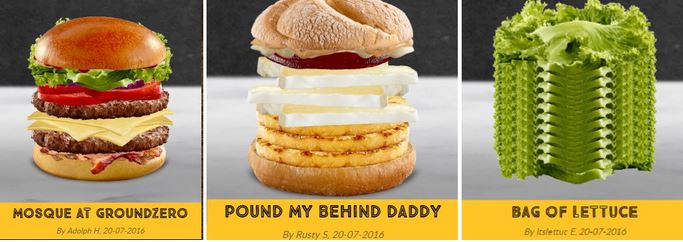
McDonalds had to know what they were doing. The New Zealand branch of the franchise launched its “Create Your Taste” campaign with a special promotion: Design your own burger
and get free fries and a soft drink for your trouble. Not a bad idea in theory, but then there’s the part where they let everyone share their hideous creations. There
was no way that someone somewhere at the company didn’t speak up at one point and say “Hey uh, you know that the internet is just going to create the most offensive and terrible
burgers possible, right?”
Three weeks ago was (give or take a few weeks because we’ve never bothered with accuracy) the end of Ruth and I’s 8th year together, and
we marked the occasion with a mini-break away for a few nights. We spent the first two nights in a ‘showman’-style gypsy caravan in Herefordshire, and it was amazing enough that I
wanted to share it with you:
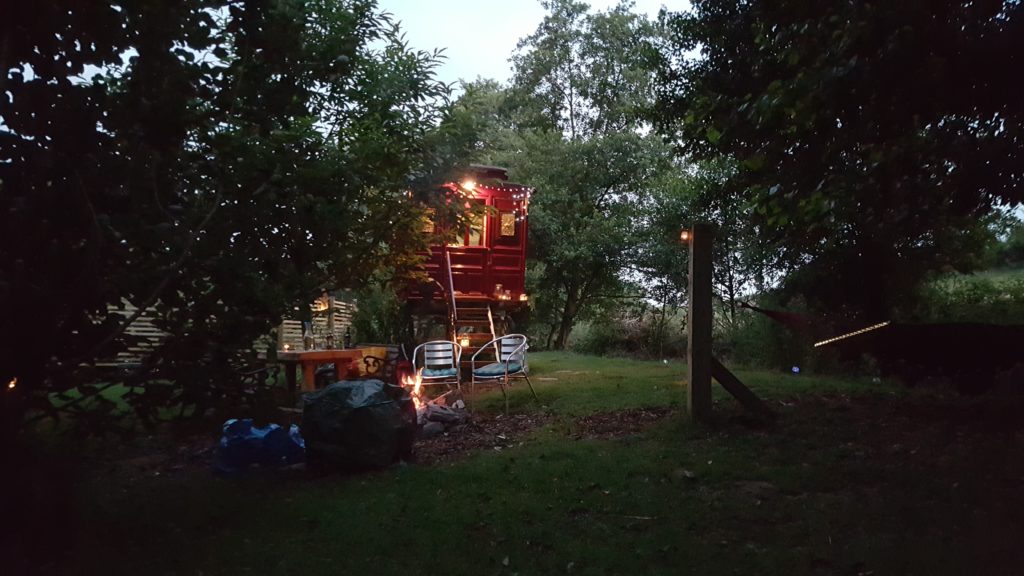
It wasn’t quite dusk yet, but we couldn’t resist the urge to light the fire (and the dozens of tiny lanterns).
The place we went was Wriggles Brook, a ‘glamping’-style site in the shadow of the Forest of Dean. In a long field that twists its way
alongside a babbling brook, the owners have set up a trio of traditional horse-drawn caravans, each in a wooded clearing that isolates it from the others. Two of the caravans are
smaller, designed just for couples (who are clearly the target market for this romantic getaway spot), but we took the third, larger, (centenarian!) one, which sported a separate living
room and bedroom.
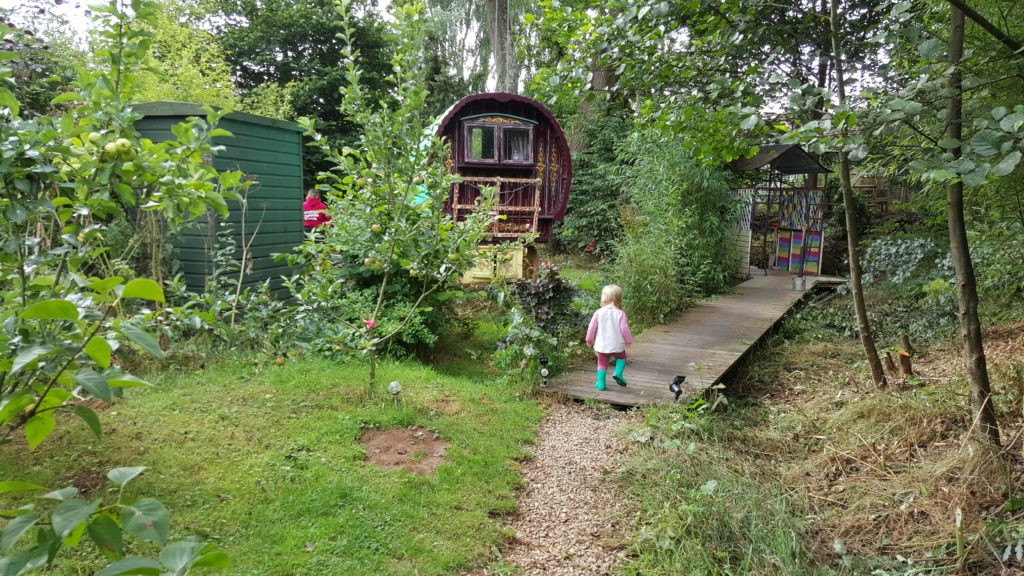
Between our caravan and the others the owners grew a varied orchard, which Annabel found particularly interesting. By which I mean delicious.
The bedroom was set up so that children could be accommodated in a bunk under the adults (with their own string of fairy lights and teeny-tiny windows, but after she bumped her head on
the underside of the beams Annabel decided that she didn’t want to sleep there, so we set up her travel cot in the living room.
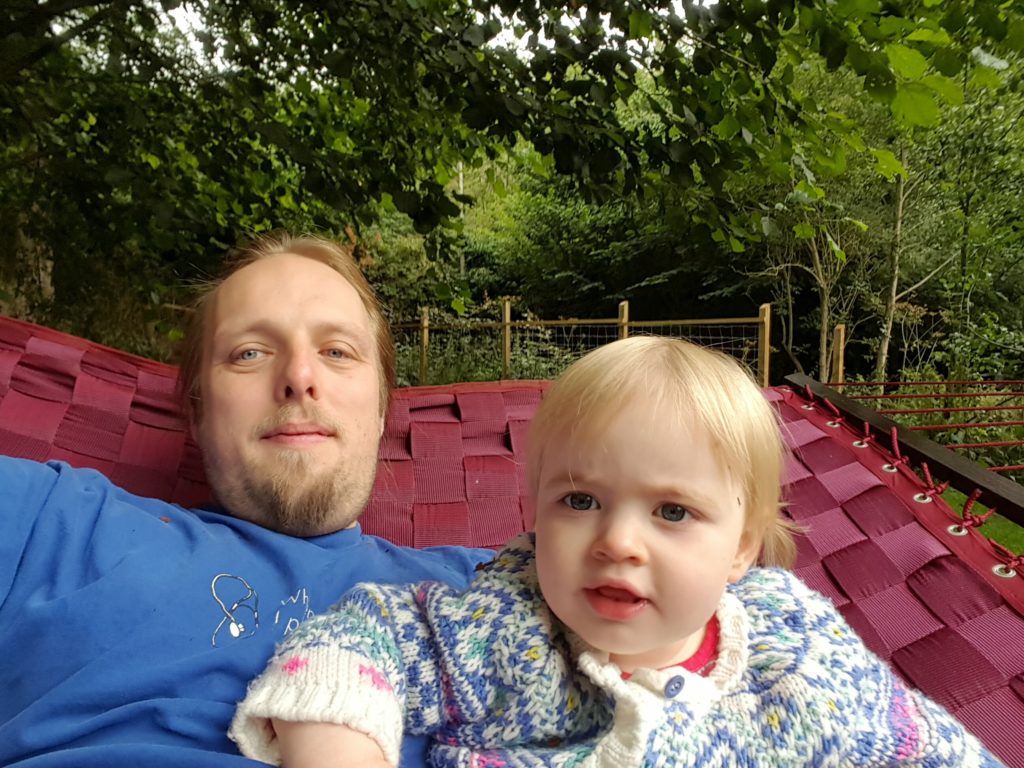
Annabel and I swinging on the hammock near the
So yeah: a beautiful setting, imaginative and ecologically-friendly accommodation, and about a billion activities on your doorstep. Even the almost-complete lack of phone signal into
the valley was pretty delightful, although it did make consulting Google Maps difficult when we got lost about 20 minutes out from the place! But if there’s one thing that really does
deserve extra-special mention, it’s the food!
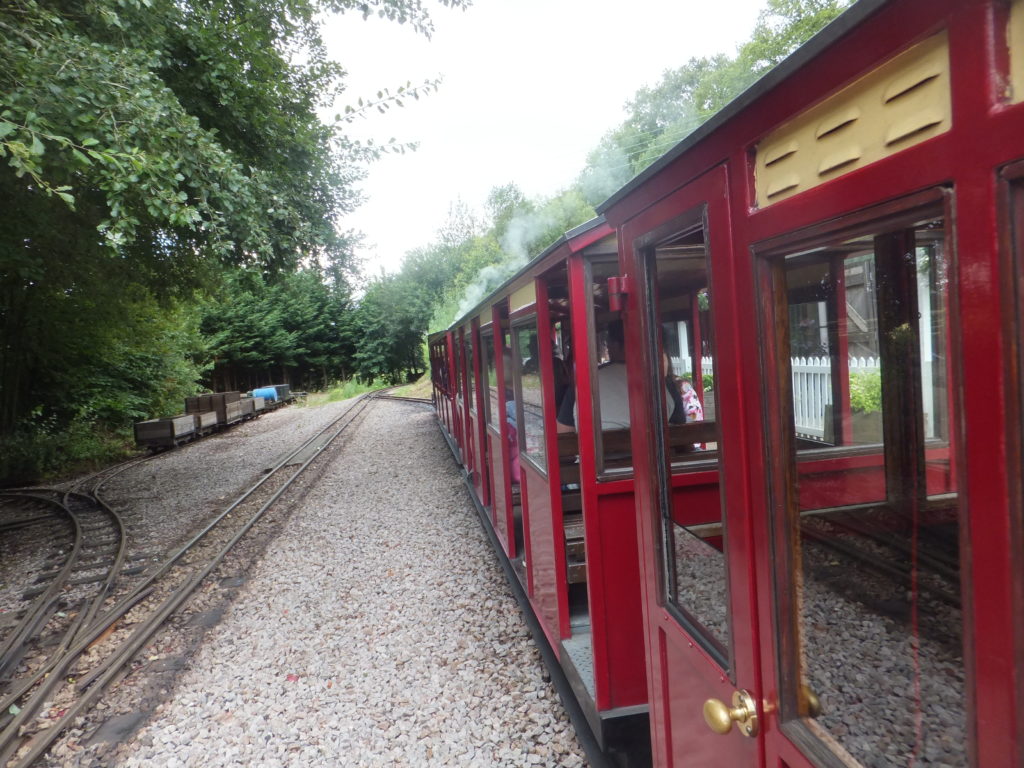
Nearby activities include steam trains. That’s all I needed to hear, really.
Our hosts were able to put on a spectacular breakfast and evening meal for us each night, including a variety of freshly-grown produce from their own land. We generally ate in their
mini dining room – itself a greenhouse for their grapevines – but it was equally-nice to have pancakes delivered to the picnic table right outside our caravan. And speaking as somebody
who’s had their fair share of second-rate veggie breakfasts over the last… what, four and a half
years?… it was a great relief to enjoy a quite-brilliant variety of vegetarian cuisine from a clearly-talented chef.
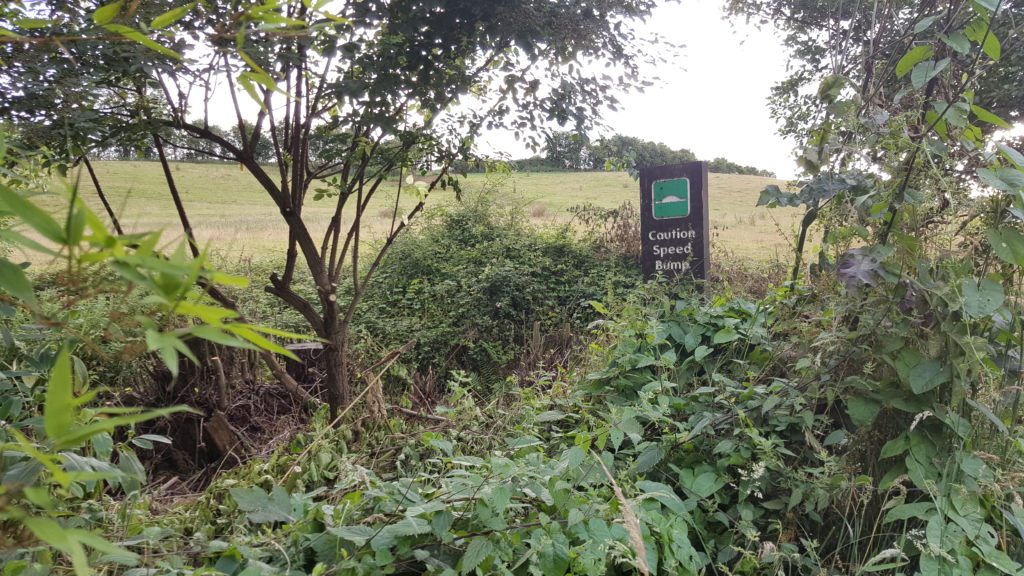
I’m not sure why the Wriggles Brook site has ocassional signs like this sticking out of the undergrowth, but they sort-of fit the eccentricity of the place.
So yeah – five stars for Wriggles Brook in Herefordshire if you’re looking for an awesome romantic getaway, with or without an accompanying toddler. Ruth and I later palmed the little
one off on JTA so that we could have a night away without her, too, which – while fun (even if we didn’t get to try all 280+ gins at the restaurant we ate at) – wasn’t quite so worthy of mention as the unusual gypsy-caravan-escape that
had preceded it. I’m hoping that we’ll get out to Wriggles Brook again.
I’m pretty sure that an outside observer, given the advance knowledge of this blog post, could easily tell when I’m in the process of getting over an illness just by the food I eat. I’m
pretty sure that I have a particular ‘tell’ in the foods I look for when I’m on the cusp of recovering from a cold, like now: or, I suppose, on those rare occasions that I’ll have drunk
enough to be suffering from a hangover.
Take this lunchtime, for example. I’ve been off work for the last couple of days, laid low by what seems to be the very same cold that I was sure I’d dodged when everybody else got it,
last month (I blame Annabel, the contagious little beast, who’s particularly keen on shoving her hands into people’s mouths). Today I’m back on my feet, but working from home: I skipped
breakfast, but by lunchtime I felt able to face some food, and quickly determined what it was that I really wanted:
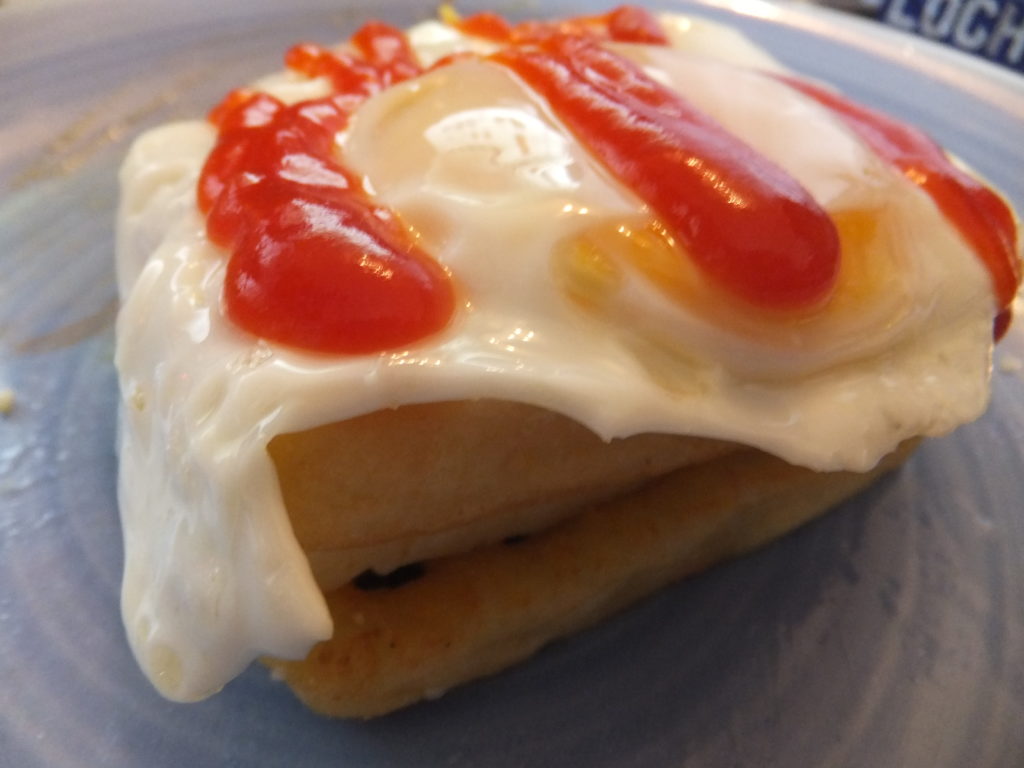
An egg and cheese wafflestack. If you think it looks calorie-laden and disgusting, then you’re right: but you wouldn’t be saying that if you were recovering from an illness!
Egg & Cheese Wafflestack
Serves: 1 unwell-but-recovering person
Preparation: 15 minutes
Difficulty: if you can’t make this, get the hell out of the kitchen
Ingredients
4 × frozen potato waffles. I’m using Birds Eye ones, but honestly, who can tell the difference?
~ 30g mature cheddar cheese, grated or thinly sliced, brought to room temperature so it melts quickly
2 × eggs
A little vegetable oil
Tomato ketchup (alternatively, brown sauce works well)
Method
Grill the waffles in accordance with the instructions. Meanwhile, fry the two eggs (“sunny side up”: keep the yolk fluid). Assemble in stacks, with each stack consisting of cheese
sandwiched between two waffles, topped with an egg and the ketchup. Serve immediately. Eat as quickly as you dare.
So now I’m sitting here eating the taste of delicious recovery, generating 4096-bit strong probable prime numbers (like you do), and reading the feedback on a browser plugin I released recently. And every part of that is a huge
improvement upon lying ill in bed.
More-lately, I’m also a big fan of making pizza. I’ve always enjoyed making bread, but over the last five years or so I’ve become particularly fascinated with making pizzas. I make a
pretty good one now, I think, although I’m still learning and periodically experimenting with different flour blends, cooking surfaces, kneading techniques and so on. Those of you who
know how capable I am of being a giant nerd about things should understand what I mean when I say that I’ve gotten to be a pizza nerd.
Normally, dough should be stretched into a circular shape: but today, I needed a perfect circle of an exact size, so I cut it instead.
In pizza-related circles of the Internet (yes, theseexist), there’s recently been some talk about pizza cake: a dish made by assembling several pizzas, stacked on top of one another in a cake tin – ideally one with a removable base – and then
baking them together as a unit. Personally, I think that the name “pizza cake” isn’t as accurate nor descriptive as alternative names “pizza pie” (which unfortunately doesn’t translate
so well over the Atlantic) or “pizza lasagne” (which is pretty universal). In any case, you can by now imagine what I’m talking about. What I’m talking about is an artery-destroying
monster.
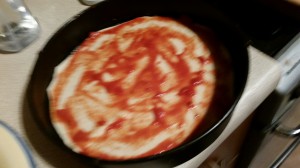
Spreading sauce onto the bottom layer of the pizza cake.
Not wanting to squander my dough-making skills on something that must be cut to size (proper pizza dough should always be stretched, or in the worst case rolled, to size – did
I mention that I’d been getting picky about this kind of stuff?), I opted to go for the lazy approach and use some pre-made dough, from a chilled can. That was probably my first and
largest mistake, but a close second was that I followed through with this crazy idea at all.
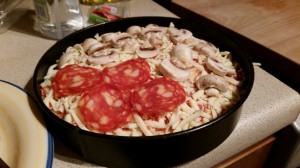
This pizza cake is one-third meaty, two-thirds veggie: the fillings go all the way down across four layers of pizzas.
I didn’t have as deep a cake tin as I’d have liked, either, so my resulting pizza cake was shorter and squatter than I might have liked. Nonetheless, it came together reasonably well,
albeit with some careful repositioning of the ingredients in order to provide the necessary structural support for each layer as it was added. I eventually built four layers: that is,
from bottom to top – dough, tomato, cheese, pepperoni & mushrooms, dough, tomato, cheese, pepperoni & mushrooms, dough, tomato, cheese, pepperoni & mushrooms, dough, tomato, cheese,
pepperoni & mushrooms. As I went along I found myself thinking about calzone.
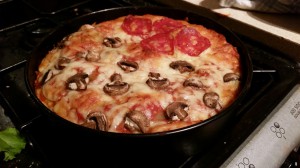
Regardless of anything else, though, it smelled amazing as it came out of the oven.
Using a cake tin with a removable base turned out to be an incredibly wise move, as it proved possible to separate the food from its container by simply running around the outside and
then tapping the tin from underneath. It had the weight and consistency of a cake of similar size, and smelled richly like freshly-based bread and cheese: exactly what you’d expect,
really. I sliced it into six wedges, “cake-style”, and served it with a side salad to my courageous test pilots.
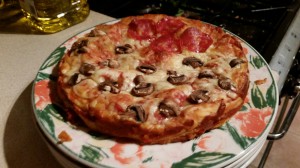
At a glance, it looked like the thickest imaginable pizza. Sadly, this was the most-awesome part of the experience.
Ultimately, though, the experience wasn’t one we’re likely to repeat: the resulting dish was less-satisfying than if I’d just gone to the effort of making four regular pizzas in the
first place. It was impossible to get an adequately crispy crust over the expanded surface area without risking burning the cheese, and as a result the central bread was unsatisfyingly
stodgy, regardless of how thin I’d rolled it in anticipation of this risk. Having toppings spread through the dish was interesting, but didn’t add anything in particular that’s worthy
of note. And while we ate it all up, we wouldn’t have chosen it instad of an actual pizza unless we’d never tried it before – once was enough.
But that’s just our experience: if you give pizza cake/pie/lasagne a go, let me know how you get on. Meanwhile, I’ll stick to making my own dough and using it to make my own regular,
flat pizzas. The way that the pizza gods intended!
This review of OxyBox originally appeared on Google Maps. See more reviews by Dan.
OxyBox, 9 Oxford Rd, Kidlington OX5 2BP, United Kingdom.
Rating: ⭐⭐⭐⭐
Contrary to others’ reviews, we’ve always found OxyBox to deliver reasonably-priced food at perfectly acceptable speeds. Sometimes we’ve had to wait as long as 40 minutes, but they’ve
always told us when this would be the case, and usually we get our food within half an hour. Their bundle deals are good, and on the one ocassion that they weren’t able to fulfil
everything in it (they’d run out of prawn crackers) they were happy to substitute in a different, mutually-agreed side in their place.
The entire infrastructure of our civilization – our entire species – is something that you can’t help but take for granted. Let’s make a cheese & pickle sandwich.
This is a bacon sandwich: not the same thing at all, but I haven’t used the picture in a while and I felt like I ought to. Click the delicious-looking sandwich to see more articles in
which it appears.
How to make a Cheese & Pickle Sandwich
Find a grass whose seed, when crushed, yields a powdery flour rich in carbohydrates and proteins – any of the dozens of species of wheat will do, but there are plenty others besides. If
you’re genuinely starting from scratch, you might find that it’s first worth your while cultivating and selectively breeding the cereal to improve its yield. Separate off the dry
outer chaff from the seeds and grind them. You’ll also need some yeast, which you can acquire from the environment by letting water in which you’ve boiled vegetables sit in the warm for
a few days, or by extracting it from the skins of fruits: alternatively, you can make use of yeast spores in the atmosphere by working slowly in the vicinity of fermenting sugars;
e.g. somebody brewing alcohol. Combine the flour with some water and the yeast to make a dough, let it rise, then put it in a hot box for a while to bake it. There’s your bread.
Insert into a hot box and wait.
Meanwhile, domesticate some cattle. You’ll need to have started this quite a while earlier. Specifically, you’re going to need cows that have recently weaned a calf, so they’re still
lactating. Manipulate the teats of the cow to extract its milk, then heat it gently while stirring it. Assuming that you don’t have the resources to identify and separate lactococcus
bacteria, you’ll want to be careful not to heat the milk enough that it kills any such bacteria already in it. Add an edible acid (lemon juice will do, assuming you’ve got access to
lemons; alternatively you could use vinegar, which you’ll be needing later on anyway) to cause the milk to begin separating into curds (the solid part) and whey (the liquid part) –
alternatively, if you’ve got spare unweaned calves that you can kill and harvest the stomachs of, you can use rennet. If you’ve got the hang of processing cotton, you can weave yourself
a square of cheesecloth and use this as a filter. Once you’ve reduced the curds as far as possible, wrap it and squeeze it in a press (you can make this by putting weight on it) for a
few days, turning occasionally. Then, cover it in an airtight seal of wax (you can get this by melting honeycombs taken from a beehive), and leave it for a month or two. There’s your
cheese.
This cheese is still curd: it’s edible, but won’t yet have that distinct mature/acidic flavour.
Harvest some fruit and vegetables, such as – depending on availability – swede, carrots, dates, onions, cauliflower, apples, courgettes, and tomatoes, and dice them. Boil
together in vinegar with cloves, mustard, and sugar added until the hardest parts (typically the swede) are firm but not crunchy. Heat a sterile, airtight container, add the mixture,
and seal. Leave for a couple of weeks. Oh: you don’t have vinegar? No problem: first you’re going to need alcohol, which you can produce from fruit – apples are probably easiest; grapes
are another popular choice – and yeast: just combine the two and give it a few weeks. Now, to turn that into vinegar, keep it at just over room temperature for
several more weeks, stirring regularly to aerate it. Seriously: if you thought that learning to milk a cow was hard, you should have given up long before now. Anyway:
there’s your pickle.
You’re really getting there, now. We’re almost ready to make a sandwich.
You’ll also want some butter, but by this point you’re used to a little work. Assuming you don’t have access to a centrifuge, the traditional thing to do next is to leave it
sitting in a shallow pan for about 24 hours, then skimming off the top – congratulations, you’ve got cream (the remaining milk is now what you would call skimmed milk; I suggest you
have yourself a cool glass of it while you start working on the next bit). Put the cream into a bowl with a pinch of salt and work it, keeping it as cool as possible while you do so, as
if you were trying to make whipped cream… but keep going! If you whip it for long enough it’ll gradually become more and more solid: drain it of the excess liquid (this is buttermilk),
and then form it into a ball or block. Hurrah: you’ve got butter!
Ready for the spready?
Finally, you can assemble your sandwich. Slide the bread, spread butter onto the slices, and put slices of the cheese and a spoonful of pickle in between them. That wasn’t so hard, now,
was it?
Why, Dan, why?
You’ll be forgiven if you’re wondering why I’ve just shared with you the most drawn-out recipe imaginable, for something so simple as a cheese & pickle sandwich.
Was it worth it? If you were bored by reading the process, you’d be really bored by the time you’d actually followed the recipe.
It’s just this: think about how much was involved in that process (and I didn’t even talk about making the tools you’d need). How complex is that process, compared
to everything eaten by every other animal on the planet. Otters use rocks to get into shellfish, and chimpanzees use sticks to pull termites out of
nests, but apart from these – and a few other exceptions – virtually no other species we’ve ever come across does anything more than picking or hunting for their food, and then
eating it. We, on the other hand – even for our simplest processed foods – put a monumental amount of effort into making them the way they are.
And as if that weren’t complex enough, we go even further. We make different kinds of bread and cheese with different kinds of flour and milk, different processes, different ages; we
make different brands of pickle and butter, and then argue on the Internet about which one is the best. We make sandwiches with egg mayonnaise (boiled eggs… in an emulsion of egg yolks
and oil), with roasted or cured meats of different kinds of animals, with hummus (a remarkably complicated ingredient in its own right).
Just be glad I didn’t tell you how to make a Baked Alaska.
When you make yourself a sandwich, you’re standing upon the shoulders of the hundreds of generations that preceded you, and all of their peers. A collective knowledge passed down
over millennia. In reality, nobody milks a cow because they want to make a sandwich: but that separation is only possible because of the enormous infrastructure we’ve built up in order
to support the production and distribution of dairy goods.
We are, indeed, a very strange species.
But if you actually do have a go at making a sandwich based on this recipe, let me know how you get on.
While you’re tucking in to your turkey tomorrow and the jokes and puzzles in your crackers are failing to impress, here’s a little riddle to share with your dinner guests:
Which is the odd-one out: gypsies, turkeys, french fries, or the Kings of Leon?
If you answer “turkey, because it’s the only one that’s a bird,” then you’re somewhat missing the point.
In order to save you from “accidentally” reading too far and spoling the answer for yourself, here’s a picture of a kitten to act as filler:
Aww.
Want a hint? This is a question about geography. Specifically, it’s a question about assumptionsabout geography. Have
another think: the kittens will wait.
Interestingly, this Persian cat could easily be another candidate for the odd-one-out.
Okay. Let’s have a look at each of the candidates, shall we? And learn a little history as we go along:
Gypsies
The Romami are an ethnic group of traditionally-nomadic people, originating
from Northern India and dispersing across Europe (and further) over the last millenium and a half. They brought with them some interesting anthropological artefacts of their culture,
such as aspects of the Indian caste system and languages (it’s through linguistic similarities that we’ve been best-able to trace their multi-generational travels, as written records of
their movements are scarce and incomplete), coupled with traditions related to a nomadic life. These traditions include strict rules about hygiene, designed to keep a travelling
population free of disease, which helped to keep them safe during the European plagues of the 13th and 14th centuries.
The migration of the Romanies. The arrows show that they stopped in France for some French Fries before continuing to Britain.
Unfortunately for them, when the native populations of Western European countries saw that these travellers – who already had a reputation as outsiders – seemed to be immune to the
diseases that were afflicting the rest of the population, their status in society rapidly degraded, and they were considered to be witches or devil-worshippers. This animosity made
people unwilling to trade with them, which forced many of them into criminal activity, which only served to isolate them further. Eventually, here in the UK, laws were passed to attempt
to deport them, and these laws help us to see the origins of the term gypsy, which by then had become commonplace.
Consider, for example, the Egyptians Act 1530, which uses the word
“Egyptian” to describe these people. The Middle English word for Egypian was gypcian, from which the word gypsy or gipsy was a
contraction. The word “gypsy” comes from a mistaken belief by 16th Century Western Europeans that the Romani who were entering their countries had emigrated from Egypt. We’ll get back
to that.
Turkeys
When Europeans began to colonise the Americas, from the 15th Century onwards, they discovered an array of new plants and animals previously unseen by European eyes, and this ultimately
lead to a dramatic diversification of the diets of Europeans back home. Green beans, cocoa beans, maize (sweetcorn), chillis, marrows, pumpkins, potatoes, tomatoes, buffalo, jaguars,
and vanilla pods: things that are so well-understood in Britain now that it’s hard to imagine that there was a time that they were completely alien here.
Gobblegobblegobblegobble.
Still thinking that the Americas could be a part of East Asia, the explorers and colonists didn’t recognise turkeys as being a distinct species, and categorised them as being a kind of
guineafowl. They soon realised that they made for pretty good eating, and started sending them back to their home countries. Many of the turkeys sent back to Central Europe arrived via
Turkey, and so English-speaking countries started calling them Turkey fowl, eventually just shortened to turkey. In actual fact, most of the turkeys reaching
Britain probably came directly to Britain, or possibly via France, Portugal, or Spain, and so the name “turkey” is completely ridiculous.
Fun fact: in Turkey, turkeys are called hindi, which means Indian, because many of the traders importing turkeys were Indians (the French, Polish, Russians, and Ukranians
also use words that imply an Indian origin). In Hindi, they’re called peru, after the region and later country of Peru, which also isn’t where they’re from (they’re native
only to North America), but the Portugese – who helped to colonise Peru also call them that. And in Scottish Gaelic, they’re called cearc frangach – “French chicken”!
The turkey is a seriously georgraphically-confused bird.
French Fries
As I’m sure that everybody knows by now, “French” fries probably originated in either Belgium or in the Spanish Netherlands (now part of Belgium), although some French sources claim an
earlier heritage. We don’t know how they were first invented, but the popularly-told tale of Meuse Valley fishing communities making up for not having enough fish by deep-frying pieces of potato, cut into the shape of fish, is
almost certainly false: a peasant region would be extremely unlikely to have access to the large quantities of fat required to fry potatoes in this way.
They may find it hard to prove that they invented fries, but the Belgians certainly hold the claim to the world’s only museum dedicated to the food.
So why do we – with the exception of some confusingly patriotic Americans – call them French fries. It’s hard to say for
certain, but based on when the food became widely-known in the anglophonic world, the most-likely explanation comes from the First World War. When British and, later, American soldier
landed in Belgium, they’ll have had the opportunity to taste these (now culturally-universal) treats for the first time. At that time, though, the official language of the Belgian army
(and the most-popularly spoken language amongst Belgian citizens) was French. The British and American soldiers thus came to call them “French fries”.
The Kings of Leon
For a thousand years the Kingdom of Leon represented a significant part of what would not be considered Spain and/or Portugal, founded by Christian kings who’d recaptured the Northern
half of the Iberian Peninsula from the Moors during the Reconquista (short
version for those whose history lessons didn’t go in this direction: what the crusades were against the Ottomans, the Reconquista was against the Moors). The Kingdom of Leon
remained until its power was gradually completely absorbed into that of the Kingdom of Spain. Leon still exists as a historic administrative region in Spain, similar to the counties of
the British Isles, and even has its own minority language (the majority language, Spanish, would historically have been known as Castilian – the traditional language of the neighbouring
Castillian Kingdom).
Leon, sandwiched between the other kingdoms of the 13th century Iberian Peninsula.
The band, however, isn’t from Leon but is from Nashville, Tennessee. They’ve got nothing linking them to actual Leon, or Spain at all, as far as I can tell, except for their name – not
unlike gypsies and Egypt, turkeys and Turkey, and French fries and France. The Kings of Leon, a band of brothers, took the inspiration for their name from the first name of their father
and their grandfather: Leon.
The Odd One Out
The Kings of Leon are the odd one out, because while all four have names which imply that they’re from somewhere that they’re not, the inventors of
the name “The Kings of Leon” were the only ones who knew that the implication was correct.
The people who first started calling gypsies “gypsies” genuinely believed that they came from Egypt. The first person to call a turkey a “Turkey fowl” really was under the impression
that it was a bird that had come from, or via, Turkey. And whoever first started spreading the word about the tasty Belgian food they’d discovered while serving overseas really thought
that they were a French invention. But the Kings of Leon always knew that they weren’t from Leon (and, presumably, that they weren’t kings).
And as for you? Your sex is on fire. Well, either that or it’s your turkey. You oughta go get it out of the oven if it’s the latter, or – if it’s the former – see if you can get some
cream for that. And have a Merry Christmas.
This is the second in a series of four blog posts which ought to have been published during January
2013, but ran late because I didn’t want to publish any of them before the first one.
I spent the weekend of my birthday working in London, alongside the Squiz team, who make the CMS that forms the foundation of most of the public-facing websites of the Bodleian Libraries. We’d originally scheduled this visit for a different week, but – in that way that projects
sometimes do – the project got juggled about a bit and so I found myself spending the week of my birthday away from home.
The team at Squiz’s London office, debriefing over drinks at the end of a crazy week.
But on Tuesday – my second day working on-site at Squiz’s office, and coincidentally my birthday – disaster struck! Our first clue was when the lights went out. And then, a minute or so
later, when the fire alarm started going off. No big deal, we all thought, as we gathered our possessions and prepared to leave the office – it’s probably just that the fire alarm
sounds as a precaution if it’s electricity supply is disrupted… but as we started to go down the stairs and smelled the smoke, we realised that there really was a fire.
My tweet, from outside the Squiz offices.
The first two fire engines arrived within minutes. Apparently, they don’t mess about when a city centre office block catches light. The smoke was very visible from the street: thick
grey plumes pouring out from the basement windows. Theories about the cause of the fire were whispered around the assembled crowd, and the consensus seemed to be that the substation in
the basement had overheated and set alight its room.
People were still filing out of the building when the first of the fire engines arrived.
A third fire engine arrived, and – after about a quarter hour of assessing the situation and controlling the crowd – we were told that we wouldn’t be able to get back into our building
for “at least an hour, probably more.” So, being British, we therefore decamped to one of the nearby bars for networking and a round of gin & tonic. After I texted some friends to say
that I hadn’t expected to spend the afternoon of my birthday in the pub, but that it wasn’t an entirely unwelcome experience, a few of them had the cheek to ask once again how
the fire had actually started.
Before long, the fire brigade had established a cordon some distance back from the fire, and were pouring water into the basement.
By the time we were allowed to return to the building, it was already getting dark, and we quickly discovered a new problem that faced us: with the power still well and truly out, the
electronic door locks that secured the offices had become completely unusable. Not willing to abandon my laptop, keys, and other personal possessions overnight in an unfamiliar office,
I waited around until a locksmith had been summoned and had drilled his way through the cylinder and allowed us into the building.
Without power, it turns out that these things can be pretty useless. At least they “fail secure”, keeping the door locked (from the outside) in the event of a problem, rather than the
alternative…
It being my birthday, I’d arranged that Ruth would come and spend the night down in London, and that we’d go out to
Dans le Noir, a restaurant that I’d heard about from news articles and via friends some years prior, and always
wanted to try. The restaurant has a distinct and quite remarkable theme that you probably won’t find anywhere else: that theme is that you eat unidentified food in pitch blackness.
Don’t be fooled: this picture of the tip of a candle wasn’t taken at Dans le Noir, but at Squiz.
As our (blind!) waiter, Gao, led Ruth and I by touch to our table, we suddenly realised that we’d all but forgotten exactly how dark pitch blackness actually is. When you stumble over
your coffee table in the dark on a morning, that’s not truly black: there’s that sliver of light coming from underneath the curtains, or the faint glow of the LED light on the stereo.
Real, complete darkness is disorienting and confusing, and to sit around in it – not even able to see whether your eyes are open or closed – for hours at a time is quite remarkable.
Now this is more like what it looks like at Dans le Noir!
It took us a little while to learn the new skills required to survive in this environment, but Gao was incredibly helpful. We worked out mechanisms for pouring drinks, for checking
whether our plates were empty, and for communicating our relative movements (being geeks, as we are, Ruth and I quickly developed a three-dimensional coordinate-based system for
navigating relative to an agreed centre-point: the tip of the bottle of our mystery wine). We also learned that there’s something truly humbling about being dependent upon the aid of a
blind person to do something that you’d normally be quite capable of doing alone: simple things, like finding where your glass is.
My tweets after coming out of Ruth and I’s remarkable experience of Dans le Noir.
But the bigger lesson that we learned was about how darkness changes the way that we operate on a social level. Ruth and I were sat alongside another couple, and – deprived of
body language, the judgement of sight, and the scrutiny of eye contact – we quickly entered into a conversation that was far deeper and more real than I would have anticipated having
with total strangers. It was particularly strange to see Ruth, who’s usually so shy around new people, really come out as confident and open. I theorise that (in
normally-signted people) eye contact – that is, being able to see that others can see you – serves as a regulator of our willingness to be transparent. Depriving it for long enough that
its lack begins to feel natural makes us more frank and honest. Strange.
Live updates, primarily for the benefit of the people back at my usual workplace, on progress at Squiz.
Back at Squiz the following day, there was still no electricity. Credit is due to the team there, though, who quickly put in to effect their emergency plans and literally “moved office”
to a handful of conference rooms and meeting spaces around Shoreditch. “Runners” were nominated to help relay messages and equipment between disparate groups of people, and virtualised
networks were established across the city. I laughed when I discovered that Squiz’s old offices had been in an old fire station.
Team members at Squiz, in their unlit, unheated office, begin to put their emergency plan into place, picking up computers and transporting them to alternative venues.
Before long, the folks I’d been working with and I were settled into a basement meeting room in a nearby café, running a stack of Mac desktops and laptops from a monumental string of
power strips, and juggling an Internet connection between the café’s WiFi and a stack of Mifi-like
devices. We were able to get on with our work, and the day was saved, all thanks to some smart emergency planning. Later in the week, a generator was deployed outside the building and
we were able to return to normal desks, but the quick-thinking of the management ensured that a minimum of disruption was caused in the meantime.
My tweet about seeing comedy with Bryn and about returning to the office (now powered by a huge generator).
Not one to waste the opportunity to make the most of being in London for a week, I spent another of my evenings out with Bryn. He and I went out to the Free Fringe
Fundraiser, which – despite a notable absence of Peter Buckley Hill, who had caught a case of the
then-dominating
norovirus – was still a great deal of fun. It was particularly pleasing to get to see Norman Lovett in the flesh: his particular brand of surrealist anti-humour tickles me mercilessly.
So what could have been “just another business trip” turned into quite the adventure, between fires and birthdays and eating-in-the-dark and comedy. If only it hadn’t taken me two
months to finish writing about it…