Last month I was working from home one day, when I heard the postman drop off an unusually-loud stack of mail through our letterbox. Anticipating that one of them might have been
a Graze box – and feeling the need for a little bit of a snack to
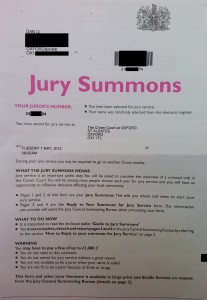
keep my brain going – I wandered downstairs to take a look. There, among some other letters, I found a windowed envelope containing a pink letter: a Jury Summons.
For some reason, the Jury Central Summoning Bureau print their letters onto pink paper. It makes them stand out, I suppose.
Responses from people I’ve told about it have been mixed: some have been positive (“that sounds really interesting”); some have been negative (“isn’t there any way you can
get out of it?”); others still have been curious (“you must tell us all about it!”). Personally, I’m pretty keen: it seems to me that jury duty’s an important civic duty,
and I’m genuinely interested in the process. If it were a role that one volunteered for – and clearly it shouldn’t be, for reasons that ought to be obvious – then I’d volunteer for and
give it a go, at least once: however, I wouldn’t necessarily volunteer for it now, when my work and life is so busy already!
Looks like I’m going to get familiar with Oxford Crown Court. First question: where’s the nearest place to safely park my bike?
I’ve spoken to people who’ve done jury service before, and a reasonable number of them said that they found the experience boring. From the sounds of things, there’re liable to be
extended periods of sitting around, waiting to be (possibly) assigned to a trial. On the up-side, though, it seems likely that I’ll be allowed to use a portable computer in the waiting
area – though obviously not in the courtroom or jury areas – so I might at least be able to get a little work done and simultaneously stave off boredom during any period that
I’m not assigned to a case.
See: no cycle parking anywhere! They’re not completely cycle-hostile, though: they have offered to pay me 9.6p per mile for biking in each day.
It’s the people who’ve expressed an interest in the process for whom I’ve decided to blog about my experience. Of course, I won’t be able to share anything at all about any case I’m assigned to or about the other
jurors who served on them, but I can certainly share my experience of being a juror. Perhaps if you’re called to a jury at some point, it’ll give you some idea what to
expect.
Monopoly – the world’s best-selling board game – sucks. I’ve said it
before, but it bears saying again. I’ve never made any secret of my distaste for the game, but it’s probably worth spelling out the reasons, in case you’ve somehow missed them.
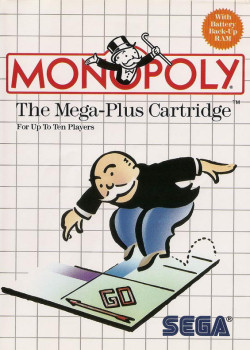
Monopoly (British Edition) in its current branding
Broadly-speaking, there are four things wrong with Monopoly: the rules, the theme, the history, and the
players.
The Rules
The following issues have plagued Monopoly for at least the last 75 years:
It takes a disproportionately long time to play, relative to the amount of fun it provides or skill it tests. A longer game is not intrinsically more-exciting:
would a 1000-square Snakes & Ladders be
ten times as good as a 100-square one? Monopoly involves a commitment of three to four hours, most of it spent watching other people take their turns.
It’s an elimination game: players are knocked out (made bankrupt) one at a time, until only one remains. This invariably leads to a dull time for those players
first removed from the game (compounded by the game length). In real-world play, it’s usually the case that a clear winner is obvious long before the game ends, leading
to a protracted, painful, and frankly dull slow death for the other players. Compare this to strategic games like Power Grid, where it can be hard to call the winner between closely matched players right up until the final turns, in which everybody
has a part.
It depends hugely on luck, which fails to reward good strategic play. Even the implementation of those strategies which do exist remain heavily
dependent on the roll of the dice. Contrast the superficially-simpler (and far faster) property game For Sale, which rewards strategic play with just a smidgen of luck.
It’s too quick to master: you can learn and apply the optimal strategies after only a handful of games. Coupled with the amount of luck involved, there’s little to
distinguish an expert player from a casual one: only first-time players are left out. Some have argued that this makes it easier for new players to feel like part of the game, but there
are other ways to achieve this, such as handicaps, or – better – variable starting conditions that make the game different each time, like Dominion.
There’s little opportunity for choice: most turns are simply a matter of rolling the dice, counting some spaces, and then either paying (or not paying) some
rent. There’s a little more excitement earlier in the game, when properties remain unpurchased, but not much. The Speed Die add-on goes a small way to fixing
this, as well as shortening the duration of the game, but doesn’t really go far enough.
The rules themselves are ambiguously-written. If they fail to roll doubles on their third turn in jail, the rules state, the player much pay the fine to be
released. But does that mean that they must pay, then roll (as per the usual mechanic), in which case must it be next turn? Or should it be this turn, and if so, should
the already-made (known, non-double) roll be used? Similarly, the rules state that the amount paid when landing on a utility is the number showing on the dice: is this to be a fresh
roll, or is the last roll of the current player the correct one? There are clarifications available for those who want to look, but it’s harder than it needs to be: it’s no wonder that
people seem to make it up as they go along (see “The Players”, below, for my thoughts on this).
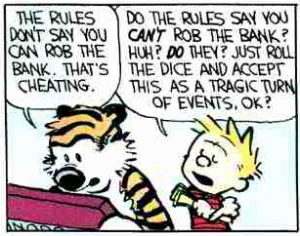
Calvin and Hobbes demonstrate exactly what’s wrong with Monopoly, by demonstrating exactly what’s wrong with Monopoly players. Click for the full comic.
The Theme
But that’s not what Monopoly‘s about, is it? Its purpose is to instil entrepreneurial, capitalist values, and the idea that if you work hard enough, and you’re lucky enough,
that you can become rich and famous! Well, that’s certainly not its original purpose (see “The History”, below), but even if it were, Monopoly‘s theme is still
pretty-much broken:
It presents a false financial model as if it were a reassuring truth. “The Bank can never go bankrupt,” state the rules, instructing us to keep track of
our cash with a pen and paper if there isn’t enough in the box (although heaven help you if your game has gone on long enough to require this)! Maybe Parker Brothers’ could have simply
given this direction to those financial institutions that collapsed during the recent banking crisis, and saved us all from
a lot of bother. During a marathon four-day game at a University of Pittsburgh fraternity, Parker Brothers couriered more money to the gamers to “prop up” their struggling bank: at
least we can all approve of a bailout that the taxpayer doesn’t have to fund, I suppose! Compare this to Puerto Rico, a game which also requires a little thematic suspension of disbelief, but which utilises the depletion
of resources as an important game mechanic, forcing players to change strategies in order to remain profitable.
Curiously, this same rule does not apply to the supply of houses and hotels, which are deliberately limited: the Monopoly world is one in which money is
infinite but in which bricks are not. This makes it more valuable to build houses when there are few resources (in order to deprive your opponents). In actual
economies, however, the opposite is true: houses are always needed, but the resources to built them change in value as they become more or less scarce. Watch the relative
perceived values of the huts available to build in Stone Age to see
how a scarcity economy can really be modelled.
The more houses I build on a street, the more each one is individually worth. Wait, what?
Also, it has a completely-backwards approach to market forces. In the real world, assuming (as Monopoly does) a free market, then it
is consumer demand that makes it possible to raise capital. In the real world, the building of three more hotels on this side of the city makes it less-likely
that anybody will stay at mine, but this is not represented at all. Compare to the excellent 7 Wonders, where I can devalue my neighbour-but-one’s goods supply by producing my own, of the same type.
It only superficially teaches that “American dream” that you can get ahead in the world with a lot of work and a little luck: this model collapses outside of
frontier lands. If you want to see what the real world is like, then wait until you’ve got a winner in a game of Monopoly, and then allow everybody else to
re-start the game, from the beginning. It’s almost impossible to get a foothold in a market when there’s already a monopoly in existence. This alternative way of playing might
be a better model for real-world monopolies (this truth is captured by the game Anti-Monopoly in a way that’s somehow even less-fun than the original).
You might shoot down any or all of these arguments by pointing out that “it’s just a game.” But on the other hand, we’ve already discovered that it’s not a very good game.
I’m just showing how it manages to lack redeeming educational features, too. With the exception of helping children to learn to count and handle money (and even that is lost in the
many computer editions and semi-computerised board game versions), there’s no academic value in Monopoly.
The electronic banking edition of Monopoly makes an already slow game even slower, unless you’re REALLY bad at arithmetic: in which case you should be playing with money so that you
can learn some arithmetic!
The History
You’ve seen now why Monopoly isn’t a very good game both (a) because it’s not fun, and (b) it’s not really educational either – the two biggest reasons that anybody might want to play
it. But you might also be surprised to find that its entire history is pretty unpleasant, too, full of about as much backstabbing as a typical game of Monopoly, and primarily for the
same reason: profit!
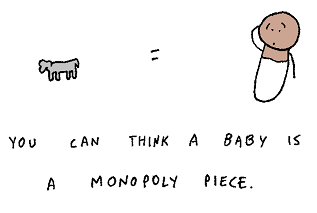
You can think of a baby as a Monopoly piece, but I wouldn’t recommend it. Click for the full comic.
If you look inside the rulebook of almost any modern Monopoly set, or even in Maxine Brady’s well-known strategy guide, you’ll read an abbreviated version of the
story of Charles Darrow, who – we’re told – invented the game and then
published it through Parker Brothers. But a little detective work into the history of the game shows that in actual fact he simply made a copy of the game board shown to him by his
friend Charles Todd. Todd, in turn, had played it in New Jersey, to which it had traveled from Pennsylvania, where it had originally been invented – and patented – by a woman
called Elizabeth Magie.
Home-made “Landlord’s Game” boards, like this one, were popular in the early part of the 20th century.
Magie’s design differed from modern interpretations in only one major way: its educational aspect. Magie was a believer in Georgian economic philosophy, a libertarian/socialist ideology that posits that while the things we create can be owned, the
land belongs equally to everybody. As a result, Georgists claim, the “ownership” of land should be taxed according to its relative worth, and that this should be the principal
– or only, say purists – tax levied by a state. Magie pushed her ideas in the game, by trying to show that allowing people to own land (and then to let out the right of others to live
on it) serves only to empower landlords… and disenfranchise tenants. The purpose of the game, then, was to show people the unfairness of the prevailing economic system.
Lizzie Magie’s 1904 patent application shows a board with familiar features like streets for sale (which can then be rented out), stations, taxes, utilities, and the “public park”
(free parking).
Magie herself approached Parker Brothers several times, but they didn’t like her game. Instead, then, she produced sets herself (and an even greater number were home-made), which proved
popular – for obvious reasons, considering their philosophical viewpoints – among Georgists, Quakers, and students. She patented a revised version in 1924, which added now-familiar features like cards to mark the owned properties, as
well as no-longer-used ideas that could actually go a long way to improving the game, such as a cash-in-hand “goal” for the winner, rather than an elimination rule.
An early boxed copy of Parker Bros’ “Monopoly”.
Interestingly, when Parker Brothers first rejected Charles Darrow, they said that the game was “too complicated, too technical, took too long to play”: at least they and I agree on one
thing, then! Regardless, once they eventually saw how popular Lizzie Magie’s version had become across Philadelphia, they changed their tune and accepted Darrow’s proposal. Then, they
began the process of hoovering up as many patents as they could manage, in order to secure their very own monopoly on a game that was by that point already 30 years old.
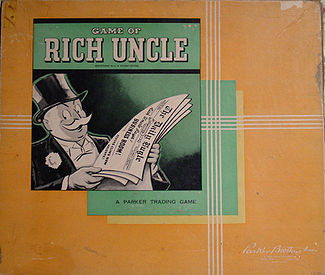
The “Rich Uncle” character, from the Parker Bros’ game of the same name, would eventually come to be the familiar mascot of Monopoly.
They weren’t entirely successful, of course, and there have been a variety of controversies around the legality and enforcability of the Monopoly
trademark. Parker Brothers (and nowadays, Hasbro) have famously taken to court the makers of board games with even-remotely similar names: most-famously, the Anti-Monopoly
game in the 1970s, which they alternately won, then lost, then won, then lost again on a series of appeals in the early 1980s: there’s a really enjoyable book about the topic, and about the history
of Monopoly in general. It’s a minefield of court cases and counter-cases, but the short of it is that trade-marking “Monopoly” ought to be pretty-much impossible. Yet somehow, that’s
what’s being done.
What’s clear, though, is that innovation on the game basically stopped once Parker’s monopoly was in place. Nowadays, Hasbro expect us to be excited when they replace the iron with a cat or bring out yet another localised edition of the board. On those
rare occasions when something genuinely new has come out of the franchise – such as 1936’s underwhelming Stock Exchange
expansion, it’s done nothing to correct the fundamental faults in the game and generally just makes it even longer and yet more dull than it was to begin with.
The Players
The fourth thing that I hate about Monopoly is the people who play Monopoly. With apologies for those of you I’m about to offend, but here’s why:
Firstly, they don’t play it like they mean it. Maybe it’s because they’ve come to the conclusion that the only value in the game is to waste time for as long as possible (and let’s face
it, that’s a reasonable thing to conclude if you’ve ever played the game), but a significant number of players will deliberately make the game last longer than it needs to. I
remember a game once, as a child, when my remaining opponent – given the opportunity to bankrupt me and thus win the game – instead offered me a deal whereby I would give him some of my
few remaining properties in exchange for my continued survival. Why would I take that deal? The odds of my making a comeback with a total of six houses on the board and £200 in my
pocket (against his monopoly of virtually all the other properties) are virtually nil, so he wasn’t doing me any favours by offering me the chance to prolong my suffering. Yet I’ve also
seen players accept deals like like, masochistically making their dull pick-up-and-roll experience last even longer than it absolutely must.
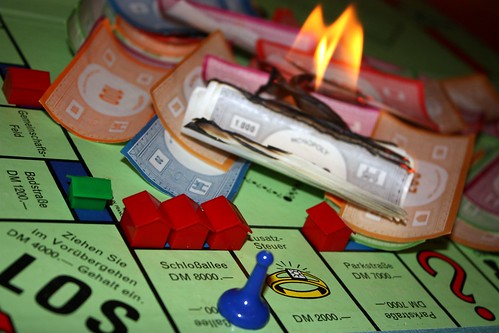
Kill it. Kill it with fire. Image courtesy Daniela Hartmann.
Or maybe it’s just that Monopoly brings out the cruel side of people: it makes them enjoy sitting on their huge piles of money, while the other players grovel around them. If they put
the other players out of their misery, it would end their fun. If so, perhaps Lizzie Magie’s dream lives on, and Monopoly really does teach us about the evils of capitalism: that the
richest are willing to do anything to trample down the poorest and keep them poor, so that the divide is kept as wide as possible? Maybe Monopoly’s a smarter game than I think: though
just because it makes a clever point doesn’t necessarily make a board game
enjoyable.
It’s not that I’m against losing. Losing a game like Pandemic is endless fun because you feel like you have a chance, right until the end, and the mechanics of games like Tigris & Euphrates mean
that you can never be certain that you’re winning, so you have to keep pushing all the way through: both are great games. No: I just object to games in which winning and losing are
fundamentally attached to a requirement to grind another person down, slowly, until you’re both sick and tired of the whole thing.
Nowadays, with computerised Monopoly games, you don’t even have to have friends to play. Which is great, because if you’re suggesting a game of Monopoly, you don’t deserve any.
The second thing that people do, that really gets on my nerves, is make up the damn rules as they go along. I know that I spent a while further up this page complaining
that Monopoly’s rules are pretty awful, but I can still have a rant about the fact that nobody seems to play by them anyway. This is a problem, because it means that if you ever play
Monopoly with someone for the first time, you just know that you’re setting yourself up for an argument when it turns out that their crazy house rules and your crazy house
rules aren’t compatible.
House rules for board games are fine, but make them clear. Before you start the game, say, “So, here’s the crazy rule we play by.” That’s fine. But there’s
something about Monopoly players that seems to make them think that they don’t need to. Maybe they assume that everybody plays by the same house rules, or maybe they don’t even
realise that they’re not playing by the “real” rules, but it seems to me that about 90% of the games of Monopoly I’ve been witness to have been punctuated at some point by somebody
saying “wait, is that allowed?”
The “Free Parking Jackpot” is probably the worst house rule for Monopoly that’s ever been invented. But it’s incredibly popular.
Because I’m a bit of a rules lawyer, I pay attention to house rules. Free Parking Jackpot, in which a starting pile of money – plus everybody’s taxes – go in to the centre of
the board and are claimed by anybody who lands on Free Parking, is probably the moth loathsome house rule. Why do people feel the need to take a game
that’s already burdened with too much luck and add more luck to it. My family used to play with the less-painful but still silly house rule that landing
exactly on “Go!” netted you a double-paycheque, which makes about as much sense, and it wasn’t until I took the time to read the rulebook for myself (in an attempt, perhaps, to work out
where the fun was supposed to be stored) that I realised that this wasn’t standard practice.
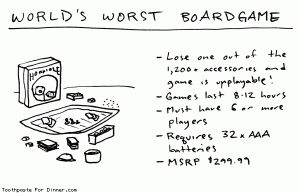
Toothpaste For Dinner has the right idea. Click through to the original comic.
Playing without auctions is another common house rule, which dramatically decreases the opportunity for skillful players to bluff, and generally lengthens the game (interestingly, it
was a house rule favoured by the early Quaker players of the game). Allowing the trading of “immunity” is another house rule than lengthens the game. Requiring that players travel
around the board once before they’re allowed to buy any properties is yet another house rule that adds a dependence on luck and – yet again – lengthens the game. Disallowing trading
until all the properties are owned dramatically lengthens the game, and for no benefit (why not just shuffle the property deck and deal it out to everybody to begin with: it’s faster
and achieves almost the same thing?).
I once met a family who didn’t play with the rule that you have to spend 10% extra to un-mortgage a property, allowing them to mortgage and un-mortgage with impunity (apparently, they
found the arithmetic too hard)! And don’t get me started on players who permit “cheating” (so long as you don’t get caught) as a house rule…
Spot something in common with these house rules? Most of them serve to make a game that’s already too long into something even longer. Players who implement these kinds of house rules
are working to make Monopoly – an already really bad game – into something truly abysmal. I tell myself, optimistically, that they probably just don’t know better, and point them in the
direction of Ticket to
Ride, The Settlers
of Catan, or Factory Manager.
But inside, I know that there must be people out there who genuinely enjoy playing Monopoly: people who finish a game and say “fancy another?”, rather than the
more-rational activity of, say, the clawing out of their own eyes. And those people scare me.
Further Reading
If you liked this, you might also be interested in:
A recent article by Joshua Hedlund explains that Monopoly is (still) an outdated board game (he shares a lot of my points, but I swear I’d almost finished
writing this post before I discovered his)
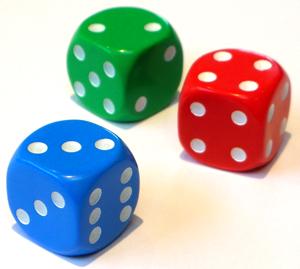
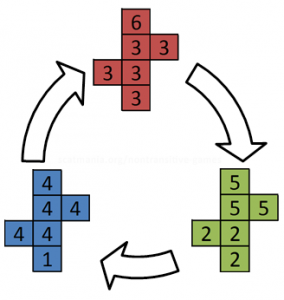
Have you ever come across non-transitive dice? The classic set, that you can get in most magic shops, consists of three different-coloured six-sided dice:
A “Grime’s” style set of 3 non-transitive dice. Notice the unusual numbering.
There are several variants, but a common one, as discussed by
James Grime, involves one die with five “3” sides and one “6” side (described as red below), a second die with three “2” sides and three “5” sides (described as
green below), and a third die with one “1” side and five “four” sides (described as blue below).
They’re all fair dice, and – like a normal six-sided dice – they all have an average score of 3.5. But they’ve got an interesting property, which you can use for all kinds of magic
tricks and gambling games. Typically: the red die will beat the green die, the green die will beat the blue die, and the blue die will beat the red die! (think Rock, Paper,
Scissors…)
Seemingly paradoxically, the dice will generally beat one another in a circular pattern.
If you want to beat your opponent, have them pick a die first. If they pick green, you take red. If they take red, you take blue. If they take blue, you take green. You now have about a
60% chance of getting the highest roll (normally you’d have about a 33% chance of winning, and a 17% chance of a draw, so a 60% chance is significantly better). To make sure that you’ve
got the best odds, play “best of 10” or similar: the more times you play, the less-likely you are to be caught out by an unfortunate unlucky streak.
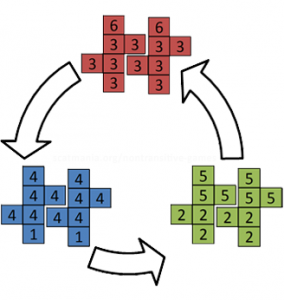
But if that doesn’t bake your noodle enough, try grabbing two sets of nontransitive dice and try again. Now you’ll see that the pattern reverses: the green pair tends to beat the red
pair, the red pair tends to beat the blue pair, and the blue pair tends to beat the green pair! (this makes for a great second act to your efforts to fleece somebody of their money in a
gambling game: once they’ve worked out how you keep winning, give them the chance to go “double or nothing”, using two dice, and you’ll even offer to choose first!)
When you pair up the dice, the cycle reverses! While red beats green, double-green beats double-red!
The properties of these dice – and of the more-exotic forms, like Oskar van Deventer’s seven-dice set (suitable for playing a game with three players and beating both of your opponents) and like the
polyhedral varieties discussed on
Wikipedia – intrigue the game theorist and board games designer in me. Could there be the potential for this mechanic to exist in a board game? I’m thinking something with
Risk-like combat (dice ‘knock out’ one another from highest to lowest) but with a “dice acquisition” mechanic (so players perform actions, perhaps in an auction
format, to acquire dice of particular colours – each with their own strengths and weaknesses among other dice – to support their “hand” of dice). There’s a discussion going on in /r/tabletopgamedesign…
I’ve even written a program (which you’re welcome to download, adapt, and use) to calulate the
odds of any combination of any variety of non-transitive dice against one another, or even to help you develop your own non-transitive dice sets.
Penney’s game
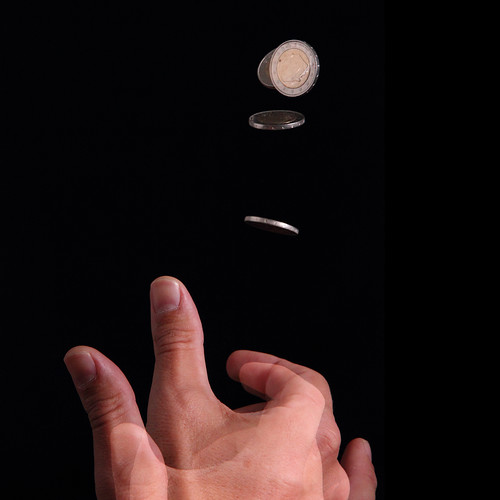
Heads or tails? Image courtesy David M. Diaz.
Here’s another non-transitive game for you, but this time: I’ve made it into a real, playable game that you can try out right now. In this game, you and I will each, in turn, predict
three consecutive flips of a fair coin – so you might predict “tails, heads, heads”. Then we’ll start flipping a coin, again and again, until one of our sequences comes up. And more
often than not, I’ll win.
If you win 10 times (or you lose 20 times, which is more likely!), then I’ll explain how the game works, so you know how I “cheated”. I’ll remind you: the coin flips are fair, and it’s
nothing to do with a computer – if we played this game face-to-face, with a real coin, I’d still win. Now go play!
This is the third in a series of four blog posts which ought to have been published during
January 2013, but ran late because I didn’t want to publish any of them before the first one.
I barely spent any of January in the office at all, between my week working in
London and the week directly after it, the latter of which I spent in the French Alps!
Les Bruyères; our chalet in the Alpine town of Les Gets.
Ruth, JTA and I had opted to make the entire journey from
Oxford to Les Gets by land, because there had (up until recently) been the real possibility that Ruth would be pregnant (and air travel is somewhat riskier for pregnant women). Secondary reasons
included the fact that flying is really, really bad
for the planet, and that JTA’s a fan of staying on Terra firma as far as he can.
Ruth validates our tickets as we prepare to change trains, at a French station.
There were good and bad aspects of this kind of travel. Bad parts included having to be at a park and ride bus terminus well before the sun rose, in order to begin a mammoth journey
that would take most of the day, and frantic dashes across the labyrinthine Paris metro. But on the upside, we didn’t at any point have to take off our shoes and get herded through
backscatter machines, plus the fact that nothing makes you feel cosmopolitan quite like standing in the bar car of a TGV, rocketing through the French countryside, while you
sip on a glass of pinot and watch the world fly by.
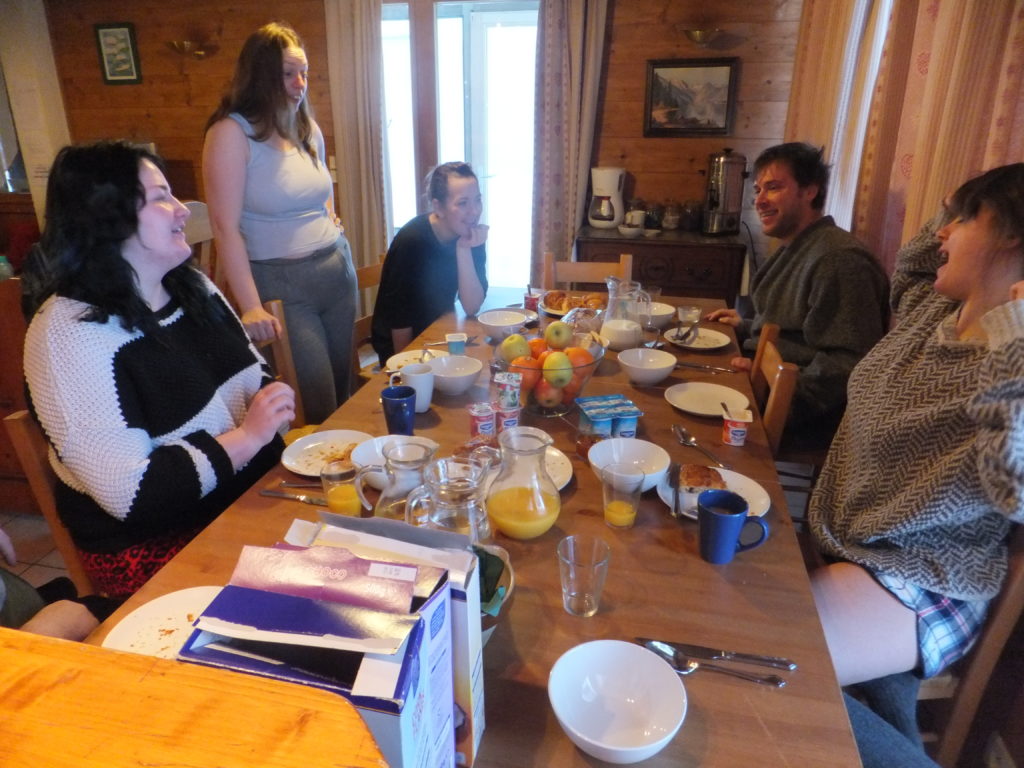
Ruth joins Becky, Harriet, Owen and Cat at the chalet’s dining table.
We arrived, and met with the rest of our team: Ruth’s brother Owen, his girlfriend Cat and his friend
Danny, JTA’s sister Harriet (who’d come over on the train from Lyon, where she’s studying right now), and my sisters Sarah and Becky. We also met our chalet host Dan, who – over the course of the week – put up with a great deal from us (not least our dinnertime conversations about duck
rape, racial stereotypes, sex toys, self-defecation, and worse) and still stood there with a smile as he served us the most spectacular meals imaginable.
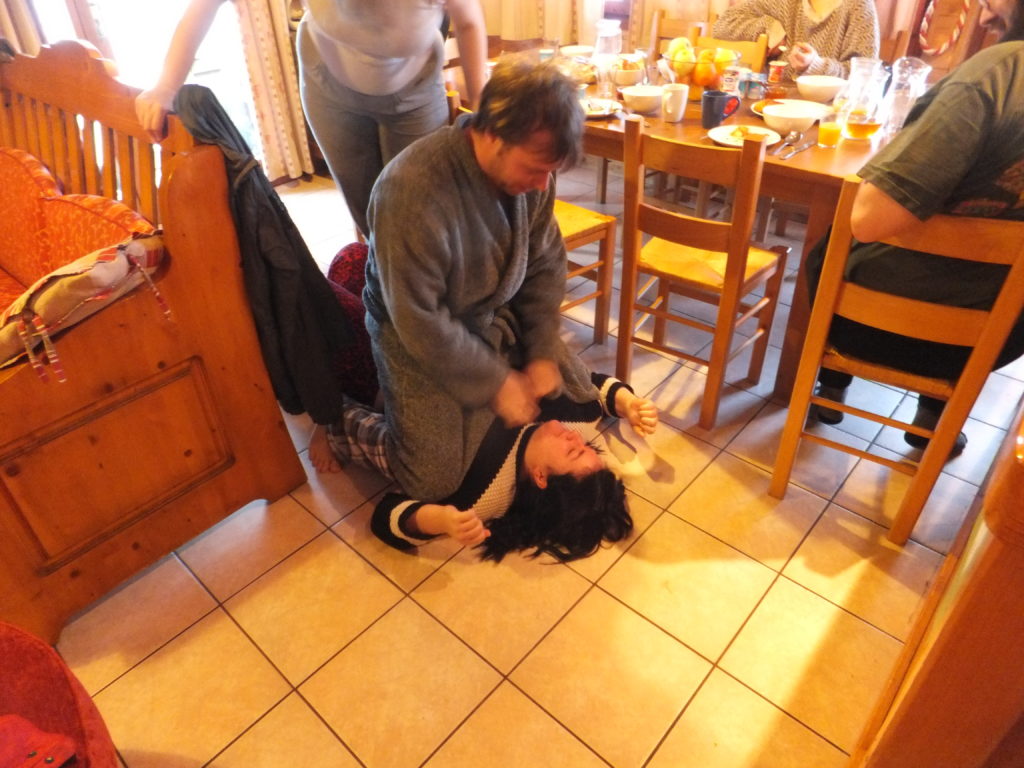
Owen shows Becky what it means to be “Double Bubbled”. She remains unimpressed.
And that’s without even mentioning “Double Bubble”, a game that Owen and Cat invented which seems to involve pinning people and tickling them. They claim that it’s the cause of the
jumping, yelping, and screaming sounds coming from their bedroom on an evening, but I’m not convinced.
Looking over the valley from the summit of Chamossiere.
My first impression of the slopes of the Les Gets-Morzine area were that they were a little heavily
geared towards intermediate skiiers, with lots of blue and red runs criss-crossing the mountains around the bowl-shaped valley, but before long I’d found my way out to some of the
aggressively-mogul-ridden and steeper black and red runs that found out towards the edges of the resort.
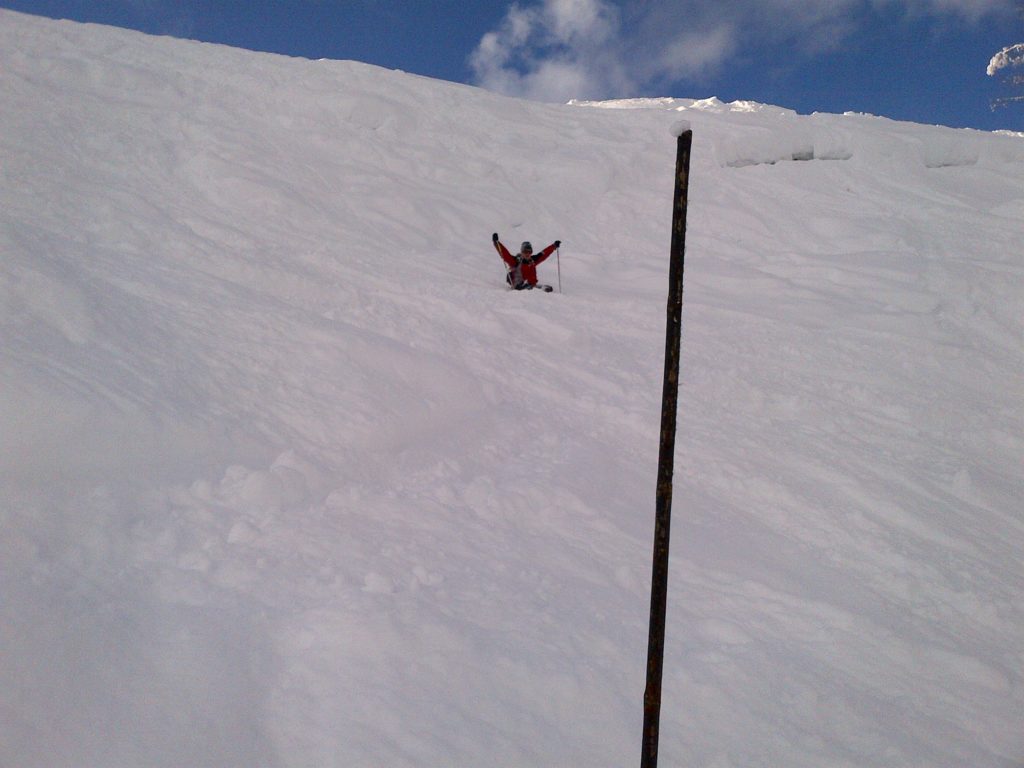
As a new skier, Harriet spent an incredible amount of time buried in snowdrifts, laying on her back, or tangled around a tree. It’s all part of the learning process.
It was particular fun to get out skiing with Sarah again, for the first time in years, and to finally prove to myself something that I’ve suspected for a while: that while my skiing
ability is close to peaking, Sarah’s still continuing to improve and is by now a better skiier than I am. As we hammered our way down some of the roughest, fastest runs we could find on
the final day before she and Becky returned to the UK, she’d pull ahead and it would be everything I could muster to keep up and keep control.
Sarah, about to try to egg me on to try another series of challenging runs, just as I’m getting my breath back from the last ones.
I also enjoyed finally getting to ski with Ruth, something that we’d wanted to do together for almost five years (during which we’d both skied, just – for one reason or another –
never together). She’s one of those weird skiers who genuinely prefers to ski without poles, which I’d often quiz her about during our periodic high-altitude beer breaks.
Following one of my first proper tumbles in years – and damn, it was a spectacular one, snowballing down black run “Yeti” when I took a corner too fast – Sarah snapped this picture.
In the video below (or watch on YouTube), she falls over at about 1m 19s, in case
you want to skip to that bit.
Our new snowsportspeople – Cat and Harriet on skis for the second and first times in their lives, and Danny on snowboard for the first time in his – took to their sports like fish to
water. Or, at their worst, like fish to waterfalls. But by the end of the week, every single one of them had made far better progress than I could have possibly imagined.
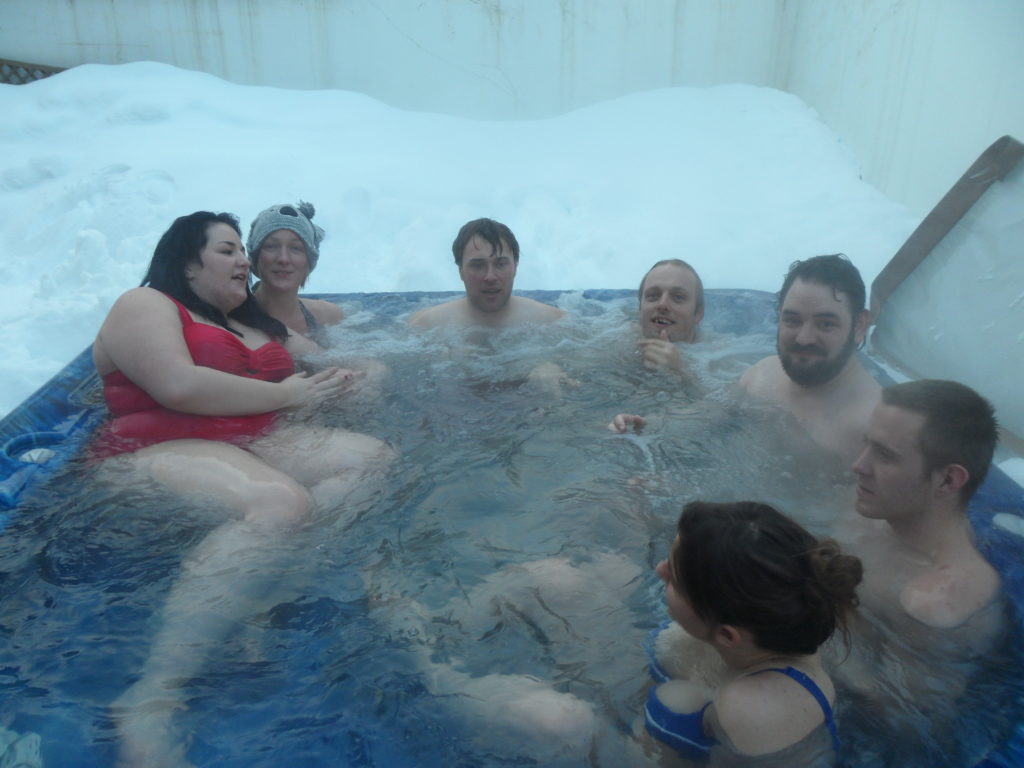
I’m sure that the hot tub was only meant to seat five or six, but that didn’t stop us all piling into it at the end of a day’s snowsports.
We worked ourselves hard, and by the time we were back in our hot tub on an evening, with glasses of gin in our hands, we really felt like we’d earned them.
Watch this space: a full gallery of all of the photos taken on the trip will be made available soon. Sorry about the delay.
I’m aware that many of my friends use Google Reader to subscribe to their favourite blogs, comics, and so on, so – if
you’re among them – I thought I’d better make you aware of some of your alternatives. Google are dropping Google Reader on 1st July (here’s the announcement on the Google Reader blog), so it’s
time to move on.
Ah; Google Reader. You were my RSS reader of choice for a long time, until you started fucking with the user interface the other year.
Getting your data out of Google Reader
The good news is that it’s pretty easy to get all of your feeds out of Google Reader, and import them into your new feed reader. You can export everything from your Reader account, but the most important
thing in your export is probably the OPML file (called ‘subscriptions.xml’ in your download), which is what your new reader will use to give you the continuity that you’re looking for.
OPML files describe a list of subscriptions: for example, this OPML file describes all of the blogs that
used to feature on Abnib (when it worked reliably).
Choosing a new RSS reader
You’ve got a few different choices for your new RSS reader. Here are a few of my favourites:
Tiny Tiny RSS – if you’re happy to host your own web-based RSS reader, and you’re enough of a geek to
enjoy tweaking it the way that you want, then this tool is simply awesome. Install it on your server, configure it the way you want, and then access it via the web or the Android app. I’ve been using Tiny Tiny RSS for a few years, and I’ve made a few
minor tweaks to add URL-shortening and sharing features: that’s what powers the “Dan is reading…” (subscribe) list in the sidebar of my blog. It’s also one of the few web-based RSS readers that offers feed authentication options, which is
incredibly useful if you follow “friends only” blogs on LiveJournal or similar platforms.
NewsBlur – this is the closest thing you’ll find to a like-for-like replacement for Google Reader, and it’s
actually really good: a slick, simple interface, apps for all of the major mobile platforms, and a damn smart tagging system. They’re a little swamped with Reader refugees right now,
but you can work around the traffic by signing up and logging in at their alternative web address of dev.newsblur.com.
Feedly – or, if you’re happy to step away from the centralised, web-based reader solutions, here’s a great
option: available as a browser plugin or a mobile app, it has the fringe benefit that you can use it to read your pre-cached subscriptions while you’re away from an Internet
connection, if that’s a concern to you.
Blogtrottr – If you only subscribe to a handful of feeds, you might want to look at Blogtrottr: it’s an
RSS-to-email service, so it delivers your favourite blogs right to your Inbox, which is great for those of you that use your Inbox as a to-do list (and pretty damn good if you set up
some filters to put your RSS feeds into a suitable tag or folder, so that you can read them at your leisure).
Finally, don’t forget that if you’re using Opera as your primary web browser, that it has a great RSS reader baked right into it! As an Opera fan, I couldn’t
help but plug that.
Or if you only care about my posts…
Of course, if mine’s the only blog you’re concerned with, you might like to follow me on
Google+ on on Twitter: all of my blog posts get publicly pushed to both of those social networks as soon
as they’re published, so if you’re a social network fiend, that’s probably the easiest answer for you!
This is the second in a series of four blog posts which ought to have been published during January
2013, but ran late because I didn’t want to publish any of them before the first one.
I spent the weekend of my birthday working in London, alongside the Squiz team, who make the CMS that forms the foundation of most of the public-facing websites of the Bodleian Libraries. We’d originally scheduled this visit for a different week, but – in that way that projects
sometimes do – the project got juggled about a bit and so I found myself spending the week of my birthday away from home.
The team at Squiz’s London office, debriefing over drinks at the end of a crazy week.
But on Tuesday – my second day working on-site at Squiz’s office, and coincidentally my birthday – disaster struck! Our first clue was when the lights went out. And then, a minute or so
later, when the fire alarm started going off. No big deal, we all thought, as we gathered our possessions and prepared to leave the office – it’s probably just that the fire alarm
sounds as a precaution if it’s electricity supply is disrupted… but as we started to go down the stairs and smelled the smoke, we realised that there really was a fire.
My tweet, from outside the Squiz offices.
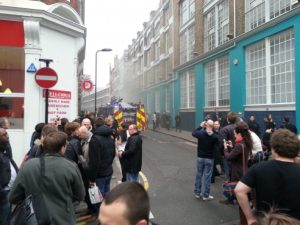
The first two fire engines arrived within minutes. Apparently, they don’t mess about when a city centre office block catches light. The smoke was very visible from the street: thick
grey plumes pouring out from the basement windows. Theories about the cause of the fire were whispered around the assembled crowd, and the consensus seemed to be that the substation in
the basement had overheated and set alight its room.
People were still filing out of the building when the first of the fire engines arrived.
A third fire engine arrived, and – after about a quarter hour of assessing the situation and controlling the crowd – we were told that we wouldn’t be able to get back into our building
for “at least an hour, probably more.” So, being British, we therefore decamped to one of the nearby bars for networking and a round of gin & tonic. After I texted some friends to say
that I hadn’t expected to spend the afternoon of my birthday in the pub, but that it wasn’t an entirely unwelcome experience, a few of them had the cheek to ask once again how
the fire had actually started.
Before long, the fire brigade had established a cordon some distance back from the fire, and were pouring water into the basement.
By the time we were allowed to return to the building, it was already getting dark, and we quickly discovered a new problem that faced us: with the power still well and truly out, the
electronic door locks that secured the offices had become completely unusable. Not willing to abandon my laptop, keys, and other personal possessions overnight in an unfamiliar office,
I waited around until a locksmith had been summoned and had drilled his way through the cylinder and allowed us into the building.
Without power, it turns out that these things can be pretty useless. At least they “fail secure”, keeping the door locked (from the outside) in the event of a problem, rather than the
alternative…
It being my birthday, I’d arranged that Ruth would come and spend the night down in London, and that we’d go out to
Dans le Noir, a restaurant that I’d heard about from news articles and via friends some years prior, and always
wanted to try. The restaurant has a distinct and quite remarkable theme that you probably won’t find anywhere else: that theme is that you eat unidentified food in pitch blackness.
Don’t be fooled: this picture of the tip of a candle wasn’t taken at Dans le Noir, but at Squiz.
As our (blind!) waiter, Gao, led Ruth and I by touch to our table, we suddenly realised that we’d all but forgotten exactly how dark pitch blackness actually is. When you stumble over
your coffee table in the dark on a morning, that’s not truly black: there’s that sliver of light coming from underneath the curtains, or the faint glow of the LED light on the stereo.
Real, complete darkness is disorienting and confusing, and to sit around in it – not even able to see whether your eyes are open or closed – for hours at a time is quite remarkable.
Now this is more like what it looks like at Dans le Noir!
It took us a little while to learn the new skills required to survive in this environment, but Gao was incredibly helpful. We worked out mechanisms for pouring drinks, for checking
whether our plates were empty, and for communicating our relative movements (being geeks, as we are, Ruth and I quickly developed a three-dimensional coordinate-based system for
navigating relative to an agreed centre-point: the tip of the bottle of our mystery wine). We also learned that there’s something truly humbling about being dependent upon the aid of a
blind person to do something that you’d normally be quite capable of doing alone: simple things, like finding where your glass is.
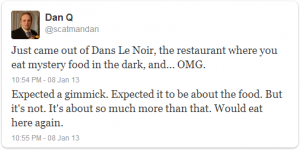
My tweets after coming out of Ruth and I’s remarkable experience of Dans le Noir.
But the bigger lesson that we learned was about how darkness changes the way that we operate on a social level. Ruth and I were sat alongside another couple, and – deprived of
body language, the judgement of sight, and the scrutiny of eye contact – we quickly entered into a conversation that was far deeper and more real than I would have anticipated having
with total strangers. It was particularly strange to see Ruth, who’s usually so shy around new people, really come out as confident and open. I theorise that (in
normally-signted people) eye contact – that is, being able to see that others can see you – serves as a regulator of our willingness to be transparent. Depriving it for long enough that
its lack begins to feel natural makes us more frank and honest. Strange.
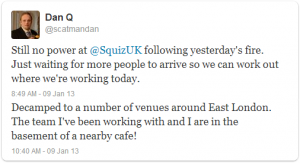
Live updates, primarily for the benefit of the people back at my usual workplace, on progress at Squiz.
Back at Squiz the following day, there was still no electricity. Credit is due to the team there, though, who quickly put in to effect their emergency plans and literally “moved office”
to a handful of conference rooms and meeting spaces around Shoreditch. “Runners” were nominated to help relay messages and equipment between disparate groups of people, and virtualised
networks were established across the city. I laughed when I discovered that Squiz’s old offices had been in an old fire station.
Team members at Squiz, in their unlit, unheated office, begin to put their emergency plan into place, picking up computers and transporting them to alternative venues.
Before long, the folks I’d been working with and I were settled into a basement meeting room in a nearby café, running a stack of Mac desktops and laptops from a monumental string of
power strips, and juggling an Internet connection between the café’s WiFi and a stack of Mifi-like
devices. We were able to get on with our work, and the day was saved, all thanks to some smart emergency planning. Later in the week, a generator was deployed outside the building and
we were able to return to normal desks, but the quick-thinking of the management ensured that a minimum of disruption was caused in the meantime.
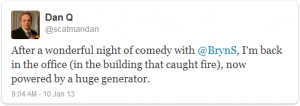
My tweet about seeing comedy with Bryn and about returning to the office (now powered by a huge generator).
Not one to waste the opportunity to make the most of being in London for a week, I spent another of my evenings out with Bryn. He and I went out to the Free Fringe
Fundraiser, which – despite a notable absence of Peter Buckley Hill, who had caught a case of the
then-dominating
norovirus – was still a great deal of fun. It was particularly pleasing to get to see Norman Lovett in the flesh: his particular brand of surrealist anti-humour tickles me mercilessly.
So what could have been “just another business trip” turned into quite the adventure, between fires and birthdays and eating-in-the-dark and comedy. If only it hadn’t taken me two
months to finish writing about it…
This is the first in a series of four blog posts which ought to have been published during January 2013,
but ran late because I didn’t want to publish any of them before the first one.
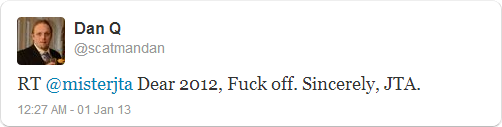
2012 was one of the hardest years of my life.
My retweet of JTA’s sentiments, shortly after midnight on New Year’s Eve, pretty much covers my feeling of the year, too.
It was a year of unceasing disasters and difficulties: every time some tragedy had befallen me, my friends, or family, some additional calamity was lined-up to follow in its wake. In an
environment like this, even the not-quite-so-sad things – like the death of Puddles, our family dog, in May – were magnified, and the ongoing challenges of the year – like the
neverending difficulties with my dad’s estate – became overwhelming.
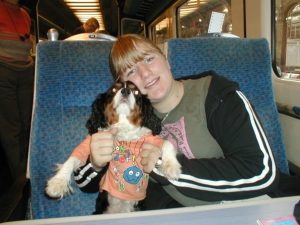
My sister Becky with Puddles, both younger and more-foolish than they eventually became. I don’t know why Puddles is wearing a t-shirt.
The sudden and unexpected death of my dad while training for his Arctic trek, was clearly the event which had the most-significant impact on me.
I’ve written about the experience at length, both here on my
blog and elsewhere (for example, I made a self-post to Reddit on the day after the accident, urging readers to “call somebody you love today”).
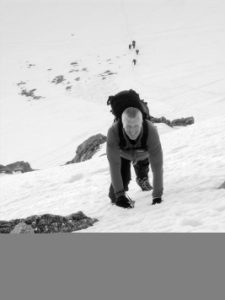
My dad, climbing Aladdin’s Mirror in the Cairngorms.
In the week of his death, my sister Becky was suffering from an awful toothache which was stopping her from eating,
sleeping, or generally functioning at all (I tried to help her out by offering some oil of cloves (which functions as a dental contact anesthetic), but she must have misunderstood my instruction about applying it to the tooth
without swallowing it, because she spent most of that evening throwing up (seriously: don’t ever swallow clove oil).
My dad’s clothes for his funeral. My sisters and I decided that he ought to be dressed as he would be for a one of his summer hikes, right down to the combination of sandals and socks
(the funeral director needed reassurance that yes, he really did routinely wear both at the same time).
Little did she know, worse was yet to come: when she finally went to the dentist, he botched her operation,
leaving her with a jaw infection. The infection spread, causing septicæmia of her face and neck and requiring that she was hospitalised. On the day of our dad’s funeral, she needed to insist that the “stop gap” surgery that she was given was done under local, rather than general,
anasthetic, so that she could make it – albeit in a wheelchair and unable to talk – to the funeral.
Five weeks later, my dad finally reached the North Pole,
his ashes carried by another member of his team. At about the same time, Ruth‘s grandmother passed away, swamping the
already-emotional Earthlings with yet another sad period. That same month,
my friend S****** suffered a serious injury, a traumatic and distressing experience in the middle of a long and difficult period of her life, and an event which caused significant
ripples in the lives of her circle of friends.
The notice of Ruth’s grandmother’s death, as it appeared in the online version of her local newspaper.
Shortly afterwards, Paul moved out from Earth, in a situation that was anticipated (we’d said when we first moved in
together that it would be only for a couple of years, while we all found our feet in Oxford and decided on what we’d be doing next, as far as our living situations were concerned), but
still felt occasionally hostile: when Paul left town six months later, his last blog post stated that Oxford could “get lost”, and that he’d “hated hated 90% of the time” he’d lived here. Despite
reassurances to the contrary, it was sometimes hard – especially in such a difficult year – to think that this message wasn’t directed at Oxford so much as at his friends there.
As the summer came to an end, my workload on my various courses increased dramatically, stretching into my so-called “free time”: this, coupled with delays resulting from all of the
illness, injury, and death that had happened already, threw back the release date of Milestone: Jethrik, the latest update to Three Rings. Coupled with the stress of the 10th Birthday Party Conference – which thankfully JTA handled most of – even the rare periods during which nobody was ill or dying were filled with sleepless nights and anxiety. And of course as soon
as all of the preparation was out of the way and the conference
was done, there were still plenty of long days ahead, catching up on
everything that had been temporarily put on the back burner.
My sister Sarah and I at the christening of a bus named after my dad. Click the picture for the full story.
When I was first appointed executor of my dad’s estate, I said to
myself that I could have the whole thing wrapped-up and resolved within six months… eight on the outside. But as things dragged on – it took almost six months until the investigation
was finished and the coroner’s report filed, so we could get a death
certificate, for example – they just got more and more bogged-down. Problems with my dad’s will made it harder than expected to get started (for example, I’m the
executor and a beneficiary of the will, yet nowhere on it am I directly mentioned by name, address, or relationship… which means that I’ve had to prove that I am the person
mentioned in the will every single time I present it, and that’s not always easy!), and further administrative hiccups have slowed down the process every step of the way.
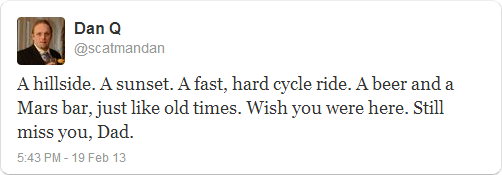
On the first anniversary of my dad’s death, I cycled up a hill to watch the sunset with a bottle of Guinness and a Mars bar. And sent this Tweet.
You know what would have made the whole thing easier? A bacon sandwich. And black
pudding for breakfast. And a nice big bit of freshly-battered cod. And some roast chicken. I found that 2012 was a harder year than 2011 in which to be a vegetarian. I guess that a nice steak would
have taken the edge off: a little bit of a luxury, and some escapism. Instead, I probably drank a lot more than I ought to have. Perhaps we should encourage recovering alcoholic, when
things are tough, to hit the sausage instead of the bottle.
It’s been a while, old friend. A while since I used this delicious-looking photograph in my blog, I mean! This is the sixth time… can you find them all?
Becky’s health problems weren’t done for the year, after she started getting incredibly intense and painful headaches. At first, I was worried that she was lined-up for a similar diagnosis to mine, of the other year (luckily, I’ve been symptom-free for a year
and a quarter now, although medical science is at a loss to explain why), but as I heard more about her symptoms, I became convinced that this wasn’t the case. In any case, she found
herself back in the operating room, for the second serious bit of surgery of the year (the operation was a success, thankfully).
The “F” is for “Fuck me you’re going to put a scalpel WHERE?”
I had my own surgery, of course, when I had a vasectomy; something I’d been
planning for some time. That actually went quite well, at least as far as can be
ascertained at this point (part three of that series of posts will be coming soon), but it allows me to segue into the topic of reproduction…
Because while I’d been waiting to get snipped, Ruth and JTA had managed to conceive. We found this out right as we were running around sorting out the Three Rings Conference, and Ruth
took to calling the fœtus “Jethrik”, after the Three Rings milestone. I was even more delighted still when I heard that the expected birth date would be 24th July: Samaritans‘ Annual Awareness Day (“24/7”).
One of the many pregnancy tests Ruth took, “just to be sure” (in case the last few were false positives). Photo from Ruth’s blog.
As potential prospective parents, they did everything right. Ruth stuck strictly to a perfectly balanced diet for her stage of pregnancy; they told only a minimum of people, because –
as everybody knows – the first trimester’s the riskiest period. I remember when Ruth told her grandfather (who had become very unwell towards the end of 2012 and died early this year:
another sad family tragedy) about the pregnancy, that it was only after careful consideration – balancing how nice it would be for him to know that the next generation of his
family was on the way before his death – that she went ahead and did so. And as the end of the first trimester, and the end of the year, approached, I genuinely believed that the string
of bad luck that had been 2012 was over.
In Ruth’s blog post, she’s used kittens to make a sad story a little softer, and so I have too.
But it wasn’t to be. Just as soon as we were looking forward to New Year, and planning to not so much “see in 2013” as to “kick out 2012”, Ruth had a little bleeding. Swiftly followed
by abdominal cramps. She spent most of New Year’s Eve at the hospital, where they’d determined that she’d suffered a miscarriage, probably a few weeks earlier.
Ruth’s written about it. JTA’s written about it, too. And I’d recommend they read
their account rather than mine: they’ve both written more, and better, about the subject than I could. But I shan’t pretend that it wasn’t hard: in truth, it was heartbreaking. At the
times that I could persuade myself that my grief was “acceptable” (and that I shouldn’t be, say, looking after Ruth), I cried a lot. For me, “Jethrik” represented a happy ending to a
miserable year: some good news at last for the people I was closest to. Perhaps, then, I attached too much importance to it, but it seemed inconceivable to me – no pun intended – that
for all of the effort they’d put in, that things wouldn’t just go perfectly. For me, it was all connected: Ruth wasn’t pregnant by me, but I still found myself wishing that my dad could
have lived to have seen it, and when the pregnancy went wrong, it made me realise how much I’d been pinning on it.
I don’t have a positive pick-me-up line to put here. But it feels like I should.
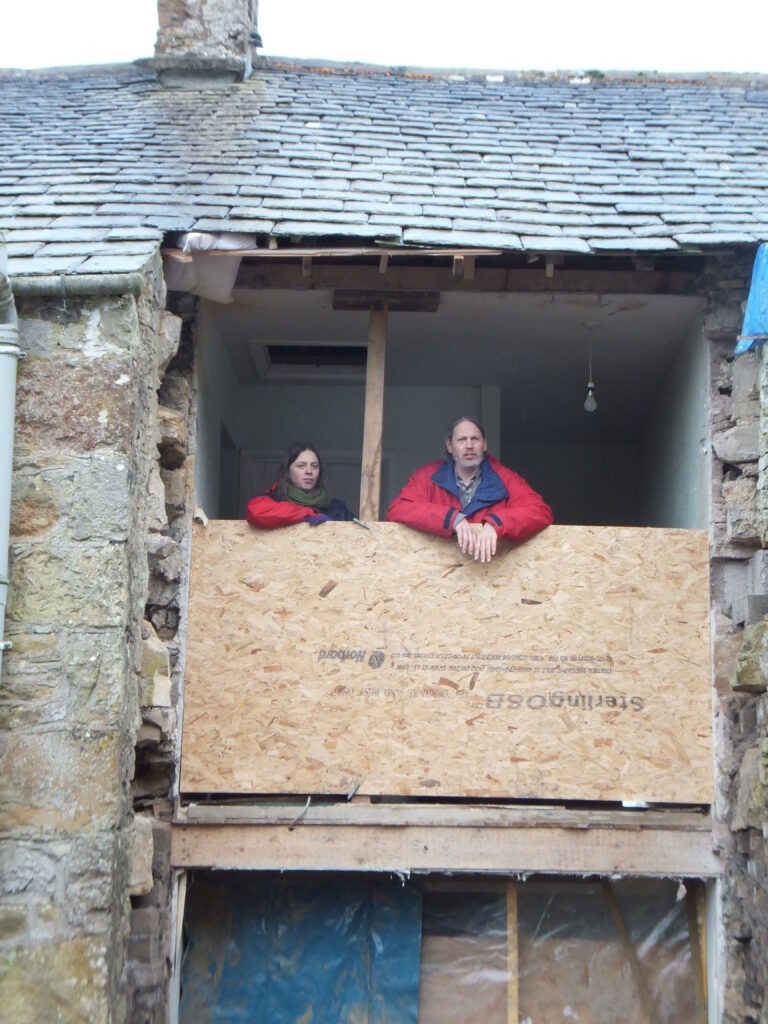
A few days before the miscarriage became apparent, Ruth and her dad survey the back garden of the house he’s rebuilding.
And so there we were, at the tail of 2012: the year that began awfully, ended awfully, and was pretty awful in the middle. I can’t say there weren’t good bits, but they were somewhat
drowned out by all of the shit that happened. Fuck off, 2012.
Here’s to 2013.
Edit, 16th March 2013: By Becky’s request, removed an unflattering photo of her and some of the ickier details of her health problems this year.
Edit, 11th July 2016: At her request, my friend S******’s personal details have been obfuscated in this post so that they are no longer readily available to
search engines.
Edit, 26th September 2016: At her request, my friend S******’s photo was removed from this post, too.
Earlier this year, I played Emily Short‘s new game, Counterfeit Monkey, and I’m pleased to say that it’s one of the best pieces of interactive fiction I’ve played in years. I’d highly recommend that you give it a go.
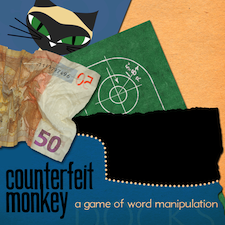
Counterfeit Monkey is one of the best interactive fiction games I’ve played in years. And not just because I love puns.
What makes Counterfeit Monkey so great? Well, as you’d expect from an Emily Short game (think Bee, which I reviewed last year, Galatea, and Glass), it paints an engaging and compelling
world which feels “bigger” than the fragments of it that you’re seeing: a real living environment in which you’re just another part of the story. The island of Anglophone Atlantis and
the characters in it feel very real, and it’s easy to empathise with what’s going on (and the flexibility you have in your actions helps you to engage with what you’re
doing). But that’s not what’s most-special about it.
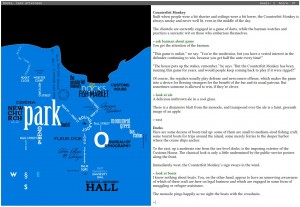
I’m in a bar, presumably in need of a pint of apple. Apple? That’s not what I mean! Where’s my P-Remover when I need one…
What’s most-special about this remarkable game is the primary puzzle mechanic, and how expertly (not to mention seamlessly and completely) it’s been incorporated into the play
experience. Over the course of the game, you’ll find yourself equipped with a number of remarkable tools that change the nature of game objects by adding, removing, changing,
re-arranging or restoring their letters, or combining their names with the names of other objects: sort of a “Scrabble® set for real life”.
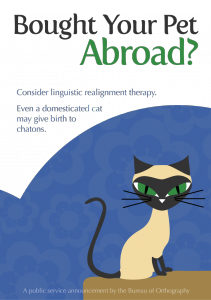
Wise words from the Bureau of Orthography.
You start the game in possession of a full-alphabet letter-remover, which lets you remove a particular letter from any word – so you can, for example, change
a pine into a pin by “e-removing” it, or you can change a caper into a cape by “r-removing” it
(you could go on and “c-remove” it into an ape if only your starting toolset hadn’t been factory-limited to prevent the creation of animate objects).
Poster for Dental Consonants Ltd. Get your consonants here!
This mechanic, coupled with a doubtless monumental amount of effort on Emily’s part, makes Counterfeit Monkey have perhaps the largest collection of potential carryable
objects of any interactive fiction game ever written. Towards the end of the game, when your toolset is larger, there feels like an infinite number of possible linguistic permutations
for your copious inventory… and repeatedly, I found that no matter what I thought of, the author had thought of it first and written a full and complete description of the result (and
yes, I did try running almost everything I’d picked up, and several things I’d created, through the almost-useless “Ümlaut Punch”, once I’d found it).
Atlantida, nominal ruler of Anglophone Atlantis.
I can’t say too much more without spoiling one of the best pieces of interactive fiction I’ve ever played. If you’ve never played a text-based adventure before, and want a gentler
introduction, you might like to go try something more conventional (but still great) like Photopia (very short, very
gentle: my review) or Blue Lacuna (massive,
reasonably gentle: my review) first. But if you’re ready for the awesome that is Counterfeit
Monkey, then here’s what you need to do:
How to play Counterfeit Monkey
Install a Glulx interpreter.
I recommend Gargoyle, which provides beautiful font rendering and supports loads of formats.
Note that Gargoyle’s UNDO command will not work in Counterfeit Monkey, for technical reasons (but this shouldn’t matter much so long as you SAVE at regular
intervals).
Download for Windows, for Mac, or for other systems.
Download Counterfeit Monkey
Get Counterfeit Monkey‘s “story file” and open it using your
Glulx interpreter (e.g. Gargoyle).
Download it here.
(alternatively, you can use experimental technology to play the game in your
web browser: it’ll take a long time to load, though, and you’ll be missing some of the fun optional features, so I wouldn’t recommend it over the “proper” approach above)
The explosion of smartphone ownership over the last decade has put powerful multi-function computers into the pockets of almost half of us. But despite the fact that the average smartphone contains at least as much
personally-identifiable information as its owner keeps on their home computer (or in dead-tree
form) at their house – and is significantly more-prone to opportunistic theft – many users put significantly less effort into protecting their mobile’s data than they do
the data they keep at home.
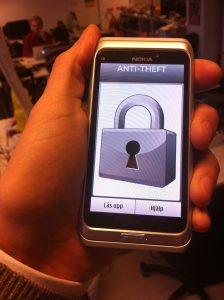
Too late, little Nokia E7: I’ve got physical access to you now.
I have friends who religiously protect their laptops and pendrives with TrueCrypt, axCrypt, or similar, but still carry around an unencrypted mobile phone. What we’re talking about here is a device that contains all of the contact details for you
and everybody you know, as well as potentially copies of all of your emails and text messages, call histories, magic cookies for social networks and other services, saved passwords, your browsing history (some people would say that’s the
most-incriminating thing on their phone!), authentication apps, photos, videos… more than enough information for an attacker to pursue a highly-targeted identity theft or
phishing attack.
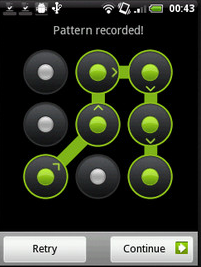
Android pattern lock: no encryption, significantly less-random than an equivalent-length PIN, and easily broken by a determined attacker.
“Pattern lock” is popular because it’s fast and convenient. It might be good enough to stop your kids from using your phone without your permission (unless they’re smart enough to do
some reverse smudge engineering: looking for the smear-marks made by
your fingers as you unlock the device; and let’s face it, they probably are), but it doesn’t stand up to much more than that. Furthermore, gesture unlock solutions dramatically reduce
the number of permutations, because you can’t repeat a digit: so much so, that you can easily perform a rainbow table attack on the SHA1 hash to reverse-engineer somebody’s gesture.
Even if Android applied a per-device psuedorandom salt to the gesture pattern (they don’t, so you can download a prefab table), it doesn’t take long to generate an SHA1 lookup of
just 895,824 codes (maybe Android should have listened to Coda
Hale’s advice and used BCrypt, or else something better still).
An encrypted iPhone can be configured to resist brute-force attacks by wiping the phone after repeated failures, which replaces one security fault (brute-force weakness) with another
(a denial of service attack that’s so easy that your friends can do it by accident).
These attacks, though (and the iPhone isn’t bulletproof, either), are all rather academic, because
they are trumped by the universal rule
that once an attacker has physical access to your device, it is compromised. This is fundamentally the way in which mobile security should be considered to be equivalent
to computer security. All of the characteristics distinct to mobile devices (portability, ubiquity, processing power, etc.) are weaknesses, and that’s why
smartphones deserve at least as much protection as desktop computers protecting the same data. Mobile-specific features like “remote wipe” are worth having, but can’t
be relied upon alone – a wily attacker could easily keep your phone in a lead box or otherwise disable its connectivity features until it’s cracked.
The bottom line: if the attacker gets hold of your phone, you’re only as safe as your encryption.
The only answer is to encrypt your device (with a good password). Having to tap in a PIN or password may be less-convenient than just “swipe to unlock”, but it gives
you a system that will resist even the most-thorough efforts to break it, given physical access (last year’s
iPhone 4 vulnerability notwithstanding).
It’s still not perfect – especially here in the UK, where the RIPA can be used (and has been used) to force key surrender. What we really need is
meaningful, usable “whole system” mobile encryption with plausible deniability. But so long as you’re only afraid of identity thieves and phishing scammers, and not being
forced to give up your password by law or under duress, then it’s “good enough”.
Of course, it’s only any use if it’s enabled before your phone gets stolen! Like backups, security is one of those things that everybody should make a habit of thinking
about. Go encrypt your smartphone; it’s remarkably easy –
This is the second part of a three-part blog post about my vasectomy. Did you read the first part, yet?
My vasectomy was scheduled for Tuesday afternoon, so I left work early in order to cycle up to the hospital: my plan was to cycle up there, and then have Ruth ride my bike back while JTA drove me home. For a
moment, though, I panicked the clinic receptionist when she saw me arrive carrying
a cycle helmet and pannier bag: she assumed that I must be intending to cycle home after the operation!
The Elliot-Smith Clinic lives in an old prefab building buried at the back end of the hospital campus. If you think it looks scary in this picture, imagine what it’s like when it’s
dark and you’re going there to be stabbed in the genitals.
It took me long enough to find the building, cycling around the hospital in the dark, and a little longer still to reassure myself that this underlit old building could actually be a
place where surgery took place.
My tweet upon arriving at the clinic.
Despite my GP‘s suggestion to the contrary, the staff didn’t feel the need to take me though their counselling process, despite
me ticking some (how many depends primarily upon how you perceive our unusual relationship
structure) of the “we would prefer to counsel additionally” boxes on their list of criteria. I’d requested that Ruth arrive at about the beginning of the process specifically so
that she could “back me up” if needed (apparently, surgeons will sometimes like to speak to the partner of a man requesting a vasectomy), but nobody even asked. I just had to sign
another couple of consent forms to confirm that I really did understand what I was doing, and then I was ready to go!
I’d shaved my balls a few days earlier, at the request of the clinic (and also at Matt‘s suggestion, who
pointed out that “if I don’t, they’ll do it for me, and I doubt they’ll be as gentle!” – although it must be pointed out that as they were already planning to take a blade to
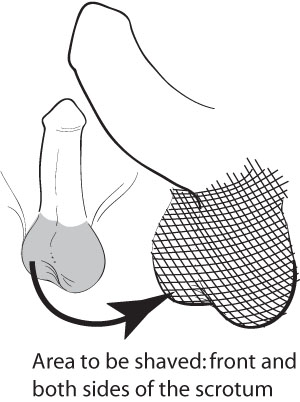
my junk, I might not have so much to worry about), which had turned out to be a challenge in itself. I’ve since looked online and found lots of great diagrams showing you
which parts you need to shave, but the picture I’d been given might as well have been a road map of Florence, because no matter which way up I turned it, it didn’t look anything like my
genitals. In the end, I just shaved all over the damn place, just to be sure. Still not an easy feat, though, because the wrinkled skin makes for challenging shaving: the best technique
I found was to “stretch” my scrotum out with one hand while I shaved it with the other – a tricky (and scary) maneuver.
If I’d had a diagram like this, rather than an Italian street map, I might have stood a better chance of just shaving what I needed to shave.
After sitting in the waiting room for a while, I was ushered through some forms and a couple more questions of “are you sure?”, and then herded into a curtained cubicle to change into a
surgical gown (over the top of which I wore my usual dressing gown). The floor was cold, and I’d forgotten to bring my slippers, so I kept my socks on throughout. I sat in a separate
waiting area from the first, and attempted to make small talk with the other gents waiting there. Some had just come out of surgery, and some were still waiting to go in, and the former
would gently tease the latter with jokes about the operation. It’s a man thing, I guess: I can’t imagine that women would be so likely to engage in such behaviour (ignoring, for a
moment, the nature of the operation).
There are several different approaches to vasectomy, and my surgeon
was kind enough to tolerate my persistent questions as I asked about the specifics of each part of the operation. He’d said – after I asked – that one of the things he liked about doing
vasectomies was that (unlike most of the other surgeries he performs) his patients are awake and he can have a conversation while he worked, although I guess he
hadn’t anticipated that there’d ever be anybody quite so interested as I was.
Warning: The remainder of this blog post describes a surgical procedure, which some people might find squicky. For the protection of those who are of a weak stomach, some photos
have been hidden behind hyperlinks: click at your own risk. (though honestly, I don’t think they’re that bad)
With my scrotum pulled up through a hole in a paper sheet, the surgeon began by checking that “everything was where it was supposed to be”: he checked that he could find each vas (if
you’ve not done this: borrow the genitals of the nearest man or use your own, squeeze moderately tightly between two fingers the skin above a testicle, and move around a bit until you
find a hard tube: that’s almost certainly a vas). Apparently surgeons are supposed to take care to ensure that they’ve found two distinct tubes, so they don’t for example sever the same
one twice.
Next, he gave the whole thing a generous soaking in iodine. This turned out to be fucking freezing. The room was cold enough already, so I asked him to close the window while my
genitals quietly shivered above the sheet.
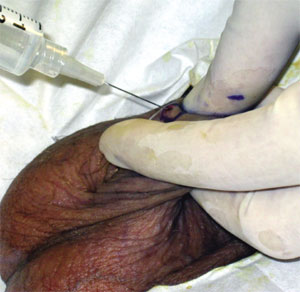
Next up came the injection. The local anaesthetic used for this kind of operation is pretty much identical to the kind you get at the dentist: the only difference is that if your
dentist injected you here, that’d be considered a miss. While pinching the left vas between his fingertips, the surgeon squirted a stack of lidocaine into the cavity
around it. And fuck me, that hurt like being kicked in the balls. Seriously: that stung quite a bit for a few minutes, until the anaesthesia kicked in and instead the
whole area felt “tingly”, in that way that your lips do after dental surgery.
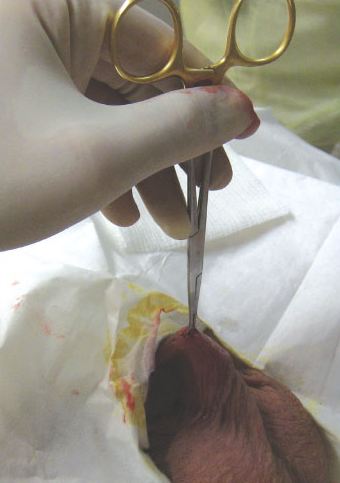
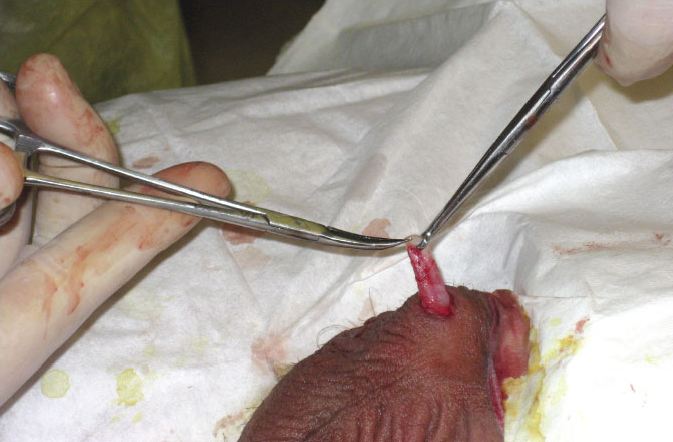
Pinching the vas (still beneath the skin at this point) in a specially-shaped clamp, the surgeon made a puncture wound “around” it with a sharp-nosed pair of forceps, and pulled the vas
clean through the hole. This was a strange sensation – I couldn’t feel any pain, but I was aware of the movement – a “tugging” against my insides.
A quick snip removed a couple of centimetres from the middle of it (I gather that removing a section, rather than just cutting, helps to reduce the – already slim – risk that
the two loose ends will grow back together again) and cauterised the ends. The cauterisation was a curious experience, because while I wasn’t aware of any sensation of heat, I could
hear a sizzling sound and smell my own flesh burning. It turns out that my flaming testicles smell a little like bacon. Or, if you’d like to look at it another way (and I can almost
guarantee that you don’t): bacon smells a little bit like my testicles, being singed.
Next up came Righty’s turn, but he wasn’t playing ball (pun intended). The same steps got as far as clamping and puncturing before I suddenly felt a sharp pain, getting rapidly worse.
“Ow… ow… owowowowowow!” I said, possibly with a little more swearing, as the surgeon blasted another few mils of anaesthetic into my bollocks. And then a little more. And
damnit: it turns out that no matter how much you’ve had injected into you already, injecting anaesthetics into your tackle always feels like a kick in the nuts for a few
minutes. Grr.
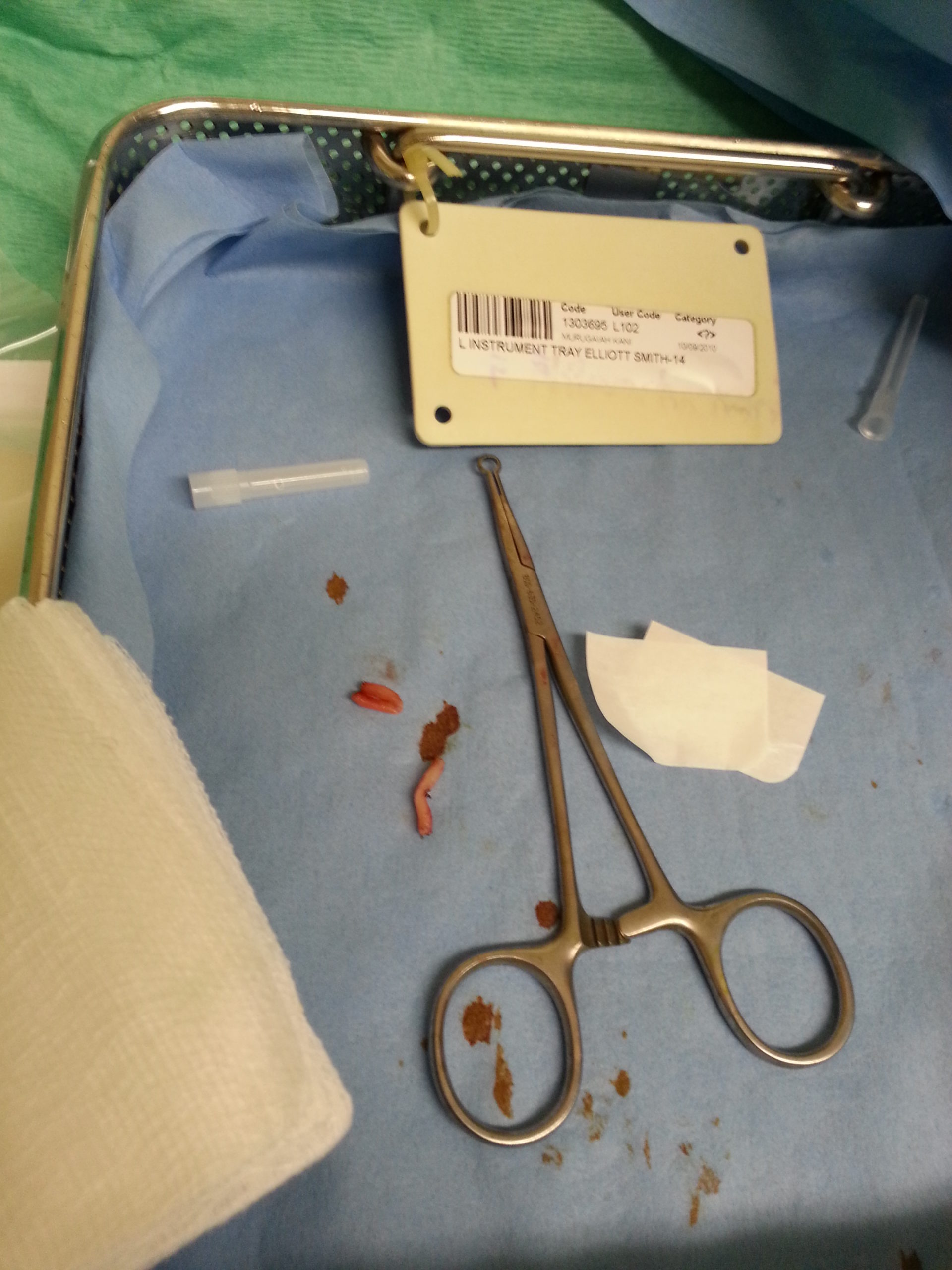
The removed sections of my vas, on a tray (actually mine)
You can see the “kink” in each, where it was pulled out by the clamp. Also visible is the clamp itself – a cruel-looking piece of equipment, I’m sure you’ll agree! – and the discarded
caps from some of the syringes that were used.
The benefit of this approach, the “no-scalpel vasectomy”, is that the puncture wounds are sufficiently small as to not need stitches. At the end of the surgery, the surgeon just stuck a
plaster onto the hole and called it done. I felt a bit light-headed and wobbly-legged, so I sat on the operating table for a few minutes to compose myself before returning to the
nurses’ desk for my debrief. I only spent about 20 minutes, in total, with the surgeon: I’ve spent longer (and suffered more!) at the dentist.
Later, I would receive this “Happy Vasectomy” card from Liz and Simon. Thanks, guys!
By the evening, the anaesthetic had worn off and I was in quite a bit of pain, again: perhaps worse than that “kick in the balls” moment when the anaesthetic was first injected, but
without the relief that the anaesthetic brought! I took some paracetamol and – later – some codeine, and slept with a folded-over pillow wedged between my knees, after I discovered how
easy it was to accidentally squish my sore sack whenever I shifted my position.
The day after was somewhat better. I was walking like John Wayne, but this didn’t matter because – as the nurse had suggested – I spent most of the day lying down “with my feet as high
as my bottom”. She’d taken the time to explain that she can’t put a bandage nor a sling on my genitals (and that I probably wouldn’t want her to, if she could), so the correct
alternative is to wear tight-fitting underwear (in place of a bandage) and keep my legs elevated (as a sling). Having seen pictures of people with painful-looking bruises and swelling
as a result of not following this advice, I did so as best as I could.
Today’s the day after that: I’m still in a little pain – mostly in Righty, again, which shall henceforth be called “the troublesome testicle” – but it’s not so bad except when I forget
and do something like bend over or squat or, I discovered, let my balls “hang” under their own weight, at all. But altogether, it’s been not-too-bad at all.
Or, as I put on my feedback form at the clinic: “A+++. Recommended. Would vasectomy again.”
(thanks due to Ruth, JTA, Matt, Liz, Simon,
Michelle, and my mum for support, suggestions, and/or fetching things to my bed for me while I’ve been waddling
around looking like John Wayne, these past two days)
Parts of Oxford have been flooded for the last few
days, and apparently the worst is yet to come. I worked from home yesterday, intimidated by the available choices
of traversing flooded roads or else taking the hilly 3+ mile diversion around the problem areas, but today: I decided that it was time to man up and cycle in to the office.
Here’s where I forded Kennington Road. Yes, I just used the word “forded” to describe crossing the road.
Conveniently, we’ve somewhere along the way acquired a large pair of Wellington boots (we think they might have been Paul‘s, but as he’s now left Oxford without them, they’ve been sitting in our charity-shop-box). So I booted up
and set out. I was yawning all the way:
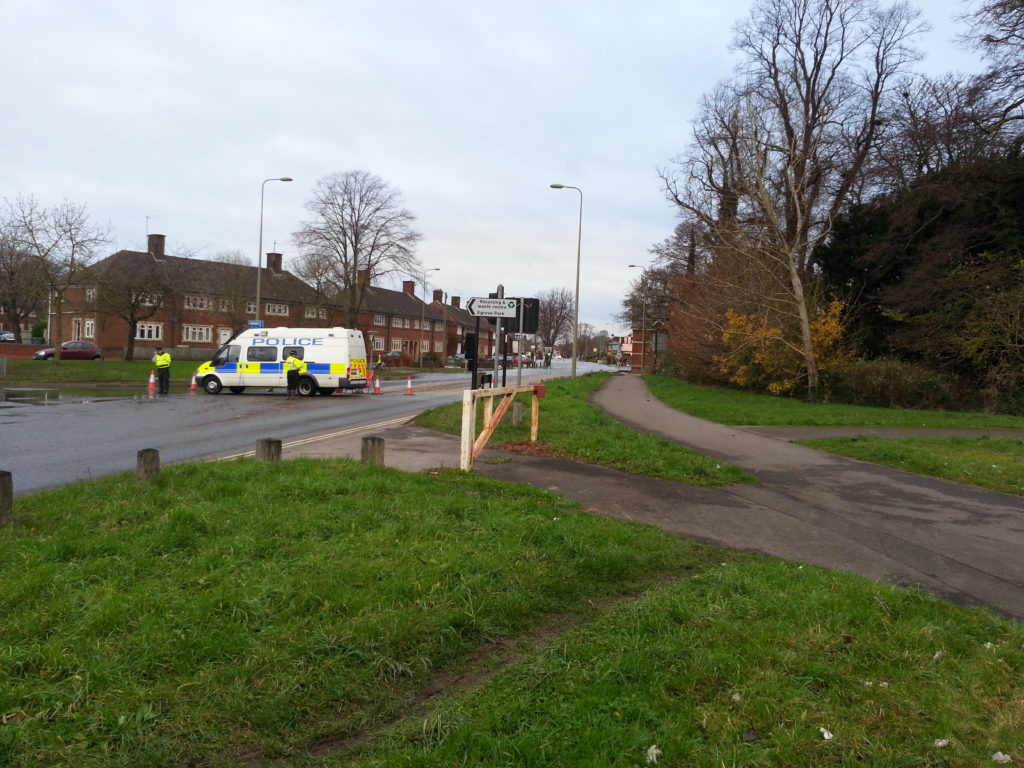
Police direct traffic away from a waterlogged Abingdon Road.
I had to weave my way back and forth around the cyclepaths nearest my house, and – on a couple of ocassions – get off the bike and wade it through: I’d considered riding through some of
the larger puddles – my mean pedal-ground clearance is about as high as the top of my boots, anyway – until I met a soaked cyclist coming the other way: he’d become disbalanced going
over a submarine kerbstone and fallen into the freezing water. Seeing that quickly made me choose the safer strategy!
Near Hinksey Lake, serious flood defences have been hastily erected and pumping operations are underway to clear gardens and footpaths.
Alongside the lake was one of the most flood-damaged areas, but heavy barriers had been erected and pumping engines were working at returning the water to the “right” side of them. The
lake bridge was completely closed off: it looked like it might be traversable, but if the water gets any higher, it won’t be.
In Hinksey Park, the playing fields and cycle path are completely underwater.
I took the cycle route through Hinksey Park in order to avoid the flooded parts of Abingdon Road, which runs parallel, but I’m not sure that it was much better. In the photo above,
you’d be forgiven for thinking that you’re looking at the lake… but in actual fact, the lake is behind me: that’s the playing fields. You can just about make out the line
down the middle of the cycle path, through the murky water.
Between Hinksey Lake and the Thames there are flooded driveways and gardens. The sign on the gate reads “No parking. Keep entrance clear at all times.”, in case anybody was thinking
of parking in this waist-deep water.
Pressing on, I came to the Thames Path, which my route typically follows for a short distance to the footbridge into the city centre. And that’s when I realised quite how high the river
really is.
To the right of the bush – the river. To the left – the footpath. You’d be forgiven if you can’t tell the difference.
By the time I found myself on a footpath with a current, I realised that my route might need a little bit of a rethink. With the bridge I was aiming for just ahead,
though, I was able to double-back and cut through an alleyway (between some seriously at-risk houses), duck under a couple of “footpath closed” barriers, and splash out to the
bridgehead.
From the bridge, it’s clear how much the waters have risen. The path on the left continues to get deeper and deeper underwater: when I’m working in a different office or running
training, that’s the route I take to work!
By the time I was on the higher, better-reinforced East bank for the river, things began to improve, and within a few minutes I was right in the city centre. There, you wouldn’t know
that, only a short distance away, a significant number of streets were underwater. To sit in the dry, on Broad Street, in the middle of Oxford, it seems strange to think that on the
edge of town, people are being evacuated from their homes.
Further reading:
Flood warning for Kennington, from the
Environment Agency (looks like we’re just on the right side of the road not to be included in the “flood warning area”).
“Live”upstreamanddownstreamwater level measurements at nearby Iffley Lock (there’s a beautiful moment in the graphs
for yesterday morning when they clearly started using the lock itself to “dump” water downstream, occasionally bringing the level to within the typical range.
What’s no joke, though, is the human population explosion. There’re just too damn many of us, as I explained last year. That’s the primary reason behind my decision, held for
pretty-much the entirety of my adult life, to choose not to breed.
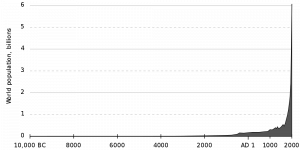
World population for the last 12,000 years.
I’m fully aware that the conscious decision to not-breed by a single individual – especially in the developed world – makes virtually no difference to the global fate of humanity. I’m
under no illusion that my
efforts as a vegetarian are saving the world either. But just like the voter who casts a ballot for their party – even though they know it won’t make a difference to the outcome of
the election – I understand that doing the right thing doesn’t necessarily have to have a directly quantifiable benefit.
Somehow, this delicious-looking BLT makes an appearance almost any time I talk about overpopulation or vegetarianism. This is the fifth time.
That’s why I’m finally taking the next obvious step. Next month, after literally years of talking about it, I’m finally going to put my genitals where my mouth is (hmm… maybe that
wasn’t the best choice of words)! Next week, I’m getting a vasectomy.
The “F” is for “Fuck me you’re going to put a scalpel WHERE?”
I first asked a doctor about the possibility of vasectomy about a decade ago. He remarked upon my age, and said – almost jokingly – “Come back in ten years if you still feel the same
way!” I almost wish that I still had the same GP now, so that I could do exactly that. Instead, I spoke about a year ago to my (old) GP here in Oxford, who misled me into thinking that
I would not be able to get the surgery on the NHS, and would have to have it done privately. Finally, a second doctor agreed to sign off their part of the consent form, and I was good
to go. The secret, it seems, is persistence.
I suppose I’ll be eligible for a Golden Snip Award. Click through for more information.
I’m sure that this is a decision that won’t be without it’s controversies. And believe me: over the course of the most-of-my-life-so-far that I’ve hinted at or talked about doing this,
I’m pretty sure I’ve heard all of the arguments. Still: I feel like I ought to pick up on some of the things I’ve heard most-often –
“Breeder Bingo” card. Complete a line, get a free case of contraceptives!
What if you change your mind?
Even despite medical advances in recent decades in vasectomy reversal, vasectomy should still be considered a “one way trip”. Especially when I was younger, people seemed concerned that
I would someday change my mind, and then regret my decision not to spawn children.
I suppose that it’s conceivable – unlike my otherwise potential offspring – but it’s quite a stretch, to believe that I might someday regret not having children (at least not
biologically: I have no problem with adopting, co-parenting, fostering, or any number of other options for being involved in the upbringing of kids). I honestly can’t see how that’d
come about. But even if we do take that far-fetched idea: isn’t it equally possible that somebody might ultimately regret having children. We take risks in our lives with
any choice that we make – maybe I’ll someday regret not having taken my degree in Law or Chemistry or Rural Studies. Well then: c’est la vie.
Do you just not like children?
Children are great, and I’d love to get the chance to be involved in raising some. However, I don’t define myself by that wish: if I never have the opportunity to look after any kids,
ever, then that wouldn’t be the worst thing in the world: I’d just spend my years writing code in a house full of cats. I have no doubt that raising children is great (for many people),
but just like there are plenty of people for whom it’s not great, there are also plenty of people – like me – who could be happy either way. No biggie!
There are those who have said that this laid-back “take it or leave it” approach, especially when coupled with the more-recent act of rendering myself infertile, will make me less
attractive to women. Leaving aside the implicit sexism in that claim, wouldn’t a fair retort be to point out that a woman who is looking for monogamous breeding probably isn’t
my “type” to begin with!
But if only we could make sure only the RIGHT people breed…
But you should be breeding?
This argument’s usually based on the idea that I’m somehow genetically superior and that my children wouldn’t be such a strain on the world as somebody else’s, or that
mine would have a significantly better-than-average chance of curing cancer, solving world hunger, or something.
Only sterilisation can prevent the detonation of the planet. Maybe.
And let’s face it, any child of mine would be just as likely to be the one to build a really big bomb. Or create a super-virus. Or just engineer the collapse the world’s economies into
a prehistoric barter economy in a technophobic future anarchy. Attaboy.
In any case, I’m pretty sure that my personal contribution to the betterment of the world ought not to be a genetic one. I’d like to make a difference for the people who are around
right now, rather than hypothetical people of the future, and I’d far rather leave ideas in my wake than a handful of genes. I’m sure that’s not the case for everybody, but then – it
doesn’t have to be.
It takes balls to have a vasectomy. Literally.
Or are there some arguments that I’ve missed? If you’re among the folks who feel really strongly about this, then you’ve got about seven days to make them, and then it’s off to the
clinic for me! Just remember: what’s right for me isn’t necessarily what’s right for you, and vice-versa. Just because I use Emacs doesn’t mean that some other, inferior text editor might not be the right choice for you.
I wonder what my surgeon might say to the possibility of me live-tweeting the process? Would anybody be interested? (I promise not to include any photos.)
(with thanks to Nina Paley for permission to use the comics)
You know how when your life is busy time seems to creep by so slowly… you look back and say “do you remember the time… oh, that was just last week!” Well that’s what my life’s been
like, of late.
Enjoying a beer at the launch of Milestone: Jethrik, the latest release of Three Rings.
There was Milestone: Jethrik and the Three Rings Conference, of course, which ate up a lot of my time but then paid off wonderfully –
the
conference was a wonderful success, and our announcements about formalising our non-profit nature and our
plans for the future were well-received by the delegates. A slightly lower-than-anticipated turnout (not least because of this winter ‘flu that’s going around) didn’t prevent
the delegates (who’d come from far and wide: Samaritans branches, Nightlines, and even a representative from a Community Library that uses the software) from saying wonderful things
about the event. We’re hoping for some great feedback to the satisfaction surveys we’ve just sent out, too.
The Three Rings Birthday Cake. It boggles my mind how they’ve managed to make the icing look so much like plastic, on the phone part.
Hot on the heels of those volunteering activities came my latest taped assessment for my counselling course at Aylesbury
College. Given the brief that I was “a volunteer counseller at a school, when the parent of a bullied child comes in, in tears”, I took part in an observed, recorded role-play
scenario, which now I’m tasked with dissecting and writing an essay about. Which isn’t so bad, except that the whole thing went really well, so I can’t take my usual
approach of picking holes in it and saying what I learned from it. Instead I’ll have to have a go at talking about what I did right and trying to apply elements of
counselling theory to justify the way I worked. That’ll be fun, too, but it does of course mean that the busy lifestyle isn’t quite over yet.
My sister Sarah, with TAS managing director Adrian Grant, prepare to announce the winner of the Peter Huntley Memorial Award for Making Buses A Better Choice.
And then on Tuesday I was a guest at the UK Bus Awards, an annual event which my dad co-pioneered back in the
mid-1990s. I’d been invited along by Transaid, the charity that my dad was supporting with his planned expedition to the North Pole before he was killed during an accident while training. I was there first and foremost
to receive (posthumously, on his behalf) the first Peter Huntley Fundraising Award, which will be given each year to the person who – through a physical activity – raises the most money
for Transaid. The award was first announced at my father’s funeral, by Gary Forster, the charity’s chief
executive. Before he worked for the charity he volunteered with them for some time, including a significant amount of work in sub-Saharan Africa, so he and I spent a little while at the
event discussing the quirks of the local cuisine, which I’d experienced some years earlier during my sponsored cycle around the country (with my dad).
So it’s all been “go, go, go,” again, and I apologise to those whose emails and texts I’ve neglected. Or maybe I haven’t neglected them so much as I think: after all – if you emailed me
last week, right now that feels like months ago.
Right now, Three Rings seems to be eating up virtually all of my time. It’s hardly the first time
– I complained about being incredibly busy
with Three Rings stuff just a couple of years ago, but somehow right now it’s busier than ever. There’s been the Milestone: Jethrik release, some complications with our uptime when our DNS servers
were hit by a DDoS attack, and – the big one – planning for this weekend’s conference.
Checking the timetable while I wait for inspiration to strike me about what to say about the “engagement” responsibilities of a Three Rings Administrator.
The Three Rings 10th Birthday Conference is this weekend, and I’ve somehow
volunteered myself to not only run the opening plenary but to run two presentations (one on the history of Three Rings, which I suppose I’m the best person to talk about, and one on
being an awesome Three Rings Administrator) and a problem-solving workshop. My mind’s been on overdrive for weeks, and I’m pretty sure I’m not even the one working the hardest (that
honour would have to go to poor JTA).
Still: all this work will pay off, I’m sure, and Saturday will be an event to remember. I’m looking forward to it… although right now I’d equally happily spend a week or two curled up
in bed under a blanket with a nice book and a mug of herbal tea, thanks.
In other news: Matt P‘s hanging out on Earth at the moment, (on his best behaviour I think) while Ruth, JTA and I decide if we’d like to live with him for a while. So far, I think he’s making a convincing argument. He’s proven
himself to be house trained (he hasn’t pooped on the carpet even once) and everything.
As web developers, we’re used to working around the bugs in Microsoft Internet Explorer. The older versions are worst, and I’m certainly glad to not have to write code that works in Internet
Explorer 6 (or, increasingly, Internet Explorer 7) any more: even Microsoft are glad to see Internet
Explorer 6 dying out, but even IE8 is pretty ropey too. And despite what Microsoft claim, I’m afraid IE9 isn’t really a “modern” browser either (although it is a huge step forwards over its predecessors).
But imagine my surprise when I this week found what I suspect might be a previously undiscovered bug in Internet Explorer 8 and below. Surely they’ve all been found (and some of them
even fixed), but now? But no. It takes a very specific set of circumstances for the bug to manifest itself, but it’s not completely unbelievable – I ran into it by accident while
refactoring parts of Three Rings.
A completely useless Internet Explorer error message. Thanks, IE.
Here’s the crux of it: if you’re –
Using Internet Explorer 8 or lower, and
You’re on a HTTPS (secure) website, and
You’re downloding one of a specific set of file types: Bitmap files, for example, are a problem, but JPEG files aren’t (Content-Type: image/bmp), and
The web server indicates that the file you’re downloading should be treated as something to be “saved”, rather than something to be viewed in your browser
(Content-Disposition: attachment), and
The web server passes a particular header to ask that Internet Explorer does not cache a copy of the file (Cache-Control: no-cache),
Then you’ll see a dialog box like the one shown above. Switching any of the prerequisites in that list out makes the problem go away: even switching the header from a strict “no-cache”
to a more-permissive “private” makes all the difference.
I’ve set up a test environment where you can see this for yourself: HTTP version; HTTPS version. The source code of my experiment (PHP) is also available. Of course, if you try it in a functional, normal web browser, it’ll all work fine. But if
you’ve got access to a copy of Internet Explorer 8 on some old Windows XP box somewhere (IE8 is the last version of the browser made available for XP), then try it in that and see for
yourself what a strange error you get.