
Jeremy Keith posted his salary history last week. I absolutely agree with him that employers exploit the information gap created by opaque salary advertisement, and I think that our industry of software engineering is especially troublesome for this.
So I'm joining him (and others) in choosing to share my salary history. I've set up a new page for that purpose, but here's the summary of its initial state:
Understand
A few understandings and caveats:
- For most of my career I've described myself as a "Full-Stack Web Applications Developer", but I've worked outside of every one of those words and my job titles have often been more like "CMS Developer" or "Senior Engineer (Security)".
- My specialisms and "hot areas" are security engineering, web standards, performance, and accessibility.
- When I worked multiple roles in a year, I've tried to capture that, but there'll be some fuzziness around the edges.
- The salaries are rounded slightly to make nice readable numbers.
- I've not always worked full-time; all salaries are translated into "full-time equivalent"1.
- I've only included jobs that fit into my software engineering career2.
- If the table below looks out-of-date then I've probably just forgotten to update it. Let me know!
History
| Year | Employer | Salary | Notes |
|---|---|---|---|
| 2025 - 2026 | Firstup | £80,000 | Remote. + Stock (spread over four years). |
| 2024 - 2025 | Automattic | £111,000 | Remote. + Stock (one-off bonus, worth ~£6,000). |
| 2023 | Automattic | £103,000 | Remote. |
| 2021 - 2022 | Automattic | £98,000 | Remote |
| 2019 - 2020 | Automattic | £89,000 | Remote. |
| 2015 - 2019 | Bodleian Libraries + Freelance | £39,000 | Hybrid. |
| 2011 - 2014 | Bodleian Libraries | £36,000 | Practices salary transparency! ❤️ |
| 2010 - 2011 | SmartData + Freelance | £26,000 | Remote. |
| 2007 - 2009 | SmartData | £24,000 | |
| 2004 - 2006 | SmartData | £19,500 | |
| 2002 - 2003 | SmartData | £16,500 | Alongside full-time study. |
| 2002 | CTA | £18,000 | |
| 2001 | Freelance | £4,500 |
Ad-hoc and hard to estimate.
Alongside full-time study. |
What does that look like?
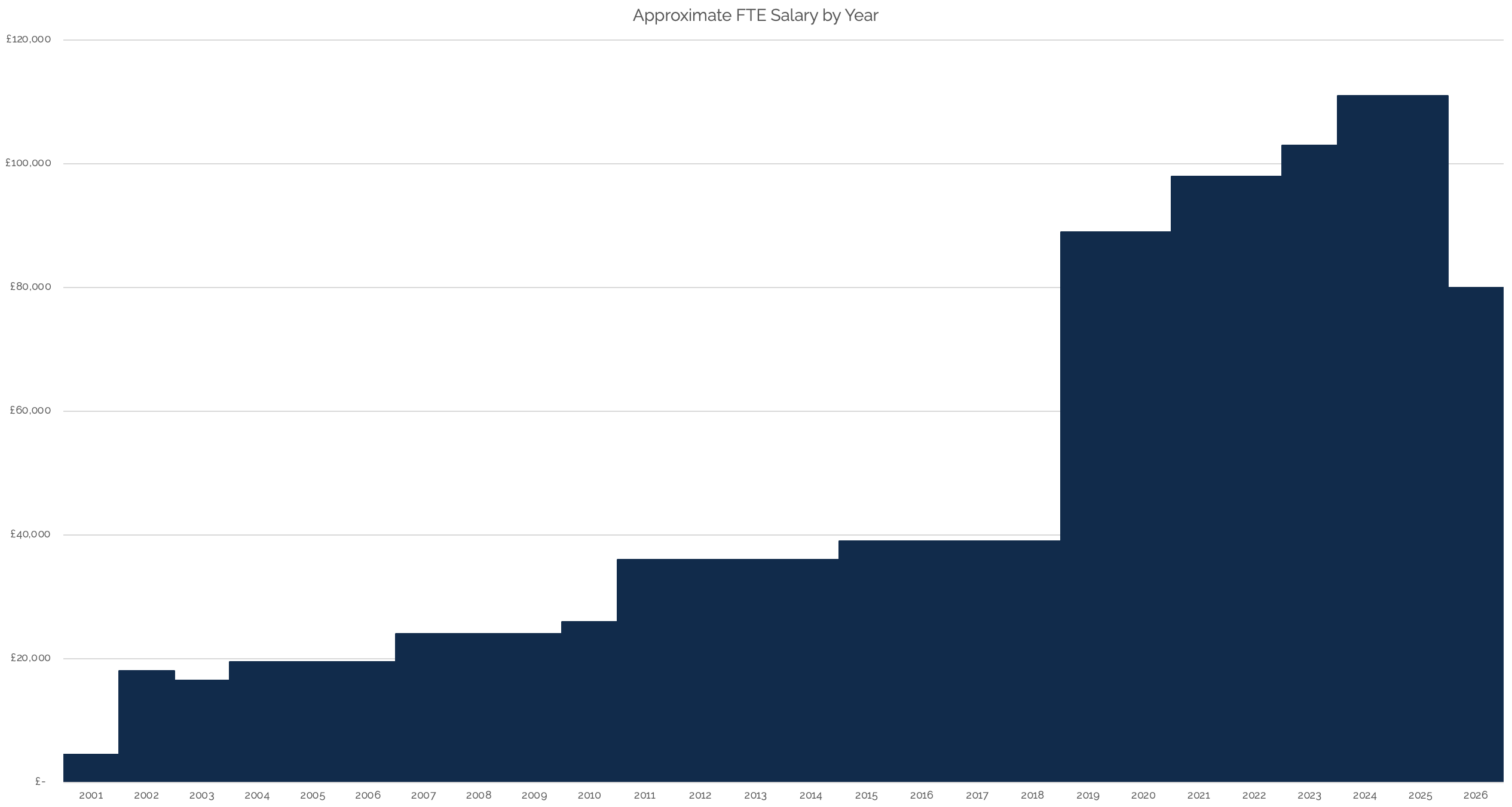
I drew a graph, but I don't like it. Mostly because I don't see my salary as a "goal" to aim for or some kind of "score".
It's gone up; it's gone down; but I've always been more-motivated by what I'm working on, with whom, and for what purpose than I have been on how much I get paid for it3. But if you want to see:
Alt
Graph showing my salary history: the same data as is in the table above.
I'm not sure to what degree my career looks typical or not. But I guess I also don't care! My motivations are probably different than most (a little-more idealistic, a little-less capitalistic), I'd guess.
Footnotes
1 i.e. what I'd have earned if I had worked full-time
2 That summer back in college that I worked in a factory building striplight fittings doesn't appear, for example!
3 Pro-tip if you're looking at my CV and pitching me an opportunity: mention what you expect to pay, sure, but if you're trying to win me over then tell me about the problems I'll be solving and how that'll make the world a better place. That's how you motivate me to accept your offer!
Thank you very much for doing that!