There are two stories here. The first is a story about a vision of the web’s future that never quite came to fruition. The second is a story about how a collaborative effort to
improve a popular standard devolved into one of the most contentious forks in the history of open-source software development.
In the late 1990s, in the go-go years between Netscape’s IPO and the Dot-com crash, everyone could see that the web was going to be an even bigger deal than it already was, even if
they didn’t know exactly how it was going to get there. One theory was that the web was about to be revolutionized by syndication. The web, originally built to enable a simple
transaction between two parties—a client fetching a document from a single host server—would be broken open by new standards that could be used to repackage and redistribute entire
websites through a variety of channels. Kevin Werbach, writing for Release 1.0, a newsletter influential among investors in the 1990s, predicted that syndication “would
evolve into the core model for the Internet economy, allowing businesses and individuals to retain control over their online personae while enjoying the benefits of massive scale and
scope.”1 He invited his readers to imagine a future in
which fencing aficionados, rather than going directly to an “online sporting goods site” or “fencing equipment retailer,” could buy a new épée directly through e-commerce widgets
embedded into their favorite website about fencing.2
Just like in the television world, where big networks syndicate their shows to smaller local stations, syndication on the web would allow businesses and publications to reach
consumers through a multitude of intermediary sites. This would mean, as a corollary, that consumers would gain significant control over where and how they interacted with any given
business or publication on the web.
RSS was one of the standards that promised to deliver this syndicated future. To Werbach, RSS was “the leading example of a lightweight syndication protocol.”3 Another contemporaneous article called RSS the first
protocol to realize the potential of XML.4 It was
going to be a way for both users and content aggregators to create their own customized channels out of everything the web had to offer. And yet, two decades later, RSS appears to be a dying technology, now used chiefly by podcasters and programmers with tech blogs.
Moreover, among that latter group, RSS is perhaps used as much for its political symbolism as its actual utility. Though of course some people really do have RSS readers, stubbornly
adding an RSS feed to your blog, even in 2018, is a reactionary statement. That little tangerine bubble has become a wistful symbol of defiance against a centralized web increasingly
controlled by a handful of corporations, a web that hardly resembles the syndicated web of Werbach’s imagining.
The future once looked so bright for RSS. What happened? Was its downfall inevitable, or was it precipitated by the bitter infighting that thwarted the development of a single RSS
standard?
…
I’ve always been a huge fan of RSS, and I use it for just about everything (I’ll even hack-it-in to services that don’t supply it natively, just to make them fit around my workflow). But even I’ve got to admit that – outside
of podcasts – it’s not done well at retaining mainstream appeal, especially after the death of Google Reader. Right now, most
people seem content to get their updates from their social media circles, and take a manual approach (ugh) to reading content in the few other places that matter to them. That’s
problematic for all kinds of reasons, and I’m perfectly happy to be one of those old fuddy-duddies who likes his web standards open and independent!
Malmaison Oxford, Oxford Castle, 3 New Rd, Oxford OX1 1AY, United Kingdom.
Rating: ⭐⭐⭐⭐
Delightful, although expensive, hotel. Theming is spot-on: you can really see the architecture that once made this place a prison, while simultaneously chilling out in a level of luxury
that would have been completely unknown to its original inhabitants. Excellent service and good amenities – you could lock me up here any day… if the prices didn’t send me to the
gallows first!
Islip Village Shop, Church Ln, Islip, Kidlington OX5 2TA, United Kingdom.
Rating: ⭐⭐⭐⭐⭐
Remarkably good prices and friendly staff. Often a selection of local produce as well as a wide variety of the usual convenience store essentials. Plenty of space to park cars and
bikes, but equally accessible by foot.
A11Y Nutrition Cards is an attempt to digest and simplify the accessibility expectations when it comes to component authoring. Based on the WAI ARIA Authoring Practices Guide.
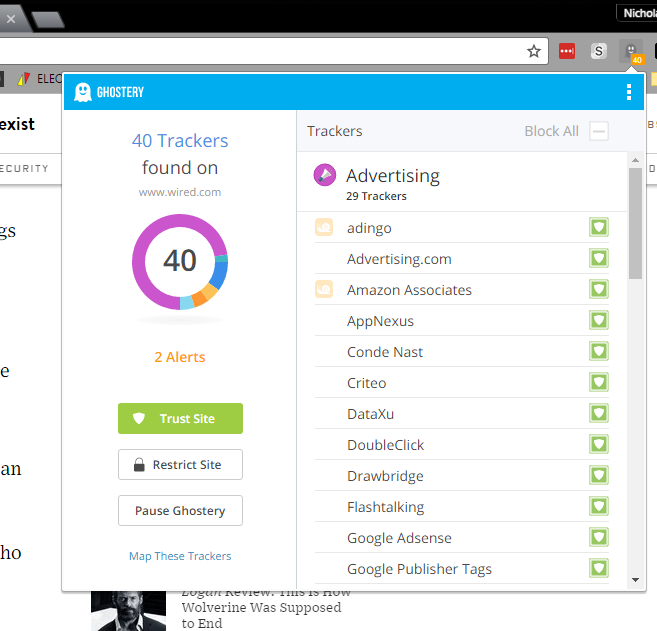
I’ve been, in the past, a firm distruster of ad blocking software. I still am, to a large extent. I don’t trust any company whose finance model is based on inserting exceptions for
advertisers they like. But I installed Ghostery, whose model is to use the stats of what gets blocked to offer consultancy to companies to make their adverts less horrific. I like
this idea, so I support it. My Ghostery install is fairly open, blocking only sites that offer page-takeover, popups, autoplaying videos, and other stuff that annoys me a lot. So I
get a bit annoyed when I’m scrolling through a Wired article and get something
like this:
Fine. I don’t disagree with the sentiment, but I don’t read Wired often enough to care about being a member, so yeah, ad supported isn’t unreasonable. Do you know what’s unreasonable,
Wired? This is what happens when I whitelist your site:
…
I’ve gone full-nuclear these last few years and I just keep Javascript disabled for most domains, most of the time (I’m using uMatrix).
The Web is a lot faster, for it, and I can just enable it for domains that “need” it as-and-when. I also keep a userscript to-hand that I can tweak as-and-when to block
anti-ad-blocker scripts, so that enabling Javascript on your domain (but not the domains of your dozen trackers/advertisers) doesn’t mean that I see your anti-ad-blocker popups either.
If your site nags gently (e.g. by mentioning where ads would be that they’re blocked, perhaps with a sad face emoticon) I’ll consider adding the ads, if your site has
value. But more likely, if your site’s good, I’ll be looking for the donate link. You can make more money out of me with donations than you ever would be showing me ads: I’m more than
happy to pay for the Web… I’m not happy to have 75% of the work my computer does when I’m reading your content be about your advertising partners tracking me nor about trying
to “block” me from seeing your content.
The full article helps show how bad the Web’s gotten. When it starts to get better again,
perhaps I’ll stop blocking ads and trackers so aggressively.
JavaScript is like salt. If you add just enough salt to a dish, it’ll help make the flavour awesome. Add too much though, and you’ll completely ruin it.
Similarly, if you add just enough JavaScript to your website, it’ll help make it awesome. Add too much though, and you’ll completely ruin it.
From now on, when I try to engage junior programmers with the notion that they should make use of their general-purpose computers to answer questions for them… no matter how silly the
question?… I’ll show them this video. It’s a moderately-concise explanation of the thought processes and programming practice involved in solving a simple, theoretical problem, and it
does a great job at it.
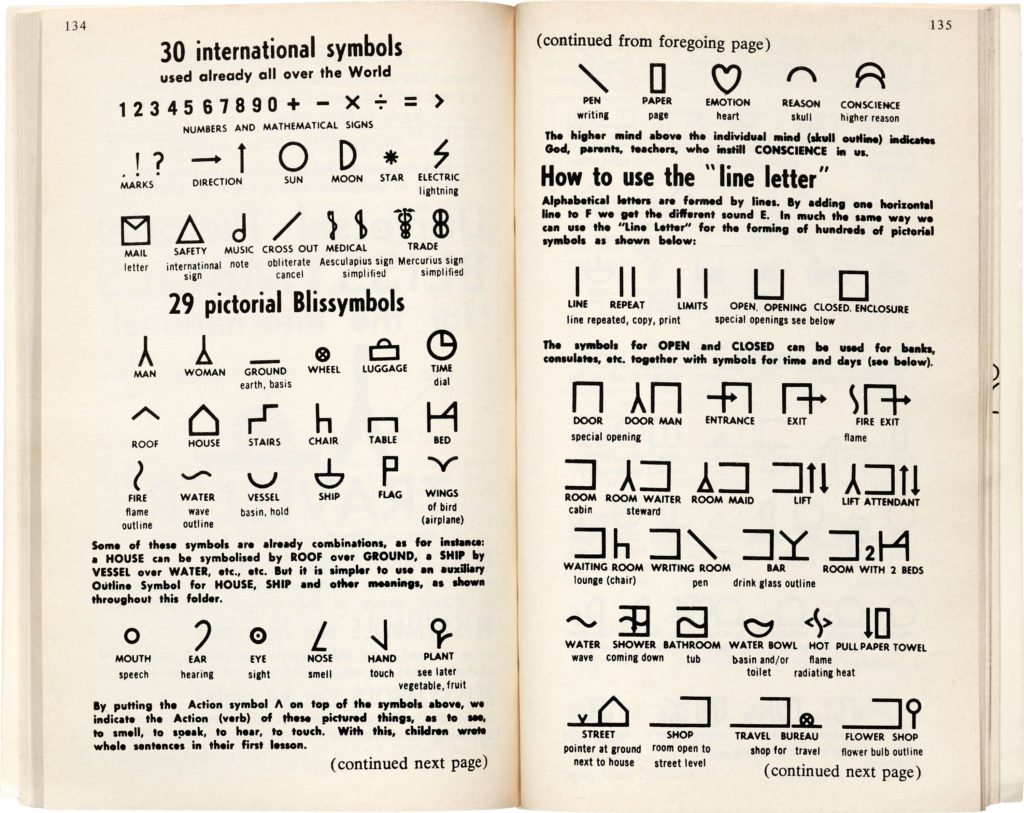
Blissymbolics was conceived by Austro-Hungarian expatriate Charles K. Bliss (1897–1985), born Karl Kasiel Blitz to a Jewish family in the town of Czernowitz (now Chernivtsi in
modern-day Ukraine). He was introduced to signs and symbols at an early age in the form of circuit diagrams – his father’s many occupations included mechanic and electrician – which
he understood immediately as a “logical language”. Bliss (then Blitz) attended the Vienna University of Technology for chemical engineering and went on to become chief of the patent
department at the German TV and radio company Telefunken, a career that was cut short in early 1938 when the Third Reich annexed Austria.
Bliss was sent to Dachau concentration camp, and then to Buchenwald, before escaping to England in 1939. The eight-month German bombing offensive against Britain known as The Blitz
began only months later, prompting him to change his surname “from the war-like Blitz to the peaceful Bliss”, as he recalled in a taped interview. Bliss fled to Shanghai by way of Canada and Japan, where he was reunited with his wife. Claire, a
German Catholic, had used her connections to get Bliss out of Buchenwald, but her relatively privileged status was not enough to spare her a fraught journey to safety across Europe
and Asia. Even in Shanghai, the couple was forced into the Hongkew ghetto following the Japanese occupation.
Bliss became enraptured with written Chinese, which he mistook initially for ideograms. (Chinese characters are, in fact, logograms.) Nevertheless, certain Chinese characters have
pictographic qualities, and it was the symbol for “man”, that sparked Bliss’s epiphany. As he learned enough to read Chinese newspaper headlines and shop signage, he soon
realized that he was reading the symbols not in Chinese, but in his native German. At the age of 45, Bliss was inspired to develop a non-alphabetic writing system that could be
mastered in a short period of time and read by anyone regardless of their spoken language. This work remained the focus of his life, even after he and Claire emigrated to Australia in
1946 and despite the general apathy and indifference with which it was met.
…
Fascinating article about the little-known “language” of Blissymbolics: coming from a similar era and background to Esperanto,
Blissymbolics failed even more to gain widespread traction but encompasses some really interesting ideas (about graphic notation and design, about linguistic concepts, about
communication theory) that we can still learn from. Read the full article…
On a blog, I can write about blogging and whimsically toss in self-indulgent pictures of May’s budding azaleas.
I can end my career, right here, in a flash. I can rant about the perfidy and corruption of my local governing party, who I devoutly hope are
about to be turfed by the voters. I can discuss the difference between O(1) and O(log(N)), which can usually be safely ignored.
On blogs, I can read most of the long-form writing that’s worth reading about the art and craft of programming computers. Or I can follow most of the economists’ debates that are
worth having. Or I can check out a new photographer every day and see new a way of seeing the world.
Having said that, it seems sad that most of the traffic these days goes to BigPubs. That the advertising dollars are being sucked inexorably into Facebook/Google and away from anyone else. That these days, I feel good over a piece that gets
more than twenty thousand reads (only one so far this year).
…
When I wrote about 20 years of blogging, this was the kind of thing I meant when I talked about why it’s important, to me. But Tim says
it better.
As of next week, I’ll have been blogging for 20 years, or about 54% of my life. How did that happen?
I’d been “blogging” – not that we called it that, yet – since late 1998, but my original collection of content-mangling Perl scripts wasn’t all that. More history…
The mid-1990s were a very different time for the World Wide Web (yes, we still called it that, and sometimes we even described its use as “surfing”). Going “on the Internet” was a
calculated and deliberate action requiring tying up your phone line, minutes of “connecting” along with all of the associated screeching sounds if you hadn’t
turned off your modem’s loudspeaker, and you’d typically be paying twice for the experience: both a monthly fee to your ISP for the service and a per-minute charge to your phone company for the call.
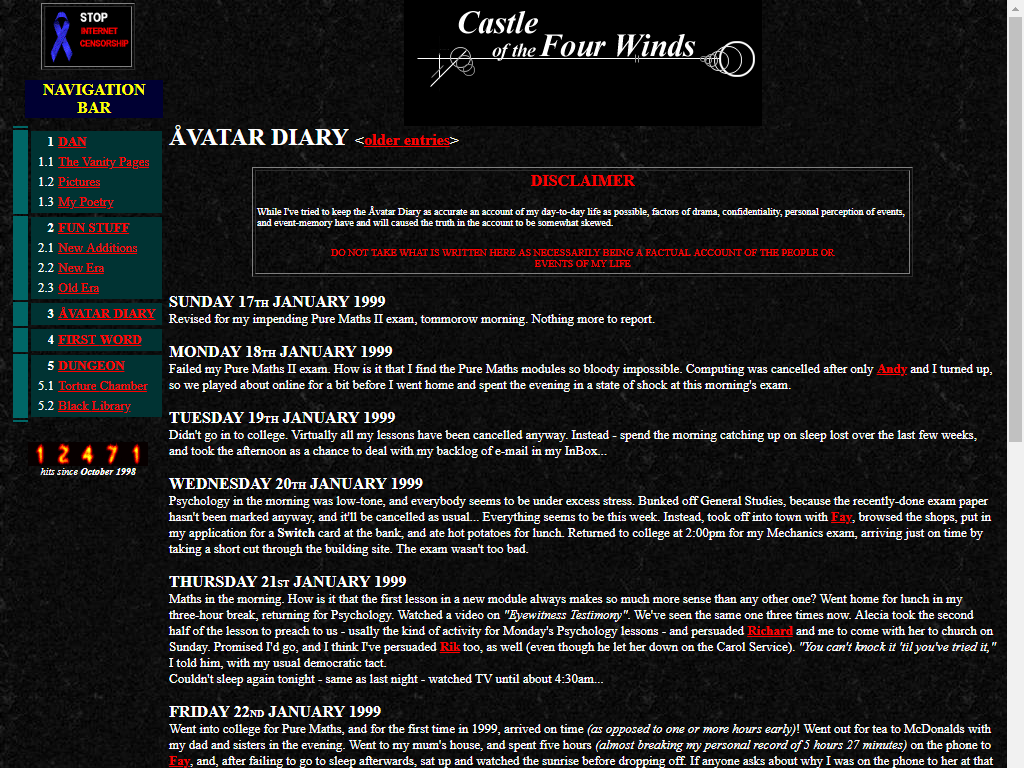
It was into this environment that in 1994 I published my first web pages: as far as I know, nothing remains of them now. It wasn’t until 1998 that I signed up an account with UserActive (whose website looks almost the same today as it did then) who offered economical subdomain hosting with shell and CGI support and launched “Castle of the Four Winds”, a set of vanity pages that
included my first blog.
Except I didn’t call it a “blog”, of course, because it wasn’t until the following year that Peter Merholz invented the word (he also commemorated 20 years of blogging, this year). I didn’t even call it a “weblog”, because
that word was still relatively new and I wasn’t hip enough to be around people who said it, yet. It was self-described as an “online diary”, a name which only served to
reinforce the notion that I was writing principally for myself. In fact, it wasn’t until mid-1999 that I discovered that it was being more-widely read than just by me and my
circle of friends when I attracted a stalker who travelled across the UK to try to “surprise” me by turning up at places she expected to
find me, based on what I’d written online… which was exactly as creepy as it sounds.
AvAngel.com
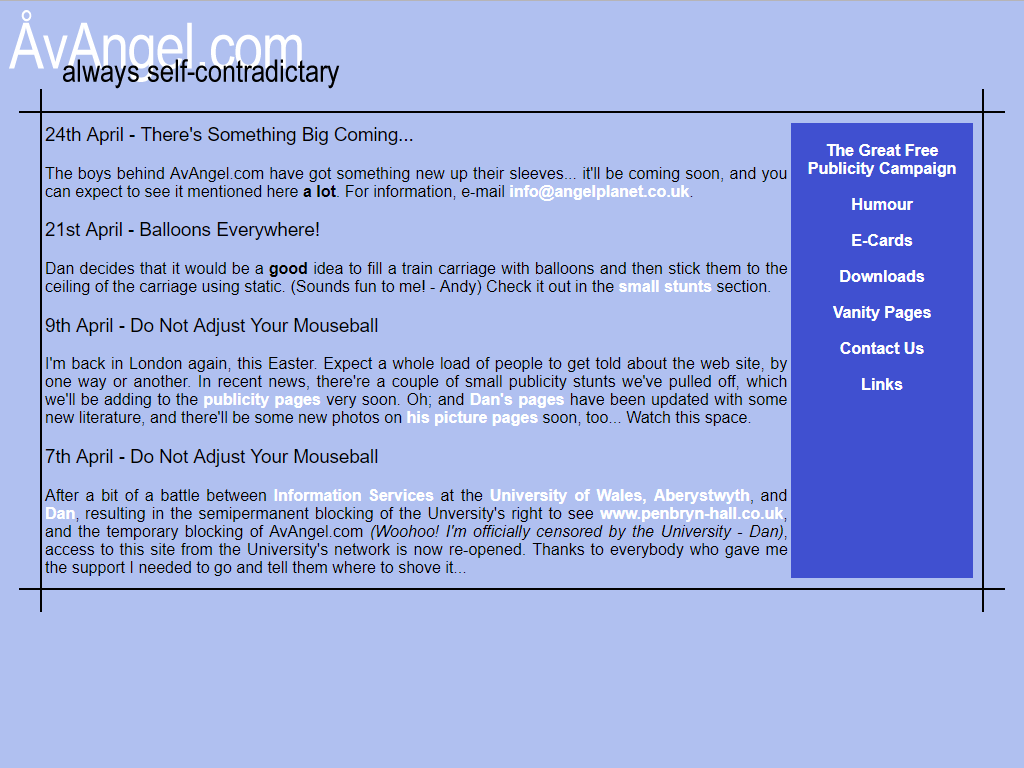
While the world began to panic that the coming millennium was going to break all of the computers, I migrated Castle of the Four Winds’ content into AvAngel.com, a joint vanity site
venture with my friend Andy. Aside from its additional content (purity tests, funny stuff, risqué e-cards), what we hosted was mostly the same old stuff, and I continued to write
snippets about my life in what was now quite-clearly a “blog-like” format, with the most-recent posts at the top and separate pages for content too old for the front page. Looking back,
there’s still a certain naivety to these posts which exemplify the youth of the Web. For example, posts routinely referenced my friends by their email
addresses, because spam was yet to become a big enough problem that people didn’t much mind if you put their email address on a public webpage somewhere, and because email
addresses still carried with them a feeling of anonymity that ceased to be the case when we started using them for important things.
Technologically-speaking, too, this was a simpler time. Neither Javascript nor CSS support was widespread (nor
consistently-standardised) enough to rely upon for anything other than the simplest progressive enhancement unless you were willing to “pick a side” in what we’d subsequently call the
first browser war and put one of those apalling “best viewed in Internet Explorer” or “best viewed in Netscape Navigator” banners on your site. I’ve always been a believer in a
universal web (and my primary browser at the time was Opera, anyway, as it mostly-remained until Opera went wrong in 2013), and I didn’t have the energy to write everything twice, so our cool/dynamic
functionality came mostly from back-end (e.g. Perl, PHP) technologies.
Meanwhile, during my initial months as a student in Aberystwyth, I wrote a series of emails to friends back home entitled “Cool And Interesting Thing Of The Day To Do At The University
Of Wales, Aberystwyth”, and put copies of each onto my student webspace; I’ve since recovered these and integrated them into my unified blog.
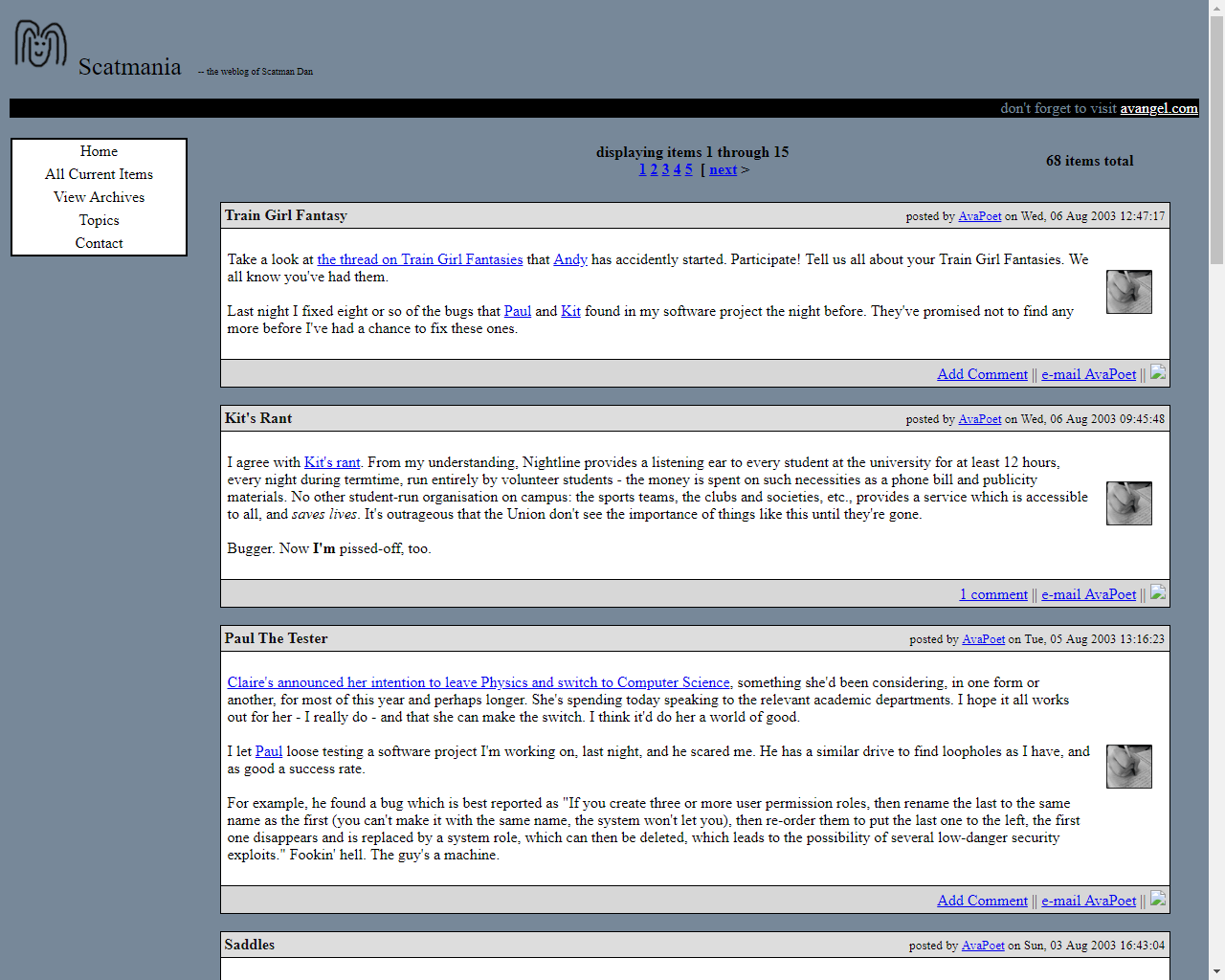
Scatmania.org
In 2002 I’d bought the domain name scatmania.org – a reference to my university halls of residence nickname “Scatman Dan”; I genuinely didn’t consider the possibility that the name
might be considered scatalogical until later on. As I wanted to continue my blogging at an address that felt like it was solely mine (AvAngel.com having been originally shared with a
friend, although in practice over time it became associated only with me), this seemed like a good domain upon which to relaunch. And so, in
mid-2003 and powered by a short-lived and ill-fated blogging engine called Flip I did exactly that. WordPress, to which I’d subsequently migrate, hadn’t been invented yet and it wasn’t clear whether its predecessor,
b2/cafelog, would survive the troubles its author was experiencing.
From this point on, any web address for any post made to my blog still works to this day, despite multiple technological and infrastructural changes to my blog (and
some domain name shenanigans!) in the meantime. I’d come to be a big believer in the mantra that cool URIs don’t change: something that as far as possible I’ve committed to trying to upload in my blogging, my archiving, and my paid work since
then. I’m moderately confident that all extant links on the web that point to earlier posts are all under my control so they can (and in most cases have) been fixed
already, so I’m pretty close to having all my permalink URIs be “cool”, for now. You might hit a short chain of redirects,
but you’ll get to where you’re going.
And everything was fine, until one day in 2004 when it wasn’t. The server hosting scatmania.org died in a very bad way, and because
my backup strategy was woefully inadequate, I lost a lot of content. I’ve recovered quite a lot of it and put it back in-place, but some is probably gone forever.
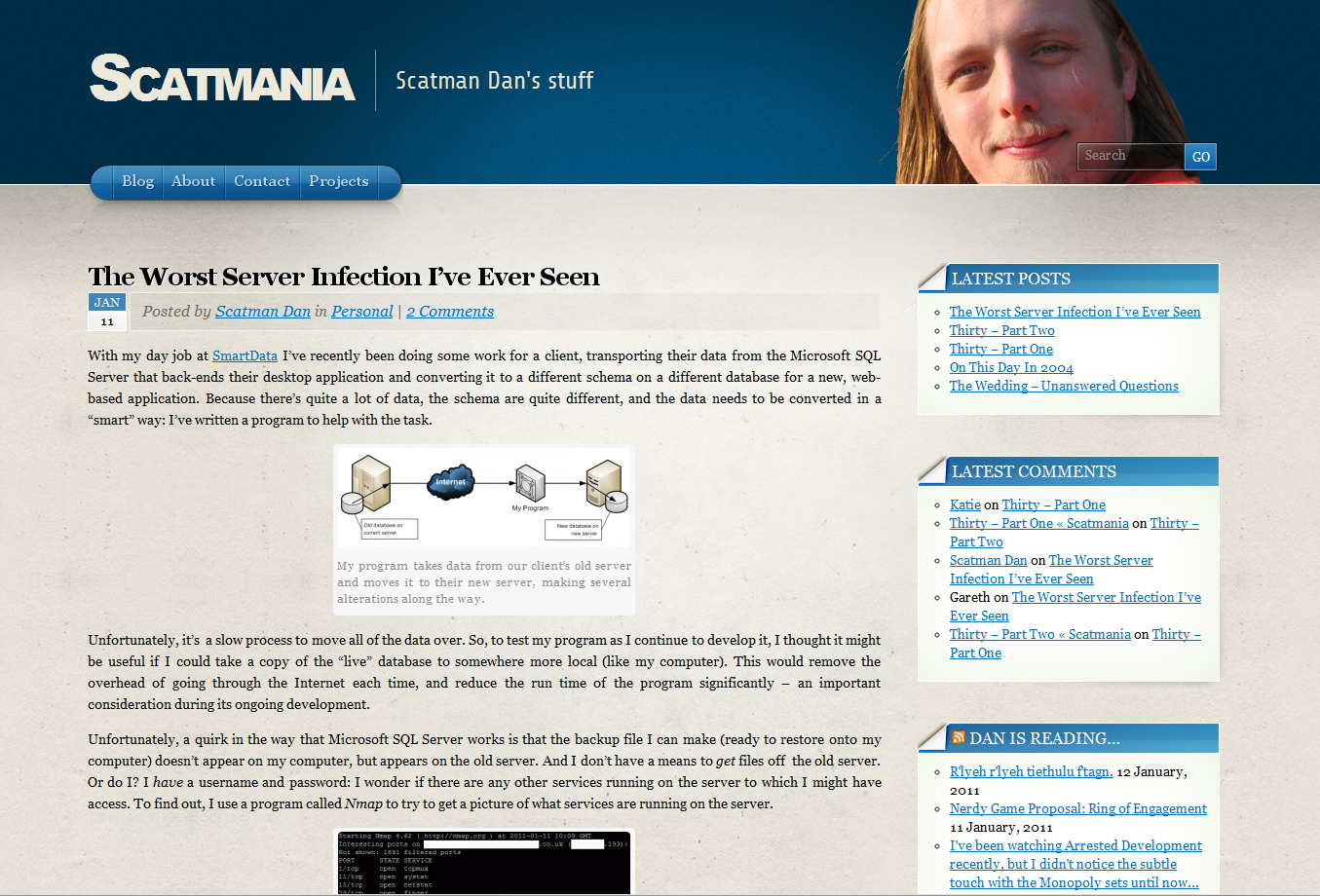
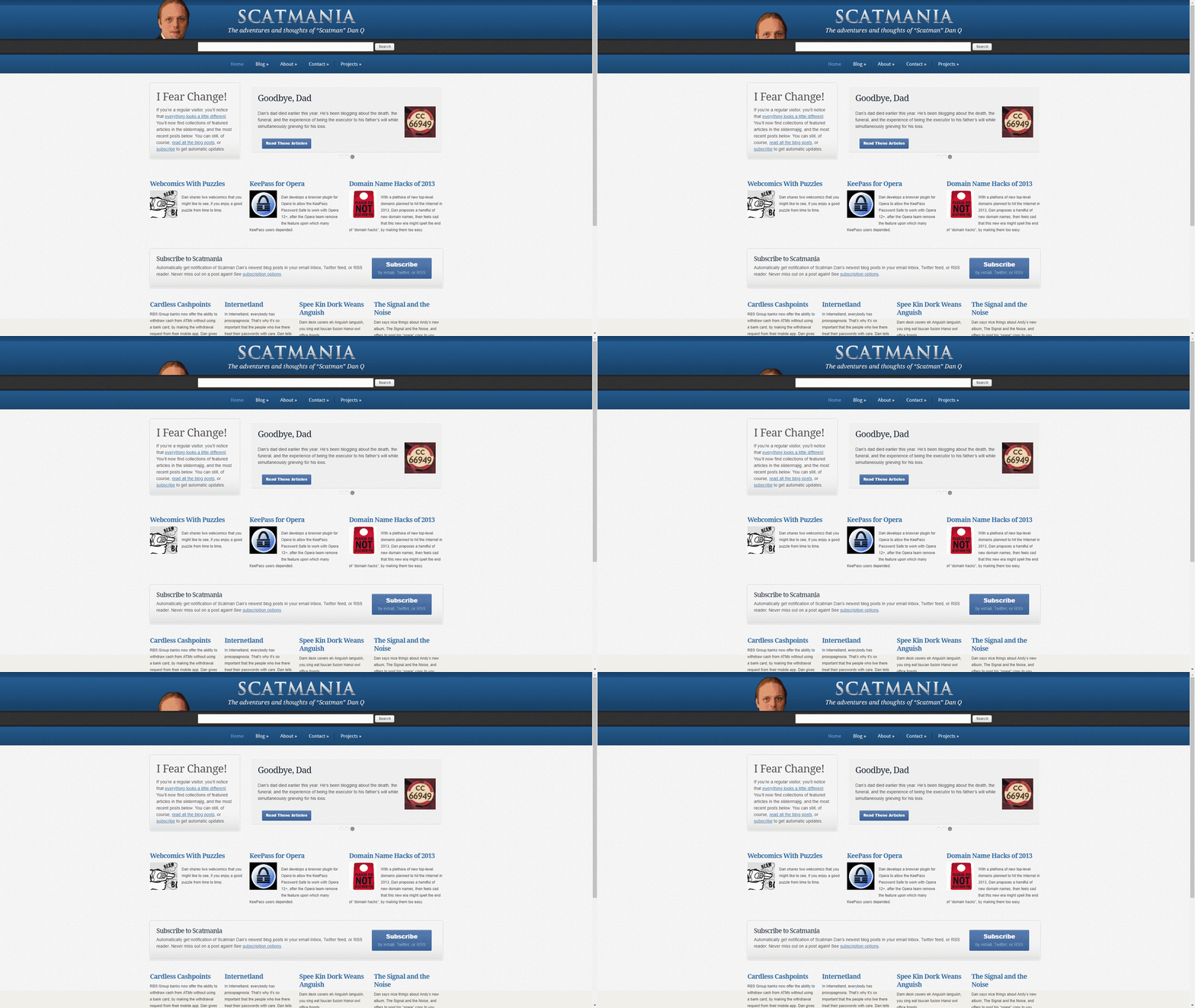
One of the longest-lived web designs for scatmania.org paid homage to the original, but with more “blue” and a WordPress backing.
The resurrected site was powered by WordPress, and this was the first time that live database queries had been used to power my blog. Occasionally,
these days, when talking to younger, cooler developers, I’m tempted to follow the hip trend of reimplementing my blog as a static site, compiling a stack of host-anywhere HTML files based upon whatever-structure-I-like at the “backend”… but then I remember that I basically did that already for six
years and I’m far happier with my web presence today. I’ve nothing against static site systems (I’m quite partial to Middleman, myself,
although I’m also fond of Hugo) but they’re not right for this site, right now.
IndieAuth hadn’t been invented yet, but I was quite keen on the ideals of OpenID (I still am, really), and
so I implemented what was probably the first viable “install-anywhere” implementation of OpenID for WordPress – you can see part of it
functioning in the top-right of the screenshot above, where my (copious, at that time) LiveJournal-using friends were encouraged to sign in to my blog using their LiveJournal identity.
Nowadays, the majority of the WordPress plugins I use are ones I’ve written myself: my blog is powered by a CMS that’s more
“mine” than not!
I no longer have the images that made my 2006 redesign look even remotely attractive, so here it is mocked-up with block colours instead.
Over the course of the first decade of my blogging, a few trends had become apparent in my technical choices. For example:
I’ve always self-hosted my blog, rather than relying on a “blog as a service” or siloed social media platform like WordPress.com, Blogger, or LiveJournal.
I’ve preferred an approach of storing the “master” copy of my content on my own site and then (sometimes) syndicating it elsewhere: for
example, for the benefit of my friends who during their University years maintained a LiveJournal, for many years I had my blog cross-post to a LiveJournal account (and backfeed copies of comments back to my site).
I’ve favoured web standards that provided maximum interoperability (e.g. RSS with full content)
and longevity (serving HTML pages from permanent URLs, adding
“extra” functionality via progressive enhancement so as to ensure that content functioned e.g. without Javascript, with CSS
disabled or the specification evolved, etc.).
These were deliberate choices, but they didn’t require much consideration: growing up with a Web far less-sophisticated than today’s (e.g. truly stateless prior to the advent of
HTTP cookies) and seeing the chaos caused during the first browser war and the period of stagnation that followed, these choices seemed intuitive.
That body font is plain old Verdana, you know: I’ve always felt that it (plus full justification) was the right choice for this particular design, even though I regret other parts of
it (like the brightness!).
As you’d expect from a blog covering a period from somebody’s teen years through to their late thirties, there’ve been significant changes in the kinds of content I’ve posted (and the
tone with which I’ve done so) over the years, too. If you dip into 2003, for example, you’ll see the results of quiz memes and
unqualified daily minutiae alongside actual considered content. Go back
further, to early 1999, and it is (at best) meaningless wittering about the day-to-day life of a teenage student. It took until around
2009/2010 before I actually started focussing on writing content that specifically might be enjoyable for others to read (even where
that content was frankly silly) and only far more-recently-still that I’ve committed to the “mostly technical stuff, ocassional bits of ‘life’ stuff” focus that I have today.
I say “committed”, but of course I’m fully aware that whatever this blog is now, it’ll doubtless be something somewhat different if I’m still writing it in another two decades…
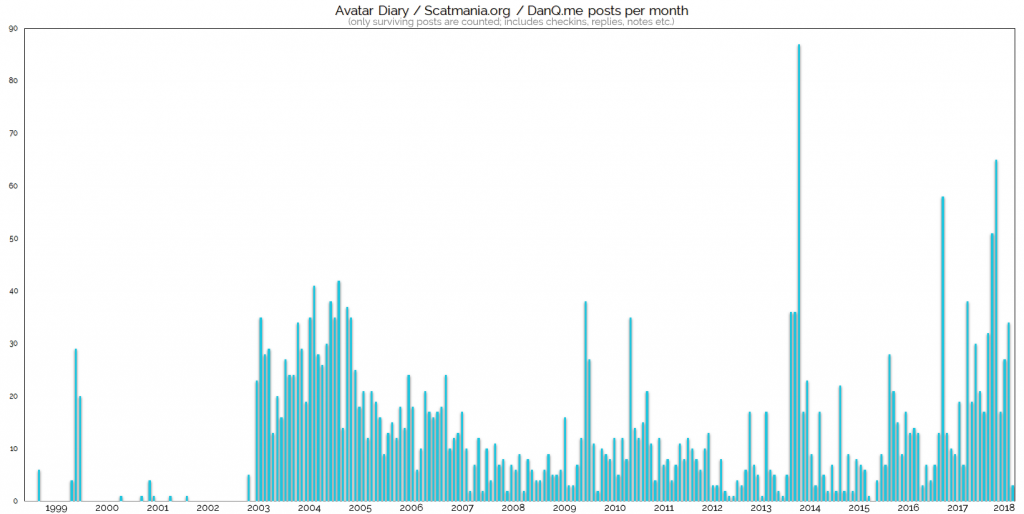
2014 may have included my most-prolific month of blogging, but 2003-2005 saw the most-consistent high-volume of content.
Once I reached the 2010s I started actually taking the time to think about the design of my blog and its meaning. Conceptually, all of my content is data-driven: database tables full of
different “kinds” of content and associated metadata, and that’s pretty-much ideal – it provides a strong separation between content and presentation and makes it possible to make
significant design changes with less work than might otherwise be expected. I’ve also always generally favoured a separation of concerns in web development and so I’m not a fan
of CSS design methodologies that encourage class names describing how things should appear, like Atomic CSS. Even where it results
in a performance hit, I’d far rather use CSS classes to describe what things are or represent. The single biggest
problem with this approach, to my mind, is that it violates the DRY principle… but that’s something that your CSS preprocessor’s there to fix for you, isn’t it?
But despite this philosophical outlook on the appropriate gap between content and presentation, it took until about 2010 before I actually attached any real significance to the
presentation at all! Until this point, I’d considered myself to have been more of a back-end than a front-end engineer, and felt that the most-important thing was to get the
content out there via an appropriate medium. After all, a site without content isn’t a site at all, but a site without design is (or at least should be) still intelligible
thanks to browser defaults! Remember, again, that I started web development at a time when stylesheets didn’t exist at all.
My previous implementations of my blog design had used simple designs, often adapted from open-source templates, in an effort to get them deployed as quickly as possible and move on to
the next task, but now, I felt, it was time to do a little more.
My 2010 relaunch put far more focus on the graphical design elements of my blog as well as providing a fully responsive design based on (then-new) CSS media queries. Alongside my
focus on separation of concerns in web development, I’m also quite opinionated on the idea that a responsive design has almost always been a superior solution to having a separate
“mobile site”.
For a few years, I was producing a new theme once per year. I experimented with different colours, fonts, and layouts, and decided (after some ad-hoc A/B testing) that my audience was
better-served by a “front” page than by being dropped directly into my blog archives as had previously been the case. Highlighting the latest few – and especially the very-latest – post
and other recent content increased the number of posts that a visitor would be likely to engage with in a single visit. I’ve always presumed that the reason for this is that regular
(but non-subscribing) readers are more-likely to be able to work out what they have and haven’t read already from summary text than from trying to decipher an entire post: possibly
because my blogging had (has!) become rather verbose.
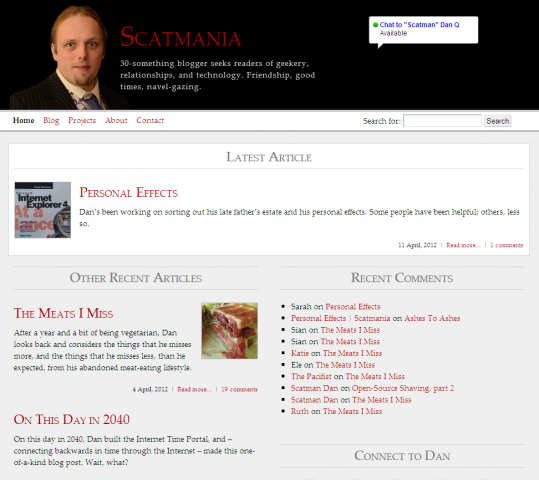
My 2011 design, in hindsight, said more about my mood and state-of-mind at the time than it did about artistic choices: what’s with all the black backgrounds and seriffed fonts? Is
this a funeral parlour?
I went through a bit of a lull in blogging: I’ve joked that I spent more time on my 2010 and 2011 designs than I did on the sum total of the content that was published in between the
pair of them (which isn’t true… at least, not quite!). In the month I left Aberystwyth for Oxford, for example, I was doing all kinds of exciting and new things…
and yet I only wrote a total of two blog posts.
With RSS waning in popularity – which I can’t understand: RSS is amazing! – I began to crosspost to
social networks like Twitter and Google+ (although no longer to Google+, following the news of its imminent demise) to help those readers who prefer to get their content via these
media, but because I wasn’t producing much content, it probably didn’t make a significant difference anyway: the chance of a regular reader “missing” something must have been remarkably
slim.
The 2012 design featured “CSS peekaboo”: a transformation that caused my head to “hide” from you behind the search bar if your cursor got too close. Ruth, I hear, spent far too long playing with just this feature.
Nobody calls me “Scatman Dan” any more, and hadn’t for a long, long time. Given that my name is already awesome and unique
all by itself (having changed to be so during the era in which scatmania.org was my primary personal domain name), it felt like I had the opportunity to rebrand.
I moved my blog to a new domain, DanQ.me (which is nice and short, too) and came up with a new collection of colours, fonts, and layout choices that I felt better-reflected my identity…
and the fact that my blog was becoming less a place to record the mundane details of my daily life and more a place where I talk about (principally-web)
technology, security, and GPS games… and just occasionally about other topics like breadmaking and books. Also, it gave me a chance to get on top of the current trend in web design for big, clean, empty spaces, square corners, and using pictures
as the hook to a story.
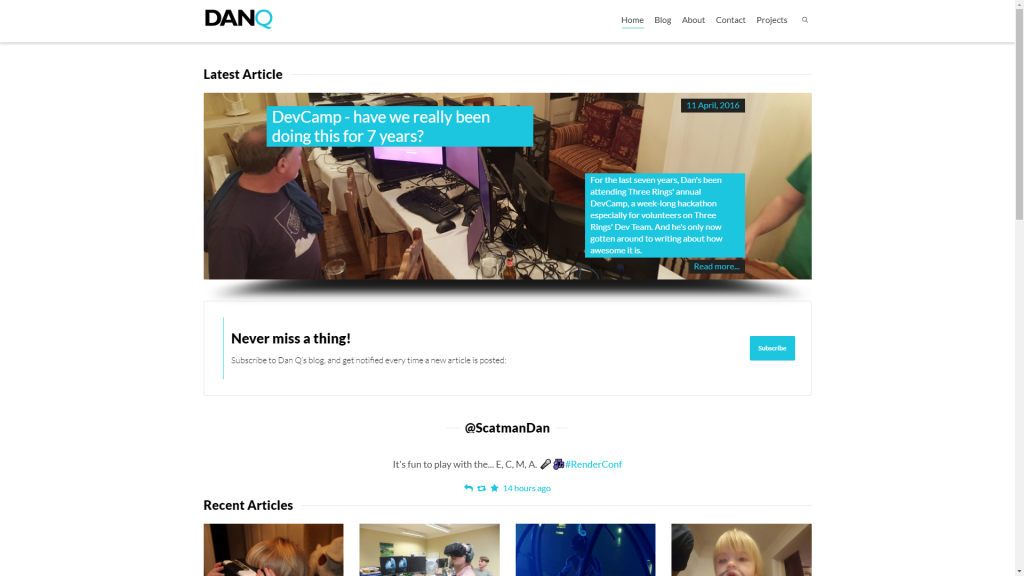
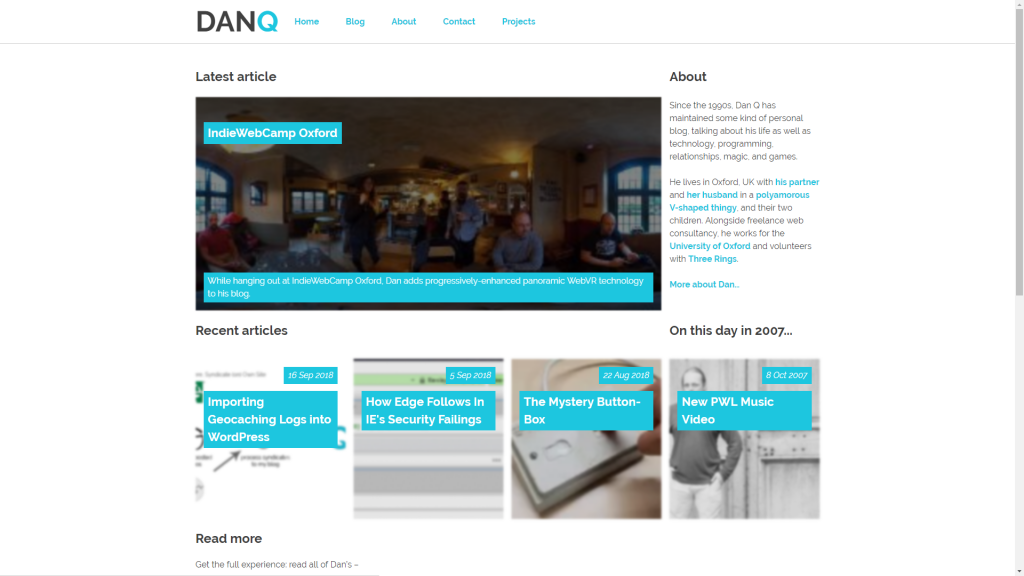
The second design of my blog after moving to DanQ.me showed-off posts with big pictures, framed by lots of white-space.
I’ve been working harder this last year or two to re-integrate (in a PESOS-like way) into my blog content that I’ve published elsewhere, mostly geocaching logs and
geohashing expedition records, and I’ve also done so retroactively, so in addition to my first blog article on the subject
of geocaching, you can read my first ever cache log without switching to a different site nor relying upon the
continued existence and accessibility of that site. I’ve been working at being increasingly mindful of where my content is siloed outside of my control and reclaiming it by hosting it
here, on my blog.
Particular areas in which I produce content elsewhere but would like to at-least maintain a copy here, and would ideally publish here first and syndicate elsewhere, although I
appreciate that this is difficult, are:
Reddit, where I’ve written tens of thousands of words under a variety of accounts, but I don’t really pay attention to the site any more
I left Facebook in 2011 but I still have a backup of what was on my “Wall” at that point, which I could look into reintegrating into my
blog
I share a lot of the source code I write via my GitHub account, but I’m painfully aware that this is yet-another-silo that I ought to learn
not to depend upon (and it ought to be simple enough to mirror my repos on my own site!)
I’ve got a reasonable number of videos on two YouTube channels which are online by Google’s good graces (and potential for advertising
revenue); for a handful of technical reasons they’re a bit of a pain to self-host, but perhaps my blog could act as a secondary source to my own video content
I write business reviews on Google Maps which I should probably look into recovering from the hivemind and hosting here… in fact, I’ve
probably written plenty of reviews on other sites, too, like Amazon for example…
On two previous occasions I’ve maintained an online photo gallery; I might someday resurrect the concept, at least for the photos that used to be published on them
I’ve dabbled on a handful of other, often weirder, social networks before like Scuttlebutt (which has a genius concept, by the way) and
Ello, and ought to check if there’s anything “original” on there I should reintegrate
Going way, way back, there are a good number of usenet postings I’ve made over the last twenty-something years that I could reclaim, if I can find them…
(if you’re asking why I’m inclined to do all of these things: here’s why)
This looks familiar.
20 years and around 717,000 words worth of blogging down, it’s interesting to look back and see how things have changed: in my life, on the Web, and in the world in general. I’ve seen
many friends’ blogs come and go: they move into a new phase of their life and don’t feel like what they wrote before reflects them today, most often, and so they delete them… which is
fine, of course: it’s their content! But for me it’s always felt wrong to do so, for two reasons: firstly, it feels false to do so given that once something’s been put on the Web, it
might well be online forever – you can’t put the genie back in the bottle! And secondly: for me, it’s valuable to own everything I wrote before. Even the cringeworthy things I
wrote as a teenager who thought they knew everything and the antagonistic stuff I wrote in my early 20s but that I clearly wouldn’t stand by today is part of my history, and
hiding that would be a disservice to myself.
The 17-year-old who wrote my first blog posts two decades ago this month fully expected that the things he wrote would be online forever, and I don’t intend to take that away from him.
I’m sure that when I write a post in October 2038 looking back on the next two decades, I’ll roll my eyes at myself today, too, but for me: that’s part of the joy of a
long-running personal blog. It’s like a diary, but with a sense of accountability. It’s a space on the web that’s “mine” into which I can dump pretty-much whatever I like.
I love it: I’ve been blogging for over half of my life, and if I can get back to you in 2031 and tell you that I’ve by-then been doing so for two-thirds of my life, that would be a win.
So, I am a professional system administrator. It says it on my business cards and everything. Every couple of months, when I have to explain to the receptionist at the London office
that yes, I do work here, and so
(My first hard drive for the Amiga 600 was second hand from my dad’s old laptop. It was SIXTY MEGABYTES. It held DOZENS of games. I would need over EIGHT HUNDRED of those drives to
hold a 50Gb World of Warcraft install).
…
I remember my first hard drive. It was 40Mb, and that felt flipping MASSIVE because I’d previously, like most people, been using floppy disks of no larger than 1.44Mb. My second hard
drive was 105Mb and it felt like a huge step-up; I ripped my first MP3s onto that drive, and didn’t care for a moment that they each consumed 2%-3% of the available space (and took
about 15 minutes each to encode).
Nowadays I look at my general-purpose home desktop’s 12TB RAID array and I think to myself… yeah, but it’s over half full… probably time to plan for the next upgrade. What happened‽
Somewhere along the line hard drive space became like mobile phone battery level became before it: something where you start to worry if you have less than half left. I don’t know how
we got here and I’m not sure I’m happy about it, but suffice to say: technology today is nuts.
@adactio: The ampersand in https://adactio.com/notes/14395 isn’t being properly escaped in your RSS feed, breaking the XML – see e.g.
https://validator.w3.org/feed/check.cgi?url=https%3A%2F%2Fadactio.com%2Frss
Why are testicles kept in a vulnerable dangling sac? It’s not why you think.
…
Some of you may be thinking that there is a simple answer: temperature. This arrangement evolved to keep them cool. I thought so, too, and assumed that a quick glimpse at the
scientific literature would reveal the biological reasons and I’d move on. But what I found was that the small band of scientists who have dedicated their professional time to
pondering the scrotum’s existence are starkly divided over this so-called cooling hypothesis.