I saw a heron this morning, and it reminded me of a police officer.
If you plot a pair of axes for birds ‘looking really dorky, especially when flying’ and ‘actually being really cool’, the grey heron would sit at the sweet spot.
Right now, while my house is… not-so-inhabitable… I have a long drive to drop the kids off at school, and this morning it took us alongside the
many flooded fields between our temporary accommodation and the various kid drop-offs.
Stopped at traffic lights, I watched a heron land in what would be best-described as a large puddle, rather than in the lake on the other side of the road. The lake, it turns out… was
“guarded” by one of those fake heron things.
I didn’t get a photo of the fake heron, but I can tell you that it was one of those tacky plastic ones, not a fancy-looking metal one like this.1 Photograph copyright Christine Matthews, used under a Creative Commons license.
You’ve seen them, probably. People put them up to discourage territorial birds from visiting and eating all their fish.2 If you haven’t seen them, you might have
at least spotted the fake owls, whose purpose is slightly different because they scare off other birds.
Anyway: I found myself thinking… do birds actually fall for this? Like scarecrows, it feels like they shouldn’t (and indeed, scarecrows don’t always work,
and birds can quickly become accustomed to them). But clearly they work at least a little…?
If you don’t want birds, get a pretend bird. The same trick works for girlfriends.
Anyway, I found myself reminded of a geocaching expedition I went on outside Cambridge a couple of years ago. At
around 6am I was creeping around outside a shopping centre on a Saturday morning, looking for a tiny magnetic geocache hidden behind a sign. I’d anticipated not having to use much
“stealth” so early in the day… but nonetheless I kept getting the feeling that I was being watched.
It took me a few minutes until I worked out why: the local Home Bargains had put up a life-size standee of a police officer in just the right position that I kept catching him in the
corner of my eye and second-guessing how much my digging-through-the-bushes looked incredibly suspicious!
Rationally, I knew that this fella wasn’t real3,
but that didn’t stop him from making my brain go “wait, is that copper watching me hide behind a sign in the empty car park of a budget variety store, like he thinks I’m the world’s
loneliest drug dealer?”
I did a double-take the first time I spotted the officer, but soon realised he was fake. But the feeling of being watched persisted! There’s clearly something deeper in human
psychology, more-instinctive, that – as social animals – gives us that feeling of being watched and influences our behaviour.
There’s a wonderful and much-cited piece of research from 2010 that describes how cooperative behaviour
like proper use of an honesty box increases if you put a picture of some eyes above it: the mechanism’s not fully understood, but it’s speculated that it’s because it induces
the feeling of being watched.
I found this picture of a fake angler (this is a mannequin with a fishing pole!), which I guess is also an anti-heron measure.4
Photograph copyright Andy Beecroft, used under a Creative
Commons license.
I reckon it’s similar with birds. They’re not stupid (some of them, like corvids, are famously smart… and probably many predator birds exhibit significant intelligence too), but if
there’s something in your peripheral vision that puts you at unease… then of course you’re not going to be comfortable! And if there’s another option nearby5
that’ll work, that’s an easy win for a hungry bird.
You don’t need to actually believe that a scarecrow, a plastic bird, a poster of some eyes, or a picture of a bobby is real in order for it to have a
psychological impact. That’s why – I believe – a fake heron works. And that’s why, today, a heron reminded me of a police officer.
Footnotes
1 I guess actual herons can’t tell the difference?
2 Presumably the same technique doesn’t work with sociable birds, who would probably turn
up to try to befriend or woo the models.
3 I don’t know, but I do wonder, whether the picture is actually of a police
officer or of a model. If I were a police officer and I knew that my likeness was being used at supermarkets and the like, I’d be first to volunteer to any call-outs to anywhere
nearby them, so any suspect who ran from me would keep spotting me, following them, at every corner. You get few opportunities for pranks as a copper, I reckon, but this one would be
a blast.
4 I wonder if a fake angler is more- or less-effective than a fake heron. Somewhere, an
animal psychology PhD student is working out the experimental conditions to answer this question, I hope.
5 Remember: a bird can have a birds-eye view of feeding spots! If one option’s gonna make
them feel like they’re being watched by a predator or a competitor, and another nearby option looks almost-as-good, they’re gonna take the alternative!
I’m not certain, but I think that I won my copy of Hello World: How to Be Human in the Age of the Machine at an Oxford Geek Nights event, after I was
first and fastest to correctly identify a photograph of Stanislav Petrov shown by the speaker.
Despite being written a few years before the popularisation of GenAI, the book’s remarkably prescient on the kinds of big data and opaque decision-making issues that are now hitting the
popular press. I suppose one might argue that these issues were always significant. (And by that point, one might observe that GenAI isn’t living up to its promises…)
Fry spins an engaging and well-articulated series of themed topics. If you didn’t already have a healthy concern about public money spending and policy planning being powered by the
output of proprietary algorithms, you’ll certainly finish the book that way.
One of my favourite of Fry’s (many) excellent observations is buried in a footnote in the conclusion, where she describes what she called the “magic test”:
There’s a trick you can use to spot the junk algorithms. I like to call it the Magic Test. Whenever you see a story about an algorithm, see if you can swap out any of the buzzwords,
like ‘machine learning’, ‘artificial intelligence’ and ‘neural network’, and swap in the word ‘magic’. Does everything still make grammatical sense? Is any of the meaning lost? If
not, I’d be worried that it’s all nonsense. Because I’m afraid – long into the foreseeable future – we’re not going to ‘solve world hunger with magic’ or ‘use magic to write the
perfect screenplay’ any more than we are with AI.
That’s a fantastic approach to spotting bullshit technical claims, and I’m totally going to be using it.
Anyway: this was a wonderful read and I only regret that it took me a few years to get around to it! But fortunately, it’s as relevant today as it was the day it was released.
The insurance loss adjusters came around this morning, accompanied by damage assessors and electricians and whatnot.
The process continues to feel painfully slow. We’re still one to two weeks from confirmation that the insurance company will accept liability and be ready to start paying for, y’know,
the immediate concerns like where we’re going to live.
“How long should we plan on renting another house to live in?” I asked, warily.
“Six to twelve months?” guessed the loss adjusters.
As I’ll demonstrate, it’s surprisingly easy to spin up your own VPN provider on a virtual machine hosted by your choice of the cloud providers. You pay for the hours you need
it2,
and then throw it away afterwards.
If you’d prefer to use GCP, AWS Azure, or whomever else you like: all you need is a Debian 13 VM with a public IP address (the cheapest one available is usually plenty!)
and this bash script.
If you prefer the command-line, Linode’s got an API. But we’re going for ‘easy’ today, so it’ll all be clicking buttons and things.
First, spin up a VM and run my script3.
If you’re using Linode, you can do this by going to my StackScript and clicking ‘Deploy New Linode’.
You might see more configuration options than this, but you can ignore them.
Choose any region you like (I’m putting this one in Paris!), select the cheapest “Shared CPU” option – Nanode 1GB – and enter a (strong!) root password, then click Create Linode.
It’ll take a few seconds to come up. Watch until it’s running.
Don’t like SCP? You can SSH in and ‘cat’ the configuration or whatever else you like.
My script automatically generates configuration for your local system. Once it’s up and running you can use the machine’s IP address to download wireguard.conf locally. For
example, if your machine has the IP address 172.239.9.151, you might type scp -o StrictHostKeyChecking=no root@172.239.9.151:wireguard.conf ./ – note that I
disable StrictHostKeyChecking so that my computer doesn’t cache the server’s SSH key (which feels a bit pointless for a “throwaway” VM that I’ll never connect to a second time!).
If you’re on Windows and don’t have SSH/SCP, install one. PuTTY remains a solid choice.
File doesn’t exist? Give it a minute and try again; maybe my script didn’t finish running yet! Still nothing? SSH into your new VM and inspect
stackscript.log for a complete log of all the output from my script to see what went wrong.
Not got WireGuard installed on your computer yet? Better fix that.
Open up WireGuard on your computer, click the “Import tunnel(s) from file” button, and give it the file you just downloaded.
You can optionally rename the new connection. Or just click “Activate” to connect to your VPN!
If you see the ‘data received’ and ‘data sent’ values changing, everything’s probably working properly!
You can test your Internet connection is being correctly routed by your VPN by going to e.g. icanhazip.com or ipleak.net: you should see the IP address of your new virtual machine and/or geolocation data that indicates that you’re in your selected region.
When you’re done with your VPN, just delete the virtual machine. Many providers use per-minute or even per-second fractional billing, so you can easily end up spending only a handful of
cents in order to use a VPN for a reasonable browsing session.
Again, you can script this from your command-line if you’re the kind of person who wants a dozen different locations/IPs in a single day. (I’m not going to ask why.)
When you’re done, just disconnect and – if you’re not going to use it again immediately – delete the virtual machine so you don’t have to pay for it for a minute longer than you
intend4.
I stopped actively paying for VPN subscriptions about a decade ago and, when I “need” the benefits of a VPN, I’ve just done things like what I’ve described above. Compared to a
commercial VPN subscription it’s cheap, (potentially even-more) private, doesn’t readily get “detected” as a VPN by the rare folks who try to detect such things, and I can enjoy my
choice of either reusable or throwaway IP addresses from wherever I like around the globe.
And if the government starts to try to age-gate commercial VPNs… well then that’s just one more thing going for my approach, isn’t it?
Footnotes
1 If you’re a heavy, “always-on” VPN user, you might still be best-served by one of the
big commercial providers, but if you’re “only” using a VPN for 18 hours a day or less then running your own on-demand is probably cheaper, and gives you some fascinating
benefits.
2 Many providers have coupons equivalent to hundreds of hours of free provision, so as
long as you’re willing to shuffle between cloud providers you can probably have a great and safe VPN completely for free; just sayin’.
3 Obviously, you shouldn’t just run code that strangers give you on the Internet unless
you understand it. I’ve tried to make my code self-explanatory and full of comments so you can understand what it does – or at least understand that it’s harmless! – but if you don’t
know and trust me personally, you should probably use this as an excuse to learn what you’re doing. In fact, you should do that anyway. Learning is fun.
4 Although even if you forget and it runs for an entire month before your billing cycle
comes up, you’re out, what… $5 USD? Plenty of commercial VPN providers would have charged you more than that!
It feels inconceivable to me that we’re only at F-Day plus three; that is, three days since a flash flood rushed through the ground floor of our house and forced us to
evacuate. We’ve been able to visit since and start assessing the damage, but for now I figured that what you’d want would be the kinds of horrible pictures that make you say “wow; I’m
glad that didn’t happen to me”.
These pictures are all from F-Day itself (which happened to be Friday the 13th; delightful, eh?):
A particularly horrifying moment was when the seals on the patio doors gave way and the dining room began to flood, and we had to pivot to laying sandbags to protect the kitchen from
the dining room rather than to protect the house as a whole. (Eventually, every ground floor room would be affected.)
The water came in so quickly! An hour earlier, a deliveryperson had to wade carefully through a puddle to reach our front door. But by this point, the entire ground floor was under a
foot of dirty water.
It’s heartbreaking to see a house that you love and cherish as it starts to look like a scene from Titanic.
Soon enough we had to pivot from trying to hold back the waters to trying to save what we could. By the time the water level reached the air bricks and vents, we were having to make
split-second choices about what we had time to save.
Not all of the books made it, but most of them did.
The fire brigade wisely had us switch off our electricity supply before the first row of sockets went underwater.
The dog was incredibly brave; retreating slowly up the stairs (while barking at the rising water!). But eventually she, too, required rescue.
In one of the few moment of levity, Ruth got to ‘play firefighter’ by carrying the poor pupper out of the building. By this point, the water depth was taller than the dog is.
We’ve had a few nights in Premier Inns, but it’s a new week and it’s time to hassle the insurance company to come and have a look around. And then, maybe, we can start working out where
we’ll live so the repair work can start.
This morning, from my Premier Inn window, the skies are clear. I could almost forget that, just 4 miles away, my house is full of water.
Today may well be a day of waders and damage assessment, conversations with insurance companies and of working out where we’ll be living for the near future.
But strangely, what’s thrown me first this morning was that I couldn’t make this post submit.
Turns out my crosspost-to-mastodon checkbox was checked. Because my Mastodon server… runs on my homelab. Which is currently unplugged and in one of the highest rooms of a house with no
electricity or Internet access. (Or, probably, running water… although that matters less to a homelab.)
I think I moved it before it got wet, but yesterday is such a blur that I just don’t know. I remember we spent some time fighting back the water with sandbags and barricades. I remember
the moments each room began to fail, one by one, and we started moving whatever we could carry to higher floors (max props to folks from Eynsham Fire Bridade for helping with the heavy
stuff). But if you ask me what order we rescued things in, I just don’t know.
I guess we’ll find out when the waters recede, and it’s safe to go check.
It’s February, which means that (here in the UK) it’s LGBT+ History Month.1
And it feels like this year, it’s more important than ever to remember our country’s queer history.
By the time Western European countries traditionally seen as ‘socially conservative’ like Ireland and Switzerland are outranking the UK in LGBT+ rights rankings… it’s a clue that
something’s gone wrong, right?
This stuff affects everybody. When you build a community that is a safe space for queer people, and trans
people,6 everybody benefits7. So even if you’re
somehow not compelled by the argument that we should treat everybody fairly and with compassion, you should at least accept that it helps you, too,
when we do.
In many ways, queer rights in the UK have been a success story in recent decades. Within my lifetime, we’ve seen the harmonisation of the age of consent (2001), civil partnerships
(2004), the Gender Recognition Act (2004), the Equality Act (2010), same-sex marriage (2013; I was genuinely surprised this bill passed!) and the mass-pardoning of people previously
convicted under discriminatory sex act laws (2017). These are enormous and important steps and it’s little wonder that the UK topped ILGA Europe’s scoreboard for a while there.
But as recent developments have shown: we can’t rest on our laurels. There’s more to do. History shows us what’s possible; it’s up to us to decide whether we keep moving forward or let
it unravel.
So this LGBT+ History Month, don’t just remember the past: pay attention to the present, and push back where it’s slipping.
3 Georgia’s backslide is superficially similar to Hungary’s except that one can’t help but
feel the influence of partial occupier Russia – a frequent bottom-scorer in ILGA’s list – in that.
4 By the way: I just looked back at my own blog posts tagged
‘sexuality’, and man, that shit is on fire! Some fun things there if you’re new to my blog and just catching-up, if I may toot my own horn a little! (Is “toots own horn” a
protected identity? ‘Cos I do it a lot.)
He observes that the design of feed readers – which still lean on the design of the earliest feed readers, which adopted the design of email software to minimise the learning
curve – makes us feel obligated to stay on top of all our incoming content with its “unread counts”.
Phantom obligation
Email’s unread count means something specific: these are messages from real people who wrote to you and are, in some cases, actively waiting for your response. The number isn’t
neutral information. It’s a measure of social debt.
But when we applied that same visual language to RSS (the unread counts, the bold text for new items, the sense of a backlog accumulating) we imported the anxiety without the cause.
…
RSS isn’t people writing to you. It’s people writing, period. You opted to be notified of their existence. The interface implied debt where none existed. The
obligation became phantom.
I use FreshRSS as my feed reader, and I love it. But here’s the thing: I use the same application
for two different kinds of feeds. I call them slow content and fast content.2
It’s an idealised interpretation of how I subscribe to different kinds of incoming messages, but it works for me. The lesson is that slowing down your consumption is not
an antifeature, it’s a deliberate choice about how you prioritise your life. For me: humans come first – what about you?
Slow content
Blogs, news, podcasts, webcomics, vlogs, etc. I want to know that there is unread content, but I don’t need to know howmuch.
In some cases, I configure my reader to throw away stuff that’s gotten old and stale; in other cases, I want it to retain it indefinitely so that I can dip in when I want to.
There are some categories in which I’ll achieve “inbox zero” most days3…
but many more categories where the purpose of my feed reader is to gather and retain a library of things I’m likely to be interested in, so that I can enjoy them at my leisure.
Some of the things I subscribe to, though, I do want to know about. Not necessarily immediately, but “same day” for sure! This includes things like when it’s a friend’s
birthday (via the Abnib Birthdays feed) or when there’s an important update to some software I selfhost.
This is… things I want to know about promptly, but that I don’t want to be interrupted for! I appreciate that this kind of subscription isn’t an ideal use for a feed reader… but I use
my feed reader with an appropriate frequency that it’s the best way for me to put these notifications in front of my eyeballs.
I agree with Terry that unread counts and notification badges are generally a UX antipattern in feed readers… but I’d like to keep them for some purposes.
So that’s exactly what I do.
How I use FreshRSS (to differentiate slow and fast content)
FreshRSS already provides categories. But what I do is simply… not show unread counts except for designated feeds and categories. To do that, I use the CustomCSS extension for FreshRSS (which nowadays comes as-standard!), giving it the following code
(note that I want to retain unread count badges only for feed #1 and categories #6 and #8 and their feeds):
.aside.aside_feed{
/* Hide all 'unread counts' */.category,.feed{
.title:not([data-unread="0"])::after,.item-title:not([data-unread="0"])::after{
display:none;}
}
/* Re-show unread counts only within: * - certain numbered feeds (#f_*) and * - categories (#c_*) */#f_1,#c_6,#c_8{
&,.feed{
.title:not([data-unread="0"])::after,.item-title:not([data-unread="0"])::after{
display:block;}
}
}
That’s how I, personally, make my feed reader feel less like an inbox and more like a… I don’t know… a little like a library, a little like a newsstand, a little like a calendar… and a
lot like a tool that serves me, instead of another oppressive “unread” count.
I just wish I could persuade my mobile reader Capyreader to follow suit.
Maybe it’ll help you too.
Footnotes
1 Or whenever you like. It’s ‘slow content’. I’m not the boss of you.
2 A third category, immediate content, is stuff where I might need to
take action as soon as I see it, usually because there’s another human involved – things like this come to me by email, Slack, WhatsApp, or similar. It doesn’t belong in a feed
reader.
3 It’s still slow content even if I inbox-zero it most days…
because I don’t inbox-zero it every day! I don’t feel bad ignoring or skipping it if I’m, for example, not feeling the politics news right now (and can you blame me?). This
is fundamentally different than ignoring an incoming phone call or a knock at the door (although you’re absolutely within your rights to do that too, if you don’t have the spoons for
it).
4 I’m yet to see a mailing list that wouldn’t be better as either a blog (for few-to-many
communication) or a forum (for many-to-many communication), frankly. But some people are very wedded to their email accounts as “the way” to communicate!
If you’re not already helping collect benches, you should give it a look. You can install the site to your mobile device as a progressive web app and start snapping benches.
This article is probably “safe for work” (depending on your workplace).
It makes reference to a popular pornographic website and the features of that website. It contains screenshots, but the porny bits are blurred. The links are all safe.
Verify your age
After Pornhub introduced age check to comply with the Online Safety Act1,
I figured that I’d make an account to see how arduous and privacy-destroying the process of verifying that I was old enough to see naked people2. I thought it would make an
amusing blog post.
I felt confident that my stupid name, if nothing else, would guarantee me a hard time with this kind of automated system.
Unfortunately3,
it turned out to be super-easy for me to pass the age verification.
I just hit “verify by email” with the third-party age verification tool they use, entered an email address that’s associated with a few online accounts (not even the one I gave
Pornhub!), and… everything just worked.
Sooo… this isn’t a blog post about how insurmountable age verification is. This is a blog post about something else I discovered as a result of doing this research:
Pornhub has “achievements”!
Achievement unlocked
I was slightly surprised to see how many “social networking”-like features Pornhub accounts have. You can upload a profile photo… you have a “wall” that you can post to, and you can
post to other people’s. Your profile (unless you tell it not to) shares which channels you’ve subscribed to, which videos you’ve favourited, and so on.
Who on Earth wants those features? I mean: really? 😅 I consider myself pretty sex-positive, but I’m not sure I’d want there to be a web page with my name, photo, and a
list of all my favourite dirty vids!4
Anyway… the other thing a Pornhub profile seems to provide is… achievements:
Hurrah, I guess? The Virgin was easy, at least (snerk), unlike most of the things on my Steam profile.
I’ve only got the one achievement right now, of course, and it’s the one that you get “for free”. So it didn’t feel like I’d earned it.
I suppose I was an actual virgin, once. And I had to prove that I’m a real human to get an account. So… maybe I earned it?
Your profile page encourages you to ‘earn and show off more achievements’. Because, yes, your ‘achievements’ are on your public profile too!
But just stop and think about what this means for a moment. At some point, in some conference room at Pornhub HQ, there was a meeting in which somebody said something like:
“You know what we need? Public profile pages for all Pornhub accounts. And they should show, like, ‘achievements’ like you get for videogames. Except the achievements are for
things like how much porn you’ve watched and how often. You can show it off to your friends!”
If it weren’t for the time-based achievements like ’10 year-old account’, I’ll bet there’d be people competing to speedrun Pornhub.
Complete list of Pornhub Achievements
I’ve reverse-engineered the complete6
collection of Pornhub Achievements for you. Y’know, in case you’re trying to finish your collection:
The Virgin
Congrats! You have accessed your account for the first time! Enjoy the ride on Many Faps Road.
The Freshman
You have accessed your account for the 10th time! I take it you’ve enjoyed the 9 last times?
The Sophomore
You have accessed your account for the 100th time! Maximus Fappitus, you’re a true Pornhub warrior!
The Junior
You have accessed your account for the 500th time! If only you could get air miles for this.
The Senior
You have accessed your account for the 1000th time! If only you could get air miles for this.
The Porn Buff
You’ve watched 10 videos – This is just the beginning, trust me.
The Two Thumbs
You’ve watched 500 videos – Lotion or no lotion, that is the question.
The Cinephile
You’ve watched 5,000 videos – Be careful, carpal tunnel is a thing.
The Connoisseur
You’ve watched 50,000 videos – you are a veritable porn expert now.
1 Year Old Account
Our very first anniversary, I wish us many more!
2 Year Old Account
Two years of pleasure!
3 Year Old Account
Three years… Ah! The memories!
4 Year Old Account
Most relationships don’t even last this long #funfact
5 Year Old Account
That’s half a decade of watching porn.. woah… that’s impressive.
6 Year Old Account
I guess we were a match made in heaven. Who would’ve known that 6 years later, you would still be fapping on me.
7 Year Old Account
No 7 year itch here! Thanks for 7 fappy years
8 Year Old Account
The Outlook is good: you’ve had 8 magical years on Pornhub!
9 Year Old Account
In 9 more years, your account will be old enough to view itself.
10 Year Old Account
You were really ahead of the wave – here’s to a decade on Pornhub!
I have no idea who this feature is “for”. I’d feel the same way if YouTube had achievements, too7, but the fact
that you can, and by default do, showcase your achievements on a porn site is what really blows my mind.
But maybe they ought to double-down and add more achievements. If they’re going to have them, they might as well make the most of them! How about achievements for watching
a particular video a certain number of times? Or for watching videos in each of many different hour segments of the day? Or for logging in to your account and out again
without consuming any pornography (hey, that’s one that I would have earned!)? If they’re going to have this bizarre feature, they might as well double-down on it!
I also have no idea who this blog post is “for”. If it turned out to be for you (maybe you wanted to know how to unlock all the achievements… or maybe you just
found this as amusing as I did), leave me a comment!
Footnotes
1 Don’t get me started with everything that’s wrong with the so-called Online Safety Act.
Just… don’t. The tl;dr would be that it’s about 60% good ideas, 20% good implementation.
2 Obviously if I were actually trying to use Pornhub I’d just use a VPN with an
endpoint outside of the UK. Y’know, like a sensible person.
3 I mean: it’s probably pretty fortunate that – based on my experience at least –
it seems to be easy for adults to verify that they’re adults in order to access services that are restricted to adults as a result of the OSA. But it’s unfortunate in that I’d hoped
to make a spicy blog post about all the hoops I had to jump through and ultimately it turned out that there was only one hoop and it was pretty easy.
4 Of course, the Indieweb fan within me also says that if I did want
such a page to exist, I’d want it to be on my own domain. Should there be an Indieweb post kind for “fap” for people who want
to publicly track their masturbatory activities as an exercise in the quantified self?
Or should there be a “sex” kind that works a bit like “invitation” in that you can optionally tag other people who were involved? Or is
sex a kind of “exercise”? Could it be considered “game play”? What about when it’s a “performance”? Of course, the irony is that anybody who puts a significant amount of effort into standardising the way that a person
might publicly catalogue their sex life… is probably rendering themselves less-likely to have one.
I think I got off-topic in this footnote.
5 To be fair, I’ve worked places where committee groupthink has made worse
decisions. Want a topical example? My former employer The Bodleian Libraries decided to call a podcast series “BodCast” without first
performing a search… which would have revealed that Playboy were already using that name for a series of titillating vlogs. Curiously, it was Playboy who caved and renamed their
service first. Presumably the strippers didn’t want to be associated with librarians?
6 It’s possible there are achievements I’ve missed – their spriteset file looks like it
contains others! – that are only available to content creators on the platform. But if that’s the case, it further reinforces that these achievements are for the purpose of
consumers who want to show off how many videos they’ve watched, or whatever! Weird, right?
7 “Congratulations: you watched your 500th YouTube ‘short’ – look how much of your life
you’ve wasted!”
It adds a layer of humanity and personality to the Web. It introduces me to cool new people, and re-introduces me to cool people whom I’d crossed paths with at a distance: Joe’s one of
the latter, but I’ve now taken the time to ensure he’s in my RSS reader… and, by proxy, in my blogroll.
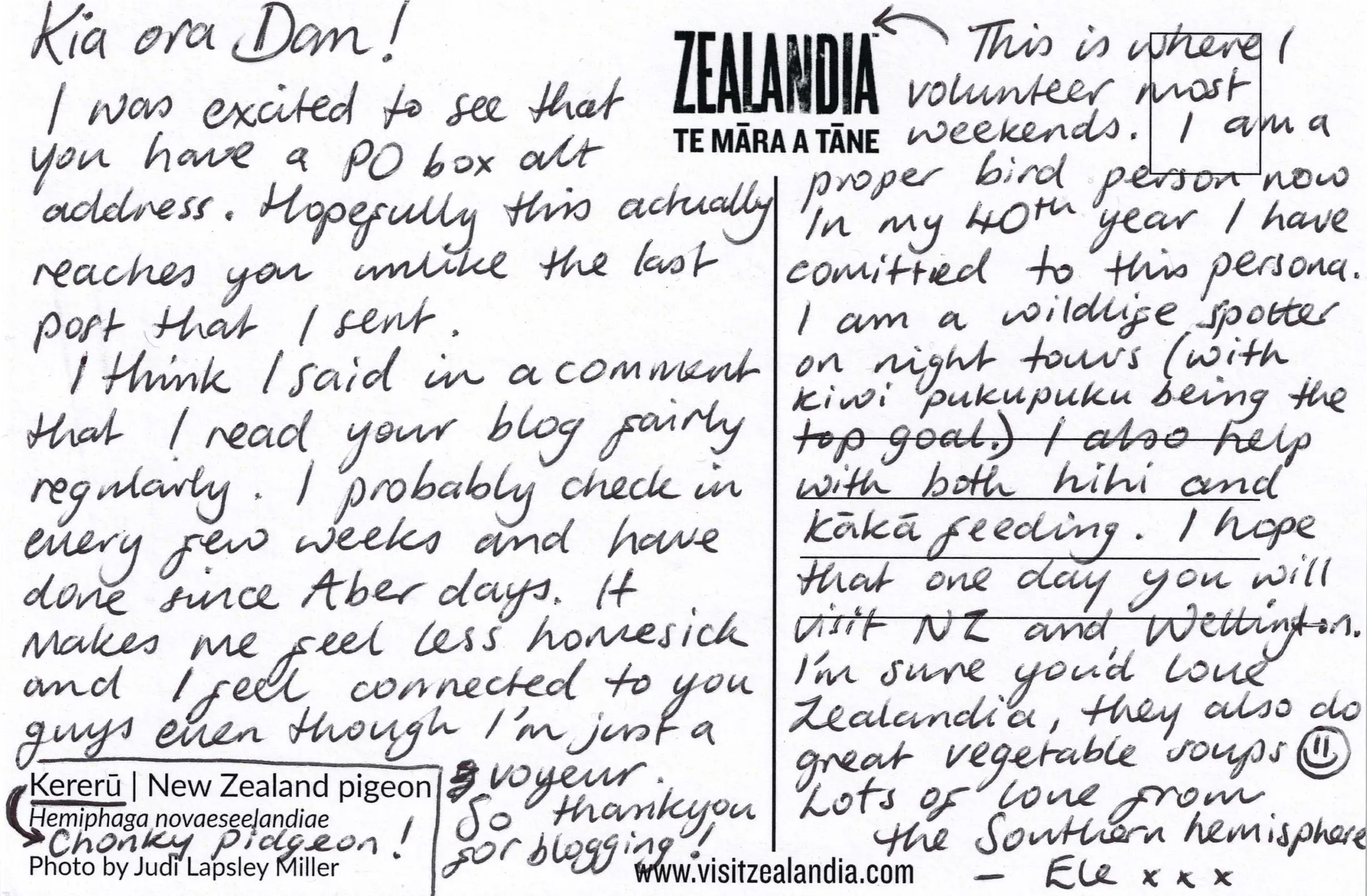
I don’t have a return address for anybody who posted anything to me, yet (obviously I’d have masked it out from the postcard if I had!), but I feel like I ought to buy some postcards
now too. It’s only a matter of time.
And hey, maybe there’s mileage in starting an Personal Web Postcards Club or something…
In January 2024 I participated in Bloganuary, a “write a blog post every day for a month” challenge organised by Automattic. I wasn’t
100% impressed by the prompts made available and was – as an employee of Automattic – shuffling towards trying to help make them better in a future year. To be part of the solution!
There’s definitely something in this ‘winter sun’ thing that seems to help me stay sane in the cold dark months. This morning, I’m blogging from a
hotel balcony in Peurtro de la Cruz, Tenerife.
Of course, two significant things changed since then:
As part of a sweeping range of redundancies, I was let go from my position at Automattic2,
and
Automattic ceased running Bloganuary: I’m guessing that the folks responsible for making it happen were among the many that Automattic decided to axe, or else their shifting
priorities – reflected by their waves of layoffs – are no longer compatible with providing that service to bloggers.
Ah well, I figured. I’d just do my own thing. I can write something for every day in January 2026, can’t I?
Generating a chart...
If this message doesn't go away, the JavaScript that makes this magic work probably isn't doing its job right: please tell Dan so he can fix it.
In general, I suppose I’ve been blogging more-frequently lately. Why is that? I guess it’s been a realisation that a blog post doesn’t always have to be polished to perfection.
I still write long-form posts which require research and planning, like setting up a network of Windows 3.x VMs just to get screenshots of what
programming then looked like or making that podcast episode with the music in it… but I’m also feeling more-free to just
express myself in the moment. To share things I see that look interesting or funny or
pretty, or just whatever I’m thinking. I’ve been using “kinds” to categorise my posts so it’s easy for people to avoid my more-inane stuff if
they like, but that’s a secondary consideration because ultimately… I blog for me.
Anyway… all of which is to say that I’ve been writing more and I’ve been loving it. The best way to read more of what I’m writing, if you’d like to, remains: by subscribing via RSS.
1 I’d anticipated having a lack of Internet access, but in fact 4G was widespread
throughout both islands and overall I managed to post something on every day except three in January 2025.
2 Based on friends I’ve spoken to, there seem to have been a lot more folks let go since;
the company seems to be shrinking quite a lot, which might go some way to explaining my second observation too.
An RM Nimbus was not the first computer on which I played Game of Life1. But this glider is here symbolically, anyway.
I can trace my hacker roots back further than my first experience of using an RM
Nimbus M-Series in circa 19922.
But there was something particular about my experience of this popular piece of British edutech kit which provided me with a seminal experience that shaped my “hacker identity”. And
it’s that experience about which I’d like to tell you:
Shortly after I started secondary school, they managed to upgrade their computer lab from a handful of Nimbus PC-186s to a fancy new network of M-Series PC-386s. The school were clearly very proud of this cutting-edge new acquisition, and we watched the
teachers lay out the manuals and worksheets which smelled fresh and new and didn’t yet have their corners frayed nor their covers daubed in graffiti.
I only got to use the schools’ older computers – this kind! – once or twice before the new ones were delivered.
Program Manager
The new ones ran Windows 3 (how fancy!). Well… kind-of. They’d been patched with a carefully-modified copy of Program Manager that imposed a variety of limitations. For example, they had removed the File > Run… menu item, along
with an icon for File Manager, in order to restrict access to only the applications approved by the network administrator.
A special program was made available to copy files between floppy disks and the user’s network home directory. This allowed a student to take their work home with them if they wanted.
The copying application – whose interface was vastly inferior to File Manager‘s – was limited to only copying files with extensions in its allowlist. This meant that (given
that no tool was available that could rename files) the network was protected from anybody introducing any illicit file types.
Bring a .doc on a floppy? You can copy it to your home directory. Bring a .exe? You can’t even see it.
To young-teen-Dan, this felt like a challenge. What I had in front of me was a general-purpose computer with a limited selection of software but a floppy drive through which media could
be introduced. What could I make it do?
This isn’t my school’s computer lab circa mid-1990s (it’s this school) but it has absolutely the same
energy. Except that I think Solitaire was one of the applications that had been carefully removed from Program Manager.
Spoiler: eventually I ended up being able to execute pretty much anything I wanted, but we’ll get to that. The journey is the important part of the story. I didn’t start by asking “can
I trick this locked-down computer lab into letting my friends and I play Doom deathmatches on it?” I started by asking “what can I make it do?”; everything else built up over
time.
Recorder + Paintbrush made for an interesting way to use these basic and limited tools to produce animations. Like this one, except at school I’d have put more effort in4.
Microsoft Word
Then I noticed that Microsoft Word also had a macro recorder, but this one was scriptable using a programming language called WordBasic (a predecessor to Visual Basic for
Applications). So I pulled up the help and started exploring what it could do.
And as soon as I discovered the Shell function, I realised that
the limitations that were being enforced on the network could be completely sidestepped.
A Windows 3 computer that runs Word… can run any other executable it has access to. Thanks, macro editor.
Now that I could run any program I liked, I started poking the edges of what was possible.
Could I get a MS-DOS prompt/command shell? Yes, absolutely5.
Could I write to the hard disk drive? Yes, but any changes got wiped when the computer performed its network boot.
Could I store arbitrary files in my personal network storage? Yes, anything I could bring in on floppy disks6
could be persisted on the network server.
I didn’t have a proper LAN at home7
So I really enjoyed the opportunity to explore, unfettered, what I could get up to with Windows’ network stack.
The “WinNuke” NetBIOS remote-crash vulnerability was a briefly-entertaining way to troll classmates, but unlocking WinPopup/Windows Chat capability was ultimately more-rewarding.
File Manager
I started to explore the resources on the network. Each pupil had their own networked storage space, but couldn’t access one another’s. But among the directories shared between
all students, I found a directory to which I had read-write access.
I created myself a subdirectory and set the hidden bit on it, and started dumping into it things that I wanted to keep on the network8.
By now my classmates were interested in what I was achieving, and I wanted in the benefits of my success. So I went back to Word and made a document template that looked
superficially like a piece of coursework, but which contained macro code that would connect to the shared network drive and allow the user to select from a series of programs that
they’d like to run.
Gradually, compressed over a series of floppy disks, I brought in a handful of games: Commander Keen, Prince of Persia, Wing Commander, Civilization,
Wolfenstein 3D, even Dune II. I got increasingly proficient at modding games to strip out unnecessary content, e.g. the sound and music files9,
minimising the number of floppy disks I needed to ZIP (or ARJ!) content to before smuggling it in via my shirt pocket, always sure not to
be carrying so many floppies that it’d look suspicious.
The goldmine moment – for my friends, at least – was the point at which I found a way to persistently store files in a secret shared location, allowing me to help them run whatever
they liked without passing floppy disks around the classroom (which had been my previous approach).
In a particularly bold move, I implemented a simulated login screen which wrote the entered credentials into the shared space before crashing the computer. I left it running,
unattended, on computers that I thought most-likely to be used by school staff, and eventually bagged myself the network administrator’s password. I only used it twice: the first time,
to validate my hypothesis about the access levels it granted; the second, right before I finished school, to confirm my suspicion that it wouldn’t have been changed during my entire
time there10.
Are you sure you want to quit?
My single biggest mistake was sharing my new-found power with my classmates. When I made that Word template that let others run the software I’d introduced to the
network, the game changed.
When it was just me, asking the question what can I make it do?, everything was fun and exciting.
But now half a dozen other teens were nagging me and asking “can you make it do X?”
This wasn’t exploration. This wasn’t innovation. This wasn’t using my curiosity to push at the edges of a system and its restrictions! I didn’t want to find the exploitable boundaries
of computer systems so I could help make it easier for other people to do so… no: I wanted the challenge of finding more (and weirder) exploits!
I wanted out. But I didn’t want to say to my friends that I didn’t want to do something “for” them any more11.
I figured: I needed to get “caught”.
I considered just using graphics software to make these screenshots… but it turned out to be faster to spin up a network of virtual machines running Windows 3.11 and some basic tools.
I actually made the stupid imaginary dialog box you’re seeing.12
I chose… to get sloppy.
I took a copy of some of the software that I’d put onto the shared network drive and put it in my own home directory, this time un-hidden. Clearly our teacher was already suspicious and
investigating, because within a few days, this was all that was needed for me to get caught and disciplined13.
I was disappointed not to be asked how I did it, because I was sufficiently proud of my approach that I’d hoped to be able to brag about it to somebody who’d
understand… but I guess our teacher just wanted to brush it under the carpet and move on.
Aftermath
The school’s IT admin certainly never worked-out the true scope of my work. My “hidden” files remained undiscovered, and my friends were able to continue to use my special Word template
to play games that I’d introduced to the network14.
I checked, and the hidden files were still there when I graduated.
The warning worked: I kept my nose clean in computing classes for the remainder of secondary school. But I would’ve been happy to, anyway: I already felt like I’d “solved” the challenge
of turning the school computer network to my interests and by now I’d moved on to other things… learning how to reverse-engineer phone networks… and credit card processors… and
copy-protection systems. Oh, the stories I could tell15.
I “get” it that some of my classmates – including some of those pictured – were mostly interested in the results of my hacking efforts. But for me it always was – and still
is – about the journey of discovery.
But I’ll tell you what: 13-ish year-old me ought to be grateful to the RM Nimbus network at my school for providing an interesting system about which my developing “hacker brain” could
ask: what can I make it do?
Which remains one of the most useful questions with which to foster a hacker mentality.
Footnotes
1 I first played Game of Life on an Amstrad CPC464, or possibly a PC1512.
2 What is the earliest experience to which I can credit my “hacker mindset”?
Tron and WarGames might have played a part, as might have the
“hacking” sequence in Ferris Bueller’s Day Off. And there was the videogame Hacker and its sequel (it’s funny to
see their influence in modern games). Teaching myself to program so that I could make
text-based adventures was another. Dissecting countless obfuscated systems to see how they worked… that’s yet another one: something I did perhaps initially to cheat at games by
poking their memory addresses or hexediting their save games… before I moved onto reverse-engineering copy protection systems and working out how they could be circumvented… and then
later still when I began building hardware that made it possible for me to run interesting experiments on telephone networks.
Any of all of these datapoints, which took place over a decade, could be interpreted as “the moment” that I became a hacker! But they’re not the ones I’m talking about today.
Today… is the story of the RM Nimbus.
3 Whatever happened to Recorder? After it disappeared in Windows 95 I occasionally had
occasion to think to myself “hey, this would be easier if I could just have the computer watch me and copy what I do a few times.” But it was not to be: Microsoft decided that this
level of easy automation wasn’t for everyday folks. Strangely, it wasn’t long after Microsoft dropped macro recording as a standard OS feature that Apple decided that MacOS
did need a feature like this. Clearly it’s still got value as a concept!
4 Just to clarify: I put more effort in to making animations, which were not part of
my schoolwork back when I was a kid. I certainly didn’t put more effort into my education.
5 The computers had been configured to make DOS access challenging: a boot menu let you
select between DOS and Windows, but both were effectively nerfed. Booting into DOS loaded an RM-provided menu that couldn’t be killed; the MS-DOS prompt icon was absent from Program
Manager and quitting Windows triggered an immediate shutdown.
6 My secondary school didn’t get Internet access during the time I was enrolled there. I
was recently trying to explain to one of my kids the difference between “being on a network” and “having Internet access”, and how often I found myself on a network that wasn’t
internetworked, back in the day. I fear they didn’t get it.
7 I was in the habit of occasionally hooking up PCs together with null modem cables, but only much later on would I end up acquiring sufficient “thinnet”
10BASE2 kit that I could throw together a network for a LAN party.
8 Initially I was looking to sidestep the space limitation enforcement on my “home”
directory, and also to put the illicit software I was bringing in somewhere that could not be trivially-easily traced back to me! But later on this “shared” directory became the
repository from which I’d distribute software to my friends, too.
9 The school computer didn’t have soundcards and nobody would have wanted PC speakers
beeping away in the classroom while they were trying to play a clandestine videogame anyway.
10 The admin password was concepts. For at least four years.
11 Please remember that at this point I was a young teenager and so was pretty well
over-fixated on what my peers thought of me! A big part of the persona I presented was of somebody who didn’t care what others thought of him, I’m sure, but a mask that
doesn’t look like a mask… is still a mask. But yeah: I had a shortage of self-confidence and didn’t feel able to say no.
13 I was briefly alarmed when there was talk of banning me from the computer lab for
the remainder of my time at secondary school, which scared me because I was by now half-way through my
boring childhood “life plan” to become a computer programmer by what seemed to be the appropriate route, and I feared that not being able to do a GCSE in a CS-adjacent subject
could jeopardise that (it wouldn’t have).
14 That is, at least, my friends who were brave enough to carry on doing so after the
teacher publicly (but inaccurately) described my alleged offences, seemingly as a warning to others.
15 Oh, the stories I probably shouldn’t tell! But here’s a teaser: when I
built my first “beige box” (analogue phone tap hardware) I experimented with tapping into the phone line at my dad’s house from the outside. I carefully shaved off some of
the outer insulation of the phone line that snaked down the wall from the telegraph pole and into the house through the wall to expose the wires inside, identified each, and then
croc-clipped my box onto it and was delighted to discovered that I could make and receive calls “for” the house. And then, just out of curiosity to see what kinds of protections were
in place to prevent short-circuiting, I experimented with introducing one to the ringer line… and took out all the phones on the street. Presumably I threw a circuit breaker in the
roadside utility cabinet. Anyway, I patched-up my damage and – fearing that my dad would be furious on his return at the non-functioning telecomms – walked to the nearest functioning
payphone to call the operator and claim that the phone had stopped working and I had no idea why. It was fixed within three hours. Phew!
I have a credit card with HSBC1. It doesn’t see much use2,
but I still get a monthly statement from them, and an email to say it’s available.
Not long ago I received a letter from them telling me that emails to me were being “returned undelivered” and they needed me to update the email address on my account.
“What’s happening?”
I don’t know what emails are being “returned undelivered” to HSBC, but it isn’t any of the ones sitting, read, in my email client.
I logged into my account, per the instructions in the letter, and discovered my correct email address already right there, much to my… lack of surprise3.
So I kicked off a live chat via their app, with an agent called Ankitha. Over the course of a drawn-out hour-long conversation, they repeatedly told to tell me how to update my
email address (which was never my question). Eventually, when they understood that my email address was already correct, then they concluded the call, saying (emphasis mine):
I can understand your frustration, but if the bank has sent the letter, you will have to update the e-mail address.
This is the point at which a normal person would probably just change the email address in their online banking to a “spare” email address.
Perhaps I should be grateful that they didn’t say that I have to change my name, which can sometimes be significantly more awkward than my email
address…
So I called Customer Services directly5,
who told me that if my email address is already correct then I can ignore their letter.
I suggested that perhaps their letter template might need updating so it doesn’t say “action required” if action is not required. Or that perhaps what they mean to say is
“action required: check your email address is correct”.
Say what you mean, HSBC! I’ve suggested an improvement to your letter template.
So anyway, apparently everything’s fine… although I reserved final judgement until I’d seen that they were still sending me emails!
“Action required”
I think I can place a solid guess about what went wrong here. But it makes me feel like we’re living in the Darkest Timeline.
You know the one I mean. Somebody rolled a ‘1’, didn’t they…
I dissected HSBC’s latest email to me: it was of the “your latest statement is available” variety. Deep within the email, down at the bottom, is this code:
What you’re seeing are two tracking pixels: tiny 1×1 pixel images, usually transparent or white-on-white to make them even-more invisible, used to surreptitiously track when
somebody reads an email. When you open an email from HSBC – potentially every time you open an email from them – your email client connects to those web addresses to get
the necessary images. The code at the end of each identifies the email they were contained within, which in turn can be linked back to the recipient.
You know how invasive a read-receipt feels? Tracking pixels are like those… but turned up to eleven. While a read-receipt only says “the recipient read this email” (usually only after
the recipient gives consent for it to do so), a tracking pixel can often track when and how often you refer to an email6.
If I re-read a year-old email from HSBC, they’re saying that they want to know about it.
But it gets worse. Because HSBC are using http://, rather than https:// URLs for their tracking pixels, they’re also saying that every time you read an email
from them, they’d like everybody on the same network as you to be able to know that you did so, too. If you’re at my house, on my WiFi, and you open an email from HSBC, not
only might HSBC know about it, but I might know about it too.
An easily-avoidable security failure there, HSBC… which isn’t the kind of thing one hopes to hear about a bank!
Tracking pixels are usually invisible, so I turned these ones visible so you can see where they hide.
But… tracking pixels don’t actually work. At least, they doesn’t work on me. Like many privacy-conscious individuals, my devices are configured to block tracking pixels (and a
variety of other instruments of surveillance capitalism) right out of the gate.
This means that even though I do read most of the non-spam email that lands in my Inbox, the sender doesn’t get to know that I did so unless I choose to tell them.
This is the way that email was designed to work, and is the only way that a sender can be confident that it will work.
But we’re in the Darkest Timeline. Tracking pixels have become so endemic that HSBC have clearly come to the opinion
that if they can’t track when I open their emails, I must not be receiving their emails. So they wrote me a letter to tell me that my emails have been “returned
undelivered” (which seems to be an outright lie).
Surveillance capitalism has become so ubiquitous that it’s become transparent. Transparent like the invisible spies at the bottom of your bank’s emails.
I’ve changed my mind. Maybe this is what HSBC’s letter should have said.
So in summary, with only a little speculation:
Surveillance capitalism became widespread enough that HSBC came to assume that tracking pixels have bulletproof reliability.
HSBC started using tracking pixels them to check whether emails are being received (even though that’s not what they do when they are reliable, which
they’re not).
(Oh, and their tracking pixels are badly-implemented, if they worked they’d “leak” data to other people on my network7.)
Eventually, HSBC assumed their tracking was bulletproof. Because HSBC couldn’t track how often, when, and where I was reading their emails… they posted me a letter to
tell me I needed to change my email address.
What do I think HSBC should do?
Instead of sending me a misleading letter about undelivered emails, perhaps a better approach for HSBC could be:
At an absolute minimum, stop using unencrypted connections for tracking pixels. I do not want to open a bank email on a cafe’s public WiFi and have
everybody in the cafe potentially know who I bank with… and that I just opened an email from them! I certainly don’t want attackers injecting content into the bottom of
legitimate emails.
Stop assuming that if somebody blocks your attempts to spy on them via your emails, it means they’re not getting your emails. It doesn’t mean that. It’s never meant
that. There are all kinds of reasons that your tracking pixels might not work, and they’re not even all privacy-related reasons!
Or, better yet: just stop trying to surveil your customers’ email habits in the first place? You already sit on a wealth of personal and financial information which
you can, and probably do, data-mine for your own benefit. Can you at least try to pay lip service to your own published principles on the
ethical use of data and, if I may quote them, “use only that data which is appropriate for the purpose” and “embed privacy considerations into design and approval processes”.
If you need to check that an email address is valid, do that, not an unreliable proxy for it. Instead of this letter, you could have sent an email that
said “We need to check that you’re receiving our emails. Please click this link to confirm that you are.” This not only achieves informed consent for your tracking, but it can be
more-secure too because you can authenticate the user during the process.
Also, to quote your own principles once more: when you make a mistake like assuming your spying is a flawless way to detect the validity of email addresses, perhaps you should “be
transparent with our customers and other stakeholders about how we use their data”.
Wouldn’t that be better than writing to a customer to say that their emails are being returned undelivered (when they’re not)… and then having your staff tell them that having received
such an email they have no choice but to change the email address they use (which is then disputed by your other staff)?
</rant>
Footnotes
1 You know, the bank with virtue-signalling multiculturalism that we used to joke about.
4 After all, as I’ll stress again: the email address HSBC have for me, and are using,
is already correct.
5 In future, I’ll just do this in the first instance. The benefits of live chat being able
to be done “in the background” while one gets on with some work are totally outweighed when the entire exchange takes an hour only to reach an unsatisfactory conclusion,
whereas a telephone call got things sorted (well hopefully…) within 10 minutes.
6 A tracking pixel can also collect additional personal information about you, such as
your IP address at the time that you opened the email, which might disclose your location.
7 It could be even worse still, actually! A sophisticated attacker could “inject” images
into the bottom of a HSBC email; those images could, for example, be pictures of text saying things like “You need to urgently call HSBC on [attacker’s phone number].” This would
allow a scammer to hijack a legitimate HSBC email by injecting their own content into the bottom of it. Seriously, HSBC, you ought to fix this.
I just needed to spin up a new PHP webserver and I was amazed how fast and easy it was, nowadays. I mean: Caddyalready makes it
pretty easy, but I was delighted to see that, since the last time I did this, the default package repositories had 100% of what I needed!
Apart from setting the hostname, creating myself a user and adding them to the sudo group, and reconfiguring sshd to my preference, I’d
done nothing on this new server. And then to set up a fully-functioning PHP-powered webserver, all I needed to run (for a domain “example.com”) was:
After that, I was able to put an index.php file into /var/www/example.com and it just worked.
And when I say “just worked”, I mean with all the bells and whistles you ought to expect from Caddy. HTTPS came as standard (with a solid QualSys grade). HTTP/3 was supported with a
0-RTT handshake.