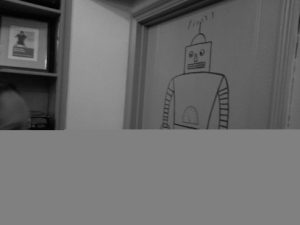
Things like this robot, painted onto the door of the bathrooms of a hipsterish East Oxford bar.
(it looks like one of the robot’s eyes fell off before the bar‘s owners Instragram’d it)
See the robot? THE ROBOT SEES YOU NOW!
There are those who would argue that this isn’t true eyebombing, because I ought to be sticking eyes to non-anthropomorphic, inanimate objects, and making them look alive by
doing so. But the folks on /r/eyebombing don’t seem to mind: they’re far more-focused on the
chaos and hilarity that ensues when you just put eyes on any damn thing that looks like it could benefit from them.
This guy’s so angry he’s popping his eyes out of his head!
When I was on holiday in Jersey, for example, I found an unattended rack of tourist information
leaflets that were just crying out for a ‘bombing.
“Does this dress make my eyes look fat?”
And because I pretty-much carry googly eyes around with me all the time – in the pocket that generally contains my headphones, a pen, a hair tie, and other everyday essentials – I
started sticking eyes onto things.
Soon.
The game didn’t stop even when I touched back down on the mainland.
Sign at the toilets in the arrivals lounge of Gatwick Airport.
When Claire and I changed our surnames to the letter Q, six and a quarter years ago, I was pretty sure that we were the only “Q”s in the world. Ah Q‘s name is a transliteration into the Latin alphabet; Stacey Q is a stage name that she doesn’t use outside of her work (she uses Swain in
general); Suzi Q‘s “Q” is short for Quatro (perhaps popularised because of the
similarly-named song, which came out when she was aged 7; Maggie Q‘s “Q” is short for Quigley (she finds that her full name is almost impossible for her fans in East
Asia to pronounce); and both Q and Q are fictional. We were reasonably sure that we were the only two people in the world
with our surname, and that was fine by us.
Fictional, as much as we love them.
After Claire and I split up, in 2009, we both kept our new names. In my case, the
name felt like it was “mine”, and represented me better than my birth name anyway. Plus, I’d really gotten to enjoy having a full name that’s only four letters long: when my poly-tribe-mates Ruth and JTA (each of whom have almost 30 letters in their full names!) were filling out mortgage application forms recently, I was able to
get through the pages I had to fill significantly faster than either of them. There are perks to a short name.
Also fictional. But we’re less-upset about that.
I can’t say why Claire kept her new name, but I’m guessing that some of our reasons overlap. I’m also guessing that laziness played a part in her decision: it took her many months to
finally get around to telling everybody she’d changed her name the first time around! And while I’ve tried to make it possible to change your name easily when I launchedfreedeedpoll.org.uk, there’s still at least a little letter-writing involved.
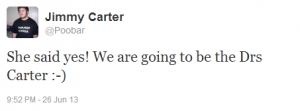
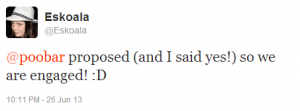
Now, though, it looks like I may soon become the only Q in the world:
Personally, I thought that after she passed her PhD she’d
have even more reason to be called “Q”. I mean: “Dr. Q”: how cool is that? It sounds like a Bond villain or something. But on the other hand: if she wants to downgrade to
an everyday name like “Carter” then, well, I guess that’s up to her. I shan’t blame them for not opting to hyphenate, though: “Carter-Q” sounds like a brand of ear bud.
It’s not like there was ever anybody famous called “Carter”. Except for this guy, I suppose. But he was more of a “brave politician in the face of international crises” character than
a “Bond villain” character. Not fictional.
Seriously, though: good for them. If those crazy kids feel that marriage is for them, then I wish them the best of luck. And let’s face it, we’re approaching a bit of a lull in this run
of all-of-our-friends-getting-married, so it’ll be nice to have an excuse for yet another wedding and a fabulous party (I’m jumping to conclusions and assuming that they’re going to
invite me, especially after this blog post!).
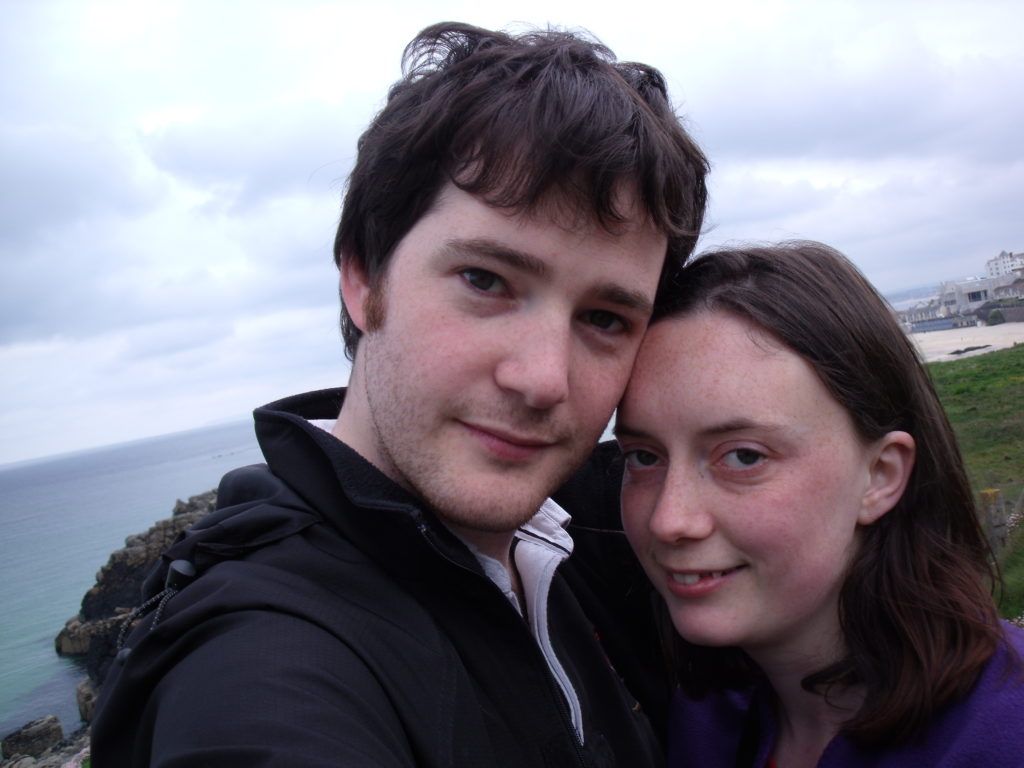
Aww. It’s a sweet photo, but somebody should probably buy them a tripod as a wedding present: it’s hard to keep the horizon level in an arms-length selfie.
In other name-related news, look out for me in the Money section of tomorrow’s Guardian, where I’ll be talking about deeds
poll, as part of their series of articles on scammy websites. I always knew that it was only a matter of time before my photo appeared in a national newspaper: I guess I should just be
thankful that it’s for something I’ve done right, rather than for something I’ve done wrong!
This blog post is the third in a series about buying our first house. If you
haven’t already, you might like to read the first part. In
the second post in the series, we’d put an offer on a house which
had been accepted… but of course that’s still early days in the story of buying a house…
We hooked up with Truemans, a local solicitor, after discovering that getting
our conveyancing services from a local solicitor is only marginally more-expensive than going with one of the online/phone/post based national ones, and you get the advantage of being
able to drop in and harass them if things aren’t going as fast as you’d like. Truemans were helpful from day one, giving us a convenient checklist of all of the steps in the process of
buying a house. I’m sure we could have got all the same information online, but by the time I was thinking about offers and acceptance and moving and mortgages and repayments and
deposits and everything else, it was genuinely worth a little extra money just to have somebody say “next, this needs to happen,” in a reassuring voice.
This gargantuan beast is our mortgage application form. All of those pages are double-sided, by the way.
Meanwhile, we got on with filling out our mortgage application form. Our choice of lenders – which Stefan, who I’d mentioned in the last post, had filtered for us – was limited slightly
by the fact that we wanted a mortgage for three people, not for one or two; but it wasn’t limited by as much as you might have thought. In practice, it was only the more-exotic mortgage
types (e.g. Option ARMs, some varieties of interest-only mortgage) that we were restricted from, and these weren’t
particularly appealing to us anyway. One downside of there being three of us, though, was that while our chosen lender had computerised their application process, the computerised
version wasn’t able to handle more than two applicants, so we instead had to fill out a mammoth 22-page paper form in order to apply. At least it weeds out people who aren’t serious, I
suppose.
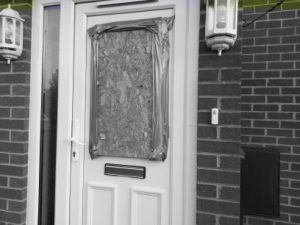
The front door of our intended new home had recently sustained some… damage. That didn’t bode well.
I revisited the house to check out a few things from the outside: in particular, I was interested in the front door, which had apparently been broken during a…
misunderstanding… by the current owners, who are in the middle of what seems like a complicated divorce. The estate agent had promised that it would be repaired before the
sale, but when I went to visit I found that this hadn’t happened yet. Of course, now we had lawyers on our side, so it was a quick job to ask them to send a letter to the seller’s
solicitor, setting the repair of the door as a condition upon which the sale was dependent.
The results of our Environmental Search were perhaps the most-interesting. But I’ll understand if you don’t think it’s as interesting as I do.
Our solicitors had also gotten started with the requisite local searches. One of the first things a conveyancing solicitor will do for you is do a little research to
ensure that the property really is owned by the people who are selling it, that there’s no compulsory purchase order so that a motorway can be built through the middle of it, that it’s
actually connected to mains water and sewers, that planning permission was correctly obtained for any work that’s been done on it, and that kind of thing. One of the first of these
searches to produce results was the environmental search.
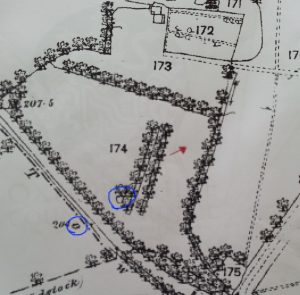
A map of the area around our new house, as it was about a century ago, unearthed by our convenient tame librarian.
One of the things that was revealed be the environmental search was that the area was at a significantly higher-than-average risk of subsidence, had the construction not been done in a
particular way – using subsidence-proof bricks, or something, I guess? I theorised that this might be related to the infill activities that (the environmental search also reported) had
gone on over the last hundred and fifty years. The house is near a major waterway, in an area that was probably once lower-lying and wetter, but many of the small ponds in the area were
filled in in the early part of the 20th century (and then, of course, the area was developed as the suburbs of central Oxfordshire expanded, in the 1980s). Conveniently, we have
a librarian on our house-buying team, and he was able to pull up a stack of old OS maps showing the area, and we
were able to find our way around this now almost-unidentifiable landscape.
A map showing a field, hedgerows, water course and – highlighted in blue – a pond. The second highlighting in blue (bottom left) is a letter ‘O’, not a pond. I got carried away
highlighting things, okay?
Sure enough, there were ponds there, once, but that’s as far as our research took us. Better, we thought, to just pass on the environmental search report to a qualified buildings
surveyor, and have them tell us whether or not it was made out of subsidence-proof bricks or shifting-ready beams or whatever the hell it is that you do when you’re
building a house to make it not go wonky. Seriously, I haven’t a clue, but I know that there are experts who do.
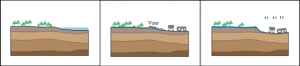
In this highly-realistic diagram, which wouldn’t look out of place in a geography textbook, houses go wonky because they’re built on ground that became more-compressible after it was
drained. This is what I want to avoid.
Given that the house we’re looking at is relatively new, I don’t anticipate there being any problems (modern building regulations are a lot more stringent than their historical
counterparts), but when you’re signing away six-figures, you learn to pay attention to these kinds of things.
Hopefully, the fourth blog post in this series will be about exchanging contracts and getting ready to move in to our new home: fingers crossed!
A couple of weeks ago – and right at the end of the incredibly-busy development cycle that preceded Three Rings‘ Milestone: Krypton – Ruth, JTA and I joined Ruth’s mother on a long-weekend trip to the island of
Jersey. I’d been to the Channel Islands only once before (and that was spent primarily either in the dark and the rain, or else in the basement meeting room of a hotel: I was there on
business!), so I was quite pleased to get the chance to visit more “properly”.
The Bay of St. Helier, looking out towards Elizabeth Castle.
Of particular interest was the history of the island during the Second World War. Hitler had been particularly pleased to have captured British territory
(after the islands, which were deemed undefensible by the British, had been demilitarised), and felt that the Channel Islands were of critical military significance. As a result, he
commanded that a massive 10% of the steel and concrete of the Atlantic Wall project should be poured into the Islands: Jersey was, as a result, probably more heavily-fortified than the
beaches of Normandy. In the end, this impregnable island fortress was left until last – Berlin fell before Jersey and Guernsey were liberated – and this was a factor in the great
suffering of the islanders during the occupation. We visited the “war tunnels“, a massive underground complex
built by the German defenders, and it was one of the most spectacular wartime museums I’ve ever experienced.
The comparatively-small main entrance to the Jersey War Tunnels doesn’t even begin to do justice to the warren of criss-crossing corridors, rooms, and bunkers that span the underside
of the hill.
The tunnels are, of course, an exhibit in themselves – and that’s what I expected to see. But in actual fact, the care and attention that has gone into constructing the museum within is
breathtaking. Starting with a history of the islands (in a tunnel filled with the music and postcards of the 1930s), you can just about hear the sounds of war, echoing distantly from
the next chamber. There, you walk through a timeline of the invasions of Poland, Denmark, Norway and France, and see how – even with the enemy just barely over the horizon – Jersey
still marketed itself as a holiday destination for Britons: a place to escape from wartime fears. Then comes the evacuation – the entire population given barely a day to decide whether
they’re staying (and doubtless being occupied by Germany) or leaving (and never knowing when or if they’ll return to their homes). And then, the story of the occupation: framed in a
wonderfully “human” context, through exhibits that engage with the visitor through storytelling and hypothetical questions: what would you do, under German occupation?
As a result of politically-correct amendments in the fifth edition of the Diagnostic and Statistical Manual of Mental Disorders, it’s become unacceptable to use the word “crazy” to
describe minature golf courses with obstacles.
Certain to ensure that the whole trip didn’t turn into an educational experience, we played a fabulous round of adventure golf under the glorious sunshine of the Channel Islands. I did
ever so well, up until the moment where I lost my ball and, swiftly afterwards, my ability to play the game in any meaningful capacity whatsoever. Eventually, Ruth and I tied, with JTA
just a little behind… but we were all quite-embarrassingly well over par.
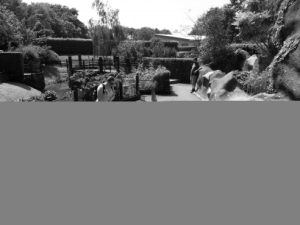
The landscaping was actually really impressive. The fake cave had successfully fooled a family of ducks into taking up residence: we found a nest full of confused-looking ducklings
when I explored around a corner, looking for a lost ball.
Jersey is apparently moderately famous for its zoo. Ruth’s mother had apparently been looking forward to
visiting it for years, and – despite it only being of a modest size – had opted to spend an entire day there, and considered taking another half-day, too. Once the rest of
us caught up with her there, we certainly had to agree that it was a pretty impressive zoo.
A young pair of komodo dragons use their forked tongues to smell a sack of meat that has been hung in the centre of their enclosure.
I was particularly pleased to visit their pair of very active young komodo
dragons, their bat cave, their tortoises, and their remarkable aye-ayes – Jersey hosts
one of very few successful captive aye-aye exhibits anywhere in the world (and let’s face it, aye-ayes are a fascinating enough species to begin with).
The crawl-through tunnel and dome within the meerkat enclosure seemed like a good idea, but once inside it became apparent that it was basically a tiny, airless greehouse… and no
closer to the animals than we were from the outside.
Ruth, her mother and I also got out for a little geocaching, an activity that I’d
somewhat neglected since last summer. It turns out that there’s quite an active community on the island, and there were loads of local caches. We hit Not much room? first, which turns out
to be among the best cache containers I’ve ever seen (spoilers below; skip the remaining photos if you’re ever likely to go ‘caching on Jersey), and certainly a worthy find for my
100th!
We were certain that we were within 5 metres or so of the cache, and were – in accordance with the title – looking for something small, or concealed in a crack. But this cache was
smarter than that. Can you see it in this photo?
Later, we set out for View
over St Aubins (which I’m sure must have been at a great viewpoint, once, until the trees grew taller and cut off the view), and a quite-enjoyable puzzle cache called Dear Fred… all in all, a great
excuse to stretch our legs and to see a little more of the island than we might otherwise have.
Here it is! Did you find it? Amazingly, Ruth’s mother was the first of us to spot it, despite this being her very first geocaching expedition. Yes, that really is a wooden mushroom
with a micro cache hidden within it.
I’m pretty sure I spent most of the holiday, though, catching up on sleep (interspersed with tiny bits of Three Rings work as we came to the tail end of the testing period –
the WiFi at our B&B was, by-now-unsurprisingly, faster than that which we get at home). Or drinking. Or one, then the other. After a hard run of Three Rings
development, coupled with “day job” work and the ongoing challenge of buying a house, I was pleased to be
chilling out and relaxing, for a change.
We also got the chance to visit Jersey Quaker Meeting House: a light, modern building near the middle of St. Helier, sandwiched discretely between the grand hotels and tall townhouses
of the island’s capital.
Most-importantly, I reflected as we passed back through airport security on our way back to the mainland, nobody felt the need to kill anybody else the entire trip. Ruth’s mother and I,
for example, haven’t always seen eye to eye (something about me ‘stealing’ Ruth from a life of monogamy, or otherwise being a bad influence, might have been an early issue), and it’s
not unknown for relations to be strained between her and her daughter or her and her son-in-law, either. But even as we bickered our way through the departures lounge at Jersey Airport,
at least I knew that we’d all survived.
Amazingly, I didn’t hold us all up by getting stopped and searched at airport security, which is usually my speciality when I travel. However, Liz did so on my behalf, by failing to
remove everything metal before she went through the metal detector.
All things considered, then: a successful trip. Fun times were had, lots of exciting history was learned, tortoises were prodded, and nobody killed anybody else, however much they might
have been tempted.
I’ve got a new favourite game, this week: Movie Title Mash-Ups (with thanks to Cougar Town). Ruth and I sat up far too late last night, playing it.
Here’s how you do it:
Cougar Town characters playing… no, wait… this is that OTHER game they play.
Movie Title Mash-Ups
Take two movie titles which share a word (or several words, or just a syllable) at the end of one and at the beginning of the other. Shmoosh them together into a combined movie title,
then describe the plot of that movie in a single sentence by borrowing elements from both component movies. See if anybody can guess what your mash-up movies were.
Here are some examples. The answers are ROT13-encoded, but if you’re reading
this post directly on
my blog, you can click on each of them to decode them (once you’ve given up!).
—
Zombies claw their way out of a graveyard, and Batman spends most of the film hiding in the attic. Gur Qnex Xavtug bs gur Yvivat Qrnq
—
While trapped in an elevator at the end of October, a superficial man is hypnotised into murdering a bunch of high-school students with knife. Funyybj Unyybjrra
—
A crazy professor and a kid travel back in time in a souped-up car, where local bully Biff cuts off the kid’s hand and tells him he’s his father. Gur Rzcver Fgevxrf Onpx gb gur Shgher
—
Bill Murray has to live the same day over and over, until he can survive the zombie apocalypse by escaping to an island. Tebhaqubt Qnl bs gur Qrnq
—
A pair of alcoholic, out-of-work actors stay at the countryside house of a Monty, dangerous robot who has learned to override his programming. Jvguanvy naq V, Ebobg
—
An evil genie who maliciously manipulates words and misinterprets wishes opens a portal between Eternia and Earth, which He-Man and Skeletor come through. Jvfuznfgref bs gur Havirefr
—
A bunch of outlawed vigilante superheroes fight shapeshifters and werewolves as they investigate a mystical curse which threatens to shatter the fragile cease-fire between Dark and
Light forces in Russia. Avtug Jngpuzra
—
Harrison Ford and Michelle Pfeiffer hold a seance to communicate with subterranean humans who worship a giant bomb. Jung Yvrf Orarngu gur Cynarg bs gur Ncrf
—
A lion cub born to a royal family grows up, climbs the Empire State Building, and fights aeroplanes. Gur Yvba Xvat Xbat
—
James Bond is sent to investigate the murder of three British MI6 agents, who turn out to have been killed using a military satellite that concentrates the sun’s rays into a
powerful laser. (hint: both films are James Bond films)
Yvir naq Yrg Qvr Nabgure Qnl
This blog post is the second in a series about buying our first house. If you
haven’t already, you might like to read the first part.
When Ruth, JTA and I first set out to look at
houses, we didn’t actually plan on buying one. We’d just gotten to the point where buying one felt like an imminent logical step, and so we decided to start looking around Oxford to see
what kind of thing we might be able to get (and what it would cost us, if we did). Our thinking was that, by looking around a few places, we’d have some context from which to
springboard our own discussions about what property we’d one day like to own.
One of the first places we looked at seemed at first to be perfect. But the more we looked at it, the more we became convinced that it really wasn’t for us.
There’s something about “window shopping” for houses that’s liberating and exciting. We don’t need a house – we’ve got somewhere to live – but we’re going to come
and look around anyway. Once you’re on their lists, estate agents will bombard you with suggestions of places that you might like, and you feel a little like they’re your servants,
running around trying to please you (in actual fact, almost the opposite is true: they’re working on behalf of the seller… although it’s certainly in their interest to get the property
sold promptly so that they can take their cut!).
The garden at this place stretched about 35 meters (115 feet), among its other charming features. But sadly, it turned out to be out of our price range.
But as we got into the swing of things, we discovered that we were ready to buy already. Between our savings (and, in particular, boosted by the first parts of
my inheritance following my dad’s death last year, as we’re finally getting
his estate sorted out), we actually have an acceptable deposit for a mortgage, and our renewal on our current place was looming fast. None of us having bought a house before, we did a bit of reading and decided that our first step probably ought to
be to work out how much can we borrow. You know, just to make our window-shopping a little more believable. Maybe.
This place is a lot like where we live now, but laid out in a more-spacious way. Hopefully you’ll be seeing it again in a future blog post…
Picture courtesy Google Maps.
One of the estate agents we dealt with introduced us to a chap called Stefan Cork, a mortgage broker working as part of the Mortgage Advice Bureau network. We were still only window-shopping at this point, but hey: if we were going to be allowed some free,
no-commitment mortgage advice, then we might as well work out how much we could potentially borrow, right? After checking his credentials (the three
questions you should ask every mortgage broker), I spoke to Stefan on the phone, and talked him through our situation. I described our unusual relationship structure (which he took in his stride) and the way that we means-assess
our household contributions, alongside more mundane details like how much we earn and what kind of deposit we could rustle up. He talked us through our options and ballparked some of
the kinds of numbers we’d be looking at, if we went ahead and got a mortgage.
Stefan’s really lovely, and didn’t panic for a moment when I said “By the way, I’m blogging this: can I take your photo?” If you’re looking for mortgage advice, get me to give you his
number.
And somehow, somewhere along the line, our perspective switched. Instead of looking at houses just to give us a feel for what we might buy, “maybe next year”, we were genuinely looking
to buy a house now. We re-visited some of the places we’d seen already, and increased our search of places we hadn’t yet seen. Over time, and by a process of elimination
(slow Internet area; too many hills; too narrow staircases; too expensive; too wonky), we cut down our options to just three potential properties. And then just two. And then we came to
an impasse.
So… we put offers on both. Under the law of England and Wales, a property purchase isn’t binding until the contracts have exchanged hands. Sellers benefit (and buyers suffer) from this
all of the time, because it permits gazumping: even after the buyers have spent money on
lawyers, mortgage applications, surveys and searches, the seller can change their mind and accept a higher offer from a different prospective buyer! But this legal quirk can
work for buyers, too: in our case, we were able to put offers in of what we were willing to pay for each of two properties (different values, at that), and let them know
that the first one of the two to agree to our price would be the one to get the sale!
Let’s pull the old switch-a-roo! Making competing “lowball” offers on two properties at once and offering to purchase from the one that accepts first turns housebuying into a
reverse-Dutch-auction.
Haggling for a house in this way felt incredibly ballsy (I’d been nominated as the negotiator on behalf of the other Earthlings), but it played against the psychology of our sellers.
Suddenly, instead of being in a position of power (“no, we won’t accept that offer… go a little higher”), the sellers were made to feel that if they didn’t accept our offers (which were
doubtless lower than they had hoped), they’d have a 50% chance of losing the sale entirely. When there are hundreds of thousands of pounds on the line, being able to keep your cool
and show that you’re willing to go elsewhere is an incredibly powerful negotiating tactic.
True to our word: when one of them came back and accepted our offer, we withdrew the offer on the other house and began the (lengthy) paperwork to start getting the purchase underway.
But that can wait for another blog post.
Let me try that again: which came first, the colour or the fruit?
Oranges
Still not quite right – one more try: which came first, orange, the English name of the colour, or orange, the English name of the fruit? What I really want
to know is: is the fruit named after the colour or the colour after the fruit? (I find it hard to believe that the two share a name and colour simply by coincidence)
Oranges
It turns out that the fruit came first. Prior to the introduction of oranges to Western Europe in around the 16th or 17th century by Portugese merchants, English-speaking
countries referred to the colour by the name ġeolurēad. Say that Old English word out loud and you’ll hear its roots: it’s a combination of the historical versions of the
words “yellow” and “red”. Alternatively, people substituted words like “gold” or “amber”: also both words for naturally-occurring substances whose identity is confirmed by
their colouration.
Green oranges. These oranges are what are now known as ‘bitter oranges’, the only variety to grow naturally: the ‘sweet oranges’ you’re used to eating are entirely a domesticated
species.
There wasn’t much need for a dedicated word in English to describe the colour, before the introduction of the fruit, because there wasn’t much around of that colour. The
colour orange isn’t common in nature: a few fruits, copper-rich soils and rocks, a small number of tropical fish, a handful of flowers… and of course autumn leaves during that brief
period before they go brown and are washed away by Britain’s encroaching winter weather.
The names for the parts of the visible spectrum are reasonably arbitrary, but primary colours tend to cover a broader “space” than secondary ones; presumably because its easier for
humans to distinguish between colours that trigger multiple types of receptors in the eye.
Brent Berlin and Paul Kay theorise that the evolution of a language tends towards the
introduction of words for particular colours in a strict order: so words to distinguish between green and blue (famously absent in Japanese,
Vietnamese, and Thai) are introduced before brown is added, which in term appears before the distinction of pink, orange, and grey. At a basic level, this seems to fit: looking at a
variety of languages and their words for different
colours, you’ll note that the ‘orange’ column is filled far less-often than the ‘brown’ column, which in turn is filled less-often than the ‘green’ column.
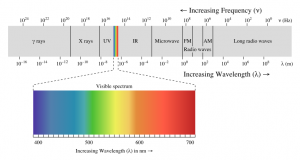
Of course, from a non-anthropocentric perspective, the “visible spectrum” is just a tiny part of the range of frequencies of electromagnetic radiation that we, and other animals, make
use of.
This is a rather crude analogy, of course, because some languages go further than others in their refinement of a particular area of the spectrum. Greek, for example, breaks down what
we would call “blue” into τυρκουάζ (turquoise) and κυανό (azure), and arguably βιολέ (violet), although a Greek-speaker would probably put the
latter down as a shade of purple, rather than of blue. It makes sense, I suppose, that languages are expected to develop a name for the colour “red” no later than they do for other
colours (other than to differentiate between darkness and lightness) – a lot of important distinctions in biology, food, and safety depend on our ability to communicate about red
things! But it seems to me that we’ve still got a way to go, working on our linguistic models of colour.
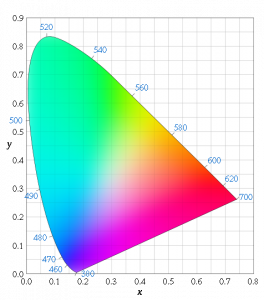
Factor in the ability of the human eye to distinguish between different colours, and you get a far more-complex picture that a simple linear spectrum.
If we’d evolved on Mars (and were still a sighted, communicative, pack creature, but – for some reason – still had a comparable range and resolution of colour vision), our languages
would probably contain an enormous variety of words for colours in the 650-750 nanometre wavelengths (the colours that English speakers universally call “red”). Being able to navigate
the red planet based on the different ratios of hematites in the rocks, plains, soils and dusts would doubtless mean that the ability to linguistically distinguish between a dark-red
feature and a medium-red feature could be of great value!
Mars. It’s pretty damn red.
The names we have for colours represent a part of our history, and our environment. From an anthropological and linguistic perspective, that’s incredibly interesting.
All six colours of the rainbow. No, wait… nine? Three? A hundred? It’s all about how you name them.
If it weren’t for the ubiquity of, say, violets and lavender in the Northern hemisphere, perhaps the English language wouldn’t have been for a word for that particular colour, and the
rainbow would have six colours instead of seven. And if I’d say, “Richard Of York Gave Battle In…”, nobody would know how to finish the sentence.
In other news, I recently switched phone network, and I’m now on Orange (after many years on Vodafone). There is no connection between this fact and this blog post; I just thought I’d share.
And just like that, it was over. The courts service kept me “on the hook” for a day or two, but after that: when I called the answerphone from which I receive my instructions, I was
told that I’d been cleared. My jury service was over.
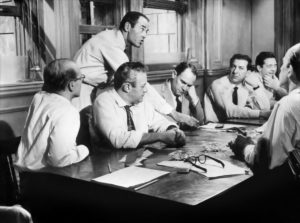
12 Angry Men is an awesome film. The behaviour of some of the characters would certainly be illegal in a contemporary UK case, so we certainly can’t consider them to be role models
for a real jury, but it’s a great film nevertheless.
I filled in my expenses form. £5.71 for lunch (where do they get these numbers?) each day. 8.9 pence per mile cycled to and from the courthouse. Given that they give a mileage bonus to
car shares, I wonder if they’d have given me a top-up if I’d have shared a tandem with another juror?
I heard the outcome of the trial second-hand, a few days later, on a local radio station. It somehow reminded me that the real world was connected to my time on a jury: something I’d
sort-of forgotten at the time. Being pulled out from your daily routine and put onto jury duty feels sometimes surreal, and – like the blind spot in your eye that fills-in what you see
with the colours around it – it’s hard to remember now that just last week I wasn’t just following my normal pattern. So when I heard about the result of a trial in which
my ‘alter ego’ – Dan the juror! – took part, it was strangely jarring. For a moment, I said to myself: “Oh yeah; that happened.”
My jury service was a really interesting experience. I’d have appreciated less sitting around and being shuffled from place to place, and more-certainty about when I would and wouldn’t
be needed, but that’s only a small issue. I got to see the wheels of justice turning from within the machine, and to take part in an important process of our society. And that’s great.
My second day of jury duty was more-successful than the first, in that I was actually assigned to a case, rather than spending the better part of the day sitting around in a waiting
room. I knew that this was likely (though not certain, on account of the nature of the randomisation process used, among other things: more on that later) because I’d called the “jury
line” the previous night. I suspect this is common, but the other potential jurors and I were given a phone number to call “after around 3:45pm to 4pm” each day, letting us know whether
we’d be needed for the following day.
After calling a national-rate number, I got to listen to an answerphone reading out a series of juror numbers needed for the following day, listening out for mine.
The jury assembly area now only contained the people who’d been brought in, like me, for the upcoming case: a total of 15 of us. I was surprised at quite how many of the other potential
jurors showed such negativity about being here: certainly, it’s inconvenient and the sitting-around is more than a little dull if (unlike me) you haven’t brought something to work on or
to read, but is it so hard to see the good parts of serving on a jury, too? Personally, I was already glad of the opportunity: okay, the timing wasn’t great… with work commitments
keeping me busy, as well as buying a house (more on that later!), working on my
course, (finally) getting somewhere with my dad’s estate, and the tail end of a busy release cycle of Three Rings, I already had quite enough going on! But I’ve always been interested in the process of serving on a jury, and besides: I feel that it’s
an important civic duty that one really ought to throw oneself at.
Few people in the Jury Assembly Area.
If it were a job that you had to volunteer for, rather than being selected at random (and thankfully it isn’t! – can you imagine how awful our justice system would be if it were!), I’d
have probably volunteered for it, at some point. Just not, perhaps, now. Ah well.
The jury officer advised us of the expected duration of the trial (up to two days), and made a note of each of our swearing-in choices: each juror could opt to swear an oath on the
Bible, Koran, Japji Sahib, Gita, or to make an affirmation (incredibly the Wikipedia page on Jurors’ oaths lacked an entry for the United Kingdom until I added it, just now). In case they were
they were empanelled onto a jury, the officer wanted to have the appropriate holy book and/or oath card ready to-hand: courtrooms, it turns out, are reasonably well-stocked with
religious literature!
I get the impression that the earlier rounds of jury selection – from the electoral roll summons through to the assignment of jurors to cases – is randomised by computer, but the
final selection of 12 is done by hand.
Once assembled, we were filed down to the courtroom, where a further randomisation process took place: a clerk for the court shuffled a deck of cards, and drew 12 at random, one at a
time. From each, she read a name – having been referred to it so often lately, I had almost expected to continue to be referred to by my juror number, and had made sure that I knew it
by heart – and each person thus chosen made their way to a seat in the jury benches. I was chosen sixth – I was on a jury! The people not chosen were sent back up to the assembly area,
so that they could be called down to replace any of us (if our service was successfully challenged – for example, if it turned out that we personally knew the defendant), but were
presumably dismissed after it became clear that this was not going to happen.
Then, each of our names were read out again, before each of us were sworn in. This, we were told, was the last chance for any challenge to be raised against us. About half of the jurors
opted to affirm (including me: none of those scriptures have any special significance for me; and furthermore I’d like to think that I shouldn’t need to swear that I’m going to do the
right thing to begin with); the other half had chosen to swear on the New Testament.
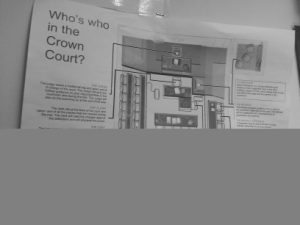
Our courtroom was quite a bit larger than the one depicted on this poster, which I found in the jury assembly room.
The trial itself went… pretty much like you’ve probably seen it in television dramas: the more-realistic ones, anyway. The prosecution explained the charges and presented evidence and
witnesses, which were then cross-examined by the defence (and, ocassionally, re-examined by the prosecution). The defence produced their own evidence and witnesses – including the
defendant, vice-versa. The judge interrupted from time to time to question witnesses himself, or to clarify points of law with the counsel or to explain proceedings to the jury.
The trial spilled well into a second day, and I was personally amazed to see quite how much attention to detail was required of the legal advocates. Even evidence that at first seemed
completely one-sided could be turned around: for example, some CCTV footage shown by the prosecution was examined by the defence (with the help of a witness) and demonstrated to
potentially show something quite different from what first appeared to be the case. The adage that “the camera never lies” has never felt farther from the truth, to me, as the moment
that I realised that what I was seeing in a courtroom could be interpreted in two distinctly different ways.
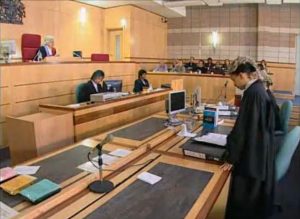
This courtroom looks a lot like the one I served in, with the jury to the left of the judge and a similar layout to the position of the prosecution and defence teams, public gallery,
and dock.
Eventually, we were dismissed to begin our deliberations, under instruction to return a unanimous verdict. I asked if any of the other jurors had done this before, and – when one said
that she had – I suggested that she might like to be our chairwoman and forewoman (interestingly, the two don’t have to be the same person – you can have one person chair the
deliberations, and another one completely return the verdict to the courtroom – but I imagine that it’s more-common that they are). She responded that no, she wouldn’t, and instead
nominated me: I asked if anybody objected, and, when nobody did, accepted the role.
I can’t talk about the trial itself, as you know, but I can say that it took my jury a significant amount of time to come to our decision. A significant part of our trial was hinged
upon the subjective interpretation of a key phrase in law. Without giving away the nature of the case, I can find an example elsewhere in law: often, you’ll find legislation that
compares illegal acts to what “a reasonable person” would do – you know the kind of things I mean – and its easy to imagine how a carefully-presented case might leave the verdict
dependent on the jury’s interpretation of what “reasonable” means. Well: our case didn’t involve the word “reasonable”, but there are plenty of other such words in law that are equally
open-to-interpretation, and we had one of these to contend with.
Like I said, they’re serious about not talking about the specifics of the trial. This screenshot comes from the gov.uk guidance on jury service.
We spent several hours discussing the case, which is an incredibly exhausting experience, but eventually we came to a unanimous decision, and everybody seemed happy with our conclusion.
As we left the court later, one of the other jurors told me that if she “was ever on trial, and she hadn’t done it, she’d want us as her jury”. I considered explaining that really, it
doesn’t work like that, but I understood the sentiment: we’d all worked hard to come to an agreement of the truth buried in all of the evidence, and I was pleased to have worked
alongside them all.
I stood in the courtroom to deliver our verdict, taking care not to make eye contact with the defendant in the dock nor with the group in the corner of the public gallery (whom I
suspected to have been the alleged victim and their family). We waited around for the administration that followed, and then were excused.
The whole thing was a tiring but valuable experience. I can’t say it’s over yet; I’m still technically on-call to serve on a second jury, if I’m needed (but I’ve returned to work in the
meantime, until I hear otherwise). But if nothing else of interest comes from my jury service, I feel like it’s been worthwhile: I’ve done my but to help ensure that a just and correct
decision was made in a case that will have had great personal importance to several individuals and their families. I could have done with a little bit less of sitting around in waiting
rooms, but I’ve still been less-unimpressed by the efficiency of the justice system than I was lead to believe that I would be by friends who’ve done jury duty before.
This is the second in a series of four blog posts about my experience of being called for jury duty in
2013. If you haven’t already, you might like to read the first.
I started my jury service this week, trotting along to the Oxford Crown Court on Tuesday morning, after the long weekend. As I’ve previously described, I can’t tell you anything about
any case that I was assigned to (for similar reasons, I’ve got fewer photos than I might have liked), but I can tell you about my experience of being a juror.
The courthouse on the only sunny morning of the week. I parked my bike at the Probation Office opposite, on the first day, but got told off for using their racks and later had to park
my bike elsewhere.
Getting into the courthouse is a little like getting through airport security: there’s a metal detector, and you have to turn over your bags to be searched. In my case, this took longer
than most, becuase I’d brought with me a laptop computer, tablet computer, Kindle, textbooks, coursework, and paperwork relating to our efforts to buy a house (more on that, later), in addition to the usual keys, wallet, mobile
phone, change, cycle helmet, gloves, etc. The metal detector seemed to be set to a rather under-enthusiastic sensitivity, though: it didn’t pick up on my metal belt buckle.
Beyond this, I checked-in with reception, presenting my juror papers and driver’s license in order to prove my identity, before being ushered into a lift up to the jury assembly area.
In order to improve universal comprehension, an entire board of signs in the crown court simultaneously use simplified English alongside pictographic representations of the words.
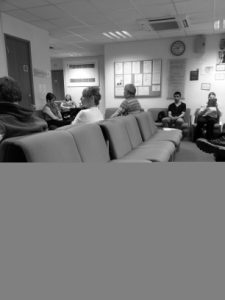
The jury assembly area is a comfortable but unexciting lounge, with chairs, tables, a handful of magazines, books, and jigsaws, a television (at a low volume), vending machines,
lockers, and nearby toilets. Well-prepared for a wait, I started setting myself up a remote office, tethering myself an Internet connection and monopolising a bank of
electrical sockets. After a while, a jury officer appeared and took a register, amid mutters from some of the other potential jurors that it was “like being at school”.
Jurors in a jury assembly area. They’re not as tightly-packed as they look: there’s space around the corner for more of them – they’re crammed into this area so that they can see the
screen to watch an imminent screening of an instructional DVD.
There was some confusion about whether some of the potential jurors were supposed to be here at all (or had finished their service in the previous week), and about whether some others
who were supposed to be present had arrived at all (and were perhaps hiding in the toilet or had disappeared down the corridor to the hot drinks dispenser), and the
official had to excuse herself for a while to sort everything out. This gave us another extended period of sitting around doing nothing, which I quickly came to discover is an integral
part of the experience of being a juror. Eventually, though, she returned and played for us a (slightly patronising) DVD, explaining our duties as jurors, before describing to us the
process of selection and panelling, claiming expenses, and so on, and answering questions from the potential jurors present.
Click through to watch “Your role as a juror”, the Ministry of Justice’s explanatory video on the role of a juror (the content is identical to the DVD we were shown).
A random selection done somewhere behind the scenes had apparently resulted in my being assigned to a case that afternoon, which I hung around for. But for some reason, that case never
happened – it just got cancelled, and I got sent home. Later – in accordance with my instructions pack – I phoned a special answerphone line I’d been given and listened, in a numbers station-like way, for my juror number to be called for the following day. It
came up, with an instruction that I’d been selected for a case starting the following morning. There was still every chance that I might not actually be selected for the jury, owing to
the complicated multi-step randomisation process (as well as the usual factors that I could be disqualified by knowing somebody involved with the case, or the case not being heard that
day at all), but this was still an exciting step forwards after spending most of a day sat in a waiting room for nothing to happen.
But that can wait for the next blog post in the series.
This blog post is the first in a series about buying our first house.
Today, I called up a man on the telephone and – on behalf of Ruth, JTA, and I – offered him several hundred thousand pounds in exchange for his house. Well, actually I spoke to the agent who represents him, but –
crazy alternatives notwithstanding – I gather that’s sort-of
the way that things are often done in the world of buying and selling property.
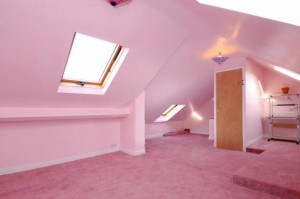
When looking at houses, it’s important to look beyond its current decoration, and see the potential beyond. If you ever get your eyesight back.
With house prices in Oxford averaging about twice the national average, it’s a genuinely scary thing to be doing, to be looking seriously at owning one. On the upside, once we’re done
paying for it we could sell it and use the money to buy a yacht. On the downside, by the time we’re done paying for it the sea level may have risen by enough that we’ll need one.
Sure, it’s got a wood-burning fire, lots of space, and a fair price… but what are the downsides?
House-hunting has been challenging, at times. The place that first caught our interest got quickly pushed down the list after we thought about the implications that the layout of rooms
would have for us (as well as its crazy stairwell). The second place that we ‘connected’ with seemed like a clear winner; lots of great features for a very reasonable price. But then we
tried cycling to it, and it turns out there’s no way to get there from Oxford without going over what JTA described as “a mountain”! And then, in case we needed more dissuasion, I
looked at how far it was from the nearest telephone exchange, and discovered that broadband Internet access there would be only marginally faster than dial-up… until at least 2015. It doesn’t matter how good its
countryside views are, it’s not worth trading high-def video for!
Will this be the last rented accommodation we ever have? [Google Street View]
I don’t know if there’ll be much to say about the process of buying a house, from here. I don’t know if there’s anything interesting enough to share! But just like my imminent jury duty, I thought I’d share with you all anyway, even if just to say: “How about a housewarming party,
sometime?”
I’d like to share with you the worst joke that I ever heard. Those of you who’ve heard me tell jokes before might think that you’ve already suffered through the worst joke
I ever heard, but you honestly haven’t. The worst joke I ever heard was simply too awful to share. But maybe now is the time.
The playground of Holme Slack Primary School, and the very wall that I was probably sitting on when I first heard this “joke”.
To understand the joke, though, you must first understand where I grew up. For most of my school years, I lived in Preston, in the North-West of England. After first starting school in
Scotland, and having been brought up by parents who’d grown up in the North-East, I quickly found that there were a plethora of local dialect differences and regional slang terms that I
needed to get to grips with in order to fit into my new environment. Pants, pumps, toffee, and bap, among others, had a different meaning here, along with entirely new words like belm
(an insult), gizzit (a contraction of “give it [to me]”), pegging it (running away, perhaps related to “legging it”?), and kegs (trousers). The playground game of “tag” was called
“tig”. “Nosh” switched from being a noun to a verb. And when you wanted somebody to stop doing something, you’d invariably use the imperative “pack it in!”
And it’s that last one that spawned the worst joke I ever heard. Try, if you can, to imagine the words “pack it in”, spoken quickly, in a broad Lancashire accent, by a young child. And
then appreciate this exchange, which was disturbingly common in my primary school:
Child 1: Pack it in!
Child 2: Pakis don’t come in tins. They come from India.
In case it’s too subtle for you, the “joke” stems from the phonetic similarity, especially in the dialect in question, between the phrase “pack it in” and the phrase “paki tin”.
Unless the recent horsemeat scandal investigation takes a dramatic and unexpected twist, we can be pretty sure that this item contains no people from Pakistan.
In case you need to ask why this is the worst joke I ever heard, allow me to explain in detail everything that’s wrong with it.
It’s needlessly racist
Now I don’t believe that race is necessarily above humour – and the same goes for gender, sexuality, religion, politics, etc. But there’s difference between using a racial slur to
no benefit (think: any joke containing the word “nigger” or “polak”), and jokes which make use of race. Here’s one of my favourite jokes involving race:
The Pope goes on a tour of South Africa, and he’s travelling in his Popemobile alongside a large river when he catches sight of a black man in the river. The man is struggling
and screaming as he tries in vain to fight off a huge crocodile. Suddenly, the Pope sees two white men leap into the water, drag the man and the crocodile to land, and beat
the crocodile to death with sticks, saving the black man’s life.
The Pope, impressed, goes over to where the two men are standing. “That was the most wonderful thing to do,” his holiness says. “You put yourselves at risk to kill the crocodile and
save the life of your fellow man. I can see that it is men like you who will rebuild this country as an example to the world of true racial harmony.”
The Pope goes on his way. “Who was that?” asks one of the white men.
The other replies: “That was the Pope. He is in direct communication with God. He knows everything.”
“Maybe,” says the first, “But he knows fuck all about crocodile fishing!”
The butt of this joke is not race, but racists. In this example, the joke does not condone the actions of the ‘crocodile fishers’: in fact, it contrasts them (through the Pope’s mistake
in understanding) to the opposite state of racial harmony. It does not work to reinforce stereotypes. Oh, and it’s funny: that’s always a benefit in a joke. Contrast to jokes about
negative racial sterotypes or using offensive terms for no value other than for the words themselves: these types of jokes can serve to reinforce the position of actual
racists who see their use (and acceptance) as reinforcement for their position, and – if you enjoy them – it’s worth asking yourself what that says about you, or might be seen to say
about you.
Among its other faults, the worst joke I ever heard relies upon an incredibly weak pun. It even makes this comic, by Completely Serious Comics, look good. [click for full comic]
It’s an incredibly weak pun
What would “paki tin” even mean, if that were what the first child had meant? It’s not as if we say “beans tin” or “soup tin” or “peas tin”. Surely, if this piece of
wordplay were to make any sense whatsoever, it would have to be based on the phrase “tin of pakis”, which I’m pretty sure nobody has ever said before, ever.
To illustrate, let me have a go at making a pun-based joke without the requirement that the pun actually make sense:
Knock knock.
Who’s there?
Yoodough.
Yoodough who?
Youdough not understand how jokes are supposed to work, do you?
You see? Not funny (except perhaps in the most dadaist of humour circles). It’s not funny because Yoodough isn’t actually a name. The format of the joke is ruined by balancing
a pun against a phrase that just doesn’t exist. Let’s try again, but this time actually make the pun make sense (note that it’s still a knock knock joke, and therefore it probably still
isn’t funny, except in an academic way):
Knock knock
Who’s there?
Yuri.
Yuri who?
Yuri-ly expect me to laugh at this, do you?
It’s stupidly inaccurate
Let’s just stop and take a look at that punchline again, shall we: “Pakis… come from India.” Even ignoring everything else that’s wrong with this joke, this is simply… wrong! Now that’s
not to say that jokes always have to reflect reality. Here’s a classic joke that doesn’t:
Lion woke up one morning with an overbearing desire to remind his fellow creatures that he was king of the jungle. So he marched over to a monkey and roared: “Who is the mightiest
animal in the jungle?”
“You are, Master,” said the monkey, quivering.
Then the lion came across a wildebeest.
“Who is the mightiest animal in the jungle?” roared the lion.
“You are, Master,” answered the wildebeest, shaking with fear.
Next the lion met an elephant.
“Who is the mightiest animal in the jungle?” roared the lion.
The elephant grabbed the lion with his trunk, slammed him repeatedly against a tree, dropped him like a stone and ambled off.
“All right,” shouted the lion. “There’s no need to turn nasty just because you don’t know the answer.”
Aside from the suspension of disbelief required for the dialogues to function at all – none of these animals are known to be able to talk! – there’s an underlying issue
that lions don’t live in jungles. But who cares! That’s not the point of the joke.
Count the lions in this picture. If you found no lions, then you counted correctly. If you got any other number, try again.
In the case of the “paki” joke, the problem could easily be corrected by saying “…they come from Pakistan.” It’d still probably be the worst joke I ever heard, but at
least it’d be trying to improve itself. I remember being about 8 or 9 and explaining this to a classmate, but he wasn’t convinced. As I remember it, he called me a
belm and left it at that.
So that’s the worst joke I ever heard. And now you’ve heard it, you can rest assured that every joke you hear from me – no matter how corny, obscure, long-winded or pun-laden – will at
least be better than that one.
Here’s one last joke, for now:
A woman gets on a bus with her baby. “Ugh!” says the bus driver, “That’s got to be the ugliest baby I’ve ever seen!”
The woman walks to the rear of the bus and sits down, fuming and close to tears. She says to a man next to her: “The driver just insulted me! I’m so upset!”
“You go up there and tell him off,” the man replies, “Go on, I’ll hold your monkey for you.”
Last month I was working from home one day, when I heard the postman drop off an unusually-loud stack of mail through our letterbox. Anticipating that one of them might have been
a Graze box – and feeling the need for a little bit of a snack to
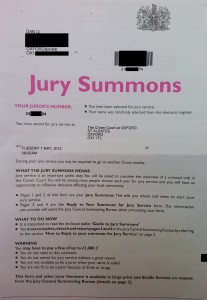
keep my brain going – I wandered downstairs to take a look. There, among some other letters, I found a windowed envelope containing a pink letter: a Jury Summons.
For some reason, the Jury Central Summoning Bureau print their letters onto pink paper. It makes them stand out, I suppose.
Responses from people I’ve told about it have been mixed: some have been positive (“that sounds really interesting”); some have been negative (“isn’t there any way you can
get out of it?”); others still have been curious (“you must tell us all about it!”). Personally, I’m pretty keen: it seems to me that jury duty’s an important civic duty,
and I’m genuinely interested in the process. If it were a role that one volunteered for – and clearly it shouldn’t be, for reasons that ought to be obvious – then I’d volunteer for and
give it a go, at least once: however, I wouldn’t necessarily volunteer for it now, when my work and life is so busy already!
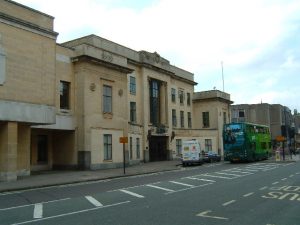
Looks like I’m going to get familiar with Oxford Crown Court. First question: where’s the nearest place to safely park my bike?
I’ve spoken to people who’ve done jury service before, and a reasonable number of them said that they found the experience boring. From the sounds of things, there’re liable to be
extended periods of sitting around, waiting to be (possibly) assigned to a trial. On the up-side, though, it seems likely that I’ll be allowed to use a portable computer in the waiting
area – though obviously not in the courtroom or jury areas – so I might at least be able to get a little work done and simultaneously stave off boredom during any period that
I’m not assigned to a case.
See: no cycle parking anywhere! They’re not completely cycle-hostile, though: they have offered to pay me 9.6p per mile for biking in each day.
It’s the people who’ve expressed an interest in the process for whom I’ve decided to blog about my experience. Of course, I won’t be able to share anything at all
about any case I’m assigned to or about the other jurors who served on them, but I can certainly share my experience of being a juror. Perhaps if you’re called to a jury
at some point, it’ll give you some idea what to expect.
Monopoly – the world’s best-selling board game – sucks. I’ve said it
before, but it bears saying again. I’ve never made any secret of my distaste for the game, but it’s probably worth spelling out the reasons, in case you’ve somehow missed them.
Monopoly (British Edition) in its current branding
Broadly-speaking, there are four things wrong with Monopoly: the rules, the theme, the history, and the
players.
The Rules
The following issues have plagued Monopoly for at least the last 75 years:
It takes a disproportionately long time to play, relative to the amount of fun it provides or skill it tests. A longer game is not intrinsically more-exciting:
would a 1000-square Snakes & Ladders be
ten times as good as a 100-square one? Monopoly involves a commitment of three to four hours, most of it spent watching other people take their turns.
It’s an elimination game: players are knocked out (made bankrupt) one at a time, until only one remains. This invariably leads to a dull time for those players
first removed from the game (compounded by the game length). In real-world play, it’s usually the case that a clear winner is obvious long before the game ends, leading
to a protracted, painful, and frankly dull slow death for the other players. Compare this to strategic games like Power Grid, where it can be hard to call the winner between closely matched players right up until the final turns, in
which everybody has a part.
It depends hugely on luck, which fails to reward good strategic play. Even the implementation of those strategies which do exist remain heavily
dependent on the roll of the dice. Contrast the superficially-simpler (and far faster) property game For Sale, which rewards strategic play with just a smidgen of luck.
It’s too quick to master: you can learn and apply the optimal strategies after only a handful of games. Coupled with the amount of luck involved, there’s little to
distinguish an expert player from a casual one: only first-time players are left out. Some have argued that this makes it easier for new players to feel like part of the game, but there
are other ways to achieve this, such as handicaps, or – better – variable starting conditions that make the game different each time, like Dominion.
There’s little opportunity for choice: most turns are simply a matter of rolling the dice, counting some spaces, and then either paying (or not paying) some
rent. There’s a little more excitement earlier in the game, when properties remain unpurchased, but not much. The Speed Die add-on goes a small way to fixing this, as well as shortening the duration of the
game, but doesn’t really go far enough.
The rules themselves are ambiguously-written. If they fail to roll doubles on their third turn in jail, the rules state, the player much pay the fine to be
released. But does that mean that they must pay, then roll (as per the usual mechanic), in which case must it be next turn? Or should it be this turn, and if so, should
the already-made (known, non-double) roll be used? Similarly, the rules state that the amount paid when landing on a utility is the number showing on the dice: is this to be a fresh
roll, or is the last roll of the current player the correct one? There are clarifications available for those who want to look, but it’s harder than it needs to be: it’s no wonder that
people seem to make it up as they go along (see “The Players”, below, for my thoughts on this).
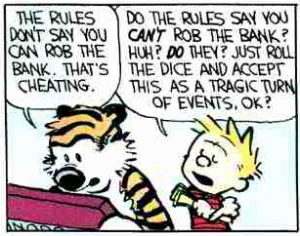
Calvin and Hobbes demonstrate exactly what’s wrong with Monopoly, by demonstrating exactly what’s wrong with Monopoly players. Click for the full comic.
The Theme
But that’s not what Monopoly‘s about, is it? Its purpose is to instil entrepreneurial, capitalist values, and the idea that if you work hard enough, and you’re lucky enough,
that you can become rich and famous! Well, that’s certainly not its original purpose (see “The History”, below), but even if it were, Monopoly‘s theme is still
pretty-much broken:
It presents a false financial model as if it were a reassuring truth. “The Bank can never go bankrupt,” state the rules, instructing us to keep track of
our cash with a pen and paper if there isn’t enough in the box (although heaven help you if your game has gone on long enough to require this)! Maybe Parker Brothers’ could have simply
given this direction to those financial institutions that collapsed during the recent
banking crisis, and saved us all from a lot of bother. During a marathon four-day game at a University of Pittsburgh fraternity, Parker Brothers couriered more money
to the gamers to “prop up” their struggling bank: at least we can all approve of a bailout that the taxpayer doesn’t have to fund, I suppose! Compare this to Puerto Rico, a game which also requires a little thematic suspension of
disbelief, but which utilises the depletion of resources as an important game mechanic, forcing players to change strategies in order to remain profitable.
Curiously, this same rule does not apply to the supply of houses and hotels, which are deliberately limited: the Monopoly world is one in which money is
infinite but in which bricks are not. This makes it more valuable to build houses when there are few resources (in order to deprive your opponents). In actual
economies, however, the opposite is true: houses are always needed, but the resources to built them change in value as they become more or less scarce. Watch the relative
perceived values of the huts available to build in Stone Age to see
how a scarcity economy can really be modelled.
The more houses I build on a street, the more each one is individually worth. Wait, what?
Also, it has a completely-backwards approach to market forces. In the real world, assuming (as Monopoly does) a free market, then it
is consumer demand that makes it possible to raise capital. In the real world, the building of three more hotels on this side of the city makes it less-likely
that anybody will stay at mine, but this is not represented at all. Compare to the excellent 7 Wonders, where I can devalue my neighbour-but-one’s goods supply by producing my own, of the same type.
It only superficially teaches that “American dream” that you can get ahead in the world with a lot of work and a little luck: this model collapses outside of
frontier lands. If you want to see what the real world is like, then wait until you’ve got a winner in a game of Monopoly, and then allow everybody else to
re-start the game, from the beginning. It’s almost impossible to get a foothold in a market when there’s already a monopoly in existence. This alternative way of playing might
be a better model for real-world monopolies (this truth is captured by the game Anti-Monopoly in a way that’s somehow even less-fun than the original).
You might shoot down any or all of these arguments by pointing out that “it’s just a game.” But on the other hand, we’ve already discovered that it’s not a very good game.
I’m just showing how it manages to lack redeeming educational features, too. With the exception of helping children to learn to count and handle money (and even that is lost in the
many computer editions and semi-computerised board game versions), there’s no academic value in Monopoly.
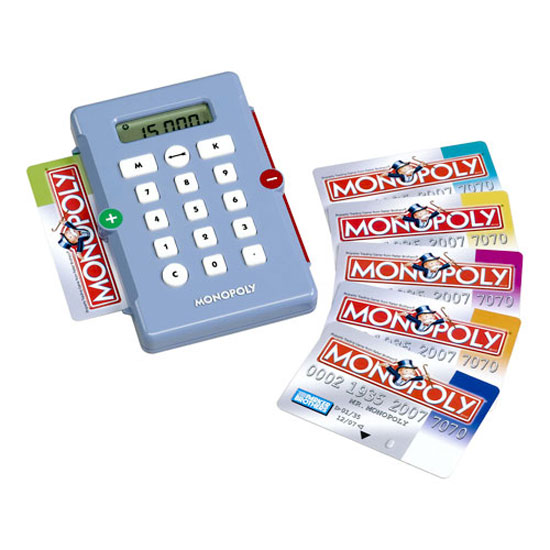
The electronic banking edition of Monopoly makes an already slow game even slower, unless you’re REALLY bad at arithmetic: in which case you should be playing with money so that you
can learn some arithmetic!
The History
You’ve seen now why Monopoly isn’t a very good game both (a) because it’s not fun, and (b) it’s not really educational either – the two biggest reasons that anybody might want to play
it. But you might also be surprised to find that its entire history is pretty unpleasant, too, full of about as much backstabbing as a typical game of Monopoly, and primarily for the
same reason: profit!
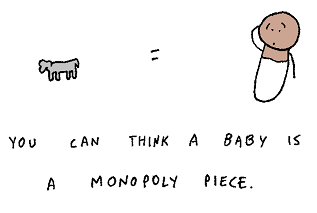
You can think of a baby as a Monopoly piece, but I wouldn’t recommend it. Click for the full comic.
If you look inside the rulebook of almost any modern Monopoly set, or even in Maxine Brady’s well-known strategy guide, you’ll read an abbreviated version of the story of Charles Darrow, who – we’re told – invented the game and then published it through
Parker Brothers. But a little detective work into the history of the game shows that in actual fact he simply made a copy of the game board shown to him by his friend Charles Todd.
Todd, in turn, had played it in New Jersey, to which it had traveled from Pennsylvania, where it had originally been invented – and patented – by a woman called Elizabeth Magie.
Home-made “Landlord’s Game” boards, like this one, were popular in the early part of the 20th century.
Magie’s design differed from modern interpretations in only one major way: its educational aspect. Magie was a believer in Georgian economic philosophy, a libertarian/socialist ideology that posits that while the things we create can be owned,
the land belongs equally to everybody. As a result, Georgists claim, the “ownership” of land should be taxed according to its relative worth, and that this should be the
principal – or only, say purists – tax levied by a state. Magie pushed her ideas in the game, by trying to show that allowing people to own land (and then to let out the right of others
to live on it) serves only to empower landlords… and disenfranchise tenants. The purpose of the game, then, was to show people the unfairness of the prevailing economic system.
Lizzie Magie’s 1904 patent application shows a board with familiar features like streets for sale (which can then be rented out), stations, taxes, utilities, and the “public park”
(free parking).
Magie herself approached Parker Brothers several times, but they didn’t like her game. Instead, then, she produced sets herself (and an even greater number were home-made), which proved
popular – for obvious reasons, considering their philosophical viewpoints – among Georgists, Quakers, and students. She patented a revised version in 1924, which added now-familiar features like
cards to mark the owned properties, as well as no-longer-used ideas that could actually go a long way to improving the game, such as a cash-in-hand “goal” for the winner, rather than an
elimination rule.
An early boxed copy of Parker Bros’ “Monopoly”.
Interestingly, when Parker Brothers first rejected Charles Darrow, they said that the game was “too complicated, too technical, took too long to play”: at least they and I agree on one
thing, then! Regardless, once they eventually saw how popular Lizzie Magie’s version had become across Philadelphia, they changed their tune and accepted Darrow’s proposal. Then, they
began the process of hoovering up as many patents as they could manage, in order to secure their very own monopoly on a game that was by that point already 30 years old.
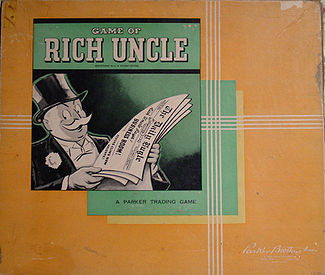
The “Rich Uncle” character, from the Parker Bros’ game of the same name, would eventually come to be the familiar mascot of Monopoly.
They weren’t entirely successful, of course, and there have been a variety of controversies around the legality and enforcability of the Monopoly trademark. Parker
Brothers (and nowadays, Hasbro) have famously taken to court the makers of board games with even-remotely similar names: most-famously, the Anti-Monopoly game in the
1970s, which they alternately won, then lost, then won, then lost again on a series of appeals in the early 1980s: there’s a really enjoyable book about the topic, and about the history
of Monopoly in general. It’s a minefield of court cases and counter-cases, but the short of it is that trade-marking “Monopoly” ought to be pretty-much impossible. Yet somehow, that’s
what’s being done.
What’s clear, though, is that innovation on the game basically stopped once Parker’s monopoly was in place. Nowadays, Hasbro expect us to be excited when they replace the iron with a cat or bring out yet another localised edition of the board. On those
rare occasions when something genuinely new has come out of the franchise – such as 1936’s underwhelming Stock Exchange
expansion, it’s done nothing to correct the fundamental faults in the game and generally just makes it even longer and yet more dull than it was to begin with.
The Players
The fourth thing that I hate about Monopoly is the people who play Monopoly. With apologies for those of you I’m about to offend, but here’s why:
Firstly, they don’t play it like they mean it. Maybe it’s because they’ve come to the conclusion that the only value in the game is to waste time for as long as possible (and let’s face
it, that’s a reasonable thing to conclude if you’ve ever played the game), but a significant number of players will deliberately make the game last longer than it needs to. I
remember a game once, as a child, when my remaining opponent – given the opportunity to bankrupt me and thus win the game – instead offered me a deal whereby I would give him some of my
few remaining properties in exchange for my continued survival. Why would I take that deal? The odds of my making a comeback with a total of six houses on the board and £200 in my
pocket (against his monopoly of virtually all the other properties) are virtually nil, so he wasn’t doing me any favours by offering me the chance to prolong my suffering. Yet I’ve also
seen players accept deals like like, masochistically making their dull pick-up-and-roll experience last even longer than it absolutely must.
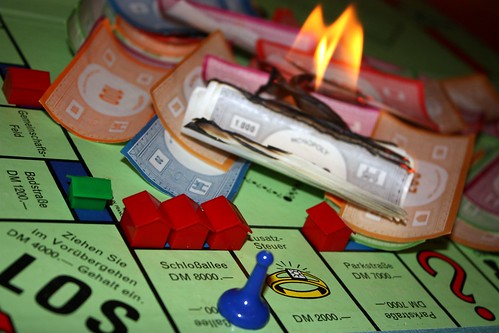
Kill it. Kill it with fire. Image courtesy Daniela Hartmann.
Or maybe it’s just that Monopoly brings out the cruel side of people: it makes them enjoy sitting on their huge piles of money, while the other players grovel around them. If they put
the other players out of their misery, it would end their fun. If so, perhaps Lizzie Magie’s dream lives on, and Monopoly really does teach us about the evils of capitalism: that the
richest are willing to do anything to trample down the poorest and keep them poor, so that the divide is kept as wide as possible? Maybe Monopoly’s a smarter game than I think: though
just because it makes a clever point doesn’t necessarily make a board game enjoyable.
It’s not that I’m against losing. Losing a game like Pandemic is endless fun because you feel like you have a chance, right until the end, and the mechanics of games like Tigris & Euphrates mean
that you can never be certain that you’re winning, so you have to keep pushing all the way through: both are great games. No: I just object to games in which winning and losing are
fundamentally attached to a requirement to grind another person down, slowly, until you’re both sick and tired of the whole thing.
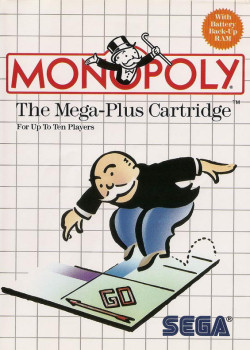
Nowadays, with computerised Monopoly games, you don’t even have to have friends to play. Which is great, because if you’re suggesting a game of Monopoly, you don’t deserve any.
The second thing that people do, that really gets on my nerves, is make up the damn rules as they go along. I know that I spent a while further up this page complaining
that Monopoly’s rules are pretty awful, but I can still have a rant about the fact that nobody seems to play by them anyway. This is a problem, because it means that if you ever play
Monopoly with someone for the first time, you just know that you’re setting yourself up for an argument when it turns out that their crazy house rules and your crazy house
rules aren’t compatible.
House rules for board games are fine, but make them clear. Before you start the game, say, “So, here’s the crazy rule we play by.” That’s fine. But there’s
something about Monopoly players that seems to make them think that they don’t need to. Maybe they assume that everybody plays by the same house rules, or
maybe they don’t even realise that they’re not playing by the “real” rules, but it seems to me that about 90% of the games of Monopoly I’ve been witness to have been punctuated at some
point by somebody saying “wait, is that allowed?”
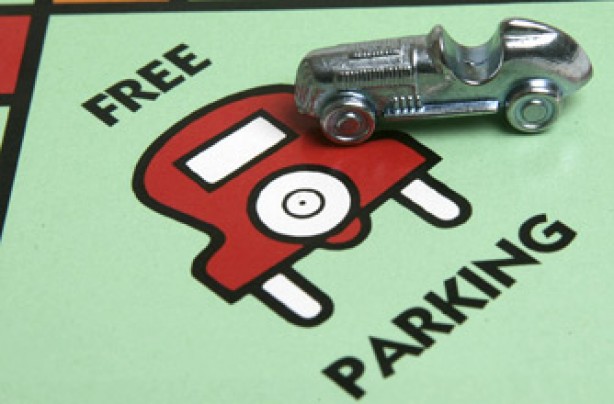
The “Free Parking Jackpot” is probably the worst house rule for Monopoly that’s ever been invented. But it’s incredibly popular.
Because I’m a bit of a rules lawyer, I pay attention to house rules. Free Parking Jackpot, in which a starting pile of money – plus everybody’s taxes – go in to the centre of
the board and are claimed by anybody who lands on Free Parking, is probably the moth loathsome house rule. Why do people feel the need to take a game
that’s already burdened with too much luck and add more luck to it. My family used to play with the less-painful but still silly house rule that landing
exactly on “Go!” netted you a double-paycheque, which makes about as much sense, and it wasn’t until I took the time to read the rulebook for myself (in an attempt, perhaps, to work out
where the fun was supposed to be stored) that I realised that this wasn’t standard practice.
Toothpaste For Dinner has the right idea. Click through to the original comic.
Playing without auctions is another common house rule, which dramatically decreases the opportunity for skillful players to bluff, and generally lengthens the game (interestingly, it
was a house rule favoured by the early Quaker players of the game). Allowing the trading of “immunity” is another house rule than lengthens the game. Requiring that players travel
around the board once before they’re allowed to buy any properties is yet another house rule that adds a dependence on luck and – yet again – lengthens the game. Disallowing trading
until all the properties are owned dramatically lengthens the game, and for no benefit (why not just shuffle the property deck and deal it out to everybody to begin with: it’s faster
and achieves almost the same thing?).
I once met a family who didn’t play with the rule that you have to spend 10% extra to un-mortgage a property, allowing them to mortgage and un-mortgage with impunity (apparently, they
found the arithmetic too hard)! And don’t get me started on players who permit “cheating” (so long as you don’t get caught) as a house rule…
Spot something in common with these house rules? Most of them serve to make a game that’s already too long into something even longer. Players who implement these kinds of house rules
are working to make Monopoly – an already really bad game – into something truly abysmal. I tell myself, optimistically, that they probably just don’t know better, and point them in the
direction of Ticket to
Ride, The Settlers
of Catan, or Factory Manager.
But inside, I know that there must be people out there who genuinely enjoy playing Monopoly: people who finish a game and say “fancy another?”, rather than the
more-rational activity of, say, the clawing out of their own eyes. And those people scare me.
Further Reading
If you liked this, you might also be interested in:
A recent article by Joshua Hedlund explains that Monopoly is (still) an outdated board game (he shares a lot of
my points, but I swear I’d almost finished writing this post before I discovered his)
Have you ever come across non-transitive dice? The classic set, that you can get in most magic shops, consists of three different-coloured six-sided dice:
A “Grime’s” style set of 3 non-transitive dice. Notice the unusual numbering.
There are several variants, but a common one, as discussed by
James Grime, involves one die with five “3” sides and one “6” side (described as red below), a second die with three “2” sides and three “5” sides (described as
green below), and a third die with one “1” side and five “four” sides (described as blue below).
They’re all fair dice, and – like a normal six-sided dice – they all have an average score of 3.5. But they’ve got an interesting property, which you can use for all kinds of magic
tricks and gambling games. Typically: the red die will beat the green die, the green die will beat the blue die, and the blue die will beat the red die! (think Rock, Paper,
Scissors…)
Seemingly paradoxically, the dice will generally beat one another in a circular pattern.
If you want to beat your opponent, have them pick a die first. If they pick green, you take red. If they take red, you take blue. If they take blue, you take green. You now have about a
60% chance of getting the highest roll (normally you’d have about a 33% chance of winning, and a 17% chance of a draw, so a 60% chance is significantly better). To make sure that you’ve
got the best odds, play “best of 10” or similar: the more times you play, the less-likely you are to be caught out by an unfortunate unlucky streak.
But if that doesn’t bake your noodle enough, try grabbing two sets of nontransitive dice and try again. Now you’ll see that the pattern reverses: the green pair tends to beat the red
pair, the red pair tends to beat the blue pair, and the blue pair tends to beat the green pair! (this makes for a great second act to your efforts to fleece somebody of their money in a
gambling game: once they’ve worked out how you keep winning, give them the chance to go “double or nothing”, using two dice, and you’ll even offer to choose first!)
When you pair up the dice, the cycle reverses! While red beats green, double-green beats double-red!
The properties of these dice – and of the more-exotic forms, like Oskar van Deventer’s seven-dice set (suitable for playing a game with three players and beating both of your
opponents) and like the polyhedral
varieties discussed on Wikipedia – intrigue the game theorist and board games designer in me. Could there be the potential for this mechanic to exist in a board game? I’m thinking
something with Risk-like combat (dice ‘knock out’ one another from highest to lowest) but with a “dice acquisition” mechanic (so players perform actions, perhaps in
an auction format, to acquire dice of particular colours – each with their own strengths and weaknesses among other dice – to support their “hand” of dice). There’s a discussion going on in /r/tabletopgamedesign…
I’ve even written a program (which you’re welcome to download, adapt, and use) to calulate the
odds of any combination of any variety of non-transitive dice against one another, or even to help you develop your own non-transitive dice sets.
Penney’s game
Heads or tails? Image courtesy David M. Diaz.
Here’s another non-transitive game for you, but this time: I’ve made it into a real, playable game that you can try out right now. In this game, you and I will each, in turn, predict
three consecutive flips of a fair coin – so you might predict “tails, heads, heads”. Then we’ll start flipping a coin, again and again, until one of our sequences comes up. And more
often than not, I’ll win.
If you win 10 times (or you lose 20 times, which is more likely!), then I’ll explain how the game works, so you know how I “cheated”. I’ll remind you: the coin flips are fair, and it’s
nothing to do with a computer – if we played this game face-to-face, with a real coin, I’d still win. Now go play!