In addition to the pension I get from my “day job” employer, I maintain a pension pot with a separate private provider which I top up with
money from my freelance work. I logged in to that second pension provider’s (reliably shonky, web-standards-violating) website about a month ago and found that I couldn’t do anything
because they’d added a new mandatory field to the “My Profile” page and I wasn’t allowed to do anything else until I’d filled it out. No problem, I thought: a few seconds won’t kill me.
If I’m lucky, I might be able to afford to retire this century.
The newly-added field turned out to be “Gender”, and as it was apparently unacceptable to leave this unspecified (as would be my preference: after all,
I’ll certainly be retiring after November 2018, when gender will cease to have any legal bearing on retirement age), I clicked the drop-down to see what options they’d provided. “Not
provided”, “Male”, and “Female” were the options: fine, I thought, I’ll just pick “Not provided” and be done with it. And for a while, everything seemed fine.
Leaving the field as the undefined “Select One” option wasn’t valid (I tried!) so I changed the value.
Over three weeks later I received a message from them saying that they hadn’t yet been able to action the changes to my profile because they hadn’t yet received hard-copy documentary
evidence from me. By this point, I’d forgotten about the minor not-really-a-change change I’d made and assumed that whatever they were on about must probably be related to my unusual name. I sent a message back to them to ask exactly what kind of evidence they needed to see. And that’s when things got weird.
I received a message back – very-definitely from a human – to say that what they needed to see what evidence of my gender change. That is, my change of gender from “not specified” to
“not provided”.
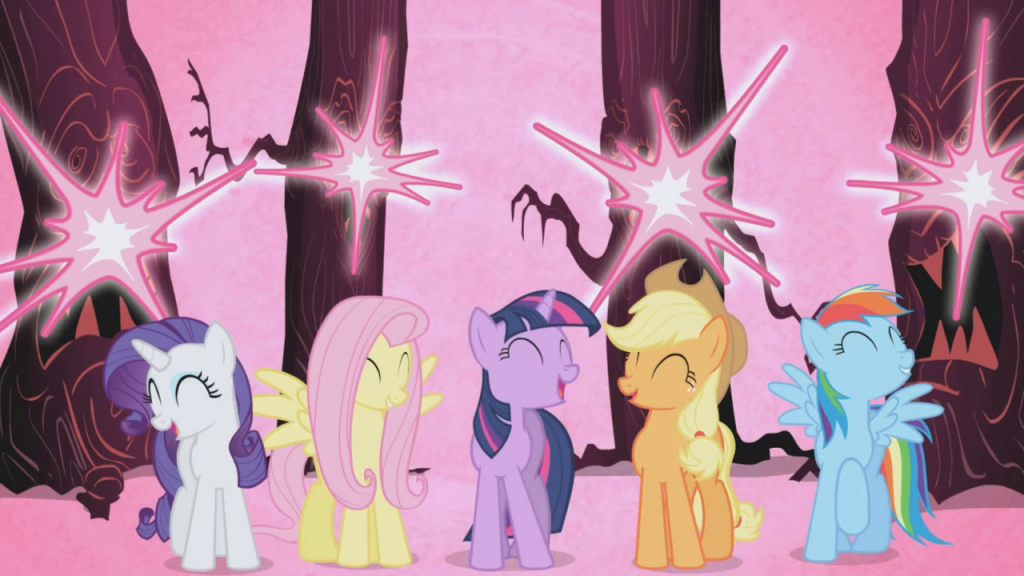
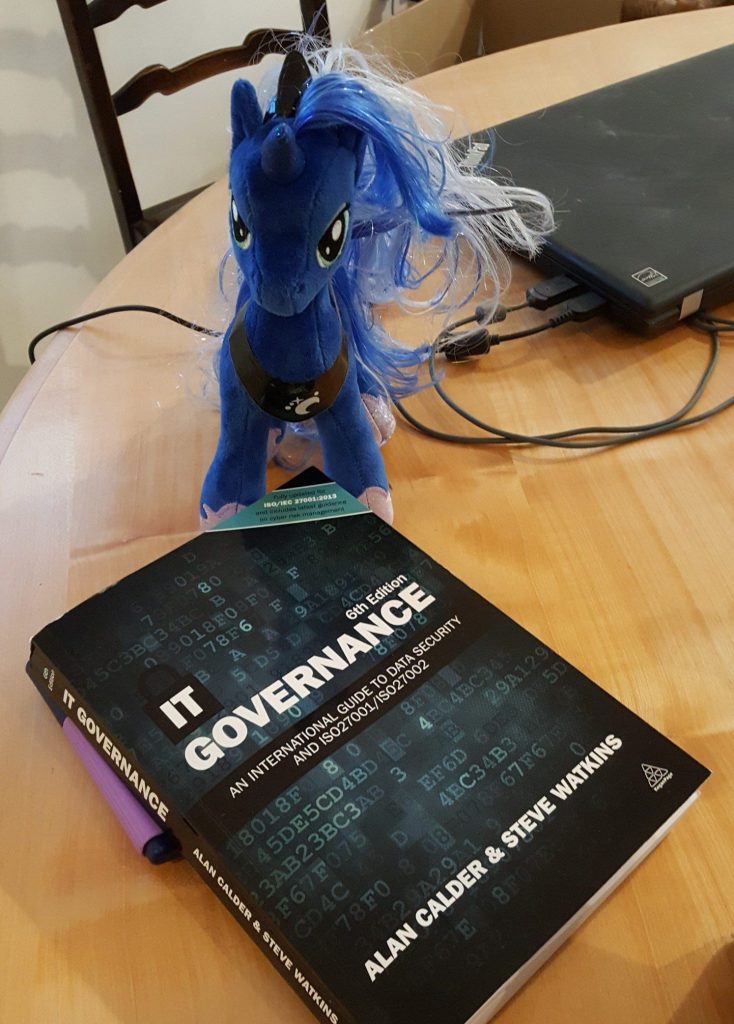
Fluttershy gets it.
They went on to suggest that I could get my doctor to certify a letter verifying my gender change. Needless to say, I haven’t made an appointment to try to get my GP to sign a document
that confirms that my gender is “not provided”. Instead, I’ve emailed back to ask them to read what they just asked me for again, and perhaps this time they’ll engage both
brain cells and try to think about what they’re actually asking, rather than getting tied up in knots in their own bureaucratic process. Let’s see how that goes.
Seeing as it’s almost Valentine’s Day and by way of proof that I’m not always so serious as to write about important topics like WordPress’s CAPTCHA implementation or
how I became a brony, here are some of the highlights of a conversation that Ruth and I just
had (tapping in to our inner 12-year-olds, I guess: some alcohol might have been involved) about song lyrics that are immeasurably improved if you replace the word “love” with “butt”.
Here are some of my favourites:
Greatest Butt Of All – Whitney Houston
Can You Feel The Butt Tonight? – Elton John
Shower Me With Your Butt – Surface
Eww.
Big Butt – Fleetwood Mac
I Would Do Anything For Butt (But I Won’t Do That) – Meat Loaf
Too Much Butt Will Kill You
“Torn between the butter and the butt you leave behind.” Yes, you can totally turn “lover” into “butter”, but it’s the addition of the word “behind” that made me snortle.
Thinking Out Loud – Ed Sheeran
“Will your mouth still remember the taste of my butt? Will your eyes still smile from your cheeks?”
Butt Song For A Vampire – Annie Lennox
Bleeding Butt – Leona Lewis
“Keep bleeding. Keep, keep bleeding, butt. You cut me open”
How Deep Is Your Butt? – Bee Gees
Addicted to Butt – Robert Palmer
“It’s closer to the truth to say you can’t get enough. You know you’re gonna have to face it: you’re addicted to butt.”
One – U2
“Did I disappoint you, or leave a bad taste in your mouth? You act like you never had butt and you want me to go without.”
Lay All Your Butt On Me – ABBA
Butt Stinks – The J. Geils Band
Tainted Butt – Soft Cell
Can’t Help Falling In Butt – Elvis Prestley
Okay, now I’ve got that out of my system we can carry on as normal.
One of the most-popular WordPress plugins is Jetpack, a product of Automattic (best-known for providing the widely-used WordPress hosting service “WordPress.com“). Among Jetpack’s
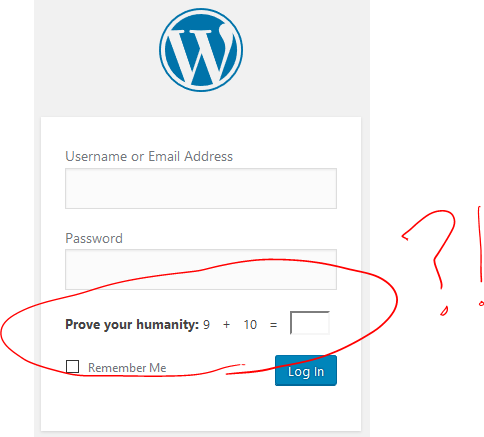
features (many of which are very good) is Jetpack Protect which adds – among other things – the possibility for a CAPTCHA to appear on your login pages. This feature is slightly worse than pointless as it makes
it harder for humans to log in but has no significant impact upon automated robots; at best, it provides a false sense of security and merely frustrates and slows down legitimate human
editors.
Thanks, WordPress, for slowing me down with a CAPTCHA that a robot can solve more-easily than a human.
“Proving your humanity”, as you’re asked to do, is a task that’s significantly easier for a robot to perform than a human. Eventually, of course, all tests of this nature seem likely to fail as robots become smarter than humans
(especially as the most-popular system is specifically geared towards training robots), but that’s hardly an excuse for inventing a system
that was a failure from its inception. Jetpack’s approach is fundamentally flawed because it makes absolutely no effort to disguise the challenge in a way that humans are able to read
any-differently than robots. I’ll demonstrate that in a moment.
Don’t just disable this, though! Other “Protect” features make sense. If only you could disable just the one that doesn’t…
A while back, a colleague of mine network-enabled Jetpack Protect across a handful of websites that I occasionally need to log into, and it bugged me that it ‘broke’ my password safe’s
ability to automatically log me in. So to streamline my workflow – as well as to demonstrate quite how broken Jetpack Protect’s CAPTCHA is, I’ve written a userscript that you can install into your web browser that will
completely circumvent it, solving the maths problems on your behalf so that you don’t have to. Here’s how to use it:
Install a userscript manager into your browser if you don’t have one already: I use Tampermonkey, but it ought to work with almost any of
them.
From now on, whenever you go to a page whose web path begins with “/wp-login.php” that contains a Jetpack Protect maths problem, the answer will be automatically calculated and
filled-in on your behalf. The usual userscript rules apply: if you don’t trust me, read the source code (there are really only five lines to check) and disable automatic updates for it
(especially as it operates across all domains), and feel free to adapt/improve however you see fit. Maybe if we can get enough people using it Automattic will fix this
half-hearted CAPTCHA – or at least give us a switch to disable it in the first
place.
Update: 15 October 2018 – the latest version of Jetpack makes an insignificant change to this CAPTCHA; version 1.2 of this script (linked above) works around the change.
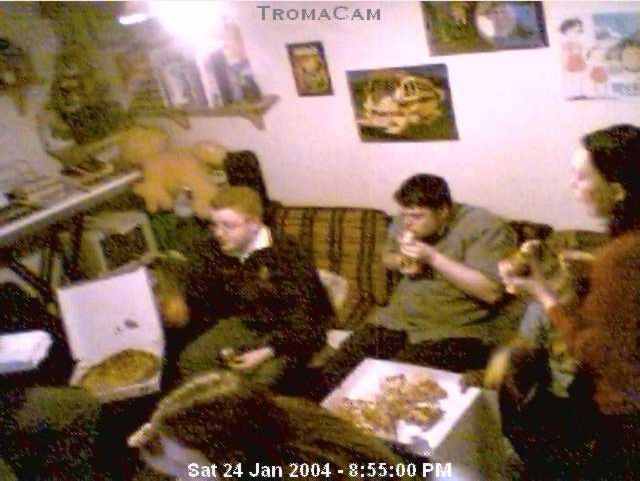
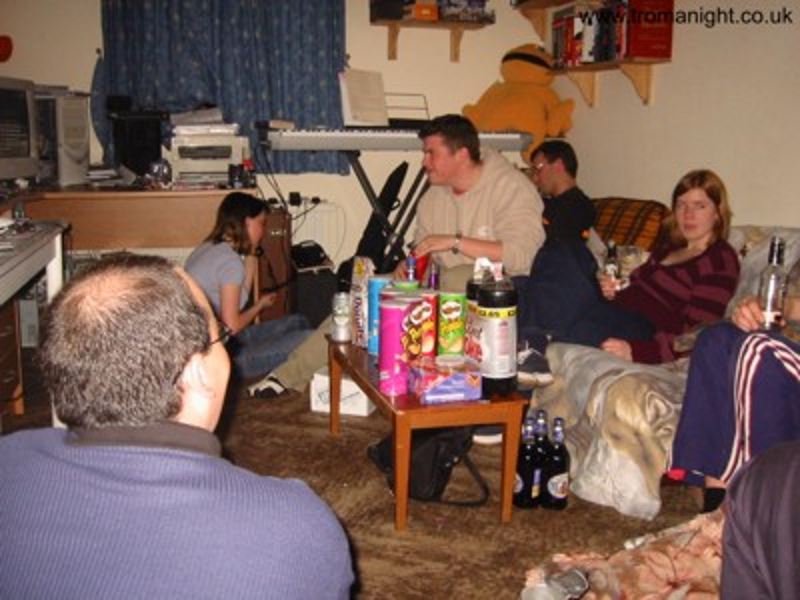
On this day in 2004… Troma Night XXI took place at The Flat. Six people were in attendance: Claire, Paul, Kit, Bryn, (Strokey) Adam and I and, unusually – remember that the digital cameras in phones were still appalling – I took pictures of everybody who showed up.
Cue exclamations of “didn’t we all look young”, etc.
Troma Night was, of course, our weekly film night back in Aberystwyth (the RockMonkey wiki once described it as “fun”). Originally launched as a one-off and then a maybe-a-few-off event with a theme of watching films produced (or
later: distributed) by Troma Entertainment, it quickly became a regular event with a remit to watch “all of the best and the worst films ever made”.
Expanding into MST3K, the IMDb “bottom 250”, and once in a while a good film, we eventually spent
somewhere over 300 nights on this activity (you can relive our 300th, if you like!)
and somehow managed to retain a modicum of sanity.
Copious quantities of alcohol might have been part of our survival strategy, as evidenced by these pictures from Troma Night V and Troma Night VI.
Troma Night XXI was among those captured by the Troma Night Webcam, streamed out to the Internet in 1-megapixel, 4 frames per second glory (when it worked).
In addition to running for over 300 weeks, Troma Night became, for many of us, a central facet of our social lives. The original attendees were all volunteers at Aberystwyth Nightline, but we were later joined by their friends, lovers, housemates… and by Liz‘s dates (who after meeting all of her friends, we usually never saw again). We quickly developed our own traditions and ideas, such as:
Pizzas like the Alec Special – a Hollywood Special (ham, pepperoni, beef, mushrooms, green peppers, onions,
sweetcorn) but without the onions and with pineapple substituted in instead – and the Pepperoni Feast particularly enjoyed by our resident vegetarian,
For those who – like me – insist that our regular Hollywood Pizza got greasier over this years, these photos from Troma Night VI.5 are pretty damning. Maybe it’s just that our tastes
changed.
Paul spontaneously throwing a sponge out of the window to mark the beginning of the evening’s activities,
Alec bringing exactly one more can of Grolsch than he’s capable of drinking and leaving the remainder in the fridge to be consumed by Kit at the start of the subsequent event,
A fight over the best (or in some cases only) seats in Claire and I’s various small (and cluttered) homes: we once got 21 people into the living room at The Flat, but it wasn’t
exactly pleasant,
Becoming such a regular customer to Hollywood Pizza that they once phoned us when we hadn’t placed an order in a timely fashion, on another ocassion turned up
with somebody else’s order because it “looked like the kind of thing we usually ordered”, and at least one time were persuaded to deliver the pizza directly up to the living room
and to each recipient’s lap (you can’t get much better delivery service than that).
Decisions about how Claire and I would lay out our furniture were eventually influenced directly by maximising the efficiency of our seating plan. This picture, from Troma Night IV,
makes it seem quite spacious and relaxed compared to later nights.
And I still enjoy the occasional awful film. I finally got around to watching Sharknado the other month, and my RiffTrax account’s library grows year on year. One of my reward card accounts is still under the name of Mr. Troma Knight. So I suppose that Troma Night
lives on in some the regulars, even if we don’t make ourselves suffer of a weekend in quite the
same ways as we once did.
To pre-empt any gatekeeping bronies in their generally-quite-nice society who want to tell me that I’m no “true” fan: save your breath, I already know. I’m not
actually claiming any kinship with the brony community. But what’s certainly true is that I’ve gained a level of appreciation for My Little Pony: Friendship is Magic that certainly goes beyond that of most people who aren’t fans of
the show (or else have children who are), and I thought I’d share it with you. (I can’t promise that it’s not just Stockholm syndrome, though…)
Twilight Sparkle and Rainbow Dash. Their friendship is magic, and yours can be too.
Ignoring the fact that I owned, at some point in the early 1980s, a “G1” pony toy (possibly Seashell) from the original, old-school My Little Pony, my first introduction to the modern series came in around 2010
when, hearing about the surprise pop culture appeal of the rebooted franchise, I watched the first two episodes, Friendship is Magic parts one and two: I’m aware that after I mentioned it to
Claire, she went on to watch most of the first season (a pegasister in
the making, perhaps?). Cool, I thought: this is way better than most of the crap cartoons that were on when I was a kid.
? Chortle at the kooky… snortle at the spooky… ?
And then… I paid no mind whatsoever to the franchise until our little preschooler came home from the library, early in 2017, with a copy of an early reader/board book called Fluttershy and the Perfect Pet. This turns out to be a re-telling of the season 2 episode May The Best Pet Win!, although of course I only know that with hindsight. I casually mentioned to her that there was a TV
series with these characters, too, and she seemed interested in giving it a go. Up until that point her favourite TV shows were probably PAW Patrol and Thomas the Tank Engine & Friends, but
these quickly gave way to a new-found fandom of all things MLP.
No ponies were harmed in the staging of this apparent massacre.
The bobbin’s now watched all seven seasons of Friendship is Magic plus the movie and so, by proxy – with a few exceptions where for example JTA was watching an episode with her – have I. And it’s these exceptions where I’d “missed” a few
episodes that first lead to the discovery that I am, perhaps, a “closet Brony”. It came to me one night at the local pub that JTA and I
favour that when we ended up, over our beers, “swapping notes” about the episodes that we’d each seen in order to try to make sense of it all. We’re each routinely roped into playing
games for which we’re expected to adopt the role of particular ponies (and dragons, and changelings, and at least one centaur…), but we’d both ended up getting confused as to
what we were supposed to be doing at some point or another on account of the episodes of the TV show we’d each “missed”. I’m not sure how we looked to the regulars – two 30-something
men sitting by the dartboard discussing the internal politics and friendship dramas of a group of fictional ponies and working out how the plots were interconnected – but if anybody
thought anything of it, they didn’t say so.
JTA and I’s local is among the most distinctly “village pub”-like pubs I’ve ever visited.
By the time the movie was due to come out, I was actually a little excited about it, and not even just in a vicarious way (I would soon be disappointed, mind: the movie’s mediocre at best, but at the three-year-old I took to the cinema was impressed, at least, and the “proper”
bronies – who brought cupcakes and costumes and sat at the back of the cinema – seemed to enjoy themselves, so maybe I just set my expectations too high). Clearly something in the TV
show had sunk its hooks into me, at least in a minor way. It’s not that I’d ever watch an episode without the excuse of looking after a child who wanted to do so… but I also
won’t deny that by the end of The Cutie Remark, Part One I wanted to make sure that I was the one to be
around when the little ‘un watched the second part! How wouldStarlight Glimmer be defeated?
? My little popcorn, my little popcorn… ?
At least part of the appeal is probably that the show is better than most other contemporary kids’ entertainment, and as anybody with young children knows, you end up exposed to plenty
of it. Compare to PAW Patrol (the previous obsession in our household), for example. Here we have two shows that each use six animated animals to promote an ever-expanding toy
line. But in Friendship is Magic the ponies are all distinct and (mostly) internally-consistent characters with their own individual identity, history, ambitions, likes and
dislikes that build a coherent whole (and that uniquely contributes to the overall identity of the group). In PAW Patrol, the pups are almost-interchangeable in identity
(and sometimes purpose), each with personality quirks that conveniently disappear when the plot demands it
(Marshall suddenly and without announcement stops being afraid of heights when episodes are released to promote the new “air pup” toys, and Chase’s allergy to cats somehow only
manifests itself some of the time and with some cats) and other characteristics that feel decidedly… forced. MLP‘s writing isn’t
great by any stretch of the imagination, but compared to the other things I could be watching with the kids it’s spectacular!
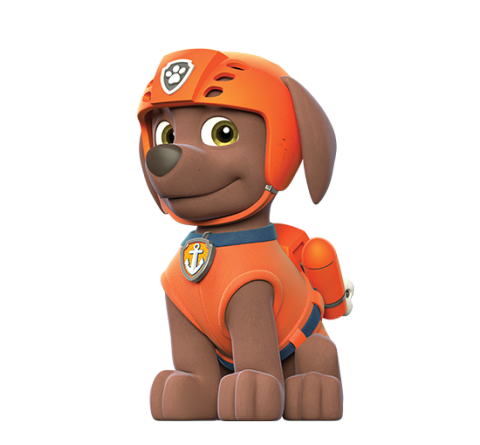
Seriously, Zuma: what are you FOR?
And compare the morality of the two shows. Friendship is Magic teaches us the values of friendship (duh), loyalty, trust, kindness, and respect, as well as carrying a strong
feminist message that young women can grow up to be whatever the hell they want to be. Conversely, the most-lasting lesson I’ve taken from watching PAW Patrol (and I’ve
seen a lot of that, too) is that police and spy agencies are functionally-interchangeable which very-much
isn’t the message I want our children to take away from their screen time.
Not all lessons are good lessons. I’m talking to you, Rarity.
It’s not perfect, of course. The season one episode A Dog And Pony Show‘s enduring moral, in which unicorn pony
Rarity is kidnapped by subterranean dogs and made to mine gemstones (she has a magical talent for divining for seams of them), seems to be that the best way for a woman to get her way
over men is to make a show of whining incessantly until they submit, and to win arguments by deliberately misunderstanding their statements as something that she can take offence to.
That’s not just a bad ethical message, it also reinforces a terrible stereotype and thoroughly undermines Rarity’s character! Thankfully, such issues are few and far between and on the
whole the overwhelming message of My Little Pony is one of empowerment, equality, and fairness.
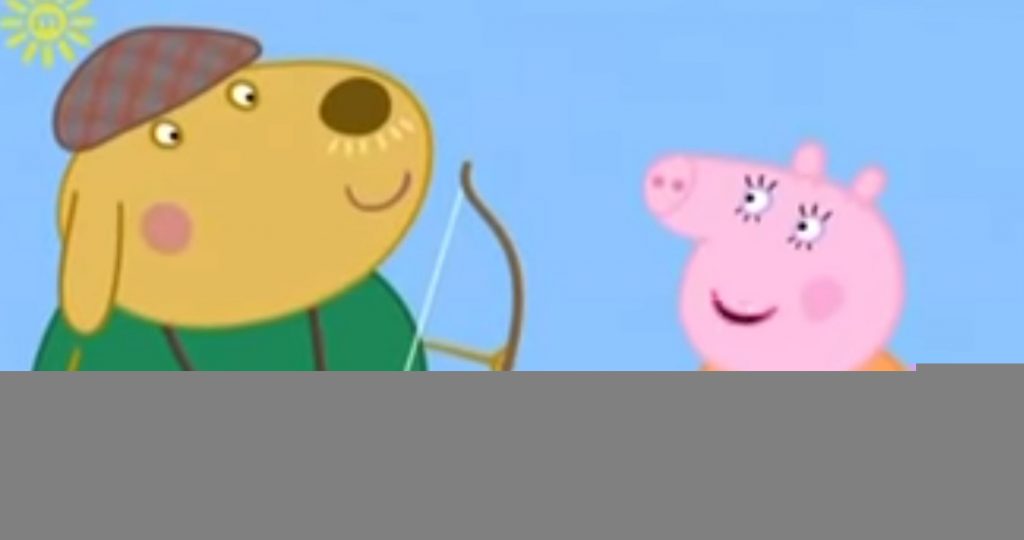
If Mr. Labrador had a Twitter account, this episode of Peppa Pig would have put him at the receiving end of a whole Internetload of feminist complaints.
For the most part, Equestria is painted as a place where gender doesn’t and shouldn’t matter, which is fantastic! Compare to the Peppa
Pig episode (and accompanying book) called Funfair in which Mummy Pig
is goaded into participating in an archery competition by being told that “women are useless” at it, because it’s a “game of skill”. And while Mummy Pig does surprise the
stallholder by winning, that’s the only rebuff: it’s still presented as absolutely acceptable to make skill judgements based on gender – all that is taught is that Mummy Pig is
an outlier (which is stressed again when she wins at a hammer swing competition, later); no effort is made to show that it’s wrong to express prejudice over stereotypes. Peppa Pig is
full of terrible lessons for children even if you choose to ignore the time the show told Australian kids to pick up and play with spiders.
Princess Luna knows what I should have been doing instead of writing this post.
I probably know the words to most of the songs that’ve had album releases (we listen to them in the car a lot; unfortunately a voice from the backseat seems to request the detestable Christmas album more than any of the far-better ones). I’m probably the second-best person in my house at
being able to identify characters, episodes, and plotlines from the series. I have… opinions on the portrayal of Twilight Sparkle’s character in the script of the movie.
Also, it might be the case that I own more than one article of geeky My Little Pony-themed clothing.
I don’t describe myself as a Brony (not that there’d be anything wrong if I did!), but I can see how others might. I think I get an exemption for not having been to a convention or read
any fanfiction or, y’know, watched any of it without a child present. I think that’s the key.
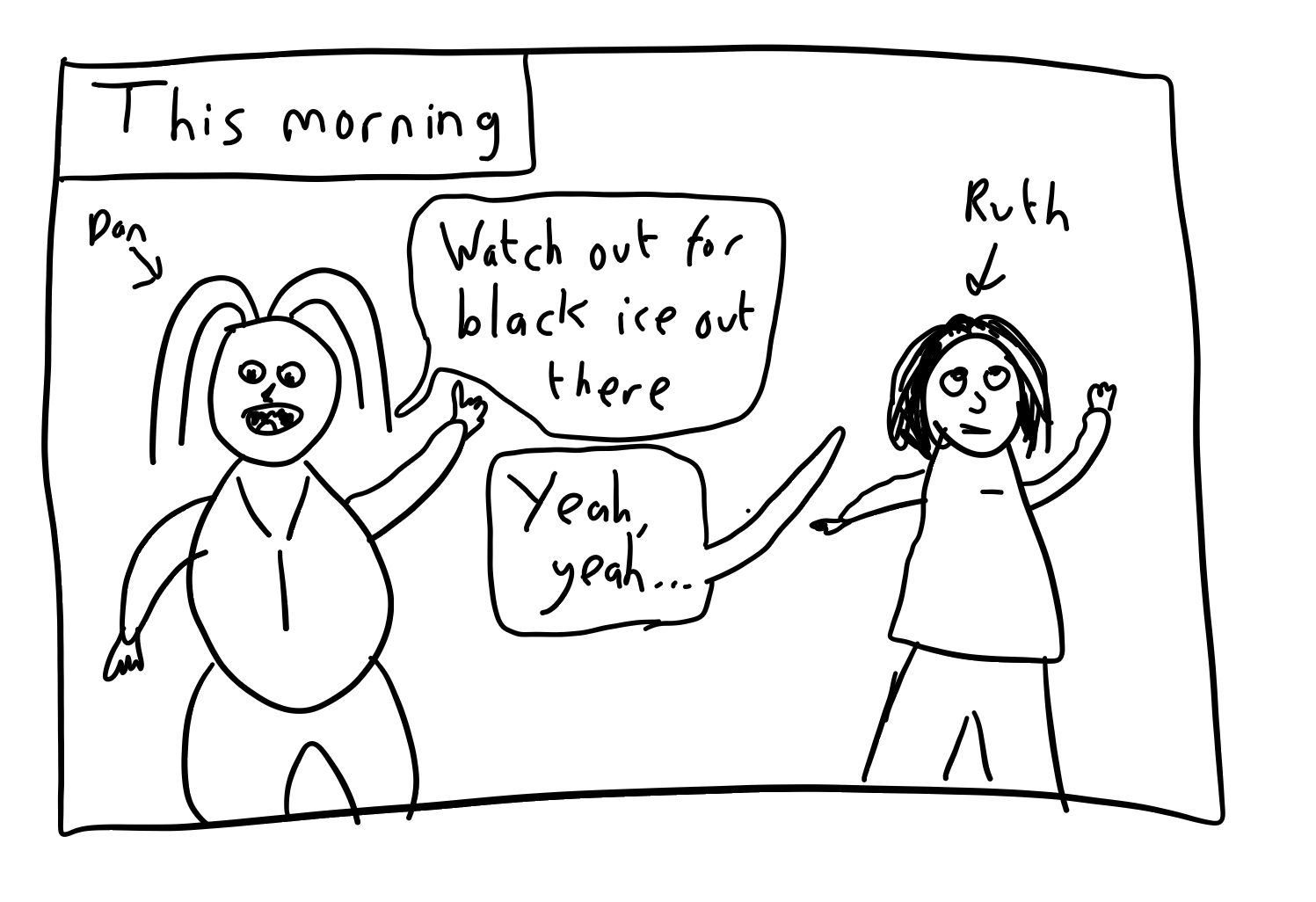
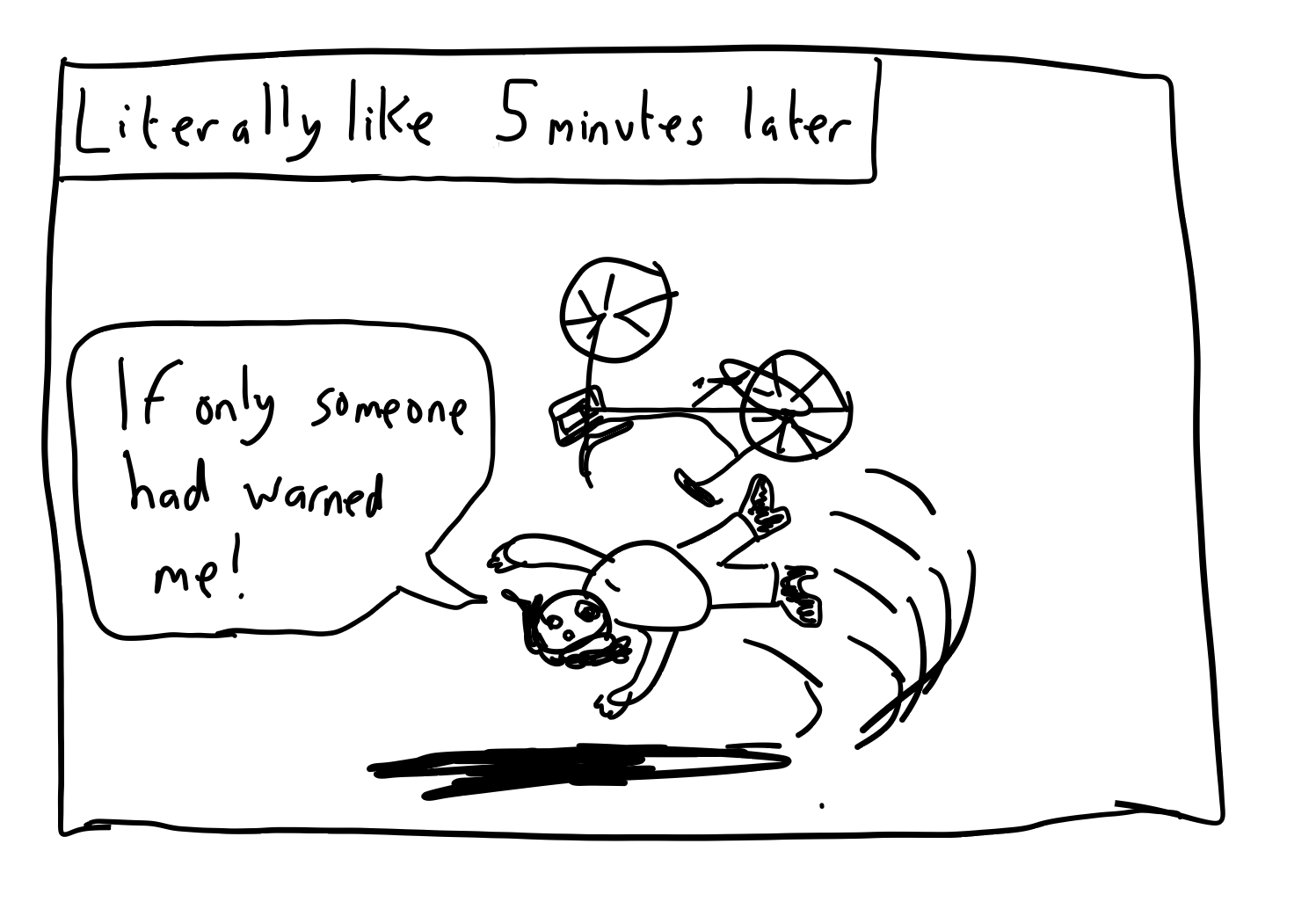
For anybody who’s worried, Ruth is fine: mostly it’s only her pride that’s been injured, although she’s looking
to be growing some badass-looking bruises. Luckily today is a work/study-from-home day for me, so I was able to go out and rescue her (she hadn’t even gotten out of our estate).
Do you remember how earlier this year, half of the Internet went nuts about the fact that – based on the emoji they’d drawn – Google didn’t know how to make a cheeseburger? It was a fun distraction from all the terrible stuff
happening in the world, which was nice, but it also got me to thinking: how many other emoji are arguably “wrong” in their depiction of whatever-it-is they’re supposed to be
showing.
I was never so offended by the fact that the cheese was underneath the burger as I was by the fact that the cheese was depicted as having somehow been melted… by the bun.
I’ve got a special kind of relationship with emoji to begin with. I wouldn’t even call it love-hate, because that would imply that there’s something about them that I love. But I
certainly think that they’re culturally-fascinating, and I wonder how future anthropologists will look back on this period of our history: the time that we went back to
heiroglyphics for a while! It’s great to have a convenient, universal, lazy icon set that anybody can use… but it’s unfortunate that people use them for literal rather
than figurative meaning (such as sharing the [?️ | reminder ribbon] icon with somebody because it’s pink and you’re doing a breast
cancer awareness fun run… without realising that the ribbon is only pink on your model of phone), or for figurative meanings that depend on specific iconography (such
as sending the [? | aubergine/eggplant] emoji to somebody to tell them that you’ve got an erection… which is apparently a thing –
I’m out of touch with youth culture… without knowing that their LG phone is going to render it as super-bent).
These two are both emoji for “ATM”: the former, by Microsoft, shows a cash machine. The latter looks like a corporate headquarters for a company called “ATM”. If you’re using a
picture because it has a specific meaning, you perhaps ought not to use emoji!
Emoji can be a way to accentuate a message, but they aren’t and shouldn’t be the message themselves because the specifics of their display are not so much a standard as a loose
collection of standards implemented by some… imaginative… graphic artists… And some cases are particularly bad:
This isn’t what juggling looks like, Apple.
Apple seem to think that three-ball juggling involves all three balls being in the air at the same time. And also, for some reason, wearing a bowler hat and a bow tie.
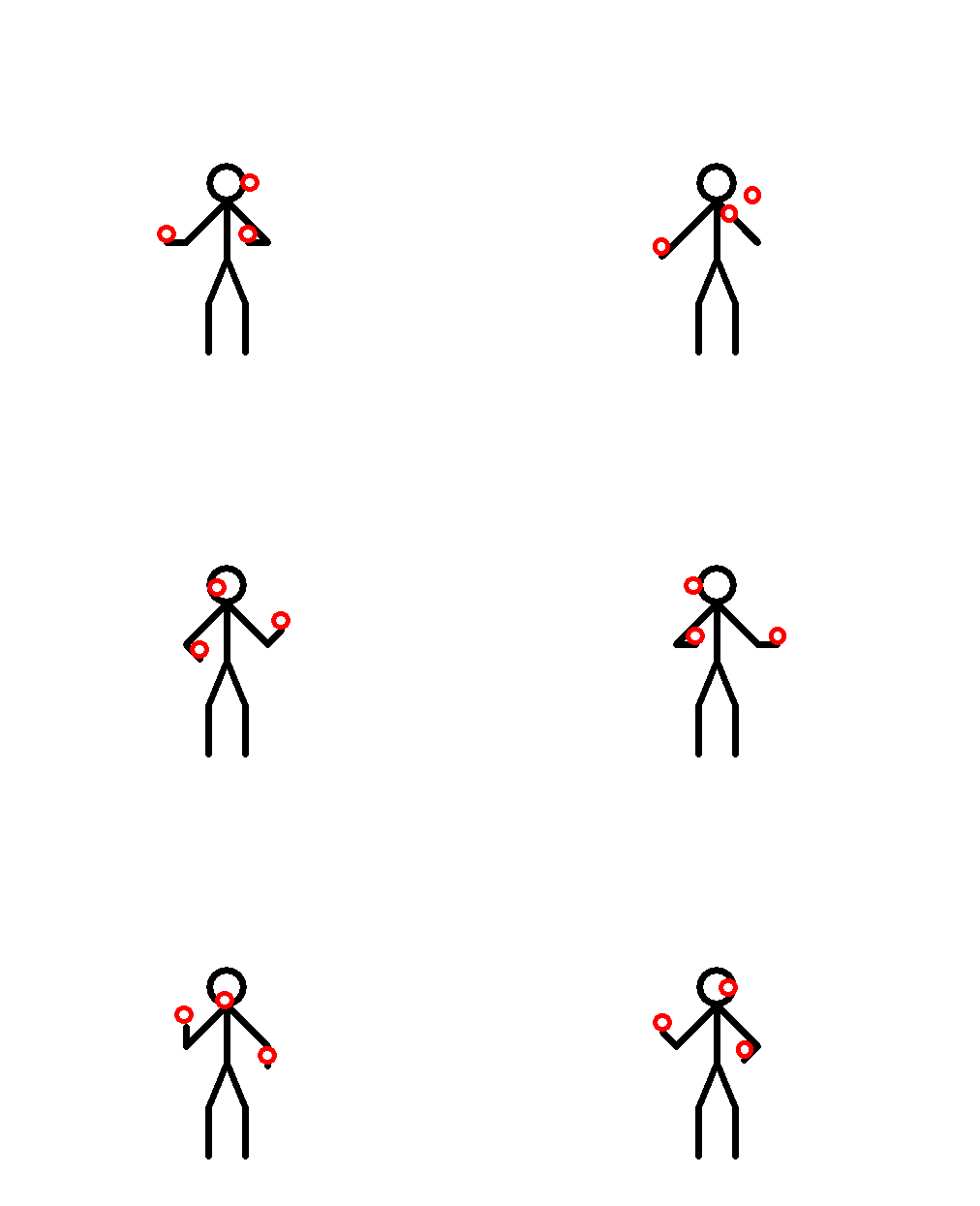
The most-common three-ball juggling technique is to throw from the inside, catch on the outside.
The idea that three-ball juggling routinely involves multiple balls in the air at once is a common one, but it’s (mostly) false. As the animated GIF above shows, there are two stages to
juggling. The first is the stage where one ball is held in each hand and a third ball is in the air. The second is the stage where the juggler throws a ball from their hand in order to
free up space to catch the descending ball. This latter one is the only point when there are multiple balls in the air, and even then it’s only two of them (specifically, for
conventional N-ball juggling, the number of balls in the air is usually N-2 and occasionally N-1).
Apple’s emoji also places the balls in very unlikely places: consider the two lowest-down balls: they’re both further out than the centre of the juggler’s hands! This means
that the juggler is throwing the balls away from himself (presumably out of panic that he’s somehow been hired as a juggler despite not knowing how to juggle).
Who’s even seen a camera like this, let alone tried to use one to capture a speeding vehicle?
Yes, yes, I get it: icons should be symbolic rather than representative, and with that in mind Apple’s icon isn’t too bad. Especially not when you compare it to some of the
other options.
This is what Google (left) and Samsung (right) think that juggling looks like.
Both Google and Samsung’s emoji have the same problem: that all the balls are bunched up in the same path, like they’re being fired from a shotgun at an unsuspecting children’s
entertainer. They form an arch over the juggler’s head like a rainbow of mistake, all rocketing from the juggler’s right hand to their left which is clearly going to be incapable of
catching them all at once. What we’re seeing, then, is a split second before the moment of photographic perfection: the point at which all the balls are in the air and
you don’t have to wait and see what a disaster happens when they all come down at once.
Also, Google: you too? What’s with the bowler hat and bow tie? Is this what jugglers are supposed to wear? Have I been doing it wrong my whole life?
Facebook has a picture of… disembodied hands spinning a three-coloured ring with balls on it?
Facebook’s “juggler” emoji is even worse. For a start, it doesn’t actually show a juggler, it shows juggling (and this isn’t a consistent style choice: Facebook’s emoji
for e.g. snowboarder, mechanic, farmer, teacher etc. all show a whole person or at least a person from the waist upwards). Secondly, the motion of the balls most-closely represents
circle-juggling, which is a way to juggle but isn’t what you normally see jugglers doing: compared to conventional juggling patterns, circle juggling is both harder to
do and looks less-impressive!
But even then, it’s confusing: why is the blue ball turning a corner of its own accord to try to avoid the hand? Perhaps this is some kind of magic available only to people who are
missing a finger from each hand, as this unusual “juggler” seems to be.
Twitter changed their “juggler” emoji in September 2016 from the one on the left to the one on the right.
Twitter used to have many of the same problems – circle juggling, balls that randomly change direction in flight, no juggler – until they revamped their emoji collection last year. Now
they’ve still got most of those, plus the “all the balls in the air” problem and the most disinterested-looking juggler I’ve ever seen. As he stands there, shrugging,
it feels like it needs a speech bubble that says “I have no feelings about what I’m doing whatsoever.” At least he’s not wearing a bowler hat and bow tie, I suppose.
Also: why do we have an emoji for juggler, but not for magician?
The short of it is: emoji have a lot to answer for.
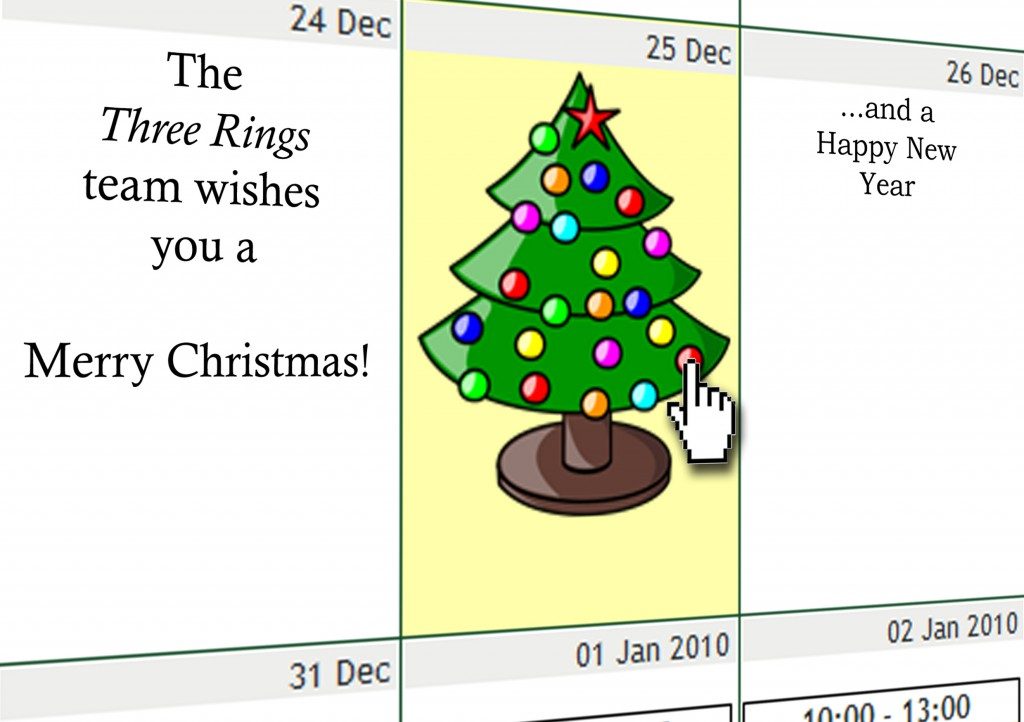
For the last eight winters, we at Three Rings have sent out Christmas cards – and sometimes mugs! – to our clients (and to special
friends of the project). The first of these was something I knocked up in Photoshop in under an hour, but we’ve since expanded into having an official “company artist” in the form of
our friend Ele who each year takes the ideas that the Three Rings volunteer team have come up with and adapts them into a stunning
original design that we’re proud to show off to our clients.
Our first Christmas card, in 2009, was knocked-up quickly and printed only a couple of days before the Christmas posting deadline, but it kicked-off a tradition that’s grown every
year since.
This year’s card is still winging its way to some of our more-distant customers, as Three Rings is used in six countries, and so it doesn’t yet appear on our gallery of previous cards. But here’s a sneak peek:
Last week, I helped stuff a little under 400 of these into envelopes and put stamps on them all for delivery to our UK customers. (Our international customers needed slightly
more-careful attention.)
For most of Three Rings life, our server’s been hosted by the awesome folks at Bytemark. We had a brief dalliance with Amazon Web Services for a while but had a seriously unsatisfying experience and we eventually came crawling back to Bytemark (complete with a
conveniently-timed Valentines’ Day message expressing our love for them and our apologies for our mistake). What I’m saying is that we’ve made a habit of sending seasonal greetings to
our buddies at Bytemark – and this Christmas was no different – but what surprised us was what we received from them this year:
Bytemark sent us not only a Christmas card but a fancy-looking fruitcake! Thanks, Bytemark!
Not only did Bytemark send us a delightful Christmas card (with a pixel-art picture of Sana literally burning the logs) but they included a fabulous-looking fruitcake. Thanks
for bringing a little bit of extra cheer to our Christmas, Bytemark!
When I first started working at the Bodleian Libraries in 2011, their websites were looking… a little
dated. I’d soon spend some time working with a vendor (whose premises mysteriously caught fire while I was there, freeing me up to spend my
birthday in a bar) to develop a fresh, modern interface for our websites that, while not the be-all and end-all, was a huge leap forwards and has served us well for the last five years
or so.
The colour scheme, the layout, the fact that it didn’t remotely work on mobiles… there was a lot wrong with the old design of the Bodleian Libraries’ websites.
Fast-forward a little: in about 2015 we noticed a few strange anomalies in our Google Analytics data. For some reason, web addresses were appearing that didn’t exist anywhere on our
site! Most of these resulted from web visitors in Turkey, so we figured that some Turkish website had probably accidentally put our Google Analytics user ID number into their
code rather than their own. We filtered out the erroneous data – there wasn’t much of it; the other website was clearly significantly less-popular than ours – and carried on. Sometimes
we’d speculate about the identity of the other site, but mostly we didn’t even think about it.
How a Bodleian Libraries’ website might appear today. Pay attention, now: there’ll be a spot-the-difference competition in a moment.
Earlier this year, there was a spike in the volume of the traffic we were having to filter-out, so I took the time to investigate more-thoroughly. I determined that the offending
website belonged to the Library of Bilkent University, Turkey. I figured that some junior web developer there must have copy-pasted the
Bodleian’s Google Analytics code and forgotten to change the user ID, so I went to the website to take a look… but I was in for an even bigger surprise.
Hey, that looks… basically identical!
Whoah! The web design of a British university was completely ripped-off by a Turkish university! Mouth agape at the audacity, I clicked my way through several of their pages to try to
understand what had happened. It seemed inconceivable that it could be a coincidence, but perhaps it was supposed to be more of an homage than a copy-paste job? Or perhaps they
were ripped-off by an unscrupulous web designer? Or maybe it was somebody on the “inside”, like our vendor, acting unethically by re-selling the same custom design? I didn’t believe it
could be any of those things, but I had to be sure. So I started digging…
Our user research did indicate that putting the site and catalogue search tools like this was smart. Maybe they did the same research?
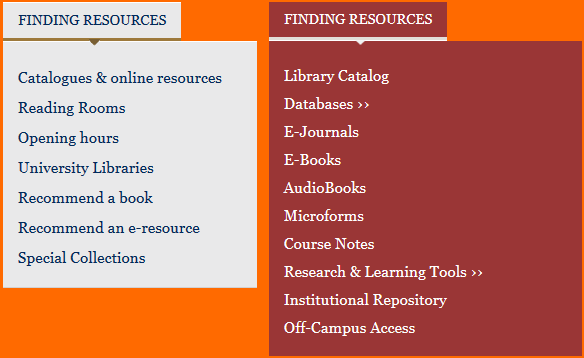
Menus are pretty common on many websites. They probably just had a similar idea.
Tabs are a great way to show opening hours. Everybody knows that. And this is obviously just the a popular font.
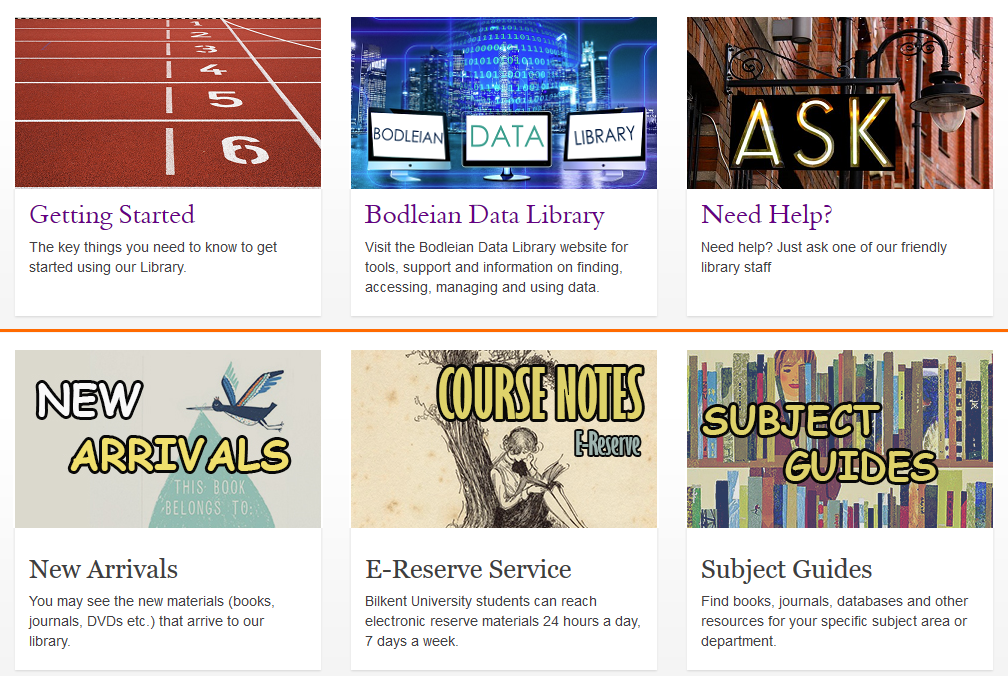
Oh, you’ve got a slider too. With circles? And you’ve got an identical Javascript bug? Okay… now that’s a bit of a coincidence…
Okay, I’m getting a mite suspicious now. Surely we didn’t independently come up with this particular bit of design?
Well these are clearly different. Ours has a copyright notice, for example…
Oh, you DO have a copyright notice. Hang on, wait: you’ve not only stolen our design but you’ve declared it to be open-source???
I was almost flattered as I played this spot-the-difference competition, until I saw the copyright notice: stealing our design was galling enough, but then relicensing it in such a way
that they specifically encourage others to steal it too was another step entirely. Remember that we’re talking about an academic library, here: if anybody ought to
have a handle on copyright law then it’s a library!
I took a dive into the source code to see if this really was, as it appeared to be, a copy-paste-and-change-the-name job (rather than “merely” a rip-off of the entire graphic design),
and, sure enough…
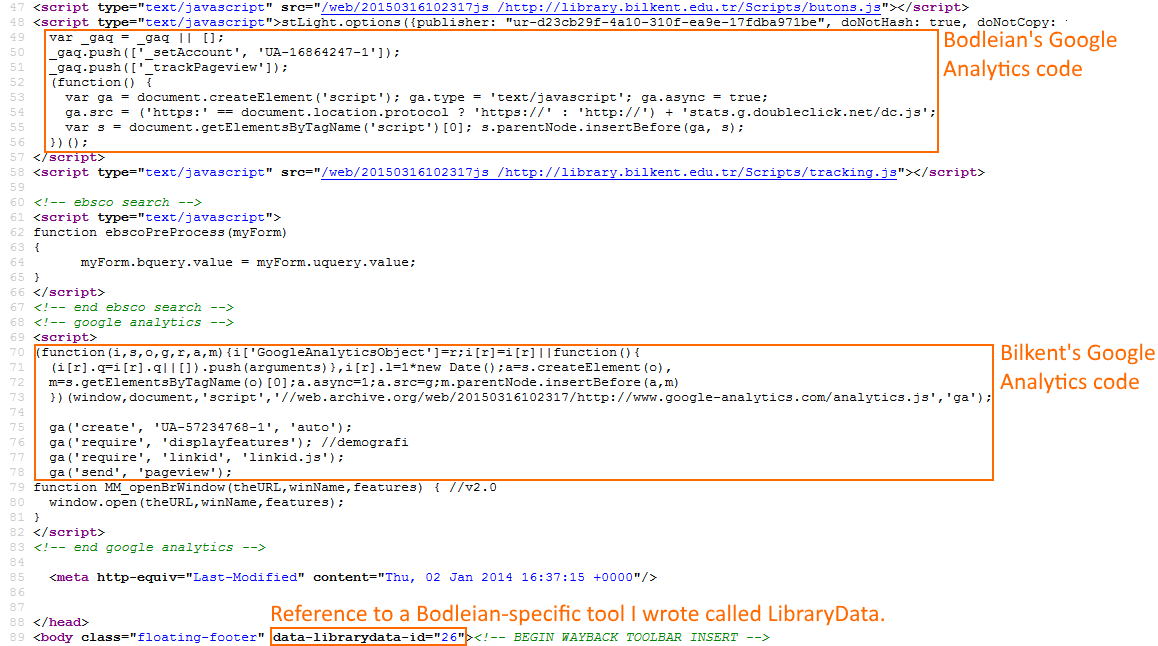
In their HTML source code, you can see both the Bodleian’s Google Analytics code (which they failed to remove) but also their own. And a data- attribute related to a project I wrote
and that means nothing to their site.
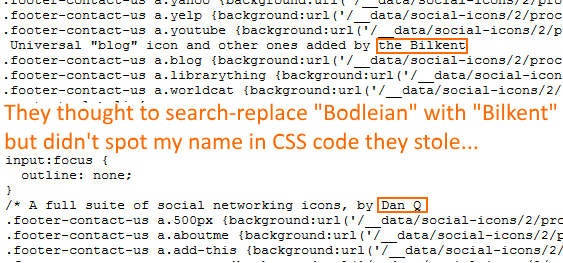
It looks like they’d just mirrored the site and done a search-and-replace for “Bodleian”, replacing it with “Bilkent”. Even the code’s spelling errors, comments, and indentation were
intact. The CSS was especially telling (as well as being chock-full of redundant code relating to things that appear on our website but not on theirs)…
The search-replace resulted in some icky grammar, like “the Bilkent” appearing in their code. And what’s this? That’s MY NAME in the middle of their source code!
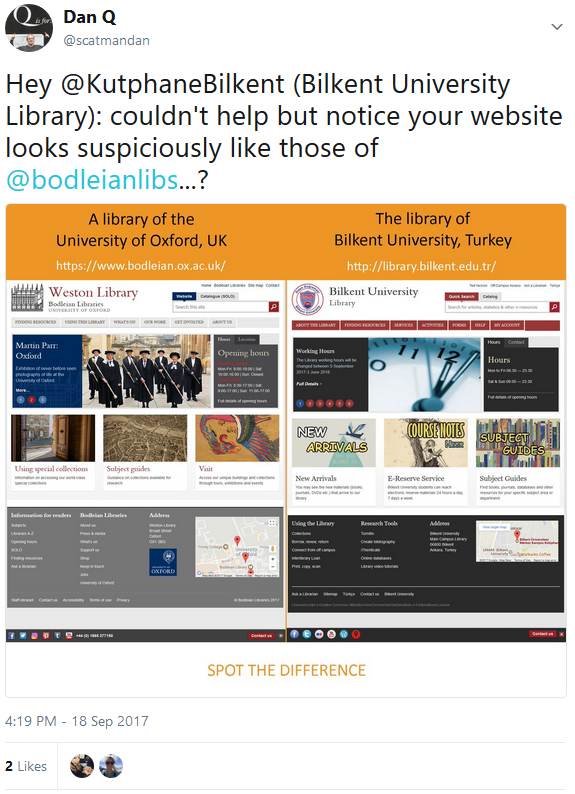
So I reached out to them with a tweet:
My first tweet to Bilkent University Library contained a “spot the difference” competition.
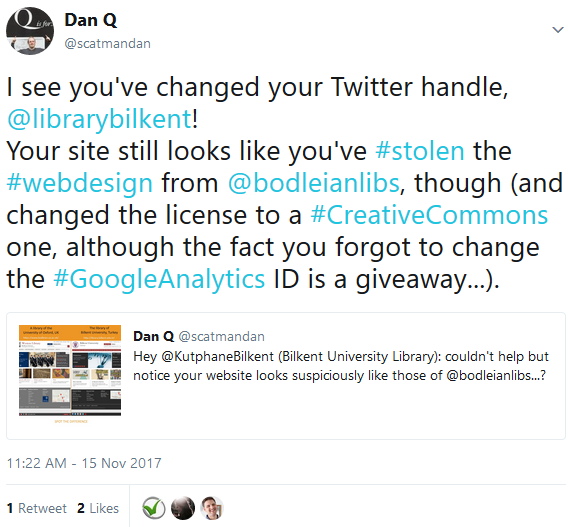
I didn’t get any response, although I did attract a handful of Turkish followers on Twitter. Later, they changed their Twitter handle and I thought I’d take advantage of the then-new
capability for longer tweets to have another go at getting their attention:
This time, I was a little less-sarcastic and a little more-aggressive. Turns out that’s all that was needed.
Clearly this was what it took to make the difference. I received an email from the personal email account of somebody claiming to be Taner
Korkmaz, Systems Librarian with Bilkent’s Technical Services team. He wrote (emphasis mine):
Dear Mr. Dan Q,
My name is Taner Korkmaz and I am the systems librarian at Bilkent. I am writing on behalf of Bilkent University Library, regarding your share about Bilkent on
your Twitter account.
Firstly, I would like to explain that there is no any relation between your tweet and our library Twitter handle change. The librarian who is Twitter admin at Bilkent did not notice
your first tweet. Another librarian took this job and decided to change the twitter handle because of the Turkish letters, abbreviations, English name requirement etc. The first name
was @KutphaneBilkent (kutuphane means library in Turkish) which is not clear and not easy to understand. Now, it is @LibraryBilkent.
About 4 years ago, we decided to change our library website, (and therefore) we reviewed the appearance and utility of the web pages.
We appreciated the simplicity and clarity of the user interface of University of Oxford Bodlien Library & Radcliffe Camera, as an academic pioneer in many fields. As a not profit institution, we took advantage of your template by using CSS and HTML, and added our own original content.
We thought it would not create a problem the idea of using CSS codes since on the web page there isn’t any license notice or any restriction related to
the content of the template, and since the licenses on the web pages are mainly more about content rather than templates.
The Library has its own Google Analytics and Search Console accounts and the related integrations for the web site statistical data tracking. We would like to point out that there is
a misunderstanding regarding this issue.
In 2017, we started to work on creating a new web page and we will renew our current web page very soon.
Thank you in advance for your attention to this matter and apologies for possible inconveniences.
Yours sincerely,
Or to put it another way: they decided that our copyright notice only applied to our content and not our design and took a copy of the latter.
Do you remember when I pointed out earlier that librarians should be expected to know their way around copyright law? Sigh.
They’ve now started removing evidence of their copy-pasting such as the duplicate Google Analytics code fragment and the references to LibraryData, but you can still find the unmodified
code via archive.org, if you like.
That probably ends my part in this little adventure, but I’ve passed everything on to the University of Oxford’s legal team in case any of them have anything to say about it. And now
I’ve got a new story to tell where web developers get together over a pint: the story of the time that I made a website for a university… and a different university stole it!
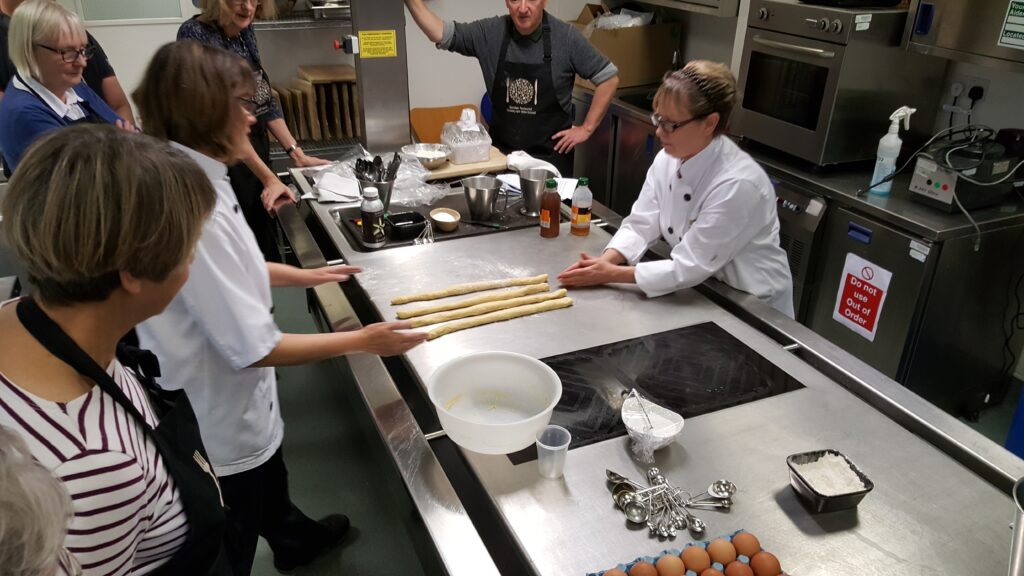
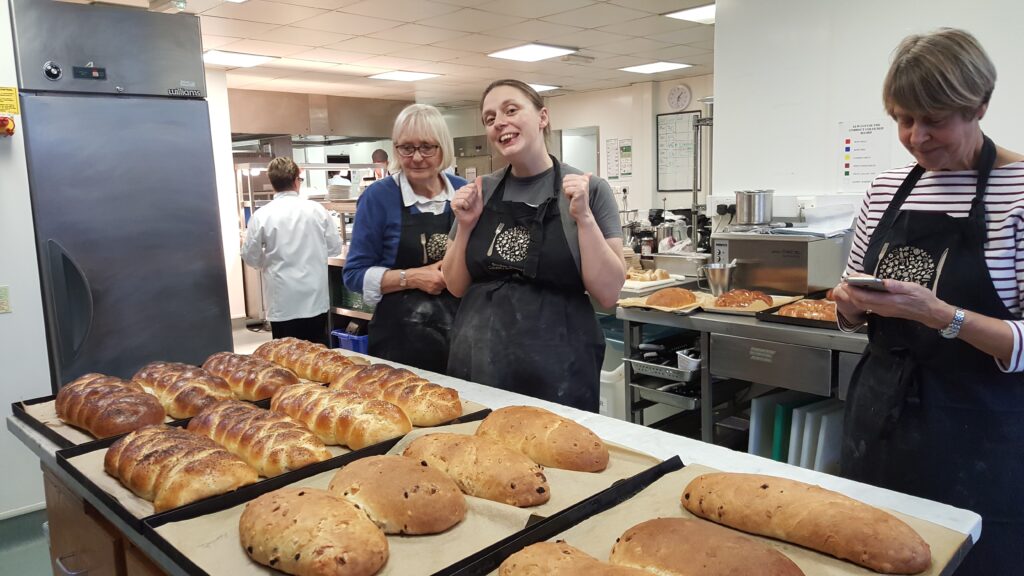
Yesterday, Ruth and I attended a Festive Breads Workshop at the Oxford Brookes
Restaurant Cookery and Wine School, where we had a hands-on lesson in making a variety of different (semi-)seasonal bread products. It was a fantastic experience and gave us both
skills and confidence that we’d have struggled to attain so-readily in any other way.
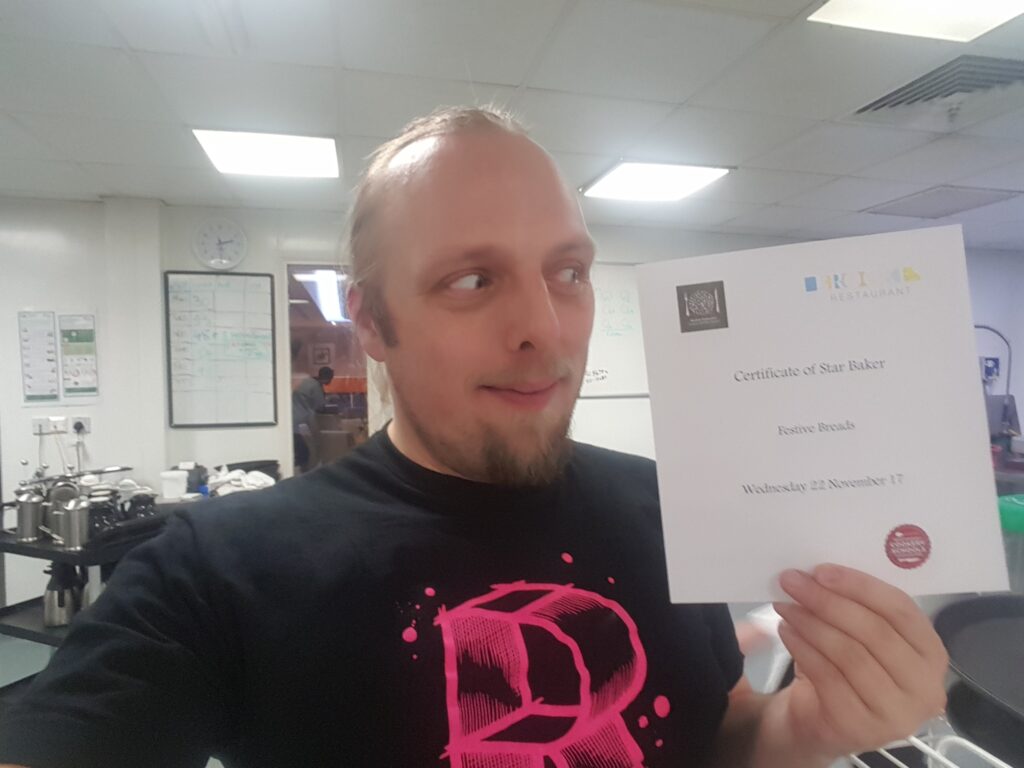
I am the Master Baker! The Bread Winner! (Okay, so everybody got one of these certificates…)
The Oxford Brookes Restaurant is a working restaurant which doubles as a place for Brookes’ students to work and practice roles as chefs, sommeliers, and
hospitality managers as part of their courses. In addition, the restaurant runs a handful of shorter or day-long courses for adults and children on regional and cuisine-based cookery,
knife skills, breadmaking, and wine tasting. Even from the prep room off the main working kitchen (and occasionally traipsing through it on the way to and from the ovens), it was easy
to be captivated the buzz of activity as the lunchtime rush began outside: a large commercial kitchen is an awesome thing to behold.
Working in our kitchen at home I often have less space than my entire work area in this, the smallest room of the Brookes’ kitchens.
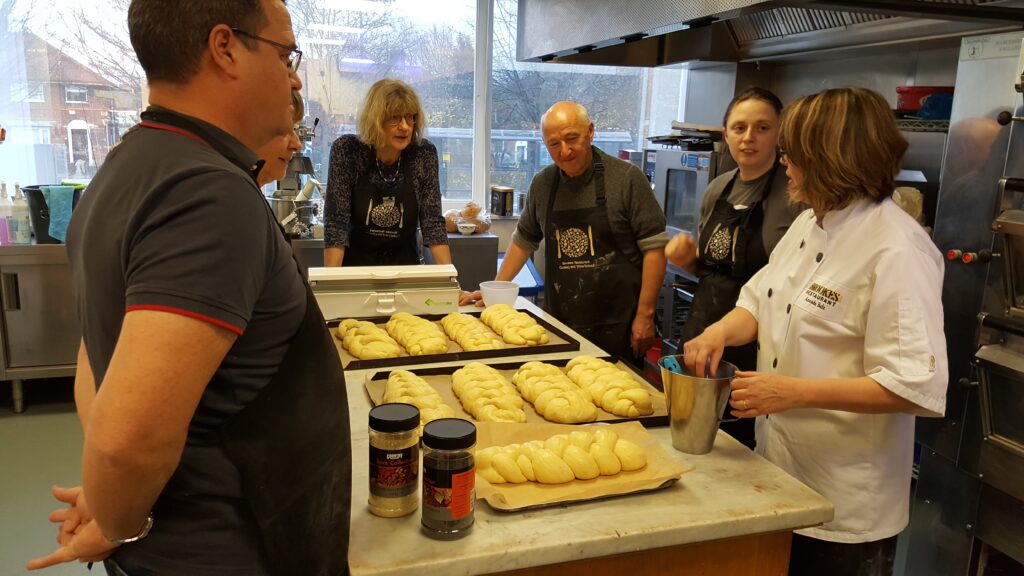
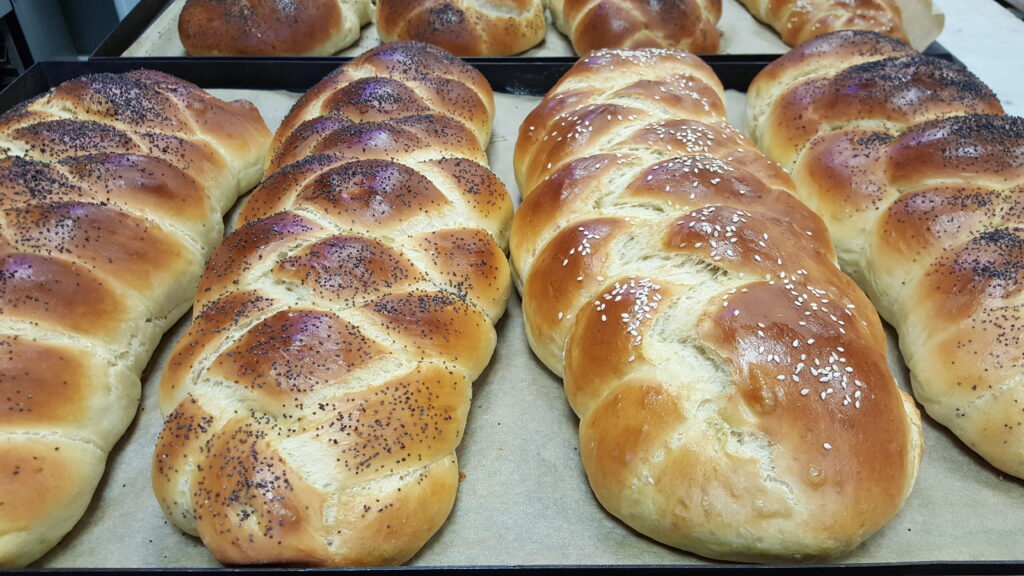
By early afternoon we’d each made five different breads: a stollen, a plaitted wreath, rum babas, a seeded flatbread, and a four-strand woven challah. That’s plenty to do (and
a good amount of standing up and kneading!), but it was made possible by the number of things we didn’t have to do. There was no weighing and measuring, no washing-up:
this was done for us, and it’s amazingly efficiency-enhancing to be able to go directly from each recipe to the next without having to think about these little tasks. We didn’t even
have to run our breads in and out of the proofing cupboard and the ovens: as we’d be starting on mixing the next dough, the last would be loaded onto trays and carried around the
kitchens.
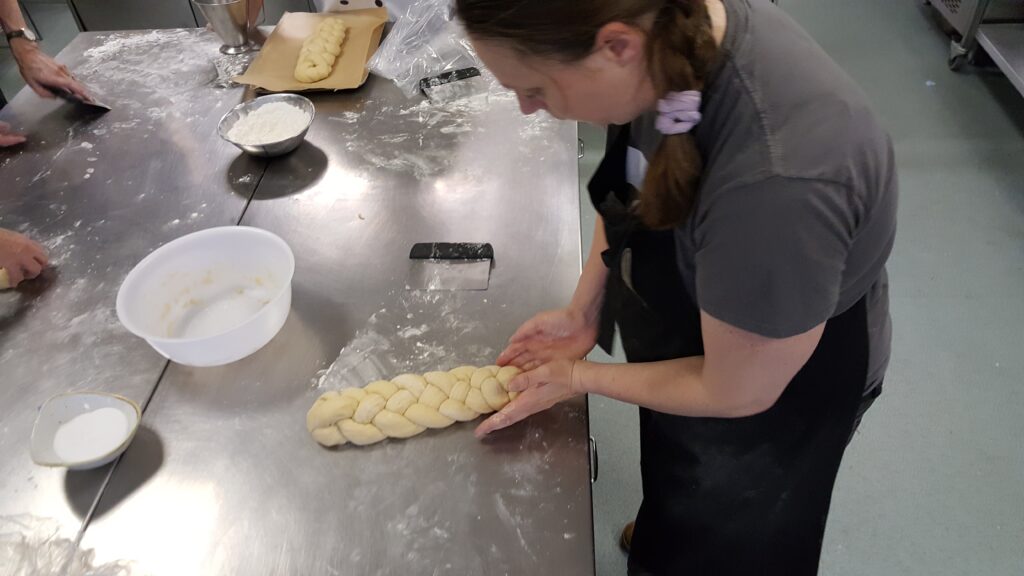
Start from the right and weave to the left: over, under, over. Repeat.
The tuition itself was excellent, too. The tutors, Amanda and Jan, were friendly and laid-back (except if anybody tried to short-cut their kneading of a wet dough by adding more flour
than was necessary, in which case they’d enter “flour police” mode and start slapping wrists) and clearly very knowledgeable and experienced. When I struggled at one point with getting
a dough ball to the consistency that was required, Jan stepped in and within seconds identified that the problem was that my hands were too warm. The pair complemented one another very
well, too, for example with Amanda being more-inclined than Jan towards the laissez-faire approach to ingredient measurement that I prefer when I make bread, for example.
It looked a little lopsided at this point, but Ruth’s challah looked among the best of all of them among the final products.
The pace was fast and Ruth in particular struggled early on to keep up, but by the end the entire group – despite many hours on our feet, much of it kneading stiff doughs – were
hammering through each activity, even though there was a clear gradient in the technical complexity of what we were working on. And – perhaps again thanks to the fantastic tuition –
even the things that seemed intimidating upon first glance (like weaving four strands of dough together without them sticking to one another or the surface) weren’t problematic once we
got rolling.
Having great equipment like large hot ovens, a proofing cupboard, and an endless supply of highly-active live (not dried) yeast might have helped too.
Our hosts, apparently somehow not having enough to do while teaching and supervising us, simultaneously baked a selection of absolutely delicious bread to be served with our lunch,
which by that point was just showing-off. Meanwhile, we put the finishing touches on our various baked goods with glazes, seeds, ribbons, and sugar.
It looked a little lopsided at this point, but Ruth’s challah looked among the best of all of them among the final products.
And so we find ourselves with a house completely full of amazingly-tasty fresh bread – the downside perhaps of having two of us from the same household on the same course! – and a whole
new appreciation of the versatility of bread. As somebody who makes pizza bases and, once in a blue moon, bread rolls, I feel like there’s so much more I could be doing and I’m looking
forward to getting more adventurous with my bread-making sometime soon.
Tired-but-proud would be a pretty good description of Ruth here, I think.
I’d really highly recommend the Brookes Restaurant courses; they’re well worth a look if you’re interested in gaining a point or two of Cooking skill.
I’ve just listened to Robert Plant’s new album, Carry Fire. It’s pretty good.
A long while after my dad’s death five years ago, I’d meant to write a blog post about the experience of grief in a digital age. As I’ve clearly
become increasingly terrible at ever getting draft posts complete, the short of it was this: my dad’s mobile phone was never recovered and soon after its battery went flat any calls to
his number would go straight to voicemail. He’d recently switched to a pay-as-you-go phone for his personal mobile, and so the number (and its voicemail) outlived him for many months. I
know I’m not the only one that, in those months, called it a few times, just to hear his voice in the outgoing message. I’m fully aware that there are recordings of his voice elsewhere,
but I guess there was something ritualistic about “trying to call him”, just as I would have before his accident.
The blog post would have started with this anecdote, perhaps spun out a little better, and then gone on to muse about how we “live on” in our abandoned Inboxes, social media accounts,
and other digital footprints in a way we never did before, and what that might mean for the idea of grief in the modern world. (Getting too caught up in thinking about exactly what it
does mean is probably why I never finished writing that particular article.) I remember that it took me a year or two until I was able to delete my dad from my phone/email
address book, because it like prematurely letting go to do so. See what I mean? New aspects of grief for a new era.
Thanks, Rob.
Another thing that I used to get, early on, was that moment of forgetting. I’d read something and I’d think “Gotta tell my dad about that!” And then only a second later
remember why I couldn’t! I think that’s a pretty common experience of bereavement: certainly for me at least – I remember distinctly experiencing the same thing after my gran’s death, about 11 years ago. I’m pretty sure it’s been almost a year since I last had such a forgetting moment for my
father… until today! Half way into the opening track of Carry Fire, a mellow folk-rocky-sounding piece called The May
Queen (clearly a nod to Stairway there), I found myself thinking “my dad’d love this…” and took almost a quarter-second before my brain kicked in and added “…damn;
shame he missed out on it, then.”
If you came here for a music review, you’re not going to get one. But if you like some Robert Plant and haven’t heard Carry Fire yet, you might like to. It’s like he set out to
make a prog rock album but accidentally smoked too much pot and then tripped over his sitar. And if you knew my dad well enough to agree (or disagree) that he would have dug it, let me
know.
I’ve lately taken an interest in collecting jokes that haven’t aged well. By which I mean: jokes that no longer work, or require explanation, because they’re conceptually ‘dated’.
Typically, these jokes aren’t funny any more, or are only funny to people who were around at the time that they were first conceived, and I imagine that we, as a civilisation, are
necessarily relegating more and more jokes into this particular category as time goes on.
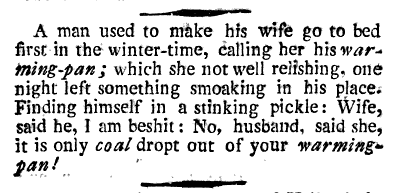
I don’t mean outdated like this joke, published in 1803, but ones that require explanation because a listener is no longer likely to recognise the concepts or people referenced. For
example, if it were the case that warming pans were now such an alien concept that nobody knew what they were any more, then the above would certainly qualify (that’s not true yet…
right?).
My favourite joke of this category is the following classic student joke, which was relevant when I first heard it in the 1990s:
What’s pink and takes an hour to drink?
Grant cheque
By way of explanation: the grant cheque was how British students used to receive their government aid to support them during their studies. It had become gradually smaller (relative to
the value of the pound) over time by failing to rise in value in line with inflation, and was printed on pink paper, hence the joke. There was an effort to revive it in the late
1990s/early 2000s as follows:
What’s green and takes an hour to drink?
Loan cheque
By this point, the grant had been replaced by the student loan, whose payments came printed on green paper instead. This is, of course, simply an example of adapting an old joke for a
new audience, as we’ve all seen time and again with the inevitable string of recycled gags that get rolled-out every time a celebrity is accused of a sex crime. Incidentally, the
revised form of the grant cheque/loan cheque joke has itself become dated as students now typically receive all of their loan payments directly to their bank accounts for convenient
immediate spending rather than what my generation had to do which was to make the beans-and-rice stretch another few days until the cheque cleared.
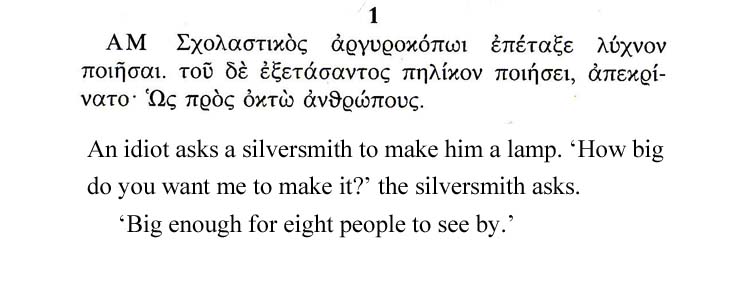
This 4th/5th century joke (presented with a contemporary translation) doesn’t count, because it’s still flipping hilarious.
Here’s another example:
Bill and Ben the flower pot men are in the garden.
“Flobalobalobalob,” says Bill
Ben replies: “You’re drunk, Bill.”
Now those of you who are about my age, or older, are unlikely to see why this joke has dated badly. But it is dated, because the 2001 reboot of The Flower Pot Men (now
called simply Bill and Ben) features the titular characters speaking in reasonably-normal English! The idea that they were only speaking Oddle Poddle because they were too
pissed to speak English is no longer a point of humour, and increasingly the population won’t remember the original stilted dialect of the flower pot men. If we assume that anybody
under the age of 24 is more-likely to have come across the newer incarnation then that’s a third of the population!
Let’s try another, which became dated at about the same time:
Why are hurricanes names after women?
Because when they come they’re wet and wild and when they go they take your house and your car.
The history of how we’ve named hurricanes over the centuries is really quite interesting, and its
certainly true that for the majority of the period during which both meteorologists and the general public have shared the same names for tropical storms they’ve been named after women.
Depending on where you are in the world, though, it’s not been true for some time: Australia began using a mixture of masculine and feminine names during the 1970s, but other regions
took until the millennium before they followed suit. However, the point still remains that this joke has been dated for a long while.
Why is a topical joke like a hurricane? When it comes, you’ve never seen anything like it. By the time it goes, you’re sick of it.
Here’s a very highly-charged joke from the 1960s which I think we can all be glad doesn’t make much sense any more:
What’s all black and comes in an all white box?
Sammy Davis Jr.
For those needing the context: Sammy Davis Jr. was a black American singer, comedian, and variety show host who triggered significant controversy when he married white Swedish actress
May Britt. Interracial marriage was at the time still illegal across much of the United States (such prohibition wouldn’t be ruled unconstitutional until the amazingly-named “Loving Day” in 1967) and relationships between whites and “coloureds” were highly taboo even where they weren’t forbidden by law.
Topical jokes like that are often too easy, like this one – even shorter-lived – from the summer of 1995, presented here with no further interpretation:
Q: What’s the difference between O. J. Simpson and Christopher Reeve?
A: O. J.’s gonna walk!
Perhaps my favourite strictly-topical joke of this variety, though, comes from 1989:
Q: Why is Margaret Thatcher like a pound coin?
A: She’s thick, brassy, and she thinks she’s a sovereign.
It’s at least two-thirds funny even if you don’t have the full context, and that’s what’s most-interesting about it: it’ll take until the new £1 becomes ubiquitous and the old one
mostly-forgotten before it will lose all of its meaning. But as you’ve probably forgotten why the third part of the punchline – “…and she thinks she’s a sovereign” – comes
from, I’ll illuminate you. The joke is wordplay: there are two meanings to “sovereign” in this sentence. The first, of course, is that a sovereign is the bullion coin representing the same value as a conventional pound coin.
To understand the second, we must first remind ourselves of the majestic plural, better known as the “royal ‘we'”. In 1989,
following the birth of her grandson Michael, Thatcher made a statement saying “we have become a grandmother”, resulting in much
disdain and mockery by the press at the time. The Prime Minister’s relationship with the Queen had always been a frosty one, and Thatcher’s (mis)use of a manner of speech that was
typically reserved for the use of royalty did nothing to make her look any more-respectful of the monarch.
And you thought it was just something to put in your penis. Turns out it’s something to put in your lungs, too.
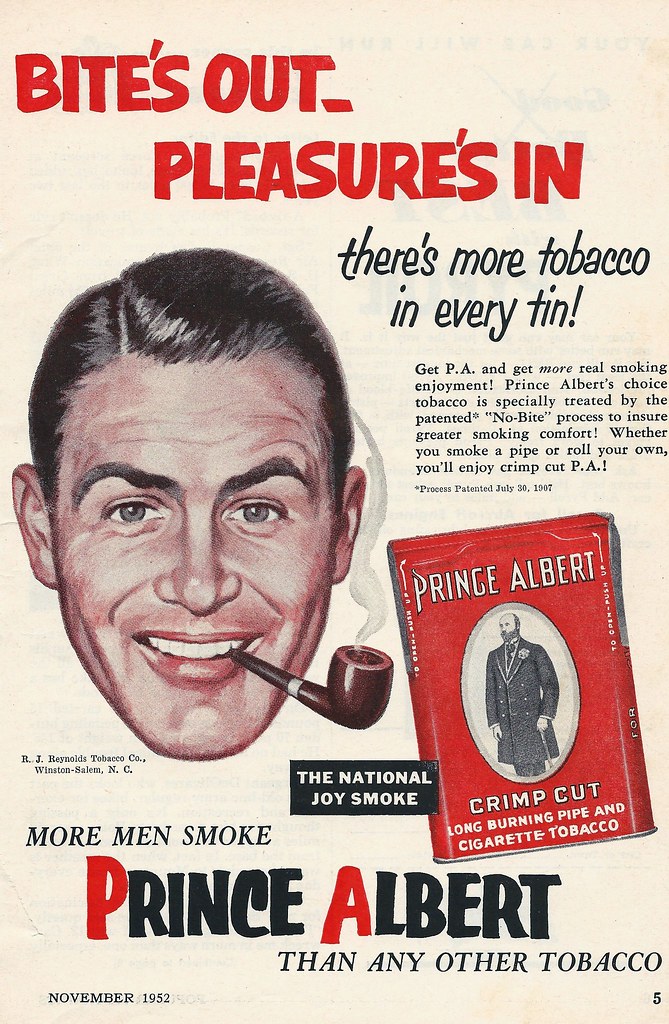
The final example I’ve got died out as a joke as a result of changing brand identities, more cost-effective packaging materials, and the gradual decline of tobacco smoking. But for a
long while, while Prince Albert Pipe Tobacco was still sold in larger quantities as it always had been, in a can, a popular prank perpetrated by radio stations that went in for such
things was to call a tobacconist and ask, “Have you got Prince Albert in a can?”. The tobacconist would invariably answer in the affirmative, at which point the prankster would response
“Well let him out then!” This joke may well predate the “Is your refrigerator running?” prank call that might be more-familiar to today’s audiences.
If you’ve got any jokes that have aged badly, I’d love to hear them. And then, I suppose, have them explained to me.
This technique’s about a decade old, but a lot of people still aren’t using it, and
I can’t help but suspect that can only be because they didn’t know about it yet, so let’s revisit:
You have a GMail account, right? Or else Google for Domains? Suppose your email address is dan@gmail.com… did you know that also means that you own:
dan+smith@gmail.com
dan+something@gmail.com
dan+anything-really@gmail.com
d.an@gmail.com
d..a..n@gmail.com
…
You have a practically infinite number of GMail addresses. Just put a plus sign (+) after your name but before the @-sign and then type anything you like there, and the
email will still reach you. You can also insert as many full stops (.) as you like, anywhere in the first half of your email address, and they’ll still reach you, too. And
that’s really, really useful.
Often, you end up having to give your email address to companies that you don’t necessarily trust…
When you’re asked to give your email address to a company, don’t give them your email address. Instead, give them a mutated form of your email address that will still
work, but that identifies exactly who you gave it to. So for example you might give the email address dan+amazon@gmail.com to Amazon, the email address
dan+twitter@gmail.com to Twitter, and the email address dan+pornhub@gmail.com to… that other website you have an account on.
Why is this a clever idea? Well, there are a few reasons:
If the company sells your email address to spammers, or hackers steal their database, you’ll know who to blame by the email address they’re sending to. I’ve actually caught
out an organisation in this way who were illegally reselling their mailing lists to third parties.
If you start getting unwanted mail from somebody (whether because spammers got the email or because you don’t like what the company is sending to you), you can easily block
them. Even if you can’t unsubscribe or just because they make it hard to do so, you can just set up a filter to
automatically discard anything that comes to that email address in future.
If you feel like organising your life better, you can set up filters for that, too: it doesn’t matter what address a company sends from, so long as you know what address
they’re sending to, so you can easily have filters that e.g. automatically forward copies of the mortgage statement that come to dan+yourbank@gmail.com to your
spouse, or automatically label anything coming to
dan+someshop@gmail.com with the label “Shopping”.
If you’re signing up just to get a freebie and you don’t trust them not to spam you afterwards, you don’t need to use a throwaway: just receive the goodies from them and them block
them at the source.
Certainly, you can have… THIS email address.
I know that some people get some of these benefits by maintaining a ‘throwaway’ email address. But it’s far more-convenient to use the email address you already have (you’re
already logged-in to it and you use it every day)! And if you ever do want a true ‘throwaway’, you’re generally better using Mailinator: when you’re asked for your email address, just mash the keyboard and then put @mailinator.com on the end, to get e.g.
dsif9tsnev4y8594es87n65y4@mailinator.com. Copy the first half of the email address to the clipboard, and then when you’re done signing up to whatever spammy service it
is, just go to mailinator.com and paste into the box to see what they emailed you.
A handful of badly-configured websites won’t accept email addresses with plus signs in them, claiming that they’re invalid (they’re not). Personally, when I come across these I
generally just inform the owner of the site of the bug and then take my business elsewhere; that’s how important it is to me to be able to filter my email properly! But another option
is to exploit the fact that you can put as many dots in (the first part of) your GMail address as you like. So you could put d…an@gmail.com in and the email
will still reach you, and you can later filter-out emails to that address. I’ll leave it as an exercise for the reader to decide how to encode information about the service you’re
signing up to into the pattern and number of dots that you use.
For the last few months, I’ve been GMing a GURPS campaign (that was originally a Warhammer Fantasy Roleplay 1st-edition campaign, in turn built upon a mixture of commercially published and homegrown
modules, including, in turn, an AD&D module…) for a few friends.
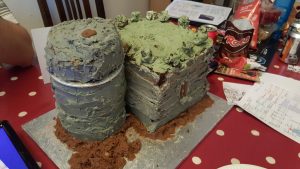
So far, it’s included such gems as a player-written poem in a fictional language, another player’s drawing of the most-cinematic action sequence they’ve experienced so far… and the opportunity, during a play session that
coincided with a player’s birthday, to explain the layout of a ruined tower by presenting them with a cake baked into the shape of the terrain.
“So we’re… here?” asked a player, jabbing with his finger at the cream-filled section of the tower at which he was standing.
But mostly I wanted to make this post so that I had a point of context in case I ever get around to open-sourcing some of the digital tools I’ve been developing to help streamline our
play sessions. For example, most of our battle maps and exploration are presented on a ‘board’ comprised of a flat screen monitor stripped of its stand and laid on its back, connected
via the web to a tool that allows me to show, hide, or adapt parts of it from my laptop or mobile phone. Player stats, health, and cash, as well as the date, time, position of the sun
as well as the phases of the moons are similarly tracked and are available via any player’s mobile phone at any time.
A rare instance of us using a paper-based battle map. Despite the fact that we play in-person, we’ve used digital tools to save table space!
These kinds of tools have been popular for ‘long-distance’/Internet roleplaying for years, but I think there’s a lot of potential in locally-linked, tabletop-enhancing
(rather than replacing) tools that deliver some of the same benefit to the (superior, in my opinion) experience of ‘proper’ face-to-face adventure gaming. Now, at least,
when I tell you for example about some software I wrote to help calculate the position of the sun in the sky of a fictional world, you’ll have a clue why I would do such a thing in the
first place.
No matter how prepared you think you are for the questions your toddler might ask (and the ways in which they might go on to interpret your answer), they’ll always find a way to catch
you off guard. The following exchange with our little one began last weekend in the car:
I’m sure we’ve all been asked “Why can’t I drink what you’re drinking?”
Her: “I read the Beano Annual at Grandtom’s house.” (Grandtom is what she calls Ruth‘s father – her maternal
grandfather.)
Me: “Oh? Did you like it?”
Her: “Yes. Did you have the Beano Annual when you were a little boy?”
Me: “Yes: I would sometimes get one for Christmas when I was little.”
Her: “Who gave it to you?”
Me: “My mummy and daddy did.”
Her: “Your mummy is Nanna Doreen.”
Me: “That’s right.”
Her: “Why haven’t I met your daddy?”
Dan and daddy.
That’s a question that I somehow hadn’t expected to come up so soon. I probably ought to have guessed that it was on its way, given her interest in her extended family lately and how
they’re all connected to one another, but I’d somehow assumed that it’d have come up organically at some point or another before her curiosity had made the connection that there was
somebody clearly missing: somebody whom she’d heard mentioned but, inexplicably, never met.
Me: “My daddy died, a couple of years before you were born. He was climbing a mountain one day when he had a nasty accident and fell off, and he died.”
Her: “…” (a thoughtful pause)
Me: “Are you okay?”
Her: “How many birthdays did he have?”
Me: “Fifty-four. That’s a bigger number than you can count to, I think!”
Her: “How many birthdays will I have?”
Wow, this went further than I expected, very quickly. Obviously, I want to be open about this: the last thing I want is to introduce a taboo, and I’m a big believer in the idea that
on I’m suddenly conscious of the fact that she’s clearly close to a minor existential crisis, having for possibly the first time connected the concepts of age and death. And, of
course, I’m trying to translate my thoughts into ideas that a toddler can follow every step of the way. While simultaneously trying to focus on driving a car: she knows how to pick her
timing! Okay…
Me: “Nobody knows for sure, but you’ll probably get lots and lots: seventy, eighty, ninety… maybe even a hundred birthdays!”
Her: “Then I’ll have a hundred candles.”
Me: “That’s right. Do you think you could blow out a hundred candles?”
Three candles was well within her grasp.
So far, so good. Knowing that, like most toddlers, ours has a tendency to make some new discovery and then sit on it for a day or two before asking a follow-up question, I briefed Ruth
and JTA so that they wouldn’t be caught too off-guard when she started telling them, for example, what she’d like for her hundredth
birthday or something.
And all was well until yesterday, when we were laying in the garden under the recent glorious sunshine, playing a game that involved rolling along the lawn and back and bumping
into one another in the middle, when she stood up and announced that she’d like to play something different.
Her: “Now we’re playing the die game.”
Me: “Oh…kay. How do we play that?”
Her: “We’re going to go up a mountain and then fall off.”
Me: (following her in a stomp around the garden) “Then what do we do?”
Her: “We die.” (mimes falling and then lies very still)
A ‘dead’ body at the bottom of a ‘mountain’. Erk!
And so that’s how I came to spend an afternoon repeatedly re-enacting the circumstances of my father’s death, complete – later on, after Ruth
mentioned the air ambulance that carried his body down from the mountain – with a helicopter recovery portion of the game. I’ve role-played some unusual games over the years, but this
one was perhaps the oddest, made stranger by the fact that it was invented by a three year-old.
Toddlers process new information in strange (to adults) ways, sometimes.