
If the Romans played bingo, do you think the callers would have used 'bingo lingo'?
- Legs two
- Growing up the wall, four
- Seagull in flight, five
- Long-nosed dead man, nineteen
- Pornography, thirty
- Use your tongue, fifty-nine
- Smiling in a blindfold, a hundred and one
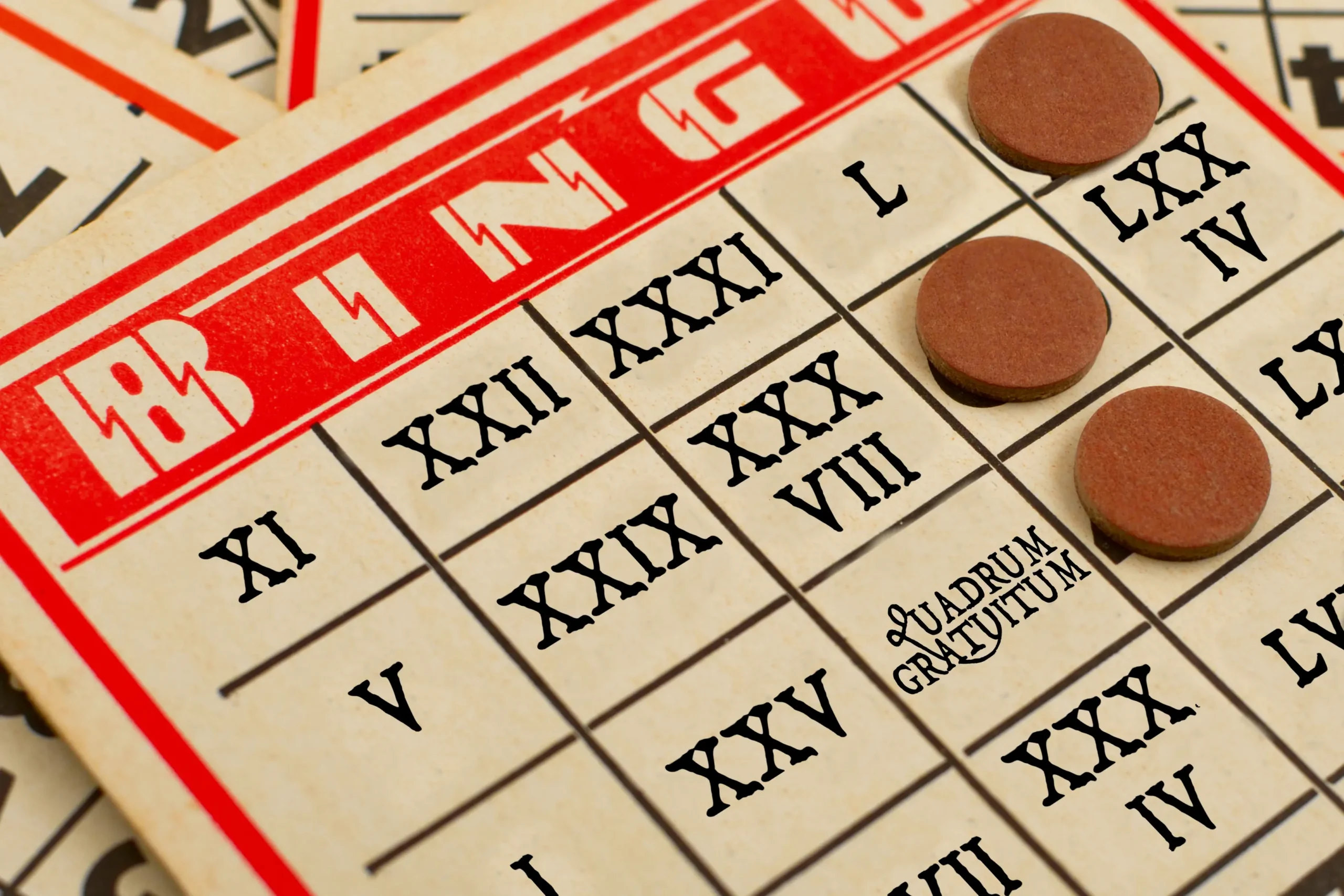
Alt
An American-style bingo card with Roman numerals in place of the numbers and 'quadrum gratuitum' in place of the free space. Based on an original photo by Oeil De Vautour / Edwin Torres, used under a Creative Commons Attribution 2.0 Generic license.
This one's a really niche joke and probably the kind of thing only I would find funny. If you want it explained to you, read on:
Bingo is a game in which a 'caller' generates random numbers, often by pulling lotto balls at random from a tumbling basket, and players try to match those numbers on pregenerated random sheets.
In Britain, there's a century-plus old tradition of particular numbers having catchphrases associated with them, some of which relate to the shapes of the numbers, e.g. "legs 11", "two little ducks, 22", "duck and a crutch, 27".
I found myself this morning wondering if there are #emoticons or #puns that can be made using Roman numerals that would lend themselves to use by a hypothetical ancient Roman bingo caller, like:
- legs two, based on II looking like a pair of legs and a nod to "legs eleven"
- growing up the wall, based on IV being phonetically similar to the word "ivy"
- seagull in flight, because sketched seagulls are sometimes compared to the shape of letter Vs
- long-nosed dead man for XIX, as if an emoticon with crosses for eyes and an "I" for a nose
- pornography for XXX, because XXX is sometimes used as a stand-in for marking something as pornographic
- use your tongue for LIX, because it could be pronounced like "licks"
- smiling in a blindfold for the emoticon CI, where the C looks like a smile and the I being a line where the eyes should be
They say that explaining a joke is like dissecting a frog. You may understand it better, but the frog doesn't survive.