
Found in the fourth place I looked. Nice container size, like the last letterbox hybrid.
This is where we’ll part ways. As much as I’ve loved this series so far and would enjoy exploring more of it, I need to get back to my accommodation where, apparently, my kids are
waking up and ready for another fun day. So I’ll be switching to the Més enllà de la
via II trail and finishing my walk soon FP awarded for this series as a whole; I’ve loved every moment of it (even that one frustrating cache from a few minutes back!).
TFTC, and if you the CO ever find yourself over my way, can I plug my cache GC9GTV3 Drive Slowly; Fox
Crossing. It’s 100% the kind of hide you’d enjoy based on what I’ve seen of your work here!
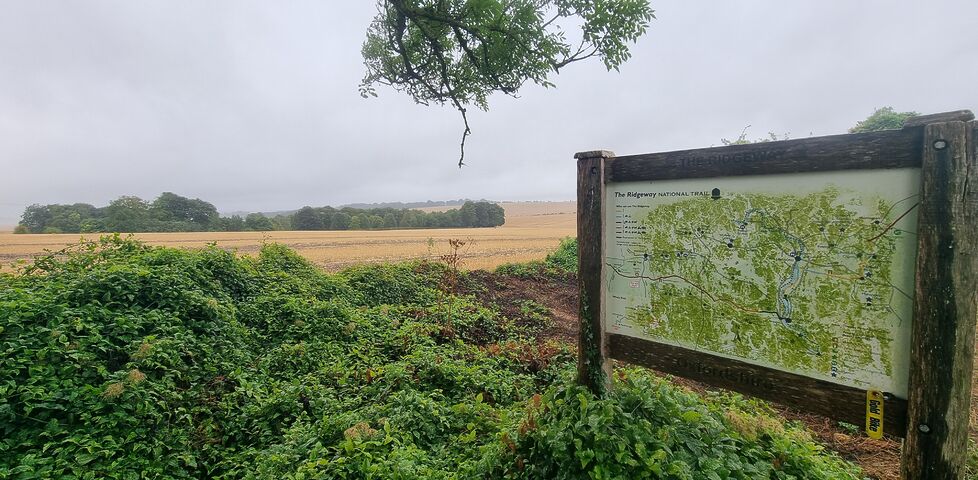
My family and I are on holiday, staying a couple of villages away. I came out this morning to see if I could find a couple of local caches before the day’s activities. This was the
first.
A great container in good condition. I love it when a cache can be hidden “in sight”. FP awarded. SL, TFTC, and greetings from Oxfordshire, UK!
I’ve been doing what remains of the Ruta Pels Volants del Mars De Salort series of took a diversion to find this cache. The impressive host didn’t need a hint – she’s pretty easy to
find!
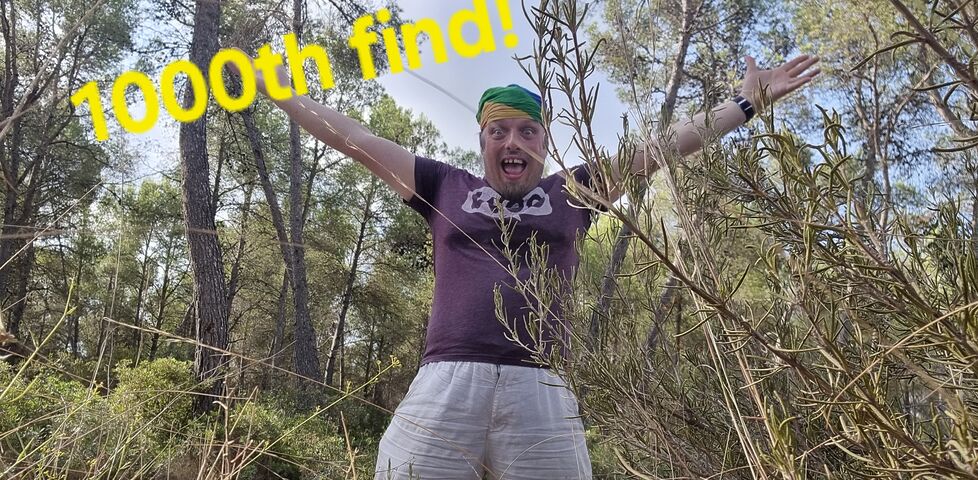
The cache container is absolutely excellent. Amazing camouflage! It’s a shame this is my 1001st find and not my 1000th because I’d have loved to make this great container my milestone! FP awarded.
Signed log and returned to its hiding place. TFTC/GPA, and greetings from Oxfordshire, UK!
Finding the cache was easy. Reaching around to pull it from its hiding place was harder! But soon I had it in hand. This has been a lovely morning walk.
Now I should have some breakfast and make my lazy children get out of bed!
TFTC/GLA. FP for the series in general (as experienced so far). And once more: greetings from Oxfordshire, UK!
The campsite provided our large group with an entire field to ourselves, including spaces for socialising, a fire pit (at which the
kids enjoyed toasting marshmallows), and a wood-fired hot tub.
The entire weekend would have surely been a memorable experience already, but one particular event will probably stick in the minds of everybody in attendance: the
fire.
The fire
The UK’s in its unprecedented third heatwave of the year: the grass is all dying and everything is tinder dry. And so it was that, on Friday night as the kids and I slept in our
glamping “dome”, I was woken by the distant beep-beep-beep of a domestic smoke alarm. A few seconds later, I heard a second such alarm with a different tone, and it became clear that
this wasn’t just somebody’s toast on fire.
Not recorded: the sound of the occupant of this static caravan/cabin – having jumped through the window to safety as the front door was blocked by flames – on the phone to the fire
brigade.
I went back into the dome to check on the children, which is when Penny knocked on my door to ensure I was aware of what was going on. The kids were sound asleep, so I ran out to the
car park to move the car (which was parked in such a position that embers were raining down on it!) and to check on the situation.
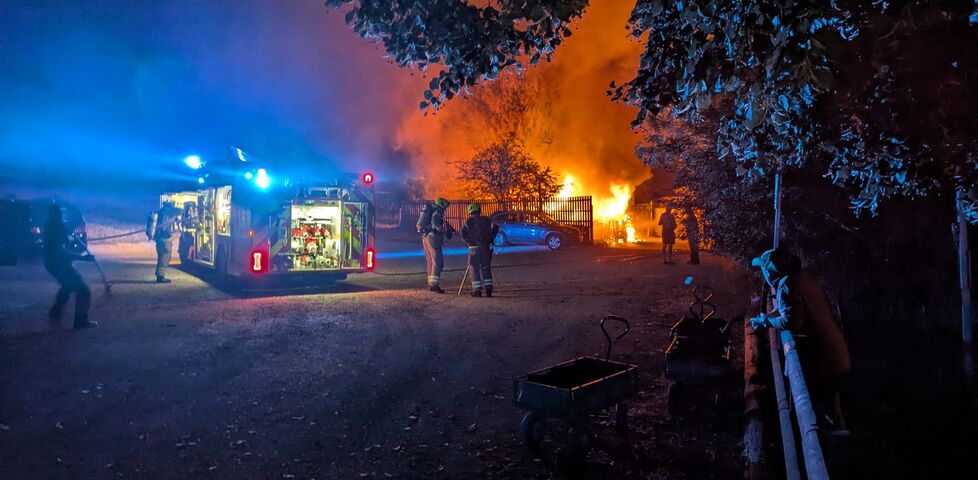
The fire intensity of the fire grew particularly intense as the sound of fire engine sirens began to be heard from the valley below. Photo copyright Rory Prior.
I returned to the dome and got the children dressed. We evacuated to a safer distance and watched as the firefighters arrived and began to tackle the blaze. Short of water, they had one
pump dousing the flaming building while two others relayed water from the nearest fire hydrant, way down the hill.
There was a brief faux pas when one of the Abnib kids exclaimed “this is so cool“… without realising that he was standing right next to the people whose
home was being destroyed in front of us.
Eventually the situation came under control and we were all able to return to bed.
The battery pack
I spoke to Mike, whose holiday home was the building that was destroyed. He’d managed to escape with some shorts and his mobile phone, but little else: in particular, his car keys
remained inside and were probably destroyed, which rendered him unable to drive back to his regular home.
The firefighters worked quickly, but it still took over three hours before they were able to finish spreading out and drenching everything that had caught light. We watched from a
distance, and sheltered all the children (including those of a non-Abnib family on-site) in one of our tents.
Mike had been turning his phone on only in bursts in order to conserve battery for all of the essential calls he’d have to make (e.g. his bank, to extract some money without his cards,
and a locksmith, to get him back into his car). His phone charger – an awkward USB-B-Micro one – hadn’t survived the fire.
But conveniently… I happened to have such a cable in my bag. Plus a fully-charged battery pack. So I lent both to Mike, in the hope that it’d make it easier for him to do all of the
necessary administration1.
It’s got to be a pretty-devastating thing to happen to your holiday home and everything in it. Mike was surprisingly chill about it when I spoke to him, taking soft-of an attitude of
“well, there’s no point fretting about it after the fact!”
“You saved my life!”
Anyway: on Saturday night, shortly after the kids and I had turned-in, there was a knock on the door. It was Mike, come to return the battery pack I’d lent him.
The kids didn’t know who he was, so I explained: “This is Mike; he’s the fella who lived in the home that burned down last night.”
Mike handed over the battery pack and charging cable and, grateful for them, used a metaphor that. “Thanks,” he said, passing the hardware to me, “You saved my life!”
I hadn’t told Mike which glamping pod was ours, and just figured I’d see him around. Or else if I didn’t get my battery pack back, that’d be fine: it’ll have been more-useful to him
than to me in the days to come! But there we were, in our pyjamas, when he appeared at our door.
He turned and left, and both kids sprung out of bed and exclaimed “You saved the life of the guy whose house burned down‽”
I’m sure they had in their minds the idea that, during the period between the fire starting and me waking and evacuating them, I’d singlehandedly dragged this dude out of a burning
building. Y’know, instead of just lending him a phone charger after-the-fact.
I only let them hold the misapprehension for a few minutes, but for a moment it lightened the mood.
Footnotes
1 I was already using my phone to call our insurance company before our flood, earlier this year, had finished. I can only imagine how inconvenient it is to suffer a disaster and lose your communications lifeline at the
same time!
This summer, the kids’ performing arts school are singing and dancing in a show at Disneyland. We’re all very excited, but my excitement, at least, was muted a little when I
was told to install the “Travelbound” app in order to get access to the itinerary, travel
arrangements, and accommodation details.
Fuck that noise. This should have been a webpage. Why do you want me to install a(nother) shitty app just to tell me something that could have been a (smaller, faster, more
universally-accessible) document?
I’m not remotely exaggerating. This app is literally text, images, and links to PDF files, delivered via the Web.
There only seem to be two things that this “app” does, that a webpage might not have, and they’re both anti-features:
It reports tracking data associated with your Google Account back to the developers.
It shows you advertisements (which they call “inspirations”) for other trips organised by the same agency.
Fuck. Everything. About. That.
A webpage would have been so much better. Unlike this app, a webpage can be…1
Copy-pastable
Printable
Saveable
Bookmarkable
Searchable
Usable on virtually any device
(Potentially) more-accessible
I’m annoyed enough… that I’m going to “fix” this app. Hold my beer.
Created a new virtual device in Android Studio’s Virtual Device Manager.
Tested adb shell was working and used rootAVD to root it: ./rootAVD.sh
system-images/android-33/google_apis_playstore/x86_64/ramdisk.img.2
Performed a cold boot, ran Magisk, and tweaked its settings to automatically grant su access to any app that
asked.3
All your traffic are belong to me. At this point, it’s just like running Wireshark or TCPdump.
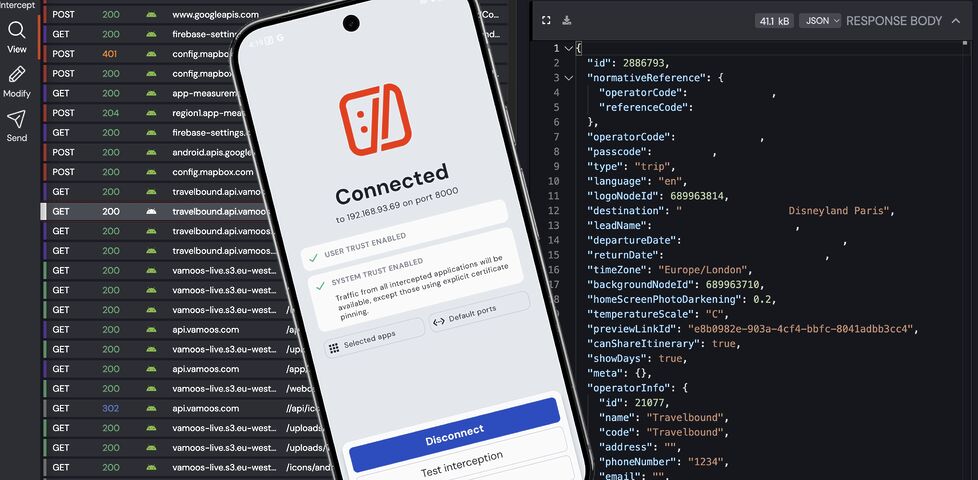
Ran HTTP Toolkit and told it to intercept AVD traffic. It installed a (fake) VPN provider, routing the phone’s traffic through the
proxy.4
Installed the Travelbound app from the Play Store.
Configured HTTP Toolkit to proxy only the Travelbound app (more signal, less noise).
With only a couple of minutes experimentation I discovered that the app works by concatenating the username and password5
and using it in a URL of the form:
This returns a pile of JSON which, with a little interpretation, can be seen to represent all of the content the app “shows”. E.g., there’s:
an array containing each leg of the itinerary,
an array containing all of the “inspirations” advertisements to show you,
a cross-referenced array containing all of the files (images etc.) that are referenced by the other sections, etc.
They’re clearly producing HTML code anyway… so again, I ask: why isn’t this a webpage?
A little experimentation showed me that the S3 image URLs were being delivered with moderately-short expiration times, so the JSON needs re-fetching periodically even if the content
hasn’t been changed.6
Turning it into something better
Now I had everything I needed to make something… better. I wrote a Ruby script that runs on a Cron schedule to pull the latest JSON and use it to build a HTML page.
I chose to have it completely skip over the “inspirations” (“overlayRows” in the data schema) and just list:
the items from the itinerary and
all of the files not referenced by the inspirations nor itinerary, (a lazy way to collate the PDF download links).
Then I hosted the page, protected by a password: the same one my tour group were given in the first place. I included the raw JSON it used in <details> elements so it
can be checked if e.g. there are bits of the schema I didn’t see but that might appear later.
My web page isn’t as “pretty” as the app from which it “borrows” its information. But it’s a fraction of the size and gets all of the Web’s standard features for free.
Some people like an “app”, and that’s… fine, I guess. But some apps could have been a webpage. And especially where, like this one, the content they deliver is already written
in HTML and delivered over HTTP… they should be a webpage, right?
I can’t understand how we got to this place with “app culture”! Software companies are happy to make their lives harder (and more expensive: deploying to the big app
stores isn’t free!), in order to deliver HTML content to fewer people and with fewer features7
than if they just published directly to the Web in the first place!
There are (some) tasks for which an “app” is absolutely the right choice of medium. Travelbound is not one of them.
But at least I (and the rest of our group, whom I’ve shared it with) now get the choice about how we access this content. Either a 43MB app (ballooning to 124MB
when it’s finished downloading extra content) with tracking and advertisements… or a 0.05MB web page (with an optional extra 35MB of images) that provides more features and works on
more devices. I know which one I’ll be using!
Footnotes
1 And these are just the features that everybody can get behind. The webpage
I ultimately ended up making to replace the app also has some user-friendly/developer-hostile features, like the fact that it removes the tracking code and doesn’t show
advertisements.
2 You need to root the device in order to force applications that use Certificate Pinning
to trust your man-in-the-middle proxy server. Without this, some applications – including the one I wanted to reverse-engineer – will recognise your self-signed TLS certificate as
invalid and refuse to communicate.
3 Without changing this setting in Magisk, I found that HTTP Toolkit would
request su access but not wait for the response, and go on to run in unprivileged mode before I had a chance to grant it!
4 Owing to Android security considerations I needed to manually install the root CA
certificate it installed for me, but the instructions “just worked”.
5 The username and password is shared by an entire tour group. I’m guessing they don’t
have a plan for if some credentials get leaked? Or possibly they consider all of the data they hold to be low-sensitivity enough that it doesn’t matter if it does… in which
case I return to my original point: why the hell wasn’t it just a webpage in the first place?
6 Or else the images need caching locally, which seems to be what the app does, in the
bloatiest possible way.
7 And, often, with worse accessibility. I’ve not audited the accessibility of this app,
but there are things about it that suggest that it’d be harder to use using accessibility technologies than my plain, simple Web version.
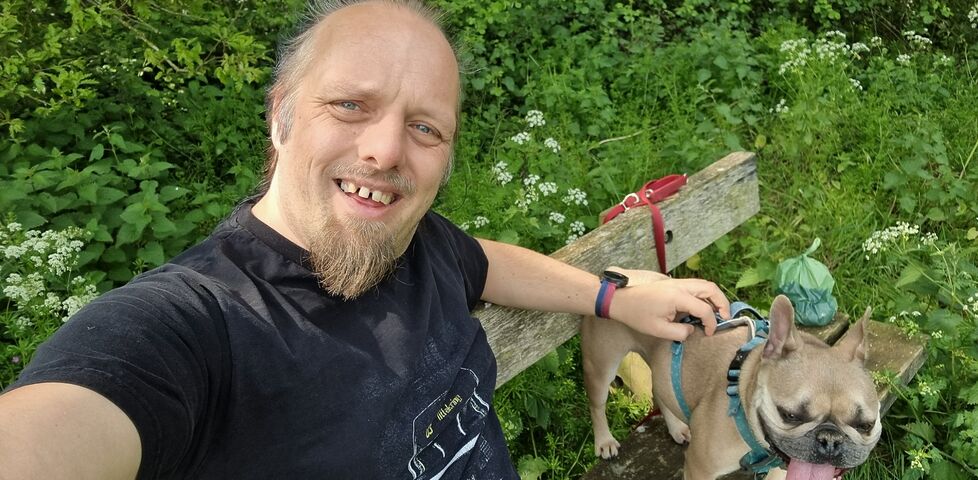
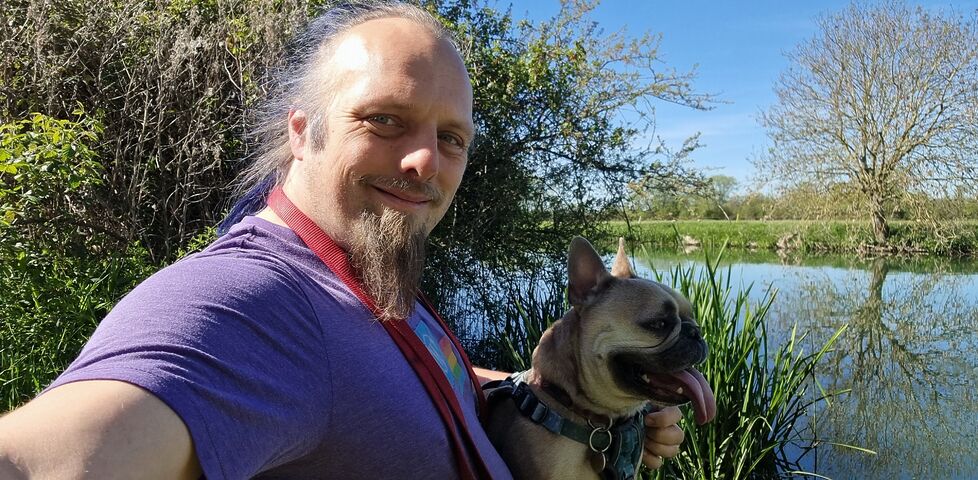
Sat in the shade with my panting pupper and almost immediately spotted this clever cache container. A great location and an imaginative container! Definitely worth an FP from me.
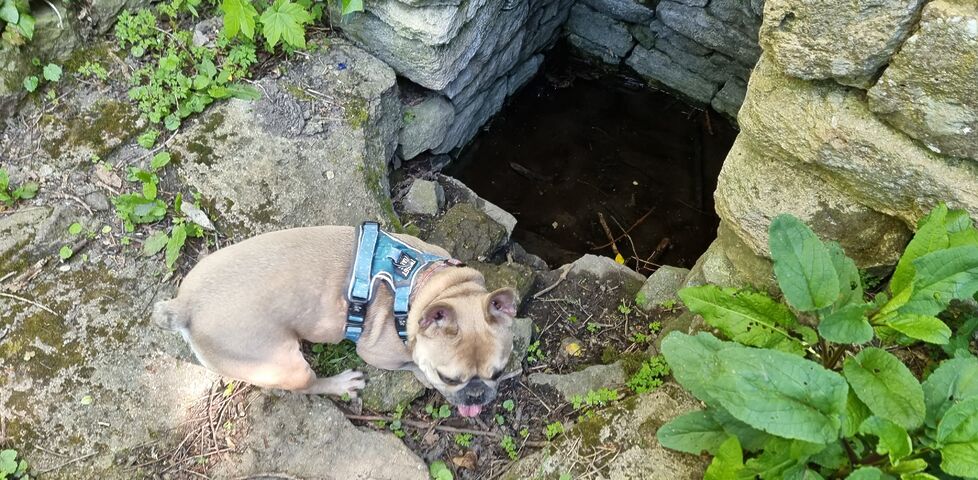
What a beautiful spot for a geocache, which the geopup and I quickly found in the second host we checked. Then, we enjoyed a delightful few minutes of peace, sitting on the riverbank,
before continuing our morning’s adventure.
This afternoon I’m acting as backup driver for my partner Ruth, who’s walking the
length of the Thames Path by (very gradual) instalments. Having parked at Culham Lock I began to walk back towards Abingdon to meet the walking team coming the other way, when I
noticed that a new cache had been published nearby and diverted to find it.
A delightful tree climb later and I had this great cache container in hand. TFTC, FP awarded!
Completing our loop (minus a couple of DNFs, but plus a couple of nearby caches), this damp geopup and I were really happy to finish with this good-sized cache!
TFTC, and for the series, if which this was our favourite and so earns the FP.