
 RSS
RSS Spotify
 Pocket Casts
 Apple Podcasts
 YouTube
To celebrate the site's 25th birthday this year, Wikipedia is encouraging/challenging people to read one Wikipedia article a day for 25 consecutive days. I felt that I could do one better than that: not only reading an article but - where I found one that was particularly interesting - to write a blog post or record a podcast episode for each of those days, sharing what I learned. For each entry, I'll hit "random article" a few times until something catches my interest, start reading, and then start writing! Everything I've written below came from Wikipedia... so you should check other sources before you use it to do your homework. Happy birthday, Wikipedia!
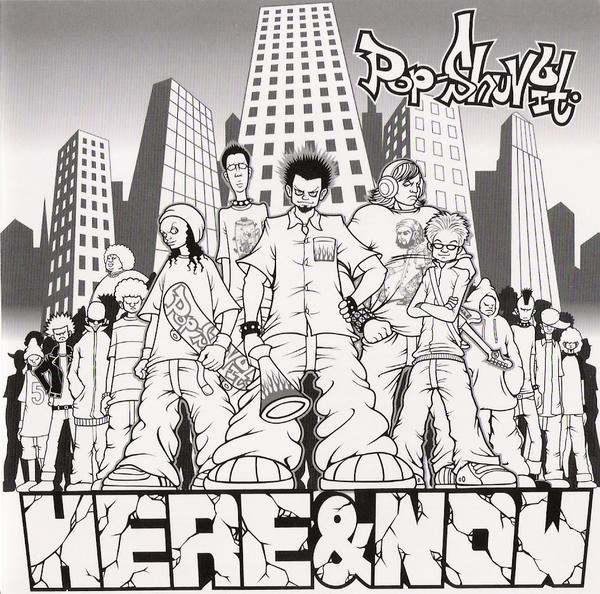
Today's random article: Here & Now (Pop Shuvit album)
Today's topic: Necker Island (Hawaii)
As I observed... what...? 15 years ago, it's easy to get lost down a series of Wikipedia links and have to use the back button to remember how you got there. That's very much what happened to me today.
My random article for the day was about Here & Now, the second album of Pop Shuvit, a Malaysian hip hop/nu metal band most-active from around 2002 to 2011. I listened to the album; the title track's pretty good, and I enjoyed Old Skool Rocka and Put 'Em Up too.
Alt
Here & Now album cover, featuring black and white line art of the band and fans in front of a cityscape.
The band take their name from a skateboarding trick called a pop shove-it, presumably using the different spelling to aid their ability to protect their copyright on it.
And this is the point at which I briefly got lost in the depths of Wikipedia's article about skateboarding. A pop shove-it, you see, is apparently a combination of an ollie and a shove-it, which still sounded like a foreign language to me, so I had to read up on both. Here's what I learned:
- An ollie is when you stomp down on the back of the board to make it jump, while sliding the front foot forward from the midpoint to keep it somewhat-level and stop it flipping "over". This results in the entire board jumping while remaining almost-horizontal, while the skater flies just above it.
- A shove-it is when you rotate the board 180° laterally, so that the "back" end of the board becomes the "front" and vice-versa: so the board ends up landing and its wheels roll the opposite direction they did at the start of the trick, but the board and skater carry on moving forwards. It's done by giving the board a bit of a kick to start it rotating and then landing on it with enough pressure to stop it rotating again.
That's a terrible explanation. Here's a terrible diagram from Wikipedia that probably doesn't help either: (you'll want to find a video if you really want to understand it, but that goes beyond what's available on Wikipedia, so I'm not sharing it as part of this blog series!)

Alt
Diagram illustrating the foot positions and board rotation of a 'pop-shuvit'.
The pop shove-it was originally called the Ty hop, after its inventor Ty Page, a famous skateboard in the 1970s also known by the name "Mr. Incredible".
I could list some of the other fifty-plus moves he's credited with inventing (like the pay hop, daffy or yeah right manual, and the toe-spin 360), but it'd probably only be fun and interesting if I mixed-in a few fake ones I conceived of myself (like the nip trip, double pipe-tail, and the indo 180).
Skateboarding had been around since at least the 1950s and had exploded in popularity in the 1960s, but a major part of the reason Ty was able to invent totally new tricks in the 1970s was the result of a two new innovations that took off at that time:
- Polyurethane wheels, invented by Frank Nasworthy to supplant the use of hard steel wheels (commonly used by rollerskates at the time) or clay composite wheels. Steel wheels were fast and smooth-running, but because they're hard they provide little grip, which makes stunts harder to control. Clay composite wheels were softer and easier, but wore out quickly, needing to be replaced after as little as seven hours of skating. Polyurethane gives a best-of-both worlds, giving a long-wearing but soft-enough-to-grip surface to the wheel from a material that was rapidly becoming cheaper to manufacture.
- The kicktail, invented (and patented) by Larry Stevenson, is the curved-up bit at the end of a board, so named because it originally only appeared at the back of a board (although Larry cleverly obtained a separate later patent on double-kicktails: one at the front and one at the rear - the front one is sometimes called a kicknose). A kicktail makes it much easier and safer to lift a board by stamping down on it, or else can make it possible to get more lift with a similar level of ease, compared to a completely flat board.

Alt
Close-up of a red wheel on a skateboard.
Ty Page helped promote the kicktail as part of the Makaha Team, sponsored by Stevenson's company MAKAHA Skateboards. And here's where I jumped into a whole different rabbithole.
At this point in history - as skateboarding was just beginning to come into its own as a sport - there was an enormous intersection between surfboarders and skateboarders, many of whom would surf when weather and tide conditions were right and skate when they weren't.
Larry Stevenson was such an individual. On his way to his deployment in the Korean War, he stopped at Hawaii where he found a particular beach to be excellent for surfing. That beach, which would eventually give its name to his company, was at the town of... Mākaha.

Alt
Tropical golden-sand beach with people playing in the waves.
One thing I found interesting while reading about Mākaha is that it's the home of Kāne’āki Heiau, Hawaii's most-completely restored heiau. Heiau are temples of the indigenous religion of Native Hawaiians, a polytheistic and animistic belief structure itself seemingly related to earlier Māori practices brought over by Polynesian seafarers from 800 CE onwards.
According to tradition, heiau were built by menehune, mythological two-foot high dwarves who lived in the deep forests and hidden valleys, far from humans, and came out at night to build structures and dig fish ponds. The concept is comparable to the European idea of brownies or hobgoblins, in particular the pre-Christian idea of these spirits as being helpful to humans so long as they're treated with respect.

Alt
Painting of a diminutive man carrying a fish almost the same size as himself out from the sea.
Pressure from Christian missionaries in Hawaii from 1820 onwards led to the neglect and destruction of most heiau, except for the most-remote of them. One such remote temple was the standing stones on Necker Island (see: we got there eventually!).
Necker Island is named after Jacques Necker, France's finance minister at the time that the first European explorer - Jean-François de Galaup - sighted the rock. We don't know what ancient Hawaiian peoples called it, but reverse-engineering Hawaiian chants passed down by oral tradition that include descriptions of islands has led the Hawaiian Lexicon Committee to assign it the name Mokumanamana, which means "pinnacled island".

Alt
A rocky island protudes from the waves.
We also don't know when Necker Island was last inhabited, but it seems that its poor thin soil is likely to have prevented permanent settlement. However, there's evidence that its caves were used for human habitation from time to time, and some have been used as tombs. Even landing on the island is difficult on account of its sheer stone cliffs around its edge (which is part of the rim of what was once a volcanic cone).

Alt
A line of rocky standing stones with sea birds perching on many of them.
But do you know what archaeologists found on Necker Island, amongst the standing stones? Menehune figurines, carved out of basalt, one and a half to two feet tall. Tales in the oral traditions of the natives of the island of Kauaʻi describe Necker Island as the last refuge of the diminutive builders after they were chased off the main island by the newly-arrived Polynesians.

Alt
A carved stone figurine.
In the way that was long-traditional for European empires exploring the culturally-important sites of distant lands, many of the artefacts found on Necker Island aren't there any more. But the standing stones are still standing, and human remains that were removed and put into a museum have been returned and re-buried, at least.
So that's Necker Island! Which I learned about because Wikipedia randomly chose me an article about an album by a Malaysian hip hop band, whose name derives from a skateboarding trick that's possible thanks to an invention by a man whose skateboarding company was named after a surf-friendly Hawaiian beach near a town that has ruins of a temple allegedly built my mythological dwarves who are said to have lived there. It's been quite a journey! I wonder where tomorrow's will take me.
0 comments