
 RSS
RSS Spotify
 Pocket Casts
 Apple Podcasts
 YouTube
To celebrate the site's 25th birthday this year, Wikipedia is encouraging/challenging people to read one Wikipedia article a day for 25 consecutive days. I felt that I could do one better than that: not only reading an article but - where I found one that was particularly interesting - to write a blog post or record a podcast episode for each of those days, sharing what I learned. For each entry, I'll hit "random article" a few times until something catches my interest, start reading, and then start writing! Everything I've written below came from Wikipedia... so you should check other sources before you use it to do your homework. Happy birthday, Wikipedia!
Today's random article: Marcus Koh
Today's topic: Yo-yo
One of the things I've discovered over my past few days of hitting "Random Article" on Wikipedia is that sometimes you get something that's worth writing about. But more often you get something worth reading but not writing about. But more often still you get something that doesn't interest you at all, and you just need to click "Random Article" again.
And that latter category is the one I thought I was in when I discovered Marcus Koh, who's a Singaporean yo-yo enthusiast who came first in the 1A division at the World Yo-Yo Contest in 2011. The page almost felt like a stub... but then I started clicking and found myself learning much more about yo-yos than I ever thought possible.
Like... I knew that the yo-yo was an old toy, but I had no idea how old.

Alt
Drawing showing a woman playing with an early form of the yo-yo.
Obviously there's a lot of pictures from around the end of the eighteenth century, which is when they became popular in Europe. In the English-speaking world at that point they were known as "bandalores", which I think is a nicer name than "yo-yo", frankly.
But their influence was clearly felt much further away and much longer ago than this.
I mean, here's a 1770 watercolor from Northern India that clearly depicts something that, despite being held in two hands, is definitely something-like-a-yo-yo:

Alt
Watercolour Mughal painting showing a woman playing with a long-stringed yo-yo, with the extended tail held over her head in her second hand, while a second woman, holding a fan, watches.
But we can go further.
If you lived in Greece in around the 5th century BCE and were serving wine to your guests, the popular drinking vessel to use was a kylix. Kylikes were pottery cups basically the shape of modern wine glasses but much more squat, having a wide bowl atop a pedestal that tapered outwards. Unlike modern wine glasses, though, they had handles, and these handles were used to play a game called kottabos: once you'd finished your wine, you'd use a handle to "flick" the sediment from your wine (I guess fining/clarification agents weren't a thing yet?) at a target in order to win a cake or something.
Sounds pretty gross for whoever had to clean up afterwards, if you ask me.
Anyway: oftentimes the inner bowl of a kylix would be decorated. Depending on the kind of party you were throwing you might have a nautical theme where everybody finds a different kind of boat at the bottom of their cup when they drain it... or for a more raucous party perhaps you'd get out the cups where the faces at the bottom all had genitals hidden in them. That way, somebody gets surprised to find that at the end of a drinking session they have a penis in their face (I've certainly had parties like that before, if you know what I mean):
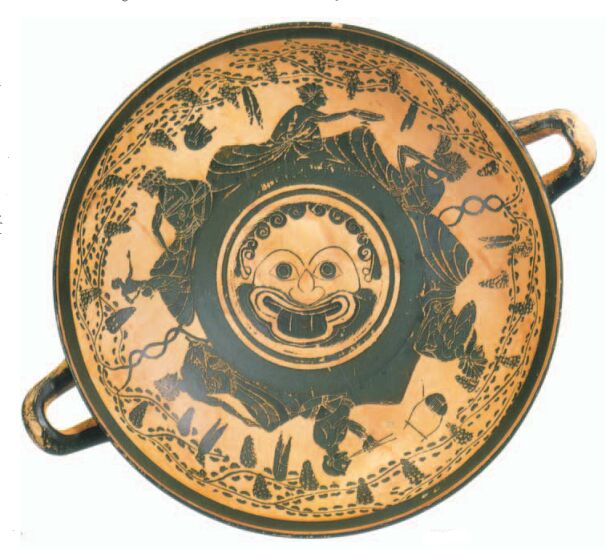
Alt
Interior of the Bomford Cup, a kylix with a face at the bottom whose nose is distinctly shaped like male genitalia.
What I'm saying is... the Ancient Greeks liked to play drinking games, and they liked drinking vessels with pictures on. Which makes you look at the "Greek culture" of fraternity houses in a whole new light.
But the pictures weren't always either (a) boats or (b) crude, of course. They could be anything. Here's an example of the bottom of a kylix that was probably used as a drinking vessel in or near Athens around 2,500 years ago:

Alt
Boy playing yo-yo. Tondo of an Attic red-figure kylix, ca. 440 BC.
It's not just novelty earthenware that tells us that the Ancient Greeks had the yo-yo, by the way. We've found actual examples of them made from bronze or terracotta, although archaeologists suspect that there were many more wooden variants that have been lost to time.
I guess it's true that it's a toy that just keeps making a comeback. Every few centuries it gets reinvented and improved, I guess! "Modern" yo-yos got their relaunch in the 1920s, when Pedro Flores (a Filipino businessman whose time in his birth country spanned a previous story) brought to the USA a toy that had been popular in his homeland but seemed to be mostly-unknown in the States. The name apparently derives from a Tagalog word that means "come-come" or "come-go" or something similar. He produced both traditional "tied-on" yo-yos and "slip-string" varieties that allowed the toy to "sleep" - to spin-freely at the end of its string - which unlocked a diversity of new tricks.
From here on, the yo-yo saw surges in popularity every 20 to 40 years. The full article's worth a read because unless you're a complete yo-yo nut I can guarantee there are things in there that you didn't know.
I was also very interested in the article about the "Eskimo yo-yo", which I'd love to see somebody operate! It's basically a bola of two weights attached to a stick using strings of two different lengths, and the trick is to get them spinning in opposite directions but using only one hand. That sounds amazing!
I also got briefly distracted by clackers, a hyperlink-adjacent childrens' toy that lends its name to the excellent lawsuit title United States v. Article Consisting of 50,000 Cardboard Boxes More or Less, Each Containing One Pair of Clacker Balls, which is going right up there in my list of favourite Wikipedia page titles alongside Salmon chaos, List of lists of lists, Thinking about the immortality of the crab, 2022 United Kingdom government crisis (disambiguation), Pope John numbering, and Pentagon pizza theory.
0 comments