They are small, almost imperceptible cues that tell the nervous system: you are safe. You are connected. You are still here. Where a trigger tightens the chest and narrows the
world, a glimmer softens the edges. It steadies the breath. It lets a thin ribbon of light slip in.
They are rarely grand in scale. Most often, they are sensory. Fleeting. Easy to miss.
…
This is beautiful.
I’m reminded of the way Ruth reframed imposter syndrome as wonder
syndrome a few years ago, which I wrote about at the time. A “glimmer” is not only a valuable and useful word
that I’d not come across before (I love it when that happens, like with entle), but it also reframes the world in a more-positive light.
I’m going to to start looking for and naming glimmers in my life as part of my general practice of gratitude. Cultivating a conscious awareness of our glimmers is probably harder than
finding an awareness of our triggers – and even that’s not always easy to narrow down specifically! – but it seems like such a worthwhile exercise.
The One and I is a delightful and long-running personal blog, by the way, if you’re looking for somebody new to follow. It feels
calming and personal and sweet and there’s a healthy corpus of pictures of pets.
NHS England has issued new guidance to staff, which has been shared with New Scientist, that demands existing and future software be pulled from public view and kept behind closed
doors. “All source code repositories must be private by default. Repositories must not be public unless there is an explicit and exceptional need, and public access has been
formally approved,” says the new guidance. The deadline for making code private is 11 May.
Last month, an AI created by Anthropic called Mythos was widely reported to be capable of discovering flaws in virtually any software, potentially allowing hackers to break into
systems running it.
NHS England’s guidance specifically points to Mythos as the cause for the new measures.
…
Yet again, “AI” is the reason why we can’t have nice things on an open and transparent Web.
This is bad, of course. But the worst part is the illusion it helps feed that closed-source software is necessarily more-secure than open-source software. Obviously it’s all
much more-complex than that. Indeed, the article goes on to quote Terence Eden thoroughly debunking the entire line of thought:
“Is it possible that Mythos will scan a repository and find a bug? Yes, 100 per cent likely. Is that going to be a bug that causes a security issue in a live NHS service
somewhere? Almost certainly not,” says Eden. “I think it’s someone in NHS England buying into the hype that Mythos is going to cause the end of security as we know it and
getting a bit panicked.”
He’s right. This policy change is unlikely to improve the security of any of the affected pieces of NHS software (for much of which, the code is already out-there and archived, and so
removing it from the Internet now is pretty pointless). If it’s going to be attacked, it’ll be attacked, and the resources that the bad guys have for probing a whole
database worth of CVEs or fuzz-testing the extremities makes the availability of vulnerability-scanning AI pretty-close to irrelevant.
At least if it were open source then the good guys would have a chance of helping out… as well as we, the taxpayers who made the software possible, being able to see where our money was
going!
I was pretty ill yesterday. It’s probably a combination of post-flood stress and my shitty lungs’ ability to take a sore throat and turn it into something that leaves me lying in bed
and groaning.
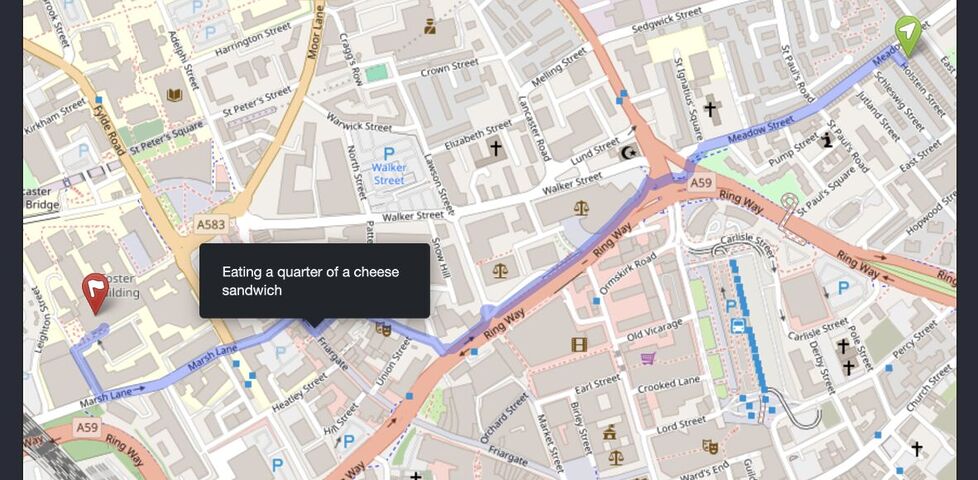
I spent most of the morning in and out of a fitful sleep, during which I dreamed up the most-bizarre application: a GPS tracker app that, after being told your destination and what you
were eating, reported your journey progress to social media by describing where you were going and how much of your food was left1.
The “eating progress” could either be updated to the status itself or overlaid onto a map of the route.
I should be clear that in the dream, I wasn’t the one that invented this concept; in fact, I didn’t even understand it at first (maybe I still don’t!). In the dream I was
at some kind of unconference event with a variety of “make art with the Web” types, and I missed a session by falling asleep2. I woke
(within the dream) right before the session ended and rushed in to see what was being presented, and only got the tail-end of the explanation of how a project – this
project – worked, after which I felt rushed to try to understand it before somebody inevitably tried to talk to me about it.
For times you’re disconnected or otherwise unable to self-track, tools like FlightRadar could step in.
I’m probably not going to implement this. It is, in the end, the kind of stupidity that could (should?) only appear in the dreams of somebody who’s got a bad head cold.
But if you manage to take this idea and turn it into something… actually good?… let me know!
Or if you’ve just got a cool, “Web 2.0-ey” idea for the name of an app that tracks both your journey progress and your meal consumption, I’d love to hear that too.
Footnotes
1 Under the assumption that its consumption would be evenly distributed throughout the
journey. Because everybody does that, right? Counting the number of steps they make before taking another equal-sized bite. Right?
2 Even in my dreams, I can dream of falling asleep. And, sometimes, of dreaming. A fever
probably helps.
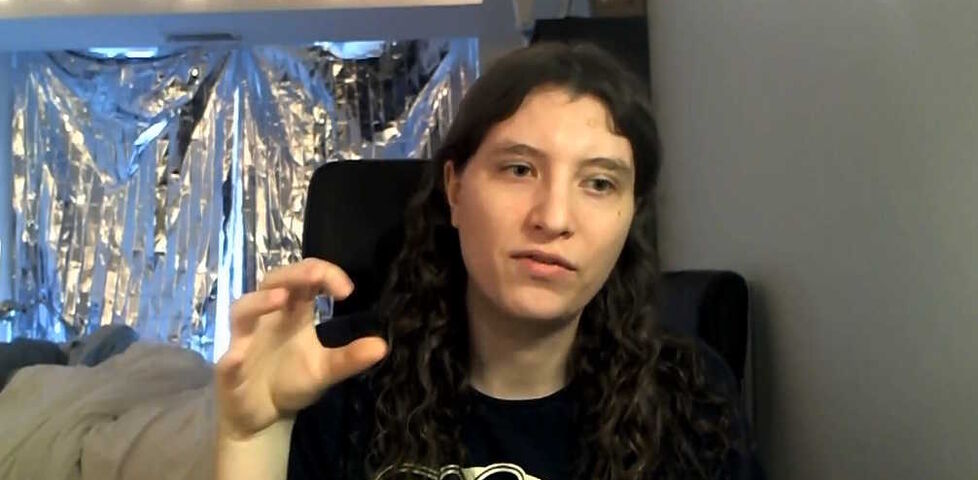
or, how to fuck your shit up by ignoring obvious birthday inflammation symptoms. don’t be like me. seek help.
sorry for this barely scripted and low quality video, the next one will be worse.
special thanks to doctor jacobi for the excellent care, and to the manna charitable foundation for the flight logistics.
The ever-excellent Blackle Mori1
posted this about 18 months ago but I don’t think it got the level of attention it deserves. If if you’ve never experienced birthday inflammation or known anybody who has, it’s an
eye-opening experience to hear a first-hand account of this unusual and definitely-real condition.
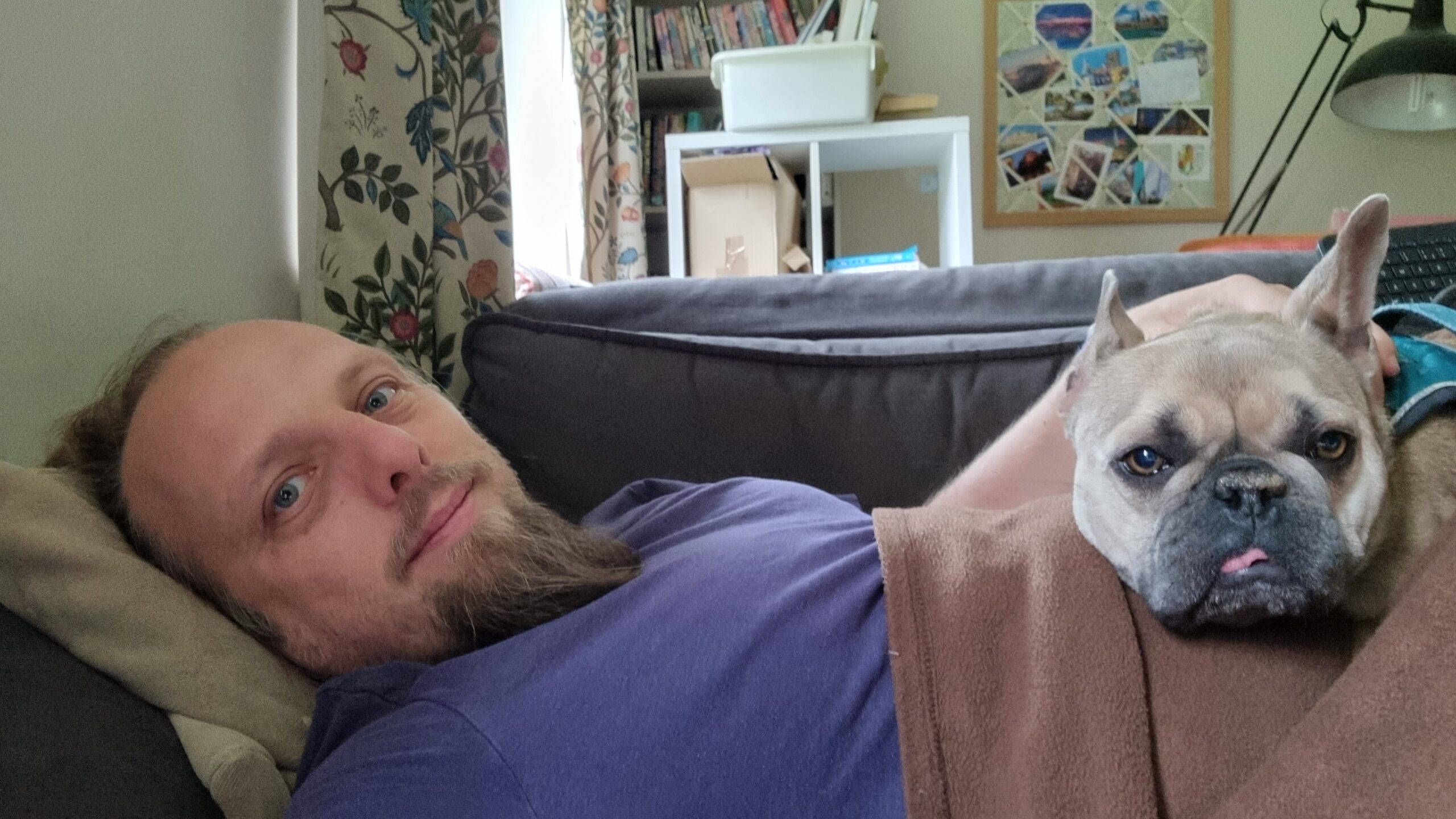
After most of four days spent primarily in bed with what’s probably a norovirus infection (or something like it), this afternoon I got up and went outside. 🎉
It felt like a huge achievement, even if I ran back in to the warmth the very second that the dog I was supervising had finished her business.
Using WordPress internally at Automattic as a productivity tool is great… until you have to call in sick three days in a row and Jetpack treats your “streak” as an “achievement”! 😅
Third day of being ill with what’s probably a winter vomiting bug, with one child home sick from school… and just having had to collect the other kid who started throwing up on his
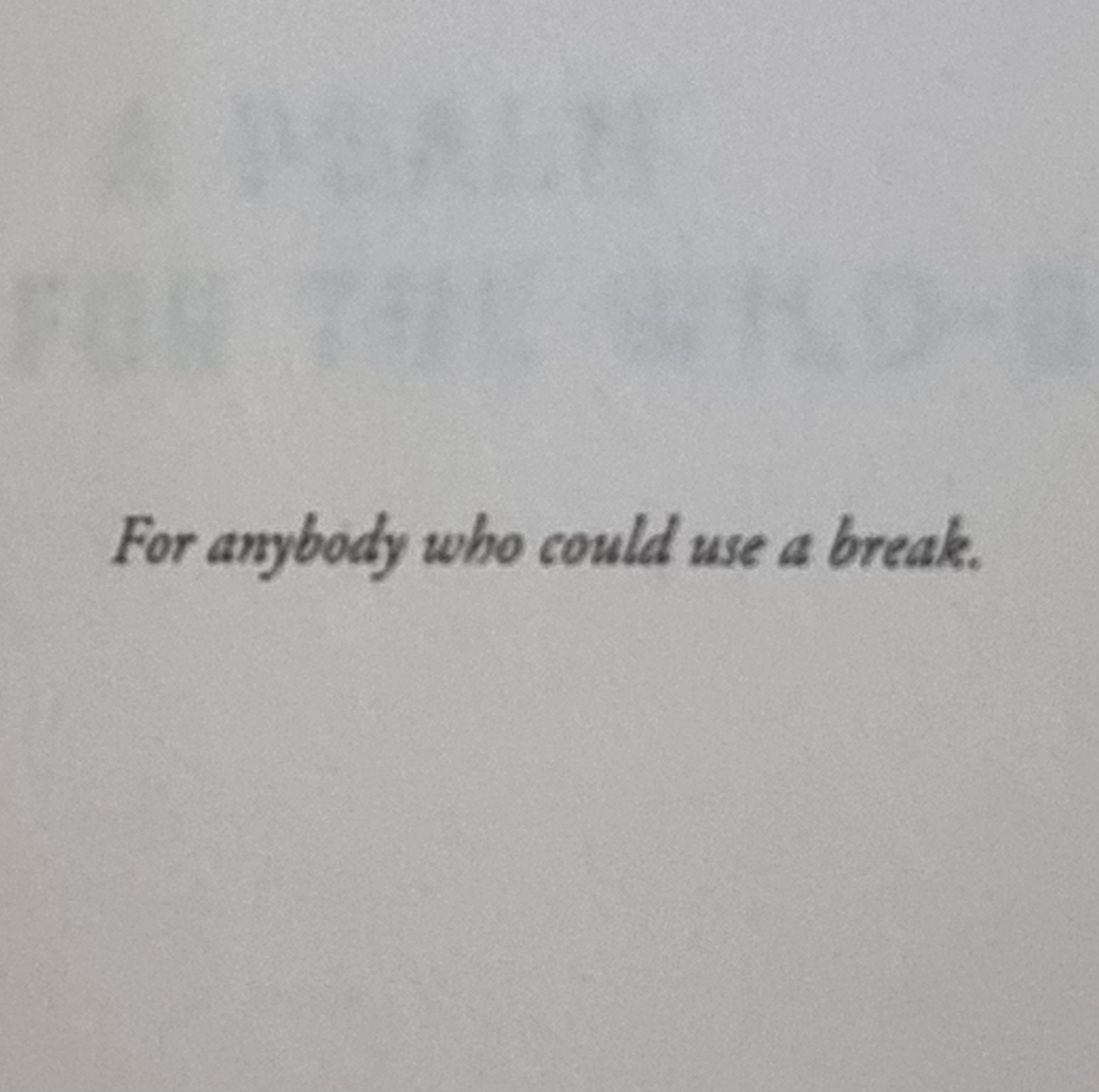
school trip… I finally got back to my bed and picked up the next book on my pile, Becky Chambers’ A Psalm for the Willd-Built.
The opening page reads: “For anybody who could use a break.”
Don’t remember the last time I felt so run-down. I’ve been unwell since Sunday with an illness I can only assume I caught from the 11-year-old, who’s been unable to keep food down for
several days.
In my case, though, I’ve mostly been full of muscular aches and cramps, ocassionally fits of shivers, and strange dizziness.
I’ve spent the last day and a bit mostly drifting in and out of sleep, where I’ve had the weirdest dreams. I just woke from one where I was lost in a sprawling hotel, looking for my
room which was number 317 or possibly 305, I couldn’t remember. The signage didn’t make sense to me and I couldn’t read it, and found myself wandering around a sprawling resort, with
hot air balloon services connecting different parts. At one point I found myself lost in a library whose winding shelves formed a Escherian maze, and a small child watched me with
suspicion as I fumbled around for an exit.
In a disturbing dream from yesterday afternoon, I was lying in a desert of cold sand as the wind gradually piled up more and more sand against me. At first I felt fascinated, thinking
I’d learned something about how dunes form, until I discovered that I wasn’t able to move. I gradually sunk deeper and deeper underground, in pain except when I lay very still and let
it take me, until eventually I started to become the very sand that I was disappearing into. I felt flakes of myself break away and become part of the desert, unable to resist
the change nor reconstruct myself, resigned to my fate.
I’m in less pain so far this morning than yesterday, so I think I’m recovering, but man this has been an unpleasant ride. Whatever I’m infected with: do not recommend, would not
contract again, one out of five.
This evening I pushed against my illness-addled brain to try to sit in on the fortnightly Zoom call with the Three Rings dev team.
Unfortunately it seems like the primary symptom of my cold is an inability to string words together.
At one point, I apologised to by colleague “Beff” (I meant “Bev”, but I had just been talking about “Geoff”) that I couldn’t work out how to stop “scaring my screen” (well, I suppose
Halloween is coming up…). Then, realising my mistake, explained that it was a bit of a “ting-twister”.
I never thought about taking the offer, but last week took a toll on all of us. It was a weird and sad week. So the Woo DM worked not only as it usually does, a week to bond with
colleagues, have fun and collaborate in person. It was also one hundred times more energizing than it usually is. It had that little taste of “we are here because we believe in
this. LFG!!!”. A togetherness that feels special. We could talk, discuss, and share our concerns, opinions, memories and new ideas for the future of Woo and WordPress.
…
That’s a good summary of the week, I feel. It was weird and sad, especially to begin with, but it grew into something that was energising and hopeful. There was, in particular, a
certain solidarity, of us being the ones who stayed. It’s great to be reminded that my experience is shared.
Whether or not somebody chose to stay for the same reason as me, or as Rosie, it felt like a bonding experience to be among those who made that same decision. I’m glad we got to have
this meetup (even though I’m feeling a bit run-down by a combination of exhaustion, jetlag, and – principally – some kind of stomach bug I’ve contracted
somewhere along the way, ugh).
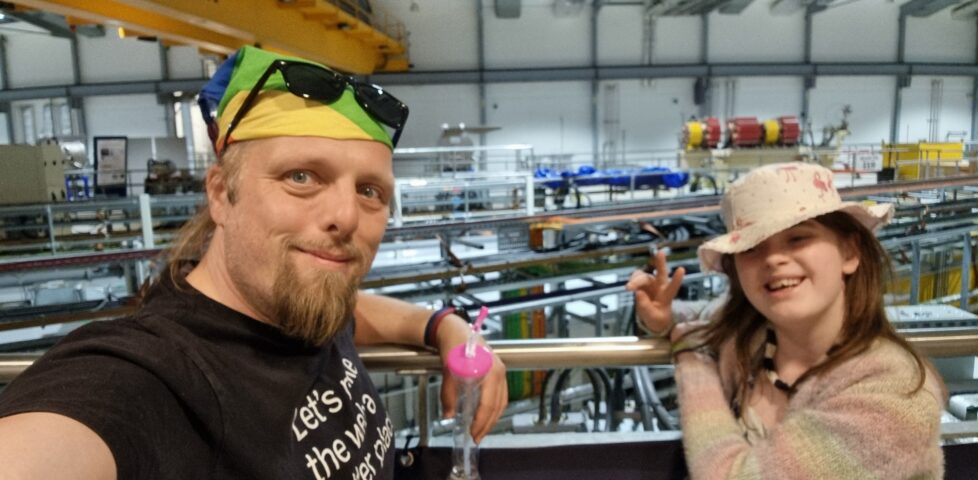
If you wanna bend a stream of electrons travelling at nearly the speed of light, you’re gonna need a lot of big magnets.
This started on Saturday with a trip to the Harwell Campus, whose first open day in eight years provided a rare opportunity for us to get up
close with cutting edge science (plus some very kid-friendly and accessible displays) as well as visit the synchrotron at Diamond Light Source.
It’s hard to convey the scale of the thing; turns out you need a big ol’ ring if you want to spin electrons fast enough to generate a meaningful amount of magnetobremsstrahlung
radiation.
The whole thing’s highly-recommended if you’re able to get to one of their open days in the future, give it a look. I was particularly pleased to see how enthused about science it made
the kids, and what clever questions they asked.
For example: the 7-year-old spent a long time cracking a variety of ciphers in the computing tent (and even spotted a flaw in one of the challenge questions that the exhibitors then had
to hand-correct on all their handouts!); the 10-year-old enjoyed quizzing a researcher who’d been using x-ray crystallography ofproteins.
Medicine
And then on Sunday I finally got a long-overdue visit to my nearest spirometry specialist for a suite of experiments to try to work out what exactly is wrong with my lungs, which
continue to be a minor medical mystery.
“Once you’ve got your breath back, let’s fill you with drugs and do those experiments again…”
It was… surprisingly knackering. Though perhaps that’s mostly because once I was full of drugs I felt briefly superpowered and went running around the grounds of the wonderfully-named
Brill Hill Windmill with the dog until was panting in pretty much the way that I might normally have been,
absent an unusually-high dose of medication.
It’s got a graph; that makes it science, right? (I’m ignoring those party political histograms that outright lie about how narrow the margins are…)
For amusement purposes alone, I’d be more-likely to recommend the first day’s science activities than the second, but I can’t deny that it’s cool to collect a load of data about your
own body and how it works in a monitorable, replicable way. And maybe, just maybe, start to get to the bottom of why my breathing’s getting so much worse these last few years!
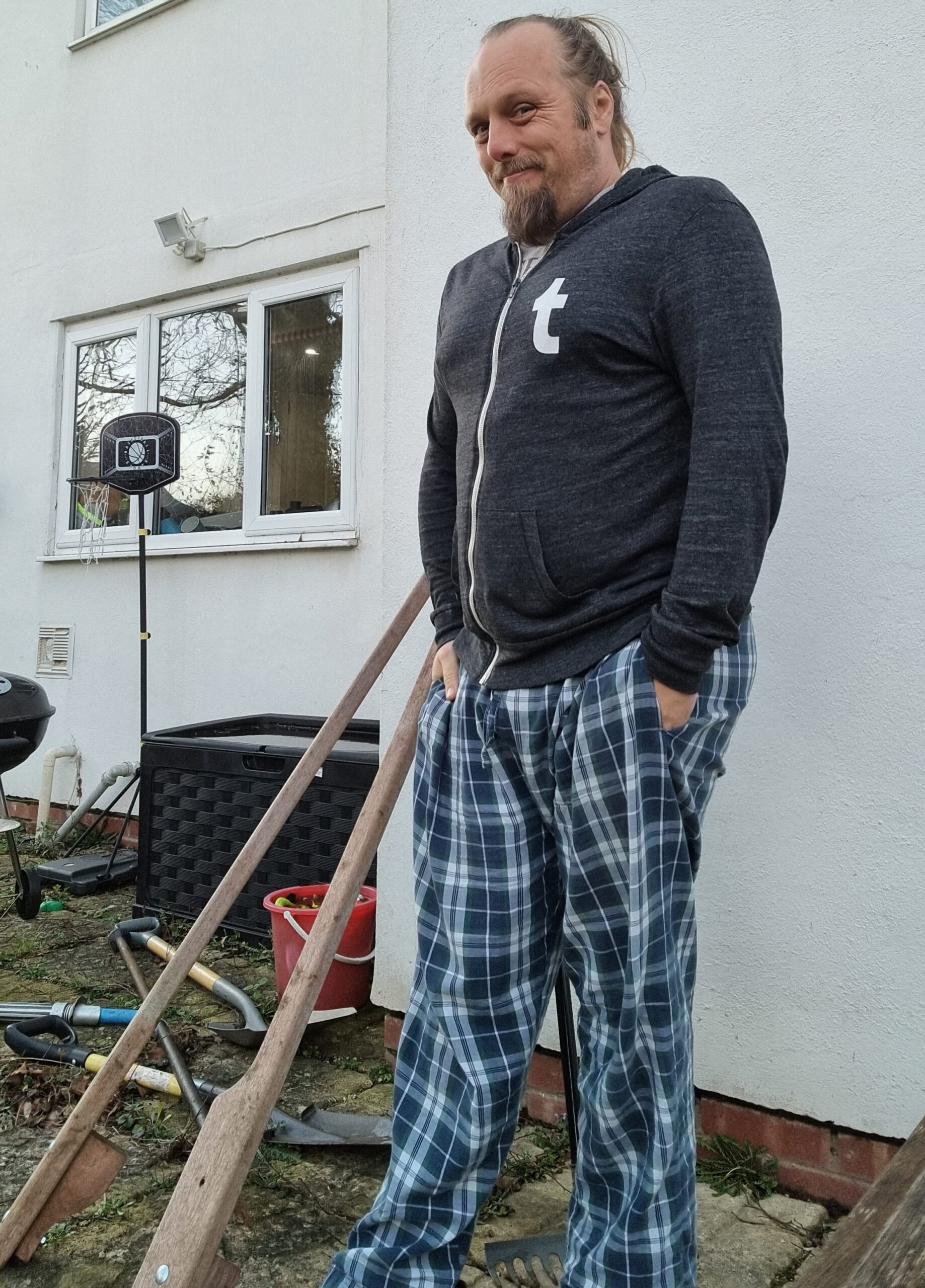
This week, I received a ~240V AC electric shock. I can’t recommend it.
As you may have guessed based on photos in previous posts, our house is currently wrapped in a convenient climbing frame scaffolding.
We’re currently having our attic converted, so we’ve had some electricians in doing the necessary electrical wiring. Shortly after they first arrived they discovered that our existing electrics were pretty catastrophic, and needed to make a few changes including a new fusebox and disconnecting the
hilariously-unsafe distribution board in the garage.
The owner before last of our house worked for SSEN and did all of his own wiring, and left us a rats’ nest
of spaghetti wiring that our electricians described as being unlike anything they’d ever seen before. Also a literal rats’ nest under the decking, but we got rid of that already.
After connecting everything new up they began switching everything back on and testing the circuits… and we were surprised to hear arcing sounds and see all the lights flickering.
The electricians switched everything off and started switching breakers back on one at a time to try to identify the source of the fault, reasonably assuming that something was shorting
somewhere, but no matter what combination of switches were enabled there always seemed to be some kind of problem.
You know those escape room puzzles where you have to get the right permutation of switch combinations? This was a lot less fun than that.
Noticing that the oven’s clock wasn’t just blinking 00:00 (as it would after a power cut) but repeatedly resetting itself to 00:00, I pointed this out to the electricians as an
indicator that the problem was occurring on their current permutation of switches, which was strange because it was completely different to the permutation that had originally exhibited
flickering lights.
I reached over to point at the oven, and the tip of my finger touched the metal of its case…
Blam! I felt a jolt through my hand and up my arm and uncontrollably leapt backwards across the room, convulsing as I fell to the floor. I gestured to the cooker and
shouted something about it being live, and the electricians switched off its circuit and came running with those clever EM-field sensor
pens they use.
Somehow the case of the cooker was energised despite being isolated at the fusebox? How could that be?
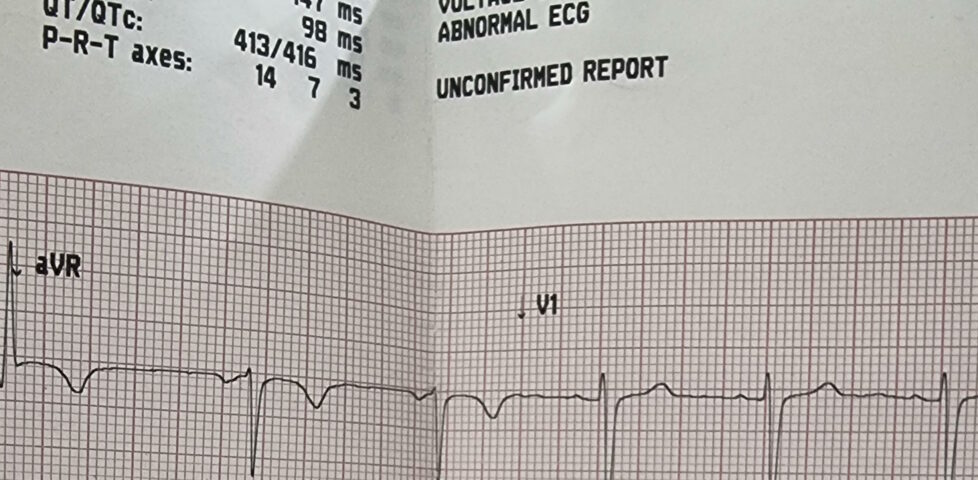
Buy one ECG appointment. Get a free partial chest-shaving free!
I missed the next bits of the diagnosis of our electrical system because I was busy getting my own diagnosis: it turns out that if you get a mains electric shock – even if you’re
conscious and mobile – the NHS really want you to go to A&E.
At my suggestion, Ruth delivered me to the Minor Injuries unit at our nearest hospital (I figured that what I had wasn’t that
serious, and the local hospital generally has shorter wait times!)… who took one look at me and told me that I ought to be at the emergency department of the bigger hospital over the
way.
The first hospital were kind enough to hook me up to an ECG before sending me on to the A&E department. It indicated possible cardiac arrhythmia in the sinus node – basically: my heart’s natural pacemaker was firing somewhat
irregularly – which is kinda what you’d expect from an AC zap.
Off at the “right” hospital I got another round of ECG tests, some blood tests (which can apparently be used to diagnose muscular
damage: who knew?), and all the regular observations of pulse and blood pressure and whatnot that you might expect.
And then, because let’s face it I was probably in better condition than most folks being dropped off at A&E, I was left to
chill in a short stay ward while the doctors waited for test results to come through.
Apparently our electricity meter blew itself up somewhere along the way, leaving us with even less of a chance to turn the power back on again.
Meanwhile, back at home our electricians had called-in SSEN, who look after the grid in our area. It turns
out that the problem wasn’t directly related to our electrical work at all but had occurred one or two pylons “upstream” from our house. A fault on the network had, from the sounds of
things, resulted in “live” being sent down not only the live wire but up the earth wire too.
That’s why appliances in the house were energised even with their circuit breakers switched-off: they were connected to an earth that was doing pretty-much the opposite of what an earth
should: discharging into the house!
For the next day or so, a parade of linesmen climbed up and down all the pylons in the field behind our house, hunting for the source of the problem.
It seems an inconceivable coincidence to me that a network fault might happen to occur during the downtime during which we happened to have electricians working, so I find myself
wondering if perhaps the network fault had occurred some time ago but only become apparent/dangerous as a result of changes to our household configuration.
I’m no expert, but I sketched a diagram showing how such a thing might happen (click to
embiggen). I’ll stress that I don’t know for certain what went wrong: I’m just basing this on what I’ve been told my SSEN plus a little speculation:
By the time I was home from the hospital the following day, our driveway was overflowing with the vehicles of grid engineers to the point of partially blocking the main street outside
(which at least helped ensure that people obeyed our new 20mph limit for a change).
We weren’t even able to get our own car onto our driveway when we got back from the hospital.
Two and a half days later, I’m back at work and mostly recovered. I’ve still got some discomfort in my left hand, especially if I try to grip anything tightly, but I’m definitely moving
in the right direction.
It’s actually more-annoying how much my chest itches from having various patches of hair shaved-off to make it possible to hook up ECG electrodes!
The actual conversation at this point seemed to consist of the guy at the top of the pole confirming that yes, he really had disconnected the live wire from our house, and
one at the bottom saying he can’t have because he’s still seeing electricity flowing. Makes sense now, doesn’t it?
Anyway, the short of it is that I recommend against getting zapped by the grid. If it had given me superpowers it might have been a different story, but I guess it just gave me
sore muscles and a house with a dozen non-working sockets.