
This is part of a series of posts on computer terminology whose popular meaning – determined by surveying my friends – has significantly
diverged from its original/technical one. Read more evolving words…
Anticipatory note: based on the traffic I already get to my blog and the keywords people search for, I imagine that some people will end up here looking to
learn “how to become a hacker”. If that’s your goal, you’re probably already asking the wrong question, but I direct you to Eric S. Raymond’s Guide/FAQ on the subject. Good luck.
Few words have seen such mutation of meaning over their lifetimes as the word “silly”. The earliest references, found in Old English, Proto-Germanic, and Old Norse and presumably having
an original root even earlier, meant “happy”. By the end of the 12th century it meant “pious”; by the end of the 13th, “pitiable” or “weak”; only by the late 16th coming to mean
“foolish”; its evolution continues in the present day.
The Monty Python crew were certainly the experts on the contemporary use of the word.
But there’s little so silly as the media-driven evolution of the word “hacker” into something that’s at least a little offensive those of us who probably would be
described as hackers. Let’s take a look.
Hacker
What people think it means
Computer criminal with access to either knowledge or tools which are (or should be) illegal.
What it originally meant
Expert, creative computer programmer; often politically inclined towards information transparency, egalitarianism, anti-authoritarianism, anarchy, and/or decentralisation of
power.
The Past
The earliest recorded uses of the word “hack” had a meaning that is unchanged to this day: to chop or cut, as you might describe hacking down an unruly bramble. There are clear links
between this and the contemporary definition, “to plod away at a repetitive task”. However, it’s less certain how the word came to be associated with the meaning it would come to take
on in the computer labs of 1960s university campuses (the earliest references seem to come from
around April 1955).
There, the word hacker came to describe computer experts who were developing a culture of:
sharing computer resources and code (even to the extent, in extreme
cases, breaking into systems to establish more equal opportunity of access),
learning everything possible about humankind’s new digital frontiers (hacking to learn, not learning to hack)
discovering and advancing the limits of computers: it’s been said that the difference between a non-hacker and a hacker is that a non-hacker asks of a new gadget “what does it do?”,
while a hacker asks “what can I make it do?”
What the media generally refers to as “hackers” would be more-accurately, within the hacker community, be called crackers; a subset of security hackers, in turn a subset of
hackers as a whole. Script kiddies – people who use hacking tools exclusively for mischief without fully understanding what they’re doing – are a separate subset on their own.
It is absolutely possible for hacking, then, to involve no lawbreaking whatsoever. Plenty of hacking involves writing (and sharing) code, reverse-engineering technology and systems you
own or to which you have legitimate access, and pushing the boundaries of what’s possible in terms of software, art, and human-computer interaction. Even among hackers with a specific
interest in computer security, there’s plenty of scope for the legal pursuit of their interests: penetration testing, security research, defensive security, auditing, vulnerability
assessment, developer education… (I didn’t say cyberwarfare because 90% of its
application is of questionable legality, but it is of course a big growth area.)
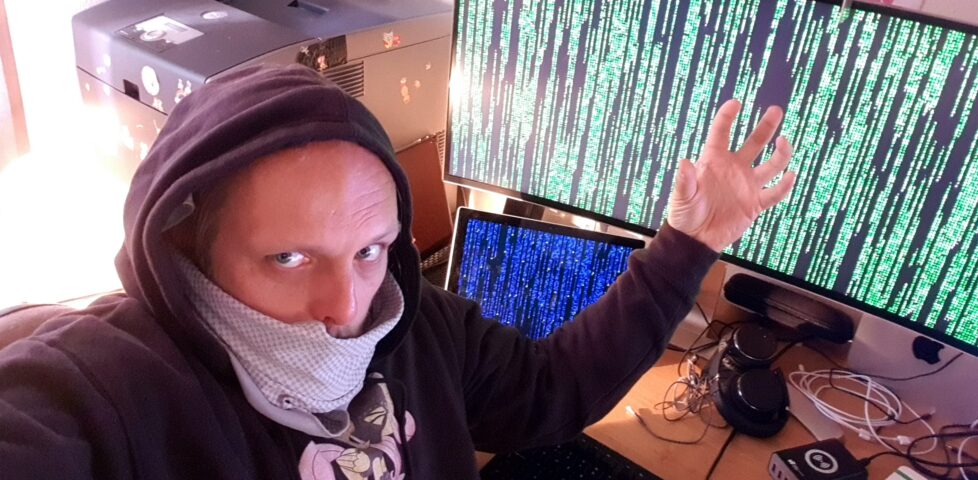
Hackers have a serious image problem, and the best way to see it is to search on your favourite stock photo
site for “hacker”. If you don’t use a laptop in a darkened room, wearing a hoodie and optionally mask and gloves, you’re not a real hacker. Also, 50% of all text should be
green, 40% blue, 10% red.
So what changed? Hackers got famous, and not for the best reasons. A big tipping point came in the early 1980s when hacking group The
414s broke into a number of high-profile computer systems, mostly by using the default password which had never been changed. The six teenagers responsible were arrested by the
FBI but few were charged, and those that were were charged only with minor offences. This was at least in part because
there weren’t yet solid laws under which to prosecute them but also because they were cooperative, apologetic, and for the most part hadn’t caused any real harm. Mostly they’d just been
curious about what they could get access to, and were interested in exploring the systems to which they’d logged-in, and seeing how long they could remain there undetected. These remain
common motivations for many hackers to this day.
Hoodie: check. Face-concealing mask: check. Green/blue code: check. Is I a l33t hacker yet?
News media though – after being excited by “hacker” ideas introduced by WarGames – rightly realised that a hacker with the
same elementary resources as these teens but with malicious intent could cause significant real-world damage. Bruce
Schneier argued last year that the danger of this may be higher today than ever before. The press ran news stories strongly associating the word “hacker” specifically with the focus
on the illegal activities in which some hackers engage. The release of Neuromancer the following year, coupled
with an increasing awareness of and organisation by hacker groups and a number of arrests on both sides of the Atlantic only fuelled things further. By the end of the decade it was
essentially impossible for a layperson to see the word “hacker” in anything other than a negative light. Counter-arguments like The
Conscience of a Hacker (Hacker’s Manifesto) didn’t reach remotely the same audiences: and even if they had, the points they made remain hard to sympathise with for those outside of
hacker communities.
‘Nuff said.
A lack of understanding about what hackers did and what motivated them made them seem mysterious and otherworldly. People came to make the same assumptions about hackers that
they do about magicians – that their abilities are the result of being privy to tightly-guarded knowledge rather than years of practice – and this
elevated them to a mythical level of threat. By the time that Kevin Mitnick was jailed in the mid-1990s, prosecutors were able to successfully persuade a judge that this “most dangerous
hacker in the world” must be kept in solitary confinement and with no access
to telephones to ensure that he couldn’t, for example, “start a nuclear war by whistling into a pay phone”. Yes, really.
Whistling into a phone to start a nuclear war? That makes CSI: Cyber seem realistic [watch].
The Future
Every decade’s hackers have debated whether or not the next decade’s have correctly interpreted their idea of “hacker ethics”. For me, Steven Levy’s tenets encompass them best:
Access to computers – and anything which might teach you something about the way the world works – should be unlimited and total.
All information should be free.
Mistrust authority – promote decentralization.
Hackers should be judged by their hacking, not bogus criteria such as degrees, age, race, or position.
You can create art and beauty on a computer.
Computers can change your life for the better.
Given these concepts as representative of hacker ethics, I’m convinced that hacking remains alive and well today. Hackers continue to be responsible for many of the coolest and
most-important innovations in computing, and are likely to continue to do so. Unlike many other sciences, where progress over the ages has gradually pushed innovators away from
backrooms and garages and into labs to take advantage of increasingly-precise generations of equipment, the tools of computer science are increasingly available to individuals.
More than ever before, bedroom-based hackers are able to get started on their journey with nothing more than a basic laptop or desktop computer and a stack of freely-available
open-source software and documentation. That progress may be threatened by the growth in popularity of easy-to-use (but highly locked-down) tablets and smartphones, but the barrier to
entry is still low enough that most people can pass it, and the new generation of ultra-lightweight computers like the Raspberry Pi are doing
their part to inspire the next generation of hackers, too.
That said, and as much as I personally love and identify with the term “hacker”, the hacker community has never been less in-need of this overarching label. The diverse variety
of types of technologist nowadays coupled with the infiltration of pop culture by geek culture has inevitably diluted only to be replaced with a multitude of others each describing a
narrow but understandable part of the hacker mindset. You can describe yourself today as a coder, gamer, maker, biohacker, upcycler,cracker, blogger, reverse-engineer, social engineer, unconferencer, or one of dozens of other terms that more-specifically ties you to your
community. You’ll be understood and you’ll be elegantly sidestepping the implications of criminality associated with the word “hacker”.
The original meaning of “hacker” has also been soiled from within its community: its biggest and perhaps most-famous
advocate‘s insistence upon linguistic prescriptivism came under fire just this year after he pushed for a dogmatic interpretation of the term “sexual assault” in spite of a victim’s experience.
This seems to be absolutely representative of his general attitudes towards sex, consent,
women, and appropriate professional relationships. Perhaps distancing ourselves from the old definition of the word “hacker” can go hand-in-hand with distancing ourselves from some of
the toxicity in the field of computer science?
(I’m aware that I linked at the top of this blog post to the venerable but also-problematic Eric S. Raymond; if anybody can suggest an equivalent resource by another
author I’d love to swap out the link.)
Verdict: The word “hacker” has become so broad in scope that we’ll never be able to rein it back in. It’s tainted by its associations with both criminality, on one
side, and unpleasant individuals on the other, and it’s time to accept that the popular contemporary meaning has won. Let’s find new words to define ourselves, instead.
This is part of a series of posts on computer terminology whose popular meaning – determined by surveying my friends – has significantly
diverged from its original/technical one. Read more evolving words…
The language we use is always changing, like how the word “cute” was originally a truncation of the word “acute”, which you’d use to describe somebody who was sharp-witted, as in “don’t
get cute with me”. Nowadays, we use it when describing adorable things, like the subject of this GIF:
Cute, but not acute.
But hang on a minute: that’s another word that’s changed meaning: GIF. Want to see how?
GIF
What people think it means
File format (or the files themselves) designed for animations and transparency. Or: any animation without sound.
What it originally meant
File format designed for efficient colour images. Animation was secondary; transparency was an afterthought.
The Past
Back in the 1980s cyberspace was in its infancy. Sir Tim hadn’t yet dreamed up the Web, and the Internet wasn’t something that most
people could connect to, and bulletin board systems (BBSes) –
dial-up services, often local or regional, sometimes connected to one another in one of a variety of ways – dominated the scene. Larger services like CompuServe acted a little like huge
BBSes but with dial-up nodes in multiple countries, helping to bridge the international gaps and provide a lower learning curve
than the smaller boards (albeit for a hefty monthly fee in addition to the costs of the calls). These services would later go on to double as, and eventually become
exclusively, Internet Service Providers, but for the time being they were a force unto themselves.
My favourite bit of this 1983 magazine ad for CompuServe is the fact that it claims a trademark on the word “email”. They didn’t try very hard to cling on to that claim, unlike their
controversial patent on the GIF format…
In 1987, CompuServe were about to start rolling out colour graphics as a new feature, but needed a new graphics format to support that. Their engineer Steve Wilhite had the
idea for a bitmap image format backed by LZW compression
and called it GIF, for Graphics Interchange Format. Each image could be composed of multiple frames each having up to 256
distinct colours (hence the common mistaken belief that a GIF can only have 256 colours). The nature of the palette system
and compression algorithm made GIF a particularly efficient format for (still) images with solid contiguous blocks of
colour, like logos and diagrams, but generally underperformed against cosine-transfer-based algorithms like
JPEG/JFIF for images with gradients (like most
photos).
This animated GIF (of course) shows how it’s possible to have more than 256 colours in a GIF by separating it into multiple non-temporal frames.
GIF would go on to become most famous for two things, neither of which it was capable of upon its initial release: binary
transparency (having “see through” bits, which made it an excellent choice for use on Web pages with background images or non-static background colours; these would become popular in
the mid-1990s) and animation. Animation involves adding a series of frames which overlay one another in sequence: extensions to the format in 1989 allowed the creator to specify the
duration of each frame, making the feature useful (prior to this, they would be displayed as fast as they could be downloaded and interpreted!). In 1995, Netscape added a custom extension to GIF to allow them to
loop (either a specified number of times or indefinitely) and this proved so popular that virtually all other software followed suit, but it’s worth noting that “looping” GIFs have never been part of the official standard!
Open almost any animated GIF file in a hex editor and you’ll see the word NETSCAPE2.0; evidence of
Netscape’s role in making animated GIFs what they are today.
Compatibility was an issue. For a period during the mid-nineties it was quite possible that among the visitors to your website there would be a mixture of:
people who wouldn’t see your GIFs at all, owing to browser, bandwidth, preference, or accessibility limitations,
people who would only see the first frame of your animated GIFs, because their browser didn’t support animation,
people who would see your animation play once, because their browser didn’t support looping, and
people who would see your GIFs as you intended, fully looping
This made it hard to depend upon GIFs without carefully considering their use. But people still did, and they just stuck a
button on to warn people, as if that made up for
it. All of this has happened before, etc.
In any case: as better, newer standards like PNG came to dominate the Web’s need for lossless static (optionally
transparent) image transmission, the only thing GIFs remained good for was animation. Standards like APNG/MNG failed to get off the ground, and so GIFs remained the dominant animated-image standard. As Internet connections became faster and faster in the 2000s, they experienced a
resurgence in popularity. The Web didn’t yet have the <video> element and so embedding videos on pages required a mixture of at least two of
<object>, <embed>, Flash, and black magic… but animated GIFs just worked and
soon appeared everywhere.
How animation online really works.
The Future
Nowadays, when people talk about GIFs, they often don’t actually mean GIFs! If you see a GIF on Giphy or WhatsApp, you’re probably actually seeing an MPEG-4 video file with no audio track! Now that Web video
is widely-supported, service providers know that they can save on bandwidth by delivering you actual videos even when you expect a GIF. More than ever before, GIF has become a byword for short, often-looping Internet
animations without sound… even though that’s got little to do with the underlying file format that the name implies.
What’s a web page? What’s anything?
Verdict: We still can’t agree on whether to pronounce it with a soft-G (“jif”), as Wilhite intended, or with a hard-G, as any sane person would, but it seems that GIFs are here to stay
in name even if not in form. And that’s okay. I guess.
This is part of a series of posts on computer terminology whose popular meaning – determined by surveying my friends – has significantly
diverged from its original/technical one. Read more evolving words…
Until the 17th century, to “fathom” something was to embrace it. Nowadays, it’s more likely to refer to your understanding of something in depth. The migration came via the
similarly-named imperial unit of measurement, which was originally defined as the span of a man’s outstretched arms, so you can
understand how we got from one to the other. But you know what I can’t fathom? Broadband.
I can’t fathom dalmatians. But this woman can.
Broadband Internet access has become almost ubiquitous over the last decade and a half, but ask people to define “broadband” and they have a very specific idea about what it means. It’s
not the technical definition, and this re-invention of the word can cause problems.
Broadband
What people think it means
High-speed, always-on Internet access.
What it originally meant
Communications channel capable of multiple different traffic types simultaneously.
The Past
Throughout the 19th century, optical (semaphore) telegraph networks gave way to the new-fangled electrical telegraph, which not only worked regardless of the weather but resulted in
significantly faster transmission. “Faster” here means two distinct things: latency – how long it takes a message to reach its destination, and bandwidth – how much
information can be transmitted at once. If you’re having difficulty understanding the difference, consider this: a man on a horse might be faster than a telegraph if the size of the
message is big enough because a backpack full of scrolls has greater bandwidth than a Morse code pedal, but the latency of an electrical wire beats land transport
every time. Or as Andrew S. Tanenbaum famously put it: Never underestimate the bandwidth of a station wagon full of
tapes hurtling down the highway.
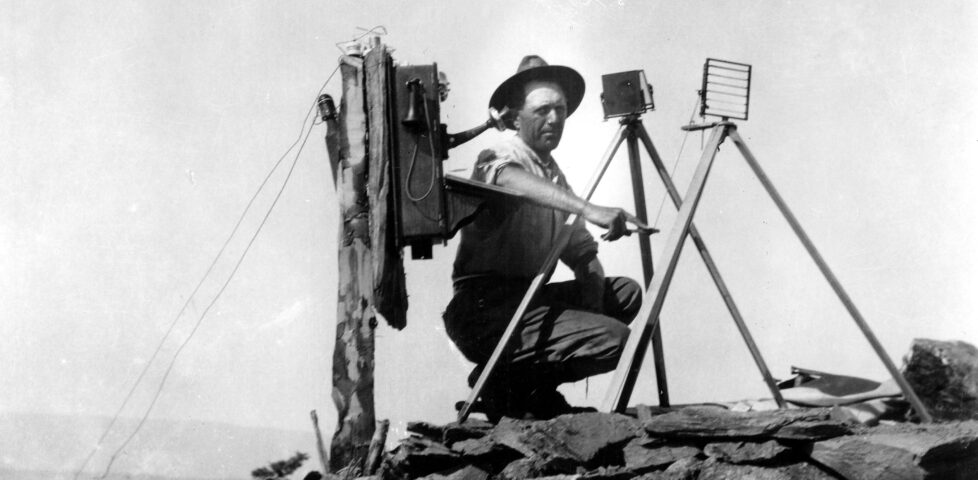
There were transitional periods. This man, photographed in 1912, is relaying a telephone message into a heliograph. I’m not sure
what message he’s transmitting, but I’m guessing it ends with a hashtag.
Telegraph companies were keen to be able to increase their bandwidth – that is, to get more messages on the wire – and this was achieved by multiplexing. The simplest approach,
time-division multiplexing, involves messages (or parts of messages) “taking turns”, and doesn’t actually increase bandwidth at all: although it does improve the perception of
speed by giving recipients the start of their messages early on. A variety of other multiplexing techniques were (and continue to be) explored, but the one that’s most-interesting to us
right now was called acoustic telegraphy: today, we’d call it frequency-division multiplexing.
What if, asked folks-you’ll-have-heard-of like Thomas Edison and Alexander Graham Bell, we were to send telegraph messages down the line at different frequencies. Some beeps and bips
would be high tones, and some would be low tones, and a machine at the receiving end could separate them out again (so long as you chose your frequencies carefully, to avoid harmonic
distortion). As might be clear from the names I dropped earlier, this approach – sending sound down a telegraph wire – ultimately led to the invention of the
telephone. Hurrah, I’m sure they all immediately called one another to say, our efforts to create a higher-bandwidth medium for telegrams has accidentally resulted in a
lower-bandwidth (but more-convenient!) way for people to communicate. Job’s a good ‘un.
If this part of Edison’s 1878 patent looks like a tuning fork, that’s not a coincidence. These early multiplexers made distinct humming sounds as they operated, owing to the movement
of the synchronised forks within.
Most electronic communications systems that have ever existed have been narrowband: they’ve been capable of only a single kind of transmission at a time. Even if you’re
multiplexing a dozen different frequencies to carry a dozen different telegraph messages at once, you’re still only transmitting telegraph messages. For the most part, that’s
fine: we’re pretty clever and we can find workarounds when we need them. For example, when we started wanting to be able to send data to one another (because computers are cool now)
over telephone wires (which are conveniently everywhere), we did so by teaching our computers to make sounds and understand one another’s sounds. If you’re old enough to have heard
a fax machine call a landline or, better yet used a dial-up modem, you know what I’m talking about.
As the Internet became more and more critical to business and home life, and the limitations (of bandwidth and convenience) of dial-up access became increasingly questionable,
a better solution was needed. Bringing broadband to Internet access was necessary, but the technologies involved weren’t revolutionary: they were just the result of the application of a
little imagination.
I’ve felt your pain, Dawson. I’ve felt your pain.
We’d seen this kind of imagination before. Consider teletext, for example (for those of you too young to remember teletext, it was a
standard for browsing pages of text and simple graphics using an 70s-90s analogue television), which is – strictly speaking – a broadband technology. Teletext works by embedding pages
of digital data, encoded in an analogue stream, in the otherwise-“wasted” space in-between frames of broadcast video. When you told your television to show you a particular page, either
by entering its three-digit number or by following one of four colour-coded hyperlinks, your television would wait until the page you were looking for came around again in the
broadcast stream, decode it, and show it to you.
Teletext was, fundamentally, broadband. In addition to carrying television pictures and audio, the same radio wave was being used to transmit text: not pictures of text, but
encoded characters. Analogue subtitles (which used basically the same technology): also broadband. Broadband doesn’t have to mean “Internet access”, and indeed for much of its history,
it hasn’t.
My family started getting our news via broadband in about 1985. Not broadband Internet, but broadband nonetheless.
Here in the UK, ISDN (from 1988!) and later ADSL would be the first widespread technologies to provide broadband data connections over the copper wires simultaneously used to
carry telephone calls. ADSL does this in basically the same way as Edison and Bell’s acoustic telegraphy: a portion
of the available frequencies (usually the first 4MHz) is reserved for telephone calls, followed by a no-mans-land band, followed by two frequency bands of different sizes (hence the
asymmetry: the A in ADSL) for up- and downstream data. This, at last, allowed true “broadband Internet”.
But was it fast? Well, relative to dial-up, certainly… but the essential nature of broadband technologies is that they share the bandwidth with other services. A connection
that doesn’t have to share will always have more bandwidth, all other things being equal! Leased lines, despite
technically being a narrowband technology, necessarily outperform broadband connections having the same total bandwidth because they don’t have to share it with other services. And
don’t forget that not all speed is created equal: satellite Internet access is a narrowband technology with excellent bandwidth… but sometimes-problematic latency issues!
Did you have one of these tucked behind your naughties router? This box filtered out the data from the telephone frequencies, helping to ensure that you can neither hear the pops and
clicks of your ADSL connection nor interfere with it by shouting.
Equating the word “broadband” with speed is based on a consumer-centric misunderstanding about what broadband is, because it’s necessarily true that if your home “broadband” weren’t
configured to be able to support old-fashioned telephone calls, it’d be (a) (slightly) faster, and (b) not-broadband.
The Future
But does the word that people use to refer to their high-speed Internet connection matter. More than you’d think: various countries around the world have begun to make legal
definitions of the word “broadband” based not on the technical meaning but on the populist one, and it’s becoming a source of friction. In the USA, the FCC variously defines broadband as having a minimum download speed of
10Mbps or 25Mbps, among other characteristics (they seem to use the former when protecting consumer rights and the latter when reporting on penetration, and you can read into that what
you will). In the UK, Ofcom‘s regulations differentiate between “decent” (yes, that’s really the word they use) and “superfast” broadband at
10Mbps and 24Mbps download speeds, respectively, while the Scottish and Welsh governments as well as the EU say it must be 30Mbps to be
“superfast broadband”.
At full-tilt, going from 10Mbps to 24Mbps means taking only 4 seconds, rather than 11 seconds, to download the music video to Faster! Harder! Scooter!
I’m all in favour of regulation that protects consumers and makes it easier for them to compare products. It’s a little messy that definitions vary so widely on what different speeds
mean, but that’s not the biggest problem. I don’t even mind that these agencies have all given themselves very little breathing room for the future: where do you go after “superfast”?
Ultrafast (actually, that’s exactly where we go)? Megafast? Ludicrous speed?
What I mind is the redefining of a useful term to differentiate whether a connection is shared with other services or not to be tied to a completely independent characteristic of that
connection. It’d have been simple for the FCC, for example, to have defined e.g. “full-speed broadband” as
providing a particular bandwidth.
Verdict: It’s not a big deal; I should just chill out. I’m probably going to have to throw in the towel anyway on this one and join the masses in calling all high-speed
Internet connections “broadband” and not using that word for all slower and non-Internet connections, regardless of how they’re set up.
This is part of a series of posts on computer terminology whose popular meaning – determined by surveying my friends – has significantly
diverged from its original/technical one. Read more evolving words…
A few hundred years ago, the words “awesome” and “awful” were synonyms. From their roots, you can see why: they mean “tending to or causing awe” and “full or or characterised by awe”,
respectively. Nowadays, though, they’re opposites, and it’s pretty awesome to see how our language continues to evolve. You know what’s awful, though? Computer viruses. Right?
“Oh no! A virus has stolen all my selfies and uploaded them to a stock photos site!”
You know what I mean by a virus, right? A malicious computer program bent on causing destruction, spying on your online activity, encrypting your files and ransoming them back to you,
showing you unwanted ads, etc… but hang on: that’s not right at all…
Virus
What people think it means
Malicious or unwanted computer software designed to cause trouble/commit crimes.
What it originally meant
Computer software that hides its code inside programs and, when they’re run, copies itself into other programs.
The Past
Only a hundred and thirty years ago it was still widely believed that “bad air” was the principal cause of disease. The idea that tiny germs could be the cause of infection was only
just beginning to take hold. It was in this environment that the excellent scientist Ernest Hankin travelled around
India studying outbreaks of disease and promoting germ theory by demonstrating that boiling water prevented cholera by killing the (newly-discovered) vibrio cholerae bacterium.
But his most-important discovery was that water from a certain part of the Ganges seemed to be naturally inviable as a home for vibrio cholerae… and that boiling this
water removed this superpower, allowing the special water to begin to once again culture the bacterium.
Hankin correctly theorised that there was something in that water that preyed upon vibrio cholerae; something too small to see with a microscope. In doing so, he was probably
the first person to identify what we now call a bacteriophage: the most common kind of virus. Bacteriophages were briefly seen as exciting for their medical potential. But then
in the 1940s antibiotics, which were seen as far more-convenient, began to be manufactured in bulk, and we stopped seriously looking at “phage therapy” (interestingly, phages are seeing a bit of a resurgence as antibiotic resistance becomes increasingly problematic).
It took until the development of the scanning electron microscope in the mid-20th century before we’d actually “see” a virus.
But the important discovery kicked-off by the early observations of Hankin and others was that viruses exist. Later, researchers would discover how these viruses
work1:
they inject their genetic material into cells, and this injected “code” supplants the unfortunate cell’s usual processes. The cell is “reprogrammed” – sometimes after a dormant
period – to churns out more of the virus, becoming a “virus factory”.
Let’s switch to computer science. Legendary mathematician John von Neumann, fresh from showing off his expertise in
calculating how shaped charges should be used to build the first atomic bombs, invented the new field of cellular autonoma. Cellular autonoma are computationally-logical,
independent entities that exhibit complex behaviour through their interactions, but if you’ve come across them before now it’s probably because you played Conway’s Game of Life, which made the concept popular decades after their invention. Von Neumann was very interested
in how ideas from biology could be applied to computer science, and is credited with being the first person to come up with the idea of a self-replicating computer program which would
write-out its own instructions to other parts of memory to be executed later: the concept of the first computer virus.
This is a glider factory… factory. I remember the first time I saw this pattern, in the 1980s, and it sank in for me that cellular autonoma must logically be capable of any
arbitrary level of complexity. I never built a factory-factory-factory, but I’ll bet that others have.
Retroactively-written lists of early computer viruses often identify 1971’s Creeper as the first computer virus:
it was a program which, when run, moved (later copied) itself to another computer on the network and showed the message “I’m the creeper: catch me if you can”. It was swiftly followed
by a similar program, Reaper, which replicated in a similar way but instead of displaying a message attempted to
delete any copies of Creeper that it found. However, Creeper and Reaper weren’t described as viruses at the time and would be more-accurately termed
worms nowadays: self-replicating network programs that don’t inject their code into other programs. An interesting thing to note about them, though, is that – contrary
to popular conception of a “virus” – neither intended to cause any harm: Creeper‘s entire payload was a relatively-harmless message, and Reaper actually tried to do
good by removing presumed-unwanted software.
Another early example that appears in so-called “virus timelines” came in 1975. ANIMAL presented as a twenty
questions-style guessing game. But while the user played it would try to copy itself into another user’s directory, spreading itself (we didn’t really do directory permissions back
then). Again, this wasn’t really a “virus” but would be better termed a trojan: a program which pretends to be something that it’s not.
“Malware? Me? No siree… nothing here but this big executable horse.”
It took until 1983 before Fred Cooper gave us a modern definition of a computer virus, one which – ignoring usage by laypeople –
stands to this day:
A program which can ‘infect’ other programs by modifying them to include a possibly evolved copy of itself… every program that gets infected may also act as a virus and thus the
infection grows.
This definition helps distinguish between merely self-replicating programs like those seen before and a new, theoretical class of programs that would modify host programs such
that – typically in addition to the host programs’ normal behaviour – further programs would be similarly modified. Not content with leaving this as a theoretical, Cooper wrote the
first “true” computer virus to demonstrate his work (it was never released into the wild): he also managed to prove that there can be no such thing as perfect virus detection.
(Quick side-note: I’m sure we’re all on the same page about the evolution of language here, but for the love of god don’t say viri. Certainly don’t say virii.
The correct plural is clearly viruses. The Latin root virus is a mass noun and so has no plural, unlike e.g.
fungus/fungi, and so its adoption into a count-noun in English represents the creation of a new word which should therefore, without a precedent to the
contrary, favour English pluralisation rules. A parallel would be bonus, which shares virus‘s linguistic path, word ending, and countability-in-Latin: you wouldn’t say
“there were end-of-year boni for everybody in my department”, would you? No. So don’t say viri either.)
No, no, no, no, no. The only wholly-accurate part of this definition is the word “program”.
Viruses came into their own as computers became standardised and commonplace and as communication between them (either by removable media or network/dial-up connections) and Cooper’s
theoretical concepts became very much real. In 1986, The Virdim method brought infectious viruses to the DOS platform, opening up virus writers’ access to much of the rapidly growing business and home computer markets.
The Virdim method has two parts: (a) appending the viral code to the end of the program to be infected, and (b) injecting early into the program a call to the appended code. This
exploits the typical layout of most DOS executable files and ensures that the viral code is run first, as an infected program
loads, and the virus can spread rapidly through a system. The appearance of this method at a time when hard drives were uncommon and so many programs would be run from floppy disks
(which could be easily passed around between users) enabled this kind of virus to spread rapidly.
For the most part, early viruses were not malicious. They usually only caused harm as a side-effect (as we’ve already seen, some – like Reaper – were intended to be not just
benign but benevolent). For example, programs might run slower if they’re also busy adding viral code to other programs, or a badly-implemented virus might
even cause software to crash. But it didn’t take long before viruses started to be used for malicious purposes – pranks, adware, spyware, data ransom, etc. – as well as to carry
political messages or to conduct cyberwarfare.
XKCD already explained all of this in far fewer words and a diagram.
The Future
Nowadays, though, viruses are becoming less-common. Wait, what?
Yup, you heard me right: new viruses aren’t being produced at remotely the same kind of rate as they were even in the 1990s. And it’s not that they’re easier for security software to
catch and quarantine; if anything, they’re less-detectable as more and more different types of file are nominally “executable” on a typical computer, and widespread access to
powerful cryptography has made it easier than ever for a virus to hide itself in the increasingly-sprawling binaries that litter modern computers.
Soo… I click this and all the viruses go away, right? Why didn’t we do this sooner?
The single biggest reason that virus writing is on the decline is, in my opinion, that writing something as complex as a a virus is longer a necessary step to illicitly getting your
program onto other people’s computers2!
Nowadays, it’s far easier to write a trojan (e.g. a fake Flash update, dodgy spam attachment, browser toolbar, or a viral free game) and trick people into running it… or else to write a
worm that exploits some weakness in an open network interface. Or, in a recent twist, to just add your code to a popular library and let overworked software engineers include it in
their projects for you. Modern operating systems make it easy to have your malware run every time they boot and it’ll quickly get lost amongst the noise of all the
other (hopefully-legitimate) programs running alongside it.
In short: there’s simply no need to have your code hide itself inside somebody else’s compiled program any more. Users will run your software anyway, and you often don’t even
have to work very hard to trick them into doing so.
Verdict: Let’s promote use of the word “malware” instead of “virus” for popular use. It’s more technically-accurate in the vast majority of cases, and it’s actually a
more-useful term too.
Footnotes
1 Actually, not all viruses work this way. (Biological) viruses are, it turns out, really
really complicated and we’re only just beginning to understand them. Computer viruses, though, we’ve got a solid understanding of.
2 There are other reasons, such as the increase in use of cryptographically-signed
binaries, protected memory space/”execute bits”, and so on, but the trend away from traditional viruses and towards trojans for delivery of malicious payloads began long before these
features became commonplace.
My hardware engineering is a little rusty, @ComputerHistory, but wouldn’t signals propogate along this copper cable at “only” somewhere between 0.64c and 0.95c, not 1c as you claim?
Computerphile at its best, here tackling the topic of additional (supplementary) processors, like FPUs, GPUs, sound processors, etc., to which CPUs outsource some of their work under
specific circumstances. Even speaking as somebody who’s upgraded a 386/SX to a 386/DX through the addition of a “math co-processor” (an FPU) and seeing the benefit in applications for
which floating point arithmetic was a major part (e.g. some early 3D games), I didn’t really think about what was really happening until I saw this video. There’s always more
to learn, fellow geeks!
Quantum computing is all the rage. It seems like hardly a day goes by without some news outlet describing the extraordinary things this technology promises. Most commentators forget,
or just gloss over, the fact that people have been working on quantum computing for decades—and without any practical results to show for it.
We’ve been told that quantum computers could “provide breakthroughs in many disciplines, including
materials and drug discovery, the optimization of complex manmade systems, and artificial intelligence.” We’ve been assured that
quantum computers will “forever alter our economic, industrial, academic, and societal landscape.” We’ve even been told that “the encryption that protects the world’s most sensitive
data may soon be broken” by quantum computers. It has gotten to the point where many researchers in various fields of physics feel obliged to justify whatever work they are doing by
claiming that it has some relevance to quantum computing.
Meanwhile, government research agencies, academic departments (many of them funded by government agencies), and corporate laboratories are spending billions of dollars a year
developing quantum computers. On Wall Street, Morgan Stanley and other financial giants expect quantum computing to mature soon and are keen to figure out
how this technology can help them.
It’s become something of a self-perpetuating arms race, with many organizations seemingly staying in the race if only to avoid being left behind. Some of the world’s top technical
talent, at places like Google, IBM, and Microsoft, are working hard, and with lavish resources in state-of-the-art laboratories, to realize their vision of a quantum-computing future.
In light of all this, it’s natural to wonder: When will useful quantum computers be constructed? The most optimistic experts estimate it will take 5 to 10 years. More cautious
ones predict 20 to 30 years. (Similar predictions have been voiced, by the way, for the last 20 years.) I belong to a tiny minority that answers, “Not in the foreseeable future.”
Having spent decades conducting research in quantum and condensed-matter physics, I’ve developed my very pessimistic view. It’s based on an understanding of the gargantuan technical
challenges that would have to be overcome to ever make quantum computing work.
…
Great article undermining all the most-widespread popular arguments about how quantum computing will revolutionise aboslutely everything, any day now. Let’s stay realistic, here:
despite all the hype, it might well be the case that it’s impossible to build a quantum computer of sufficient complexity to have any meaningful impact on the world beyond the
most highly-experimental and theoretical applications. And even if it is possible, its applications might well be limited: the “great potential” they carry is highly
hypothetical.
Don’t get me wrong, I’m super excited about the possibility of quantum computing, too. But as Mickhail points out, we must temper our excitement with a little realism and not give in to
the hype.
So, I am a professional system administrator. It says it on my business cards and everything. Every couple of months, when I have to explain to the receptionist at the London office
that yes, I do work here, and so
(My first hard drive for the Amiga 600 was second hand from my dad’s old laptop. It was SIXTY MEGABYTES. It held DOZENS of games. I would need over EIGHT HUNDRED of those drives to
hold a 50Gb World of Warcraft install).
…
I remember my first hard drive. It was 40Mb, and that felt flipping MASSIVE because I’d previously, like most people, been using floppy disks of no larger than 1.44Mb. My second hard
drive was 105Mb and it felt like a huge step-up; I ripped my first MP3s onto that drive, and didn’t care for a moment that they each consumed 2%-3% of the available space (and took
about 15 minutes each to encode).
Nowadays I look at my general-purpose home desktop’s 12TB RAID array and I think to myself… yeah, but it’s over half full… probably time to plan for the next upgrade. What happened‽
Somewhere along the line hard drive space became like mobile phone battery level became before it: something where you start to worry if you have less than half left. I don’t know how
we got here and I’m not sure I’m happy about it, but suffice to say: technology today is nuts.
As an engineer for the U.S. Digital Service, Marianne Bellotti has encountered vintage mainframes that are still being used in production — sometimes even powering web apps. Last month she
entertained a San Francisco audience with tales about some of them, in a talk called “7074 says Hello World,” at Joyent’s “Systems We Love” conference.
Created under the Obama administration, The U.S. Digital Service was designed as a start-up-styled consultancy to help government agencies modernize their IT operations, drawing engineering talent from Google, Facebook and other web-scale companies.
Or, as President Obama put it last March, it’s “a SWAT team — a world-class technology office.”
So it was fascinating to hear Bellotti tell stories about some of the older gear still running, and the sometimes unusual ways it was paired with more contemporary technology…
I have a vivid, recurring dream. I climb the stairs in my parents’ house to see my old bedroom. In the back corner, I hear a faint humming.
It’s my old computer, still running my 1990s-era bulletin board system (BBS, for short), “The Cave.” I thought I had shut it down ages ago, but it’s been chugging away this whole time
without me realizing it—people continued calling my BBS to play games, post messages, and upload files. To my astonishment, it never shut down after all…