Look at the following list of words and try to find the intruder:
wp-activate.php
wp-admin
wp-blog-header.php
wp_commentmeta
wp_comments
wp-comments-post.php
wp-config-sample.php
wp-content
wp-cron.php
wp engine
wp-includes
wp_jetpack_sync_queue
wp_links
wp-links-opml.php
wp-load.php
wp-login.php
wp-mail.php
wp_options
wp_postmeta
wp_posts
wp-settings.php
wp-signup.php
wp_term_relationships
wp_term_taxonomy
wp_termmeta
wp_terms
wp-trackback.php
wp_usermeta
wp_users
What are these words?
Well, all the ones that contain an underscore _ are names of the WordPress core database tables. All the ones that contain a dash - are WordPress core file
or folder names. The one with a space is a company name…
…
A smart (if slightly tongue-in-cheek) observation by my colleague Paolo, there. The rest of his article’s cleverer and worth-reading if you’re following the WordPress Drama (but it’s
pretty long!).
tl;dr: I’m tidying up and consolidating my personal hosting; I’ve made a little progress, but I’ve got a way to go – fortunately I’ve got a sabbatical coming up at
work!
At the weekend, I kicked-off what will doubtless be a multi-week process of gradually tidying and consolidating some of the disparate digital things I run, around the Internet.
I’ve a long-standing habit of having an idea (e.g. gamebook-making tool Twinebook, lockpicking puzzle game Break Into Us, my Cheating Hangman game, and even FreeDeedPoll.org.uk!),
deploying it to one of several servers I run, and then finding it a huge headache when I inevitably need to upgrade or move said server because there’s such an insane diversity of
different things that need testing!
DNDle, my Wordle-clone where you have to guess the Dungeons & Dragons 5e monster’s stat block, is now hosted by GitHub Pages. Also, I
fixed an issue reported a month ago that meant that I was reporting Giant Scorpions as having a WIS of 19 instead of 9.
Abnib, which mostly reminds people of upcoming birthdays and serves as a dumping ground for any Abnib-related shit I produce, is now hosted by
GitHub Pages.
RockMonkey.org.uk, which doesn’t really do much any more, is now hosted by GitHub Pages.
Sour Grapes, the single-page promo for a (remote) murder mystery party I hosted during a COVID lockdown, is now hosted by GitHub
Pages.
A convenience-page for giving lost people directions to my house is now hosted by GitHub Pages.
Dan Q’s Things is now automatically built on a schedule and hosted by GitHub Pages.
Robin’s Improbable Blog, which spun out from 52 Reflect, wasn’t getting enough traffic to justify
“proper” hosting so now it sits in a Docker container on my NAS.
My μlogger server, which records my location based on pings from my phone, has also moved to my NAS. This has broken
Find Dan Q, but I’m not sure if I’ll continue with that in its current form anyway.
All of my various domain/subdomain redirects have been consolidated on, or are in the process of moving to, to a tinyLinode/Akamai
instance. It’s a super simple plain Nginx server that does virtually nothing except redirect people – this is where I’ll park the domains I register but haven’t found a use for yet, in
future.
I was pretty proud of EGXchange.org, but I’ll be first to admit that it’s among the stupider of my throwaway domains.
It turns out GitHub pages is a fine place to host simple, static websites that were open-source already. I’ve been working on improving my understanding of GitHub Actions
anyway as part of what I’ve been doing while wearing my work, volunteering, and personal hats, so switching some static build processes like DNDle’s to GitHub
Actions was a useful exercise.
Stuff I’m still to tidy…
There’s still a few things I need to tidy up to bring my personal hosting situation under control:
DanQ.me
You’re looking at it. But later this year, you might be looking at it… elsewhere?
This is the big one, because it’s not just a WordPress blog: it’s also a Gemini, Spartan, and Gopher server (thanks CapsulePress!), a Finger server, a general-purpose host to a stack of complex stuff only some of which is powered by Bloq (my WordPress/PHP integrations): e.g.
code to generate the maps that appear on my geopositioned posts, code to integrate with the Fediverse, a whole stack of configuration to make my caching work the way I want, etc.
FreeDeedPoll.org.uk
Right now this is a Ruby/Sinatra application, but I’ve got a (long-running) development branch that will make it run completely in the browser, which will further improve privacy, allow
it to run entirely-offline (with a service worker), and provide a basis for new features I’d like to provide down the line. I’m hoping to get to finishing this during my Automattic
sabbatical this winter.
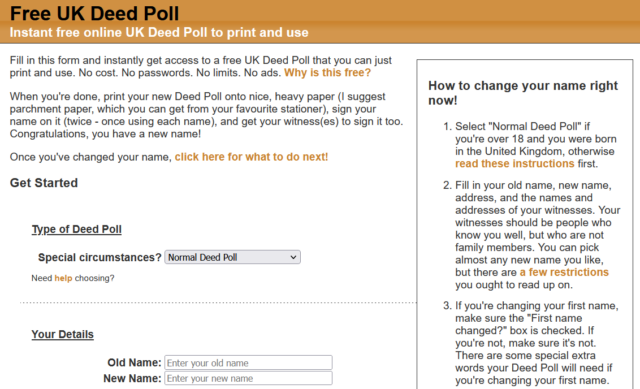
The website’s basically unchanged for most of a decade and a half, and… umm… it looks it!
A secondary benefit of it becoming browser-based, of course, is that it can be hosted as a static site, which will allow me to move it to GitHub Pages too.
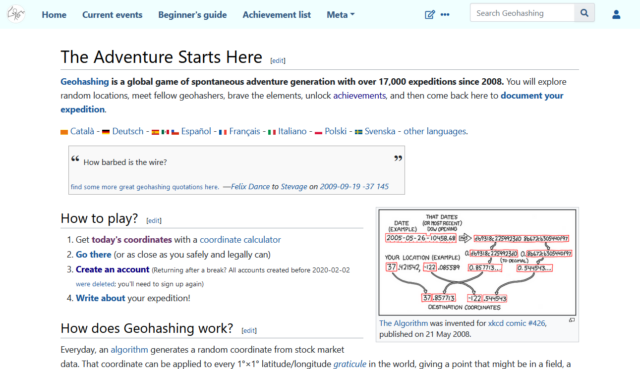
When I took over running the world’s geohashing hub from xkcd‘s Randall Munroe (and davean), I flung the site together on whatever hosting I had sitting
around at the time, but that’s given me some headaches. The outbound email transfer agent is a pain, for example, and it’s a hard host on which to apply upgrades. So I want to get that
moved somewhere better this winter too. It’s actually the last site left running on its current host, so it’ll save me a little money to get it moved, too!
Geohashing’s one of the strangest communities I’m honoured to be a part of. So it’d be nice to treat their primary website to a little more respect and attention.
Right now I run this on my NAS, but that turns out to be a pain sometimes because it means that if my home Internet goes down (e.g. thanks to a power cut, which we have from time to time), I lose access to the first and last place I
go on the Internet! So I’d quite like to move that to somewhere on the open Internet. Haven’t worked out where yet.
Next steps
It’s felt good so far to consolidate and tidy-up my personal web hosting (and to rediscover some old projects I’d forgotten about). There’s work still to do, but I’m expecting to spend
a few months not-doing-my-day-job very soon, so I’m hoping to find the opportunity to finish it then!
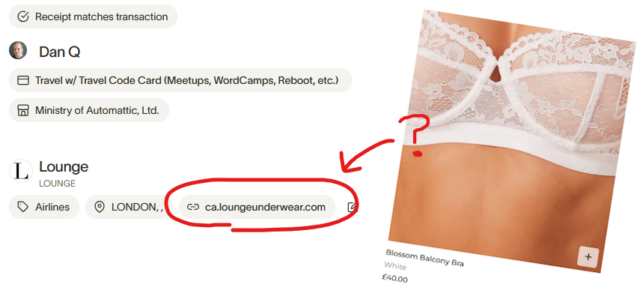
At work, we recently switched expenses system to one with virtual credit card functionality. I decided to test it out by buying myself lounge access for my upcoming work trip to Mexico.
Unfortunately the new system mis-detected my lounge access as being a purchase from lingerie company loungeunderwear.com. I’m expecting a ping
from Finance any moment to ask me why I’m using a company credit card to buy a bra.
One might ask why our expenses provider can (mis-)identify loungeunderwear.com from a transaction in the first place. Did somebody at some company that uses this provider
actually buy some ladies’ briefs on a company credit card at some point?
Cast your mind back to 15½ years ago, when the Internet was delighted by The Duck Song, a stupid adaptation of an
already-ancient joke, presented as a song for a child and accompanied by some MS Paint-grade animation. It was catchy, though, and before long everybody had it stuck in their heads.
Over the subsequent year it was followed by The Duck Song 2 and The Duck Song 3, each in a similar vein but with a different accompanying joke. There’s sort-of an ongoing narrative – a story
arc – than spans the three, as the foils of the first and second are introduced to one another in the third in a strange duck-related meet-cute.
And then there was nothing for… well, almost 14 years. The creators went on to do other things, and we all assumed that this series was completed (unlike for example the Wave Hello trilogy I mentioned the other day, which is clearly supposed to get one more part, and is overdue!). That’s fine, of
course. Things are allowed to finish, contrary to what many American TV execs seem to think.
Then last year, we got a seasonal treat in the form of The Christmas Duck Song. It felt like a non-canonical
spinoff, though, not a true “fourth Duck Song”. Like the Star Wars Holiday Special. Except good. It’s appearance wasn’t taken as heralding a return of duck songs.
But perhaps it should’ve, because earlier this year we got The Duck Song 4! Yet again, it retells a stupid joke – in
this case, an especially silly and immature one – but man, it feels like an old friend coming home. Welcome back, Duck Song.
Permit yourself to be entranced by the magnificence of the animation, the piquancy of the wordplay, the splendorous yet seductive simplicity of the G-C-D chord progression. Let the
duck, like Virgil in Dante’s “Divine Comedy,” be your guide — lean into the quotidian but sempiternal question of whether the man at the lemonade stand has any grapes. Consider the
irritation of the man at the stand and ask yourself if the wrath of Achilles is really that much more disastrous. Admire the cunning of the duck’s questioning — was Socrates so very
different?
The eldest is really getting into her WW2 studies at school, so I arranged a trip for her and a trip to the ever-excellent Bletchley Park for a glimpse at the code war that went on
behind the scenes. They’re clearly looking forward to the opportunity to look like complete swots on Monday.
Bonus: I got to teach them some stories about some of my favourite cryptanalysts. (Max props to the undersung Mavis Batey!)
Noticed while on a dog walk that the container looked a little loose, so came by to tighten it up. Noticed that the logbook was missing – muggled? – so replaced that while I was here.
Ready to go!
Back when I was a student in Aberystwyth, I used to receive a lot of bilingual emails from the University and its departments1.
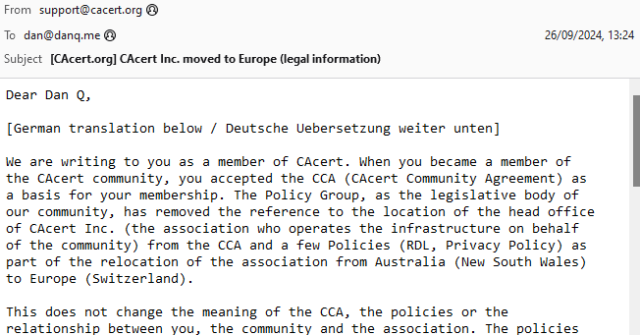
I was reminded of this when I received an email this week from CACert, delivered in both English and German.
Simply putting one language after the other isn’t terribly exciting. Although to be fair, the content of this email wasn’t terribly exciting either.
Wouldn’t it be great if there were some kind of standard for multilingual emails? Your email client or device would maintain an “order of preference” of the languages that you
speak, and you’d automatically be shown the content in those languages, starting with the one you’re most-fluent in and working down.
It turns out that this is a (theoretically) solved problem. RFC8255 defines a mechanism for breaking an email into multiple
different languages in a way that a machine can understand and that ought to be backwards-compatible (so people whose email software doesn’t support it yet can still “get by”).
Here’s how it works:
You add a Content-Type: multipart/multilingual header with a defined boundary marker, just like you would for any other email with multiple “parts” (e.g. with a HTML
and a plain text version, or with text content and an attachment).
The first section is just a text/plain (or similar) part, containing e.g. some text to explain that this is a multilingual email, and if you’re seeing this
then your email client probably doesn’t support them, but you should just be able to scroll down (or else look at the attachments) to find content in the language you read.
Subsequent sections have:
Content-Disposition: inline, so that for most people using non-compliant email software they can just scroll down until they find a language they can read,
Content-Type: message/rfc822, so that an entire message can be embedded (which allows other headers, like the Subject:, to be translated too),
a Content-Language: header, specifying the ISO code of the language represented in that section, and
optionally, a Content-Translation-Type: header, specifying either original (this is the original text), human (this was translated by a
human), or automated (this was the result of machine translation) – this could be used to let a user say e.g. that they’d prefer a human translation to an automated
one, given the choice between two second languages.
Let’s see a sample email:
Content-Type: multipart/multilingual;
 boundary=10867f6c7dbe49b2cfc5bf880d888ce1c1f898730130e7968995bea413a65664
To: <b24571@danq.me>
From: <rfc8255test-noreply@danq.link>
Subject: Does your email client support RFC8255?
Mime-Version: 1.0
Date: Fri, 27 Sep 2024 10:06:56 +0000

--10867f6c7dbe49b2cfc5bf880d888ce1c1f898730130e7968995bea413a65664
Content-Transfer-Encoding: quoted-printable
Content-Type: text/plain; charset=utf-8

This is a multipart message in multiple languages. Each part says the
same thing but in a different language. If your email client supports
RFC8255, you will see this message in your preferred language out of
those available. Otherwise, you will probably see each language after
one another or else each language in a separate attachment.

--10867f6c7dbe49b2cfc5bf880d888ce1c1f898730130e7968995bea413a65664
Content-Disposition: inline
Content-Type: message/rfc822
Content-Language: en
Content-Translation-Type: original

Subject: Does your email client support RFC8255?
Content-Type: text/plain; charset="UTF-8"
Content-Transfer-Encoding: 7bit
MIME-Version: 1.0

RFC8255 is a standard for sending email in multiple languages. This
is the original email in English. It is embedded alongside the same
content in a number of other languages.

--10867f6c7dbe49b2cfc5bf880d888ce1c1f898730130e7968995bea413a65664
Content-Disposition: inline
Content-Type: message/rfc822
Content-Language: fr
Content-Translation-Type: automated

Subject: Votre client de messagerie prend-il en charge la norme RFC8255?
Content-Type: text/plain; charset="UTF-8"
Content-Transfer-Encoding: 7bit
MIME-Version: 1.0

RFC8255 est une norme permettant d'envoyer des courriers
électroniques dans plusieurs langues. Le présent est le courriel
traduit en français. Il est intégré à côté du même contenu contenu
dans un certain nombre d'autres langues.

--10867f6c7dbe49b2cfc5bf880d888ce1c1f898730130e7968995bea413a65664--
Why not copy-paste this into a raw email and see how your favourite email client handles it! That’ll be fun, right?
Can I use it?
That proposed standard turns seven years old next month. Sooo… can we start using it?4
Turns out… not so much. I discovered that NeoMutt supports it:
NeoMutt’s implementation is basic, but it works: you can specify a preference order for languages and it respects it, and if you don’t then it shows all of the languages as a series
of attachments. It can apparently even be used to author compliant multilingual emails, although I didn’t get around to trying that.
Support in other clients is… variable.
A reasonable number of them don’t understand the multilingual directives but still show the email in a way that doesn’t suck:
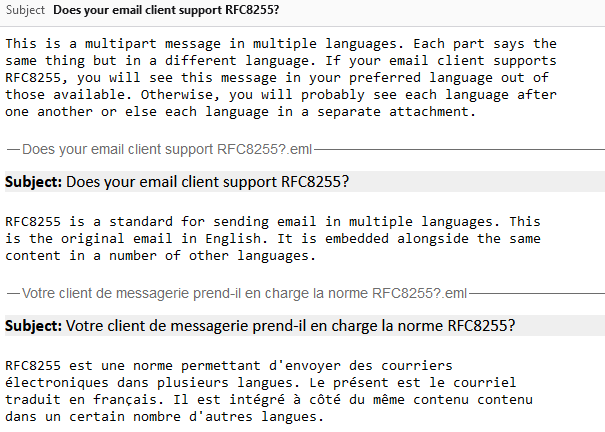
Mozilla Thunderbird does a respectable job of showing each language’s subject and content, one after another.
Some shoot for the stars but blow up on the launch pad:
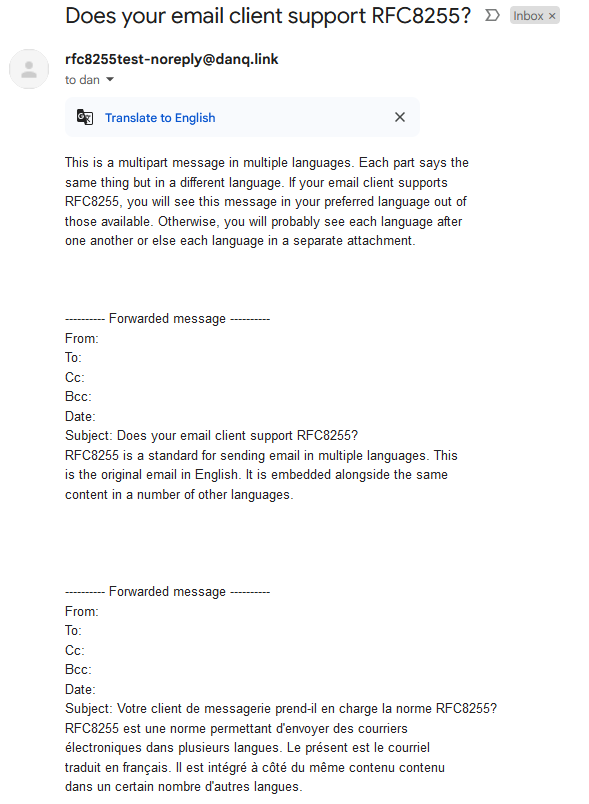
GMail displays all the content, but it pretends that the alternate versions are forwarded messages and adds a stack of meaningless blank headers to each. And then offers to
translate the result for you, even though the content is already right there in English.
Others still seem to be actively trying to make life harder for you:
ProtonMail’s Web interface shows only the fallback content, putting the remainder into .eml attachments… which is then won’t display, forcing you to download them and
find some other email client to look at them in!5
And still others just shit the bed at the idea that you might read an email like this one:
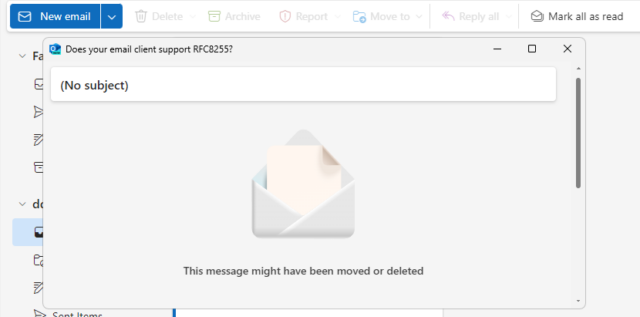
Outlook 365 does appallingly badly, showing the subject in the title bar, then the words “(No subject)”, then the message “This message might have been removed or deleted”. Just
great.
That’s just the clients I’ve tested, but I can’t imagine that others are much different. If you give it a go yourself with something I’ve not tried, then let me know!
I guess this means that standardised multilingual emails might be forever resigned to the “nice to have but it never took off so we went in a different direction” corner of the
Internet, along with the <keygen> HTML element and the concept of privacy.
Footnotes
1 I didn’t receive quite as much bilingual email as you might expect, given that the
University committed to delivering most of its correspondence in both English and Welsh. But I received a lot more than I do nowadays, for example
2 Although you might not guess it, given how many websites completely ignore your
Accept-Language header, even where it’s provided, and simply try to “guess” what language you want using IP geolocation or something, and then require that you find
whatever shitty bit of UI they’ve hidden their language selector behind if you want to change it, storing the result in a cookie so it inevitably gets lost and has to be set again the
next time you visit.
3 I suppose that if you were sending HTML emails then you might use the lang="..." attribute to mark up different parts of the message as being in different
languages. But that doesn’t solve all of the problems, and introduces a couple of fresh ones.
4 If it were a cool new CSS feature, you can guarantee that it’d be supported by every
major browser (except probably Safari) by now. But email doesn’t get so much love as the Web, sadly.
5 Worse yet, if you’re using ProtonMail with a third-party client, ProtonMail screws up
RFC8255 emails so badly that they don’t even work properly in e.g. NeoMutt any more! ProtonMail swaps the multipart/multilingual content type for
multipart/mixed and strips the Content-Language: headers, making the entire email objectively less-useful.
The people who make the most money in WordPress are not the people who contribute the most (Matt / Automattic really is one of the exceptions here, as I think we are). And this is a
problem. It’s a moral problem. It’s just not equitable.
I agree with Matt about his opinion that a big hosting company such as WPEngine should contribute more. It is the right thing to do. It’s fair. It will make the WordPress community
more egalitarian. Otherwise, it will lead to resentment. I’ve experienced that too.
…
In my opinion, we all should get a say in how we spend those contributions [from companies to WordPress]. I understand that core contributors are very important, but so are the
organizers of our (flagship) events, the leadership of hosting companies, etc. We need to find a way to have a group of people who represent the community and the contributing
corporations.
Just like in a democracy. Because, after all, isn’t WordPress all about democratizing?
Now I don’t mean to say that Matt should no longer be project leader. I just think that we should more transparently discuss with a “board” of some sorts, about the roadmap and the
future of WordPress as many people and companies depend on it. I think this could actually help Matt, as I do understand that it’s very lonely at the top.
With such a group, we could also discuss how to better highlight companies that are contributing and how to encourage others to do so.
…
Some wise words from Joost de Valk, and it’s worth reading his full post if you’re following the
WP Engine drama but would rather be focussing on looking long-term towards a better future for the entire ecosystem.
I don’t know whether Joost’s solution is optimal, but it’s certainly worth considering his ideas if we’re to come up with a new shape for WordPress. It’s good to see that people are
thinking about the bigger picture here, than just wherever we find ourselves at the resolution of this disagreement between Matt/Automattic/the WordPress Foundation and WP Engine.
Thinking bigger is admirable. Thinking bigger is optimistic. Thinking bigger is future-facing.
The YouTube channel @simonscouse has posted exactly two videos.
The first came a little over ten years ago. It shows a hand waving and then wiggling its fingers in front of a patterned wallpaper:
The second came a little over five years ago, and shows a hand – the same hand? – waving in front of a painting of two cats while a child’s voice can be heard in the background:
In a comment on the latter, the producer promised that it’s be “only
another 5 years until the trilogy is completed”.
Where’s the third instalment, Simon? We’re all waiting to see it!
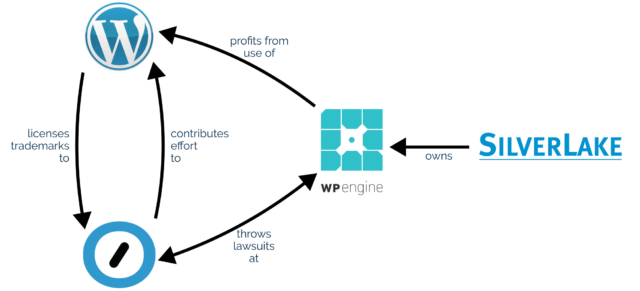
If you’re active in the WordPress space you’re probably aware that there’s a lot of drama going on right now between (a) WordPress hosting company WP Engine, (b) WordPress
hosting company (among quiteafewotherthings) Automattic1,
and (c) the WordPress Foundation.
If you’re not aware then, well: do a search across the tech news media to see the latest: any summary I could give you would be out-of-date by the time you read it anyway!
I tried to draw a better diagram with more of the relevant connections, but it quickly turned into spaghetti.
In particular, I think a lot of the conversation that he kicked off conflates three different aspects of WP Engine’s misbehaviour. That muddies the waters when it comes to
having a reasoned conversation about the issue3.
I’ve heard Matt speak a number of times, including in person… and I think he did a pretty bad job of expressing the problems with WP Engine during his Q&A at WCUS. In his defence,
it sounds like he may have been still trying to negotiate a better way forward until the very second he walked on stage that day.
I don’t think WP Engine is a particularly good company, and I personally wouldn’t use them for WordPress hosting. That’s not a new opinion for me: I wouldn’t have used them last year or
the year before, or the year before that either. And I broadly agree with what I think Matt tried to say, although not necessarily with the way he said it or the platform he
chose to say it upon.
Misdeeds
As I see it, WP Engine’s potential misdeeds fall into three distinct categories: moral, ethical4,
and legal.
Morally: don’t take without giving back
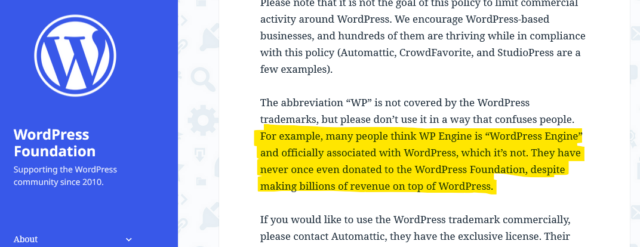
Matt observes that since WP Engine’s acquisition by huge tech-company-investor Silver Lake, WP Engine have made enormous profits from selling WordPress hosting as a service (and nothing else) while
making minimal to no contributions back to the open source platform that they depend upon.
If true, and it appears to be, this would violate the principle of reciprocity. If you benefit from somebody else’s
effort (and you’re able to) you’re morally-obliged to at least offer to give back in a manner commensurate to your relative level of resources.
The principle of reciprocity is a moral staple. This is evidenced by the fact that children (and some nonhuman animals) seem to be able to work it out for themselves
from first principles using nothing more than empathy. Companies, however aren’t usually so-capable. Photo courtesy Cotton.
Abuse of this principle is… sadly not-uncommon in business. Or in tech. Or in the world in general. A lightweight example might be the many millions of profitable companies that host
atop the Apache HTTP Server without donating a penny to the Apache Foundation. A heavier (and legally-backed) example might be Trump Social’s
implementation being based on a modified version of Mastodon’s code:
Mastodon’s license requires that their changes are shared publicly… but they don’t do until they’re sent threatening letters reminding them of their obligations.
I feel like it’s fair game to call out companies that act amorally, and encourage people to boycott them, so long as you do so without “punching down”.
Ethically: don’t exploit open source’s liberties as weaknesses
WP Engine also stand accused of altering the open source code that they host in ways that maximise their profit, to the detriment of both their customers and the original authors of
that code5.
It’s well established, for example, that WP Engine disable the “revisions” feature of WordPress6.
Personally, I don’t feel like this is as big a deal as Matt makes out that it is (I certainly wouldn’t go as far as saying “WP
Engine is not WordPress”): it’s pretty commonplace for large hosting companies to tweak the open source software that they host to better fit their architecture and business model.
But I agree that it does make WordPress as-provided by WP Engine significantly less good than would be expected from virtually any other host (most of which, by the way, provide much
better value-for-money at any price point).
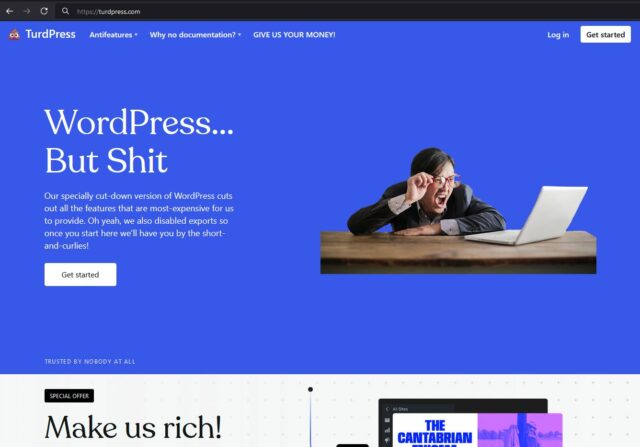
There’s nothing to stop me from registering TurdPress.com and providing a premium WordPress web hosting solution with all the best features disabled: I could even disable
exports so that my customers wouldn’t even be able to easily leave my service for greener pastures! There’s nothing stop me… but that wouldn’t make it
right7.
It also looks like WP Engine may have made more-nefarious changes, e.g. modifying the referral links in open source code (the thing that earns money for the original authors of
that code) so that WP Engine can collect the revenue themselves when they deploy that code to their customers’ sites. That to me feels like it’s clearly into the zone ethical bad
practice. Within the open source community, it’s not okay to take somebody’s code, which they were kind enough to release under a liberal license, strip out the bits that provide
their income, and redistribute it, even just as a network service8.
Again, I think this is fair game to call out, even if it’s not something that anybody has a right to enforce legally. On which note…
Obviously, this is the part of the story you’re going to see the most news media about, because there’s reasonable odds it’ll end up in front of a judge at some point. There’s a good
chance that such a case might revolve around WP Engine’s willingness (and encouragement?) to allow their business to be called “WordPress Engine” and to capitalise on any confusion that
causes.
I’m not going to weigh in on the specifics of the legal case: I Am Not A Lawyer and all that. Naturally I agree with the underlying principle that one should not be allowed to profit
off another’s intellectual property, but I’ll leave discussion on whether or not that’s what WP Engine are doing as a conversation for folks with more legal-smarts than I. I’ve
certainly known people be confused by WP Engine’s name and branding, though, and think that they must be some kind of “officially-licensed” WordPress host: it happens.
If you’re following all of this drama as it unfolds… just remember to check your sources. There’s a lot of FUD floating around on the Internet right now9.
In summary…
With a reminder that I’m sharing my own opinion here and not that of my employer, here’s my thoughts on the recent WP Engine drama:
WP Engine certainly act in ways that are unethical and immoral and antithetical to the spirit of open source, and those are just a subset of the reasons that I wouldn’t use them as
a WordPress host.
Matt Mullenweg calling them out at WordCamp US doesn’t get his point across as well as I think he hoped it might, and probably won’t win him any popularity contests.
I’m not qualified to weigh in on whether or not WP Engine have violated the WordPress Foundation’s trademarks, but I suspect that they’ve benefitted from widespread confusion about
their status.
Footnotes
1 I suppose I ought to point out that Automattic is my employer, in case you didn’t know,
and point out that my opinions don’t necessarily represent theirs, etc. I’ve been involved with WordPress as an open source project for about four times as long as I’ve had any
connection to Automattic, though, and don’t always agree with them, so I’d hope that it’s a given that I’m speaking my own mind!
2 Though like Manu, I don’t
think that means that Matt should take the corresponding blog post down: I’m a digital preservationist, as might be evidenced by the unrepresentative-of-me and frankly embarrassing
things in the 25-year archives of this blog!
3 Fortunately the documents that the lawyers for both sides have been writing are much
clearer and more-specific, but that’s what you pay lawyers for, right?
4 There’s a huge amount of debate about the difference between morality and ethics, but
I’m using the definition that means that morality is based on what a social animal might be expected to decide for themselves is right, think e.g. the Golden Rule etc., whereas ethics is the code of conduct expected within a particular community. Take stealing, for example,
which covers the spectrum: that you shouldn’t deprive somebody else of something they need, is a moral issue; that we as a society deem such behaviour worthy of exclusion is an
ethical one; meanwhile the action of incarcerating burglars is part of our legal framework.
5 Not that nobody’s immune to making ethical mistakes. Not me, not you, not anybody else.
I remember when, back in 2005, Matt fucked up by injecting ads into WordPress (which at that point didn’t have a reliable source of
funding). But he did the right thing by backpedalling, undoing the harm, and apologising publicly and profusely.
6 WP Engine claim that they disable revisions for performance reasons, but that’s clearly
bullshit: it’s pretty obvious to me that this is about making hosting cheaper. Enabling revisions doesn’t have a performance impact on a properly-configured multisite hosting system,
and I know this from personal experience of running such things. But it does have a significant impact on how much space you need to allocate to your users, which has cost
implications at scale.
7 As an aside: if a court does rule that WP Engine is infringing upon
WordPress trademarks and they want a new company name to give their service a fresh start, they’re welcome to TurdPress.
8 I’d argue that it is okay to do so for personal-use though: the difference for
me comes when you’re making a profit off of it. It’s interesting to find these edge-cases in my own thinking!
9 A typical Reddit thread is about 25% lies-and-bullshit; but you can double that for a
typical thread talking about this topic!







 RSS
RSS Spotify
 Pocket Casts
 Apple Podcasts
 YouTube