
Content warning
This post briefly touches on experience of the practical and emotional side-effects of a credible threat being made to the safety of a loving and healthy families by the underchecked power of social workers if they bringing to their work bigoted opinions about the shape a relationship "should" be.
I was at Polyday on Saturday and facilitated a session on The Politics of Polyamory
Grant will be leading a discussion abut how we want law and policy to relate to our poly lives in the short and longer term, mapping out what our community wants in terms of rights, general access and acceptance.
About 40 people showed up. I was mainly facilitating but also took a few notes so others may add or correct. I use poly, non-monogamy and similar interchangeably here.
Polyamory is not a protected characteristic in terms of the Equality Act - do we want it to be or are we mainly being left alone? We could be sacked for it. One person chooses not to disclose their relationship shape as while their education employer don't seem to have a problem with it, HR and union suggest doing so could attract publicity and lead to pressure on the employer. Anyone working with or having children could more strongly attract moral outrage.
...
My BiCon/Polyday buddy Grant facilitated a session at Polyday 2026. I didn't make it, so I appreciated him putting together these notes, which reflect some of the things I've been thinking about recently.
I'm acutely aware that my relationship structure is not a protected characteristic and so discriminating against me for it could potentially be legally-viable. E.g. if an employer felt that it reflected poorly upon them that my partner was married to somebody else and fired me as a result... it might be tough to find legal recourse.1
That said: I've always been transparent about my relationships in both my personal and professional life. I feel like I'm in a relatively "safe" position to do so (if I were a primary school teacher I might think twice about it!), and I feel like those of whom for which it's "safe" have a bit of a duty to be uncloseted, in order to help normalise polyamory on behalf of all of the people for whom it's not so-safe for them to be out. Normalisation is a powerful force in countering discrimination, because - even without specific legal recognition - it weakens the argument that, for example, a polyamorous person brings their employer into disrepute. Imagine if any of the polyamorous MPs (statistically, there must have been some!) were out about it: what representation that would be!2
Grant goes on to note:
...
Child access / custody could be a time relationships are contested. Could evidence of non-monogamy be used against people? Do lawyers understand non-monogamy? Might we introduce them and related professionals in disputes to some of the concepts and arguments that might come up before they do?
Here's where my fears lie, and they're not unfounded. We've already had direct experience of our access to our children being threatened by the prejudices of people in positions of power over us.
The biggest example of this came in 2017, when a confluence of misguided opinions by medical professionals and social workers lead to us being closely investigated, interrogated, and monitored for much of the year, and treated as if we were endangering our children (which we self-evidently weren't). I've not written about it online before and (nine years on) I'm still not ready to do so in-detail, because it was a sufficiently traumatic experience that it visibly impacts "how we parent" to this day.
Suffice to say that a paediatrician thought it odd that their patient's mother mentioned having two partners and this, coupled with an at-that-point unexplained medical condition (which turned out to be a whole lot of nothing) lead them to summon social services. Then the social worker who was assigned to the case (who was going through his own relationship-related difficulties and should probably not have been given this kind of work in the first place) brought a narrow-minded bias about our family structure led him to believe from the outset that we must be guilty of any number of negligent or even abusive behaviours. And this kicked-off the bureaucratic juggernaut that is children's services and imposed an insane amount of legal pressure on us for a long and painful time.
We're smart, and well-supported, and well-resourced. We lawyered-up and we fought and we won3. But again, this leans into our privilege: the same kind of privilege that I lean on when I'm "out" at work. And it serves to remind us that not every polyamorous family has our level of privilege and there are others who wouldn't have survived the things that we were put through.
In hindsight, it would have been trivially easy to simply lie to a doctor about our relationship status, and the problem would have never arisen. I'm sure there are polyamorous people who lie to people in positions of authority all the time, for their own protection, and our experience shows that they might well be right to do so. Discrimination against polyamorous relationships is real.
...
Some organisations such as the NHS use forms and boxes that we don't all fit in well. Other gender, sexuality and relationship divergent people and groups can have similar problems. Changing forms and tech can be slow and expensive, though we might piggyback onto existing update and review cycles.
We can study and share how to work with or around existing systems. Some people have more access to resources and knowledge of how to get them than others.
...
Ignoring the (big) thing above, most of the poly-discrimination I see in my everyday life is of a smaller, microaggression-ish, tripping-over-established-systems kind of way.
Like: when you take the time to list all three parents on a form that you submit to the school, only to discover that they've only listed as contacts the two of them whose surname is shared with the child and you have to reach out separately, prove your legitimacy, and get it corrected.
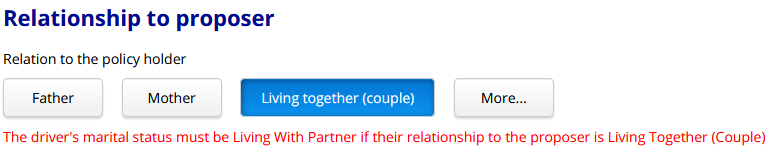
Or like the problems I've documented with filling out census forms, where if I fill them out honestly online I'm forbidden from submitting them because they disallow any declaration of relationships that says, for example, that a person has both a spouse and a partner. Incidentally, I get the same problem when I try to buy insurance:
Alt
Relationship to policy holder: Living together (couple) results in the error "The driver's marital status must be Living With Partner" if their relationship to the proposer is Living Together (Couple)".
Or like how when you use a parental controls system like Google Family Link and discover its "undocumented feature" that if you add a third parent... then the least-recently-added existing parent gets expelled from the group.
These are annoyances, and I'd love to see sufficient legal recognition that I'd be able to more-assertively fight to get them fixed4. But really what I'm concerned about is the problems that deny rights to polyamorous folk: rights related to end-of-life care, to marriage, to inheritance, to childcare, and so on. These are the big problems that could do with legal consideration, in my mind.
Anyway: I was grateful for Grant for keeping such solid notes on a discussion that I couldn't be at. It gives me hope that other people are concerned about some of these kinds of things, too. Go read Grant's notes in full if you like.
Footnotes
1 There'd be a few possible counter-arguments, but none of them are guaranteed winners like race, sexuality, or marital status might be!
2 Of course I'm familiar with Sarah Brown and Zoë O'Connell, openly-polyamorous Lib Dem councillors, the latter of whom came a respectable third place for their constituency in the 2017 general election, but what I'm really looking for is somebody in the commons to come out!
3 Also, our fight ensured that the intolerant social worker we were initially assigned - whose prejudice turned what could have been a quick chat into a drawn-out, expensive, and emotionally-gruelling affair - was struck off and will not work in the sector again.
4 For now, my best weapon has been data protection regulation. E.g. I can fill out an insurance application form in a way that satisfies their validation, and then follow-up with an email asking them to correct the incorrect personal information they're holding about me. I'm sure I've annoyed some database administrators who've ended up having to bypass validations in order to correct their data, but to be fair: their software teams shouldn't have implemented hard validations on these things in the first place, should they? I use the same trick, with great success, with people whose systems have trouble with my surname.
0 comments