
Polyday Politics workshop

This is a repost promoting content originally published elsewhere. See more things Dan's reposted.

Content warning

This post briefly touches on experience of the practical and emotional side-effects of a credible threat being made to the safety of a loving and healthy families by the underchecked power of social workers if they bringing to their work bigoted opinions about the shape a relationship “should” be.

I was at Polyday on Saturday and facilitated a session on The Politics of Polyamory

Grant will be leading a discussion abut how we want law and policy to relate to our poly lives in the short and longer term, mapping out what our community wants in terms of rights, general access and acceptance.

About 40 people showed up. I was mainly facilitating but also took a few notes so others may add or correct. I use poly, non-monogamy and similar interchangeably here.

Polyamory is not a protected characteristic in terms of the Equality Act – do we want it to be or are we mainly being left alone? We could be sacked for it. One person chooses not to disclose their relationship shape as while their education employer don’t seem to have a problem with it, HR and union suggest doing so could attract publicity and lead to pressure on the employer. Anyone working with or having children could more strongly attract moral outrage.

…

My BiCon/Polyday buddy Grant facilitated a session at Polyday 2026. I didn’t make it, so I appreciated him putting together these notes, which reflect some of the things I’ve been thinking about recently.

I’m acutely aware that my relationship structure is not a protected characteristic and so discriminating against me for it could potentially be legally-viable. E.g. if an employer felt that it reflected poorly upon them that my partner was married to somebody else and fired me as a result… it might be tough to find legal recourse.1

That said: I’ve always been transparent about my relationships in both my personal and professional life. I feel like I’m in a relatively “safe” position to do so (if I were a primary school teacher I might think twice about it!), and I feel like those of whom for which it’s “safe” have a bit of a duty to be uncloseted, in order to help normalise polyamory on behalf of all of the people for whom it’s not so-safe for them to be out. Normalisation is a powerful force in countering discrimination, because – even without specific legal recognition – it weakens the argument that, for example, a polyamorous person brings their employer into disrepute. Imagine if any of the polyamorous MPs (statistically, there must have been some!) were out about it: what representation that would be!2

Grant goes on to note:

…

Child access / custody could be a time relationships are contested. Could evidence of non-monogamy be used against people? Do lawyers understand non-monogamy? Might we introduce them and related professionals in disputes to some of the concepts and arguments that might come up before they do?

…

Here’s where my fears lie, and they’re not unfounded. We’ve already had direct experience of our access to our children being threatened by the prejudices of people in positions of power over us.

The biggest example of this came in 2017, when a confluence of misguided opinions by medical professionals and social workers lead to us being closely investigated, interrogated, and monitored for much of the year, and treated as if we were endangering our children (which we self-evidently weren’t). I’ve not written about it online before and (nine years on) I’m still not ready to do so in-detail, because it was a sufficiently traumatic experience that it visibly impacts “how we parent” to this day.

Suffice to say that a paediatrician thought it odd that their patient’s mother mentioned having two partners and this, coupled with an at-that-point unexplained medical condition (which turned out to be a whole lot of nothing) lead them to summon social services. Then the social worker who was assigned to the case (who was going through his own relationship-related difficulties and should probably not have been given this kind of work in the first place) brought a narrow-minded bias about our family structure led him to believe from the outset that we must be guilty of any number of negligent or even abusive behaviours. And this kicked-off the bureaucratic juggernaut that is children’s services and imposed an insane amount of legal pressure on us for a long and painful time.

We’re smart, and well-supported, and well-resourced. We lawyered-up and we fought and we won3. But again, this leans into our privilege: the same kind of privilege that I lean on when I’m “out” at work. And it serves to remind us that not every polyamorous family has our level of privilege and there are others who wouldn’t have survived the things that we were put through.

In hindsight, it would have been trivially easy to simply lie to a doctor about our relationship status, and the problem would have never arisen. I’m sure there are polyamorous people who lie to people in positions of authority all the time, for their own protection, and our experience shows that they might well be right to do so. Discrimination against polyamorous relationships is real.

…

Some organisations such as the NHS use forms and boxes that we don’t all fit in well. Other gender, sexuality and relationship divergent people and groups can have similar problems. Changing forms and tech can be slow and expensive, though we might piggyback onto existing update and review cycles.

We can study and share how to work with or around existing systems. Some people have more access to resources and knowledge of how to get them than others.

…

Ignoring the (big) thing above, most of the poly-discrimination I see in my everyday life is of a smaller, microaggression-ish, tripping-over-established-systems kind of way.

Like: when you take the time to list all three parents on a form that you submit to the school, only to discover that they’ve only listed as contacts the two of them whose surname is shared with the child and you have to reach out separately, prove your legitimacy, and get it corrected.

Or like the problems I’ve documented with filling out census forms, where if I fill them out honestly online I’m forbidden from submitting them because they disallow any declaration of relationships that says, for example, that a person has both a spouse and a partner. Incidentally, I get the same problem when I try to buy insurance:

Relationship to policy holder: Living together (couple) results in the error "The driver's marital status must be Living With Partner" if their relationship to the proposer is Living Together (Couple)".

Or like how when you use a parental controls system like Google Family Link and discover its “undocumented feature” that if you add a third parent… then the least-recently-added existing parent gets expelled from the group.

These are annoyances, and I’d love to see sufficient legal recognition that I’d be able to more-assertively fight to get them fixed4. But really what I’m concerned about is the problems that deny rights to polyamorous folk: rights related to end-of-life care, to marriage, to inheritance, to childcare, and so on. These are the big problems that could do with legal consideration, in my mind.

Anyway: I was grateful for Grant for keeping such solid notes on a discussion that I couldn’t be at. It gives me hope that other people are concerned about some of these kinds of things, too. Go read Grant’s notes in full if you like.

Footnotes

1 There’d be a few possible counter-arguments, but none of them are guaranteed winners like race, sexuality, or marital status might be!

2 Of course I’m familiar with Sarah Brown and Zoë O’Connell, openly-polyamorous Lib Dem councillors, the latter of whom came a respectable third place for their constituency in the 2017 general election, but what I’m really looking for is somebody in the commons to come out!

3 Also, our fight ensured that the intolerant social worker we were initially assigned – whose prejudice turned what could have been a quick chat into a drawn-out, expensive, and emotionally-gruelling affair – was struck off and will not work in the sector again.

4 For now, my best weapon has been data protection regulation. E.g. I can fill out an insurance application form in a way that satisfies their validation, and then follow-up with an email asking them to correct the incorrect personal information they’re holding about me. I’m sure I’ve annoyed some database administrators who’ve ended up having to bypass validations in order to correct their data, but to be fair: their software teams shouldn’t have implemented hard validations on these things in the first place, should they? I use the same trick, with great success, with people whose systems have trouble with my surname.

×

New social media restrictions

This is a repost promoting content originally published elsewhere. See more things Dan's reposted.

🚫 Regrettably you have been locked out of diamond geezer pending age verification protocols.

You may be UNDER 16 YEARS OF AGE and therefore you must not read anything here UNTIL YOU CAN PROVE THAT YOU’RE NOT.

The government is taking urgent action to ensure that children are no longer able to access harmful social media apps. At the personal behest of the Prime Minister a raft of carefully thought-through definitely-not-rushed non-kneejerk policies designed to restrict inappropriate content is to be introduced forthwith.

There is some absolutely terrible stuff online, much of which has already tarnished the minds of innocent youth. It is therefore imperative that all potentially terrible stuff must now be wrapped in a secure plain cover and placed on the digital top shelf. It’s for everyone’s own good.

…

Despite being parody, diamond geezer’s new age-gating – which e.g. asks for personal information but, obviously, doesn’t actually block access to the site – somehow perfectly straddles the line between “invasive” and “ineffective”… in exactly the same way that I expect the UK’s legal implementation will manage in a year or two.

Reply to: Sent to Coventry: Who is Princess Victor Duleep Singh?

This is a reply to a post published elsewhere. Its content might be duplicated as a traditional comment at the original source.

Sundeep Braich said:

…

Second: the language “committed suicide” is no longer appropriate. Princess Irene died by suicide. “Committed” is the language of crime. For example, one does not commit a heart attack.

…

You clearly feel strongly enough about this point to have committed it to writing.

(It’s obviously a cause that you’re committed to.)

I’m being sarcastic, of course, but there’s a point. While (like most mental health services) I’m not a fan of describing the act of suicide as “committing” suicide today, for exactly the reasons you describe, it might be appropriate for a historical case.

That’s all I meant to say in a comment… but then I ended up going down a rabbithole.


Let’s sidestep into an example: I said “John William Gott committed blasphemy in 1921” that would be fair. His actions would not be considered criminal today: he was initially arrested for selling pamphlets containing information on birth control but prosecutors tacked on a blasphemy charge because they figured they could get it to stick too, based on the ways his literature was presented. But legally-speaking, Gott committed a crime; a crime that doesn’t exist today.

It’s not a coincidence I’ve lumped jumped from suicide to blasphemy: both were formerly criminalised in Britain and her empire (among many other places) as a direct result of Christian religious tradition: you can probably blame Thomas Aquinas!

Language about the criminality of past offences gets very complicated, very quickly. Some contemporary values seem to be considered so fundamental that it feels wrong to describe historical convictions as criminal. In some of these cases, we see pardons issued or other admissions of fault by the state. Take for example in recent years the payment of compensation to former military personnel who were dishonourably discharged on account of their sexuality. But I’m not aware of anything like that happening related to past convictions of suicide (or, indeed, blasphemy).

With that grounding: let’s take a deeper dive into Irene Duleep Singh, to decide whether or not her suicide would have been considered criminal at the time (it was certainly considered shameful and taboo, even within societies that would not have considered it illegal, but that’s not what I’m interested in right now). Irene died by suicide in the Principality f Monaco in 1926. At that time, Monaco was a protectorate of France with less independence than it is today, and for the most part its legal system seems to have paralleled that in France. I can’t find a specific provision for suicide in Monaco, so it would probably not have been illegal (suicide was illegal under the Ancien Régime but was effectively decriminalised by its omission from the Napoleonic Penal Codes). So: no crime.

Buuuut… Irene could also be considered a citizen of Britain, or of India, or of British India. Suicide was illegal in the UK prior to 1961 and in India until 2024 (wait, what? yeah, really… well… kinda; it’s complicated, especially after 2018). So in her capacity as a citizen or subject of the British Empire, her suicide was criminal.

Both John William Gott and Irene Duleep Singh may well both have committed crimes that would not be considered crimes today. In both cases, their crimes were things that, in my opinion, should never have been criminalised in the first place. But that doesn’t make the historical fact any less-true.


And that’s why I picked up on this one line for my comment.

I absolutely agree that it’s inappropriate and unhelpful to talk about somebody have “committed suicide” today. The language creates a barrier to help and support, which is what should be offered to people experiencing suicidal thoughts! But I don’t see the harm in using it when discussing a historical case from a century ago, at a time at which suicide was seen very differently.

So long as it’s appropriately contextualised for the audience, it seems to me to be harmless. By which I mean to say: not worthy of being called-out by your one-liner… and even-less worthy of my having gone down this long and complicated rabbithole which, somehow, has involved translating old French legislation, digging through the history of Monaco, and learning about the courts of the British Raj.

I guess what I mean to say is that if your intention was to nerdsnipe me with this line… then well played, Sundeep, well played.

Run your own WireGuard VPN

With the news that the British government are considering requiring identity checks for age verification before allowing people to use VPNs, it’s time for my periodic reminder that you don’t have to use a “VPN provider” to use a VPN1.

As I’ll demonstrate, it’s surprisingly easy to spin up your own VPN provider on a virtual machine hosted by your choice of the cloud providers. You pay for the hours you need it2, and then throw it away afterwards.

Today, I’ll be using Linode to host my “throwaway” VPN provider for a price of USD $0.0075 per hour ($5/month if I ran it full-time), using a Linode StackScript I created for this purpose.

If you’d prefer to use GCP, AWS Azure, or whomever else you like: all you need is a Debian 13 VM with a public IP address (the cheapest one available is usually plenty!) and this bash script.

Screenshot from Linode's Web interface, showing my StackScript and indicating the location of the Deploy New Linode button.
If you prefer the command-line, Linode’s got an API. But we’re going for ‘easy’ today, so it’ll all be clicking buttons and things.

First, spin up a VM and run my script3. If you’re using Linode, you can do this by going to my StackScript and clicking ‘Deploy New Linode’.

Linode configuration screenshot with the key options highlighted as described below.
You might see more configuration options than this, but you can ignore them.

Choose any region you like (I’m putting this one in Paris!), select the cheapest “Shared CPU” option – Nanode 1GB – and enter a (strong!) root password, then click Create Linode.

It’ll take a few seconds to come up. Watch until it’s running.

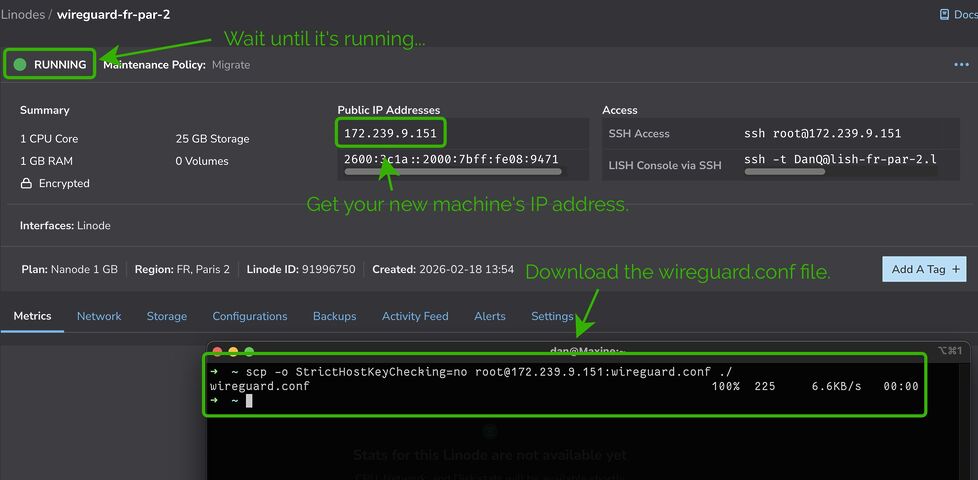
Screenshot of Linode's Web interface showing a running VM, overlaid with a terminal using SCP to download wireguard.conf from it.
Don’t like SCP? You can SSH in and ‘cat’ the configuration or whatever else you like.

My script automatically generates configuration for your local system. Once it’s up and running you can use the machine’s IP address to download wireguard.conf locally. For example, if your machine has the IP address 172.239.9.151, you might type scp -o StrictHostKeyChecking=no root@172.239.9.151:wireguard.conf ./ – note that I disable StrictHostKeyChecking so that my computer doesn’t cache the server’s SSH key (which feels a bit pointless for a “throwaway” VM that I’ll never connect to a second time!).

If you’re on Windows and don’t have SSH/SCP, install one. PuTTY remains a solid choice.

File doesn’t exist? Give it a minute and try again; maybe my script didn’t finish running yet! Still nothing? SSH into your new VM and inspect stackscript.log for a complete log of all the output from my script to see what went wrong.

Screenshot highlighting WireGuard's 'Import tunnel(s) from file' button.
Not got WireGuard installed on your computer yet? Better fix that.

Open up WireGuard on your computer, click the “Import tunnel(s) from file” button, and give it the file you just downloaded.

You can optionally rename the new connection. Or just click “Activate” to connect to your VPN!

Screenshot of WireGuard running, connecting to our new VPN on a Linode VM.
If you see the ‘data received’ and ‘data sent’ values changing, everything’s probably working properly!

You can test your Internet connection is being correctly routed by your VPN by going to e.g. icanhazip.com or ipleak.net: you should see the IP address of your new virtual machine and/or geolocation data that indicates that you’re in your selected region.

When you’re done with your VPN, just delete the virtual machine. Many providers use per-minute or even per-second fractional billing, so you can easily end up spending only a handful of cents in order to use a VPN for a reasonable browsing session.

Screenshot showing Linode list with our new VM's kebab menu opened and the 'delete' option selected.
Again, you can script this from your command-line if you’re the kind of person who wants a dozen different locations/IPs in a single day. (I’m not going to ask why.)

When you’re done, just disconnect and – if you’re not going to use it again immediately – delete the virtual machine so you don’t have to pay for it for a minute longer than you intend4.

I stopped actively paying for VPN subscriptions about a decade ago and, when I “need” the benefits of a VPN, I’ve just done things like what I’ve described above. Compared to a commercial VPN subscription it’s cheap, (potentially even-more) private, doesn’t readily get “detected” as a VPN by the rare folks who try to detect such things, and I can enjoy my choice of either reusable or throwaway IP addresses from wherever I like around the globe.

And if the government starts to try to age-gate commercial VPNs… well then that’s just one more thing going for my approach, isn’t it?

Footnotes

1 If you’re a heavy, “always-on” VPN user, you might still be best-served by one of the big commercial providers, but if you’re “only” using a VPN for 18 hours a day or less then running your own on-demand is probably cheaper, and gives you some fascinating benefits.

2 Many providers have coupons equivalent to hundreds of hours of free provision, so as long as you’re willing to shuffle between cloud providers you can probably have a great and safe VPN completely for free; just sayin’.

3 Obviously, you shouldn’t just run code that strangers give you on the Internet unless you understand it. I’ve tried to make my code self-explanatory and full of comments so you can understand what it does – or at least understand that it’s harmless! – but if you don’t know and trust me personally, you should probably use this as an excuse to learn what you’re doing. In fact, you should do that anyway. Learning is fun.

4 Although even if you forget and it runs for an entire month before your billing cycle comes up, you’re out, what… $5 USD? Plenty of commercial VPN providers would have charged you more than that!

× × × × × ×

Actually, Yes! (that IS what my birth certificate says)

Duration

Podcast Version

This post is also available as a podcast. Listen here, download for later, or subscribe wherever you consume podcasts.

I’ve been going by the name Dan Q for almost 19 years… so like two-thirds of my adult life. I haven’t even needed to show a deed poll to anybody in over a decade1

But just sometimes, somebody asks2 “Yeah, but what does your birth certificate say?”

Dan, a white man with blue hair and a goatee beard, wearing a t-shirt reading 'you see a mousetrap, I see free cheese and a fucking challenge', holds up a Birth Certificate Extract on which his name appears as 'Dan Q'
My birth certificate says… Dan Q. Fuck the haters3.

It didn’t used to say “Dan Q”, but nowadays… yes, that’s exactly what my birth certificate says.

Y’see, I was born in Scotland, and Scottish law – in contrast to the law of England & Wales4 – permits a change of name to recorded retroactively for folks whose births (or adoptions) were registered there.

And so, after considering it for a few months, I filled out an application form, wrote an explanatory letter to help the recipient understand that yes, I’d already changed my name but was just looking for modify a piece of documentation, and within a few weeks I was holding an updated birth certificate. It was pretty easy.

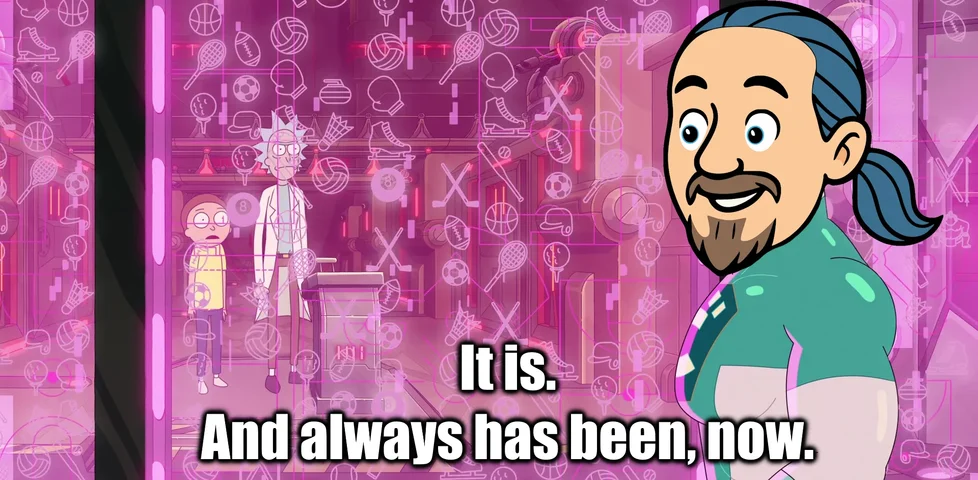
Adapted comic based upon frames from Rick and Morty Season 6, Episode 7 (Full Meta Jackrick). Beyond a sports-themed force field, Morty says to Rick 'That's called ret-conning; couldn't his name just BE Dan Q.' On the near side of the force field, Brett/Rhett Caan, with a comic-art version of Dan's head, says 'It is. And always has been, now.'
Somehow my modification does not make this Rick and Morty episode any more batshit-crazy than it already was.

I flip-flopped on the decision for a while. Not only is it a functionally-pointless gesture – there’s no doubt what my name is! – but I was also concerned about what it implies.

Am I trying to deny that I ever went by a different name? Am I trying to disassociate myself from my birth family? (No, and no, obviously.)

But it “feels right”. And as a bonus: I now know my way around yet another way for (some) Brits to change their names. Thanks to my work at FreeDeedPoll.org.uk I get an increasing amount of email from people looking for help with their name changes, and now I’ve got first-hand experience of an additional process that might be a good choice for some people, some of the time5.

Footnotes

1 By the time you’ve got your passport, driving license, bank account, bills etc. in your name, there’s really no need to be able to prove that you changed it. What it is is more-important anyway.

2 Usually with the same judgemental tone of somebody who insists that one’s “real” name is the one assigned closest to birth.

3 If you’re zooming in on the details on that birth certificate and thinking “Hang on, he told me he was an Aquarius but this date would make him a Capricon?”, then I’ve got news for you about that too.

4 Pedants might like to enjoy using the comments to point out the minority of circumstances under which a birth certificate can be modified retroactively – potentially including name changes – under English law.

5 I maintain that a free, home-made deed poll is the easiest and cheapest way to change your name, as a British citizen, and that’s exactly what FreeDeedPoll.org.uk helps people produce… and since its relaunch it does its processing entirely in-browser, which is totally badass from both a hosting and a user privacy perspective.

× ×

Woodcraft Folk statement on the exclusion of trans children from Girlguiding

This is a repost promoting content originally published elsewhere. See more things Dan's reposted.

Woodcraft Folk stands in solidarity with every trans child, young person and volunteer who faces exclusion from Girlguiding UK following the announcement on Trans inclusion.

We recognise that Girlguiding UK have taken this decision in the context of intense political pressure and legal uncertainty. However, this does not make the outcome acceptable. Young people should never bear the consequences of political disputes. All children and young people deserve respect, safety and inclusion in their youth organisations.

…

Excellent statement from Woodcraft Folk.

I was saddened to hear the news that Girlguiding will no longer accept trans girls as members. It seems to me that it would have been perfectly reasonable for them to change their articles in response to the Supreme Court silliness: instead of declaring themselves as being for the benefit of “girls and women” they could have become for the benefit of “girls, women, trans girls, and trans women”.

Yes, obviously it’s horrible that the Supreme Court’s othering decision means that people have to spell out that “by women, we mean all women, including trans women”. But that’s a thing that a charity can do. It’s perfectly reasonable for a charity to be for the benefit of multiple groups.

But no, they took the easy option.

So it’s great to see youth-supporting organisations like Woodcraft Folk make a statement like this that trans kids continue to be welcome with them. Okay, this was easier for them than for Girlguiding because Woodcraft’s articles didn’t contain any gendered language in the first place. And it’s fine that Girlguiding’s does use gendered language – it’s okay for charities to be gender-specific! – but it’s a shame that they didn’t… pardon the pun… have the balls to stand up for what’s right for all women and girls, in spite of the UK’s growing transphobia. Ugh.

Anyway: nice work, Woodcraft Folk.