It’s February, which means that (here in the UK) it’s LGBT+ History Month.1 And it feels like this year, it’s more important than ever to remember our country’s queer history.
In 2015, the UK was ranked first place in ILGA Europe‘s annual “Rainbow Map” study of LGBT rights in 50 countries of Europe. By 2025, the UK had fallen to 22nd place. That’s the fastest drop of any country in the list, tied with Hungary2 and Georgia3.
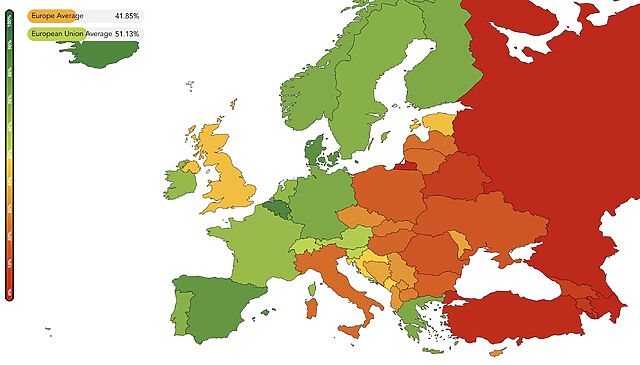
Knowing your history is important. I’ve talked before about my personal experience of growing up under Section 28, and I don’t think that the UK’s backsliding is, by any means, harmless4. In case the reasons for the UK’s drop in the rankings aren’t obvious, it’s pretty much entirely to do with the UK’s increasingly restrictive gender identity laws (thanks, Supreme Court)5.
This stuff affects everybody. When you build a community that is a safe space for queer people, and trans people,6 everybody benefits7. So even if you’re somehow not compelled by the argument that we should treat everybody fairly and with compassion, you should at least accept that it helps you, too, when we do.
In many ways, queer rights in the UK have been a success story in recent decades. Within my lifetime, we’ve seen the harmonisation of the age of consent (2001), civil partnerships (2004), the Gender Recognition Act (2004), the Equality Act (2010), same-sex marriage (2013; I was genuinely surprised this bill passed!) and the mass-pardoning of people previously convicted under discriminatory sex act laws (2017). These are enormous and important steps and it’s little wonder that the UK topped ILGA Europe’s scoreboard for a while there.
But as recent developments have shown: we can’t rest on our laurels. There’s more to do. History shows us what’s possible; it’s up to us to decide whether we keep moving forward or let it unravel.
So this LGBT+ History Month, don’t just remember the past: pay attention to the present, and push back where it’s slipping.
Footnotes
1 We celebrate it in February; I’ve never truly understood why. The Independent claims the month was chosen to coincide with the 2003 abolition of Section 28 in England and Wales, but that wouldn’t happen until later in the year; it doesn’t really coincide with the Employment Equality (Sexual Orientation) Regulations 2003 (made June, commencing December) either. So if anybody knows the real reason the UK marks LGBT+ History month in February, I’ve love to hear it.
2 Hungary banned same-sex couples from adopting five years ago and banned Pride parades last year, in an incredible backslide for an EU country.
3 Georgia’s backslide is superficially similar to Hungary’s except that one can’t help but feel the influence of partial occupier Russia – a frequent bottom-scorer in ILGA’s list – in that.
4 By the way: I just looked back at my own blog posts tagged ‘sexuality’, and man, that shit is on fire! Some fun things there if you’re new to my blog and just catching-up, if I may toot my own horn a little! (Is “toots own horn” a protected identity? ‘Cos I do it a lot.)
5 It’s also aggravated by established but regressive problems like the fact that the UK still doesn’t outlaw “conversion therapy”, gender identity is not a recognised justification for seeking asylum, and protections for intersex people are basically nonexistent.
6 And, it turns out, furries, who’ve ‘gone from “ew cringe” to “they’re the lichens of a healthy social ecosystem”‘.
7 Everybody benefits… except, perhaps, nazis.
0 comments