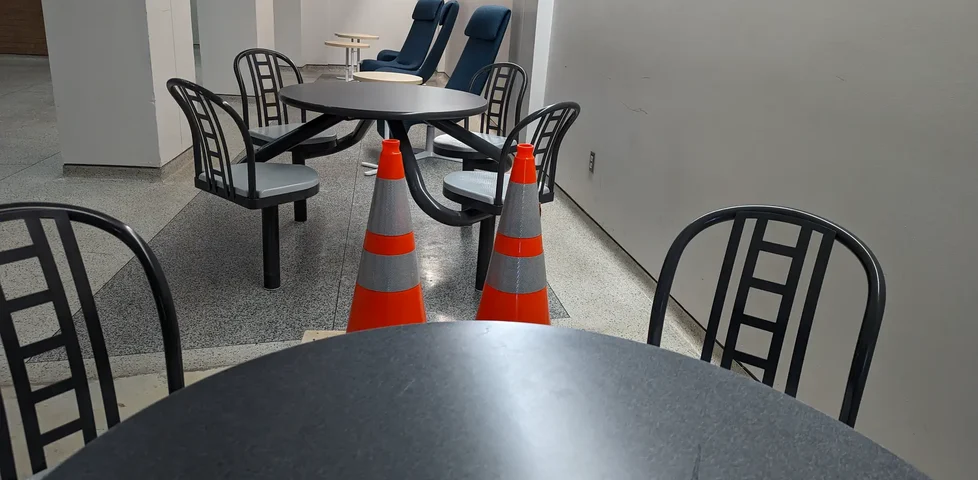
I had another submission accepted to Curious Cones last month; it remains one of my favourite silly niche
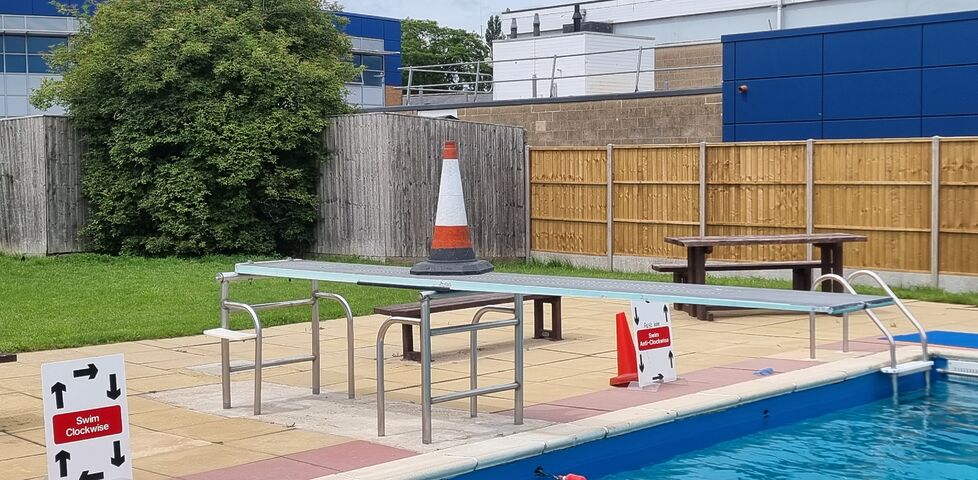
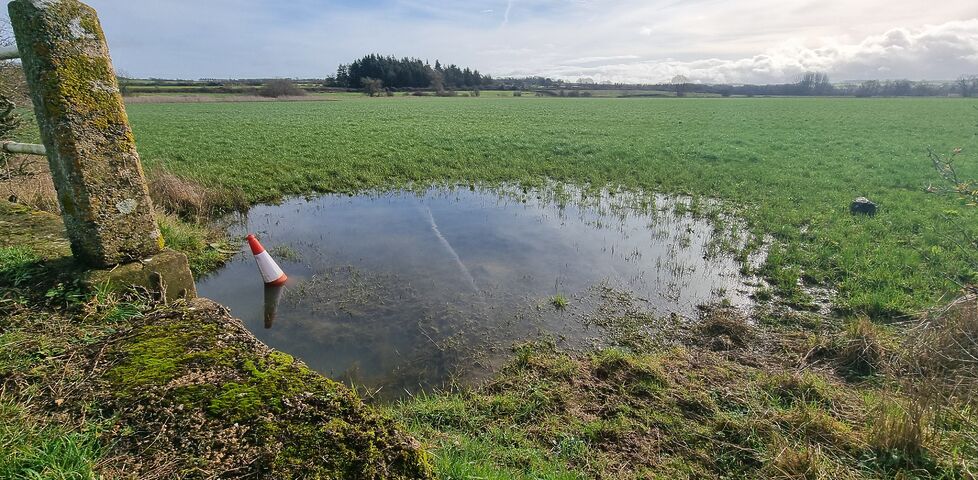
blogs. This time around, it was this traffic cone seemingly about to take a dive from the low board at an outdoor pool (at which the younger kid and I were taking a respite from the
heat!).
Not-accepted, but shared here for your enjoyment, was a photo I took while at West End Live in London the other week. I spotted a
traffic cone on a shelf in the left luggage room at our hotel! I took the pic quickly and the room was dark and the photo came out blurry, so it’s fair that it didn’t make it onto the
blog, but it’ll remind me to keep an eye out for cones in the most-curious of places!
To celebrate the site’s 25th birthday this year, Wikipedia is encouraging/challenging
people to read one Wikipedia article a day for 25 consecutive days. I felt that I could do one better than that: not only reading an article but – where I found one that was
particularly interesting – to write a blog post or record a podcast episode for each of those days, sharing what I learned. For each entry, I’ll hit
“random article” a few times until something catches my interest, start reading, and then start writing! Everything I’ve written below came from Wikipedia… so you should check other
sources before you use it to do your homework. Happy birthday, Wikipedia!
The planet Mercury is covered with impact craters, which isn’t surprising because it has no atmosphere to slow down incoming
meteors nor significant active tectonic or erosion processes to conceal them once they’re created. In 2015 the IAU ran a competition to name four such craters: the winning entries resulted in the naming of the craters Carolan, Enheduanna, Kulthum, Rivera, and
Karsh.
The Karsh crater is about 180km wide, which is approximately comparable to… your mum.
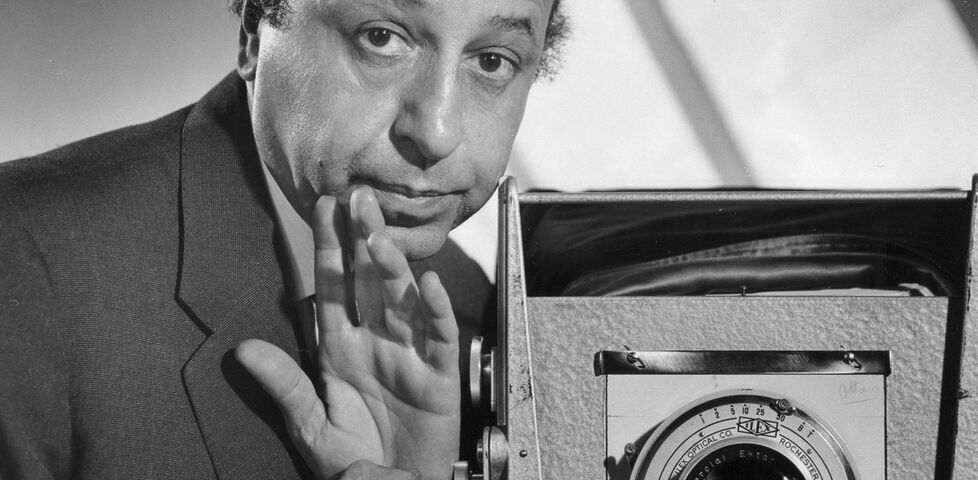
This crater is named after Yousuf Karsh, who’s sufficiently famous that I’d actually heard of him, which was an unusual result
from hitting “random article” on Wikipedia.
But in case you don’t know who Yousaf Karsh is – or if, like me, you just wanted to learn more about him – then you’re in luck!
Selfies used to be a lot harder in 1958.
Yousuf Karsh was an Canadian-Armenian photographer who took principally portrait photographs, some of which you’ve almost-certainly seen already. He photographed a huge number of famous
and significant individuals of the 20th century. Like this one:
“Oh yes!” No wait, that’s the other Churchill’s catchphrase.
That photo, taken in 1941, is titled The Roaring Lion, and it’s got a story to it.
Winston Churchill posed for his photograph on his way out from delivering the “some chicken! some neck!” speech to the Canadian parliament (you can see his
notes from the speech tucked into his jacket pocket). He had his trademark cigar in his mouth, but Karsh wanted it gone. He asked Churchill to remove it, but Churchill refused, and
Karsh went ahead to take the photograph anyway. But then at the last second, Karsh said “Forgive me, sir” and snatched the cigar directly out of the Prime Minister’s mouth.
“By the time I got back to the camera, he looked so belligerent, he could have devoured me,” said Karsh later, of the expression on Churchill’s face. But it’s that expression that he
captured with the camera, and that would go on to be described by the USC as a “defiant and scowling portrait
[which] became an instant icon of Britain’s stand against fascism.” Absolutely iconic.
Churchill himself said, after the picture was taken, that “you can even make a roaring lion stand still to be photographed.” Hence the portrait’s name.
Or how about this picture of the Marx Brothers in 1948:
Karsh became known for his use of harsh lighting to pick out the fine details of his subjects’ faces, which I think is especially clear in this picture.
Or how about this fantastic photo of the then Princess Elizabeth, aged 21 or 22, before her accession as Queen Elizabeth II:
“So long as Daddy manages to die before he has any sons, I’mma get me so much Empire Commonwealth.”
Here’s some things I didn’t know about Yousuf Karsh, though:
Being born to ethnic Armenians in the Ottoman Empire could have been a death sentence in itself for young Yousuf. Ottoman
and later Turkish Nationalist authorities and paramilitaries deported, confined, or murdered hundreds of thousands and quite possibly over a million Armenians, who they saw as a threat
to their national identity (among other candidate causes).
Karsh and his family travelled with a Kurdish caravan to Aleppo in Syria in 1922, and a year later his parents took advantage of a
humanitarian scheme to transport displaced Armenians to live with relatives in Canada: the then 15-year-old who “spoke little French, and less English” and “had no money and little
schooling” moved half way around the world to live with his uncle.
Yousuf’s uncle was a photographer and taught him the essentials of early-20th-century photography technology and techniques, before sending him to apprentice in Boston under John H.
Garo, a fellow Armenian whose studio hosted the still-running Boston Camera Club. He worked in the USA for a time then
returned to Canada, opening his own studio in 1932. When his brother Malak was able to join him in Canada in 1937, Yousuf helped
Malak break into a career in photography too: a career that would probably have been better-known were it not for being in the shadow of his older brother!
I don’t know whether he’d care about having a crater named after him or not. But he’d probably have been more proud of the legacy that lives on in the Karsh Award, given every alternate
year by the City of Ottawa for outstanding artistic work in a photo-based medium.
Hurrah! I just made my first successful submission to Curious Cones, a weblog collecting photographs of traffic cones spotted in unusual places.
I spotted this cone while the younger child and I took a walk to the next-nearest village to our temporary accommodation, in order to find a geocache, tag some benches for OpenBenches, and have a cafe brunch.
Anyway: if you’re not following Curious Cones, it’s exactly as delightful as you might expect.
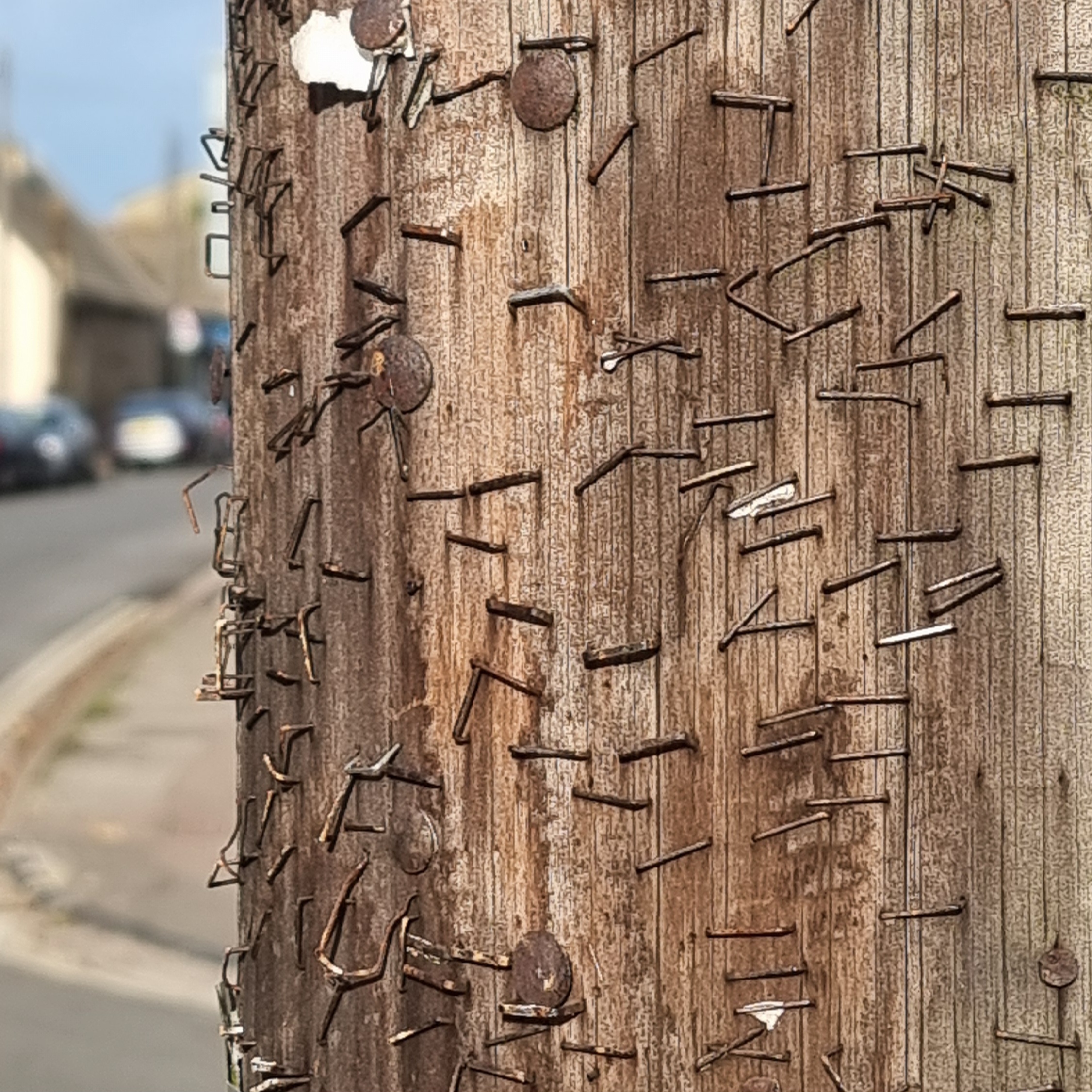
This telegraph pole in the centre of Eynsham carries the scars of hosting countless community announcements, notices, and flyers over the last 30 years.
This has been doing the rounds; I last saw it on Kev’s blog. I like that the social blogosphere’s doing this kind
of fun activity again, these days1.
1. Do you floss your teeth?
Umm… sometimes? Not as often as I should. Don’t tell my dentist!
Usually at least once a month, never more than once a week. I really took to heart some advice that if you’re using a fluoridated mouthwash then you shouldn’t do it close to when you
brush your teeth (or you counteract the benefits), so my routine is that… when I remember and can be bothered to floss… I’ll floss and mouthwash, but like in the middle of the day.
And since I moved my bedroom (and bathroom) one floor further up our house, it’s harder to find the motivation to do so! So I’m probably flossing less. The unanticipated knock-on effect
of extending your house!
2. Tea, coffee, or water?
I love a coffee to start a workday, but I have to be careful how much I consume because caffeine hits me pretty hard, even after a concentrated effort over the last 10 years or so to
gradually increase my tolerance. I can manage a couple of mugs in the morning and be fine, now, but three coffees… or any in the mid-afternoon onwards… and I’m at risk of
throwing off my ability to sleep later2.
I wear holes in footwear (and everything else I wear) faster than anybody I know, so nowadays I go for good-value comfort over any other considerations when buying shoes.
One time it was the dog’s fault that my footwear fell apart, but usually they do so by themselves.
4. Favourite dessert?
Varies, but if we’re eating out, I’m probably going to be ordering the most-chocolatey dessert on the menu.
5. The first thing you do when you wake up?
The very first thing I do when I wake up is check how long it is before I need to get up, and make a decision about when I’m going to do so. I almost never need my alarm
to wake me: I routinely wake up half an hour or so before my alarm would go off, most mornings. But exactly how early I wake directly impacts what I do next. If I’m
well-rested and it’s early enough, I’ll plan on getting up and doing something productive: an early start to work, or some voluntary work for Three Rings, or some correspondence. If it’s close to the time I need to get up I’ll more-often just stay in bed and spend longer doing
the actual answer I should give…
…because the “real” answer is probably: pick up my phone, and open up FreshRSS – almost always the
first and last thing I do online in a day! I’ll skim the news and blogosphere and “set aside” for later anything I’d like to re-read or look at later on.
6. Age you’d like to stick at?
Honestly, I’m good where I am, thanks.
Sure, I was fitter and healthier in my 20s, and I had more free time in my early 30s… and there are certainly things I miss and get nostalgic about in any era of my life. But
conversely: it took me a long, long time to “get my shit together” to the level I have now, and I wouldn’t want to have to go through all of the various bits of
self-growth, therapy, etc. all over again!
So… sure, I’d be happy to transplant my intellect into 20-year-old me and take advantage of my higher energy level of the time for an extra decade or so3. But I wouldn’t go back even a
decade if it meant that I had to go relearn and go through everything from that decade another time, no thanks!
7. How many hats do you own?
Four. Ish.
They are:
A bandana. Actually, I own maybe half a dozen bandanas, mostly in Pride rainbow colours. Bandanas are amazingly versatile: they fold small which suits my love of travelling light these last few years, they can function as headgear, dust mask, neckerchief,
flannel, etc.4, and they do a pretty good job of
keeping my head cool and protecting my growing bald spot from the fierce rays of the summer sun.
A “geek” hat. Okay, I’ve actually got three of these, too, in slightly different designs. When they first started appearing at Oxford Geek Nights, I just kept winning them! I’m not a huge fan of caps, so mostly the kids wear them… although
I do put one on when I’m collecting takeaway food so I can get away with just putting e.g. “geek hat” in the “name” field, rather than my name5.
A warm hat that comes out only when the weather is incredibly cold, or when I’m skiing. As I was reminded while skiing on my recent trip to Finland, I should probably switch to wearing a helmet when I ski, but I’ve been skiing for three to four decades without one
and I find the habit hard to break.6
A wooly hat that I was given by a previous employer at a meetup in Mexico last year. I wore it a couple of times last winter
but it’s otherwise not seen much use.
8. Describe the last photo you took?
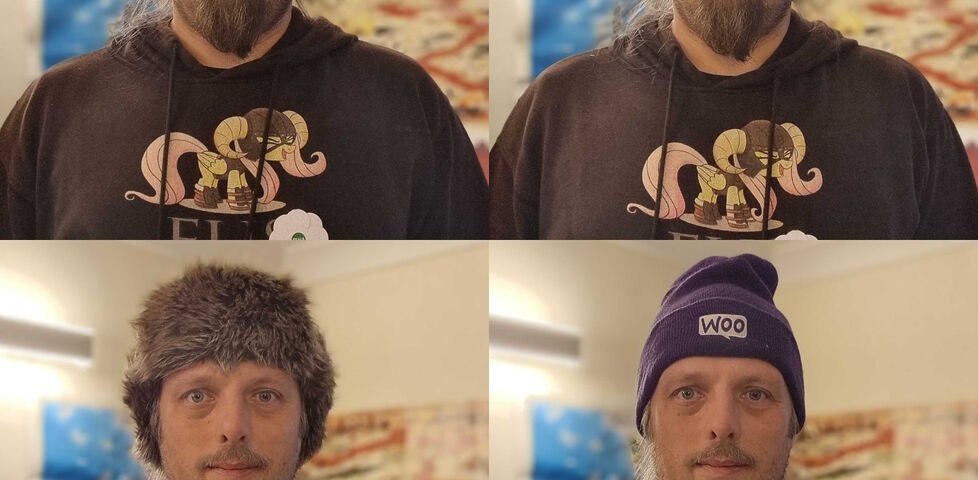
The last photo I took was of myself wearing a “geek” hat. You’ve seen it, it’s above!
But the one before that was this picture of an extremely large bottle of champagne, with a banana for scale, that was delivered to my house earlier today:
A 6-litre champagne bottle is properly-termed a Methuselah, after Noah’s grandad I guess.
Ruth and JTA celebrate their anniversary every few years with the “next size up” of champagne bottle, and this is the one they’re up to. This
year, merely asking me to help them drink it probably won’t be sufficient (that’d still be two litres each!) so we’re probably going to have to get some friends over.
I took the photo to send to Ruth to reassure her that the bottle had arrived safely, after the previous attempt went… less well. I added the banana “for scale” before sharing the photo with some other friends, too.
The previous delivery… didn’t go so well. 😱
9. Worst TV show?
PAW Patrol. No doubt.
You know all those 1980s kids TV shows that basically existed for no other purpose than as a marketing vehicle for a range of toys? I’m talking He-Man (and
She-Ra), Transformers, G.I. Joe, Care Bears, M.A.S.K., Rainbow Brite, and My Little Pony. Well,
those shows look good compared to PAW Patrol.
Six pups, each endowed with exactly one personality trait7
but a plethora of accessories and vehicles which expands every season so that no matter how many toys you’ve got, y0u’re always behind the curve.
10. As a child, what was your aspiration for adulthood?
This is the single most-boring thing about me, and I’ve doubtless talked about it before. At some point between the age of about six and eight years old, I decided that I
wanted to grow up and become… a computer programmer.
And then I designed the entirety of the rest of my education around that goal. I learned a variety of languages and paradigms under my own steam while setting myself up for a GCSE in
IT, and then A-Levels in Maths and Computing, and then a Degree in Computer Science, and by the time I’d done all of that I was already working in the industry: self-actualised by 21.
Like I said: boring!
Your turn!
You should give this pointless quiz a go too. Ping/Webmention me if you do (or comment below, I suppose); I’d love to read what you write.
Footnotes
1 They’re internet memes, in the traditional sense, but sadly people usually use
“meme” nowadays exclusively to describe image memes, and not other kinds of memetic Internet content. Just another example of our changing
Internet language, which I’ve written about before. Sometimes they were silly quizzes (wanna know what Meat Loaf song I
am?); sometimes they were about you and your friends. But images, they weren’t: that came later.
2 Or else I’ll get a proper jittery heart-flutter going!
3 I wouldn’t necessarily even miss the always-on, in-your-pocket, high-speed Internet of
today: the Internet was pretty great back then, too!
4 Obviously an intergalactic hitch-hiker should include a bandana, perhaps as
well as an equally-versatile towel, in their toolkit.
5 It’s not about privacy, although that’s a fringe benefit I suppose: mostly it’s about
getting my food quicker! If I walk into Dominos wearing a geek hat and they’ve got pizza on the counter with a label on it that says it’s for “geek hat”, they’ll just hand it over, no
questions, and I’m in-and-out in seconds.
6JTA observed that similar excuses
were used by people who resisted the rollout of mandatory seatbelt usage in cars, so possibly I’m the “bad guy” here.
7 From left to right, the single personality traits for each of the pups are (a) doesn’t
like water, (b) is female, (c) likes naps, (d) is allergic to cats, (e) is clumsy, and (f) is completely fucking pointless.
As time has gone by, a great many rural English villages have been consumed by their nearest towns, or else become little more than dormitory villages: a place where people do little
more than eat and sleep in-between their commutes to-and-from their distant workplaces1.
And so it pleases me at least a little that the tiny village I’ve lived in for five years this week still shows great success in how well
it clings on to its individual identity.
Right now our village green is surrounded by flags, bunting, and thematic decorations.
Every summer since time immemorial, for example, it’s hosted a Village Festival, and this year it feels like the community’s gone all-out. The theme this year is A Century in
Television, and most of the festivities seem to tie-in to the theme.
If you recognise these characters from their first time around on British television, you’re probably older than I am. If you recognise them from their 2001 “reboot”, then you’re probably younger.
I’ve been particularly impressed this year by entrants into the (themed) scarecrow competition: some cracking scarecrows (and related decorations) have started popping up around the
village in advance of festival week!
Bob the Builder’s helping out with the reconstruction of the roof of one of the houses down towards the end of my hamlet, just outside the village proper.
There’s a clear bias towards characters from childrens’ television programmes, but that only adds to the charm. Not only does it amuse the kids when we walk by them, but it feeds into
the feeling of nostalgia that the festival theme seems to evoke (as well, perhaps, as a connection to the importance of this strange village tradition).
Well-played, Letterbox Cottage. Well-played.
If you took a wrong turning and found your way through our village when you meant to be somewhere else, you’d certainly be amused, bemused, or both by the plethora of figures standing
on street corners, atop hedgerows, and just generally around the place2.
Shaun the Sheep and what I believe must be his cousin Timmy stand atop a hedge looking down on a route used by many children on their way to school.
The festival, like other events in the local calendar, represents a collective effort by the “institutions” of the village – the parish council, the church, the primary school, etc.
But the level of time and emotional investment from individual households (whether they’re making scarecrows for the Summer festival… decorating windows as a Christmas advent calendar…
turning out for a dog show last week, I hear3…)
shows the heart of a collective that really engage with this kind of community. Which is really sweet.
An imaginative use of a coloured lampshade plus some excellent tinfoil work makes Zebedee here come to life. He could only have been more-thematic if he’d been installed on the
village’s (only) roundabout!
Anyway, the short of it is that I feel privileged to live in a village that punches above its weight class when it comes to retaining its distinctive personality. And seeing so many of
my neighbours, near and far, putting these strange scarecrows out, reminded me of that fact.
I’m sure I’m barely scraping the surface – there are definitely a few I know of that I’ve not managed to photograph yet – but there are a lot of scarecrows
around my way, right now.
Footnotes
1 The “village” in which our old house
resided certainly had the characteristic feel of “this used to be a place of its own, but now it’s only-barely not just a residential estate on the outskirts of Oxford, for example.
Kidlington had other features, of course, like Oxford’s short-lived zoological gardens… but it didn’t really feel like it had an identity in
its own right.
2 Depending on exactly which wrong turn you took, the first scarecrow you saw might well
be the one dressed as a police officer – from some nonspecific police procedural drama, one guesses? – that’s stood guard shortly after the first of the signs to advertise our new 20mph speed limit. Holding what I guess is supposed to be a radar gun (but is clearly actually a mini handheld
vacuum cleaner), this scarecrow might well be having a meaningful effect on reducing speeding through our village, and for that alone it might be my favourite.
3 I didn’t enter our silly little furball into the
village dog show, for a variety of reasons: mostly because I had other things to do at the time, but also because she’s a truculent little troublemaker who – especially in the heat of
a Summer’s day – would probably just try to boss-around the other dogs.
You’ve probably come across GeoGuessr already: it’s an online game where you (and friends, if you’ve got them) get dropped into Google Street
View and have two minutes to try to work out where in the world you are and drop a pin on it.
Can you tell where we are, yet?
A great strategy is to “walk around” a little, looking for landmarks, phone numbers, advertisements, linguistic clues, cultural indicators, and so on, narrowing down the region of the
world you think you’re looking at before committing to a country or even a city. You’re eventually scored by how close you are to the actual location.
Cheating at GeoGuessr
I decided to see if ChatGPT can do better than me. Using only the free tier of both GeoGuessr and ChatGPT1, I pasted
screenshots of what I was seeing right into ChatGPT:
ChatGPT confidently assessed the geographic clues, translated some text that it found, and eventually made a guess down to a particular street in St Petersburg.
That’s pretty spooky, right?
The response came back plenty fast enough for me to copy-and-paste the suggested address into Google Maps, get the approximate location, and then drop a pin in the right place in
GeoGuessr. It’s probably one of my most-accurate guesses ever.
This isn’t a one-off fluke. I tried again, this time using only a single photo, rather than one pointing in each direction on the street:
Again, the text recognition and translation capabilities of the AI were highly useful, but it was helped by architectural and cultural clues too.
This time, it wasn’t quite right: the actual location of the photo was Chittagong, not Dhaka, about 200km away.
But that’s still reasonably spectacular from only a single vantage from a single point.
Don’t think I’d have done better, though.
Obviously my approach here was crude, but it’d be relatively easy to, for example, implement a browser wrapper that cheated on-your-behalf: while playing GeoGuessr, you’d just click a
“send to AI” button whenever you fancied and it’d start working in the background, improving precision with each subsequent screenshot (so you could still “walk around” and pass extra
details to it).
And similarly, a little prompt manipulation could have the output include estimated GPS coordinates, allowing the code to place the pin for you while outputting its reasoning
on the side2.
The short of what I’m saying is: if you’re playing GeoGuessr against somebody you don’t trust not to cheat… they might well be cheating. And thanks to the explanatory output, they can
even justify their explanations for the places they dropped pins.
What about other photos?
The other thought that comes to my mind is: could this be used to infer approximate geolocations from photos whose EXIF metadata has been stripped. Because if so, that’s the
kind of thing that’s certain to get exploited by all kind of people who want to know where you are/were at a particular time. For example… law enforcement, stalkers, and
other unsavoury types.
Explanation: The photograph shows a large ship docked at a port with a building that displays the text “WELCOME TO PORT OF SPAIN”. This text is in English,
indicating an English-speaking country. The mention of “Port of Spain” directly specifies the port’s location in the capital city of Trinidad and Tobago. The design and style of
the port facilities, as well as the presence of a ship named “Logos Hope”, which is known to visit many ports globally, further suggests a Caribbean port, aligning with Port of
Spain’s known characteristics.
Location: The Rollright Stones, England, United Kingdom
Explanation: The photograph depicts an area with several ancient standing stones arranged in a circle in a rural setting, characteristic of a stone circle.
These are typically found in certain parts of the UK. The terrain is typical of the British countryside, with a grassy field and surrounding trees. The specific arrangement
and size of the stones, along with the style of fencing and walking paths, are reminiscent of the Rollright Stones, one of Britain’s historic sites known for a circle of
Neolithic or Bronze Age standing stones located in Oxfordshire, England.
Coordinates: 51.9743, -1.5731
✅ Again, spot on. If you’d never been to the Rollright Stones, you probably wouldn’t get that one, because while it’s a distinctive-looking stone circle… it’s not that
distinctive-looking, right? Let’s be honest: it’s some rocks in a field.
Explanation: The photograph prominently features the Galata Tower in the background, a well-known landmark in Istanbul, Turkey. Moreover, the presence of a ferry
or similar boat and the architectural style of the surrounding buildings are indicative of Istanbul’s famous skyline. The signage in Turkish, as suggested by the word partially
visible on the left, also supports this location as Turkey is a predominantly Turkish-speaking country. These elements combined make it highly likely that the photograph was taken
in Istanbul.
Coordinates: 41.0082, 28.9784
✅ The coordinates aren’t exactly right – it’s placed us in the city rather than on a boat, which we clearly are – but it’s not done badly. Spotting the Galata Tower3 was a nice move.
Location: Cardiff Bay, Cardiff, Wales, United Kingdom
Explanation: The photograph features a marina with modern residential buildings, which is characteristic of the Cardiff Bay area in Cardiff, Wales. The
architecture, clear blue skies, and marina setting are reminiscent of Cardiff’s waterfront development. Additionally, the presence of English signage on the boat (“FINBAR”)
supports a location in an English-speaking country. Cardiff Bay is known for its redeveloped waterfront area with modern apartments and leisure facilities surrounding the marina.
The style and design of the building are consistent with developments in Cardiff’s revitalized docklands.
Coordinates: 51.4626, -3.1678
❌ Oops! Nope. I can see the thinking of what it’s claiming, there, but this was actually the Ipswich marina. I went for a walk to take a break from the code I’d been writing
and took this somewhere in the vicinity of the blue plaque for Edward Ardizzone that I’d just spotted (I was
recording a video for my kids, who’ve enjoyed several of his Tim… books).
So I don’t think this is necessarily a game-changer for Internet creeps yet. So long as you’re careful not to post photos in which you’re in front of any national monuments and
strip your EXIF metadata as normal, you’re probably not going to give away where you are quite yet.
Footnotes
1 And in a single-player game only: I didn’t actually want to cheat anybody out
of a legitimate victory!
2 I’m not going to implement GeoCheatr, as I’d probably name it. Unless somebody
feels like paying me to do so: I’m open for freelance work right now, so if you want to try to guarantee the win at the GeoGuessr World Championships (which will involve the much-riskier act of cheating in
person, so you’ll want a secret UI – I’m thinking a keyboard shortcut to send data to the AI, and an in-ear headphone so it can “talk” back to you?), look me up? (I’m mostly
kidding, of course: just because something’s technically-possible doesn’t mean it’s something I want to do, even for your money!)
4 3Camp is Three Rings‘ annual volunteer
get-together, hackathon, and meetup. People come together for an intensive week of making-things-better for charities the world over.