I hadn’t really talked about it yet, because I’ve been too busy… I don’t know… blogging about Marmite and
beds and computers or something… but I had the most fabulous time at a New Year’s party
hosted by Liz and Simon at
their house in Macclesfield. There was drinking, and board games, and truly awful Troma films, and then at midnight we all counted down from 7, or 12, or something, and spontaneously
broke out into a chorus of Auld Lang Syne. See: there’s a
video and everything –
It seems that my mnemonic (as used in the title of this post) is broken, unless we reinstate Pluto as a planet and rename the fourth and eighth planets in the solar system to Lars and
Septune, respectively. Which I think are better names, anyway.
It was a fantastic opportunity to catch up with folks I don’t see enough of, to talk about what had gone right (and wrong) about the year gone by, and what we were looking forward to in
the year to come. Liz suggested that perhaps this should become a regular thing, a little like “fake Christmas” has begun to, and that seems like a good idea (and I’m pretty sure I
heard Bryn volunteer to host it next year…).
By the way: do you remember how last year Paul, Ruth, JTA and I invented Argh! It Burns Night? We’re doing it again this year, and because so many of you expressed an interest in joining us, we’d like you to come too. It’ll be
on the evening of Saturday 4th February (yes, we know this is a little late for a Burns Night, but the second part of Ruth & JTA’s honeymoon is going to get in the way otherwise):
drop me an email if you want to come along for a night of haggis, whisky, and fanfiction.
This weekend, I integrated two new computers into the home network on New Earth. The first of these is
Tiffany2.
Tiffany2 is a small "media centre" style computer with an all-in-one remote keyboard/mouse.
Tiffany2 replaces Tiffany, the media centre computer I built a little under four years ago. The original Tiffany was built on a shoestring budget of
under £300, and provided the technical magic behind the last hundred or so Troma Nights, as well as countless other film and television nights, a means to watch (and record and pause)
live TV, surf the web, and play a game once in a while.
The problem with Tiffany is that she was built dirt-cheap at a time when building a proper media centre PC was still quite expensive. So she wasn’t very good. Honestly, I’m
amazed that she lasted as long as she did. And she’s still running: but she “feels” slow (and takes far too long to warm up) and she makes a noise like a jet engine… which isn’t what
you want when you’re paying attention to the important dialogue of a quiet scene.
Tiffany and Tiffany2. Were this a histogram of their relative noise levels, the one on the left would be much, much larger.
Tiffany2 is virtually silent and significantly more-powerful than her predecessor. She’s also a lot smaller – not much bigger than a DVD player – and generally more
feature-rich.
This was the first time I’d built an ITX form-factor computer (Tiffany2 is Mini-ITX): I wanted to make her small, and it seemed like the best standard for the job. Assembling some of her components felt a little like
playing with a doll’s house – she has a 2.5″ hard disk and a “slimline” optical drive: components that in the old days we used to call “laptop” parts, which see new life in small
desktop computers.
Examples of six different hard drive form factors. Tiffany2 uses the third-smallest size shown in this picture. The computer you're using, unless it's a laptop, probably uses the
third-largest (picture courtesy Paul R. Potts, CC-At-SA).
In order to screw in some of the smaller components, I had to dig out my set of watchmaker’s screwdrivers. Everything packs very neatly into a very small space, and – building her – I
found myself remembering my summer job long ago at DesignPlan Lighting, where I’d have to tuck dozens of little
components, carefully wired-together, into the shell of what would eventually become a striplight in a tube train or a prison, or something.
She’s already deployed in our living room, and we’ve christened her with the latest Zero Punctuation, a few DVDs, some episodes of Xena: Warrior Princess, and an episode of Total Wipeout featuring JTA‘s old history teacher as a contestant. Looks
like she’s made herself at home.
(for those who are sad enough to care, Tiffany2 is running an Intel Core i3-2100 processor, underclocked to 3GHz, on an mITX Gigabyte GA-H61N-USB3 motherboard with 4GB RAM, a 750GB hard disk, and DVD-rewriter, all wrapped up in an Antec ISK 300-150 case with a 150W power supply: easily enough for a media centre box plus some
heavy lifting if I ever feel the need to give her any)
I took a tour of the United Kingdom over the Christmas period, and was offered no fewer than five different beds to sleep in. Here’s a little about each of them:
Robin’s Bed
The first bed belonged to Robin, (Ruth‘s little brother) at their mother’s house. Robin wasn’t with us for
the entire period that Ruth, JTA and I spent visiting Ruth’s mother, so I was able to annex his bed for much of the
time.
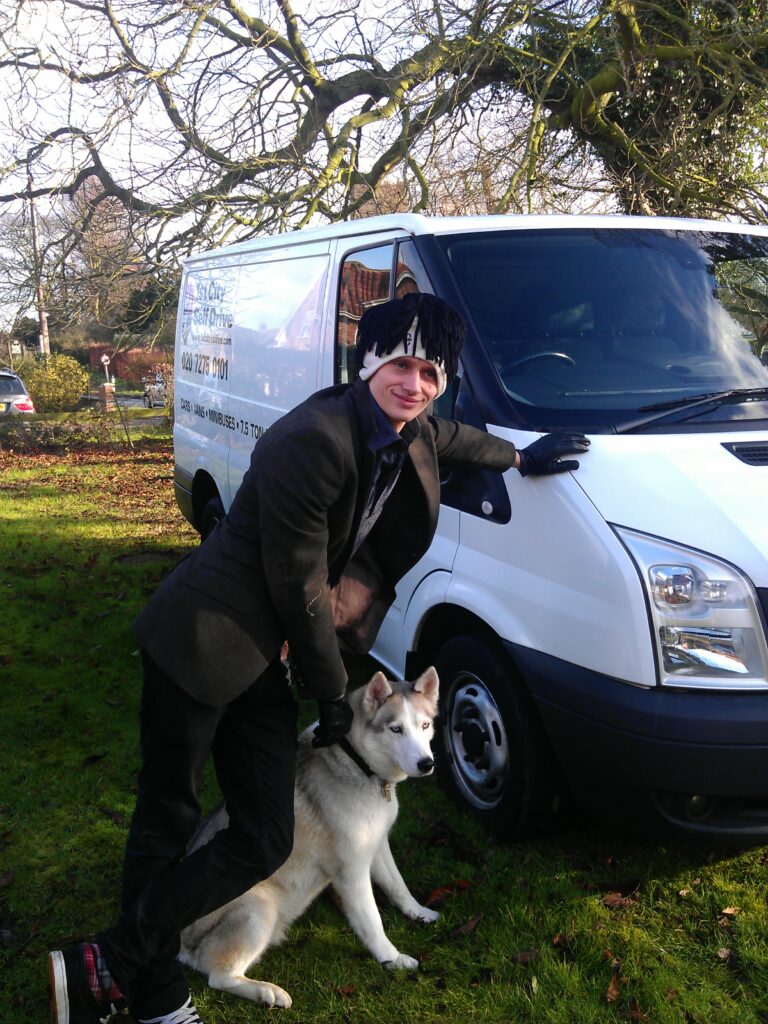
Robin, his boss, and his boss’s dog turned up in a rental van: “The only vehicle they could get hold of at short notice on Christmas Eve.”
While at first it appeared to be just a regular single bed, closer investigation revealed that the entire headboard was hinged, with radial bolts to hold it upright during normal use.
Opening these bolts allowed the headboard to tilt forward and lie down on the bed. I have no idea what purpose this mechanism was supposed to serve, but it was very
useful for getting my hand down the back to plug my mobile phone charger in to the otherwise-inaccessible sockets behind.
Owen’s Folding Mattress
While Robin and his boss were around, though, I was relegated to the living room floor, and given a folding mattress that Owen (Ruth’s older brother) used to keep in his van as a
crash-space. Unfolded and then wrapped in a blanket and sheet for comfort, it didn’t look like much except a quick way to consume floor space.
But damned if it wasn’t the most comfortable thing I slept on all week. I’d jarred my back in some awkward way (probably lugging my enormous suitcase and a stack of presents around the
country!), and a low, firm mattress on a hard floor turns out to have been exactly what it needed to speed my recovery.
If this kind of futon looks familiar, then like me you probably used to volunteer somewhere that owned one. This one’s a single, which is significantly less-awkward to fold and
unfold.
My Mother’s Futon
My next overnight stop was in Preston, visiting my family. My mother keeps a futon in her study, a room barely bigger than the bed when fully deployed, which made getting into and out
of the room more than a little challenging, but only marginally less-difficult than re-folding it back into a chair every time.
The futon itself was comfortable enough, but the room was extremely nippy. After a particular cold snap one day, I began taking not one but two hot water bottles to bed, and running an
electric heater for an hour or so beforehand. I suppose the main problem was the tiny 4.5-tog “summer” duvet I was using, which I’m sure would have delightful if I were in, say, Egypt.
Still: I got to rediscover quite how delightfully opulent it is to get into a bed that’s been freshly warmed by a pair of hot water bottles, which was nice (albeit also necessary).
My Dad’s Bed
When he left Preston to go and finish his final few days with Go North East, he offered me the use of his bed, which –
given the temperatures on my mother’s futon – I should have taken.
But I didn’t, so this bed is the bed that wasn’t. Five just seemed like a better number than four for the article title. And no, “five beds” isn’t a metaphor for
something (which I feel the need to say after some of the feedback I got to my apparently-too-mysterious earlier post, “Marmite“).
The beds might be cold, but this photo shows a few dozen great things about Christmas at my mother’s. When drinking, stop before you get as far back as the cooking oil.
Liz & Simon’s Massage Mattress
I saw the New Year in at Liz and Simon‘s house in Macclesfield, where I was given the choice between the couch and a “massage mattress”. Naturally, I opted for the latter – one doesn’t turn
down a strange-looking, vibrating sleeping partner without good cause!
Unfortunately, I never got to try it out! After a copious quantity of alcohol and a handful of other substances, my one-day-only roommate Alex collapsed onto the sofa and fell
asleep within seconds. Not wanting to wake him, I left the mattress off and just, y’know, slept on it (how old-fashioned). It was still a great night’s rest after a fantastic party,
though.
So there we are – a round-up review of my sleeping arrangements. Apparently I’m in a slightly off-the-wall blogging mood so far this year. Because sleeping on-the-wall… would be weird.
This blog post is about Marmite. I apologise if it makes you hungry, nauseous, or confused.
Your mate. Marmite.
My partner enjoys Marmite. This isn’t a surprise: I’ve known it for years. Some weekend mornings I’ve seen her enthusiastically scoff down some Marmite on toast, and I’ve known times
that she’s been feeling run-down and hungry and the prospect of a bit of Marmite is exactly what she needs to get her motor running again. She doesn’t eat it all the time, but she
likes to keep a jar around in anticipation: Marmite lasts pretty much forever, so there’s no hurry.
It’s only since living with her, though, that I’ve seen so much of the strange sticky substance as I have. That’s not her doing, I’ll stress: she’s always respectful of the fact that I
seem to just be one of those people who’s just never going to be a Marmite-eater, and she doesn’t surprise me with Marmite-infused foodstuffs. In exchange, I try not to complain
whenever I can smell that the jar is open.
Her husband enjoys Marmite too. Sometimes she makes Marmite whirls, pastry spirals with a sharp taste of Marmite, and I think she does so mostly because she knows that he enjoys them so
much. I honestly don’t know how often he eats the stuff other than when she serves it: occasionally, I guess.
Marmite whirls. You love them, or you hate them, or you go round and round and round them like an escaped rollercoaster.
I’ve only recently kept Marmite in my cupboard: it’s a new addition to my food supply. Are my partner and husband responsible for this? No… well, only insofar as that they once reminded
me that they keep Marmite in the house: “We keep our Marmite in this cupboard,” they said, and that was that. (sometimes they disagree on which shelf the Marmite belongs on,
but more often than not they’re in agreement)
But now there’s Marmite in my cupboard. I’m not sure why I keep it there. I still don’t really like Marmite, although I think that with experience I’ve learned to appreciate
what others see in its flavour, even if it doesn’t sit comfortably in me.
I look at the jar of Marmite in my cupboard. “Why are you there?” I ask it, “What am I supposed to do with you?” It doesn’t answer. It is, of course, only Marmite. I realise that I’m
standing alone in the kitchen, talking to my shelf, and I feel a little stupid. But it’s a puzzle that I can’t solve: how did the Marmite even get into my cupboard? I certainly didn’t
buy it. Did it… put itself there?
Time for some buttered toast.
This blog post is not about Marmite. My apology still stands.
In April, my dad’s off to the North Pole, in another of his crazy expeditions! Long-term readers might remember that he and I cycled around Malawi and attempted to canoe down the Caledonian Canal, but his latest adventure makes those two look like a walk
in the park!
It’s particularly challenging, I think, because he’s having to walk there. It turns out that there isn’t a regular bus service to the North Pole, which I think pretty-well represents
everything that’s wrong with the bus industry these days. I worry about the poor old lady who lives at the North Pole – you know, Santa’s wife – and how she gets out and about when her
husband is out in their only flying sleigh.
My dad, dragging a tyre along the edge of the river in Gateshead.
But in any case, dragging a sled behind yourself which holds everything that you need to survive for over a fortnight on the Arctic ice is a monumental challenge for anybody. As part of
his training, my dad’s been dragging a tyre, roped to his waist, around Gateshead. This apparently approximates the amount of drag that is produced by a fully-laden sled, although I’m
not sure that the experience is truly authentic as polar bears are significantly less-likely than geordies to mock you for dragging a tyre around. Also less likely to maul you.
In fact, now I think about it, the dangers of Arctic exploration – with its shifting ice, temperatures below -30°C, polar bears, and blizzards – are actually quite tame by comparison to
going for a stroll in some parts of Tyneside.
In any case, I’m incredibly proud of what he’s doing. His expedition is self-funded, but he’s also accepting sponsorship to raise money for an organisation called TransAid, who help provide sustainable and safe transport solutions in the developing world, where they can make all the difference to people who otherwise wouldn’t be
able to reach a hospital, school, or work opportunities.
I’ve always been enamoured with the concept of urban
exploration: that is, the infiltration and examination of abandoned human structures. I was reminded of this recently, when Ruth, JTA and I got the chance to go on an (organised) tour of long-abandoned Aldwych Tube Station in London.
The Eastern platform at Aldwych. Closed in 1914, we missed the last train by almost a hundred years.
I think for me the appeal comes from the same place as it does when I’m looking around, for example, the ruin of a castle or the wreck of a ship. As opposed to the exploration of the
natural world, looking around a man-made thing really gives you the feeling that you’re uncovering the long-lost purpose of the place. This place you are was designed and
built to fill a particular need and, for whatever reason, it’s now left to rot and decay. And you – the amateur urban archaeologist, are the link that connects this abandoned world
with the present.
I’ve been thinking about some of the places I’ve explored – sewer tunnels underneath what is now Deepdale
Retail Park, waterlogged WWII bunkers occupied by squatters, disused railway lines and railyards, roofs of semi-accessible castles, and the (then-disused) wreck that was
Aberystwyth’s Alexandra
Hall, back when tragically-empty buildings was part of the quirky charm of the place, before they transformed into being a symptom of its downfall. I wanted to share with you a story or
two. But instead of any of these, I’ve picked a place that none of you are likely to have heard about:
Wittingham Hospital
Wittingham Hospital, near Goosnargh, Lancashire - perhaps my earliest illicit expedition.
In the mid-19th century, the lunatic asylums of Lancashire and Merseyside were overflowing, and Wittingham Mental Hospital was built to replace them. Originally built to hold 1000 patients, it held over 3,500 by the outbreak of the second
world war, making it the largest mental hospital in the country. The mental health reforms of the 1960s (and an inquiry into patient abuse), and new drugs and treatments in the 1970s and 1980s, led to it being gradually emptied and, in 1995,
closing for good.
I was still at school when word got around about the closure and a couple of friends and I decided to cycle up to the old hospital and explore it, because there’s nothing like
schoolboys egging one another on to give you the courage to “break into the old asylum”. Apparently when I was a kid, I didn’t watch enough horror films about haunted old buildings or
about murderous psychopaths, because it seemed like a perfectly reasonable suggestion to me. The council have since put up secure fences and begun demolition, but back then it didn’t
take more than a little bit of climbing to gain access to the abandoned complex.
A contemporary (2010) photo from inside the hospital by urban explorer "Infiltrator". Click on the photo for his full report and more photos. It's degraded a lot since I visited.
There was a deathly quiet inside the buildings. The distance from the nearest road and the surrounding woodlands muffled the distant sounds of the outside world to less than a whisper,
and as the three of us split up and spread out, it was very easy to feel completely alone. The silence was more comforting, though, than eerie: on the hard tile floors and in the big,
empty rooms, it’d be impossible to catch anybody unawares, no matter how fleet of foot you might be.
I was surprised to see quite how much furniture and equipment had been simply left: it was almost as if the buildings had been evacuated in a panic, rather than undergoing a controlled,
phased closure. Filing cabinets remained, stuffed with papers, in a room with net curtains and a carpet. An upright piano, only slightly out-of-tune, remained in an otherwise
empty ward. Beds, operating tables, and cupboards stood exactly as they had when the hospital was still alive.
An old leaflet, discovered on a 2009 expedition by urban explorer "BA". Click on the image for his full story. Apart from looking a little more weathered for the 13 years between my
visit and his, this looks exactly like the kinds of things I saw.
I couldn’t understand how a place could be abandoned in this way. It’s as if the place itself had died and, instead of being buried, had just been left to decompose in the open air. It
seemed – at the least – irresponsible: a friend of mine even came across surgical supplies and syringes, simply left in a cupboard… but more than that, it seemed
disrespectful to the building to leave it responsible for looking after these memories of its old self: things which no longer have any purpose, of which it was the custodian, unwilling
and unthanked.
We didn’t take any photos – I’m not sure that any of us owned a camera, back then – and we didn’t liberate any of the paperwork (tempting though it was). I’m pretty sure that not one of
the three felt that our parents would have approved of us illicitly gaining access to a disused medical facility, so any evidence of our presence was to be avoided! But there was more
than that at stake: spending an hour or two wandering around these forgotten corridors, I felt more like a ghost than like a person. We crept about in silence, not saying a word to one
another until we’d all reached perimeter once more. It wasn’t our place to interact with this building: all we were there to do was to observe, impotently: to see the beginning of its
long decay, that’s since been documented by so many others. That was enough.
I’ll tell you what, though: that early experience? I totally hold it responsible for my subsequent interest in abandoned places.
Last week, I wrote about two of the big-name video games I’ve been
playing since I suddenly discovered a window of free time in my life, again. Today, I’d like to tell you about some of the smaller independent titles that have captured my interest:
Minecraft
A well-developed Minecraft city port, on the edge of a sprawling and mountainous landmass.
I’d love to be able to say that I was playing Minecraft before it was cool, and I have been playing it since
Infdev, which came before the Alpha version. But Minecraft was always cool.
Suppose you’ve been living on another planet all year and so you haven’t heard of Minecraft. Here’s what you need to know: it’s a game, and it’s also a software toy, depending on how you choose to play
it. Assuming you’re not playing in “creative mode” (which is a whole other story), then it’s a first-person game of exploration, resource gathering and management, construction, combat,
and (if you’re paying multiplayer, which is completely optional) cooperation.
Your character is plunged at dawn into a landscape of rolling (well, stepped) hills, oceans, tundra, and deserts, with infinite blocks extending in every direction. It’s a reasonably
safe place during the daytime, but at night zombies and skeletons and giant spiders roam the land, so your first task is to build a shelter. Wood or earth are common starting materials;
stone if you’ve got time to start a mine; bricks later on if you’ve got clay close to hand; but seriously: you go build your house out of anything you’d like. Then begins your
adventure: explore, mine, and find resources with which to build better tools, and unlock the mysteries of the world (and the worlds beyond). And if you get stuck, just remember that
Minecraft backwards is the same as Skyrim forwards.
Parts of it remind me of NetHack, which is one of the computer games that consumed my life: the open world, the randomly-generated terrain, and the scope of the
experience put me in mind of this classic Rougelike. Also perhaps Dwarf Fortress or Dungeon Keeper: there’s plenty of opportunities for mining,
construction, trap-making, and defensive structures, as well as for subterranean exploration. There are obvious similarities to Terraria, too.
I think that there’s something for everybody in Minecraft, although the learning curve might be steeper than some players are used to.
Limbo
This is not a game for those with a fear of spiders.
I first heard about Limbo when it appeared on the XBox last year, because it got a lot of press at the time for it’s dark stylistic
imagery and “trial and death” style. But, of course, the developers had done a deal with the devil and made it an XBox-only release to begin with, putting off the versions for other
consoles and desktop computers until 2011.
But now it’s out, as Paul was keen to advise me, and it’s awesome. You’ll die – a lot – when you play it, but
the game auto-saves quietly at very-frequent strategic points, so it’s easy to “just keep playing” (a little like the equally-fabulous Super Meat Boy), but the real charm in this game comes from the sharp contrast between the light, simple platformer interface and the dark, oppressive environment
of the levels. Truly, it’s the stuff that nightmares are made of, and it’s beautiful.
While at first it feels a little simplistic (how often nowadays do you get a game whose controls consist of the classic four-button “left”, “right”, “climb/jump”, and “action”
options?), the game actually uses these controls to great effect. Sure, you’ll spend a fair amount of time just running to the right, in old-school platformer style, but all the while
you’ll be getting drawn in to the shady world of the game, set on-edge by its atmospheric and gloomy soundtrack. And then, suddenly, right when you least expect it: snap!, and
you’re dead again.
The puzzles are pretty good: they’re sometimes a little easy, but that’s better in a game like this than ones which might otherwise put you off having “one more go” at a level. There’s
a good deal of variety in the puzzle types, stretching the interface as far as it will go. I’ve not quite finished it yet, but I certainly will: it’s a lot of fun, and it’s a nice bit
of “lightweight” gaming for those 5-minute gaps between tasks that I seem to find so many of.
Blue Lacuna
Those with limited capacity for imagination should be aware that this is not an in-game screenshot. An in-game screenshot would consist pretty-much of just text.
I know, I know… as an interactive fiction geek I really should have gotten around to finishing Blue Lacuna sooner.
I first played it a few years ago, when it was released, but it was only recently that I found time to pick it up again and play it to, well, it’s logical conclusion.
What do you need to know to enjoy this game? Well: firstly, that it’s free. As in: really free – you don’t have to pay to get it, and anybody can download the complete source code (I’d recommend finishing the game first, because the source code is, of course,
spoiler-heavy!) under a Creative Commons license and learn from or adapt it themselves. That’s pretty awesome, and something we don’t see enough of.
Secondly, it’s a text-based adventure. I’ve recommended a few of these before, because I’m a big fan of
the medium. This one’s less-challenging for beginners than some that I’ve recommended: it uses an unusual user interface feature that the developer calls Wayfaring, to make it easy and
intuitive to dive in. There isn’t an inventory (at least, not in the conventional adventure game sense – although there is one optional exception to this), and most players won’t feel
the need to make a map (although keeping notes is advisable!). All-in-all, so far it just sounds like a modern, accessible piece of interactive fiction.
But what makes this particular piece so special is it’s sheer size and scope. The world of the game is nothing short of epic, and more-than almost any text-based game I’ve played
before, it feels alive: it’s as much fun to explore the world as it is to advance the story. The “simplified” interface (as described above) initially feels a little limiting
to an experienced IFer like myself, but that quickly gives way as you realise how many other factors (other than what you’re carrying) can be used to solve problems. Time of day, tides,
weather, who you’ve spoken to and about what, where you’ve been, when you last slept and what you dreamed about… all of these things can be factors in the way that your character
experiences the world in Blue Lacuna, and it leads to an incredibly deep experience.
It describes itself as being an explorable story in the tradition of interactive fiction and text adventures… a novel about discovery, loss, and choice.. a game about words and
emotions, not guns. And that’s exactly right.
It’s available for MacOS, Windows, Linux, and just about every other platform, and you should totally give it a go.
tl;dr: [skip to the end] I’m closing my Facebook account. I’ve got some suggestions at the
bottom of this post about how you might like to keep in touch with me in future, if you previously liked to do so via Facebook.
The Backstory
A little over three weeks ago, I was banned from Facebook for having a fake name.
This surprised me, because I was using my real name – it’s an unusual name, but it’s mine.
I was interested to discover that Claire, who shares my name, hadn’t been similarly banned, so it seems that this
wasn’t part of some “sweep” for people with one-letter names, but instead was probably the result of somebody (some stranger, I’d like to hope) clicking the “Report this as a fake name”
link on my profile.
Perhaps somebody clicked their way through to this page, and claimed that I was not a "real person".
There are many, many things about this that are alarming, but the biggest is the “block first; ask questions later” attitude. I wasn’t once emailed to warn me that I would be
banned. Hell: I wasn’t even emailed to tell me that I had been banned. It took until I tried to log in before I found out at all.
The Problem
I don’t make much use of Facebook, really. I cross-post my blog posts there, and I keep Pidgin signed in to Facebook
Chat in case anybody’s looking for me. Oh, and I stalk people from my past, but that’s just about the only thing I do on it that everybody does on it. I don’t really
wallpost, I avoid internal messages (replying to them, where possible, by email), and I certainly don’t play fucking FarmVille.
Once, one of my Facebook friends invited me to FarmVille. They're not my Facebook friend any more.
So what’s the problem? It’s not like I’d be missing anything if I barely use it anyway? The problem is that my account was still there, it’s just that I didn’t have access to
it.
That meant that people still invited me to things and sent me messages. My friends are smart enough to know that I won’t see anything they write on their wall, but they assume
that if they update the information of a party they’ve Facebook-invited me to that I’ll get it. For example, I was recently at a fabulous party at Gareth and Penny‘s which they organised mostly via Facebook.
They’d be forgiven for assuming that when they sent a message to “the guests” – a list that included me – that I would get that message: but no – it fell silently away into Facebook’s
black hole.
The Farce(book?)
Following this discovery, here’s how I spent the next three weeks:
Facebook gave me a form to fill in when I tried to log in, explaining their “Real Names” policy and asking me to fill in my real name and explain “what I use Facebook for”
(“Ignoring friends and stalking exes, same as everybody else,” I explained, “Why; what do YOU use Facebook for?”).
It then asked me to scan and upload some government-issued photographic ID, which I did. It still wouldn’t let me log in, but it promised that somebody would look at my ID soon (and
then destroy their copy) and re-enable my account.
I periodically tried to log in over the next few days, without success: I was to wait, I was told.
After about a week, I received an email from “Rachel” at Facebook, who explained the “Real Names” policy and asked me to provide my REAL name, and a scan of some photographic ID. I
replied to explain that I’d already done this once, but complied with her request anyway.
Another few days passed, and I still hadn’t heard anything, so I filled in the Contact Forms in the Help section of Facebook, asking to have my request processed by an actual human
being. I provided by ID yet again.
Another few days later, I received an email from “Aoife” at Facebook. It was pretty-much exactly the same as the earlier email from Rachel. I replied to explain that we’d
been through this already. I supplied another pile of photo ID, and a few sarcastic comments.
A real person, with a real name, holding two examples of his real government-issued photographic ID. I wonder how long it would take a smart person to look at a scan of that ID and
say, "Yeah, this person's real enough to be allowed to post pictures of cats on his wall, again."
Another couple of days passed, so I dug up the postal addresses of Facebook’s HQ, and Mark Zuckerberg‘s new Palo Alto house (he’s tried to keep it secret, but the Internet is pretty good at this kind of
detective work), and sent each of them a letter explaining my predicament.
Yet more days passed, and we reached the third week of my ban. I replied to Rachel and Aoife, asking how long this was likely to take.
Finally, a little over three weeks after the ban was first put in place, it was lifted. I received an email from Aoife:
Hi Dan,
Thanks for verifying your identity. Note that we permanently deleted your attached ID from our servers.
After investigating this further, it looks like we suspended your account by mistake. I’m so sorry for the inconvenience. You should now be able to log in. If you have any issues
getting back into your account, please let me know.
Thanks,
Aoife
User Operations
Facebook
The Resolution
So now, I’m back on Facebook, and I’ve learned something: having a Facebook account that you can’t log in to is worse than not having a Facebook account at all. If
I didn’t have one at all, at least people would know that they couldn’t contact me that way. In my situation, Facebook were effectively lying to my friends: telling them “Yeah, sure:
we’ll pass on your message to Dan!” and then not doing so. It’s a little bit like digital identity theft, and it’s at least a little alarming.
I’ve learned something else, too: Facebook can’t be trusted to handle this kind of situation properly. Anybody could end up in my situation. Those of you with unusual
(real) names, or unusual-looking pseudonyms, or who use fake names on Facebook (and I know that there are at least a dozen of you on my friends list)… or just those of you whose name
looks a little bit off to a Facebook employee… you’re all at risk of this kind of lockout.
Me? I was a little pissed off, but it wasn’t the end of the world. But I know people who use Facebook’s “single sign-on” authentication systems to log in to other services. I know
people who do some or all of their business through Facebook. Increasingly, I’ve seen people store their telephone or email address books primarily on Facebook. What do you do when you
lose access to this and can’t get it back? When there’s nowhere to appeal?
And that’s how I came to my third lesson: I can’t rely on Facebook not to make this kind of fuck-up again. No explanation was given as to how their “mistake” was
made, so I can’t trust that whatever human or automated system was at fault won’t just do the same damn dumb thing tomorrow to me or to somebody I know. And personally, I don’t
like Facebook to seize control of my account and to pretend to be me. I come full circle to my first realisation – that it would be better not to have a Facebook account
at all than to have one that I can’t access – and realise that because that’s liable to happen again at any time, that I shouldn’t have a Facebook account.
The Conclusion
So, I’m ditching Facebook.
Goodbye, Facebook.
None of this pansy “deactivation” shit, either – do you know what that actually does, by the way? It just hides your wall and stops new people from friending you: it still keeps all of
your information, because it’s basically a scam to try to keep your data while making you think you’ve left. No, I’m talking about the real “permanent deletion” deal.
I’m going to hang around for a few days to make sure I’ve harvested everybody’s email addresses and pushing this post to my wall and whatnot, and then I’m gone.
If you’re among those folks who aren’t sure how to function outside of Facebook, but still want to keep in touch with me, here’s what you need to know:
I like email! Remember email? I’ve always preferred it to Facebook messages anyway – that’s why I always reply to you by email, where possible. My email address
is pretty obvious – it’s my first name @ this domain name – but if that’s too hard for you, just fill in this form to get in touch
with me. If you’re up for some security while you’re at it, why not encrypt your email to me.
I like instant messaging! I may not be on Facebook Messenger any more, but we can still chat! The best way to get me is on Google Talk, but there are plenty of
other options too. Here’s how you do it. Or if you’re really lazy, just check at
the top of my blog for the little green light and click “Chat to Dan”.
I like blogging! Want to know what’s going on in my life? I never updated my “wall” anyway except to link to blog posts – you might as well just come look at my
blog! Too much like work? Follow my RSS feed and get updated when I post to my blog, or keep an eye on my Twitter, which usually gets links to my new blog posts almost as soon as they go up.
I like sharing!I’m not on Google Reader any more, but when I find fun
things on the Internet that I enjoyed reading, I put them in this RSS feed.
Subscribe and see what I’ve been looking at online, or just look at “Dan is Reading…” in the right-hand column of my blog.
And I’m not opposed to social networking! I’ve just reached the end of my patience with Facebook, that’s all. Look me up on Google+ and I’ll see you over there (They also have a “Real Names” policy, which is
still a bit of a
problem, but I’m sending them a pre-emptive “Don’t ban me, bro!” email now)!
Ironically, the only Facebook accounts I’ll have now are the once which do have fake names. Funny how they’re the ones that never seem to get banned.
As I previously indicated, I’ve recently found myself
with a little free videogaming time, and I thought I’d share some of the things that have occupied my time, over the course of two blog posts:
Skyrim
Ava, a level 38 Dark Elf Florist and Dog-Walker, glad that he's wearing thermal underwear beneath his dragonscale armour.
Well; here’s the big one. This game eats time for breakfast. It’s like World Of Warcraft for people who don’t have friends. No, wait…
Seriously, though, Bethesda have really kicked arse with this one. I only played a little of the earlier games in the series, because they didn’t “click” with me (although I thoroughly
enjoyed the entire Fallout series), but Skyrim goes a whole extra mile. The game world feels truly epic and “living”: you don’t have to squint more than a little to get the illusion
that the whole world would carry on without you, with people eating and sleeping and going to work and gossiping about all the dragon attacks. The plot is solid, the engine is
beautiful, and there’s so much content that it’s simply impossible to feel that you’re taking it all in at once.
It’s not perfect. It’s been designed with console controls in mind, and it shows (the user interface for skills upgrades is clunky as hell, even when I tried it on my XBox
controller). The AI still does some damn stupid things (not standing-and-talking-to-walls stupid, but still bad enough that your so-called “friends” will get in your way, fire
area-effect weapons at enemies you’re meleeing with, and so on). Dragons are glitchy (the first time I beat an Elder Dragon it was mostly only because it landed in a river and got its
head stuck underwater, like it was seeing how long it could hold it’s breath while I gradually sliced its tail into salami).
But it’s still a huge and beautiful game that’s paid for itself in the 55+ hours of entertainment it’s provided so far. Recommended.
Update: between first drafting and actually publishing this list, I’ve finished the main questline of Skyrim, which was fun. 85 hours and counting.
Modern Warfare 3
I was incredibly excited by the opportunity to fight my way through the London Underground, until I realised that the Tube in the game was designed by aliens rather than TfL.
I should confess, first, that I’m a Call Of Duty fanboy. Not one of the these modern CoD fanboys, who rack up kills in multiplayer matchups orchestrated by ability-ranking
machines in server farms, shouting “noob” as they teabag one another’s corpses. I mean I’m a purist CoD fanboy. When I got my copy of the first Call Of Duty game,
broadband was just beginning to take off, and games with both single-player and multiplayer aspects still had to sell themselves on the strength of the single-player aspects, because
most of their users would only ever play it that way.
And the Call of Duty series has always had something that’s been rare in action-heavy first-person shooters: a plot. A good plot. A plot that you can actually get behind and care about.
Okay, so we all know how the World War II ones end (spoiler: the allies win), and if you’ve seen Enemy At The Gates then you also know how every single Russian mission goes, too, but they’ve still got a fun story and they work hard to get you
emotionally-invested. The first time I finished Call of Duty 2, I cried. And then I started over and shot another thousand Nazis, like I was some form of human tank.
Modern Warfare was fantastic, bringing the franchise (complete with Captain Price) right into the era of nuclear threats and international terrorism. Modern Warfare 2 built on this and
took it even further, somehow having a final boss fight that surpassed even the excellence of its predecessor (“boss fights” being notoriously difficult to do well in first-person
shooters inspired by the real world). Modern Warfare 3… well…
It was okay. As a fanboy, I loved the fact that they finally closed the story arc started by the two previous MW games (and did so in a beautiful way: I maintain that Yuri is my
favourite character, simply because of the way his story is woven into the arc). The chemical weapon attacks weren’t quite so impressive as the nuclear bomb in MW2, and the
final fight wasn’t quite as good as the previous ones, but they’re all “good enough”. The big disappointment was the length of the campaign. The game finished downloading
and unlocked at 11pm, and by 4am I was tucked up in bed, having finished it in a single sitting. “Was that it?” I asked.
Recommendation: play it if you’re a fan and want to see how the story ends, or else wait until it’s on sale and play it then.
Part Two will come when I find time, along with some games that you’re less-likely to have come across already.
A strange package appeared outside of the door to my office, some time this morning, wrapped as a gift and accompanied by a card.
A card, bottle of wine, and box of chocolates!
It turns out to have been my colleagues at the Bodleian Shop, whose newly-relaunched e-commerce site I was drafted
into at the last minute to iron out a few technical hitches in time for them to start making online sales before the Christmas rush. There were a few somewhat-stressful moments as
technical folk from disparate providers worked together to link-up all of the parts of the site (warehouse and stock level systems, order and payment processing, content management, and
of course the web front end), but it all came together in the end… and I think a lot of lessons were learned from the experience.
My bottle of wine, chilling amidst the anti-bird-wire on the window ledge of the building.
So that was a very sweet surprise. I knew that they’d appreciated my “hopping department” in order to firefight the various problems that came up during their deployment, but it
was still really awesome to get an alcoholic, chocolatey thank-you and a cute card signed by their team, to boot.
The last few months, and especially the last few weeks, have been incredibly hectic. The giveaway, I suppose, should have been how little I’ve blogged recently: it’s a dead giveaway
that I’m really busy when I’m able to neglect writing about how busy I am. I’m not complaining, of course, just apologising to the Internet at large.
Mostly, my time’s been eaten up by Three Rings. We launched Milestone: Iridium,
the latest new version of the helpline management software, at the weekend, after an extended testing period and a long-extended development cycle. There’s a metricfucktonofnewfeaturesinthisrelease, including the massive Rota Autopopulation feature, which uses some incredibly complicated mathematics and fine-tuneable
weighting preferences to find the best people for each shift, with minimal human interaction. Oh, and we got a new server. And launched a documentation website. I’ve no doubt that this is our biggest release to-date.
Some of you might be old enough to remember when Three Rings looked like this. Not many of you, but some.
It’s amazing to see how far we’ve come. It still boggles my mind every time I look at the statistics, and see that we’re now helping over ten thousand volunteers. When I started, we
were supporting about ten. Sometimes it scares me. Mostly it thrills me. It’s a great project to be involved with, even when it does consume all of my free time for weeks
on end.
This evening, I found myself momentarily at a loose end. I felt like there were things I ought be be doing, urgently, but there weren’t. There’s a backlog of personal
email to catch up on, and a stack of little jobs to be doing, but there’s nothing critical.
It took a few minutes to reassure myself that I really had nothing that needed doing immediately. Then I poured myself a glass of wine, popped my feet up, and played some video
games. My Steam catalogue has gotten bloated, full of games that I’ve bought over the last few
months to play “when I get the time”. Time to cut that list down.
The message I see when I try to log in to Facebook. Sadly, I'm also prohibited from using Pidgin to connect to Facebook Chat, which is just about the only thing I use Facebook for
these days.
Okay, that’s not what that message actually says, but that’s how I chose to read it. It turns out that my name isn’t
real. I went through their forms to tell them that “no, really, this is my name”. They also asked me “what I use Facebook for”, to which I – of course – answered “chatting to friends
and stalking exes, same as everybody else – why, what do YOU use Facebook for?” But when I submitted the form, it just ran me back around in a circle back to where I started.
Also: Facebook! Is that exposed HTML code in your message? Dear me.
I’d be less frustrated if I didn’t just send them a copy of my driving license earlier this year, in order to prove that my name was really my name. I guess that the media
claims that Facebook keeps all of your information indefinitely aren’t true, and in actual fact they have the memory of a proverbial goldfish.
I’d be more frustrated if I actually used Facebook for anything more than pushing blog posts out to people who prefer to see them on Facebook, and occasionally chatting to people,
thanks to the wonderful pidgin-facebookchat plugin.
So on average, I suppose, I’m pretty indifferent. That’s the Facebook way.
On Tuesday last week, Ruth and I went to Etiquette, an unusual (and at least a little experimental) theatrical
experience at the Oxford Playhouse. I say “theatrical experience”, because while there were certainly elements to
the evening that could be considered to be reminiscent of more-conventional theatre, it was far more like not going to see a play than it was
like doing so.
Dan arrives, sits down, and puts his headphones on.
The event takes place in a café. And I mean that literally… I’m not just setting the scene; although many of the scenes also take place in a café. This is actually a cafe, with a
handful of other participants, sat in pairs at their respective tables, and a majority of people who are just everyday folks out for a drink or a sandwich.
We were shown to our table and invited to sit. On the table were a collection of objects – glasses of water, a pipette, stage blood, two plastic figurines (one man, one woman), a ball
of white tack, some chalk, a book, some notepaper, some blank cards… and a pair of MP3 players with headphones. We were instructed to put on the headphones. Simultaneously, the MP3
players were started.
Ruth begins to receive her instructions.
From there on, we followed the instructions given over the earpieces. My role was that of an older man, a self-described philosopher. Ruth played a prostitute, which lead to at least a
little embarrassment on her part when she was required to say, “I am a prostitute,” in a crowded café. It’s easy to feel acutely self-conscious when you’re relaying what
you’re told in a pair of headphones out loud. You know that feeling that you get when you realise that you’re singing along to the music you’re listening to, in public? It’s a little
bit like that, but instead of music, you’re spouting out-of-context nonsense.
The inner ‘stage’ – the table between us – on which a second, inner, story is told, through the medium of miniatures and chalk.
It’s not just dialogue, though; it’s also stage direction, motivation, and prompts to inspire emotion. Some of the story is told in a very abstract way: early on, Ruth’s and my
characters had agreed to meet in a house on a hill, near a tree. Ruth laid her hand out on the table, on which she had, under previous instruction, drawn a square and a dot on the heel
of her palm. I was told to examine the shape of the “landscape” of her hand, and try drip water from my pipette, from as high as I could reach, onto it. Simultaneously, her
character – already in the house (the square) – was told that it had begun to rain, and she heard the sound of a storm beginning through her headphones.
Throughout the course of the event, we each took on a variety of roles: as characters in our own play, as directors of a “play” performed on our table using the props we had to hand, as
the audience to both of the above, and even as parts of the scenery.
The story itself… was okay. It felt like it was lacking something. It wasn’t bad, and it certainly took advantage of the space and technology it required, but it was perhaps trying to
say a little bit too much in a little bit too short a time. But the medium? That whole “scripted, but you don’t get to read ahead”, headphones-acting? That’s kind-of cool and exciting.
I’ve got the urge to try to write something similar myself (perhaps for a cast of five or six). Although first, I’ve got a murder mystery to finish writing!
Long ago, I used desktop RSS readers. I was only subscribed to my friends’ blogs back then anyway, so it didn’t matter that I could only read them from my home computer. But then RSS
feeds started appearing on news sites, and tech blogs started appearing about things related to my work. And smartphones took over the world, and I wanted to be able to synchronise my
reading list everywhere. There were a few different services that competed for my attention, but Google Reader was the best. It was simple, and fast, and easy, and it Just Worked in
that way that Google products often do.
I put up with the occasional changes to the user interface. Hey, it’s a beta, and it’s still the best thing out there. Hey, it’s free, what can you say? I put up with the fact that from
time to time, they changed the site in ways that were sometimes quite hostile to Opera, my web
browser of choice. I put up with the fact that it had difficulty with unsigned HTTPS certificates (it’s fine now) and that it didn’t provide a mechanism to authenticate against services
like LiveJournal (it still doesn’t). I even worked around the latter, releasing my own tool and updatingit a few times until LiveJournal blocked it (twice) and I had to instead recommend that people switched to rival service FreeMyFeed.
The new Google Reader (with my annotations - click to embiggen). It sucks quite a lot.
I know that they’re ever-so-proud of the Google+ user interface, but rebranding all of the other services to look like
it just isn’t working. It’s great for Google+, not-bad for Search, bad for GMail (but at least you can turn it off!), and fucking awful for Reader. I like
distinct borders between my items. I don’t like big white spaces and buttons that eat up half the screen.
The sharing interface is completely broken. After a little while, I worked out that I still can share things with other people, but I can’t any longer see what other
people are sharing without clicking over to Google+. This sucks a lot. No longer can I keep track of which shared items I have and haven’t read, and no longer can I read the interesting
RSS feeds my friends have shared in the same place as I read (and share) my own.
So that’s the last straw. Today, I switched everything over to Tiny Tiny RSS.
Tiny Tiny RSS - it's simple, clean, and (in an understated way) beautiful.
Originally I felt that I was being pushed “away” from Google Reader, but the more I’ve played with it, the more I’ve realised that I’m being drawn “towards” Tiny Tiny, and wishing that
I’d made the switch further. The things that have really appealed are:
It’s self-hosted. Tiny Tiny RSS is a free, open-source solution that you host for yourself (or I suppose you can use a shared host; there are a few around). I know
that this is a downside to most people, but to me, it’s a serious selling point: now, I’m in control of what updates are applied, when, and if I don’t like the
functionality of a part of the system, I can change it – I’m in control.
It’s simple and clean. It’s got a great user interface, in an understated and simplistic way. It’s somewhat reminiscent of desktop email clients,
replacing the “stream of feeds” idea with a two- or three-pane view (your choice). That sounds like it’d be a downside, until you realise…
…with great keyboard controls. Tiny Tiny RSS is great for keyboard lovers like me. The default key-commands (which are of course customisable) are based on
Emacs, so if that’s your background then it’s easy to be right at home in minutes and browsing feeds faster than ever.
Plus: it’s got a stack of nice features. I’m loving the “fresh” filter, that helps me differentiate between the stuff I’ve “saved for later” reading and the
stuff that’s actually new and interesting. I’m also impressed by the integrated authentication, which removes my dependency on FreeMyFeed-like services and (because it’s self-hosted)
lets me keep my credentials securely under my own control. It supports authentication using SSL certificates, a beautiful and underused technology. It allows you to customise the
update frequency of your feeds, so I can stalk by friends’ blogs at lightning-quick rates and stall my weekly update subscriptions so they don’t get checked so frequently. And unlike
Google Reader, it actually tells me when feeds break, so I don’t just “get no updates” for a while before I think to check the site (and it’ll even let me change the
URLs when this happens, rather than unsubscribing and resubscribing).
Put simply: all of my major gripes with Google Reader over the last few years have been answered all at once in this wonderful little program. If people are interested in how I set up
Tiny Tiny RSS and and made the switchover as simple and painless as possible, I’ll write a blog post to talk you through it.
I’ve had just one problem: it’s not quite so tolerant of badly-formed XML as Google Reader. There’s one feed in my list which, it turns out, has (very) invalid XML in it’s
feed, that Google Reader managed to ignore and breeze over, but Tiny Tiny RSS chokes on. I’ve contacted the site owner to try to get it fixed, but if they don’t, I might have to hack
some code to try to make a workaround. Not ideal, and not something that everybody would necessarily want to deal with, so be aware!
If, like me, you’ve become dissatisfied by Google Reader this week, you might also like to look at rssLounge, the
other worthy candidate I considered as a replacement. I had a quick play but didn’t find it quite as suitable for my needs, but it might be to your taste: take a look.
The new sidebar, showing what I'm reading in my RSS reader lately.
Oh, and one more thing: if you used to “follow” me on Google Reader (or even if you didn’t) and you want to continue to subscribe to the stuff I “share”, then
you’ll want to subscribe to this new RSS feed of “my shared stuff”, instead: it can also be found syndicated in
the right-hand column of my blog.
Update:this guy’s made a
bookmarklet that makes the new Google Reader theme slightly less hideous. Doesn’t fix the other problems, though, but if you’re not quite pissed-off enough to jump ship, it
might make your experience more-bearable.
Update 2: others in the blogosphere are saying good things about Reader rival NewsBlur, which recently turned one year old. If you’re looking for a hosted
service, rather than something “roll-your-own” like Tiny Tiny RSS, perhaps it’s the tool for you?
Recently, I wrote about the fact that I’m driving to and from Aylesbury once a week in order to study there.
I passed my driving test a year and a half ago, but, of course, I don’t actually own a car.
What I’ve been doing is using a car sharing company called Zipcar (technically, Streetcar, when I started, but the latter is merging into the former).
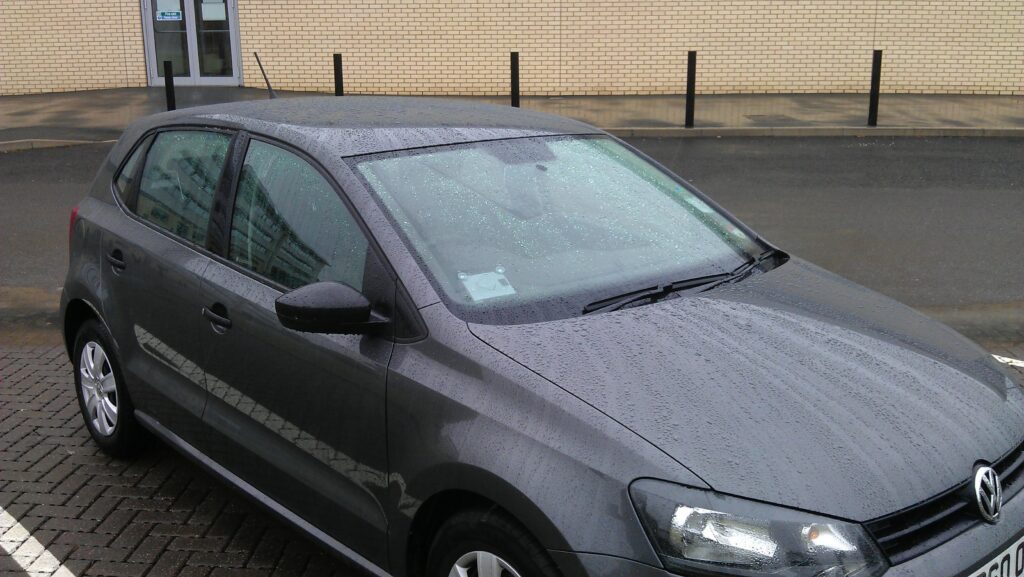
Golf “Eulalia”, one of the Oxford Streetcar/Zipcar vehicles, seen here parked at Aylesbury College.
There are two varieties of car sharing clubs. These are:
Ones like Zipcar, which are companies with a large fleet of vehicles, pre-vetting of customers, and
“live”/”on-demand” booking.
Ones like WhipCar, which act as portals to allow members of the public to borrow one another’s privately-owned cars.
I haven’t had the chance to try the latter variety yet, although there are a number in my area. The important things are the things that both types have in common, and that is
distinctfrom most traditional car rental companies:
They keep their fleets spread out in disparate locations, meaning that you don’t have to “go somewhere” to pick up a car.
They make heavy use of the Internet, mobile apps, and – in the case of the corporate varieties – remotely-managed engine computers and RFID technology, to give their members access
to vehicles.
As a result of the above, they cater in particular to people who want to borrow a car occasionally, conveniently, but only perhaps for a few hours at a time.
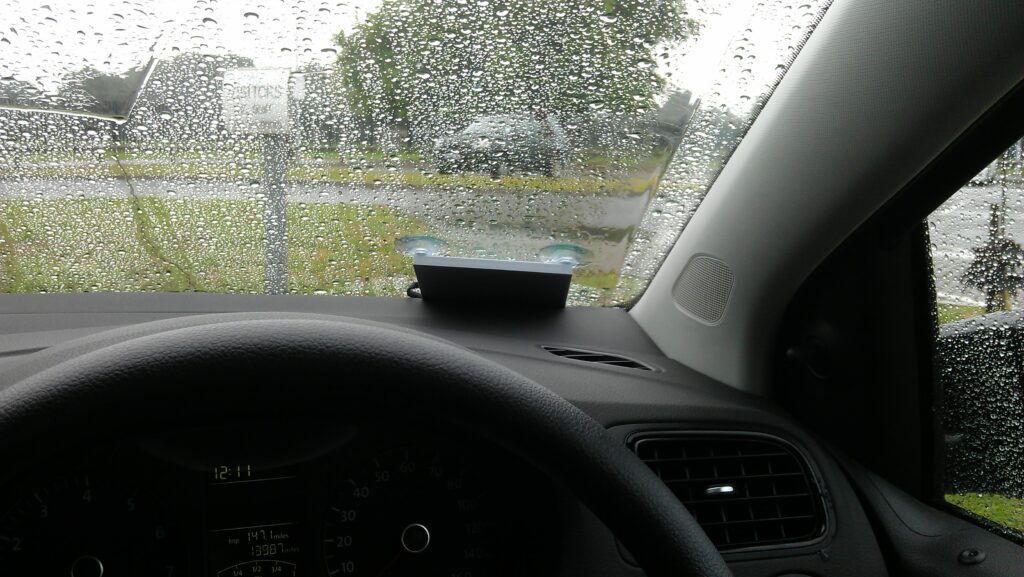
The sensor on the top of the dashboard allows the car to be locked and unlocked with your RFID card (assuming that you’ve made a booking).
For me, at least, it’s far cheaper than owning a car – I only make one journey a week, and sometimes not even that. It’s far more convenient for that journey, for me, than public
transport (which would involve travelling at awkward times and a longer journey duration). If I were using my own car, I’d have to park it in Oxford city centre on Mondays in
order to make my journey possible (which is as challenging as it is expensive). Paying by the half-hour makes it convenient for short hops, and the ability to book, pick up, and return
the car without staff intervention means that it doesn’t matter if it’s midnight or a bank holiday or anything: if I ever need access to a car or van in a hurry, there’s almost always
one available for me to just “swipe into”.
And it’s far simpler than a conventional car rental company… at least, once you’ve gone through the telephone set-up process: a three-way phone call between you, the DVLA, and the car
hire company. If I want a car, I pop up the website or pull out my phone, find a nearby one that’s free when I want it, and go drive.
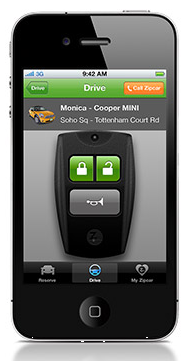
As you can probably see, this is the iPhone version of the app. The Android one is virtually identical.
The cars are all new and well-kept, and the pricing is reasonable: you get a daily mileage allowance (now 40 miles, which is pretty ideal for me, as my round trip journey is barely more
than that), and then pay a mileage rate thereafter (if you need to fuel up, there’s a fuel card in the car). Paying by the mile, rather than the litre, has the unfortunate side-effect
of failing to encourage eco-driving, but other than that it’s a sensible policy which allows you to accurately anticipate your costs.
It’s been great, so far. I’ve been doing it for a few months and I’ve only had one niggle: I was on my way to college, as usual, when Zipcar called me to let me know that the previous
person booking my car was running late. I’d never had this happen before: I’d never even been lined up back-to-back with another user before; it actually seems to be quite rare. In any
case, Zipcar found me another car, which I declined (it was on the wrong side of town, and by the time I’d cycled back to it and driven across to this side again, I might
as well have waited). In the end, the other user was fined, and I was given a discount in excess of the “missed” time, which I spent on a tin of biscuits to share with my classmates by
way of apology for turning up late and disrupting the lesson. I’ve had a few difficulties with their website, especially when they first started taking over Streetcar’s fleets, but
they’ve been pretty good about fixing them promptly.
So there we go: a nod of approval for Zipcar from me. So if you’re based in London (where there’s loads of them), Brighton, Bristol, Oxford, Cambridge, or – soon –
Maidstone, Guildford, or Edinburgh, and occasionally have need for an on-demand car, look into them. And if you sign up using this link or the shiny button below, we’ll each get £25 of free driving credit. Bonus!
Update (2022): Many years later, ZipCar would come to start mis-charging me and then repeatedly fuck up my
requests for them to stop doing so and stop processing my personal information (they actually told me twice that they’d done the latter, and I needed to log into my account to produce
screenshots for them with which to demonstrate that they were lying to me). As a result, I can’t give them the same level of glowing recommendation as I used to.
Update (2023): Somehow, ZipCar are still fucking-up my personally-identifiable information, despite
repeatedly being told to delete it (and on several occasions promising that they would or had). I can no longer in good faith recommend them as a company. Please don’t use them.