Even when it’s technical, not all of my International Volunteer Day work for Three Rings has been spent using our key technologies (LNMR [Linux, Nginx, MariaDB, Ruby] stacks).
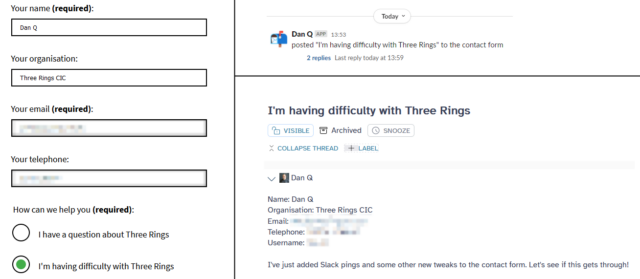
Today, I wrote some extra PHP for our WordPress-powered contact form to notify our Support Team volunteers via Slack when messages are sent. We already aim to respond to every message
within 24 hours, 365 days a year, and are often faster than that… but this might help us to be even more-responsive to the needs of the charities who we help look after.
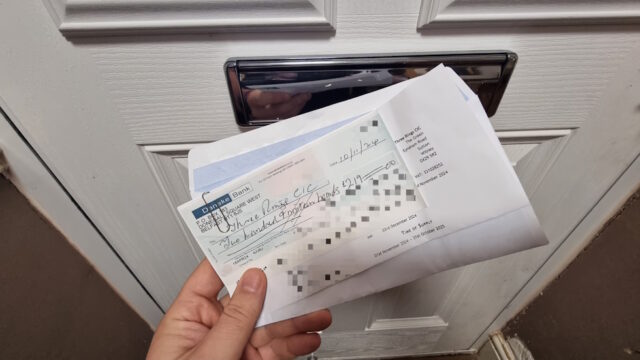
My Three Rings volunteering this International Volunteer Day isn’t all technical work. It’s also time to process the incoming postal mail.
Our time as volunteers may be free, but our servers aren’t, so the larger and richer charities that use our services help contribute to our hosting costs. Most send money digitally, but
some use dual-signatory accounts that require they send cheques.
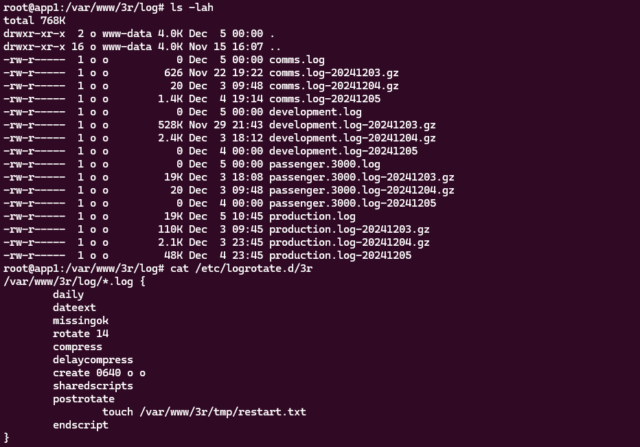
As well as the programming tasks I’m working on for Three Rings this International Volunteer Day, I’m also doing a little devops. We’ve got a new server architecture rolling out next
week, and I’m tasked with ensuring that the logging on them meets our security standards.
Each server’s on-device logs are retained in date-stamped files for 14 days, but they’re also backed-up offsite daily.
Those bits all seem to be working, so next I need to work out a way to add a notification to our monitoring platform if any server doesn’t successfully push a log to the offsite backup
in a timely manner.
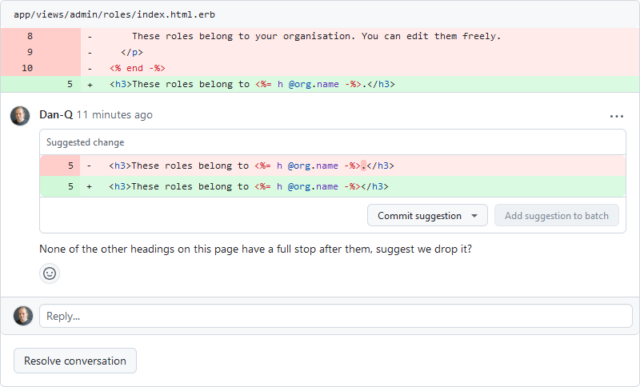
Not every code review is fireworks, but most Three Rings changes come from the actual needs of the voluntary organisations that Three Rings supports. Some of our users were confused by
the way the Admin > Roles page was laid out, so one of our volunteers wrote an improved version.
And because we’re all about collaboration, discussion, learning from one another, and volunteer-empowerment… I’ve added a minor suggestion… but approved their change “with or without”
it. I trust my fellow volunteer to either accept my suggestion (if it’s right), reject it (if it’s wrong), or solicit more reviews or bring it to Slack or our fortnightly dev meeting
(if it requires discussion).
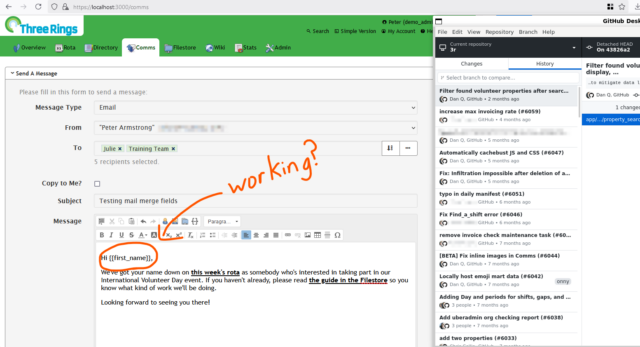
Good news! It turns out that the new code to fix the mail merge fields in Three Rings doesn’t introduce an inconsistency with established behaviour. It was important to check, but it
turns out all is well.
I touched bases with a fellow volunteer on Slack. Three Rings volunteers primarily communicate via Slack: it helps us to work asynchronously, which supports the fact that our volunteers
all have different schedules and preferences. Some might do a couple of evenings a week, others might do the odd weekend, others still might do an occasional intense solid week of
volunteering with us and then nothing for months! A communication model that works both synchronously and asynchronously is really important to make that volunteering model work, and
Slack fits the bill.
We get together in person sometimes, and we meet on Zoom from time to time too, but Slack is king of communication at Three Rings
My first task this International Volunteer Day is to test a pull request that aims to fix a bug with Three Rings’ mail merge fields functionality. As it’s planned to be a hotfix (direct
into production) we require extra rigor and more reviewers than code that just goes into the main branch for later testing on our beta environment.
My concern is that fixing this bug might lead to a regression not described by our automated tests, so I’m rolling back to a version from a couple of months ago to compare the behaviour
of the affected tool then and now. Sometimes you just need some hands-on testing!
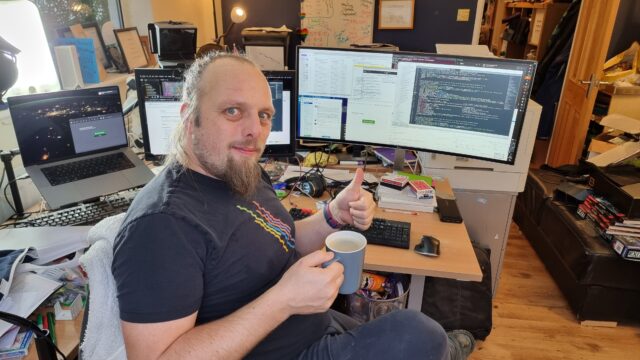
As I’m on sabbatical, I’m in the lucky position of being able to spend most of the day on a volunteer project very close to my heart: Three
Rings. Three Rings is a 22-year-old web-based service produced by volunteers, for volunteers. The software service we produce supports the efforts of around 60,000 volunteers
working at charities and other voluntary organisations around the globe.
I’ll be posting throughout the day about some of the different tasks I take on. My volunteer role with Three Rings is primarily a developer/devops one, but it takes all sorts to make a
project like this work (even if my posts look biased towards the technical stuff)!
“I was sincere! I wanted to tell you happy Birthday but I wanted to have AI do it.”
“Why?” I shot back, instantly annoyed.
“Because I didn’t know how to make it lengthy. Plus, it’s just easier.”
I felt as if I’d been punched in the gut. I just sat there, stunned. The last sentence repeating itself in my head.
It’s just easier. It’s just easier. It’s. Just. Easier.
…
Robert shares his experience of receiving a birthday greeting from a friend, that had clearly been written by an AI. The friend’s justification was because they’d wanted to make the
message longer, more easily. But the end result was a sour taste in the recipient’s mouth.
There’s a few things wrong here. First is the assumption by the greeting’s author (and perhaps a reflection on society in general) that a longer message automatically implies more care
and consideration than a shorter one. But that isn’t necessarily true (and it certainly doesn’t extend to artificially stretching a message, like you’re being paid by the word
or something).
A second problem was falling back on the AI for this task in the first place. If you want to tell somebody you’re thinking of them, tell somebody you’re thinking of them. Putting an LLM
between you and then introduces an immediate barrier: like telling your personal assistant to tell your friend that you’re thinking of them. It weakens the connection.
And by way of a slippery slope, you can imagine (and the technology has absolutely been there for some time now) a way of hooking up your calendar so that an AI would
automatically send a birthday greeting to each of your friends, when their special day comes around, perhaps making reference to the last thing they wrote online or the last
message they sent to you, by way of personalisation. By which point: why bother having friends at all? Just stick with the AI, right? It’s just easier.
Ugh.
Needless to say: like Robert, I’d far rather you just said a simple “happy birthday” than asked a machine to write me a longer, more seemingly-thoughtful message. I care more about
humans than about words.
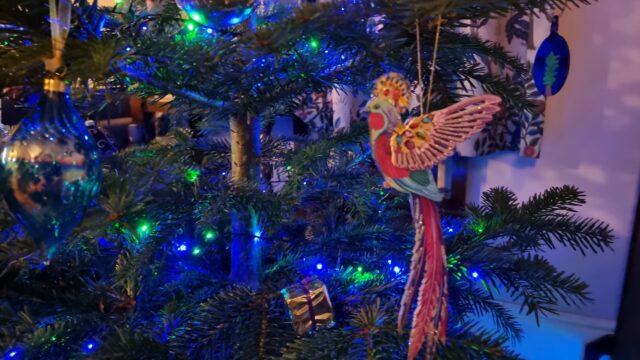
For a long time now, every year we’ve encouraged our two children (now 10 and 8 years old) to each select one new bauble for our Christmas tree1.
They get to do this at the shop adjoining the place from which we buy the tree, and it’s become a part of our annual Christmas traditions.
This approach to decoration: ad-hoc, at the whims of growing children, and spread across many years without any common theme or pattern, means that our tree is decorated in a way that
might be generously described as eclectic. Or might less-generously be described as malcoordinated!
But there’s something beautiful about a deliberately-constructed collection of disparate and disconnected parts.
I’m friends with a couple, for example, who’ve made a collection of the corks from the wine bottles from each of their anniversary celebrations, housed together into a strange showcase.
There might be little to connect one bottle to the next, and to an outsider a collection of used stoppers might pass as junk, but for them – as for us – the meaning comes as a
consequence of the very act of collecting.
Each ornament is an untold story. A story of a child wandering around the shelves of a Christmas-themed store, poking fingerprints onto every piece of glass they can find as they weigh
up which of the many options available to them is the most special to them this year.
And every year, at about this time, they get to relive their past tastes and fascinations as we pull out the old cardboard box and once again decorate our family’s strangely beautiful
but mismatched tree.
It’s pretty great.
Footnotes
1 Sometimes each has made a bauble or similar decoration at their school or
nursery, too. “One a year” isn’t a hard rule. But the key thing is, we’ve never since their births bought a set of baubles.
But meanwhile, I should show this post to my 8-year-old, who recently finished playing through a Kirby game and won’t stop talking about it. He might appreciate it, but perhaps in a
different way to me.
Not quite ready for wintering indoors, our village’s hardy sheep are enjoying pasturing in the large field near the school this beautiful but chilly morning.
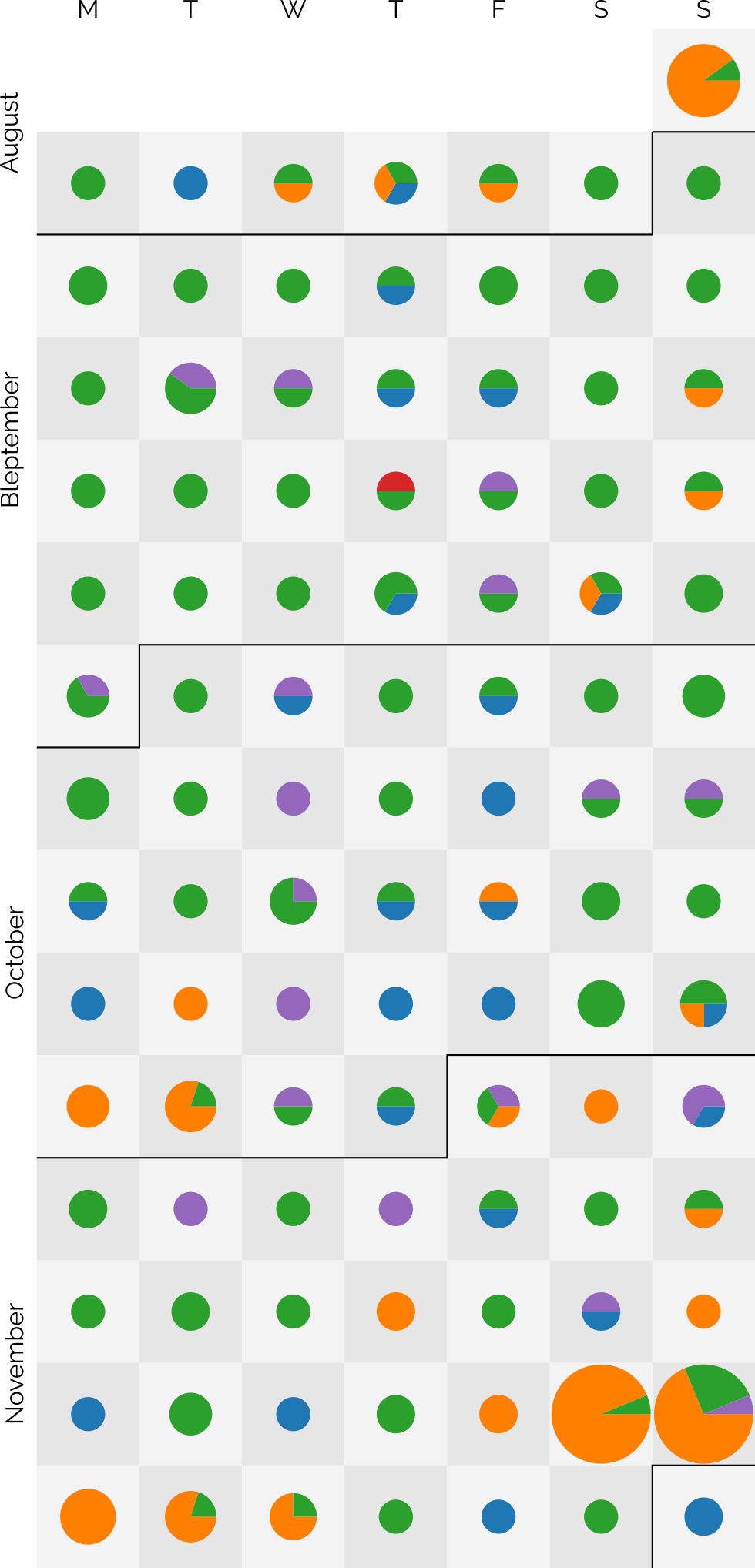
The dots are sized based on the number of posts and broken-down by post kind: articles are blue, notes are green, checkins are orange, reposts are purple, and replies are red3.
I didn’t set out with the aim of getting to a hundred4, as I might well
manage tomorrow, but after a while I began to think it a real possibility. In particular, when a few different factors came together:
Travel’s given me more opportunity for geocaching (and, this last week, geohashing), as reflected in my copious checkin logs for that period.
Earlier this year, inspired by Clayton Errington, I came up with a process to streamline my mobile blogging
“flow”5. I now use a custom
Progressive Web App to provide a better interface for quickly posting on-the-move to one or both of this blog and my personal Mastodon account,
which I tested heavily during Bleptember.
Previous long streaks have sometimes been aided by pre-writing posts in bulk and then scheduling them to come out one-a-day6.
I mostly don’t do that any more: when a post is “ready”, it gets published.
I didn’t want to make a “this is my 100th day of consecutive blogging” on the 100th day. That attaches too much weight to the nice round number. But I wanted to post to
acknowledge that I’m going to make it to 100 days of consecutive blogging… so long as I can think of something worth saying tomorrow. I guess we’ll all have to wait and see.
Footnotes
1 Given that I’ve been blogging for over 26 years, that I’m still finding noteworthy
blogging “firsts” is pretty cool, I think
2 My previous record “streak” was only 37 days, so there’s quite a leap there.
3 A massive 219 posts are represented over the last 99 days: that’s an average of over 2 a
day!
I was a small child the first time I got stuck in an elevator. I was always excited by lifts and the opportunity for button-pushing that they provided1,
and so I’d run ahead of my mum to get into a lift, at which point the doors closed behind me. The call button on the outside didn’t work for some reason, and I wasn’t tall enough to
reach the “open doors” button on the inside. As a result, I was trapped within the elevator until it was called from another floor.
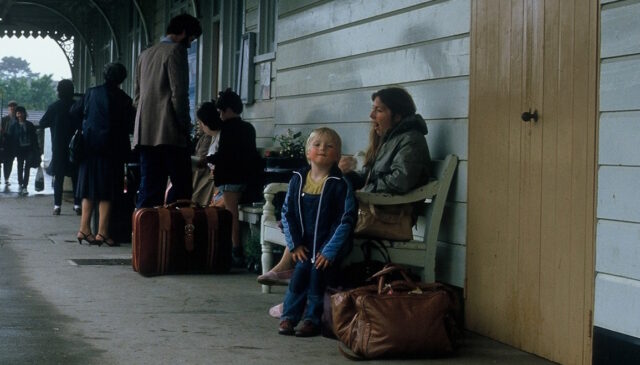
The lift I got stuck in as a child wasn’t here at Liskeard Station in Cornwall2.
This photo is just to provide a sense of scale about how small I once was.
That time as a small child is, I think, the only time I’ve been stuck in a lift as a result of my own incapability. But my most-memorable getting-stuck-in-a-lift was
without a doubt a result of my own stupidity.
How to brake break a lift
Y’see: it turns out that in some lifts, the emergency brakes are sensitive enough that even a little bit of a bounce can cause them to engage. And once they’re locked-on, the lift won’t
move – at all – until the brakes are manually released by an engineer.
As I discovered, way back in March 2004.
Contrary to what TV and movies will teach you, it’s actually incredibly difficult to make a lift “drop” down its shaft.
On behalf of Three Rings, I was speaking at the 2004 Nightline Association conference. While there,
I’d bumped into my friend Fiona, who was also attending the
conference3
The conference was taking place on the upper floor of the Manchester University Students Union building, and as the pair of us got into a lift down to the ground floor, I noticed
something strange.
“Woah! This lift is really spongy, isn’t it?” I asked, noticing how much the cabin seemed to bounce and sag as we stepped into it.
“Yeah,” said Fiona, shifting her weight to give it an experimental jiggle.
The elevator started to descend, and as it did so we both gave it another gentle bump, mostly (in my case at least) with an experimental mindset: did it only wobble so much when it was
stopped at a floor, or did it do it at all times?
It turns out it did so at all times. Except when it bounced between floors, as we were now, the emergency brakes detected this as a problem and locked on. The lift jerked to an
immediate halt. We were stuck.
I was reminded of my 2004 capture-by-a-lift in a dream the other night, which in turn was probably inspired by Ruth sharing with me her
recent experience of using a “smart” lift she found in Dublin.
We shouted for help from people passing on a nearby floor, and they were able to summon assistance from the lift’s maintenance company. Unfortunately, we were told, because it was a
weekend we’d likely have to wait around four hours before anybody could get to us, so we’d have to amuse ourselves in the meantime.
The first thing I learned about Fiona that day
That’s when I made the first of two discoveries that I would make, this day, about Fiona. I learned… that she’s mildly claustrophobic. Not enough to stop her from going into a lift, but
enough that when she knows she can’t get out of a lift, it’s likely to cause her a problem. I realised that I should try to find a way to distract her from our situation, so I
suggested a game.
“How about I-Spy?” I asked, half-jokingly, knowing that this game could surely not occupy us for long within the confines of a small metal box.
“Sure,” she agreed, “You go first.”
The Manchester University Student’s Union building. Image courtesy Peter
McDermott, used under a CC-By-SA license.
“I spy with my little eye… something beginning with… N!” I said. If we were going to be stuck here playing I-Spy for several hours, I might as well pick something deviously tricky.
Embedded into the corners of the floor were four recessed hexagonal nuts: my word was nut. That’d keep her occupied for a while.
I forget what she guessed and when, but she eventually guessed correctly. It probably took less than 5 minutes. Now it was her turn.
The second thing I learned about Fiona that day
Fiona thought for a little while, looking around our tiny prison for inspiration. Eventually, she’d found something:
“I spy with my little eye,” she said. Then, after a pause: “Something beginning with… S.”
“Screw?” I asked, assuming immediately that she’d have chosen something as devious as I’d thought mine was, and noticing that the button panel was secured with a quartet of recessed
flat-head screws. Nope, Fiona indicated.
“Shoes? Oh! Soles?” I suggested, pointing to the bottoms of my shoes, which were visible as I sat on the floor of the lift. Nope.
“Shirt? Socks?” I glanced at myself. I wasn’t sure there was much inside the lift that wasn’t me or Fiona, so it seemed likely that the thing I was looking for was on, or part of,
one of us.
“Step?” I gambled, indicating the metal strip that ran underneath the closed doors. No luck.
“Umm… shaft? Can you see part of the lift shaft somehow?” A smirk and an eye roll. I was getting further from the right answer.
It turns out there’s not much to I-Spy in a stopped elevator. “Six? Seven? No… wait… there aren’t that many floors in this building…”
“Ssss….sliding doors?” “Slit?” “Slot?” Still nothing.
This continued for… three… hours4.
Fiona sat, self-satisfied, smugly enjoying my increasing frustration right up until the point at which the lift engineer arrived and began levering open the doors on one of the two
floors we were between to allow us to wriggle our way out. I must’ve inspected every square centimetre of that tiny space, of myself, and of my gaming companion. Clearly I was alongside
the world grandmaster of I-Spy and hadn’t even known it.
“Okay, I give up,” I said, at last. “What the hell was it?”
Soon, I would make the second of the two discoveries I would make about Fiona that day. That she’s quite profoundly dyslexic.
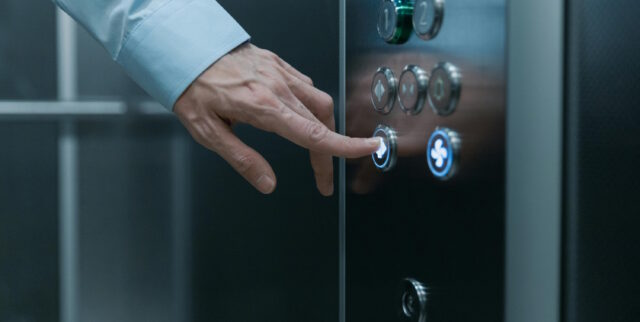
“Circle,” she said, pointing at the lit ring around the alarm button, which we’d pressed some hours before.
I don’t think it’s possible for a person to spontaneously explode. Because if it were, I’d have done so.
1 My obsession with button-pushing as a child also meant that it was hard to snap a photo
of me, because I always wanted to be the one to press the shutter button. I’ve written about this previously, if you’d like to see
examples of a photos I took as a toddler.
2 The photo is, specifically, Platform 3 of Liskeard Station, which is distinctly separate
from the other two platforms, requiring that you leave the main station and cross the road. This is a quirky consequence of the way this section of the Liskeard to Looe branch line was constructed, which necessitated entering Liskeard at
right angles to the rest of the station.
3 If I remember rightly, I first met Fiona on a bulletin board when she volunteered to
help test Three Rings. She later visited Aberystwyth where she and Kit – who was also helping with the project back in those days – fell in love. It was very sweet.
4 I’d love to say that the three hours flew by, but they didn’t. But it was still
infinitely preferable to being stuck in there alone. And, in fact, there are plenty of people for whom I’d have rather been stuck alone than stuck with.






 RSS
RSS Spotify
 Pocket Casts
 Apple Podcasts
 YouTube