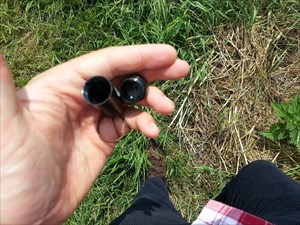
Suppose I have a pair of 15x zoom telescopes (for example, I separated a pair of 15x zoom binoculars) and laid them end-to-end. Naturally there’d be some loss of field-of-vision when
looking through them both. But would the resulting zoom level be 152 (i.e. 225x)? Or 15*2 (i.e. 30x)? Or something else entirely? Or am I oversimplifying?
As I indicated in my last blog post, my new blog theme has a “pop up” Dan in the
upper-left corner. Assuming that you’re not using Internet Explorer, then when you move your mouse cursor over it, my head will “duck” back behind the bar below it.
My head "pops up" in the top-left hand corner of the site, and hides when you hover your mouse cursor over it.
This is all done without any Javascript whatsoever: it’s pure CSS. Here’s how it’s done:
<divclass="sixteen columns"> <divid="dans-creepy-head"></div> <h1id="site-title"class="graphic">
<ahref="/"title="Scatmania">Scatmania</a>
</h1> <spanclass="site-desc graphic">
The adventures and thoughts of "Scatman" Dan Q
</span> </div>
The HTML for the header itself is pretty simple: there’s a container (the big blue bar) which contains, among other things, a <div> with the id
"dans-creepy-head". That’s what we’ll be working with. Here’s the main CSS:
The CSS sets a size, position, and background image to the <div>, in what is probably a familiar way. A :hover selector changes the style to increase the
distance from the top of the container (from -24px to 100px) and to decrease the height, cropping the image (from 133px to 60px – this was necessary
in this case to prevent the bottom of the image from escaping out from underneath the masking bar that it’s supposed to be “hiding behind”). With just that code, you’d have a perfectly
workable “duck”, but with a jerky, one-step animation.
The transition directive (and browser-specific prefix versions -o-transition, -webkit-transition, and -moz-transition, for compatability) are what
makes the magic happen. This element specifies that any ("all") style is changed on this element (whether via CSS directives, as in this case, or by a change of class or
properties by a Javascript function), that a transition effect will be applied to those changes. My use of "all" is a lazy catch-all – I could have specified the
individual properties ( top and height) that I was interested in changing, and even put different periods on each, but I’ll leave it to you to learn about CSS3 transition options for yourself. The 800ms is the
duration of the transition: in my case, 0.8 seconds.
I apply some CSS to prevent the :hover effect from taking place in Internet Explorer, which doesn’t support transitions. The "ie" class is applied to the
<html> tag using Paul Irish’s technique, so it’s easy to detect and handle IE users without loading separate
stylesheet files for them. And finally, in order to fit with my newly-responsive design, I make the pop-up head disappear when the window is under 780px wide (at which point there’d be
a risk of it colliding with the title).
That’s all there is to it! A few lines of CSS, and you’ve got an animation that degrades gracefully. You could equally-well apply transformations to links (how about making them fade in
or out, or change the position of their background image?) or, with a little Javascript, to your tabstrips and drop-down menus.
Geoff Major’s tweet about my dad reaching his destination.
So it was a really special moment to discover that, this weekend, my dad finally made it to the pole. My sisters and I had arranged that a portion of his cremated ashes would be
carried with the polar trek team and scattered at what must be one of the most remote places on Earth – the very top of the world. It’s nice to think that not even death was enough to
stop my dad from getting to the planet’s most Northernmost spot, even if he had to be carried for the last 600 miles.
My dad, “dressed for cold weather”, according to my sister.
Meanwhile, donations flooded in faster than ever to my dad’s fundraising page,
taking the grand total to over £12,000 – significantly in excess of the £10,000 he’d hoped to raise. My family and I are gobsmacked with the generosity of the people who’ve donated, and
incredibly grateful to them as well as to the team that took him on the last ten days of his journey to the Pole.
The fundraising total, according to JustGiving. A significant amount of money was also raised offline, via donations at or around my dad’s wake, and is not included in this
already-impressive total.
It pleases me that my dad gets to trespass somewhere he shouldn’t be, one last time: this time, breaking the international conventions that require that nothing gets “left” at the North
Pole. The remainder of my fathers ashes will be scattered by my sisters and I from the top of a particular mountain, as he’d sometimes said that he’d wanted.
And after all of these adventures, I think he deserves to get what he wants. With no apologies for the pun: he’s urn‘d it!
Well, it’s been over a year since I last updated
the look-and-feel of my blog, so it felt like it was time for a redesign. The last theme was made during a period that I was just recovering from a gloomy
patch, and that was reflected the design: full of heavy, dark reds, blacks, and greys, and it’s well-overdue a new look!
The old Scatmania design: very serious-looking, and with dark, moody colours.
I was also keen to update the site to in line with the ideas and technologies that are becoming more commonplace in web design, nowadays… as well as using it as a playground for some of
the more-interesting CSS3 features!
This new design has elements in common with the theme before last: a big blue header, an off-white background, and sans-serif faces.
Key features of the new look include:
A theme that uses strong colours in the footer and header, to “frame” the rest of the page content.
A responsive design that rescales dynamically all the way from a mobile phone screen through tablets, small 4:3 monitors, and widescreen ratios (try
resizing your browser window!).
CSS transitions to produce Javascript-less dynamic effects: hover your cursor over the picture of me in the header to make me “hide”.
CSS “spriting” to reduce the number of concurrent downloads your browser has to make in order to see the content. All of the social media icons, for
example, are one file, split back up again using background positioning. They’re like image maps, but a million times less 1990s.
Front page “feature” blocks to direct people to particular (tagged) areas of the site, dynamically-generated (from pre-made templates) based on what’s
popular at any given time.
A re-arrangement of the controls and sections based on the most-popular use-cases of the site, according to visitor usage trends. For example, search
has been made more-prominent, especially on the front page, the “next post”/”previous post” controls have been removed, and the “AddToAny” sharing tool has been tucked away at the
very bottom.
[spb_message color=”alert-warning” width=”1/1″ el_position=”first last”]Note that some of these features will only work in modern browsers, so Internet Explorer users might be out of
luck![/spb_message]
As always, I’m keen to hear your feedback (yes, even from those of you who subscribe by
RSS). So let me know what you think!
Since my dad’s funeral, a little over a month ago, I’ve been responsible – as executor of his will – for
leading the efforts to deal with the distribution of his estate. By necessity of the complexity of the case, we’ve had to draft some friendly lawyers, but there’s still been an awful
lot to be taken care of by my sisters, my mother, my dad’s partner, and I, among others. Some bits have been easier than others.
TV Licensing, for example, have been particularly useless, as evidenced by this cheque.
Standard Life‘s pensions department, for example, made my dealings with them very easy: they explained exactly what
they needed from me, exactly what they’d do with it, and how quickly they could act upon it. TV Licensing, on the other
hand, seem to be working against me rather than for me, issuing me a cheque made out as it is to “Executor of MR P HUNTLEY”, which was subsequently rejected by my bank on account of
being in the name of nobody at all. I suppose I could easily change my
name in order to accept that cheque, but that seems like the wrong solution. Plus I’ve always felt like more of a “Dan” than an “Executor”.
For some reason, my dad kept his copy of the (rather thick) book “Internet Explorer 4 At A Glance”; a book whose necessity I would have questioned even back in 2001, when it was
published.
I’ve begun packing up the contents of my dad’s house, too, so that they can be meaningfully distributed to whoever ought to have them. This leads to an inevitable clash, of course,
between the lawyers and the local council. The former want us to remove as little as possible before they can appraise the value of the contents, which is relevant to the assessment of
inheritance tax. The latter demand that the house be left unfurnished so that it does not become liable for council tax. In order to walk the fine line between the two I’ve been
packaging things up based on their types: his vast library of transport books in these boxes, etc. And despite great efforts (such as the work it took to disassemble the rusty
old trampoline in the back garden), it still feels like there’s a long, long, long way to go.
There’s a difference between having understanding and compassion for the men who are trapped in the Box and cutting them slack. After all, it isn’t as if the dude in the Box is giving
any slack to women, queers, transgender or genderqueer folks, or for that matter, heterosexual cisgender men who refuse to pretend to be Real Men. And cutting men slack is another way
of coddling them instead of helping them learn to let go of the Box and discover the freedom that comes from being who you are. Having compassion without coddling people is fierce.
It’s powerful. And it requires the ability to hold onto both the fact that the Box hurts us all and that it gives heterosexual cisgender men privilege.
I’ve been a vegetarian for a year
and a bit, now, and it’s not significantly easier than it was to begin with. There are lots of meats that I miss. And there are some meats that I expected to miss, that I don’t. Here’s
my experience:
This is how my subconscious communicates with me, too. Click for the original comic.
The things I miss the most:
Fish finger sandwiches. I know they’re not to everybody’s taste, but these things are just delicious.
Chicken in convenient things. What do you mean, I can’t have the dupiaza unless it’s with chicken? You do other dishes with vegetables!
Having a wide variety of choice. If I grab myself a lazy pre-made sandwich from the supermarket, my choices are – at best – limited to cheese-and-tomato or egg mayo.
There are plenty of great veggie sandwich fillings: like falafel and hummus, roasted peppers, brie and pickle, curried tofu and lettuce, carrot and rocket, or even QuornTM. But I’ve had to get used
to many supermarkets giving me a choice of one or two (and this is also the case in a shocking number of restaurants, too).
This is the fourth time I’ve used this photo on my blog, and it isn’t getting any easier. Man, that’s a tasty-looking sandwich.
And things I don’t miss as much as I expected to:
Bacon. I’ve had the ocassional craving for crispy, well-done bacon. This is odd, because as a meat-eater I generally preferred my bacon barely cooked at all. But I’ve
not missed bacon as much as I’d feared, and that’s great, because JTA‘s still liable to cook it, and the smell
might otherwise have been intolerable.
Steak. I occasionally feel like I’m missing out, but this is more-often because I’m stuck with a limited choice on a restaurant menu than that the steak in itself
looked particularly tasty. I guess I wasn’t as attached to lumps of beef or mutton as I suspected!
Cooking with meat. I expected to have some difficulties here: I cook a variety of different things, some of them well. And of those, the vast majority had a meat
component. Meat-substitutes aren’t always suitable (even where they are adequate), so I’ve had to discover a stack of new things that I can put together in the kitchen. But this
turned out to be simpler than I thought… perhaps in part thanks to the number of vegetarians I’ve lived with or dated over the years.
The webcomic-o-sphere loves bacon. Click for the original comic.
So there we go. There are things I miss more than I thought, and there are things I’ve missed less. And there’s not a particularly strong pattern between them.
If you’ve restricted your diet (e.g. by choosing to be vegetarian), what do you miss? Or if you haven’t, what do you think you’d miss the most? I think we all know how Adam feels, at least…
On this day in 2040 I first managed to get my Internet Time Portal working. It’s been a long time coming, but my efforts have
finally paid off. The trick was just to run The Wayback Machine in reverse, which just
required the integration of my flux capacitor with the webserver. Thankfully, Apache 5‘s plugin architecture’s
made it pretty easy, but I’ve already talked about how time-travel/webserver integration works back in my blog posts at the end of 2039, so I won’t bore you with them all again.
Despite what I said about password security back in 2011, I
haven’t actually changed the password for my blog in 28 years, so it was the obvious target for my first reverse-websurfing experiment. That’s why past-me will be surprised to find this
article posted to his blog, now that I’ve connected back in time and posted it. And I know he’ll be surprised, because I was.
In fact, it was probably this moment – this surprising moment back in April 2012 – that first made me realise that reverse-chronological web access was possible. That’s why I spent most
of the next three decades cracking the secret and finally working out a way to send information back in time through the Internet.
Looking Back
There’s so much potential for this new technology. I’m hoping that soon the technology will evolve to the point where I’ll even be able to use ancient and outdated Internet protocols
like “Facebook” (remember that fad?) to actually communicate directly with the people of the early 21st century. Just think of what we can learn from them!
After the second coming of Jesus in 2028 resulted in the deletion the mysterious “Video R” from the entire Internet, as well as from the minds of everybody on Earth, we’ve only been able to speculate what this
mysterious media contained. Whatever it was, it was something so offensive to our Lord and Saviour that He saw fit to wipe it from the face of the Earth… but you can’t help but be
curious, can’t you? Of course, those of you reading this back in 2012 can still see the video, you lucky lucky guys.
The possibilities are limitless. As soon as I’ve finished making this post, I’ll be trying to make contact with the past version of myself and see if past-Dan is capable of looking up
this Wikipedia article for me: for some reason I can’t get access to it now, in 2040…
This blog post is part of the On This Day series, in which Dan periodically looks back on
years yet to come.
It’s like stepping back in time through videogaming history. And also sideways, into a parallel universe of knights and dragons.
8-bit Google Maps. At different view levels, you’ll see mountainous areas (Wales is worth looking at) and sprites for cities of different sizes.
It’s like Google Maps, but in the style of retro top-down, turn-based RPGs. It’s really quite impressive: it’s presumably being generated at least semi-dynamically (as it covers the
whole world), but it’s more than a little impressive. It sometimes makes mistakes with rivers – perhaps where their visibility from the air is low – but nonetheless an
interesting feat from a technical perspective.
Commissioned, a webcomic I’ve been reading for many years now, recently made a couple of observations on the nature of “fetch quests” in contemporary computer
role-playing games. And naturally – because my brain works that way – I ended up taking this thought way beyond its natural conclusion.
Today’s children are presumably being saturated with “fetch quests” in RPGs all across the spectrum from fantasy Skyrim-a-likes over to modern-day Grand Theft Auto clones and science fiction Mass Effect-style video games. And the little devil on my left shoulder asks me how this can be manipulated for fun
and profit.
A typical fetch quest, taken to an illogical extreme. It's only a matter of time until you see this in a video game.
The traditional “fetch quest” goes as follows: I’ll give you what you need (the sword that can kill the monster, the job that you need to impress your gang, the name of the star that
the invasion fleet are orbiting, or whatever), in exchange for you doing a delivery for me. Either I want you to take something somewhere, or I want you to pick something up, or – in
the most overused and thankfully falling out of fashion example – I want you to bring me X number of Y object… 9 shards of triforce, 5 orc skulls, $10,000, or whatever. Needless to say,
about 50% of the time there’ll be some kind of challenge along the way (you need to steal the item from a locked safe, you’ll be offered a bribe to “lose” the item, or perhaps you’ll
just be mobbed by ninja robots as you ride along on your hypercycle), which is probably for the best because it’s the only thing that adds fun to role-playing a postman. I
wonder if being attacked by mage princes is something that real-life couriers dream about?
This really doesn’t tally with normality. When you want something in the real world, you pay for it, or you don’t get it. But somehow in computer RPGs – even ones which allegedly try to
model the real world – you’ll find yourself acting as an over-armed deliveryman every ten to fifteen minutes. And who wants to be a Level 38 Dark Elf
Florist and Dog Walker?
YAFQ.
So perhaps… just perhaps… this will begin to shape the future of our reality. If the children of today start to see the “fetch quest” as a perfectly normal way to introduce
yourself to somebody, then maybe someday it will be socially acceptable.
I’m going to try it. The next time that somebody significantly younger than me looks impatient in the queue for the self-service checkouts at Tesco, I’m going to offer to let them go in
front of me… but only if they can bring me a tin of sweetcorn! “I can’t go myself, you see,” I’ll say, “Because I need to hold my place in the queue!” A tin of sweetcorn may
not be as impressive-sounding as, say, the Staff of Fire Elemental Control, but it gets the job done. And it’s one of your five-a-day, too.
Or when somebody asks me for help fixing their broken website, I’ll say “Okay, I’ll help; but you have to do something for me. Bring me the bodies of five doughnuts, to
prove yourself worthy of my assistance.”
You just can’t rely on GMail’s “contacts” search any more. Look what it came up with:
Not a result I'd commonly associate with the word "virgin".
With apologies to those of you who won’t “get” this: the person who came up in the search results is a name that is far, far away, in my mind, from the word “virgin”.
In not-completely-unrelated news, I use a program called SwiftKey X on my phone, which uses Markov chains (as I’ve described before) to
intelligently suggest word completion and entire words and phrases based on the language I naturally use. I had the software thoroughly parse my text messages, emails, and even this
blog to help it learn my language patterns. And recently, while writing a text message to my housemate Paul, it suggested
the following sentence as the content of my message:
I am a beautiful person.
I have no idea where it got the idea that that’s something I’m liable to say with any regularity. Except now that it’s appeared on my blog, it will. It’s all gone a little recursive.
I’ve just come across a product called SonicNotify, and I’m wracking my brain to try to find a way to see it as a good idea.
I’m struggling.
SonicNotify. You spray red noise into your audience, and their phones become infuriating. Or something.
The world is just coming to terms with spatial advertising and services that “link” to their mobile devices. I’ve quite enjoyed playing with QR codes, but there are plenty of other
mechanisms enjoying some amount of exposure, such as Bluejacking: in the early days of Bluetooth, some advertisers experimented with devices that would push out Bluetooth
messages to anybody who strayed within range. Now that most Bluetooth devices capable of receiving such messages “switch off” Bluetooth after a couple of minutes, they need to be
coupled with a visual medium that says, for example, “turn on Bluetooth to get our business card”, or something, which is slightly less insidious.
SonicNotify works by having a smartphone app that passively listens for high-frequency sound waves, which act as carriers to the marketing message. These messages can be broadcast at
live events over existing PA systems, embedded in traditional media like radio or television, or transmitted from localised devices concealed in billboards or alongside products on
shelves. Lady Gaga tried it out in a concert, in order to – I don’t
know – distract her fans from actually listening to the music by giving them things to play with on their phones, instead.
Buy Doritos? I never would have thought of that on my own! Thanks, SonicNotify!
Let’s stop for a moment and think about everything that’s wrong with this idea:
I have to install a closed-source third-party app that runs in the background and keeps my microphone open at all times? We’ve got a name for that kind of device: a
bug.
This app would presumably need to run the whole time, reducing battery lifespan and consuming clock cycles… and for what? So that I can see more advertisements?
Thinking about the technology – I’m not convinced that mobile phone microphones are well-equipped to be able to pick up ultrasonic waves with any accuracy, especially not once
they’re muffled in a bag or trouser pocket. I can’t always even hear my phone ringing when it’s in my pocket, but it expects to be able to hear something “ringing” some distance away?
For that matter: television and radio speakers, and existing PA systems, aren’t really designed to be able to faithfully reproduce ultrasound, either. Why would they? A good
entertainment system is one which sounds best at all of the frequencies that humans can hear. Anything else is useless.
And let’s not forget that different people have different hearing ranges. Thinking back to the controversies surrounding anti-youth alarm The Mosquito: do you really want to be surrounded by sharp,
tinnitus-like noises just on the cusp of your ability to hear them?
No thank you, SonicNotify. I don’t think there’s mileage in this strange and quirky product idea.
scatmania.org in August 2003, showing off the simplistic look it had before it was deleted.
Since then, I’ve kept regular backups. A lot of the old stuff is sometimes cringeworthy (in a “did I really used to be such a dick?” way), and I’m sure that someday I’ll
look back at my blog posts from today, too, and find them shockingly un-representative of me in the future. That’s the nature of getting older.
Nostalgia’s awesome, which I choose to represent with this photo of me and my parents on a hilltop somewhere. You have permission to “aww”.
But it’s still important to me to keep all of this stuff. My blog is an extension to my diary: the public-facing side of what’s going on in my life. I back-link furiously, especially in
the nostalgia-ridden “On This Day” series of blog posts I throw out once in a while.
If you remember my blog when it used to look like this, back in the late 1990s, then you’ve been following me than longer than most folks have been on the Web at all.
The blog posts I’ve newly recovered are:
Parcel of Goodies(1st December 2003), in which I get some new jeans and announce an upcoming Chez Geek Night (the
predecessor to what eventually became Geek Night) at the Ship & Castle
AbNib & Str8Up (2nd December 2003), in which I apologise for Abnib being down and perv over hot young
queer people
The Software Engineers Behind My Alarm Clock(3rd December 2003), containing my complaints about the
engineering decisions behind my clock, which woke me up too early in the morning
Something In The Water(10th December 2003), talking about several of the new romantic releationships that have appeared
amongst my friends – of these, the one that had surprised me the most is the one that lasts to this day
Andy & Sian, the adorable couple who I declared “most surprising” of the new relationships to get underway late in 2003. The pair married in 2010.
Worst 100 Films Of All Time(10th December 2003): my observation about how many Police Academy movies made
it into the IMDb’s “bottom 100”
Gatecrashing(13th December 2003), in which I drop in uninvited on a stranger’s house party, and everything goes better than expected
Final Troma Night Of The Year(14th December 2003); a short review of 2003’s final Troma Night – at this point, we
probably had no idea that we’d have still been having Troma Nights for seven more years