Category: Personal
Intercepting HTTPS Traffic from Android Emulator
Mostly for my own benefit, as most other guides online are outdated, here’s my set-up for intercepting TLS-encrypted communications from an emulated Android device (in Android Emulator) using Fiddler. This is useful if you want to debug, audit, reverse-engineer, or evaluate the security of an Android app. I’m using Fiddler 5.0 and Android Studio 2.3.3 (but it should work with newer versions too) to intercept connections from an Android 8 (Oreo) device using Windows. You can easily adapt this set-up to work with physical devices too, and it’s not hard to adapt these instructions for other configurations too.

1. Configure Fiddler
Install Fiddler and run it.
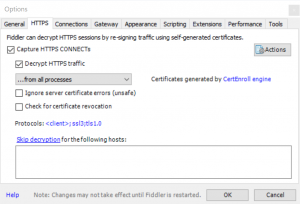
Under Tools > Options > HTTPS, enable “Decrypt HTTPS traffic” and allow a root CA certificate to be created.
Click Actions > Export Root Certificate to Desktop to get a copy of the root CA public key.

On the Connections tab, ensure that “Allow remote computers to connect” is ticked. You’ll need to restart Fiddler after changing this and may be prompted to grant it additional permissions.
If Fiddler changed your system proxy, you can safely change this back (and it’ll simplify your output if you do because you won’t be logging your system’s connections, just the Android device’s ones). Fiddler will complain with a banner that reads “The system proxy was changed. Click to reenable capturing.” but you can ignore it.
2. Configure your Android device

Install Android Studio. Click Tools > Android > AVD Manager to get a list of virtual devices. If you haven’t created one already, create one: it’s now possible to create Android devices with Play Store support (look for the icon, as shown above), which means you can easily intercept traffic from third-party applications without doing APK-downloading hacks: this is great if you plan on working out how a closed-source application works (or what it sends when it “phones home”).
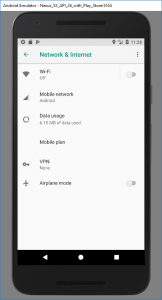 In
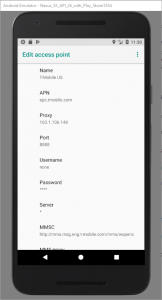
Android’s Settings > Network & Internet, disable WiFi. Then, under Mobile Network > Access Point Names > {Default access point, probably T-Mobile} set Proxy to the local IP
address of your computer and Port to 8888. Now all traffic will go over the virtual cellular data connection which uses the proxy server you’ve configured in Fiddler.
In
Android’s Settings > Network & Internet, disable WiFi. Then, under Mobile Network > Access Point Names > {Default access point, probably T-Mobile} set Proxy to the local IP
address of your computer and Port to 8888. Now all traffic will go over the virtual cellular data connection which uses the proxy server you’ve configured in Fiddler.
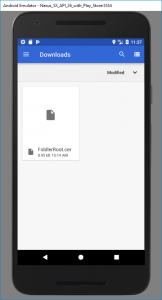
Drag the root CA file you exported to your desktop to your virtual Android device. This will automatically copy the file into the virtual device’s “Downloads” folder (if you’re using a physical device, copy via cable or network). In Settings > Security & Location > Encryption & Credentials > Install from SD Card, use the hamburger menu to get to the Downloads folder and select the file: you may need to set up a PIN lock on the device to do this. Check under Trusted credentials > User to check that it’s there, if you like.
Test your configuration by visiting a HTTPS website: as you browse on the Android device, you’ll see the (decrypted) traffic appear in Fiddler. This also works with apps other than the web browser, of course, so if you’re reverse-engineering a API-backed application encryption then encryption doesn’t have to impede you.
3. Not working? (certificate pinning)
A small but increasing number of Android apps implement some variation of built-in key pinning, like HPKP but usually implemented in the application’s code (which is fine, because most people auto-update their apps). What this does is ensures that the certificate presented by the server is signed by a certification authority from a trusted list (a trusted list that doesn’t include Fiddler’s CA!). But remember: the app is running on your device, so you’re ultimately in control – FRIDA’s bypass script “fixed” all of the apps I tried, but if it doesn’t then I’ve heard good things about Inspeckage‘s “SSL uncheck” action.
Summary of steps
If you’re using a distinctly different configuration (different OS, physical device, etc.) or this guide has become dated, here’s the fundamentals of what you’re aiming to achieve:
- Set up a decrypting proxy server (e.g. Fiddler, Charles, Burp, SSLSplit – note that Wireshark isn’t suitable) and export its root certificate.
- Import the root certificate into the certificate store of the device to intercept.
- Configure the device to connect via the proxy server.
- If using an app that implements certificate pinning, “fix” the app with FRIDA or another tool.
The Web That Never Was
This is a repost promoting content originally published elsewhere. See more things Dan's reposted.
Underappreciated video presentation on how only a few small changes to the timeline of the Internet and early Web results in a completely different set of technologies and companies becoming dominant today. Thought-provoking.
Gaia
This is a repost promoting content originally published elsewhere. See more things Dan's reposted.
Saturday Morning Breakfast Cereal –

Geohashing expedition 2018-08-04 51 -1
This checkin to geohash 2018-08-04 51 -1 reflects a geohashing expedition. See more of Dan's hash logs.
Location
Looks to be deep in the bushes alongside the unnamed road that connects Kidlington Road (to Islip), the sliproad exiting the A34 Southbound, and Bicester Road (in Kidlington).
Participants
Plans
The nearest road is about 10 minutes cycle from my (Dan Q) house, so I plan to zip out there either overnight (perhaps aiming for a Midnight Geohash?) or early in the morning. If you happen to plan to hit this hashpoint too, though, let me know and I can try to synchronise plans (but I ought to be spending the day studying, so I might not be able to!).
Expedition
At 2018-08-03 23:02 (BST – local time) I started packing a bag and set out to the hashpoint. Suddenly it didn’t seem like such a good idea as it had in the warm sunlight, earlier: a dark and moonless night isn’t the best time to be cycling along unlit roads. But fully-equipped with lights and supplies, I set out nonetheless. I’d left longer than I needed and had about a quarter of an hour sitting by the side of the road before midnight came and I was able to visit the hashpoint (thereby gaining my Midnight Achievement).
Photos







Dan Q posted a note for GC6P6WR Pub Quiz
This checkin to GC6P6WR Pub Quiz reflects a geocaching.com log entry. See more of Dan's cache logs.
I just received a message from user LesHommesSauvages who’re so close to solving this puzzle. Here’s hoping that the mild hint I gave them about which digit they’d gotten wrong is enough to have their “Found it” message be the next log on this cache!
Quantum Key Distribution Whitepaper
This is a repost promoting content originally published elsewhere. See more things Dan's reposted.
This white paper describes our current position on quantum key distribution (QKD). QKD is an approach to key distribution that relies on the properties of quantum mechanics to provide security.
…
For all the practical, business and security reasons given above, at this point in time we:
- do not endorse QKD for any government or military applications
- advise against replacing any existing public key solutions with QKD for commercial applications
The UK should continue its research and development of QKD systems. But this should be balanced by a growing body of practical QKD vulnerability research, and accompanied by the development of methods for quantifying and validating the security claims of real-world QKD systems. Responsible innovation should be accompanied by independent validation.
…
Wise words from the NCSC here:while QKD continues to depend upon conventional components that often lack battle-testing they may have vulnerabilities. Furthermore, current implementations of quantum cryptography fail to address the bigger and harder problems of authentication and identity – key distribution, while not perfectly solved, is still something that we understand very well… and many real-world attacks target other parts of the process (which QKD does not seek to solve).
Are movies getting longer?
This is a repost promoting content originally published elsewhere. See more things Dan's reposted.
Either I’m getting older or movies are getting longer… and longer … and longer. So which is it? I took a look at the numbers. I studied the running time of the top 100 US-grossing films since 1994 (2,200 films in total) and all films shot in the UK 2005-14 (2,142 films). In summary… The median length of …
Either I’m getting older or movies are getting longer… and longer … and longer. So which is it? I took a look at the numbers.
I studied the running time of the top 100 US-grossing films since 1994 (2,200 films in total) and all films shot in the UK 2005-14 (2,142 films). In summary…
- The median length of a top 100 US-grossing films between 1994 and 2015 was 110 minutes
- Running times have increased in six of the past seven years
- The longest films are historical and western films and the shortest are animations and documentaries.
- Peter Jackson makes the longest movies in Hollywood, with a median running time of 169 minutes.
- The median running time of UK feature films (2008-14) was 94 minutes.
- Films with lower budgets have shorter running times
- The complete extended Lord of the Rings and Hobbit trilogies are a combined 21 hours long
…
It’s reassuring to read that I wasn’t the only one to observe this trend in filmmaking, and to find that somebody else had done the research to save me from feeling the need to do so myself! The full article also makes a number of other interesting observations; worth a read.
The Bullshit Web
This is a repost promoting content originally published elsewhere. See more things Dan's reposted.
My home computer in 1998 had a 56K modem connected to our telephone line; we were allowed a maximum of thirty minutes of computer usage a day, because my parents — quite reasonably — did not want to have their telephone shut off for an evening at a time. I remember webpages loading slowly: ten […]
My home computer in 1998 had a 56K modem connected to our telephone line; we were allowed a maximum of thirty minutes of computer usage a day, because my parents — quite reasonably — did not want to have their telephone shut off for an evening at a time. I remember webpages loading slowly: ten to twenty seconds for a basic news article.
At the time, a few of my friends were getting cable internet. It was remarkable seeing the same pages load in just a few seconds, and I remember thinking about the kinds of the possibilities that would open up as the web kept getting faster.
And faster it got, of course. When I moved into my own apartment several years ago, I got to pick my plan and chose a massive fifty megabit per second broadband connection, which I have since upgraded.
So, with an internet connection faster than I could have thought possible in the late 1990s, what’s the score now? A story at the Hill took over nine seconds to load; at Politico, seventeen seconds; at CNN, over thirty seconds. This is the bullshit web.
But first, a short parenthetical: I’ve been writing posts in both long- and short-form about this stuff for a while, but I wanted to bring many threads together into a single document that may pretentiously be described as a theory of or, more practically, a guide to the bullshit web.
A second parenthetical: when I use the word “bullshit” in this article, it isn’t in a profane sense. It is much closer to Harry Frankfurt’s definition in “On Bullshit”:
It is just this lack of connection to a concern with truth — this indifference to how things really are — that I regard as of the essence of bullshit.
I also intend it to be used in much the same sense as the way it is used in David Graeber’s “On the Phenomenon of Bullshit Jobs”:
In the year 1930, John Maynard Keynes predicted that, by century’s end, technology would have advanced sufficiently that countries like Great Britain or the United States would have achieved a 15-hour work week. There’s every reason to believe he was right. In technological terms, we are quite capable of this. And yet it didn’t happen. Instead, technology has been marshaled, if anything, to figure out ways to make us all work more. In order to achieve this, jobs have had to be created that are, effectively, pointless. Huge swathes of people, in Europe and North America in particular, spend their entire working lives performing tasks they secretly believe do not really need to be performed. The moral and spiritual damage that comes from this situation is profound. It is a scar across our collective soul. Yet virtually no one talks about it.
[…]
These are what I propose to call ‘bullshit jobs’.
What is the equivalent on the web, then?
…
This, this, a thousand times this. As somebody who’s watched the Web grow both in complexity and delivery speed over the last quarter century, it apalls me that somewhere along the way complexity has started to win. I don’t want to have to download two dozen stylesheets and scripts before your page begins to render – doubly-so if those additional files serve no purpose, or at least no purpose discernable to the reader. Personally, the combination of uMatrix and Ghostery is all the adblocker I need (and I’m more-than-willing to add a little userscript to “fix” your site if it tries to sabotage my use of these technologies), but when for whatever reason I turn these plugins off I feel like the Web has taken a step backwards while I wasn’t looking.
Challenge Robin
Do you remember Challenge Anneka? It aired during the late 1980s and early 1990s and basically involved TV presenter Anneka Rice being dropped off somewhere “random” and being challenged to find and help people in sort-of a treasure-trail activity; sort of a game show but with only one competitor and the prizes are community projects and charities. No? Doesn’t matter, it’s just what I was thinking about.

Ruth‘s brother Robin is doing a project this year that he calls 52 Reflect (you may recall I shared his inaugural post) which sees him leaving London to visit a different place every weekend, hike around, and take some photos. This last weekend, though, he hadn’t made any plans, so he came up to Oxford and asked us to decide where he went: we were to pick a place between 10 and 15 miles away, blindfold him, and drop him off there to see if he could find his way home. Naturally he’d need to be deprived of a means of navigation or communication, so we took his phone, and to increase the challenge we also took his wallet, leaving him with only a tenner in case he needed to buy a packet of crisps or something.

After much secretive discussion, we eventually settled on N 51° 50.898′, W 001° 28.987′: a footpath through a field in the nothingness to the West of Finstock, a village near the only-slightly-larger town of Charlbury. Then the next morning we bundled Robin into a car (with a blindfold on), drove him out to near the spot, walked him the rest of the way (we’d been careful to pick somewhere we believed we could walk a blindfolded person to safely), and ran quietly away while he counted to 120 and took off his blindfold.

I also slipped a “logging only” GPS received into his backpack so that we’d be able, after the fact, to extract data about his journey – distance, speeds, route etc.. And so when he turned up soaking wet on our door some hours later we could look at the path he took at the same time as he told us the story of his adventure. (If you’re of such an inclination, you can download the GPX file.)

For the full story of his adventure, go read Robin’s piece about it (the blog posts of his other adventures are pretty good too). Robin’s expressed an interest in doing something similar – or even crazier – in future, so you might be hearing more of this kind of thing.
Digest for July 2018
Summary
In July 2018, I did a little geocaching and shared an awesome Pride GIF and an old advert.
All posts
Posts marked by an asterisk (*) are referenced by the summary above.
Checkins
- Dan Q found GLWG7T19 Blind-House Lacock Revisited *
- Dan Q performed maintenance for GC7R0HB The Fairy Elevator
- Dan Q posted a note for GC54KVD Oxford Medical History #2: Grey matter
Reposts
Reposts marked with a dagger (†) include my comments or interpretation.
- AWOOOOO †
- Ambition
- Cyborg Time With Kimiko Ross †
- Why your brain never runs out of problems to find
- Happy Pride Month! †
- Test Your Awareness : Whodunnit? †
- Cropmarks 2018
- Frigid †
- The Alice and Bob After Dinner Speech †
- Einstein’s theory still passes the test: weak and strong gravity objects fall the same way †
- How To Play – Carcassonne †
- The Insane Story In The Background Of Arrested Development
AWOOOOO
This is a repost promoting content originally published elsewhere. See more things Dan's reposted.
AWOO AWOOOO. AWOO AWOO AWOO AWOOOOO. AWOO AWOO AWOO AWOOOO AWOO. AWOO AWOO AWOOOO AWOO AWOO AWOOOO. AWOO AWOO AWOO AWOOOOOO AWOO AWOOOOO. AWOO AWOO AWOOOOOOO AWOO AWOOO AWOO AWOOOO AWOO. AWOO AWOO AWOO AWOO AWOOOOO AWOO AWOO AWOO. AWOO AWOOOOOO AWOOOOOO AWOOOO AWOO AWOO AWOO AWOOOOOOO AWOO AWOOOOOO AWOO. AWOOOOOO AWOO AWOOOO AWOO AWOOOO AWOO AWOO. AWOO AWOO AWOO AWOOOOO AWOO AWOO AWOOOOO AWOO AWOOO AWOO. AWOOOO AWOOO AWOOOO AWOO AWOO. AWOOO AWOO AWOOO AWOO AWOO AWOO AWOOOOO AWOOOO AWOO AWOO AWOO. AWOOOOOO AWOO AWOO AWOOOOO AWOOOOO AWOO AWOO. AWOO AWOO AWOO AWOOOOOOOO. AWOO AWOO AWOO. AWOOOO AWOO AWOO AWOOOOOO AWOO AWOOOOO. AWOO AWOO AWOO AWOOOOOOOO AWOO AWOO AWOO AWOOOOO AWOO AWOO. AWOO AWOO AWOO AWOO. AWOO AWOOOOOO AWOOOOOO AWOOOOO AWOO AWOO AWOOOOOO AWOO AWOOOOOO. AWOOOOOO AWOO AWOO AWOOOOO AWOOOOO AWOO AWOO AWOO AWOO AWOOOOOO. AWOO AWOO AWOO. AWOOOOOOO. AWOO AWOO. AWOOO. AWOOOOO AWOO AWOO AWOO AWOO AWOO. AWOO! AWOO! AWOO! AWOO! AWOO! (AWOOOOO AWOO AWOOOO AWOOOO.) AWOOOO AWOO

AWOO AWOOOO. AWOO AWOO AWOO AWOOOOO.
AWOO AWOO AWOO AWOOOO AWOO. AWOO AWOO AWOOOO AWOO AWOO AWOOOO. AWOO AWOO AWOO AWOOOOOO AWOO AWOOOOO. AWOO AWOO AWOOOOOOO AWOO AWOOO AWOO AWOOOO AWOO.
AWOO AWOO AWOO AWOO AWOOOOO AWOO AWOO AWOO. AWOO AWOOOOOO AWOOOOOO AWOOOO AWOO AWOO AWOO AWOOOOOOO AWOO AWOOOOOO AWOO. AWOOOOOO AWOO AWOOOO AWOO AWOOOO AWOO AWOO. AWOO AWOO AWOO AWOOOOO AWOO AWOO AWOOOOO AWOO AWOOO AWOO. AWOOOO AWOOO AWOOOO AWOO AWOO.
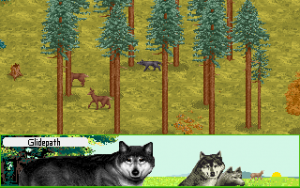
AWOOO AWOO AWOOO AWOO AWOO
AWOO AWOOOOO AWOOOO AWOO AWOO AWOO. AWOOOOOO AWOO AWOO AWOOOOO AWOOOOO AWOO AWOO. AWOO AWOO AWOO AWOOOOOOOO. AWOO AWOO AWOO. AWOOOO AWOO AWOO AWOOOOOO AWOO AWOOOOO. AWOO AWOO AWOO AWOOOOOOOO AWOO AWOO AWOO AWOOOOO AWOO AWOO.
AWOO AWOO AWOO AWOO. AWOO AWOOOOOO AWOOOOOO AWOOOOO AWOO AWOO AWOOOOOO AWOO AWOOOOOO. AWOOOOOO AWOO AWOO AWOOOOO AWOOOOO AWOO AWOO AWOO AWOO AWOOOOOO. AWOO AWOO AWOO. AWOOOOOOO. AWOO AWOO. AWOOO.
…
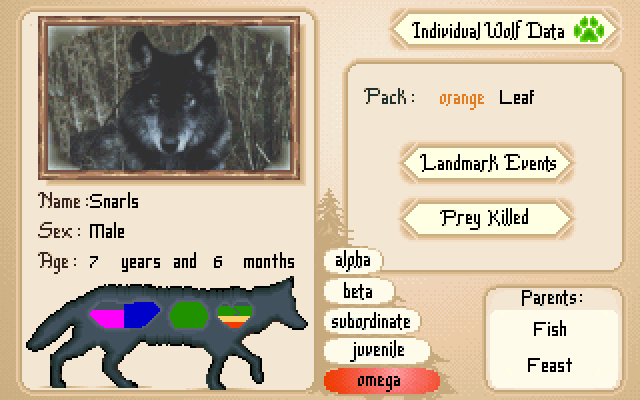
After The Obsuritory – a blog providing reviews of old and less-well-known video games – published a review of 1994’s Wolf, they followed-up with this additional review… written for a wolf.
The Internet is weird and hilarious.
Review of National Trust – Cliveden
This review of National Trust - Cliveden originally appeared on Google Maps. See more reviews by Dan.
Lovely country garden with knowledgeable staff. The hedge maze and the water gardens are especially nice.
Review of Royal National Hotel
This review of Royal National Hotel originally appeared on Google Maps. See more reviews by Dan.
Small rooms with no air conditioning. Noisy streets below. Fire alarm went off in the middle of the night but no explanation or apology given, just sent back to our rooms.
They were able to adjust my room booking at short notice, but that’s the best thing I can say about them.
Review of Isis Farmhouse
This review of Isis Farmhouse originally appeared on Google Maps. See more reviews by Dan.
Delightful riverside pub with great beer and good food. Only really accessible from the Thames Path and not by road, which personally feels like it adds up the magic but requires planning if you’re not used to this particular quirk!