Well, I’ve seen it all now. I’ve just been in a gents toilets in a shopping centre in Nottingham in which there was a poster advertising cheaper car insurance… for women.
Author: Dan Q
Another Strange Dream
Well, I’m in Derby (after a hideously long and complicated journey involving long train delays, diversions, and a taxi ride – lost – around the middle of Derby city centre) visiting my friend Katie.
And another strange dream for my collection. But this one isn’t suitable for print (no, not in that way), so you’ll have to wait and ask about it.
Back in Aber tomorrow afternoon. Have a great Troma Night 200!
Christmas Cards
[thanks to several people for the suggestion behind this post]
I’ve never really "got" the sending of Christmas cards, or, really, got "into" it. It feels like a waste of overpriced paper to line the pockets of big printing companies just to save you the bother of actually picking up the phone and talking to the people you care about over the holiday season. So I won’t be sending any. But read on.
If you would have liked a Christmas card from me (and I know you!), leave your name and e-mail address using the comments form for this post. In exchange, I’ll donate £1 to Samaritans of Aberystwyth and Mid-Wales (my local Samaritans branch) in your name. Plus a £25 ‘kitty’ in the names of you all.
Samaritans volunteers will be working round the clock on Christmas Eve, Christmas Day, New Year’s Eve, and New Year’s Day – just like every other day in the year – to provide emotional support to those who are suffering from feelings of distress or despair, including those which may lead to suicide. Christmas can be a difficult time for many people, and this vital service – provided by telephone, post, and e-mail, as well as by face-to-face contacts – can, for some, make all the difference.
Technical note: You’ll probably end up classified as blogspam if you leave an empty comment, so say something, even if it’s just "Merry Christmas!"
We’re Going Down
Another strange dream last night:
I was in a small aircraft (one aisle, two seats either side, about 80 seats in total, two jet engines, for those who feel the need to identify the aircraft in my dreams), sat by a window on the left hand-side, when the right-hand engine caught fire. The plane was forced to make an emergency water landing somewhere off the coast of India. The other passengers and I were all instructed to put on our life-jackets, fasten our seat belts, and brace for impact, but as the plane went down, I suddenly came to an understanding that we were all going to be okay. I took off my seatbelt and stood up moments before the plane hit the water, and (despite a little juddering) I was perfectly okay. Around me people were panicking, but I was completely calm.
Read into that whatever you like.
Suppose I’d better start my Christmas shopping, today.
A Quick Play With HTML5
I’ve been playing with HTML 5 a little this morning. It’s really quite fabulous: a lot of smart design decisions have been made and it looks like – given a good few years to get things up to scratch even after the specification has been finalised – it’ll really provide a lot of useful tools to help the web developers of tomorrow reach their goals more easily and in a more structured way.
I knocked up a quick test page to see how the code comes together, and, in particular, to play with the new sectioning elements that can be used to state what parts of the page have what purpose and what their relationship is to the rest of the document. So far, so good. Then I tried to style them.

Internet Explorer 7 didn’t really stand a chance, I suppose. Microsoft don’t have any plans to support either HTML 5 or XHTML 2 – an alternative language for the future web – and that probably won’t change until they think they’re losing browser market share over it. That’ll happen, perhaps, but much slower than they lost market share to Firefox over issues of speed and security: the media make a far bigger deal of computer security these days than they ever will about standards-compliance, because standards-compliance doesn’t sell newspapers.
So yeah; IE7 got all the content, at least, thanks to the fact that HTML 5 is backwards-compatible (in a way that XHTML 2 simply isn’t), and the page is just about understandable. But it wouldn’t allow CSS styles to be applied to any of the "new" tags it didn’t understand, so the page is quite a bit more simplistic that it should have been.

I’d expected more from the latest beta version of Mozilla Firefox – Mozilla are, along with Apple, perhaps the biggest supporters of HTML 5 as the future of the web. Unfortunately, I was mistaken.
Perhaps the majority of the HTML 5 support will come in a later release of Firefox – although it’d be nice it they supported at least the core, well-understood features in the final
release of Firefox 3. Yeah, yeah, I know they’ve started to implement support for things like <canvas> and stuff, but it’s hard to get excited about things that,
while cool, I’m just not likely to use.
Firefox understood that there was something to do with floating something in the <aside> element, but didn’t do a very good job of actually floating it, instead just
drawing a box where it might have put it if it understood it better. This is actually just slightly worse behavior than IE, which failed to understand but didn’t half-heartedly try to
interpret what it didn’t "get." Nonetheless, Firefox still rendered a readable, understandable page – good old backwards-compatibility, there.

Opera, as I’d have expected, excelled here. Opera’s support for emerging standards has always been impressive, and this was no exception, as it rendered the page almost exactly as I would have expected. It genuinely seems to understand the new sectioning elements provided by HTML 5 (although a later experiment has shown that this is possibly just because it will happily interpret CSS directives for unrecognised elements: however, this is a good future-proofing strategy for any browser – had Mozilla taken this approach, the majority of the page would have looked perfect in Firefox, too).
In short, we’re a long way from being able to use HTML 5 in any real way, and all the exciting things it’s bringing will have to wait for now. But I expect we’ll be seeing better and better compliance with the standard as the standard becomes more finalised next year and the geeks at the major browser manufacturers compete to have the coolest features first. My prediction? Lead by Opera, Safari, and Firefox (as well as Konquerer, which I gather is also likely to support HTML 5 early), we’ll start seeing usable snippets of some of the fun things the future of the web will bring us as early as next year, and Microsoft will – eventually – give in and implement them in Internet Explorer too.
In the meantime, it’s been fun to read through the current working draft specification for what I think is likely to be the more popular language of the next generation of the web. But that’s perhaps just because I’m the kind of person who enjoys reading specifications for fun.
Update: Two more browser snapshots (thanks Katie).

Camino, as you might expect, looks pretty much identical to Firefox.

Safari fares well, rendering the page in the same way as Opera did, seemingly understanding all of the elements perfectly.
Still Having Strange Dreams
Last night’s dream:
I visited the house of Simon [my boss] to collect £49.97 which, in my dream, he owed me. He and his wife, Jill, were there. Simon gave me a £50 note, but I didn’t have three pence in change, so I have him a five pence piece and he gave me two pennies.
Perhaps there’s something wrong with me.
High Places
Another unusual dream last night. I’d meant to blog about it earlier in the day, before it faded, but it’s been a ludicrously busy day with one thing and another and I didn’t get a chance. I slept kind-of fitfully, I think, and I’m pretty sure this dream came to me in two distinct chapters, because I remember details that I’d become aware of after falling asleep a second time, even though they applied to the dream I’d remembered after waking up for the first time during the night. Strange.
Claire and I were at Gregynog, just as we were last month, to help out with the Computer Science Department away weekend. Unusually, though, the majority of the guests were accommodated in tents scattered around the grounds of the hall, rather than in bedrooms in the building itself. We’d arrived early in the day, and had trouble persuading the staff that we were supposed to be there, and when we were finally able to drop off our bags we decided to wander into the nearby town [there isn’t actually a town for miles and miles around] and look around.
In need of some lunch, we got a taxi and asked for a lift to a cafe we’d heard about, but he took us to a beach. We walked along a rickety walkway (which had evidently been replaced recently, but not very well) laid over the beach, and it was hard to follow because it was becoming covered in sand, but we just about found our way, despite protests from Claire that we should try a different route. The beach opened up to a series of villas and some kind of tourist resort, and we realised that the taxi had dropped us off far further from the cafe than we had imagined.
We took a shortcut through a dry ski slope, and I remember walking across a very high open-sided bridge, which Claire again objected to.
I’m sure there were significant other bits to the dream, but I don’t remember them now. Strange stuff. Perhaps I need to relax a little and think less.
It’s Good To Be Me
It’s Sunday morning. I’ve just eaten a second crumpet, put some music on, and I’m working on writing some interesting program code for a project I’m involved with.
Ruth just challenged Claire to have a shower in less time than it takes her to go to the shops and buy some milk. Then made it more challenging by putting obstacles in her way, which she’s trying to negotiate while not flashing the neighbours through the windows – made challenging by the fact that she’s wearing my dressing gown, and it doesn’t have a belt.
JTA‘s just booted up the Nintendo Wii and is going to play a game of Super Paper Mario.
I comlpain about being busy, sometimes: about never having any free time. But I supopse that’s the way I like it. I wouldn’t wish it any other way.
Better get on with that code.
The Aber Masterplan
Have you seen the Aber Masterplan yet? The Welsh Development Agency/Welsh Assembly Government/Ceredigion County Council document that takes a SimCity-like approach to planning the future development of Aberystwyth.
No? You oughta. Here: download a copy [PDF].

It’s got some good bits. Re-routing some of the trunk roads to improve traffic flow and reduce dependence on the older, narrower roads through Llanbadarn and the town centre – good. Better use of Park & Ride schemes and a reorganisation of public transport – good. Reorganising parking spaces, making more space to park in the town centre and prioritising residents’ access to the parking spaces outside their houses – good. Better cycle lanes and cycleway connections – good. You see where I’m coming from.
And it’s got some… other bits. Moving the railway station quarter of a mile up the line and out of the town centre – not so good. Concrete everywhere – umm. Building a stadium – y’what?

The whole thing’s filled with buzzphrases, like “The overall concept for this area is to create a new piece of town commensurate with that achieved in the Victorian period.” But with a bit of work, it’s possible to cut through the cruft and get to the key points of the proposal. Here are some of the more fascinating segments:
- “Whilst a continuing University function for Old College is desirable, there are also possible complementary uses such as a high quality boutique hotel or art gallery.”
- “Park Avenue could be developed as a positive, integrated part of town if the railway station was moved east to an area adjacent to the Vale of Rheidol Station.”
- “Redeveloped football club site as high quality mixed use development developed on a grid pattern.”
- “Mill Street car park development comprised of multistorey car park and retail units.”
- “Redevelopment of cinema site.” (hint: it involves persuading the cinema to move elsewhere)
There’s a meeting open to the public in the WAG side of the Technium, on the marina, at 5:30 on Monday 10th December, so if you’d like to ask any questions about the plans, to enthuse or complain, or just to make your voice heard – in fact, if you have any opinion at all about these plans – you should come along and say your piece.
Further reading: Issue 10 of The Cambrian Snooze pokes fun at the Masterplan in it’s own way.
Badge Planet – design your own badges, keyrings and fridge magnets, buttons badg…
This is a repost promoting content originally bookmarked via del.icio.us. See more del.icio.us imports or more things Dan's reposted.
Oh, And My Sisters Are Black
Strange dream last night. I only remember fragments of it, but here’s what I do:
At some point during it, I left work at lunchtime to visit my dad and my sisters (who lived, conveniently, within walking distance of work). I bought a bag of sherbert along the way, but I was disappointed with how clumpy it was. I met my sisters – Sarah and Becky – on the way to my dad’s house, and Becky told me that she’s just got a job working at a chain bakery (a Greggs-like place) conveniently situated at the end of my dad’s road. Sarah teased Becky about the low level of skill required to do her job, and they argued. Oh, and both Sarah and Becky were black – I’m not sure how that’s relevant, it wasn’t important in the dream, I don’t think, and in fact it’s only now, thinking back over the dream, that I’ve noticed that that’s a little unusual.
In any case; when we got to my dad’s (and I’d almost finished my bag of sherbert) he tried to persuade me that I needed to start running up and down a hill in order to get into training for some kind of event, but I pointed out that I needed to get back to work, so I left.
When I got back to work, the caterers were carrying some kind of large soup pan and a ladle along the corridor to the kitchen on our floor.
The creepy bit of this is that when I got to work this morning and popped my head into the kitchen opposite our office, there is a large soup pan in there. It’s a fair bit smaller than the one in my dream, but it’s in the same style. Weird.
Interpretations welcome, as usual, but don’t expect to make sense of me.
Reactions To The Unholy Alliance
 Here’s a blog
post I’ve been meaning to write for several months now: it’s about some of the varied and different ways that people reacted to the news that Ruth and I were together, and that Claire and JTA
were also a couple (and, of course, Ruth and JTA are still the fabulous pair they always were, and Claire and I are still ticking along nicely with the wonderful relationship that we
have). There probably aren’t many people who’ll read this to whom that news will be a shock (after all, Ruth made a
friends-only post some time ago, and Claire dropped a one-liner into a recent blog post), so I’ll gloss over it and get on to what I
actually wanted to write about.
Here’s a blog
post I’ve been meaning to write for several months now: it’s about some of the varied and different ways that people reacted to the news that Ruth and I were together, and that Claire and JTA
were also a couple (and, of course, Ruth and JTA are still the fabulous pair they always were, and Claire and I are still ticking along nicely with the wonderful relationship that we
have). There probably aren’t many people who’ll read this to whom that news will be a shock (after all, Ruth made a
friends-only post some time ago, and Claire dropped a one-liner into a recent blog post), so I’ll gloss over it and get on to what I
actually wanted to write about.
I don’t want to write about how brilliantly it’s going so far – although it is – because you’ve probably heard that enough. I don’t want to spout liberal nonsense about personal freedoms and choices and what’s right for us, because I don’t feel the need to prove that what we’re all “up to” feels right. Hell, I don’t even want to try to argue that polyamory is as valid as a lifestyle choice as the infinitely more popular serial monogamy (but if you want to buy me a pint, we can debate that particular idea until the sun goes down).
All I’d like to do right now is share with you some of the fascinating reactions that I’ve heard (or overheard) since breaking the news of our new relationship structure to friends and family. Because, in the end, that’ll make more amusing reading material, and if I’m to be remembered for anything, I’d like it to be that I made people laugh.
Oh; there’s a few references to sex (but almost none to particular sexual activities), so please insert the usual disclaimer here and cover the eyes of the child that’s sat on your lap while you’re reading this. Ta. Seriously, it’s all pretty tame; enough to make a 14-year-old blush but nothing that’ll put you off your dinner or stop you from making eye contact with any of us, but I just felt like I ought to warn you before you started e-mailing me your complaints.
So, skim read it, or skip it, or drill down to the funny bits. But if I put this all down here, now, it’ll save me revisiting it all in quite such ludicrous detail in future, and I can spare the abnib front page the excesses of my ramblings.
Common Reactions
Here are some of the things that loads of people said:
“Congratulations!”
Okay, so perhaps it shouldn’t be right up here at the top of the list of the most common reactions we’ve gotten when one of us has “come out” about our somewhat unorthodox relationship structure. That top spot should perhaps belong to “Umm… what?”“You’re joking, right?” But it has been a popular response – more popular than I expected – and it’s been great to have this kind of support from so many people. To the handful of friends and family members who were so open-minded that their first reaction was “So you’ve gotten into a new relationship and you’re happy? Well; congratulations are in order!”, I salute you: you’ve shown an unprecedented level of acceptance and understanding.
That’s not to say that anybody who said anything else is somehow less thoughtful: just, in many cases, more shocked or surprised. And, in the end, almost everybody who knows has said “Well that’s great, then!” or something similar after they’d been given a while to think about it. It’s not easy to know the correct social etiquette procedure to follow when given news like this, so we were braced for a lot of confused faces, and we saw far fewer than we anticipated. Good for you.
Or, to put it another way: congratulations yourself!
“I couldn’t do it!”
This is a really, really common response. There are two things that I can really say to it:
- You might be surprised. Relationships aren’t just something you’re good at or bad at; there are skills that can be learned – and that goes for all kinds of relationships, even creepy weird ones like mine. It’s possible to learn to be able to organise yourself (and your time!) in multiple relationships, and it’s possible to learn the communication skills and trust it takes to talk about things like jealousy and shit like that.
- But that doesn’t matter anyway. You couldn’t do it? Okay.
We know that this kind of silliness isn’t for everybody. And don’t worry, polyamory isn’t contagious like smallpox or homosexuality: we’re not going to try to infect you and make you in to evil sex-crazed swingers like us. Even though that’s not what we are. Probably.
“Don’t you get jealous, though?”
Yes. Almost everybody in the world gets jealous at some point or other; it’s perfectly natural and – like any other negative emotion – it can be worked through.
Jealousy is one of the first things that comes to many people’s minds as being a potential problem with this kind of relationship. And perhaps it is. But it’s important not to forget that jealousy isn’t limited to non-monogamy. I’ve felt jealous during perfectly healthy, happy, committed, monogamous relationships before: because I’ve not gotten to spent as long with my lover as I’d like (and, perhaps, when somebody else – their friend, perhaps – has), or not been emotionally as close to them as somebody else, or when they’ve talked about their past sexual conquests or the size, stamina, or general studliness of their last lover. I’m sure I’m not alone in that.
Something I’ve learnt of late, though, is how important it is to talk about feelings of jealousy, so that your partner(s) know exactly what it is that bothers you and so that, between you, you can come to compromises and agreements that make these feelings bearable, or make them go away entirely. And even if it doesn’t all work out (and let’s face it: statistically speaking, our age and the novelty of our new relationships alone counts against it), I’ll have learnt a couple of important lessons about communication in relationships.
Did you know that many biologists consider parrots to be one of the most jealous species on the planet? I don’t remember where I learnt that, but it sounds like it could be true. Hmm; they’re monogamous breeders. Perhaps I’m undermining my point with my knowledge of stupid fun facts. Damn.
“What happens if one of the four relationships breaks up? How will that affect the rest of them?”
For all the planning and all the talking we’ve done, we can’t answer questions like this one. They’re just too tough, with too many unknown factors. I’d like to think that if one of our partnerships split, the other three might be able to continue, but the ripple effects of that kind of break-up might be too much, and other splits may occur as a result.
It’s a risk we’re willing to take. Just like the risk of a heart-breaking separation doesn’t stop you from throwing yourself headlong into a relationship with somebody you adore, we’re risking our relationships and our friendships by establishing these new, less-common relationships. I think it’s worth it. You’re welcome to disagree, but you can’t feel what I feel.
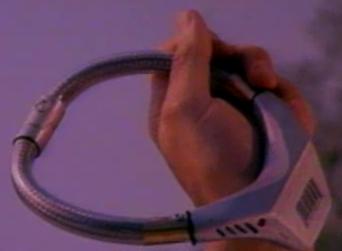
On the other hand, we have all fitted ourselves with stylish tamper-proof detonator collars like the one shown below, wired so that if one of us does leave the presence of the other three for more than a week, their collar will self destruct. It’s the single best way to keep us together.
Less Common Reactions
This section contains a selection of the less-common responses to our news.
“So you’re all getting lots of sex, then?”
Not as much as you’d expect, I’d bet. I’d estimate that the average frequency at which any given one of us gets a bit of nookie has barely increased at all (or maybe that’s just what they want me to think). The increase in the amount of sex I was getting when, for example, I went from being single to being in a relationship: that was a hell of a leap, for sure. The increase when I went from being in one committed relationship to being in two? Far less significant.
Sex is great, but – in my mind at least – it’s not among the biggest things I look at in a relationship.
Breasts are the biggest things I look at in a relationship.
Ahem.
Those last two lines were a joke, by the way, in case it wasn’t obvious.
“So have you have a threesome yet?”
A few people have asked this, and it’s honestly surprised me how often it’s come up. Moreover, I was really surprised when one person in particular was quite shocked at the answer: no, we haven’t.
I’ve have a couple of threesomes over the years, but none of them have ever involved Ruth or JTA.
I’m not sure why people think of this first. Perhaps it’s because threesomes are some great romantic mystery in so many people’s minds: to be fair, there aren’t many men who’d turn down the opportunity for a bedroom experience with two Hot Bi Babes. Perhaps it’s because it seems like an obvious “next step.” I don’t know.
In any case: the answer’s no. Perhaps it’ll happen someday, but it’s not the most important thing to sort out. Far more important questions that you don’t think of until you end up in a relationship like this are far more mundane things like:
- Who gets the front seat in the car?
- Who pays for dinner?
- Which side of the bed do I sleep on? Your other lover sleeps on that side, but I prefer to sleep on this side.
- This invitation says “Plus partner.” Who do I take?
- What are we doing for Christmas?
- If I cook, who washes up? (turns out the answer is often “nobody”)
- Who have I just woken up next to? I’m not sober yet and it’s still dark and I can’t remember who I got into bed with. I could prod them and listen to them grunt in their sleep, see if I can identify them that way… or perhaps I could turn the reading light on for just a second…
The big questions are so often the ones you don’t anticipate.

“Have you ever thought about… umm… crossing the square?”
Another reasonably popular but not really common question: is there any potential of a relationship between JTA and I? Or between Claire and Ruth?
Between JTA and I? No. JTA’s very definitely straight, and even with gender cast aside, I’m not sure we’d be “compatible” in the way that I wildly speculate he’d want (note: wild speculation).
Ruth and Claire? Well, it’s not my place to say what they think or feel. Whether or not that interests them is up to them, of course, but it’s my impression that neither of them have any intention of drawing any kind of “relationship line” through our “square,” at least not a line comparable to the lines that form it’s edges.
I’ll set the webcam up, though, just in case. Don’t click here if you want to see it.
“But how can you love two people at once?”
That’s a far bigger, more philosophical point than I’d like to go in to detail on here. A better question is: why is it that you think you can’t love more than one person at once?
My belief is that love is, fundamentally, chemicals in the brain: and I find it hard to believe that the chemicals in my brain have the concept of “counting to two” (in fact, I’ve discovered on long evenings in the pub, if I put enough chemicals in to my brain, I can’t even count to two): they’re a lot simpler than that. “Oh no,” says the brain-chemistry, “I can’t possibly make more of this chemical in the presence of that person, because I already make that chemical when I’m in the presence of that other person!” Please.
Love’s a remarkable thing, y’see, because there’s no “starvation economy” of it: when a mother has a second child, she doesn’t love the first one any less because of it. I don’t believe for a minute that we’re born with a certain quantity of “love juice” (ahem) in us and we use it up by loving people (damn, I really should have thought of a better term than “love juice,” which is just icky-sounding). Unlike time, money, and energy, love is virtually limitless, and you don’t run out of it just because there are more people who you care about.

“So how do you find the time, money, and energy for two relationships?”
Now that’s a better question. With great difficulty.
It genuinely is quite a challenge to find enough hours in a day, sometimes, and it takes a reasonable amount of planning to ensure that you even get enough time to yourself. In particular, I’ve found it very difficult to spend as much time with my other friends as I would like, and that’s something I’m working on improving.
Google Calendar is my friend. With it’s text-message alerts (*beep* *beep* *beep* “Oh shit, I’m supposed to be in bed with somebody!”), it’s a lifesaver.
“What does this mean for QParty? What does this mean for Ruth & JTA’s plans to marry?”
That’s two questions, but two that often get lumped together, despite the fact that they’re two very different questions. Let’s look at them one at a time:
Firstly, QParty. The (in some ways) unfortunate timing of my new partnership – getting a new girlfriend just weeks before a party to celebrate my relationship with my established girlfriend – and a similar situation for Claire… may have, we understand, confused the message of QParty for some people. And for that, I apologise.
The meaning of QParty doesn’t change, of course. It was always a celebration of Claire and I’s love for and commitment to one another, and that love and that commitment hasn’t changed one bit for the addition of an extra lover each. QParty itself was, of course, a special day for the pair of us, and those of you present may have observed that Ruth and JTA kept a respectable distance away (not least to reduce the risk of confusing some of our relatives); a favour we’ll be returning at their wedding in… what?… just under three years time.
I can’t speak for Ruth and JTA and their plans, but it’s my understanding that there’s no change in them. They still plan to marry, and marriage still seems to mean the same thing to them as it already did. And while marriage isn’t for Claire and I, I think I speak for us both when I say that we respect their choice to tie the knot in that way and we agree that it’s the right thing for them, and we’re really happy that they’re doing it.
I suppose that one obvious up-shot is that Claire could be the stripper for JTA’s stag party. Or is that just a little bit too weird?
“But, I mean: why are you having a party with Claire and not with Ruth?”
Because I’ve been with Claire for five and a bit years, and (at the time of QParty) I’d been with Ruth for less than a month. Is that a good enough reason? Part of QParty was celebrating that, after five years, Claire and I are still together. Many relationships don’t make it that far, and, in many ways, it’s a pleasant surprise that Claire and I did, especially considering how we started our relationships.
Perhaps, if everything goes smoothly, we’ll have another party in 2012 to celebrate both Ruth and I and Claire and JTA’s relationships. You’ll just have to wait and see.
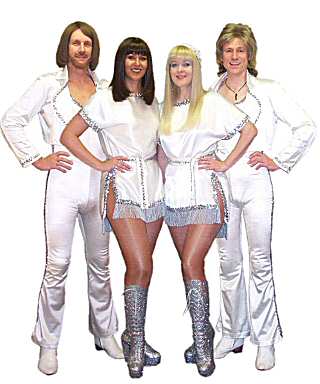
And if we do, you can almost guarantee it’ll be fancy dress. Sorry, Jimmy. In any case, start thinking of suggested foursome-themed costume ideas suitable for two men and two women now (no, we’re not going as ABBA).
Pretty Unique Reactions
Finally, here’s a list of things that people have said that’s just a little bit more “off the wall.”
[silence; nods of approval]
One particular couple – who discovered our “quad” by accident because we forgot that we hadn’t told them and they “noticed” – took the approach of being so cool with it that they didn’t even feel the need to pass comment on it. “Oh, so they’re together now. Should I be shocked?” That’s pretty damn unique.
An alternative theory is that the people in question were shocked into silence. Or perhaps had taken a vow of silence as part of some religious cult. But I like my theory.
“It expect it’ll be a fucking disaster.”
We’re sorry to hear that a handful of our friends – thankfully very few – don’t think that it can possibly work out.
It may well not work out. There are loads of things that can go wrong in any new relationship (and, in fact, there are plenty that can go wrong in old relationships, too). We don’t think for a moment that it’ll be an easy thing to make work, but we’re glad that we’re able to work towards making it the success we hope it will be. We’ve laid a lot of important groundwork to help us support one another and to make it work, and we think we’ve got as good a chance as any relationship does.
Worst case, we’ve always got the exploding collars.
“Wow. So four of my friends are now each in a threesome? That’s ace!”
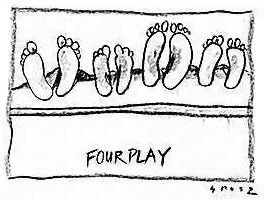
And that’s thinking like a mathematician. It’s not accurate, of course: I mentioned above that “threesomes” haven’t happened, and in poly-parlance, a “vee” (two people joined by one in the middle, in a ‘V’ shape) is a more accurate way of looking at any individual one of us, rather than a “threesome” or “triad” (which implies a relationship between the two people at the tips of the ‘V’). But honestly, mate, you call us whatever the fuck you want, because you had one of the single coolest-sounding responses to the news of anybody, and a ludicrous grin to go with it.
“So, what about children?”
Honestly, I’m surprised more people didn’t ask this question; especially among those who hope themselves to be grandparents in the making. But I was very impressed when somebody did ask, especially as the answer is so simple and unfinalised.
We’re not sure. Children may be on the agenda some way down the line, but we’ve still got a lot of discussion to do on that subject (and, to be fair, there are more immediate things on the agenda right now, like – who gets the front seat in the car? who pays for dinner? – and so on).
Me? I think the four of us would make great parents, and no, I don’t think the fact that theoretical far-future potential children would, in general, give a fig that for some reason they’ve got between two and four times as many parents as their peers. Hmm… I’ve just thought about that: surely I meant to say *exactly* two or four times: it’s not like we can comprise three times as many people as any other set of people: apologies if I’m wrong to any single-and-a-third parent families out there.
Really, though, that’s a fucking huge question to ask pretty much anybody who’s been in a relationship for three months or so. You might as well ask if we have a mortgage together yet or if we’ve reached that level of intimacy in which it’s okay to fart in bed: one step at a time, now, folks!
“What do you call each other? What do I call you?”
Well, I’m Dan, and that’s Claire, and over there is Ruth, and… oh, but that wasn’t what you were asking, was it? What you mean is, if Claire is my “partner,” then who is Ruth?
It must be so much easier to be Ruth or JTA, in this regard. Ruth, for example, can call me her boyfriend and JTA her fiance. I don’t have that luxury, so I tend to call them both my partners, or, better yet, refer to them by name (particularly when talking to somebody who’s only just discovered that “partner” doesn’t have to imply that there is exactly one of them).
What do you call us? Call us anything you like, for all I care! But I know what you’re asking: you’re saying, “I was telling my friend about this couple I know, then I realised that ‘couple’ might not be the right word, then it all got complicated…” Yeah, sorry about that: we didn’t mean to make things complicated for you. I quite like the word “quad.” It may make us sound a bit like small motor vehicle, but it’s an easy-to-remember, short, and understandable word: people tend to just work out what you mean when you say it, and so you don’t get yourself into any excessive complexity.
But honestly; if it makes your life easier to pretend to other people that you don’t know that we’re four couples at all, that’s fine by me too. Conversely, if you want to tell everybody you meet, that’s probably okay as well (albeit just a little bit creepy). There are more important things in life than the words you use. Like who gets the front seat in the car, who washes up, who takes soup up to the ill person in bed, what the correct protocol is for talking to people’s parents…
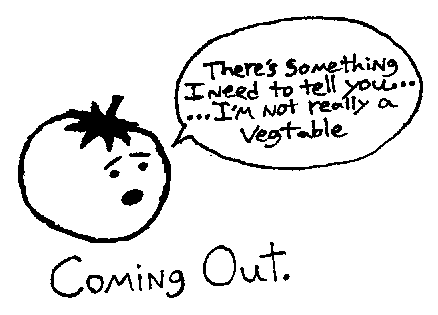
Well, as you’ve managed to read this far, thanks! It means it might have been worth it to type all of this. Of course this isn’t an exhaustive list of everything anybody has ever asked us, it’s just a selection. I hope it’s been interesting, but I hope even more that you’ve been able to chuckle at it.
Love and hugs to all those who deserve it. Now get back to surfing the web like you’re supposed to.
Return From The Real Ale Ramble (and upcoming Abnib Events)
Real Ale Ramble 2007
Well, the Real Ale Ramble was fabulous as always. Particularly wet and muddy, especially on the first day, this year, but good visibility, so we got to see a lot of the beautiful mid-Wales countryside. Thanks to getting lost on the first day and walking a lot longer than we’d planned, I ended up walking in the region of 30 miles plus altogether, and Claire walked even further, doing a medium-length walk on the second day, too. JTA and are managed to beat Norman around Route C on the second day, which is a first (Norman is a 78-year-old who walks with a cane yet somehow manages to get around any walk we participate in faster than us… until now).


Oh, and after my trousers got soaking wet on the first day they began to chafe quite badly, which – in the cold – I didn’t realise until I took my trousers off and noticed that both my legs were bleeding. Sorry for the shitty-resolution photo and for the fact that I cleaned up this particular wound as much as possible "in the field" before thinking to take a picture for the record.

But altogether, it was a fantastic weekend away. As far as the beer’s concerned, I can particularly recommend Special-O, from Otley Brewing Company, which is the most delicious beer of it’s strength I’ve ever tasted, Berserker from Hebredian, a remarkably fruity Scottish brew, and Aur Cymru from local Heart Of Wales Brewery as clear favourites of mine.
Oh, and here’s the obligatory "JTA falling asleep in pub after long walk" photo:

Troma Night & Buffy Night
So now we’re back in Aber, which is nice, and I thought I’d share those pictures with you. We even had our very own "Troma Night On Location" out in Llanwrtyd Wells, and watched Goldeneye. Nobody’s blogged about whether Troma Night happened back here in Aber, too, yet, so I haven’t a clue. All I know is that next Troma Night will be similarly hosted by somebody other than Claire and I, as we’ll be in York (with, yes again, Ruth and JTA).
On, and there’ll be a Buffy Night this week: Thursday at 7pm at The Cottage.
Soundsnap.com: Find and Share Free Sound Effects and Loops
This is a repost promoting content originally bookmarked via del.icio.us. See more del.icio.us imports or more things Dan's reposted.
Bookmarked via del.icio.us: Soundsnap.com: Find and Share Free Sound Effects and Loops.
Apology, Troma Night Update, Etc.
Damnit, I wrote a blog post and didn’t save it as I was going along (mistake one) and then closed the browser without posting it (mistake two). It’s kind-of demotivating, and I can’t be arsed to write it all again in full. So here’s the much, much shortened version of what I’ve been up to and what’s happening this weekend:
Last week: Me. Grumpy. Apologies. Head of cold. Not so arsey now. Woohoo.
Weekend: Claire away with Sundeep.
Friday: Quizzlecrawl. Tom + Amy = Brilliant. Richard III vs. MacBeth. Very close. Richard III lost. Grr.
Saturday: Troma Night. LolliLove. Star Trek V (RiffTrax). Hairspray. Virgins: Selina, Elizabeth. Fantastic.
Sunday: Lounging. Chilling out. Ruth. JTA. Paul. Roast boar. Roast everything. Digesting. Nom nom nom. Geek Night. Rory. Elizabeth again. BGA. Top Gear (too many cars).
This week and coming weekend: No Buffy Night =o(. Troma Night @ Rory’s ‘cos Claire, JTA, Ruth & I at Real Ale Ramble.
Consider yourselves updated.