
...
why bother going to the brick-and-mortar store? amazon is more "convenient". why bother cooking a nice meal for yourself? doordash and uber eats are more "convenient". why go out and socialize with people? facebook is more "convenient". why use a digital camera, camcorder, or polaroid? your smartphone is more "convenient". why bother going to the theater or concerts? netflix and spotify are more "convenient". why bother making art? asking an AI to generate it for you is more "convenient".
well, i say nuts to that. from now on, i'm going to make my life as inconvenient as possible. i'm going to go to the store and buy stuff in person. i'm going to make my own food with my own hands. i'm going to socialize with people face-to-face. i'm going to use a true camera instead of my phone's camera. i'm going to buy blu-rays, DVDs, and CDs instead of streaming. i'm going to take my time when creating, watching, playing, and reading a work of art.
...
I'm seeing an growing movement in indieweb, revivalist, and adjacent circles that express RNotté's sentiment: that the endless (and highly-marketable) quest for increased convenience in our lives has gained us free time, but we've lost something along the way.
What we've lost varies from case to case, but includes freedom (from lock-in to subscription services), creative satisfaction (from convenient "artistic" expression), privacy (from becoming the product, packaged-up by big-data advertising-funded tools), and social interactions (from so much of "social" media).
But reading RNotté share their thoughts on the matter today was the first time that it's reminded me of The Matrix.
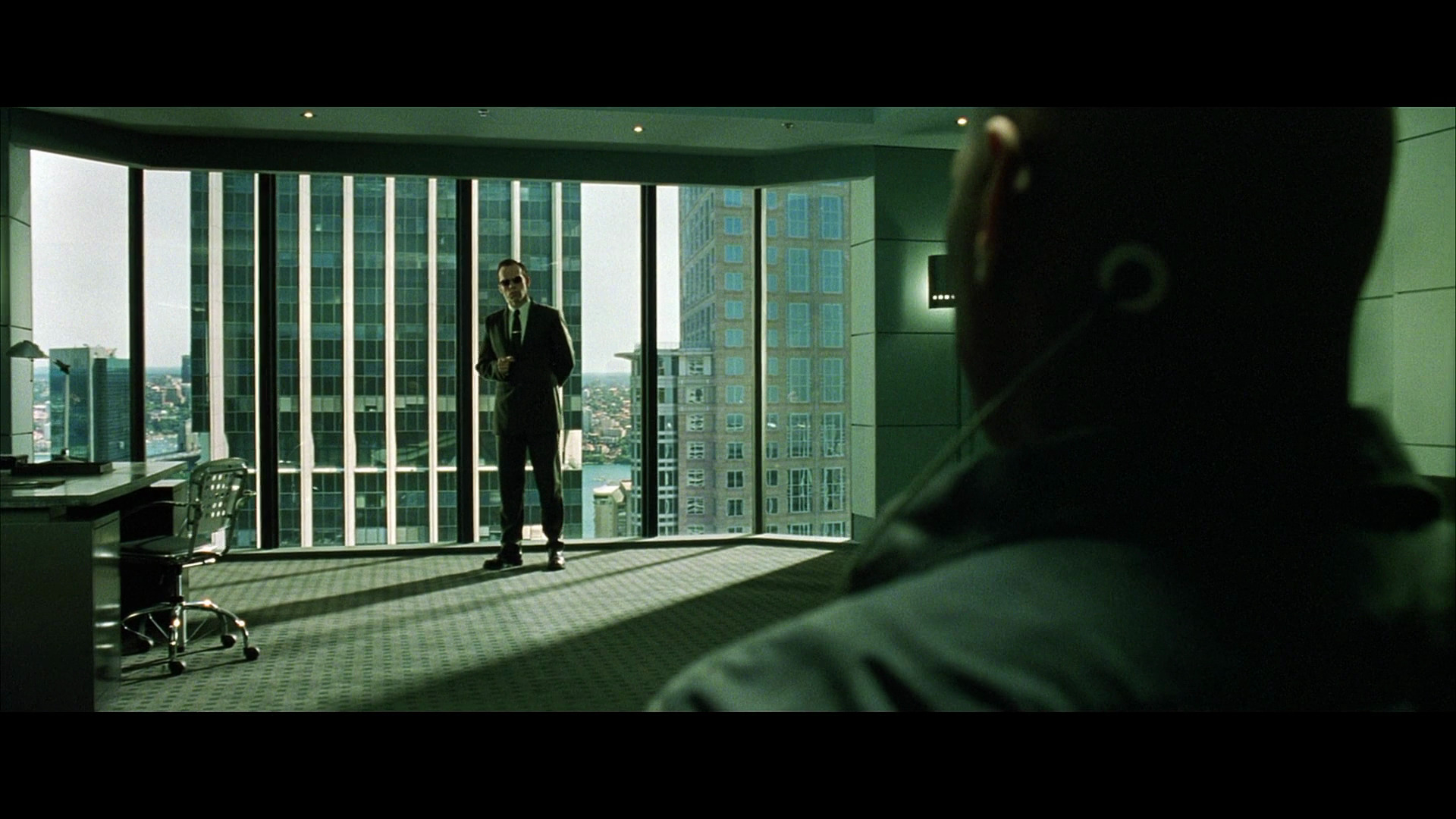
Alt
Framegrab from The Matrix. In the foreground is the silhouette of Morpheus, who is about to be interrogated by Agent Smith, a man in a suit at the windowed far end of an office.
There's a bit where Agent Smith says, to his captive the rebel captain Morpheus:
Did you know that the first Matrix was designed to be a perfect human world? Where none suffered, where everyone would be happy. It was a disaster. No one would accept the program. Entire crops were lost. Some believed we lacked the programming language to describe your perfect world.
Smith goes on to elucidate that his personal explanation for this fault was that humans depend upon suffering and misery, while acknowledging that there are other explanations. And perhaps we've touched upon one.
Perhaps humans - all humans - have a limit for how much they're willing to accept convenience as compensation. Connected humans in The Matrix grain a convenient life, superficially superior to the struggle for survival experienced by humans living in the real world, short on food and hunted by machines. But to get that, they trade away their individual ability to become aware of the truth and, collectively, the ability for humanity for shape its own destiny. But there's something about the imbalance of power in the arrangement niggles in human minds, and some rebel against the established order... and are joined by others who are shown that an alternative is available.
Clearly - as RNotté and others show - faceless technological forces need not go quite so far as enslaving an entire species before "convenience" no longer becomes a tolerable mitigation!
I'm not convinced that seeking out inconvenience is in itself a good. But questioning what your conveniences are worth and what you're paying for them... that's definitely worthwhile.
0 comments