This article is a follow-up to my article “Why Google AMP is a threat to the Open
Web”. In the comments of that article I promised I’d soon provide a follow-up, and for reasons I’ll get into, that has not been possible until now – but now I’m finally
providing it.
Back in February I wrote an article saying how I believed Google AMP has been imposed on the web by Google as a ‘standard’ for developing fast webpages, and my dismay about that.
Google apparently developed this as an internal project without any open collaboration, and avoiding the W3C standardization processes. Google made implementation of Google AMP a
requirement to show at the top of the search results for common news searches.
To many of us open web folk, Google’s AMP violated the widely held principle of search engines not putting bias into search results, and/or the principle of web standards (take your
pick – it would not be bias if it was a standardized approach that the wider web community had agreed upon).
…
You know how I feel about AMP. I’m not alone, and others are doing a pretty good job of talking to Google about our concerns. Unfortunately, Google aren’t
listening.
This weekend, I attended part of Oxford’s first ever IndieWebCamp! As a long (long, long) time
proponent of IndieWeb philosophy (since long before anybody said “IndieWeb”, at least) I’ve got my personal web presence pretty-well sorted out.
Still, I loved the idea of attending and pushing some of my own tools even further: after all, a personal website isn’t “finished” until its owner says it is! One of the things I ended
up hacking on was pretty-predictable: enhancements to my recently-open-sourced geocaching PESOS tools… but the
other’s worth sharing too, I think.
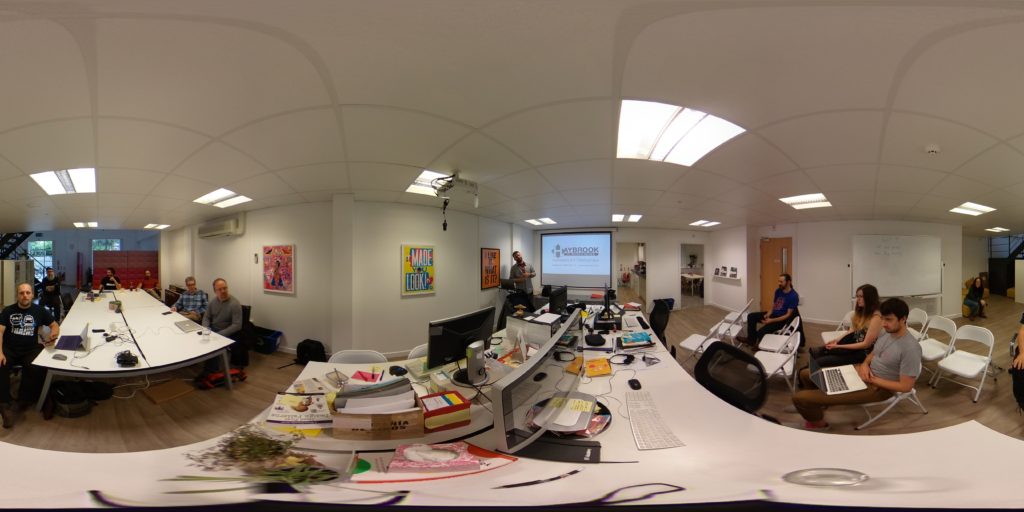
Some of IndieWebCamp Oxford’s attendees share knowledge and hack code together.
I’ve recently been playing with WebVR – for my day job at the Bodleian, I swear! – and I was looking for
an excuse to try to expand some of what I’d learned into my personal blog, too. Given that I’ve recently acquired a Ricoh Theta
V I thought that this’d be the perfect opportunity to add WebVR-powered panoramas to this site. My goals were:
Entirely self-hosted; no external third-party dependencies
Must degrade gracefully (i.e. even if you’re using an older browser, don’t have Javascript enabled, etc.) it should at least show the original image
In plain-old browsers should support mouse (or touch) control to pan the scene
Where accelerators are available (e.g. mobiles), “magic window” support to allow twist-to-explore
And where “true” VR hardware (Cardboard, Vive, Rift etc.) with WebVR support is available, allow one-click use of that
It wouldn’t be a geeky hacky camp thingy if it didn’t finish at a bar.
Hopefully the images above are working for you and are “interactive”. Try click-and-dragging on them (or tilt your device), try fullscreen mode, and/or try WebVR mode if you’ve got
hardware that supports it. The mechanism of operation is slightly hacky but pretty simple: here’s how it works:
The image is inserted into the page as normal but with an extra CSS class of “vr360” and a data attribute pointing to the full-resolution image, e.g.:
<img class="vr360" src="/uploads/2018/09/R0010005_20180922182210-1024x512.jpg" alt="IndieWebCamp Oxford attendees at the pub" width="640" height="320"
                data-vr360="/uploads/2018/09/R0010005_20180922182210.jpg" />
Some Javascript swaps-out images with this class for an iframe of the same size, showing a special page and passing the image filename after the hash, e.g.:
for(vr360 of document.querySelectorAll('.vr360')){


                const width = parseInt(vr360.width);


                const height = parseInt(vr360.height);


                if(width == 0) width = '100%'; // Fallback for where width/height not specified,


                if(height == 0) height = '100%'; // needed because of some quirks with Dan's lazy-loader


                vr360.outerHTML = `<iframe src="/q23-content/themes/q18/vr360/#${vr360.dataset.vr360}" width="${width}" height="${height}" class="aligncenter" class="vr360-frame" style="min-width:
                340px; min-height: 340px;"></iframe>`;


                }
The iframe page loads this Javascript file. This loads three.js (to make 3D things easy)
and WebVR-polyfill (to fix browser quirks). Finally (scroll to the bottom of the code), it creates a camera in the centre
of a sphere, loads the image specified in the hash, flips it, and paints it onto the inside surface of the sphere, sets up controls, and turns the user loose on it. That’s all there is
to it!
You’re welcome to any of my code if you’d like a drop-in approach to hosting panoramic photographs on your own personal site. My solution’s pretty extensible if you want e.g.
interactive hotspots or contextual overlays – in fact, that – plus an easy route to editing the content for less-technical users – is pretty-much exactly what I’m working on for my day
job at the moment.
My home computer in 1998 had a 56K modem connected to our telephone line; we were allowed a maximum of thirty minutes of computer usage a day, because my parents — quite reasonably
— did not want to have their telephone shut off for an evening at a time. I remember webpages loading slowly: ten […]
My home computer in 1998 had a 56K modem connected to our telephone line; we were allowed a maximum of thirty minutes of computer usage a day, because my parents — quite reasonably —
did not want to have their telephone shut off for an evening at a time. I remember webpages loading slowly: ten to twenty seconds for a basic news article.
At the time, a few of my friends were getting cable internet. It was remarkable seeing the same pages load in just a few seconds, and I remember thinking about the kinds of the
possibilities that would open up as the web kept getting faster.
And faster it got, of course. When I moved into my own apartment several years ago, I got to pick my plan and chose a massive fifty megabit per second broadband connection, which I
have since upgraded.
So, with an internet connection faster than I could have thought possible in the late 1990s, what’s the score now? A story at the Hill took over
nine seconds to load; at Politico, seventeen seconds; at CNN, over thirty seconds. This is the
bullshit web.
But first, a short parenthetical: I’ve been writing posts in both long- and short-form about this stuff for a while, but I wanted to bring many threads together into a single document
that may pretentiously be described as a theory of or, more practically, a guide to the bullshit web.
A second parenthetical: when I use the word “bullshit” in this article, it isn’t in a profane sense. It is much closer to Harry Frankfurt’s definition in “On Bullshit”:
It is just this lack of connection to a concern with truth — this indifference to how things really are — that I regard as of the essence of bullshit.
In the year 1930, John Maynard Keynes predicted that, by century’s end, technology would have advanced sufficiently that countries like Great Britain or the United States would have
achieved a 15-hour work week. There’s every reason to believe he was right. In technological terms, we are quite capable of this. And yet it didn’t happen. Instead, technology has
been marshaled, if anything, to figure out ways to make us all work more. In order to achieve this, jobs have had to be created that are, effectively, pointless. Huge swathes of
people, in Europe and North America in particular, spend their entire working lives performing tasks they secretly believe do not really need to be performed. The moral and
spiritual damage that comes from this situation is profound. It is a scar across our collective soul. Yet virtually no one talks about it.
[…]
These are what I propose to call ‘bullshit jobs’.
What is the equivalent on the web, then?
…
This, this, a thousand times this. As somebody who’s watched the Web grow both in complexity and delivery speed over the last quarter century, it apalls me that somewhere along the way
complexity has started to win. I don’t want to have to download two dozen stylesheets and scripts before your page begins to render – doubly-so if those additional
files serve no purpose, or at least no purpose discernable to the reader. Personally, the combination of uMatrix and Ghostery is all the adblocker I need (and I’m more-than-willing to add a little userscript to “fix” your site if it tries to sabotage my use of these
technologies), but when for whatever reason I turn these plugins off I feel like the Web has taken a step backwards while I wasn’t looking.
I recently discovered a minor security vulnerability in mobile webcomic reading app Comic Chameleon, and I thought that it was interesting
(and tame) enough to share as a learning example of (a) how to find security vulnerabilities in an app like this, and (b) more importantly, how to write an app like this
without this kind of security vulnerability.
The nature of the vulnerability is that, for webcomics pushed directly into the platform by their authors, it’s possible to read comics (long) before they’re published. By way
of proof, here’s a copy of the top-right 200 × 120 pixels of episode 54 of the (excellent) Forward
Comic, which Imgur will confirm was uploaded on 2 July 2018: over three months ahead of its planned publication date.
I’m not going to spoil this comic for you, but if you follow it then when October comes I think you’ll be pleased.
How to hack a web-backed app
Just to be clear, I didn’t set out to hack this app, but once I stumbled upon the vulnerability I wanted to make sure that I was able to collect enough information that I’d be
able to explain to its author what was wrong and how to fix it. You’d be amazed how many systems I find security holes in almost-completely by accident. In fact, I’d just noticed that
the application supported some webcomics that I follow but for which I hadn’t been able to find RSS feeds (and so I was selfdogfooding my own tool, RSSey, to “produce” RSS feeds for my reader by screen-scraping: not the most-elegant solution). But if this app could produce a list of issues of the comic, it
must have some way of doing what I was trying to do, and I wanted to know what it was.
Comic Chameleon brings a lot of comics into a single slick Android/iOS app. Some of them you’ll even have heard of!
The app, I figured, must “phone home” to some website – probably the app’s official website itself – to get the list of comics that it supports and details of where to get their feeds
from, so I grabbed a copy of the app and started investigating. Because I figured I was probably looking for a URL, the first thing I
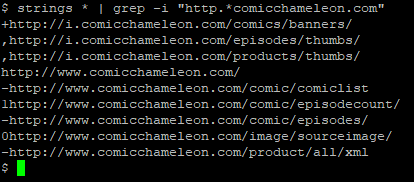
did was to download the raw APK file (your favourite search engine can tell you how to do this), decompressed it (APK files are just ZIP files, really) and ran strings on it to search for
likely-looking URLs:
As predicted, there are several hard-coded addresses. And all over unencrypted HTTP, eww!
I tried visiting a few of the addresses but many of them seemed to be API endpoints that were expecting additional parameters. Probably, I figured, the strings I’d extracted were
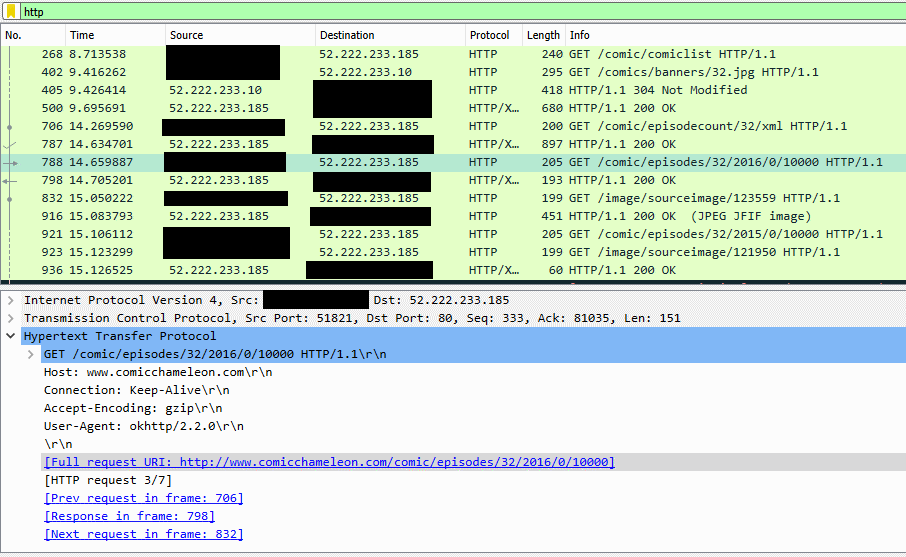
prefixes to which those parameters were attached. Rather than fuzz for the right parameters, I decided to watch what the app did: I spun up a simulated Android device using the official
emulator (I could have used my own on a wireless network that I control, of course, but this was lazier) and ran my favourite packet sniffer to
see what the application was requesting.
The web addresses are even clearer, here, and include all of the parameters I need.
Now I had full web addresses with parameters. Comparing the parameters that appeared when I clicked different comics revealed that each comic in the “full list” was assigned a numeric
ID which was used when requesting issues of that comic (along with an intermediate stage where the year of publication is requested).
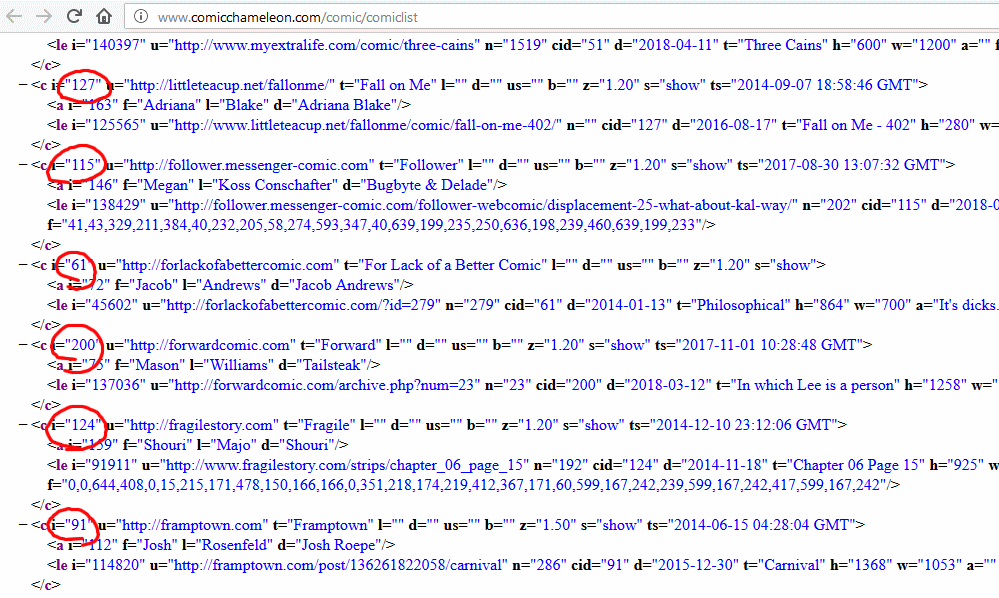
Each comic is assigned an ID number, probably sequentially.
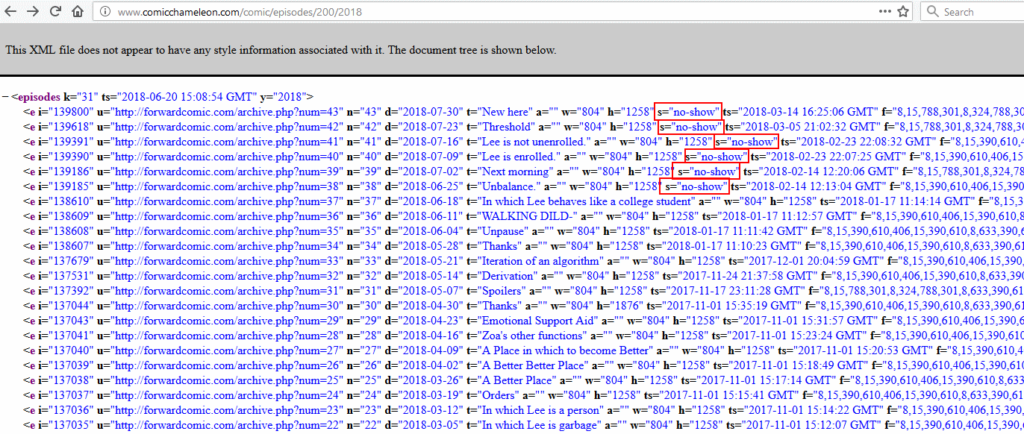
Interestingly, a number of comics were listed with the attribute s="no-show" and did not appear in the app: it looked like comics that weren’t yet being made available via
the app were already being indexed and collected by its web component, and for some reason were being exposed via the XML
API: presumably the developer had never considered that anybody but their app would look at the XML itself, but the thing about the Web is that if you put it on the Web, anybody can see it.
Still: at this point I assumed that I was about to find what I was looking for – some kind of machine-readable source (an RSS feed
or something like one) for a webcomic or two. But when I looked at the XML API for one of those webcomics I discovered quite a bit more than I’d bargained on finding:
Hey, what’s this? This feed includes titles for webcomics that haven’t been published yet, marked as ‘no-show’…
The first webcomic I looked at included the “official” web addresses and titles of each published comic… but also several not yet published ones. The unpublished ones were
marked with s="no-show" to indicate to the app that they weren’t to be shown, but I could now see them. The “official” web addresses didn’t work for me, as I’d expected,
but when I tried Comic Chameleon’s versions of the addresses, I found that I could see entire episodes of comics, up to three and a half months ahead of their expected
publication date.
Whoops.
Naturally, I compiled all of my findings into an email and contacted the app developer with all of the details they’d need to fix it – in hacker terms, I’m one of the “good guys”! – but
I wanted to share this particular example with you because (a) it’s not a very dangerous leak of data (a few webcomics a few weeks early and/or a way to evade a few ads isn’t
going to kill anybody) and (b) it’s very illustrative of the kinds of mistakes that app developers are making a lot, these days, and it’s important to understand why
so that you’re not among them. On to that in a moment.
Responsible disclosure
Because (I’d like to think) I’m one of the “good guys” in the security world, the first thing I did after the research above was to contact the author of the software. They didn’t seem
to have a security.txt file, a disclosure policy, nor a profile on any of the major disclosure management sites, so I sent an email. Were the
security issue more-severe, I’d have sent a preliminary email suggesting (and agreeing on a mechanism for) encrypted email, but given the low impact of this particular issue, I just
explained the entire issue in the initial email: basically what you’ve read above, plus some tips on fixing the issue and an offer to help out.
This is what stock photo sites think “hacking” is. Well… this, pages full of green code, or hoodies.
I subscribe to the doctrine of responsible disclosure, which – in the event of more-significant vulnerabilities –
means that after first contacting the developer of an insecure system and giving them time to fix it, it’s acceptable (in fact: in significant cases, it’s
socially-responsible) to publish the details of the vulnerability. In this case, though, I think the whole experience makes an interesting learning example about ways in which
you might begin to “black box” test an app for data leaks like this and – below – how to think about software development
in a way that limits the risk of such vulnerabilities appearing in the first place.
The author of this software hasn’t given any answer to any of the emails I’ve sent over the last couple of weeks, so I’m assuming that they just plan to leave this particular leak in
place. I reached out and contacted the author of Forward Comic, though, which turns out (coincidentally) to be probably the most-severely affected publication on the platform, so that
he had the option of taking action before I published this blog post.
Lessons to learn
When developing an “app” (whether for the web or a desktop or mobile platform) that connects to an Internet service to collect data, here are the important things you really, really
ought to do:
Don’t publish any data that you don’t want the user to see.
If the data isn’t for everybody, remember to authenticate the user.
And for heaven’s sake use SSL, it’s not the 1990s any more.
It’s a good job that nobody on the Web would ever try to view something easily-available but which they shouldn’t, right? That’s why screens like this have always worked so well.
That first lesson’s the big one of course: if you don’t want something to be on the public Internet, don’t put it on the public Internet! The feeds I found simply
shouldn’t have contained the “secret” information that they did, and the unpublished comics shouldn’t have been online at real web addresses. But aside from (or in addition to)
not including these unpublished items in the data feeds, what else might our app developer have considered?
Encryption. There’s no excuse for not using HTTPS these days. This alone wouldn’t have prevented a deliberate effort
to read the secret data, but it would help prevent it from happening accidentally (which is a risk right now), e.g. on a proxy server or while debugging something else on the same
network link. It also protects the user from exposing their browsing habits (do you want everybody at that coffee shop to know what weird comics you read?) and from having
content ‘injected’ (do you want the person at the next table of the coffee shop to be able to choose what you see when you ask for a comic?
Authentication (app). The app could work harder to prove that it’s genuinely the app when it contacts the website. No mechanism for doing this can ever be perfect,
because the user hasa access to the app and can theoretically reverse-engineer it to fish the entire authentication strategy out of it, but some approaches are better than others.
Sending a password (e.g. over Basic Authentication) is barely better than just using a complex web address, but
using a client-side certiciate or an OTP algorithm would (in conjunction
with encryption) foil many attackers.
Authentication (user). It’s a very-different model to the one currently used by the app, but requiring users to “sign up” to the service would reduce the risks and
provide better mechanisms for tracking/blocking misusers, though the relative anonymity of the Internet doesn’t give this much strength and introduces various additional burdens both
technical and legal upon the developer.
Fundamentally, of course, there’s nothing that an app developer can do to perfectly protect the data that is published to that app, because the app runs on a device that the user
controls! That’s why the first lesson is the most important: if it shouldn’t be on the public Internet (yet), don’t put it on the public Internet.
Hopefully there’s a lesson for you somewhere too: about how to think about app security so that you don’t make a similar mistake, or about some of the ways in which you might test the
security of an application (for example, as part of an internal audit), or, if nothing else, that you should go and read Forward, because it’s
pretty cool.
Some time ago, I wrote a web-based calendar application in PHP, one of my favourite programming
languages. This tool would produce a HTML tabular calendar for a four week period, Monday to Sunday, in which the current date (or a
user-specified date) fell in the second week (so you’re looking at this week, last week, and two weeks in the future). The user-specified date, for various reasons, would be provided as
the number of seconds since the epoch (1970). In addition, the user must be able to flick forwards and backwards through the calendar, “shifting” by one or four weeks each time.
Part of this algorithm, of course, was responsible for finding the timestamp (seconds since the epoch) of the beginning of “a week last Monday”, GMT. It went something like this (pseudocode):
1. Get a handle on the beginning of "today" with [specified time] modulus [number of seconds in day]


              2. Go back in time a week by deducting [number of seconds in day] multiplied by [number of days in week] (you can see I'm a real programmer, because I set "number of days in week"
              as a constant, in case it ever gets changed)


              3. Find the previous Monday by determining what day of the week this date is on (clever functions in PHP do this for me), then take
              [number of seconds in day] multiplied by [number of days after Monday we are] from this to get "a week last Monday"


              4. Jump forwards or backwards a number of weeks specified by the user, if necessary. Easy.


              5. Of course, this isn't perfect, because this "shift backwards a week and a few days" might have put us in to "last month", in which case the calendar needs to know to deduct one month
              and add [number of days in last month]


              6. And if we just went "back in time" beyond January, we also need to deduct a year and add 11 months. Joy.
So; not the nicest bit of code in the world.
I’ve recently been learning to program in Ruby On Rails. Ruby is a comparatively young language which
has become quite popular in Japan but has only had reasonable amounts of Westernised documentation for the last four years or so. I started looking into it early this year after reading
an article that compared it to Python. Rails is a web application development framework that sits on top of Ruby and promises to be “quick and
structured”, becoming the “best of both worlds” between web engineering in PHP (quick and sloppy) and in Java (slow and structured). Ruby is a properly object-oriented language – even your literals are objects – and Rails takes full advantage of
this.
For example, here’s my interpretation in Rails of the same bit of code as above:
@week_last_monday is just a variable in which I’m keeping the result of my operation.
7.days might fool you. Yes, what I’m doing there is instantiating an Integer (7, actually a Fixint, but who cares), then calling the “days” function on it, which returns me
an instance of Time which represents 7 days of time.
Calling the ago method on my Time object, which returns me another Time object, this time one which is equal to Time.now (the time right now) minus the amount of
Time I already had (7 days). Basically, I now have a handle on “7 days ago”.
The only thing PHP had up on me here is that it’s gmdate() function had ensured I already had my date/time in
GMT; here, I have to explicitly call gmtime to do the same thing.
And then I simply call monday on my resulting Time object to get a handle on the beginning of the previous Monday. That simple. 24 characters of fun.
+ params[:weeks].to_i.weeks simply increments (or decrements) the Time I have by a number of weeks specified by the user (params[:weeks] gets the number of weeks
specified, to_i converts it to an integer, and weeks, like days, creates a Time object from this. In Ruby, object definitions can even override operators
like +, -, <, >, etc., as if they were methods (because they are), and so the author of the Time class made it simple to perform arithmetic upon times and dates.
This was the very point at which I feel in love with Ruby on Rails.
Going to be registering a website thingy tonight to mess around with. Any hints/tips/advice from all you people who know about this stuff would be gratefully received. I am, after
all, officially computer illiterate.
Register your domain name with somebody respectable (won’t rip you off or otherwise fuck up) like Easily, who’ll give you a domain
name (whateveryoulike.co.uk) for as little as £9.99/2 years.
As far as hosting is concerned, I can’t say a bad word about the fantastic DreamHost, who now provide hosting for me,
Paul, Claire, Matt (from SmartData), JTA & Ruth, Statto… etc. etc.
I’m not sure if it still works, but if you sign up for their Crazy Domain Insane offer ($9.95/month), paying for the
first year up-front, and use the promo code “777”, they’ll give you the first YEAR for the price of the first month. Which is nice. And as it includes a free .com domain name of your
choice, that’s pretty fab, too (saves you heaps of cash, no commitment to stay with them more than a year anyway, etc.). They’re pretty damn good.
Drop me an e-mail if you want any specific help/advice on such geekibits. Will see what I can do.
Here’s a thought: a way to try to get unsolicited (treeware) junk mail banned –
Every time you receive a bit of junk mail, just go and put it back in the post box: it’s almost all franked mail, and so the post office will re-sort it and deliver it back to you. Put
a tally on the reverse side, and add one to it each time you forward it to yourself. If enough people did it, I wonder how many recursions you’d need to put through the post office
before the postal workers union petitioned the government to disallow the sending of unsolicited treeware junk mail.
Not sure if it’d work, but I think I’ll do it anyway, just out of curiosity about how high a tally I can get before the post office start refusing to re-deliver them. Heh.
Got my Dad’s web site done. Just waiting for the domain name registration to go through so I can deploy it.