In my review of my new HTC Sensation earlier this month, I tried to explain how
my new phone – with it’s swish and simple interface – didn’t feel quite… geeky enough for me. I picked up on the way that it’s process management works, but I’ve since
realised that this is only symptomatic of a deeper problem. This is entirely to do with the difference between traditional computers (of which my old N900 was one) and modern consumer-centric devices (which, inspired by the iPod/iPhone/iPad/etc.) try to simplify things for the
end-user and provide strong support for centralised repositories of pre-packaged “apps” for every conceivable purpose.
To take an example of the difference: my N900 ran Linux, and felt like it ran Linux. As a reasonably-sensible operating system, this meant that all of the applications on it
used pretty much the same low-level interfaces to do things. If I wanted, I could have installed (okay, okay – compiled) sshfs, and be reasonably confident that every application on my phone, whether it’s a media player or a geocaching application or whatever,
would use that new filesystem. I could store my geocaching .gpx files on an SSH-accessible server somewhere, and my phone could access them, and my geocaching app wouldn’t
know the difference because I’d have that level of control over the filesystem abstraction layer.
Similarly, if I installed a game which made use of Ogg Vorbis to store
its sound files, which therefore installed the Vorbis codecs, then I can expect that my media player software will also be able to make use of those codecs, because
they’ll be installed in the standard codec store. This kind of thing “just works”. Okay, okay: you know as well as I do that computers don’t always “just work”, but the principle is
there such that it can “just work”, even if it doesn’t always.
On these contemporary smartphones, like the iPhone, Android devices, and (I assume) modern BlackBerrys, the model is different: individual applications are sandboxed and packaged up
into neat little bundles with no dependencies outside of that provided by the platform. If you have two applications installed that both use sshfs, then they both have to
include (or implement) the relevant bundle! And having them installed doesn’t automatically give sshfs-like functionality to your other filesystem-accessing tools.
It’s not all bad, of course: this “new model” is great for helping non-technical users keep their devices secure, for example, and it means that there’s almost no risk of dependency hell. It’s very… easy. But I’m still not
sure it quite works: I’ll bet that 90% of users would install an application that demands dubious levels of permissions (and could, for example, be stealing their address book data for
sale to scammers) without even thinking about the risks, so the security benefits are somewhat nullified.
In summary:
Pros
Cons
Traditional-computing device (e.g. N900)
User actually “owns” device
Applications to be combined (e.g. pipes, automation, new middleware)
More secure (in theory) as platform exposes little
Centralised “app store”/”marketplace”
Potentially limiting for technical users
Only as secure as the user is savvy.
Centralised “app store” store can act as a “lock in”
Needless to say, the new model devices are winning, and already tablet computers powered by the very same platforms as the mobile phones are beginning to be seen as a simpler, easier
alternative to conventional laptops. It’s to be expected: most of today’s users don’t want a learning curve before they can use their smartphone: they just want to make some calls, play
Angry Birds a bit, keep up with their Facebook friends, and so on.
But I hope that there’ll always be room for a few folks like me: folks who want to tinker, want to play, want to hack code for no really benefit but their own pleasure… and without
having to shell out for a developer license in order to do so!
Since last year, I’ve been volunteering at a helpline called Oxford Friend, providing emotional support
and information to the LGBT community in Oxfordshire (those who are aware of my volunteering background are unlikely
to find this surprising). More-recently, though, I became a trustee of that charity, and that’s what I thought I’d tell you about.
Every helpline and similar service I’ve volunteered with has had it’s… quirks. They’ve all got their own unique personality and identity, their own
strange policies and practices, and Oxford Friend is no exception. One thing that I always found unusual about them – and still do – is the peculiar way they differentiate between
trainee and “full” members: once they’re done as a trainee and become a full member, volunteers become trustees of the charity.
At first, this seemed like a lot of paperwork with little benefit, but the idea has grown on me a little. By becoming a trustee, you’re becoming responsible for (and liable for!) the
actions of the charity, which should encourage one to have it’s best interests at heart (as if that were ever a concern!). It fosters a sense of ongoing shared responsibility, making a
charity that’s less like a corporation and more like a co-operative.
It’s only feasible, I think, because the charity is so small: a few dozen volunteers collectively running a helpline, email service, and providing external outreach and training on LGBT
issues. It’s a very communal approach to the management of the operation of the charity, and it seems to work perfectly well: they’ve been running for 30 years now! But I
don’t think it would work for a larger charity like either of the Samaritans branches I’ve worked with.
I’ll be interested to see if the addition of my unusual name to the record at the Charity Commission goes to plan (Companies House always seem to have difficulty with it!). But
regardless: for now, I’m proud to be able to support Oxford Friend and the remarkably valuable work that they do.
Is this a chronogoldfish? I don't know. And neither do you. I just made them up.
You see: the thing that goldfish are famous for – except for their allegedly very short memory, which is actually a myth – is that they grow to fill the available space. That is: if you
keep a goldfish in a smaller tank, it’ll grow to a full-size that is smaller than if you kept it in a larger tank or even a pond. I’m not certain that’s actually true either, and I’m
sure that Kit will correct me pretty soon if it’s not, but it’s part of my analogy and I’m sticking with it.
A chronogoldfish, then, is somebody who grows to fill the available time. That is: the more free time you give them, the more they’ll work at filling it up. This is a mixed
blessing, which is a euphemism for “usually pretty bad.” You’ll almost never catch me bored, for example – I’ve no idea how I’d find time to be bored! – but conversely it’s reasonably
rare to find me with free time in which I don’t have something scheduled (or, at least: in which I don’t have something I ought to be doing).
Earlier this year, I started working for the Bodleian, and this – along with a couple of other changes going on in my life, suddenly thrust upon me several hours extra
in each week than I’d had previously. It was like being transplanted from a tank… into a pond and – once I’d stopped checking for herons – I found myself sitting around, wondering what
to do with my sudden surge of extra free time. But then, because I’m a chronogoldfish, I grew.
The activities that I already did became bigger – I took on more responsibilities in my voluntary work, took more opportunities to socialise with people I spend time with, and expanded
my efforts to develop a variety of “side project” software projects. I’ve even lined myself up for a return to (part-time) education, later this year (more on that in another blog
post, little doubt). And so, only a few months later, I’m a big, fat chronogoldfish, and I’ve once again got just about as little “free” time – unplanned time – as I had before.
But that’s not a bad thing. As Seth Godin says, wasting time (properly) is a good thing. And there’s little doubt that my growth into “new” timesinks is productive (education,
voluntary work), experimental (side-projects, education), and joyful (socialising, everything else). I’d like to think I use time well, even if I do sometimes
wonder: where did it all go?
I suppose the opposite of a chronogoldfish might be a chronomidget: somebody who doesn’t grow to consume any more time than they have to. The test, I suppose, would be
to ask yourself: what would you do if there was an extra half-hour in the day? If your brain immediately rushes to fill that space with an answer (a genuine answer:
something you’d actually do – there’s no point lying to yourself and saying you’d spend it at the gym if you wouldn’t!), you’re probably a goldfish. If not, you’re probably a midget.
I think I can name people among my friends who are goldfish, and people who are midgets. But I do wonder what type they would say that they are…
As a result of a couple of different health issues and the death of my
old and much-loved mobile, August wasn’t shaping up to be a very good month already. But the biscuit was really taken this week during what turned into An Unexpectedly Expensive
Night Out.
An Unexpectedly Expensive Night Out
It started okay: Ruth and went out for tapas, then for cocktails, and then to the cinema to watch the
(pretty disappointing) Cowboys & Aliens. So a good start, getting worse. The
food was cheap (hooray for vouchers!), the cocktails were reasonably priced (although we did have… a few of them), and the cinema was aided by Orange Wednesdays, so all seemed to be going pretty well, so far, until we came to going home.
Because when we got back to the cycle racks, my bike wasn’t there. By the look of things, somebody cut through my bike lock and had away with it, rendering me bikeless. Suddenly, it
became a far more-expensive night out than I’d planned for.
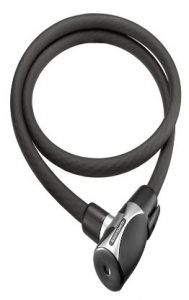
Here's the kind of lock I was using. Turns out that it's insufficient to stop a determined attacker.
They say that you haven’t lived in Oxford until you’ve had your bike stolen[citation needed]. Well: now I have, and I’ve learned an important lesson about the ineffectiveness of moderate-security cable locks
like the Kryptonite HardWire (the lock I was using) when up against thieves
who are willing to put in the effort to, for example, bring bolt cutters on a night out.
I spoke to a police officer yesterday who’s going to see if any of the nearby CCTV cameras are going to be of any use in finding the bugger. But in the meantime, I’ve had enough
of August. It’s had highlights, like Liz & Simon’s wedding, but mostly it’s been
less-than-great.
Last weekend, I got to go to the wedding of Liz and Simon. Particular highlights included:
Simon & Liz cut the cake.
Liz & Simon getting married! Aww. Congratulations to you both!
Catching up with ex-Aberites from far and wide. Drinking, dancing, and talking about religion, philosophy, and sex.
The céilidh, which is one of the best wedding ideas ever, not least because everybody gets to dance with the bride.
A fantastic venue: the beautiful St. Mary’s Guildhall,
in Coventry (a city with, it seems, a half-dozen nice buildings nestled in between a thousand concrete monstrosities and a ring road modeled on Satan’s anus itself).
Delicious food! And cake! And (veggie) sausage sandwiches just as we were beginning to run out of energy to continue dancing!
Speeches – both moving and funny – from the bride’s father, the groom, and the best man… but all were beaten by Kellie, a 2 year-old guest whose own short but hilarious
speech, “I’m pooing!”, which she shouted from the balcony of the dining room.
Simon & Liz heading off to take part in about a gazillion photos.
In my office at the Bodleian, we’ve got a calendar on which employees mark their annual leave.
The theme of the calendar is supposed to be paintings inspired by flowers… but – and maybe it’s just my dirty mind – this month’s image seems just a little bit saucy:
Our calendar this month. That’s supposed to be a flower, is it?
Click to embiggen. It can’t be just me that sees… it… right?
My Name Is Me. I choose to participate on much of the Internet by my full name. I say “full name”, rather than “real name”, because the term “real name” is full of loaded connotations. For example,
I (still) periodically have people insist that Dan Q isn’t my real name, because it’s not the name I was born with. It doesn’t matter to them that it’s the name I’m known
by to pretty much everybody (except my mother, who still calls me Daniel). It doesn’t matter that it’s the name on my passport or driving license. To them, it’s not “real” because to
them, real names are either those acquired by birth or marriage, and somehow nothing else is valid. And that’s without even looking at the number of times I’ve been discriminated
against because my name is “too short” for ill-designed computer systems.
That doesn’t bother me. What does bother me is that sites like Facebook and – in the
news recently on this very topic – Google+ demand that full “real” names are used on the profiles of their site users. If you
don’t use the name that appears on your government-issued documentation (if you have such a thing), then your accounts on these sites are liable to be closed. By the way: the same is
theoretically true of your Google Profile, too, so even if you’re not on the Google+ bandwagon and you, say, use a nickname in your Google Profile, your account is still at risk.
Now, I can see the point that these policies are trying to make. In fact, there was a time that I’d have naively agreed with them. They’re trying to make the Internet a safer,
more-accountable place. But in actual fact, there’s a real risk that they’ll make the Internet a lot more-treacherous for some people. I shan’t bother listing folks who are affected,
because others have done it far
more-thoroughly than I ever could.
But I shall point you in the direction of my.nameis.me, where you can read a little more about these issues.
Thanks.
To those of you that don’t know already, I have a confession to make. After years of picking holes in and finding flaws in their various ethical or other arguments and of mocking their
dietary choices, I’ve become… a vegetarian.
This cow, which was not harmed in the making of this blog post, was just as shocked as you are by the news of my vegetarianism.
Okay, this probably wasn’t actually a shock to anybody. Between the observations of the barbeque food I’ve been enjoying recently and the fact that I willingly chose
falafel over hog roast a month or so ago, it’s quite possible that you’re saying “well, duh” at this so-called revelation. That’s why I thought it’d be far more-interesting for me
to talk about the principal reason for this change.
You don’t eat what, now?
For some, however, this change has been a gradual one, beginning with dropping beef from my diet in January, and other red meats in March (making me, technically-speaking, a
lacto–ovo–melo–pollo–pescetarian, which is quite a mouthful). Poultry and fish disappeared from my diet in April and May.
For a brief stint, I tried to remove milk, too, aiming for ovo-vegetarianism, but it turns out that – while oatmilk is a perfectly reasonable alternative to the white stuff, and there
are some great soya-based dairy-free deserts – there really are no adequate vegan substitutes for cheese… and I’m just not quite capable of coping without it.
Things Dan eats.
Why, Dan? WHY?
My decision to adopt a vegetarian diet is based on a few different influences, but the principal one amongst these is one of environmentalism and sustainability. Over the last few years
it’s become increasingly apparent to me that the Western Pattern Diet has a hugely damaging effect in the following areas:
Water usage sustainability – studies consistently show[1][2] that it takes an order of magnitude more water to produce beef than wheat, rice, or maize, by weight of food produced. Other meats fare
somewhat better, being only three or four times less water-efficient per unit of weight of food, but are still unacceptably water-expensive, to me. Milk and eggs are really quite
water-efficient, being (respectively) about as efficient as soybeans/rice (depending on the region they’re grown in) and maize (note, of course, that beef and dairy cattle are almost
always separate breeds[3], so the counter-argument that beef is a by-product of milk production or vice-versa is
not valid).
Climatic impact – intensive modern livestock farming has an appreciable negative impact on global climate, contributing over a third of the world’s methane[4], probably the most-significant of the
greenhouse gases[5].
Food scarcity – despite worldwide crop yields increasing faster than population growth[6], year
on year, food security is becoming a growing issue owing to desertification of equatorial regions, increased uptake of the wasteful Western Pattern Diet, and an increase in the
production of biofuels. A still-growing population, the depletion of fish stocks, and a rapid increase by developed nations in biofuel demands as oil supplies
dwindle will only aggravate these issues. While a widely-adopted vegetarian/vegan diet would not in itself alleviate these problems (many of which are caused by political and
economic constraints), it would help to ensure that it is possible to feed our booming population in the decades to come.
Overfishing – most of those reasons, of course, are only applicable to the farming of mammals and birds, but it’s hard to deny that there are huge problems with our consumption of fish, too[7]. We’re already reaching the point where the consumption of many species of fish is ethically very dubious, and an increasing number of
species are threatened with extinction. To ensure that fish stocks remain available for future generations, we need either extremely restrictive multinational agreements on fishing
quotas (unlikely), or dramatic reductions in the demand for fish.
In short, I could probably best be described as an economic environmentalist vegetarian: I’m concerned primarily with making sure that our agricultural practices are
sustainable for the benefit of humans, whether currently existing or future. More on that, little doubt, in the Frequently Anticipated Questions, below.
So… how’re you finding it?
Man, I miss bacon.
A BLT; one of many culinary delights that I’m now denied. /sob/
Giving up beef, it turned out, was reasonably easy. Ditto lamb. But bacon: that’s something I miss. When my co-worker Liz had a bacon, mushroom and cheese jacket potato at an office lunch the other week, I could have almost drowned in my own drool. I find myself envying those
vegetarians I know who don’t eat meat because they don’t like it: those guys have it so easy…
Chicken’s been challenging, too, because it’s always been a go-to base ingredient for me, and I’ve had to learn to substitute other sources of protein into my diet. Thankfully, I’ve
been in a strong position: many years of cooking for vegetarians, at one point or another, has given me a pretty good understanding of what’s good for what and a decent repertoire of
already-vegetarian dishes.
I tried to give up milk and milk products after realising that the ecological impact of milk production – while significantly less than beef, for a variety reasons – is still higher
than I’d like. Sadly, it turns out that milk turns up in just about everything, and cheese and cream are remarkably hard to do without. Maybe some day I’ll give that another
go.
On the up-side, though, I’ve discovered a reasonable number of things that I didn’t think I liked, that actually I do… or at least, that are perfectly adequate substitutes for meat
products.
I also routinely slip up on the likes of isinglass (used in the production of many of my favourite beers), and gelatine (which appears in a surprising number of things), and I try not
to kick up a fuss where food is being prepared for several people, of which I’m only one, in a non-compatible way. For example, I tolerate the addition of Worcester sauce (containing
anchovies) as an ingredient where a meal is being prepared for several people – it’d be incredibly inconvenient to require a separation of the food at this point during cooking, and I’m
happy to compromise a little where the chef’s convenience collides with my ethics.
Frequently Anticipated Questions
In order that I jump the gun and answer you before you ask:
You consume products made using isinglass, gelatine, and occasional small quantities of fish sauce… you’re not a vegetarian at all!
I guess not. But the label’s for my convenience, not yours. I use the word vegetarian because it’s the simplest-common-denominator. If I ask in a restaurant “what have you got that’s
vegetarian, or would be but that it contains trace amounts of isinglass, is made using gelatine, has Worcester sauce in, etc.” I’d never get my meal. Plus, the staff would be confused.
To take a mathematical model: the set of things that better-vegetarians-than-I eat is completely contained within the set of things that I eat, and the two are very nearly the same, so
to call myself a vegetarian is closer to a convenient rounding error than a lie.
Also; that wasn’t a question.
Do you expect to make a significant difference?
No. But, like many moral decisions, this isn’t about making a significant difference but about doing the right thing.
If there’s a riot in your town and an out-of-control crowd begins damaging and looting the shops in the high street, you might be tempted to go out and steal a nice laptop or television
yourself, too. Regardless of whether or not you do so, you won’t make a significant difference – Currys will be just as empty in the morning whether you partake of a little ransacking
or not. But that doesn’t change the fact that it would be wrong of you to rob them.
On the other hand, over the course of the rest of my life I’m liable, under ideal circumstances, to make a miniscule but measurable net decrease in the demand for meat products, which
might, under ideal circumstances, have an impact on meat production, thereby coming some way to achieving my ideals. Moreover, I’d like to think that my dietary choices go some way to
making those dietary choices more palatable (hah!) for others, which may influence others to reduce their meat consumption too.
If the aim is to reduce meat consumption, why not simply eat less meat?
Because I can’t trust everybody else to play along.
My gut feeling is that this would work (although I haven’t read any research to either confirm or deny that suspicion): that if we all just cut down our meat consumption so that we were
eating meat only once every few weeks, that we’d have a huge impact on sustainability for the future. But I can’t make everybody do this. The best I can do is to do so myself.
However, if I go just a little bit further and stop eating meat altogether, then I also help to “make up” for other people’s meat-heavy diets.
For every animal you don’t eat, I’m going to eat two!
Well, I hope you enjoy it, because you’ll probably not live too long after consuming all the saturated fats of all of the animals I don’t eat.
You mentioned that the economic/ecological reasons were the principal cause for your vegetarianism. Are there other reasons, too, like the health and longevity benefits or the cost
saving?
Yes. But they’re not the principal reasons.
Incidentally, removing meat from my diet made it far easier for me to lose the second of my three 10kg weight loss goals (as part of my ongoing effort to get down from 110kg to 80kg;
I’m currently at about 89kg), because it’s far easier to avoid fats when you’re already avoiding meat.
How does JTA feel, being the only non-vegetarian in the house?
He’s not… so much. These days, Ruth eats a reasonable amount of a select few different varieties of meat,
and Paul… well, I’m not sure I can keep up with our favourite pepperoni-eating vegetarian, but I think that
right now he’s abstaining from meat entirely, but I’m not sure.
I have a hypothesis that perhaps the world can only tolerate a certain number of vegetarians at once, so as I became one, Ruth had to stop.
What about sustainably-farmed fish/synthetic meat/a survival situation/some other hypothetical situation?
I’m pragmatic, first and foremost, so if somebody wants to demonstrate that a particular farmed fish is environmentally sound, to my satisfaction, then great: it’s back on the menu! I’m
not going out of my way to look for any, though, because I was never a big seafood fan to begin with! It’s not a high priority for me to make my life more complicated by coming up with
some kind of complex list of what’s okay and what’s not, when the simple rule “no meat” seems to be perfectly workable.
Survival situation: sure, I’d chow down on whatever was available to stay alive. I’m not stupid!
And synthetic meat? If it was economically-sound, environmentally-friendly, safe, and tasty… sounds like a win to me. Fetch me a plate!
Isn’t this quite a turnaround for somebody who was once quoted on the BBC as describing vegetarianism as an “eating disorder”?
Yes, I suppose it is. I’ve always prided myself, though, on what I call “correctness over consistency”: that is, I’d like to think that I’m able to do the right thing, even
where it means contradicting my previous attitudes or behaviour. I believe that we’d all do a lot better if people were less attached than they are, on average, to appearing consistent,
especially when they’re faced with new information. There’s no shame in saying “I was wrong then,” so long as you can show that you’re learning.
But yes, I’ve been quite mean to many vegetarians for many years, as if I needed reminding. And so yes, this really is quite a turnaround. And I’m proud to be capable of that.
I’ve recently gotten a new phone – a HTC Sensation running
Android 2.3, and I thought I’d offer up a few thoughts on
it. But first…
Hang on: what was wrong with your old phone?
Well-remembered! You’re right, of course, that last year I got a Nokia N900, and that it was the
best mobile communications device I’d ever owned. I don’t care so much about a slim profile or an “app store”, but I do care about raw power and geeky hardware features, and the N900
delivers both of those in spades. I’ve had several phones that have, at the time, been the “best phone I’ve ever owned” – my 7110 and my N96 both also earned that distinction, whereas my 7610 and my C550 – the latter of which had only one redeeming feature – fell far short.
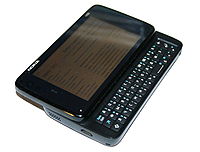
Nokia N900 with keyboard extended
Awesome though it is, with it’s beautiful hardware keyboard, mighty processor, FM receiver and transmitter, Bluetooth and IR, etc., and completely unlocked,
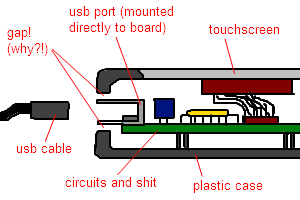
tamper-friendly architecture, the N900 suffers from one terrible, terrible flaw: for some reason, the engineers who built it decided to mount the Micro-B USB port (used for charging,
tethering, mounting etc. the phone) not to the hard plastic case, but to the fragile inner circuit board. Allow me to illustrate:
A cross-section of a Nokia N900, showing how the USB port is mounted directly to the circuit board, and doesn't touch the hard plastic case.
Why is this a problem? Well, as Katie explained to me at the New Earth housewarming party,
most of her other friends who’d had N900s had encountered a problem by now, whereby the USB cable used to charge the device eventually puts a strain on the connection between the port
and the board, tearing them apart. “Nope,” I told her, “I’ve never had any such problem with mine.”
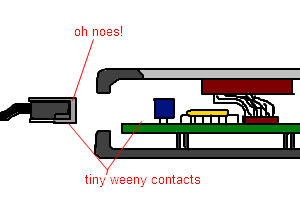
A cross-section of a Nokia N900, showing the USB port snapped off by the USB cable.
Looks like I spoke too soon, because that very week, I managed to break my N900 in exactly this way. My theory: that girl is cursed. I shall be attempting to
exorcise the anti-technology demons in her the very next time I see her, possibly in some kind of ceremony involving high-voltage direct current. In any case, I found myself with a
phone that I couldn’t charge.
So you replaced it?
No, of course not. My N900 remains a fantastic palmtop and a great device. It’s just got a minor problem in that it’s no longer possible to charge or “hard”-tether it to anything any
more. The latter problem was an easy one to fix: a separate battery charger (I already carry a spare battery for it, so this was no hardship), bought for about £4 on eBay, made it easy
to keep the device rolling. The second problem’s not so much of an issue, because I tend to do all of my synchronisation by Bluetooth and WiFi anyway. But even if
these were an issue, it looks like a pretty
simple job to re-solder the USB port (and epoxy it to the case, as it should have been to begin with!). I might give it a go, some day, but my current soldering iron is a little big
and chunky for such fine and delicate work, and I’m a little out of practice, so I’ll save that project for another day.
The repairing of a Nokia N900 USB port
However, I’m a big believer in the idea that when the Universe wants you to have a new phone, it finds a fault with your current phone. Perhaps this is the geek equivalent of thinking
that “When God
closes a door, He opens a window”.
So: I’ve got myself a HTC Sensation, which narrowly beat the Sony Ericsson Xperia Arc after carefully weighing up the reviews. I’d always planned that I’d try an Android device next, but
I’d originally not expected to do so until Ice Cream Sandwich, later this year. But… when the Universe
closes your USB Port, it opens a Gingerbread shop… right?
The New Sensation
After a few difficulties relating to my name – it turns out that my mobile
phone network has recorded my name correctly in their database, and I can’t change it, but whenever I use their web-based checkout it asks me to enter a longer surname even though I
don’t have a surname field to change – I finally received my new phone.
HTC Sensation seen from the back, front, and side.
The first thing one notices about this phone is that it’s fast. Blindingly fast. I’ve used a variety of Android-powered HTC devices before, as well as other modern
touchscreen smartphones like the iPhone, and I’m yet to use anything that consistently ramps up high-end graphics and remains slick and responsive like this does. Its mighty dual-core
1.2GHz processor’s the cause of this, little doubt. I originally worried that battery life might be limited as a result – I don’t mind charging my phone every night, but I don’t want to
have to charge it during the day too! – but it’s actually been really good. Using WiFi, GPRS, GPS, playing videos, surfing the web, and other “everyday” tasks don’t put a dent in the
battery: I’ve only once seen it dip to under 10% battery remaining, and that was after 40 hours of typical use during a recent camping weekend (with no access to electricity).
It’s also been really well-designed from a usability perspective, too. Those familiar with Android would probably just start using it, but I’ve not had so much exposure to the platform
and was able to come to it with completely fresh eyes. Between Android 2.3 and HTC Sense 3, there’s a nice suite of “obvious” apps, and I didn’t have any difficulty synchronising my contacts, hooking up my various email
accounts, and so on. There are some really nice “smart” touches, like that the phone rings loudly if it thinks it’s in a bag or pocket, more quietly after you pick it up, and silences
the ringer completely if you pick it up from a table and flip it from face-up to face-down. These simple gestural touches are a really nice bit of user interface design, and I
appreciate the thought that’s gone into them.
Browsing movies for HD streaming on the HTC Sensation.
The Android Marketplace is reasonable, although I feel as though I’ve been spoiled. On the N900, if there was an application I needed, I usually already knew what it was and where I’d
find it: then I’d either apt-get it, or download the source and
compile it, right there on the device. For somebody who’s already perfectly confident at a *nix command-line, the N900 is fab, and it feels a little restrictive to have to
find equivalent apps in a closed-source environment. It’s not that the pricing is unreasonable – most of the applications I’ve wanted have been under a quid,
and all have been under £4 – it’s just that I know that there are FOSS alternatives that would have been easy to compile on my old device: I guess it’s just a transition.
On the other hand, the sheer volume of applications so-easily available as the Android Market is staggering. I’ve been filled with app ideas, but every idea I’ve had but one or
two already exist and are just waiting to be installed. It’s a little like being a kid in a candy store.
It’s also taking me quite some time to get used to the way that process management works on an Android device. On Android devices, like the iPhone/iPad, returning to the home screen
doesn’t (necessarily) close the application, but it might – that’s up to the developer. If it doesn’t, the application will probably be “paused” (unless it’s
a media player or it’s downloading or something, then it’ll likely keep going in the background). And when you re-launch the same application, it could be
simply unpausing, or perhaps it’s relaunching (in which case it may or may not restore its previous state, depending on the whim of the developer)… You see
all of the keywords there: might, probably, likely, could, perhaps. Great for most users, who don’t want to have to
think about what their phone is doing in the background, but it feels like a step backwards to me: I’m used to being able to ALT-TAB between
my currently-running applications, to know what’s running, when (and I can always use top and find out exactly what resources a process is eating). Putting all of this process management into the hands of developers feels to me like giving
up control of my device, and it’s a challenging change to undergo. Yes: despite the openness of the platform, Android feels just a little out of my control compared to
what I’m used to.
Hacker's Keyboard, my preferred keyboard layout for SSH, etc.
Switching from a physical to a virtual keyboard for the first time is a significant change, too, and it’s slowed me down quite a lot, although applications like SwiftKey X – with its incredibly intelligent personalised predictions – and Hacker’s Keyboard – which gives me back some of the keys I was
“missing” – have helped to ease the transition a lot.
In summary: the HTC Sensation seems to be a fantastic device, and I’m really enjoying using it. I’ve got a few niggles to contend with, but these are all things that were destined to
catch me out upon switching away from a platform as open as the N900, and they’re not severe enough to make me give up and get an N950 instead: I’m reasonably confident that I’ll come
to love the Sensation and we’ll go on to be very happy together.
But will it become my latest “best phone ever”? Time will tell, I guess.
Family Picnic: Joining Ruth and JTA at Ruth’s annual family picnic, among her billions of
second-cousins and third-aunts.
New Earthwarming: Having a mini housewarming on New Earth, where I live with Ruth, JTA, and Paul. A surprising number of people came from surprisingly far away, and it was fascinating to see some really interesting networking being done by a mixture of
local people (from our various different “circles” down here) and distant guests.
Bodleian Staff Summer Party: Yet another reason to love my
new employer! The drinks and the hog roast (well, roast vegetable sandwiches and falafel wraps for me, but still delicious) would have won me over by themselves. The band was just
a bonus. The ice cream van that turned up and started dispensing free 99s: that was all just icing on the already-fabulous cake.
TeachMeet: Giving a 2-minute nanopresentation at the first Oxford Libraries
TeachMeet, entitled Your Password Sucks. A copy of my presentation (now with annotations to make up for the fact that you can’t hear me talking over it) has been uploaded to the website.
New Earth Games Night: Like Geek Night, but with folks local to us, here, some of whom might have been put off by being called “Geeks”, in that strange way that
people sometimes do. Also, hanging out with the Oxford On Board folks, who do similar things on
Monday nights in the pub nearest my office.
Meeting Oxford Nightline: Oxford University’s Nightline is just about the only Nightline in the British Isles to not be using Three Rings, and they’re right on my doorstep, so I’ve
been meeting up with some of their folks in order to try to work out why. Maybe, some day, I’ll actually understand the answer to that question.
Alton Towers & Camping: Ruth and I decided to celebrate the 4th anniversary of us getting together with a trip to Alton Towers, where their new ride, Thirteen, is really quite
good (but don’t read up on it: it’s best enjoyed spoiler-free!), and a camping trip in the Lake District, with an exhausting but fulfilling trek to the summit of Glaramara.
Setting up camp at Stonethwaite.
That’s quite a lot of stuff, even aside from the usual work/volunteering/etc. stuff that goes on in my life, so it’s little wonder that I’ve neglected to blog about it all. Of
course, there’s a guilt-inspired downside to this approach, and that’s that one feels compelled to not blog about anything else until finishing writing about the first neglected thing, and so the problem snowballs.
So this quick summary, above? That’s sort-of a declaration of blogger-bankruptcy on these topics, so I can finally stop thinking “Hmm, can’t blog about X until I’ve written about
Code Week!”
On this day in 2003 I first juggled with flaming
clubs! But first, let’s back up to when I very first learned to juggle. One night, back in about 1998, I had a dream. And in that dream, I could juggle.
I’d always been a big believer in following my dreams, sometimes in a quite literal sense: once I dreamed that I’d been writing a Perl computer program to calculate the frequency pattern of consecutive months which both have a Friday 13th in them. Upon
waking, I quickly typed out what I could remember of the code, and it worked, so it turns out that I really can claim to be able to program in my sleep.
In this case, though, I got up and tried to juggle… and couldn’t! So, in order that nobody could ever accuse me of not “following my dreams,” I opted to learn!
About three hours later, my mother received a phone call from me.
“Help!” I said, “I think I’m going to die of vitamin C poisoning! How much do I have to have before it becomes fatal?”
“What?” she asked, “What’s happened?”
“Well: you know how I’m a big believer in following my dreams.”
“Yeah,” she said, sighing.
“Well… I dreamed that I could juggle, so I’ve spent all morning trying to learn how to. But I’m not very good at it.”
“Okay… but what’s that got to do with vitamin C?”
“Well: I don’t own any juggling balls, so I tried to find something to use as a substitute. The only thing I could find was this sack of oranges.”
“I think I can see where you’re going wrong,” she said, sarcastically, “You’re supposed to juggle with your hands, Dan… not with your mouth.”
“I am juggling with my hands! Well; trying to, anyway. But I’m not very good. So I keep dropping the oranges. And after a few drops they start to rupture and burst, and I can’t
stand to waste them, so I eat them. I’ve eaten quite a lot of oranges, now, and I’m starting to feel sick.”
I wasn’t overdosing on vitamin C, it turns out – that takes a quite monumental dose; perhaps more than can be orally ingested in naturally-occuring forms – but was simply
suffering from indigestion brought on as a result of eating lots and lots of oranges, and bending over repeatedly to pick up dropped balls. My mother, who had herself learned to juggle
when she was young, was able to give me two valuable tips to get me started:
Balled-up thick socks make for great getting-started juggling balls. They bounce, don’t leak juice, and are of a sensible size (if a little light) for a beginning juggler.
Standing with your knees against the side of a bed means that you don’t have to bend over so far to pick up your balls when you inevitably drop them.
I became a perfectly competent juggler quite quickly, and made a pest of myself in many a supermarket, juggling the produce.
So: fast forward five years to 2003, when Kit, Claire, Paul, Bryn and I decided to have a fire on the beach, at Aberystwyth. We’d… acquired… a large solid
wooden desk and some pallets, and we set them up and ignited them and lounged around drinking beer. After a little while, a young couple came along: she was swinging flaming poi around, and he was juggling flaming clubs!
Fire poi! They look fantastic when they're flying around you; scary when they're flying towards you.
I asked if I could have a go with his flaming clubs. “Have you ever juggled flaming clubs before?” he asked. “I’ve never even juggled clubs before,” I
replied. He offered to extinguish them for me, first, but I insisted on the “full experience.” I’d learn faster if there existed the threat of excruciating pain every time I fucked up,
surely. Right?
Juggling clubs, it turns out, is a little harder than juggling balls. Flaming clubs, even more so, because you really can’t get away with touching the “wrong” end. Flaming
clubs at night, after a few drinks, is particularly foolhardy, because all you can see is the flaming end, and you have to work backwards in your mind to interpret
where the “catching end” of the stick must be, based on the movement of the burning bit. In short: I got a few minor singes.
But I went home that night with the fire still burning in my eyes, like a spark in my mind. I couldn’t stop talking about it: I’d been bitten by the flaming-clubs-bug.
Looking Forward
I ordered myself a set of flaming clubs as soon as I could
justify the cost, and, after a couple of unlit attempts in the street outside my house, took them to our next beach party a few days later. That’s when I learned what really makes flaming clubs dangerous: it’s
not the bit that’s on fire, but the aluminium rod that connects the wick to the handle. Touching the flaming wick; well – that’ll singe a little, but it won’t leave a burn so long as
you pull away quickly. But after they’ve been lit for a while – even if they’ve since been put out – touching the alumium pole will easily leave a nasty blister.
Me juggling flaming clubs at the barbecue I mentioned, in 2007. I almost look like I know what I'm doing. And more importantly, I feel like a badass.
Still: I learned quickly, and was still regularly flinging them around (and teaching others) at barbecues many years later.
Once, a Nightline training ended up being held at an unusual location, and the other trainers and I were
concerned that the trainees might not be able to find it. So we advertised on the email with the directions to the training room that trainees who can’t find it should “introduce
themselves to the man juggling fire outside the students union”, who would point them in the right direction: and so I stood there, throwing clubs around, looking for lost people all
morning. Which would have worked fine if it weren’t for the fact that I got an audience, and it became quite hard to discreetly pick out the Nightline trainees from the
students who were just being amused by my juggling antics.
Nowadays, I don’t find much time for juggling. I keep my balls to-hand (so to speak) and sometimes toss them about while I’m waiting for my computer to catch up with me, but it’s been a
long while since I got my clubs out and lit them up. Maybe I’ll find an excuse sometime soon.
This blog post is part of the On This Day series, in which Dan periodically looks back on years gone
by.
Last week, I was invited to a barbeque with Oxford’s Young Friends. Despite being neither a Friend
(in their “capital-F” meaning of the word: a Quaker) nor young (at least; not so young as I was, whatever that means), I went along and showed off my barbecue skills. It also gave me an
excuse to make use of my Firestick – a contemporary tinderbox – to generally feel butch
and manly, perhaps in an effort to compensate for the other week.
Anyway: this is how I discovered halloumi and mushroom skewers. Which may now have become my favourite barbeque foodstuff. Wow. Maybe it’s just the lack of
mushrooms in my diet (we operate a cooking rota on Earth, but Paul doesn’t like mushrooms so I usually only get them when he or I happen to be eating elsewhere), but these things are just
about the most delicious thing that you can pull off hot coals.
Aside from meat, of course.
Update: we just had some at the Three Rings Code Week, and they were almost as delicious once again,
despite being hampered by a biting wind, frozen mushrooms, and a dodgy barbeque.
Last week, I saw X-Men: First Class at the cinema with Ruth. The film was… pretty mediocre, I’m afraid… but another part of the cinemagoing experience was quite
remarkable:
There’s a bit in the film where Xavier, then writing his thesis at Oxford University, and a CIA agent are talking. As they talk, they walk right through the middle of the Bodleian
Library, right past my office. It’s not just Morse and Lewis and the Harry Potter films that make use of the Library (at great expense, I gather)
for filming purposes! “That’s my office!” I squee’d, pointing excitedly at the screen.
Needless to say, the student-heavy audience cheered loudly at the presence of parts of Oxford that they recognised, too. It’s been a while since I was in a cinema where people actually
cheered at what was going on. In fact, the last time will have been in the Commodore
Cinema in Aberystwyth. But cinema-culture in Aberystwyth’s strange anyway.
A couple of weeks ago, the other Earthlings and I played our very first
game of Spirit of the Century. Spirit of the Century is a
tabletop roleplaying game based on the FATE system (which in turn
draws elements from the FUDGE system, and in particular,
the FUDGE dice). Are you following me so far?
Four sets of FUDGE/FATE dice. Each die is labelled with 2 “blank”, 2 “minus” and 2 “plus” sides, and all four are rolled to obtain a result between -4 and +4, on a probability
bell-curve trending towards 0. Neat.
Spirit of the Century is set in the “pulp novel” era of the 1920s, in the optimistic period between the two world wars. The player characters play pulp-style heroes: the learned
professor, the adventurous archaeologist, the daring pilot, all of those tropes of the era. Science, or – as it should be put – Science! is king, and there’s no telling
what fantastic and terrifying secrets are about to be unleashed upon the world. Tell you what… let me just show you the cover for the sourcebook:
Yes; that’s a gorilla flying a biplane away from a stricken zeppelin, fighting a masked hero. Meanwhile, a female mechanic clambers under the fuselage and man wearing a jetpack pulls
alongside, guns blazing.
Everything you need to know about the game is right in that picture, right there.
The character generation mechanism is different from most RPGs; even other fluffy, anti-min/max-ey ones. All player characters (for reasons relevant to the mythos) were born on
1st January 1901, so the first part of character creation is explaining what they did during their childhood. The second part is about explaining what they did during the Great War.
During each of these (and every subsequent step), the character will gain two “aspects”, which they’ll later use for or against their feats in a way not-too-dissimilar from the PDQ System (which may be familiar to those of you who’ve played
Ninja Burger 2nd Edition).
The third chapter of character generation involves telling your character’s own story – their first adventure – in the style of a pulp novel. The back of the character sheet will
actually end up with a “blurb” on it, summarising the plot of their novel. Then things get complicated. In the fourth and fifth chapters, each character will co-star in the novels of
randomly-selected other player characters. This can involve a little bit of re-writing, as stories are bent in order to fit around the ideas of the players, but it serves
an important purpose: it gives groups of player characters a collaborative backstory. “Remember the time that we fought off Professor Mechk’s evil robot
army?”
Johnny Sparks is a character of my creation.
That’s exactly what Johnny Sparks did in “Johnny Sparks and the Robot Army”. When Professor Mechk released his evil robot army on the streets of New York City, Johnny Sparks –
government-sponsored whizkid – knew he had to act. With his old friend Jack Brewood (and Jack’s network of black market contacts), he acquired the parts to build a weapon powered by
lightning itself. Then, alongside Mafia child and expert pugilist Michael Leone, he fought his way up the Empire State Building to Mechk’s control centre. While Michael duelled
with Mechk, Johnny channeled the powers of the heavens into the gigantic robot brainwave transmitter at the top of the tower, sending it into overload. As the tower-top base melted down
and exploded, Michael and Johnny abseiled rapidly down the side to safety.
And so they have a history, you see! And some “aspects” for it: Johnny got “Master of Storms” from his lightning-based research and “With thanks to Jack” for his friend’s support.
Meanwhile Jack got “On Johnny’s wavelength” to represent the fact that he’s one of the few people who can follow Johnny’s strange and aspie-ish thought patterns.
Beer, crisps, and roleplaying. What more does an Earthling need?
In our first play session, Michael Leone (Paul), Jack Brewood (JTA), and Anna Midnight (Ruth) found themselves in a race to rescue aviator Charles Lindbergh from the evil Captain Hookshot and his blimp-riding pirates.
Hookshot hoped to use the kidnap of Lindbergh as leverage to get his hands on some of Thomas Edison‘s secret research, which he hoped would allow him to gain a stranglehold on the world’s aluminium supply, which was only just
beginning to be produced in meaningful quantities. So began an epic boat (and seaplane) chase across the Atlantic to mysterious Barnett Island, a fight through the pirates’ slave camp and bauxite mines, a Mexican-stand-off aboard a zeppelin full of
explosives, and a high-speed escape from an erupting volcanic island.
Highlights included:
Jack’s afraid of flying, so while the others arrived for the first scenes of the adventure by seaplane, Jack trundled well behind in a cruiser. As a result, he completely missed
the kidnapping.
When Hookshot was first kidnapping Edison, his attempt was foiled when Ana threw a cutlass at him, severing the grapple he had tied to the scientist.
Michael’s a badass at barehand combat. When he wasn’t flinging wild dogs into trees, he was generally found crushing the skulls of pirates into one another.
Spirit of the Century encourages a particular mechanism for “player-generated content”. This was exemplified wonderfully by Jack’s observation that he “read once that there was
a tribal whaling camp on an island near here, called Ingleshtat.” He paid a FATE point and made an Academics roll, but because I wouldn’t tell him the target of the roll he only knew
that he’d “done well”, and not that he’d “done well enough.” He and the other player characters weren’t sure that his knowledge was accurate until they reached the
island (and thankfully found that he was right). Similarly, the motivation for the kidnapping wasn’t about aluminium until one of the players speculated that it might be.
Ana Midnight’s spectacularly failed attempt at stealth, as she crept via a creaky door into a building full of armed guards. Also, Jack’s fabulous rescue attempt, as he dived
and rolled into the building, firing his pistol as he went, while Michael climbed up the zeppelin’s boarding tower, leading to…
The tense (and, surprisingly, combat-free… barely!) stand-off and negotiation aboard Hookshot’s zeppelin, towards the end of the story.
There’s a lot of potential for a lot of fun in this game, and we’ll be sure to play it again sometime soon.
When I relaunched Abnibthe other week (which
I swear I didn’t expect to have to do, until people started complaining that I was
going to let it die – this genuinely wasn’t some “marketing” stunt!), I simultaneously brought back Abnib Chat (#abnib),
the IRC channel.
I blame Jen for this. She told me that she missed the long-dead #rockmonkey chat room, and wanted it (or something
similar) back, so I decided to provide one. Hell; if Jen wanted it, maybe other people wanted it to? And it’s an easy thing to set up, I thought.
Personally, I thought that the chat room would be a flop. I’d give it a go, of course, but I didn’t hold up much hope for its survival. When Abnib first launched, back in 2003, the Abnibbers were all students first and foremost. Now, they’ve all got jobs,
and many of those jobs aren’t of a variety compatible with sitting on an IRC channel all day. And at night? We’ve got money, nowadays, and homes, and spice, and all kinds of activities that consume our lives on an evening. Many of us
get what our younger student selves would call an “early night” every day of the week, and there’s always so much to do that shooting the breeze over a laborious IRC
channel simply isn’t compatible with our lives any more.
Looks like I was right. Here’s the channel activity for the first fortnight of the new Abnib Chat:
#abnib participants in June 2011
Sure, the 1st of the month was busy, but not very busy: in actual fact, many of the people who were “around” were only around briefly, and one of those – Guest1332 – didn’t
even identify themselves.
We’ve all got new ways of communicating now. Some folks are using Twitter (I occasionally read the feeds of those who write in a way that I’m permitted to see, but I don’t “tweet”
myself). Others use Facebook (for a given definition of “use”, anyway). Others still continue to blog (that’s the medium for me: I think I’m just a little too wordy for
anything less). In any case; we’re like Abnib: The Next Generation, and we’ve got reliable transporters and replicators and all kinds of cool shit, and hanging around in
an IRC channel just feels kind of… backwards.
Perhaps I’ve been watching too much Star Trek recently.
Anyway – unless people object to that, too (seriously?), I’ll be turning off Iggy later this month: so if you’ve got something important to say to him, say it soon! I’ll leave the
“Chat” button on Abnib because it’s lazier than removing it, and you never know if somebody might find a use for it, but I think it’s time to declare the channel “dead”.