A week ago, Ruth pushed a baby out of her body, completely upstaging my birthday and, incidentally,
throwing all of our lives pretty much into chaos. Having gotten to the point at which she’d resigned herself to “being pregnant forever“, Ruth would have certainly been glad to have that stage over and done with, were it not for a long and painful labour followed by a torturous and
exhausting birth.
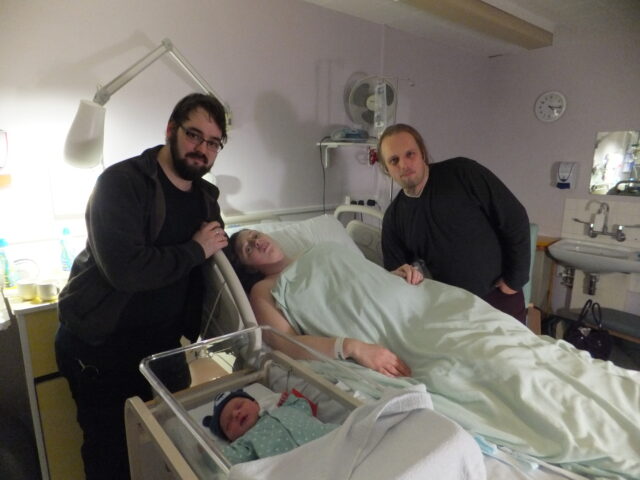
If Ruth looks like she’s about to die of exhaustion in this photo, that’s because that’s how she’s feeling.
There’s a lot that can be said about the labour: a 38-hour crescendo of Ruth gradually and repeatedly finding levels of pain and tiredness that each seemed impossible, until she reached
them. But Ruth has suggested that she might like to write a little about it herself, so I shan’t steal her limelight. What I can say is that I didn’t – and I don’t think that JTA, either – appreciate quite how emotionally draining the experience would be for the two of us, as well. There was a
strange sensation for me about twelve hours in: a sensation perhaps most-comprehensible by our friends who’ve done emotional support work. That was: after watching somebody I love so
much suffer so greatly for so long, I felt as if I’d somehow begun to exhaust whatever part of my brain feels empathy. As if the experience of supporting Ruth had served to drain me in
a way I’d never fully experienced before, like when you discover a muscle you didn’t know you had when it aches after an unusual new exercise.
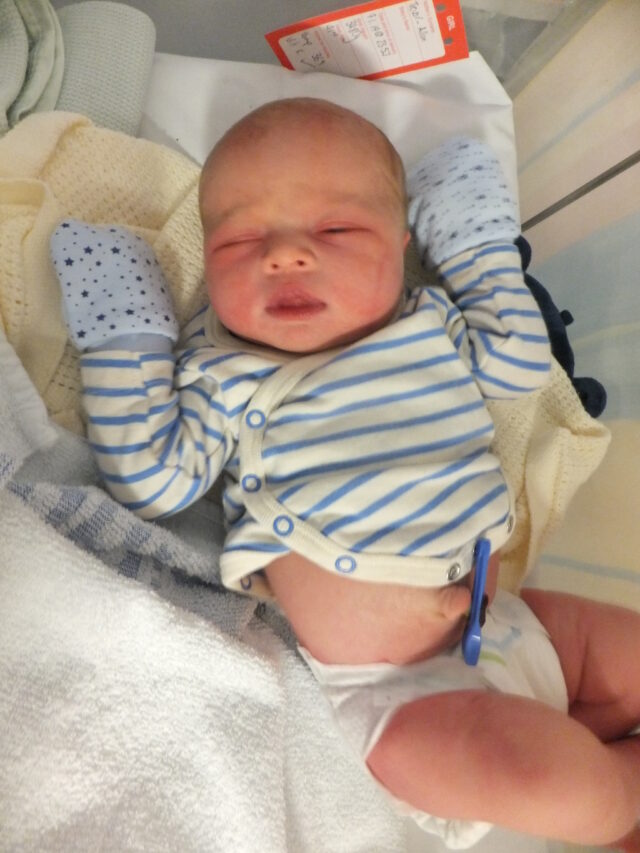
Forcep-marks still visible, the newborn takes an extended nap in a crib alongside Ruth’s recovery-bed.
Of course, after the ordeal we got to take home a little bundle of joy, who continues – despite now having a perfectly fabulous name of her own – to be referred to as “tiny”, even
though her birth weight of 8lbs 12oz (that’s about 4kg, for those who – like me – prefer to think in metric) doesn’t really make that a very fitting nickname! Nor the amount of damage
she did to Ruth on the way out, which also might be ill-described as “tiny”! She’s also often referred to as “the poopmachine”, for reasons that ought not need spelling out.
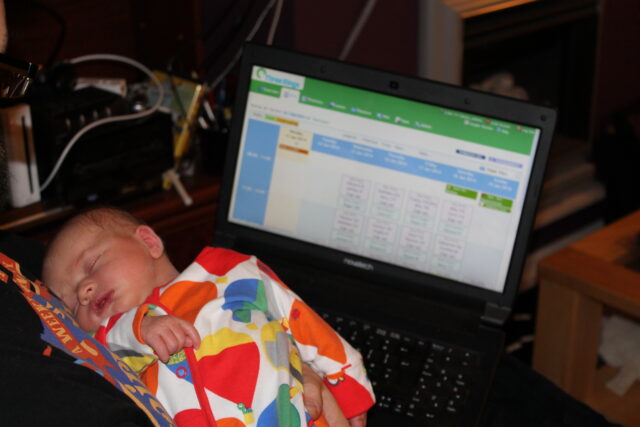
I’m smiling, because I don’t yet know that, within seconds of this photo being taken, she’s about to fill her nappy.
My employer was kind enough to give me paternity leave, even though I’m not the biological father (JTA is; and he’s very-much still in the picture!). I’d looked at my contract and
discovered that the wording seemed to imply that I was eligible, stating that I’d be permitted to take paternity leave if I was about to become a father, or if my partner was about to
give birth, the latter of which seemed perfectly clear. To be certain, I’d wandered along to Personnel and explained our living arrangement, and they just had looks on their faces that
said “we’re not touching that with a barge pole; let’s just err on the side of giving him leave!” As a result, we’ve had all hands on deck to help out with the
multitudinous tasks that have suddenly been added to our lives, which has been incredibly useful, especially given that Ruth has been spending several days mostly lying-down, as she’s
been recovering from injuries sustained during the delivery.
If only we had some kind of way to set up a web-based rota of feeding, changing and comforting the little one…
Despite everything, we and the rest of the Three Rings team still managed to push the latest version into testing on schedule, though
fitting in time for bug-fixing is even harder than it would be were we at our “day jobs” during the daytimes! It’s not that our little poopmachine takes up all of our time, though she
does seem to take a lot of it, it’s simply that we’re all so tired! For the last few nights she’s been fussy about sleeping, and we’ve all lost a lot of rest time over keeping her fed,
clean, and feeling loved.
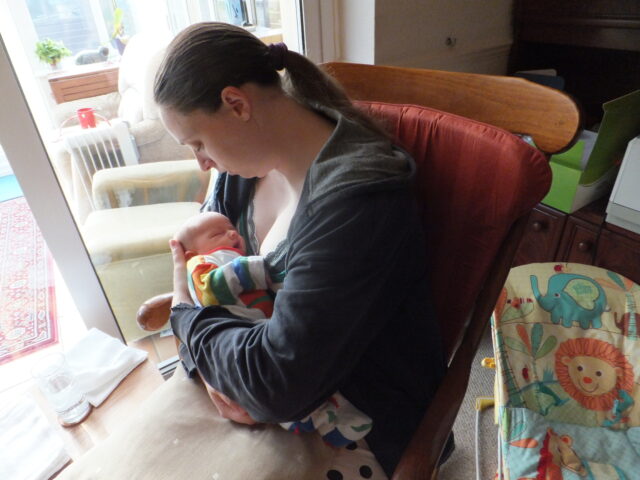
Who loves boob? Baby does! Also, everybody else in the house.
For all my complaining, though, what we’ve got here is an adorable and mostly well-behaved little bundle of joy. And when she’s not covered in poop, shouting for
attention, or spitting milk all over you, she’s a little angel. And I’m sure you’ll all be sick of hearing about her very soon.
While you’re tucking in to your turkey tomorrow and the jokes and puzzles in your crackers are failing to impress, here’s a little riddle to share with your dinner guests:
Which is the odd-one out: gypsies, turkeys, french fries, or the Kings of Leon?
If you answer “turkey, because it’s the only one that’s a bird,” then you’re somewhat missing the point.
In order to save you from “accidentally” reading too far and spoling the answer for yourself, here’s a picture of a kitten to act as filler:
Aww.
Want a hint? This is a question about geography. Specifically, it’s a question about assumptionsabout geography. Have
another think: the kittens will wait.
Interestingly, this Persian cat could easily be another candidate for the odd-one-out.
Okay. Let’s have a look at each of the candidates, shall we? And learn a little history as we go along:
Gypsies
The Romami are an ethnic group of traditionally-nomadic people, originating
from Northern India and dispersing across Europe (and further) over the last millenium and a half. They brought with them some interesting anthropological artefacts of their culture,
such as aspects of the Indian caste system and languages (it’s through linguistic similarities that we’ve been best-able to trace their multi-generational travels, as written records of
their movements are scarce and incomplete), coupled with traditions related to a nomadic life. These traditions include strict rules about hygiene, designed to keep a travelling
population free of disease, which helped to keep them safe during the European plagues of the 13th and 14th centuries.
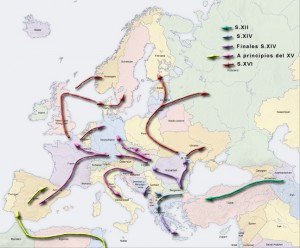
The migration of the Romanies. The arrows show that they stopped in France for some French Fries before continuing to Britain.
Unfortunately for them, when the native populations of Western European countries saw that these travellers – who already had a reputation as outsiders – seemed to be immune to the
diseases that were afflicting the rest of the population, their status in society rapidly degraded, and they were considered to be witches or devil-worshippers. This animosity made
people unwilling to trade with them, which forced many of them into criminal activity, which only served to isolate them further. Eventually, here in the UK, laws were passed to attempt
to deport them, and these laws help us to see the origins of the term gypsy, which by then had become commonplace.
Consider, for example, the Egyptians Act 1530, which uses the word
“Egyptian” to describe these people. The Middle English word for Egypian was gypcian, from which the word gypsy or gipsy was a
contraction. The word “gypsy” comes from a mistaken belief by 16th Century Western Europeans that the Romani who were entering their countries had emigrated from Egypt. We’ll get back
to that.
Turkeys
When Europeans began to colonise the Americas, from the 15th Century onwards, they discovered an array of new plants and animals previously unseen by European eyes, and this ultimately
lead to a dramatic diversification of the diets of Europeans back home. Green beans, cocoa beans, maize (sweetcorn), chillis, marrows, pumpkins, potatoes, tomatoes, buffalo, jaguars,
and vanilla pods: things that are so well-understood in Britain now that it’s hard to imagine that there was a time that they were completely alien here.
Gobblegobblegobblegobble.
Still thinking that the Americas could be a part of East Asia, the explorers and colonists didn’t recognise turkeys as being a distinct species, and categorised them as being a kind of
guineafowl. They soon realised that they made for pretty good eating, and started sending them back to their home countries. Many of the turkeys sent back to Central Europe arrived via
Turkey, and so English-speaking countries started calling them Turkey fowl, eventually just shortened to turkey. In actual fact, most of the turkeys reaching
Britain probably came directly to Britain, or possibly via France, Portugal, or Spain, and so the name “turkey” is completely ridiculous.
Fun fact: in Turkey, turkeys are called hindi, which means Indian, because many of the traders importing turkeys were Indians (the French, Polish, Russians, and Ukranians
also use words that imply an Indian origin). In Hindi, they’re called peru, after the region and later country of Peru, which also isn’t where they’re from (they’re native
only to North America), but the Portugese – who helped to colonise Peru also call them that. And in Scottish Gaelic, they’re called cearc frangach – “French chicken”!
The turkey is a seriously georgraphically-confused bird.
French Fries
As I’m sure that everybody knows by now, “French” fries probably originated in either Belgium or in the Spanish Netherlands (now part of Belgium), although some French sources claim an
earlier heritage. We don’t know how they were first invented, but the popularly-told tale of Meuse Valley fishing communities making up for not having enough fish by deep-frying pieces of potato, cut into the shape of fish, is
almost certainly false: a peasant region would be extremely unlikely to have access to the large quantities of fat required to fry potatoes in this way.
They may find it hard to prove that they invented fries, but the Belgians certainly hold the claim to the world’s only museum dedicated to the food.
So why do we – with the exception of some confusingly patriotic Americans – call them French fries. It’s hard to say for certain, but based
on when the food became widely-known in the anglophonic world, the most-likely explanation comes from the First World War. When British and, later, American soldier landed in Belgium,
they’ll have had the opportunity to taste these (now culturally-universal) treats for the first time. At that time, though, the official language of the Belgian army (and the
most-popularly spoken language amongst Belgian citizens) was French. The British and American soldiers thus came to call them “French fries”.
The Kings of Leon
For a thousand years the Kingdom of Leon represented a significant part of what would not be considered Spain and/or Portugal, founded by Christian kings who’d recaptured the Northern
half of the Iberian Peninsula from the Moors during the Reconquista (short
version for those whose history lessons didn’t go in this direction: what the crusades were against the Ottomans, the Reconquista was against the Moors). The Kingdom of Leon
remained until its power was gradually completely absorbed into that of the Kingdom of Spain. Leon still exists as a historic administrative region in Spain, similar to the counties of
the British Isles, and even has its own minority language (the majority language, Spanish, would historically have been known as Castilian – the traditional language of the neighbouring
Castillian Kingdom).
Leon, sandwiched between the other kingdoms of the 13th century Iberian Peninsula.
The band, however, isn’t from Leon but is from Nashville, Tennessee. They’ve got nothing linking them to actual Leon, or Spain at all, as far as I can tell, except for their name – not
unlike gypsies and Egypt, turkeys and Turkey, and French fries and France. The Kings of Leon, a band of brothers, took the inspiration for their name from the first name of their father
and their grandfather: Leon.
The Odd One Out
The Kings of Leon are the odd one out, because while all four have names which imply that they’re from somewhere that they’re not, the inventors of
the name “The Kings of Leon” were the only ones who knew that the implication was correct.
The people who first started calling gypsies “gypsies” genuinely believed that they came from Egypt. The first person to call a turkey a “Turkey fowl” really was under the impression
that it was a bird that had come from, or via, Turkey. And whoever first started spreading the word about the tasty Belgian food they’d discovered while serving overseas really thought
that they were a French invention. But the Kings of Leon always knew that they weren’t from Leon (and, presumably, that they weren’t kings).
And as for you? Your sex is on fire. Well, either that or it’s your turkey. You oughta go get it out of the oven if it’s the latter, or – if it’s the former – see if you can get some
cream for that. And have a Merry Christmas.
What’s the hardest word to guess, when playing hangman? I’ll come back to that.
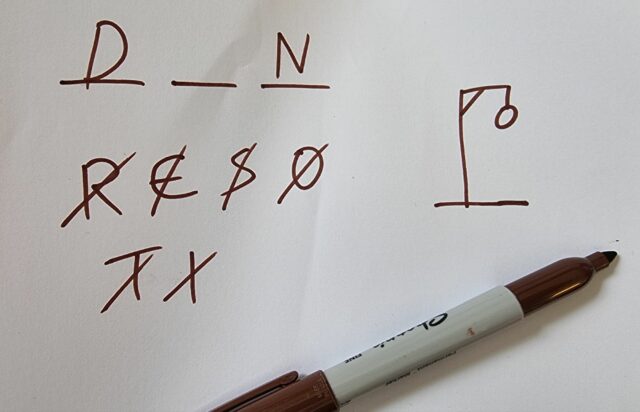
Whatever could the missing letter be?
Last year, Nick Berry wrote a fantastic blog post about the optimal strategy for Hangman. He showed that the best guesses
to make to get your first “hit” in a game of hangman are not the most-commonly occurring letters in written English, because these aren’t the most commonly-occurring
letters in individual words. He also showed that the first guesses should be adjusted based on the length of the word (the most common letter in 5-letter words is ‘S’, but the most
common letter in 6-letter words is ‘E’). In short: hangman’s a more-complex game than you probably thought it was! I’d like to take his work a step further, and work out which word is
the hardest word: that is – assuming you’re playing an optimal strategy, what word takes the most-guesses?
The rules of hangman used to be a lot more brutal. Nowadays, very few people die as a result of the game.
First, though, we need to understand how hangman is perfectly played. Based on the assumption that the “executioner” player is choosing words randomly, and that no clue is given as to
the nature of the word, we can determine the best possible move for all possible states of the game by using a data structure known as a tree. Suppose our opponent has chosen a
three-letter word, and has drawn three dashes to indicate this. We know from Nick’s article that the best letter to guess is A. And then, if our guess is wrong, the next
best letter to guess is E. But what if our first guess is right? Well, then we’ve got an “A” in one or more positions on the board, and we need to work out the next best
move: it’s unlikely to be “E” – very few three-letter words have both an “A” and an “E” – and of course what letter we should guess next depends entirely on what positions
the letters are in.
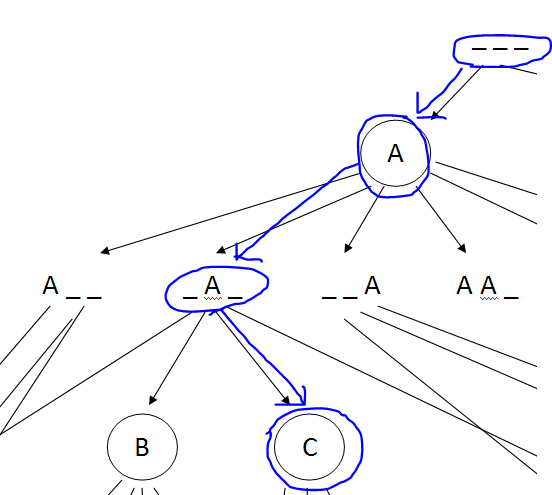
There are billions of possible states of game play, but you can narrow them down quickly with strategic guessing.
What we’re actually doing here is a filtering exercise: of all of the possible letters we could choose, we’re considering what possible results that could have. Then for
each of those results, we’re considering what guesses we could make next, and so on. At each stage, we compare all of the possible moves to a dictionary of all possible
words, and filter out all of the words it can’t be: after our first guess in the diagram above, if we guess “A” and the board now shows “_ A _”, then we know that of the
600+ three-letter words in the English language, we’re dealing with one of only about 134. We further refine our guess by playing the odds: of those words, more of them have a “C” in
than any other letter, so that’s our second guess. If it has a C in, that limits the options further, and we can plan the next guess accordingly. If it doesn’t have a C
in, that still provides us with valuable information: we’re now looking for a three-letter word with an A in the second position and no letter C: that cuts it
down to 124 words (and our next guess should be ‘T’). This tree-based mechanism for working out the best moves is comparable to that used by other game-playing computers. Hangman is
simple enough that it can be “solved” by contemporary computers (like draughts –
solved in 2007 – but unlike chess: while modern chess-playing
computers can beat humans, it’s still theoretically possible to build future computers that will beat today’s computers).
Zen Hangman asks the really important questions. If a man has one guess left and refuses to pick a letter, does he live forever, or not at all?
Now that we can simulate the way that a perfect player would play against a truly-random executioner, we can use this to simulate games of hangman for every possible word
(I’m using version 0.7 of this British-English dictionary).
In other words, we set up two computer players: the first chooses a word from the dictionary, the second plays “perfectly” to try to guess the word, and we record how many guesses it
took. So that’s what I did. Here’s the Ruby code I used. It’s heavily-commented and
probably pretty understandable/good learning material, if you’re into that kind of thing. Or if you fancy optimising it, there’s plenty of scope for that too (I knocked it out on a
lunch break; don’t expect too much!). Or you could use it as the basis to make a playable hangman game. Go wild.
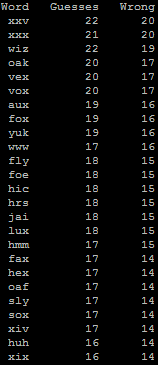
The hardest three-letter hangman words. “Sly” is particularly… well, sly.
Running the program, we can see that the hardest three-letter word is “xxv”, which would take 22 guesses (20 of them wrong!) to get. But aside from the roman numeral for 25, I don’t
think that “xxv” is actually a word. Perhaps my dictionary’s not very good. “Oak”, though, is definitely a word, and at 20 guesses (17 wrong), it’s easily enough to hang your opponent
no matter how many strokes it takes to complete the gallows.
Interestingly, “oaks” is an easier word than “oak” (although it’s still very difficult): the addition of an extra letter to a word does not make it harder, especially when that letter
is common.
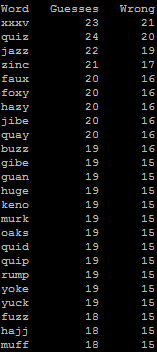
There are more tougher words in the four-letter set, like the devious “quiz”, “jazz”, “zinc”, and “faux”. Pick one of those and your opponent – unless they’ve seen this blog post! – is
incredibly unlikely to guess it before they’re swinging from a rope.
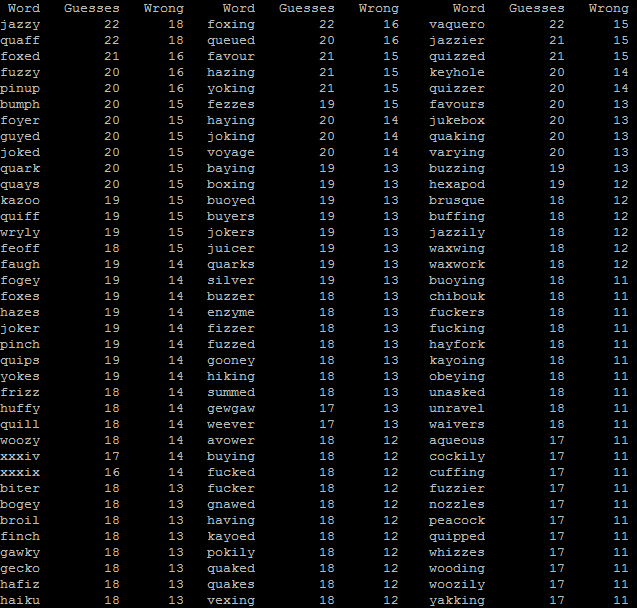
“Hazing foxes, fucking cockily” is not only the title of a highly-inappropriate animated film, but also a series of very challenging Hangman words.
As we get into the 5, 6, and 7-letter words you’ll begin to notice a pattern: that the hardest words with any given number of letters get easier the longer
they are. That’s kind of what you’d expect, I suppose: if there were a hypothetical word that contained every letter in the alphabet, then nobody would ever fail to (eventually) get it.
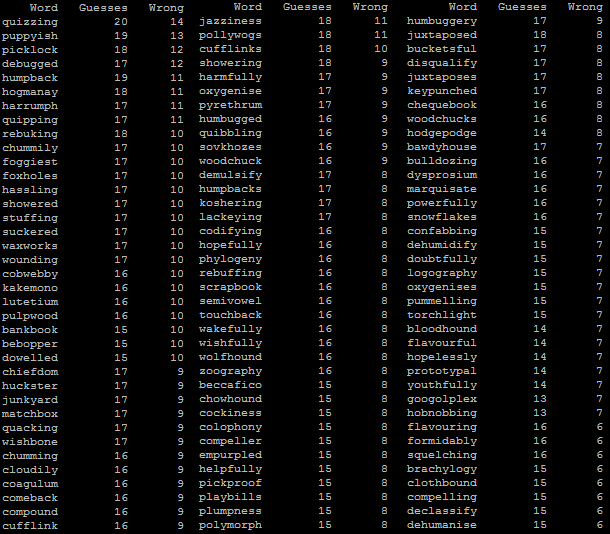
Some of the longer words are wonderful, like: dysprosium, semivowel, harrumph, and googolplex.
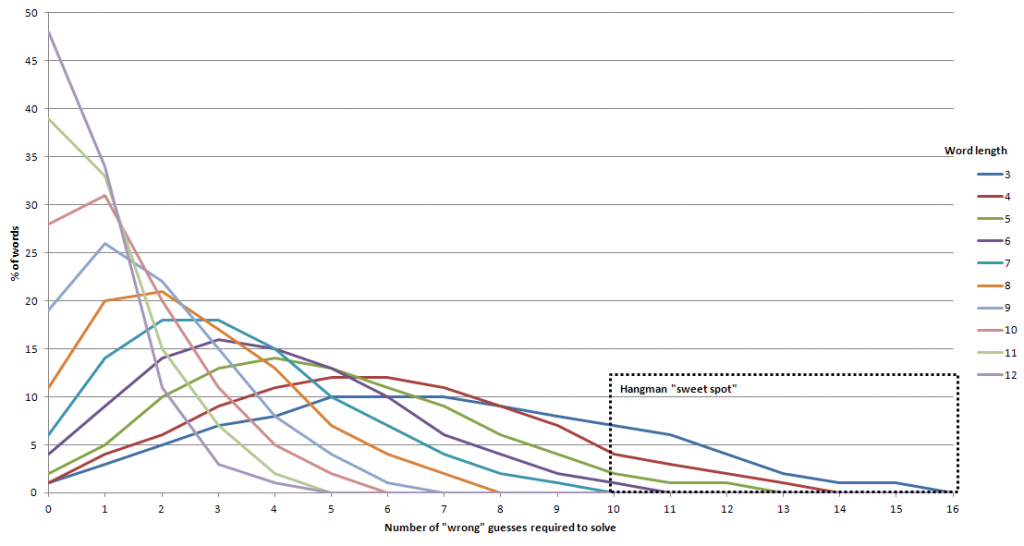
When we make a graph of each word length, showing which proportion of the words require a given number of “wrong” guesses (by an optimised player), we discover a “sweet spot” window in
which we’ll find all of the words that an optimised player will always fail to guess (assuming that we permit up to 10 incorrect guesses before they’re disqualified). The
window seems small for the number of times I remember seeing people actually lose at hangman, which implies to me that human players consistently play sub-optimally, and do not
adequately counteract that failing by applying an equal level of “smart”, intuitive play (knowing one’s opponent and their vocabulary, looking for hints in the way the game is
presented, etc.).
The “sweet spot” in the bottom right is the set of words which you would expect a perfect player to fail to guess, assuming that they’re given a limit of 10 “wrong” guesses.
In case you’re interested, then, here are the theoretically-hardest words to throw at your hangman opponent. While many of the words there feel like they would quite-rightly be
difficult, others feel like they’d be easier than their ranking would imply: this is probably because they contain unusual numbers of vowels or vowels in unusual-but-telling positions,
which humans (with their habit, inefficient under normal circumstances, of guessing an extended series of vowels to begin with) might be faster to guess than a
computer.
I’ve had a tardy summer for blogging, falling way behind on many of the things I’d planned to write about. Perhaps the problem is that I’m still on Narrowboat Time, the timezone of a
strange parallel universe in which everything happens more-slowly, in a gin-soaked, gently-rocking, slowly-crawling haze.
The apparent haze in the centre of this photograph is not the result of gin, however, but of a scuff on the lens of the camera I was using; a fault which was not apparent to me until
after I looked at the pictures, and so – now I’ve pointed it out – you won’t be able to un-see it in any of the other snaps, either.
That’s believable, because this summer Ruth, JTA and I – joined for some of the journey by
Matt – rented a narrowboat and spent a week drifting unhurriedly down the Monmouthshire and Brecon Canal… and then another week making a leisurely cruise back up it again.
Symptoms of “boat-lag”, which is a result of spending any significant period on Narrowboat Time, include siestas, lounging, and a generally relaxed and laid-back attitude.
We picked up Nerys, out of Cambrian Cruisers, who also gave us an introduction to the operation of the boat (driving it, filling it with water, pumping out sewage,
generating electricity for appliances, etc.) and safety instructions (virtually all of the canal is less than four feet deep, so if you fall in, the best thing to do is to simply
walk to the shore), and set out towards Brecon. In order to explore the entire canal in the time available, we needed to cover an average of only five miles per day. When
you’re going at about two and a half miles per hour and having to stop to operate locks (there are only six locks on the navigable stretch of the canal, but they’re all clustered
towards the upper end), though, five miles is plenty.
Time spent mooring up, casting off, refilling the water tank, and squeezing past other boats on the narrow canal willalso slow you down. But it’s still worth getting started moving on
a morning, to ensure that you don’t need to compete for one of the more-beautiful spots to tie up at the end of your day’s travel.
The upper end of the canal is by far the busiest, with not only narrowboats cruising up and down but a significant number of day boats (mostly on loan from Brecon) and at least
one tour boat: a 50-seater that you don’t
want to have to wiggle past at sharp corner North of the Bryich Aqueduct. From a navigation perspective, though, it’s also the best-maintained: wide enough that two boats can pass
one another without much thought, and deep enough across its entire width that you needn’t be concerned about running aground, it makes for a great starting point for people who want
some narrowboating practice before they hit the more challenging bits to the South.
The towpath is also a haven for geocachers. Ruth and I are here seen holding GC3698Y, “Jass @ Jammy”, which was hidden only a short walk from where we moored at the end of our first
and third days.
Ruth was excited to find in me a driver who was confident holding the boat steady in a lock. Perhaps an expression of equal parts talent and arrogance, I was more than happy to take
over the driving, leaving others to jump out and juggle the lock gates and lift bridges. Owing to Ruth’s delicate condition, we’d forbidden her from operating the entirely-manual locks, but she made sure to get a go at running one of the fancy
hydraulic ones.
The hydraulic locks aren’t any faster than the unassisted ones, but they don’t take quite so much “pushing”.
After each day’s cruising, we’d find a nice place to moor up, open a bottle of wine or mix up some gin-and-tonics, and lounge in the warm, late summer air.
Matt, Dan and JTA enjoy wine on their moored-up boat. Ruth, who of course can’t drink, is behind the camera.
As we wound our way further South, to the “other” end of the waterway, we discovered that the already-narrow canal was ill-dredged, and drifting anywhere close to the sides – especially
on corners – was a recipe for running around. Crewmates who weren’t driving would take turns on “pole duty”, being on standby to push us off if we got too close to one or the other
bank.
Another effect of the shallow sides was that we’d sometimes have to “walk the plank” to get ashore. On the upside, we could raise the plank at night and feel like we were isolated in
our own little fortress, with its own little drawbridge.
Each night moored up in a separate place gives a deceptive feeling of travel. Deceptive, because I’ve had hiking trips where I’ve traveled further each day than we did on our boat! But
the nature of the canal, winding its way from the urban centre of Brecon out through the old mining villages of South Wales.
Modern narrowboats have a chemical toilet that needs to be “pumped out”. Slightly icky, but probably less nasty than the distant historical alternative, presumably, of putting your
bum over the edge.
The canal, already quite narrow and shallow, only became harder to navigate as we got further South. Our weed hatch (that’s the door to the propeller box, that is, not a slang term for
the secret compartment where you keep your drugs) saw plenty of use, and we found ourselves disentangling all manner of curious flora in order to keep our engine pushing us forwards
(and not catching fire).
Reaching into a dirty, cold, damp hole and pulling out gunky, slimy strands of crap isn’t the most-fun job. And you really want to make sure you’ve taken the key out of the ignition,
too, assuming that you’re fond of your fingers.
Eventually, we had to give up navigating the waterway, tie up, and finish the journey on foot. We could have gotten the boat all the way to the end, but it’d have
been a stop-start day of pushing ourselves off the shallow banks and cleaning out the weed hatch. Walking the last few miles – with a stop either way at a wonderful little pub called
The Open Hearth – let us get all the way to both ends of the navigable stretch of the canal, with
a lot less hassle and grime.
Ruth and JTA at the head of Five Locks, the lowest remaining navigable point of the Monmouthshire and Brecon Canal.
It’s a little sad coming to the end of a waterway, cut short – in this case – by a road. There’s no easy way – short of the removal of an important road, or the challenging and
expensive installation of a drop lock, that this waterway will ever be connected at this point again. The surrounding landscape doesn’t even make it look likely that it’ll be connected
again by a different route, either: this canal is broken here.
The Cwmbran Tunnel is narrow, 87 yards long, and both ends are badly in need of dredging. Knowing our luck, we’d have gotten grounded in there if we’d have brought the boat that far.
I found myself remarking on quite how well-laid-out the inside of the narrowboat was. Naturally, on a vehicle/home that’s so long and thin, a great number of clever decisions had
clearly been made. The main living space could be converted between a living room, dining room, and bedroom by re-arranging planks and poles; the kitchen made use of
carefully-engineered cupboards to hold the crockery in place in case of a… bump; and little space-saving features added up all along the boat, such as the central bedroom’s wardrobe
door being adaptable to function as a privacy door between the two main bedrooms.
In dining room configuration, we were even able (with judicious use of nearby shelves and the seats alongside us) to play a game of Arkham Horror. And we won, which was perhaps even
more-remarkable.
On the way back up the canal, we watched the new boaters setting out in their narrowboats for the first time. We felt like pros, by now, gliding around the corners with ease and passing
other vessels with narry a hint of a bump. We were a well-oiled machine, handling every lock with ease. Well: some ease. Unfortunately, we’d managed to lose not one
but both of our windlasses on the way down the canal and had to buy a replacement pair on the way back up, which somewhat dented our “what pros we are” feeling.
Our final pass through Brynich Lock was slick and seamless.
Coming to the end of our narrowboating journey, we took a quick trip to Fourteen Locks, a beautiful
and series of locks with a sophisticated basin network, disconnected from the remains of the South Wales canal network. They’ve got a particular lock (lock 11), there, whose unusual
shape hints at a function that’s no-longer understood, which I think it quite fabulously wonderful – that we could as a nation built a machine just 200 years ago, used it for a hundred
years, and now have no idea how it worked.
Our “big” trip to Ikea a few weeks later was significantly bigger, even, than this one, though.
Our next stop was Ikea, where we’d only meant to buy a couple of shelves for our new home, but
you know how it is when you go to Ikea.
We wrapped up our holiday with a visit to Sian and Andy (and their little one), and Andy showed off his talent of singing songs that send babies to sleep. I swear, if he makes an album of
children’s songs and they’re as effective as he is in person, we’ll buy a copy.
MiniRegz and parents.
Altogether, a wonderfully laid-back holiday that clearly knocked my sense of urgency so far off that I didn’t blog about it for several months.
Edit, 22 June 2018: after somebody from the Canal & River Trust noticed that my link to their page on the Brynich Aqueduct was broken after they’d rearranged their
site, I removed it. They suggested an alternative page, but it didn’t really have the same content (about the aqueduct itself) so I’ve just removed the link. Boo, Canal & River Trust!
Cool URIs Don’t Change!
This is not a blog post about pentesting, or any other kind of software-engineering inspired testing
of pens. Nor is it a blog post about the kind of fascination
some people have with pens and ink. Instead, this is a blog post about history and psychology.
Recently, JTA asked me what I do when I want to test a pen, and he was surprised with the answer. Before I tell you
how I answered, I’ll tell you about what I learned from the conversation. And before that, I’ll tell you about the history of pen testing. And then, finally, I’ll tell you why I think
it’s important from a psychological perspective.
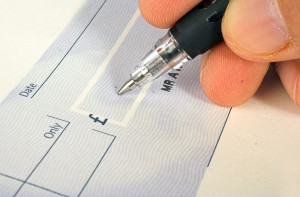
The oldest surviving Probatio Pennae, or “pen test”, is of the Old Dutch words “hebban olla uogala”, and is stored in the Bodleian Library.
Historically, the “breaking in” of a new pen was called a probatio
pennae, literally “pen test”, and would typically be a few lines of text or a short proverb: something that demonstrated the pen’s ability to write. For the entire mediaeval
period, plus several centuries besides, the principle instrument for writing would be the quill pen: the primary wing feathers of a large bird such as a goose, often hardened in hot
ashes, stripped of barbs, and cut down to size with an blade whose purpose lends its name to what we now call a “pen knife”. With such a tool, a scribe would want to be sure that the
pen could hold an adequate nibful of ink without splashing or spraying, and – despite the high value of paper – it was clearly essential to write a whole sentence or two to be sure.
De Klerk, by Philip van Djik, contemporaneously shows a scribe cutting the nib of his quill pen.
A modern ballpoint pen has no such issues, but instead introduces some of its own: a plastic-lined inkwell can be gradually penetrated by the air, causing the ink to dry up; the ball
can become stuck and will not turn freely; air bubble can develop within the tube (especially if the pen is stored, or worse-still used, the wrong way up); and, of course, the pen can
run out of ink. This typically precipitates its disposal: your biro isn’t built to be re-used for anything except perhaps to perform an emergency tracheotomy, and it’s cheap enough that
you don’t want to waste your time repairing it. As a result,
our pen tests have become fast, designed to determine within a few seconds whether the pen we’ve got is working or, in the case of a stuck ball, can be made to start working with a
sufficiency of scribbling. Our culture of disposal can’t spare the time for any more than a cursory test before we give up
and grab the next one.
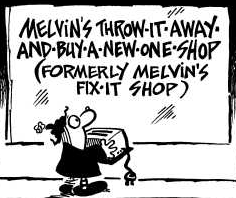
Why keep a pen? Why keep a toaster? Why keep a computer?
So what do we write? What is the probatio pennae of our times? It’s been widely-reported (although I can’t find any decent citations) that, upon being offered a new pen to try out, 97% of people will
write their own name. Now that statistic smells fishy to me (no good citations anywhere, and 97% of people use 97% as their “virtually all” number, for made-up
statistics), but I’ve been testing the hypothesis among friends these last few days, and I’ve gathered enough evidence to convince me that it’s probably the case that many or most
people will write their own name to test a pen.
That’s not so surprising: in this computerised age, most times we’re given a pen it’s to sign our name. About 97% of the time, anyway. ;-)
Somebody had presumably asked JTA what he wrote, earlier in the day, because he took the time to tell me that when he tests a new pen, he typically writes the word
“hello”.
Now I find that pretty weird. Maybe it’s the software engineer in me, but to me the mark of a good test is that it covers all of the possible cases, in the
minimal possible effort. Writing your name is easy because it’s managed by what is popularly-called “muscle memory”: a second-season episode of Castle (correctly) used this as a
plot point, when a man suffering from retrograde amnesia was unable to remember his name, but was still able to sign his name because the act of signing it had been
rendered, by years of practice, into his procedural memory, which was unaffected by his condition. But writing a word, like “hello”… requires a comprehension of language. Unless he’s
tested enough pens to have built a procedural memory of writing “hello” to test pens, JTA’s test has a greater number of neural dependencies, which – with apologies to those of you who
aren’t interested in automated software testing – produces what we’d call an unnecessarily “brittle” test.
A demonstration of a handful of ways in which people test pens, in Animated GIF format.
Me? I just scribble, which my quick survey (and several comparable ones online) show to be probably the second-most popular action to test a pen. Scribbling, to me, simply seems like
the minimal test path: the single simplest thing that can be done with a pen that will demonstrate that it’s fit for purpose. I don’t need to test that a new pen can
write words, because – to me – writing words in particular is not a function of the pen, but a function of my brain! To me, the pen’s function is simply one of
transferring ink to the paper, and any semantic meaning coming from the ink is a product of my intellect, not of the writing implement.
So why is this important? Well: I have a half-baked hypothesis that the choice of what to write with a new pen might be linked to other aspects of our psychology. When I’m developing a
new template for a website, for example, I use lorem ipsum text and
dummy placeholder images as filler (just occasionally, I’ll
use kittens, because kittens are adorable). That’s because the absence of meaning to the
words that appear (I don’t read Latin, and even if I did, lorem ipsum is frequently mangled) has no bearing on my comprehension of the design: and, in fact, it can sometimes be
a benefit to be deprived of the distraction of legible content.
At last, a legitimate use in an otherwise un-kitten-related blog post to use a PlaceKitten.com image!
But I’d hypothesise that people who write words as a probatio pennae would be less-comfortable with illegible placeholder-text in a design than those who drew scribbles or
signed their name. I have a notion, from my own experience, that the same parts of the brain that is responsible for judging the quality of a writing implement are used in the judgement
of a piece of design work. Hey: maybe if that’s true, graphic designers should have their clients test pens out, in their presence, before they decide whether to use believable filler
or lorem ipsum text in the designs they’d like approved.
Or maybe I’m way off base. What do you write when you test a pen?
Short version of the review: a few teething problems aside, we all had a wonderful time and we’d certainly consider a Daggerville game for our next murder
mystery party. The characters were, on the whole, wonderful characters well-realised and fully-developed within the constraints of the genre, the twist was clever, there were moments
of great hilarity (such as the point when we realised that there’d been a veritable conga-line of people stealthily following one another around the hotel), and the event built up to
a fun and satisfying conclusion. I’d suggest that you all keep an eye on Daggerville in the future.
As implied earlier this week, this weekend
Ruth, JTA and I had planned to host the latest in a long
series of murder mystery party nights (a handful of which have been reviewed on this
blog). Despite our earlier worries, we eventually filled the “missing” slots in our party with our friends Liz and Dean: exactly the couple we’d planned to fill it with in the first
place, but they’d been painfully slow at RSVPing.
When they eventually turned up late, but still earlier than our other guests, Liz and Dean quickly found themselves back in our good books.
We’ve played a lot of murder mystery games over the years: we could probably be described as connoisseurs of the genre, and that might be worth bearing in mind when you
read what we had to say about this particular event. To enumerate, there’s been:
The entire back catalogue of Paul Lamond‘s Murder a la Carte / Inspector McClue
series
And several murder mystery games that I’ve written: one in a “scripted” style, the rest in an “open” style
That said, this latest party really had the opportunity to cross the board, with Liz and Dean having never been to a murder mystery night before and (other) Liz and Simon having been to only
a few. And to top it all off, we were working with a completely new game from a creator of whom we’d had no experience. What could be more exciting?
See: even JTA’s excited.
You see: I was contacted a little over two months ago, via my web form,
by a Martin from Daggerville Games, a new murder mystery party provider of the “buy-and-download” variety. Upon
visiting their website, I was immediately struck by some of the similarities between their signup form (which asks for player names to be associated with characters, genders to be
chosen for characters whose gender can be selected based on the gender balance among the players, and email addresses to which invitations will be sent) and a prototype one of my own
design, used in the construction of my upcoming games Murder at the Glam Rock Concert and Murder on the Social Network, the first of which we hope to host in
about a year’s time. I mentioned this to Martin, in the hope that they won’t think I’m ripping them off if I eventually put some of my pieces online for the world to play, too.
One of the quirks of Daggerville is that they email fragmented scripts directly to your players, which they’re then welcome to read completely before they turn up (or not; whichever
they prefer).
The Daggerville folks, perhaps anticipating that I would be likely to blog about the event in hindsight and thus provide them with some free publicity, offered me a voucher for a free
game of my choice, which I accepted. After a little discussion, we settled upon The Ambassador’s Notebook, a 7-player murder mystery set in a rural 1920s hotel and revolving around the untimely death of a Mr.
Sullivan, presumably related to a valuable journal that was in his possession.
But who can the murderer be, Liz ponders, from her comfortable chair in the Accusing Chamber.
In order to keep the spoilers at the tail end of this blog post (there’ll be a nice big warning before you get to them, so you can refrain from reading them if you’re planning to
someday play this game yourself), I’ll cut to the chase and first provide a summary of the night as a whole.
Right before I opened the “Deus Ex Manilla”, otherwise known as the “Miss. Marple Envelope”, in which the solution would be found, I – as usual – encouraged a vote on who we’d be
turning over to the police.
We all had a fun time: as usual for these gatherings, there was good wine, great company, and spectacular food (Ruth had, once again, put together a wonderfully thought-out and
thematically-sound menu): honestly, under these conditions we’d be pretty-much guaranteed a good night no matter what. The murder mystery itself was a scripted affair similar to those
you’ll find in any off-the-shelf kit, but with a few quirks. For a start, as hinted above, everybody gets their fragments of the script (along with dialogue entry and exit cues) very
early on: it’s possible, permitted, and even encouraged that players read their script before they arrive for the event. Some of us were concerned that this might result in
“spoilers”, and a few of those of us who did pre-read our scripts said that they regretted doing so, so be aware: it’s a spoiler-risk.
If you pay attention to following a fragmented script, you might lose track of a clue. But if you pay attention to the clues, you might lose track of your place in the script. It’s a
challenge.
Unlike similar-styled games, though, players aren’t given additional information outside of the script, and we all felt that this made things challenging when it came to
the discussion breaks. All that we had to go on for our deliberations was exactly what we’d all heard, just minutes before, tempered by our own speculation. Sometimes somebody would
ask, or consider asking, a valid question after somebody’s whereabouts, alibi, or history, but no answer was forthcoming because all that we had, collectively, was the script. This
caused additional confusion when, for example, Liz’s character mentioned JTA’s character by his first name, it was a surprise to everybody… even JTA, who had no idea to
begin with that it was supposed to be his name!
The lack of “character sheets” did encourage imaginative ad-libbing, for example, such as Simon’s decision that his character had just come over from Australia.
None of the problems we experienced “broke” the game, and we found our way to a reasonably-satisfactory conclusion. A majority of us voted correctly, determining the identity of the
murderer, and Ruth even managed to identify an important twist (albeit not based on anything more than speculation: the “flash” was a little subtle for us). There were a few
anachronisms in the script, but they’re of the kind that only nerds like us would notice (the National Theatre is mentioned despite the fact that it won’t be founded for another four
decades or so, and a character makes a reference to a frozen turkey, even though freezing of meat in the West wasn’t yet commonplace, for example). We’d have really liked to have each
had a brief – even just half a page! – to tell us each more about our own characters (their names, for example, as well some of the secrets that they might be concealing and any
established relationships they have with other characters), and if we knew that Daggerville were adding this feature, it’d make us far more-likely to buy their products in future.
The short review would be: a few teething problems aside, we all had a wonderful time and we’d certainly consider a Daggerville game for our next murder mystery
party. The characters were, on the whole, wonderful characters well-realised and fully-developed within the constraints of the genre, the twist was clever, there were moments of great
hilarity (such as the point when we realised that there’d been a veritable conga-line of people stealthily following one another around the hotel), and the event built up to a fun and
satisfying conclusion. I’d suggest that you all keep an eye on Daggerville in the future.
[spb_message color=”alert-warning” width=”1/1″ el_position=”first last”]Spoiler warning: reading beyond here could result in seeing spoilers. Don’t read on if you’re
likely to ever take part in a game of The Ambassador’s Notebook.[/spb_message]
Aside from the lack of character “introductions”, another thing we found difficult in this game were issues in the script. The script for “The Neighbour” ended up one-number out of sync
in the middle of Scene 2, where her ‘line 42’ indicated that a different person should be talking to what the rest of the scripts said. On another occasion, the script for “The
Proprietress” seemed to be missing a line (although other characters had the ‘tail end’ of that line). The character of “The Journalist” can be played by a man or a woman, and although
I selected “male” when I filled in the form, some of the scripts referred to the character as a woman! At first I thought that this might be related to difficulties some of us had had
receiving the emailed scripts (Martin at Daggerville was incredibly helpful at sending out fresh ones, though), but we found at least one instance in which one person flip-flopped
between referring to “The Journalist” as female or male!
(there’s a video I’ve put together of some of the highlights of our evening, but there’s possible spoilers in it)
Our traditional end-of-game shot shows the murderer, played by Dan, accused by the rest of the participants. (Ruth is behind the camera)
Personally, though, my favourite moment of the night came right at the start, as we all introduced our characters. One of the Liz’s, an American, had decided to play her
character as an American, and introduced herself as such. “Oh,” said the other Liz, whom she’d just met, “Are you going to do an accent?”
We’re hoping to have a mini-murder mystery thisSaturday, 2nd November, in Oxford, and after a
series of people who can’t make it, we’re in need of two people to come along and play. If you want to come then, basically, you’re in, and we’d love to have you.
We’ll be playing a scenario called The Ambassador’s Notebook, courtesy of Daggerville Games. But only if you turn up!
We’re looking for either two women or a man and a woman, but even if you haven’t got a “date” to bring, if you can make it then let us know and we’ll try to find somebody to fill the
other gap. Just leave a comment and I’ll get back to you soon!
Pocket dialling was bad enough. I once received a phone
call from a friend whose phone called me – as the last number he’d dialled – just as he was putting on a harness in anticipation of doing a bungee jump. So all I got to hear was
rustling, and shuffling… and then a blood-curdling scream. Nice one.
Hello? Yes, this is cat. Just thought I’d press some buttons and see who I got.
But in this age of smartphones, the pocket search has become a new threat. Thanks to the combination of touchscreens, anticipatory keyboards (I use SwiftKey, and I’m beginning to think that it knows me better than I do myself), and always-online devices, we’re able to perform quite complex
queries quite accidentally. I’ve got a particular pair of trousers which seems to be especially good at unlocking my phone, popping up a search engine, typing a query (thanks to the
anticipatory keyboard, usually in full words), and then taking a screenshot and saving it for me, so that I can’t later deny having searched for… whatever it was.
This morning, while cycling to work, I searched for the following (which I’ve reformatted by inserting line breaks, in order to transform it into the sort-of poem you might expect from
sombebody both insane and on hallucinogens):
thanks again
and it all goes on
and I will Also
Also A bit LIKE THAT
THE ANSWER is
That you are looking at your Local Ryanair
and a ripening
and a ripening
I can assure are a BIT
and see the new template by clicking here
for
for YOU GUYS
GUYS HAVE YOU ANY COMMENTS
ON MY WAY BACK FROM YOU
And the other side and I will have the same
as a friend or relative
relative humidity
humidity
to you
you are here car
car
and
and embarrassing
embarrassing
the best thing is the first three years and over
over?
Maybe my phone is gradually becoming sentient and is trying to communicate with me. I for one welcome our new robot overlords.
Those of you who’ve met my family will probably already have an understanding of… what they’re like. Those of you who haven’t are probably about to gain one.
Did you did you… did you know that: Becky can eat mango, all by herself?
It started on a weekend in April, when my mother and I went to a Pink concert. The support act were a really fun band called
Walk the Moon, who finished their energetic set with I Can Lift A Car, with its’ catchy chorus hook “Did you did you… did you know know: I can lift a car up, all by
myself?” Over the weeks that followed, perhaps because of its earworm qualities,
this song became sort-of an inside Rickroll between my mum and I.
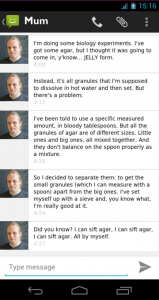
For example, this Bel-Air-meme style text message used a shaggy dog story to deliver a play on words.
At one point, she sent me a link to this video (also visible below), in which she is seen to lift
a (toy) car. My sister Becky (also known as “Godzilla”) was behind the camera (and, according to the credits,
everything else), and wrote in the doobly doo: “I think I’m gonna start doing family vlogs.”
She’d experimented with vlogging before, with a short series of make-up tutorials and a “test video post” on her blog, but this represented something new: an effort to show off her family (and guest
appearances from her friends) as they really are; perhaps this was an effort to answer the inevitable question asked by people who’ve visited them – “are they always like
that?” Perhaps that’s why she chose the name she did for the Family Vlog – “IRL”.
The essential Family Vlog (“IRL”) scene is the car scene, with the camera facing backwards from the dashboard. See also my second review…
At the time of writing, Becky (on her YouTube channel) has produced eight such videos
(one, two, three, four, five, six, seven, eight), reliably rolling out one a week for the last two months. I thought they
were pretty good – I thought that was just because they were my family, but I was surprised to find that it’s slowly finding a wider reach, as I end up speaking to friends who mention
to me that they “saw the latest family vlog” (sometimes before I’ve had a chance to see it!).
As I was visiting Preston, I ended up featuring in “IRL – Week 6”. My review (click on the image for it), therefore, seemed to be equal in parts recursive and narcissistic.
Naturally, then, the only logical thing to do was to start producing my own YouTube series, on my channel,
providing reviews of each episode of my sister’s vlog. I’ve managed to get seven out so far (one, two, three, four, five, six, seven), and I’d like to think that they’re actually better than the
originals. They’re certainly more-concise, which counts for a lot, because they trim the original vlog down to just the highlights (interrupted only occasionally by my wittering
atop them).
The widget above (or this playlist) will let
you navigate your way through the entire body of vlogs, and their reviews (or lets you play them all back to back, if you’ve got two and a quarter hours to spare and a pile of brain
cells you want killing). But if you’re just looking for a taster, to see if it’s for you, then here are some starting-out points:
The best episode? My favourite is six, but number two has the most views, probably the keywords “lesbian foursome”
are popular search terms. Or possibly “girls peeing”. I’m not sure which scares me the most.
Of if you just want to drop-in and have a taster, start from the latest review.
This blog post is the sixth and final part in a series about buying our first house.
In the fifth post, we finally exchanged contracts with the sellers after a long-running disagreement about who was going to repair the
front door…
A series of days flew by in a cardboard-box-filled blur, and suddenly it was the last Friday in July – the day upon which our sale was completed. I’d run out of spare days of annual
leave, so I was only able to justify taking the afternoon off to pick up a van, scoop up Ruth and Matt, get the keys to the new house, and meet JTA
there.
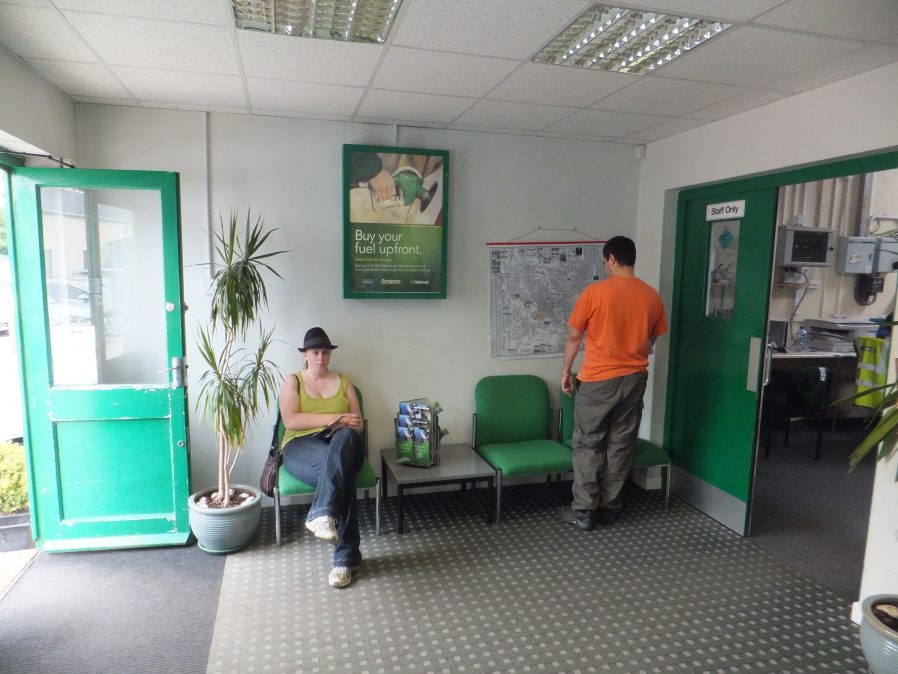
The first mission was to collect a van from Europcar, so that we’d be able to spend the entire weekend going up and down the A34.
The estate agents were conveniently just two doors down from a locksmith, so we got some keys cut to what we believed
to be the new front door, while we were there. It’s also sandwiched between a funeral home and a florist, which makes it sort of a one-stop street when somebody dies and you want to put
their house on the market.
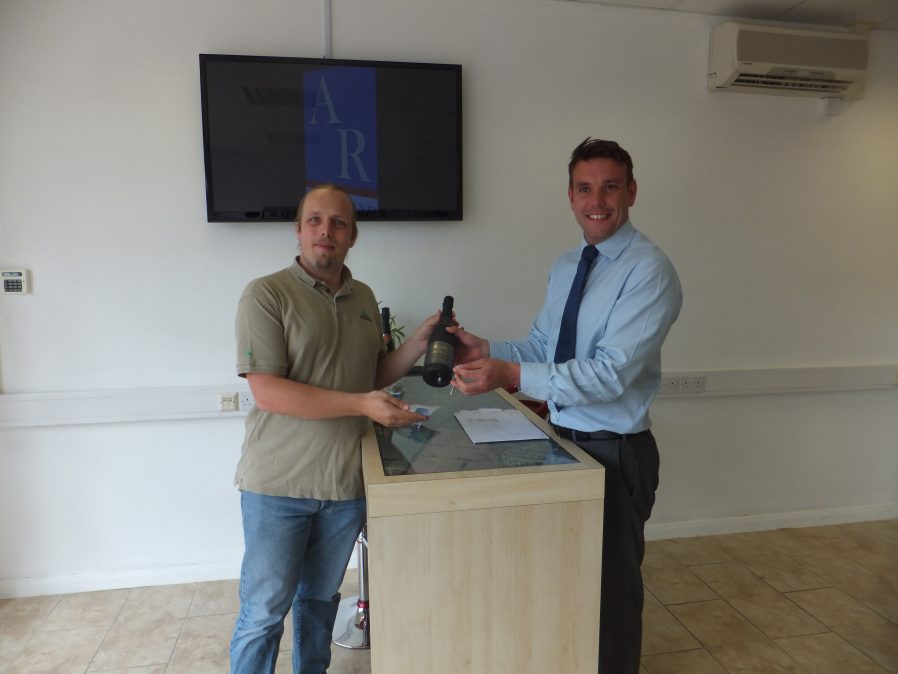
The great thing about getting champagne as a housewarming gift, from your estate agent, is that you don’t need to unpack the corkscrew to open it.
We soon discovered that the “fix” that had ultimately been applied to the broken front door was simply to swap it for a different exterior door, from the inner porch. A little cheeky,
and a little frustrating after all the fighting we’d done, but not the end of the world: we still had a perfectly good front door and – as we planned to use the annex as part of the
main house, anyway, we were happy to take the door down and leave an open doorway, anyway.
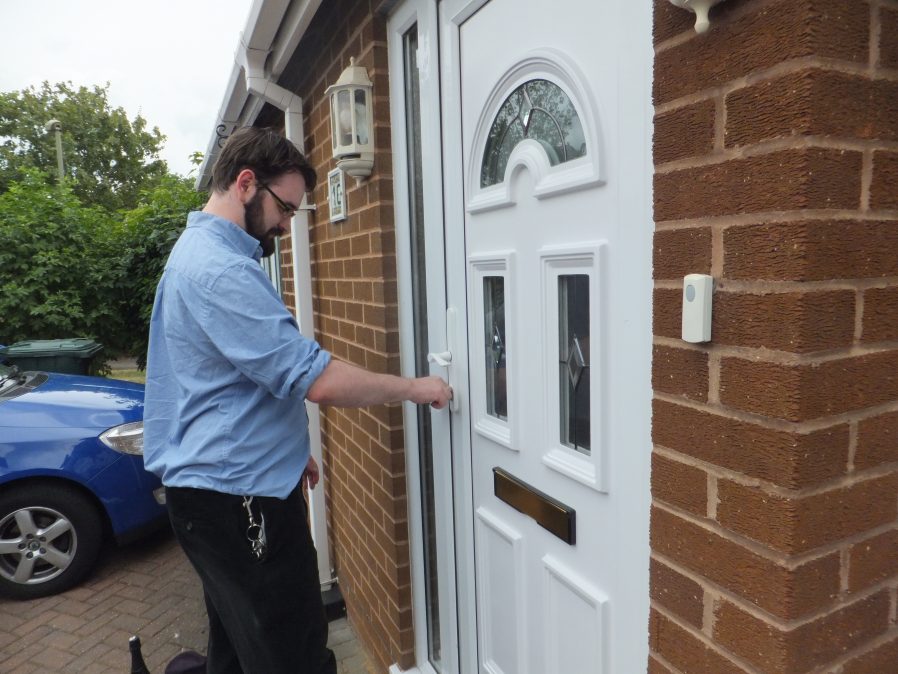
We gave JTA the honour of being the first to open the door to our new home. After some fiddling with what turned out to be the wrong key, the door turned out to be already unlocked.
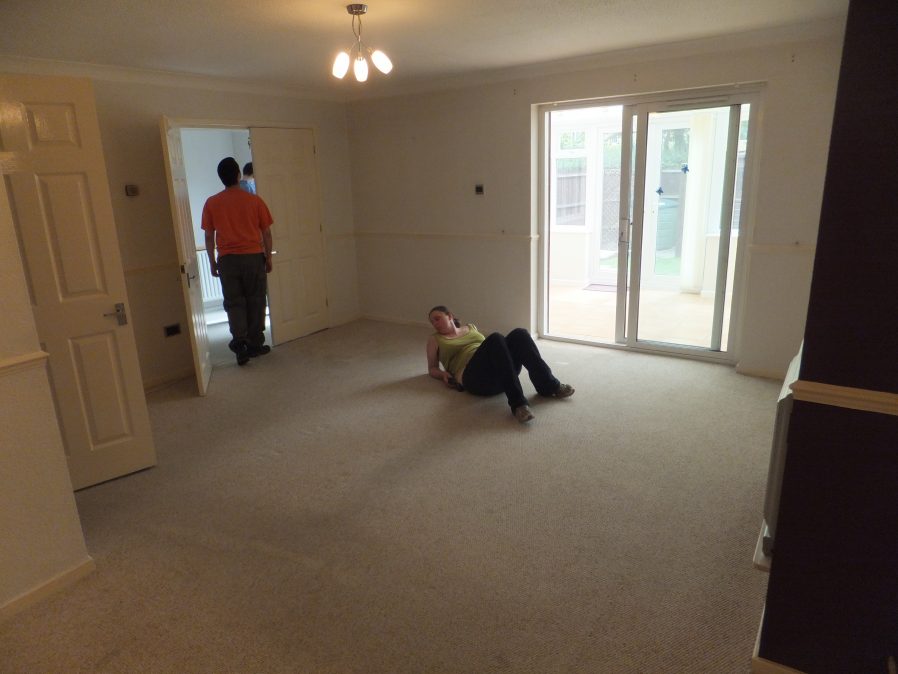
A vacant house feels big and empty. Our new – large! – living room felt enormous. Meanwhile, packing up our old house – with its painted walls and wooden floors – was beginning to sound
echoey as it became emptier.
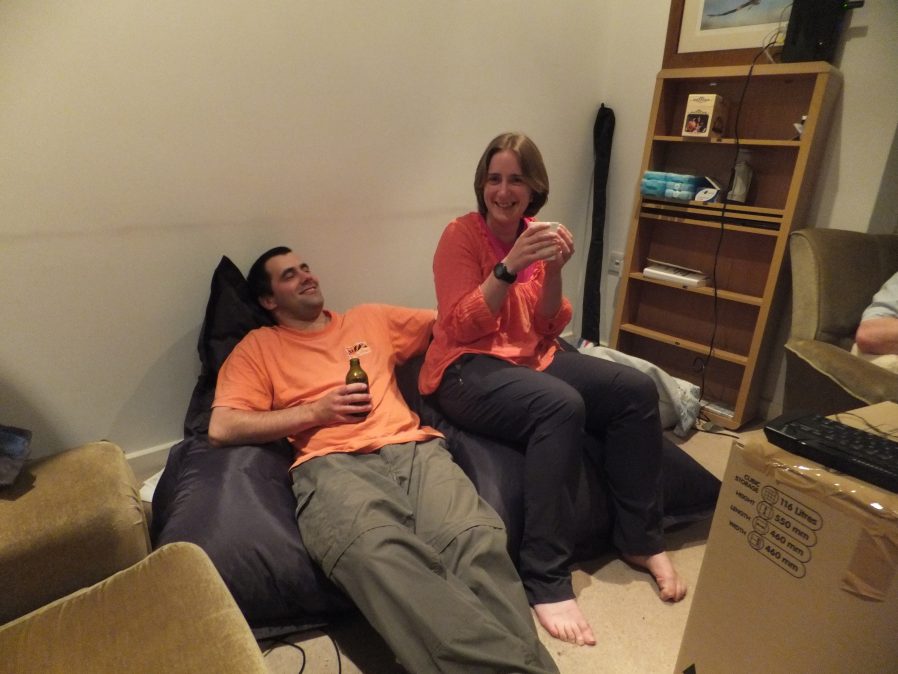
Lounging in the living room. (or is she living in the lounge?)
We spent a long time working out which of the many keys we had fit which of the locks, as there were quite so many: there’s the front door, the inner front door, the other
inner front door, the back door, the outer conservatory door, the inner conservatory door, the gate lock, the shed lock, the window locks, and a good handful of keys besides that we
still haven’t identified the purpose of. It’s was like the previous owners just bought a pile of additional keys, just as a prank.
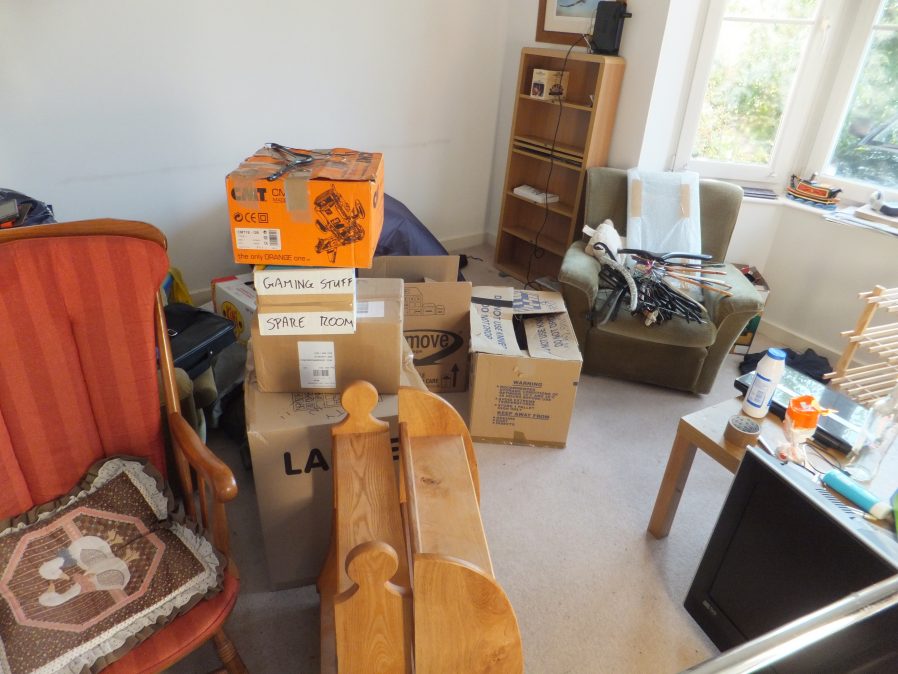
Our old house – New Earth – became emptier and yet more-chaotic as the stacks of boxes were gradually loaded into the van.
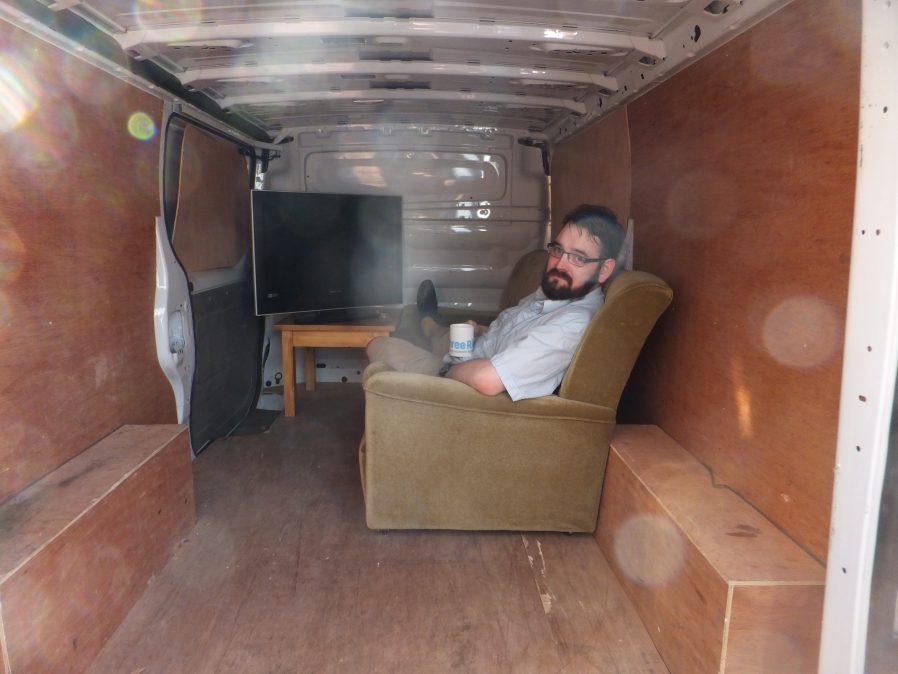
We’d rented a van over a long weekend in which to do the majority of the move, and we’d hired some burly men with a bigger van to move some of the heaviest furniture, and to collect a
piano that we’d bought (yes, we have a piano now; booyah).
“Pack the living room into the van,” I said. “Okay,” said JTA, putting the kettle on.
Very helpfully, Alec came and joined us, and helped run an enormous amount of boxes and furniture down and out of the three-stories of our old house, and in and up the three-stories of
our new house. Why do we keep torturing ourselves with these tall buildings? At least our new staircases are a better shape for carrying mattresses up.
Now that I’ve discovered that I can hire muscular men on-demand, I’m not sure that I’ll ever do anything else.
The weather stayed good, with only occasional showers (and thankfully, never when we were carrying soft furnishings between a van and a building) and one brief but wild thunderstorm
(that we managed to avoid only with a quick re-arrangement of the van contents, slamming the doors, and sprinting for cover), and we worked hard, and we ended up a day ahead of schedule
before we were finished.
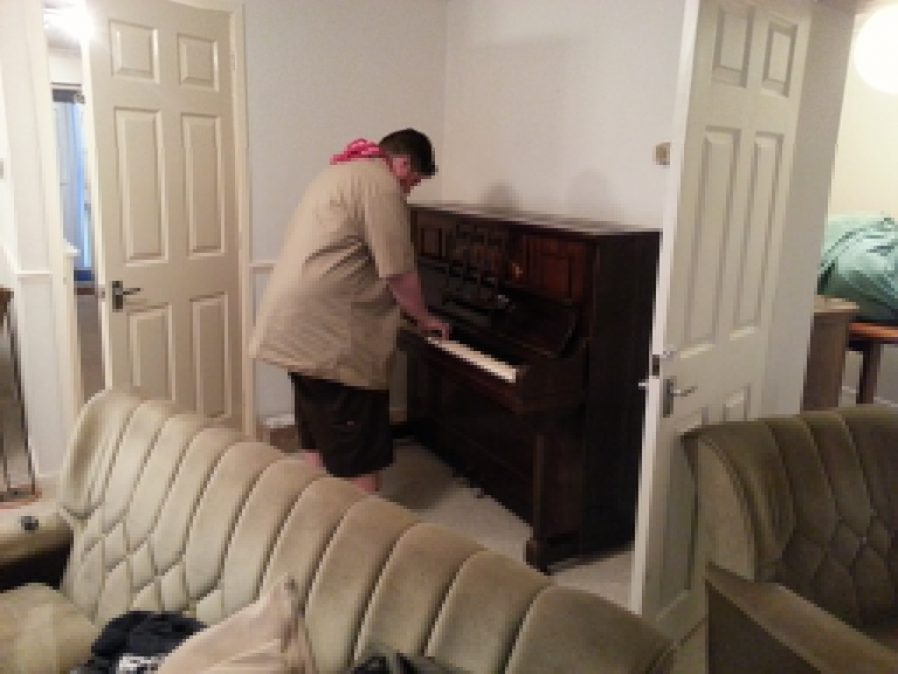
Alec helped out with lots of heavy lifting, but also with ‘testing’ the piano. Which, before it had been tuned, wasn’t the best of experiences for anybody involved.
In order to minimise the amount of the deposit that we might otherwise lose, from our old place, and because we rightly anticipated being too exhausted from the move to do all of the
requisite cleaning ourselves, we’d hired some professionals. By this point, we weren’t even able to think in terms of money like normal people – by the time you’re spending five figures
on tax and lawyers, you find it pretty easy to shrug off the cost of a team of cleaners!
I’m pretty sure that the local ice cream van driver was following us around, because on each day of the move, he’d arrive on the scene right after we’d finished unloading a van and
could really do with an ice cream break.
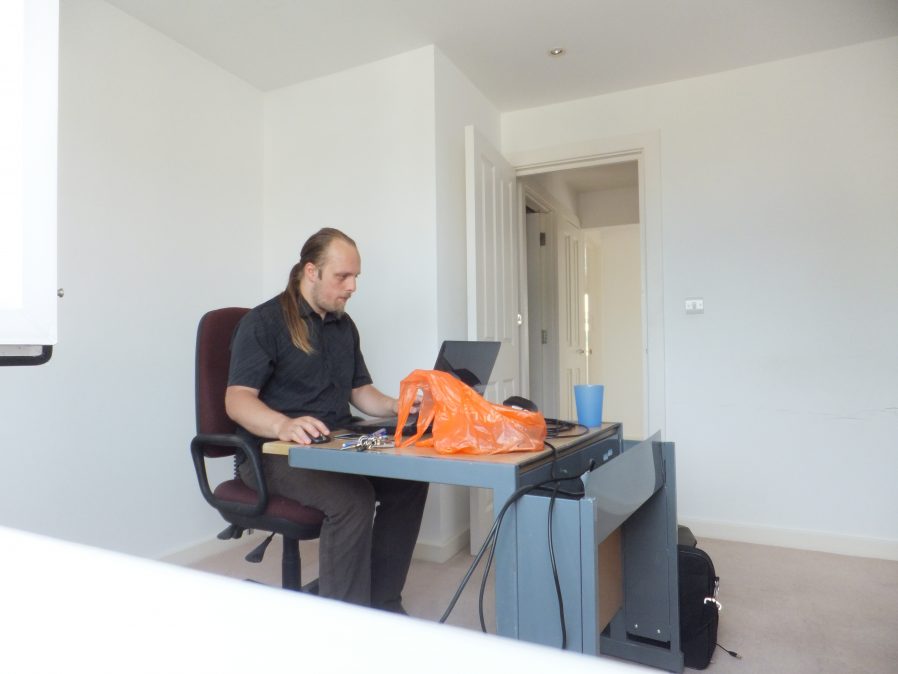
This did mean that Ruth and I had to each work from home, from the old house, for one last day while we let the cleaners, gardener etc. in. We left in the old house an absolute minimum
of furniture: a single desk, chair, laptop computer, cup (for water), router, and cables.
One desk, one chair, one laptop, one router… in a five bedroom house. It’s a lonely life.
As I left the house for the last time, as empty and quiet as it was the day we
first moved in, I felt a sense of serenity; a calm that came from a number of simultaneous realisations… that this was probably the last house move I’d have to do in a long while…
that I finally lived somewhere that I didn’t (theoretically, at least) have to ask for somebody’s permission before I put a picture hook up or painted a wall… and that at long last I
was paying off my own mortgage, rather than somebody else’s. It was the beginning of a new era.
The first box that we unpacked was the one containing Alec, of course.
Changing tack from the theme by which our houses have been named since 2010, our new home is called Greendale.
And yes, there’s a website (albeit a little sparse, for now). There’s always a
website.
Susan didn’t help much with the packing and moving, but I’m not sure I’ve put a photo of her and Matt online yet. So now I have.
There’ll be a housewarming party on 22nd September: if you’re a friend of one or more of us, you’ve probably received an invitation already. But if you haven’t – and
it’s not impossible, because we weren’t sure of everybody’s best email addresses these days – and you expect you should have, let me know. It’s not that we don’t love you: we just don’t
love you enough to remember to invite you to stuff, that’s all.
This morning, I was cycling to work along my usual route, National Cycle Network Route 51, on its final leg down Banbury Road to Parks Road. Here, the cycle route shares its path with
a bus lane, and – on a warm, bright morning like this one, having a broad, flat lane is a great opportunity for a strong cyclist to make great time in a safe environment.
Oxford’s multitudinous bus/cycle lanes are great for public transport and even better for cyclists: providing a safe, well-signposted space away from the majority of the main flow of
traffic.
As I approached the bus stop, a spotted a car in the lane to my right, just ahead, slow down and turn on it’s indicator to turn left: it was heading for one of the driveways. But when
the car began its maneuver, a split second later, I realised that the driver had not seen me. Perhaps she’d not checked her mirrors before turning? Or perhaps she’d only glanced (and
seen no buses in the bus lane – just me and the second cyclist behind me)? Or perhaps she’d underestimated my speed, or dramatically overestimated her ability to get into the driveway
before I reached her? In any case, she turned out to be wrong. I hit my brakes as sharply as I safely could, but it wasn’t enough to stop me from ploughing right into the side of her
bonnet.
I’m not entirely sure what happened next. At the time, it felt like everything went into slow motion: a gentle flight through the air followed by a gradual landing on the other side,
and that I’d be able to recall every single moment. But, probably as a result of the blow to my head (which as I’ve discovered before can have
profound and confusing effects on memory), my memory of everything from a few seconds before the collision onwards is fuzzy and fragmented. But I spoke to the driver (a woman with dark
hair), to the cyclist behind me (who was wearing a white t-shirt), and to a man who came out of a nearby building (who spoke with an accent – these details are the only things I can
reliably remember about any of them), and based upon their descriptions – any my injuries – I’ve managed to piece together broadly what happened.
There never was a graceful bicycle crash. Some, however, are less painful than others.
I hit the side of the car and flipped forward, throwing myself, some of the contents of my pannier bag, and my D-lock into the air. My handlebars knocked a dent into the bonnet of the
car, and the lock landed elsewhere on it, but I flew clear over the car and flipped around in the air. I’m not sure how I landed, but it was probably on my back, because I struck the
backs of my head, right shoulder, and elbow… but I must have rolled, because I also managed to scrape and graze the front of my legs.
I initially thought that I was fine (though I was clearly in shock), but I discovered about a quarter of an hour (or thereabouts: I’ve only been able to piece together a timeline in
hindsight) that I was in more pain than I’d first thought, was feeling intermittently dizzy, and was unable to remember the details of the accident or even what day of the week it was.
I asked for a taxi to be called for me and rode to the hospital, where they cleared me of anything seriously wrong (spinal injuries, serious concussion, broken bones, etc.) and sent me
home for a day of lying down and mainlining NSAIDs.
A heavy D-lock like mine makes quite an impact when it’s catapulted into sheet metal.
Now it’s the early evening. I’m still far from entirely “with it”: I feel like my brain’s been rebooted into safe mode – I seem to be incapable of decent multi-tasking (for example: I can have a conversation with you, or can
listen for my name being called by the doctor, but not both). I’ve got aching shoulders and arms and a bit of a limp. And I’ve been pretty much exhausted the whole day.
But here’s something: if I’m right about the angle I landed at, based on where I hurt the most, then it’s possible that my cycle helmet saved my life, today.
This blog post is the fifth in a series about buying our first house.
In the third post in the series, we’d contracted some lawyers and applied for a mortgage, and in the fourth post we asked for help with the upcoming move. If you feel like we weren’t telling you the whole story, that’s because
we weren’t: some of the bits we can now reveal were things that we needed to keep close to our chest while we were negotiating over the sale…
Things were continuing apace with our new house purchase, and that was the way that we wanted it. We’d had an offer accepted, applied for a mortgage (of which we’d been provisionally
accepted already; this was just a paperwork affair), and our solicitors had gotten started with the searches and drafting the contracts. So long as the surveyor’s visit didn’t turn up
any problems, we were on a roll.
Our new house, up in Kidlington.
Courtesy Google Maps.
Unfortunately, a few things did seem to be conspiring against us. The first was that the two sellers – a married couple who were in the middle of what appeared to be
a… messy… separation – didn’t seem to be very communicative either with one another nor with their solicitor: or else, their solicitor was incredibly slow at relaying information back to our solicitor.
I made a point of visiting the property a few times, to see how things were progressing. On this occasion, I got to meet with our surveyor and one of the owners.
This posed a problem, because Ruth, JTA, Matt and I had already arranged with our letting agents
that we’d be vacating our current house by the 5th of August. We’d left two clear weekends of possible “moving” time, but they were rushing up fast. Before the exchange of contracts, we
couldn’t really let the sellers know how important it was that we complete the sale in a hurry, or else we’d be in a very weak negotiating position (and they’d be free to move the
goalposts, knowing that we were running out of options). On the other hand, we really wanted to push to get the last couple of issues sorted out as soon as possible.
Yeah… that’s gonna be a problem, mate.
This ties in to the second thing that conspired against us: there were two particular issues with the house that we didn’t want to go ahead without resolving. The first was that the
boiler hadn’t been serviced in a long time, so we insisted upon a gas safety inspection being carried out before we would exchange contracts. The second was that the front door was more
“hole” than “door”, believed to have occurred during some kind of fracas between the owners (did I mention that their divorce was a little unpleasant?).
The sellers were keen to re-home a number of pieces of furniture along with the house.
The gas safety inspection got sorted out after a while, but we went back and forth over the front door for what felt like an age. Who should repair it? Who should pay? We were told that
the sellers were having cashflow problems and weren’t sure that they could pay for the repair of the door prior to the sale, but we weren’t happy to agree to the sale without a
commitment that the door would be repaired by the completion (our insurer, answerable to our mortgage lender, wasn’t keen on us moving in to a house will a hole in it): we were at an
impasse. So when the sellers produced for us a list of furniture they’d like to offer to sell to us, we noted with some suspicion that the total value of the furniture was remarkably
close to the value of the quote for the repair of the door: clearly, they planned to offer to give us the furniture for “free” in exchange for not repairing the door.
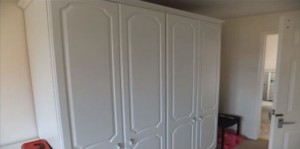
The sellers were particularly keen to sell us this enormous pair of wardrobes, but -m for the price they were asking – we weren’t biting.
Which might have been fine, except for the fact that we didn’t want about half (by value) of the things they were offering. Having been living in unfurnished
accomodation for several years, we’ve already got a sufficiency of wardrobes. We were keen to take their appliances off their hands (including a gas cooker and a very large
fridge/freezer), but we weren’t willing to buy something that we didn’t need just so that they could find it easier to repair something that they broke! We made a number of other
offers, such as lending them the money to repair the door (which they’d be able to pay us back following the sale), but they weren’t keen.
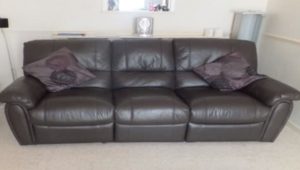
Given that at least one of the sellers was a smoker, we didn’t really want to buy any soft furnishings from them, such as this sofa. Besides, we thought, my dad’s house already
contains a perfectly fabulous couch that nobody’s using!
We put into place our emergency plan, and made arrangements to go and start viewing rental properties, in case we ran out of time and needed somewhere to live. JTA and I played “good
cop, bad cop” with them in a spectacular tag team, leveraging this situation as a threat to pull out of the purchase entirely… and just like that, they caved. Within a day or so, their
solicitor had agreed to the terms of our contract, and the sellers agreed to sort out the front door prior to completion of the sale, and we made sure to get it in writing. Our
solicitor had already requested the money from our mortgage lender, so we agreed upon a completion date later in the week.
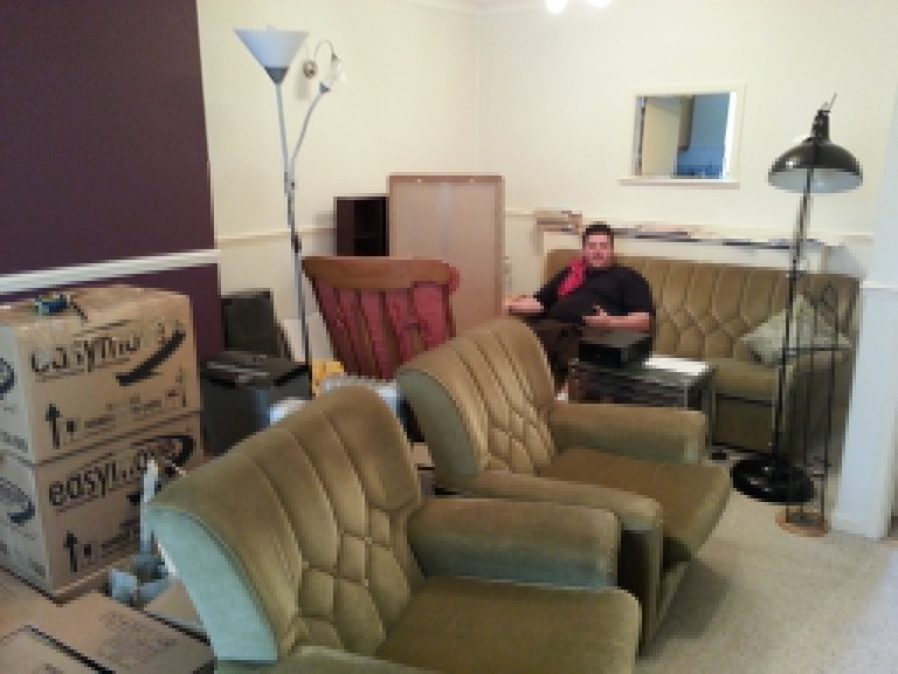
Gradually the kitchen, hallway, and living room became completely full of cardboard boxes.
We popped open a bottle of prosecco and celebrated the successful exchange, and redoubled our efforts to fill our house with boxes, prior to the move.
This blog post is the third in a series about buying our first house. In the
third post, Ruth, JTA and I had acquired some
lawyers and started the conveyancing process…
We’re moving house! And we want your help!
There’ve been… a few hitches with the house move. A few little hurdles. And then a few big hurdles. It’s been a little challenging, is what I’m trying to say. I’ll write about that in
Part 5, but for now: we need your help!
Here’s what we’ve got:
A weekend in which we want to move (27th – 28th July).
A van (probably).
A lot of furniture, piles of boxes, and all the board games in the
known universe. – a lot of stuff!
A couple of extra pairs of hands who are willing to load and unload vans in exchange for:
Pizza
All the booze you can eat
Being among the first to see our new home!
(cynical folks might notice that pizza, booze, rental vans and friends are a lot cheaper than professional removals companies, especially for short hops across to the other side of
a city)
Simply put: we need you!
Can you help? Can you be free for some or all of the weekend of 27th & 28th of July, to come and shift boxes in exchange for good times, booze and snacks? If you are, we’d love to have
you over. Ruth has written more about the wonderful perks that
you’ll enjoy if you can help us, so – if you’re free and can get to Oxford – please come! And it’ll be lovely to see you, too!
At the end of 2012, I shared some sad news: that Ruth and JTA had suffered a miscarriage. It was a tragic end
to a tragic year.
I just wanted to share with you something that we’ve all kept quiet about until now, until we all felt confident that we weren’t likely to have a repeat of that tragedy: as Ruth just mentioned on her blog, too, she’s pregnant again! With a due date of New Year’s
Eve there’s plenty of time for us to get settled into our new house before
then, but it looks like she’s still going to find herself excused of all of the heavy lifting during the move.
Needless to say, this is all incredibly exciting news on New Earth, and we’ve had to bite our tongues sometimes to not tell people about it. Apologies to those of you who’ve invited us
to things (e.g. at Christmas and New Years’) that we’ve had to quietly turn down without explanation – at least now you know!
I’m sure there’ll be lots to say over the coming months. I can’t promise as thorough updates as Siân‘s fantastic
pregnancy blogging, but we’ll see what we can do.
Hot on the heels of our long weekend in Jersey, and right after the live deployment of Three
Rings‘ Milestone: Krypton, came
another trip away: I’ve spent very little time in Oxford, lately! This time around, though, it was an experimental new activity that we’ve inserted into the Three Rings
calendar: Dev Training.
We rented a secluded cottage to which we could whisk away our prospective new developers. By removing day-to-day distractions at work and home, our thinking was that we could fully
immerse them in coding.
The format wasn’t unfamiliar: something that we’ve done before, to great success, is to take our dedicated volunteer programmers away on a “Code Week”: getting everybody together in one
place, on one network, and working 10-14 hour days, hammering out code to help streamline charity rota management. Sort-of like a LAN party, except instead of games, we do
work. The principle of Code Week is to turn volunteer developers, for a short and intense burst, in to machines that turn sugar into software. If you get enough talented people
around enough computers, with enough snacks, you can make miracles happen.
I’m not certain that the driveway was really equipped for the number of cars we brought. But I don’t get on terribly well with laptops, so clearly I was going to bring a desktop
computer. And a second desktop computer, just in case. And that takes up a lot of seat space.
In recent years, Three Rings has expanded significantly. The test team has exploded; the support team now has to have a rota of their own in order to keep track of who’s
working when; and – at long last – the development team was growing, too. New developers, we decided, needed an intensive session of hands-on training before they’d be set loose on
real, production code… so we took the principles of Code Week, and turned it into a boot camp for our new volunteers!
New developers Rich, Chris, and Mike set up their development environments. Owing to the complexity of the system, this can be a long part of the course (or, at least, it feels that
way!).
Recruiting new developers has always been hard for us, for a couple of reasons. The first reason is that we’ve always exclusively recruited from people who use the system. The thinking
is that if you’re already a volunteer at, say, a helpline or a community library or a fireboat-turned-floating-museum or any of the other organisations that use Three Rings, then you already understand why what we
do is important and valuable, and why volunteer work is the key to making it all happen. That’s the bit of volunteering that’s hardest to ‘teach’, so the thinking is that by making it a
prerequisite, we’re always moving in the right direction – putting volunteering first in our minds. But unfortunately, the pool of people who can program computers to a satisfactory
standard is already pretty slim (and the crossover between geeks and volunteers is, perhaps, not so large as you might like)… this makes recruitment for the development
team pretty hard.
Turfed out of the Ops Centre and into the living room, JTA works on important tasks like publicity, future posts on the Three Rings blog, and ensuring that we all remember to eat at
some point.
A second difficulty is that Three Rings is a hard project to get involved with, as a newbie. Changing decisions in development convention, a mess of inter-related (though
thankfully not inter-depedent) components, and a sprawling codebase make getting started as a developer more than a little intimidating. Couple that with all of the things our
developers need to know and understand before they get started (MVC, RoR, TDD, HTML, CSS, SQL, DiD… and that’s just the acronyms!), and you’ve got a learning curve that’s close to vertical. Our efforts to integrate
new developers without a formal training program had met with limited success, because almost nobody already has the exact set of skills we’re looking for: that’s how we knew it was
time to make Dev Training Weekend a reality.
Conveniently, there was a pub literally just out the gate from the back garden of the cottage, which proved incredibly useful when we (finally) downed tools and went out for a drink.
We’d recruited three new potential developers: Mike, Rich, and Chris. As fits our pattern, all are current or former volunteers from organisations that use Three Rings. One of them had
been part of our hard-working support team for a long time, and the other two were more-new to Three Rings in general. Ruth and I ran a series of workshops covering Ruby, Rails, Test-Driven Development, Security, and so on, alternated between stretches of supervised
“hands-on” programming, tackling genuine Three Rings bugs and feature requests. We felt that it was important that the new developers got the experience of making a real difference,
right from the second or the third day, they’d all made commits against the trunk (under the careful review of a senior developer, of course).
Mike demonstrates test-driven development, down at the local pub: 1. touch cat 2. assert cat.purring? When the test fails, of course, the debugging challenge begins: is the problem
with the test, the touch, or the cat?
We were quite pleased to discover that all three of them took a particular interest early on in different parts of the system. Of course, we made sure that each got a full and
well-rounded education, but we found that they were all most-interested in different areas of the system (Comms, Stats, Rota, etc.), and different layers of development (database,
business logic, user interface, etc.). It’s nice to see people enthused about the system, and it’s infectious: talking with some of these new developers about what
they’d like to contribute has really helped to inspire me to take a fresh look at some of the bits that I’m responsible for, too.
Chris drip-feeds us fragments of his life in computing and in volunteering; and praises Ruby for being easier, at least, than programming using punchcards.
It was great to be able to do this in person. The Three Rings team – now about a dozen of us in the core team, with several dozen more among our testers – is increasingly geographically
disparate, and rather than face-to-face communication we spend a lot of our time talking to each other via instant messengers, email, and through the comments and commit-messages of our
ticketing and source control systems! But there’s nothing quite like being able to spend a (long, hard) day sat side-by-side with a fellow coder, cracking through some infernal bug or
another and talking about what you’re doing (and what you expect to achieve with it) as you go.
Chris, Mike and Rich discuss some aspect or another of Three Rings development.
I didn’t personally get as much code written as I’d have liked. But I was pleased to have been able to support three new developers, who’ll go on to collectively achieve more than I
ever will. It’s strange to look back at the early 2000s, when it was just me writing Three
Rings (and Kit testing/documenting most of it: or, at least, distracting me with facts about Hawaii while I was trying to write
the original Wiki feature!). Nowadays Three Rings is a bigger (and more-important) system than ever before, supporting tens of thousands of volunteers at hundreds of voluntary
organisations spanning five time zones.
I’ve said before how much
it blows my mind that what began in my bedroom over a decade ago has become so critical, and has done so much good for so many people. And it’s still true today: every time I think
about it, it sends my head spinning. If that’s what it’s done in the last ten years, what’llitdo in the next ten?