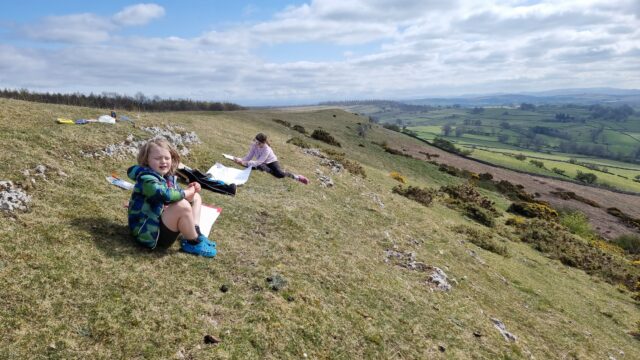
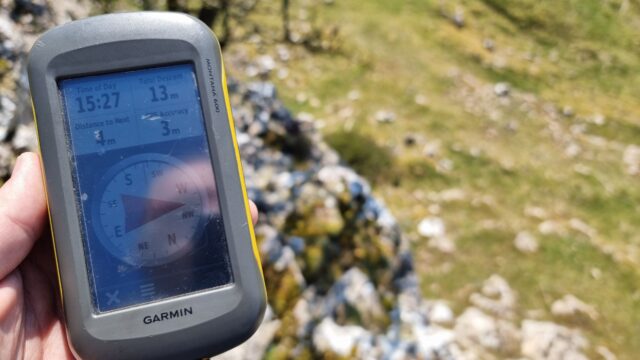
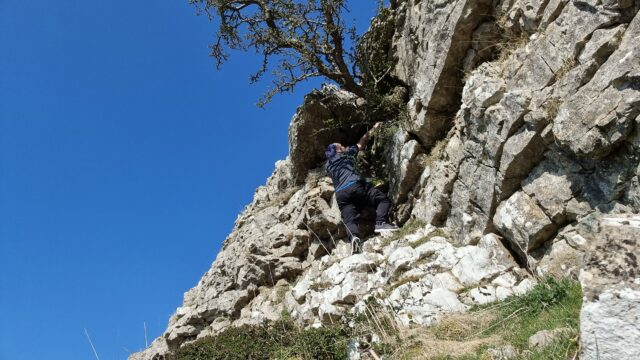
After claiming the FTF on the new cache to the North East, the geohound and I continued our walk with a wander through thy
woods, eventually finding ourselves near this gate. I’d nearly attempted this cache during a previous visit to these woods but IIRC was dragged right past it by impatient dogs,
children, or both. 😂
Today, though, it was a QEF for the doggo and I. Fun container and a good size too, FP awarded. TFTC!
Woke this morning slightly hungover and figured a nice walk with the geopup might help me feel better. And what an opportunity: a brand new cache only a short way from home!
Jumped in the car and zipped up to Church Hanborough, parking near the cemetery/allotments because the church bells were ringing and all the parking spots nearer to the centre of thy
village were occupied by churchgoers. Walked up the paths to the GZ and had sight of the cache’s shiny container before we were even there. Retrieval was quick and easy, but we had to
wait a while before we could return it to it’s hiding place because a large group of dog walkers (one of whom was holding court on how he was confident that Donald Trump would soon
“dismantle the Deep State” 🙄) were passing.
After a night that alternated between raining and freezing winds here, at the edge of Storm Éowyn, this morning my skylight has ice patterns on it that look beautiful and almost
organic.
Obviously all of the 118 executive orders President Trump
signed into effect on 20 January fall somewhere on the spectrum between fucking ridiculous and tragically fascist. But there’s a moment of joy to be taken in the fact that now, by
Presidential executive order, one could argue that all Americans are legally female:
…
One of Trump’s order is titled “Defending Women from Gender Ideology Extremism and Restoring Biological Truth to the Federal Government.” In the definition, the order claims,
“‘Female’ means a person belonging, at conception, to the sex that produces the large reproductive cell.” It then says, “’Male’ means a person belonging, at conception, to the sex
that produces the small reproductive cell.”
What critics point out is the crucial phrase “at conception.” According to the Associated
Press, the second “order declares that the federal government would recognize only two immutable sexes: male and female. And they’re to be defined based on whether people are
born with eggs or sperm, rather than on their chromosomes, according to details of the upcoming order.”
…
So yeah, here’s the skinny: Trump and team wanted to pass an executive order that declared that (a) there are only two genders, and (b) it’s determined biologically and can be
ascertained at birth. Obviously both of those things are categorically false, but that’s not something that’s always stopped lawmakers in the past (I’m looking at you, Indiana’s 1897 bill to declare Pi to be 3.2 exactly…).
But the executive order is not well thought-out (well duh). Firstly, it makes the unusual and somewhat-complicated choice of declaring that a person’s gender is determined by whether or
not it carries sperm or egg cells. And secondly – and this is the kicker – it insists that the point at which the final and absolute point at which gender becomes fixed is… conception
(which again, isn’t quite true, but in this particular legal definition it’s especially problematic…).
At conception, you consisted of exactly one cell. An egg cell. Therefore, under US law, all Americans ever conceived were – at the point at which their gender became
concrete – comprised only of egg cells, and thus are legally female. Every American is female. Well done, Trump.
Obviously I’m aware that this is not what Mrs. Trump intended when she signed this new law into effect. But as much as I hate her policies I’d be a hypocrite if I didn’t respect her
expressed gender identity, which is both legally-enforceable and, more-importantly, self-declared. As a result, you’ll note that I’ve been using appropriate feminine pronouns for her in
this post. She’s welcome to get in touch with me if she uses different pronouns and I’ll respect those, too.
(I’m laughing on the outside, but of course I’m crying on the inside. I’m sorry for what your President is doing to you, America. It really sucks.)
Checked in on this cache while on a dog walk to ensure the Storm Éowyn hadn’t trashed it. Good news: it’s fine! I need to update the cache description to reflect that the speed limit
here is now 20mph, though!
Today was my first day back at work after three months of paid leave1. I’d meant to write about the overall experience of my sabbatical and the things I gained
from it before I returned, but I’m glad I didn’t because one of the lessons only crystallised this morning.
This is about the point on the way back from the school run at which I pull out my phone and see what’s happening in the world or at work. But not today.
My typical work schedule sees me wake up some time before 06:30 so I can check my notifications, formulate my to-do list for the day, and so on, before the kids get up. Then I can focus
on getting them full of breakfast, dressed, and to school, and when I come back to my desk I’ve already got my day planned-out. It’s always felt like a good way to bookend my day, and
it leans into my “early bird” propensities2.
Over the last few years, I’ve made a habit of pulling out my phone and checking for any new work Slack conversations while on the way back after dropping the kids at school. By this
point it’s about 08:45 which is approximately the time of day that all of my immediate teammates – who span five timezones – have all checked-in. This, of course, required that I was
signed in to work Slack on my personal phone, but I’d come to legitimise this bit of undisciplined work/life-balance interaction by virtue of the fact that, for example, walking the dog
home from the school run was “downtime” anyway. What harm could it do to start doing “work” things ten minutes early?
Here. Here is where work happens (or, y’know, anywhere I take my work laptop to… but the crucial thing is that work has a time and a place, and it doesn’t include “while walking the
dog home after dropping the kids at school”).
But walking the dog isn’t “downtime”. It’s personal time. When I’m looking at your phone and thinking about work I’m actively choosing not to be looking at the
beautiful countryside that I’m fortunate enough to be able to enjoy each morning, and not to be thinking about… whatever I might like to be thinking about! By blurring my
work/life-balance I’m curtailing my own freedom, and that’s bad for both my work and personal lives!
My colleague Kyle recently returned from six months of parental leave and shared some wisdom with me, which I’ll
attempt to paraphrase here:
It takes some time at a new job before you learn all of the optimisations you might benefit from making to your life. This particular workflow. That particular notetaking strategy. By
the time you’ve come up with the best answers for you, there’s too much inertia to overcome for you to meaningfully enact personal change.
Coming back from an extended period of leave provides the opportunity to “reboot” the way you work. You’re still informed by all of your previous experience, but you’re newly blessed
with a clean slate within which to implement new frameworks.
He’s right. I’ve experienced this phenomenon when changing roles within an organisation, but there’s an even stronger opportunity, without parallel, to “reboot” your way of
working when returning from a sabbatical. I’ve got several things I’d like to try on this second chapter at Automattic. But the first one is that I’m not connecting my personal phone to
my work Slack account.
2 Mysteriously, and without warning, at about the age of 30 I switched from being a “night
owl” to being an “early bird”, becoming a fun piece of anecdotal evidence against the idea that a person’s preference is genetic or otherwise locked-in at or soon after
birth. As I’ve put it since: “I’ve become one of those chirpy, energetic ‘morning people’ that I used to hate so much when I was younger.”.
The final weekend of my sabbatical was spent, like the first one, at a Three Rings event. As a side activity to the volunteer work, everybody was asked to put their name on a paper
plate and leave it on a particular table, allowing others to semi-anonymously add compliments, thanks, or kind words about its owner.
Comments on my plate:
* Your my faveriot [sic] brother (gee, I wonder who THAT one was from 😂)
* Always seems to be doing interesting things. A maverick! Thinks outside the box
* Awesome
* Thank you for inventing this (a) system & (b) corporate model!
* Always smiley and excited
* Thanks for always pushing lots of new features!
* Puts up with idiots willingly and patiently
* You literally dreampt this whole thing into existence!
* Quirky
* Innovative solutions!
* Helpful in all ways!
Another book I received at Christmas Eve’s book exchange
was We’ll Prescribe You A Cat by Syou
Ishida, translated from the original Japanese by Emmie Madison Shimoda. It’s apparently won all kinds of acclaim and awards and what-have-you, so I was hoping for something pretty
spectacular.
It’s… pretty good, I guess? Less a novel, it’s more like a collection of short stories with an overarching theme, within which a deeper plot which spans them all begins to emerge… but
is never entirely resolved.
That repeating theme might be summed up as this: a person goes to visit a clinic – often under the illusion that it’s a psychiatric specialist – where, after briefly discussing their
problems with the doctor, they’re prescribed a dose of “cat” for some number of days. There’s a surprising and fun humour in the prescription, each time: the matter-of-fact way that the
doctor dispenses felines as if they were medications and resulting reactions of his nonplussed patients. Fundamentally, a prescription of cat works, and by the time the cat is returned
to the clinic, its caretaker is cured, albeit not necessarily in the way in which they would have originally expected.
Standing alone, each chapter short story is excellent. The writing is compelling and rich and the characters well-developed, particularly in the short timeframes in which we
get to know each of them. There’s a lot of interesting bits of Japanese culture represented, too, which – as an outsider – piqued my curiosity: whether by the careful work of the author
or her translator it never left me feeling lost, although I suspect there might be a few subtler points I missed as a result of my geographic bias1.
The characters (whether human, feline, or… otherwise…?) and their situations are quirky and amusing, and there are a handful of heart-warming… and heart-wrenching… moments that I
thoroughly enjoyed. But by the time I was half-way through the book, I was becoming invested in a payoff that would never come to be delivered. The nature of the doctor, his
receptionist, and their somewhat-magical clinic is never really resolved, and the interconnections between the patients is close to non-existent, leaving the book feeling like a
collection of tales that are related to… but not connected to… one another. As much as I’d enjoyed every story – and I did! – I nonetheless felt robbed of the opportunity to
wrap up the theme that they belong to.
Instead, we’re given just more unanswered questions: hints at the nature of the clinic and its occupants, ideas that skirt around ideas of magic and ghosts, and no real explanation.
Maybe the author’s planning to address it in the upcoming sequel, but unless I’m confident that’s the case, I’ll probably skip it.
In summary: some beautifully-written short stories with a common theme and a fun lens on Japanese culture, particularly likely to appeal to a cat lover, but with no payoff for getting
invested in the overarching plot.
Footnotes
1 Ishida spends a significant amount of intention describing the regional accents of
various secondary characters, and comparing those to the Kyoto dialect, for example. I’m pretty sure there’s more I could take from this if I had the cultural foothold to better
understand the relevance! But most of the cultural differences are less-mysterious.
This is funny, but I’m confident Wrexham’s potholes have nothing on the Trinbagonian ones I’ve been experiencing all
week, which have sometimes spanned most of the width of a road or been deep enough that dipping a wheel into them would strike the road with your underchassis!
Yesterday, Ruth and I made the first ever attempt at a geohashing expedition in Trinidad & Tobago, successfully finding a hashpoint in Chase Village in the West of Trinidad!
I’ve been on holiday on the islands of Trinidad & Tobago this week. These island nations span graticules that are dominated by the Caribbean and Atlantic Oceans, so it’s little wonder
there’s never been an attempted geohashing expedition in them. So when a hashpoint popped-up in a possibly-accessible location, I had to go for it!
For additional context: Trinidad & Tobago is currently under a state of
emergency as gang warfare and an escalating murder rate has reached a peak. It’s probably ill-advised to go far off the beaten track, especially as somebody who’s clearly a foreign
tourist. The violence and danger is especially prevalent in and around parts of nearby Port of Spain.
As a result, my partner Ruth (wisely) agreed to drive with me to the GZ strictly under the understanding that we’d turn back at a moment’s notice if anything looked remotely sketchy,
and we’d take every precaution on the way to, from, and at the hashpoint area (e.g. keeping car doors locked when travelling and not getting out unless necessary and safe to do so,
keeping valuables hidden out of sight, knowing the location of the nearest police station at any time, etc.).
I don’t have my regular geohashing kit with me, but I’ve got a smartphone, uLogger sending 5-minute GPS location pings (and the ability to send a location when I press a button in the
app, for proof later), and a little bravery, so here we go…
Expedition
Our plane from Tobago landed around 15:20 local time, following an ahead-of-schedule flight assisted by a tailwind from the Atlantic side. We disembarked, collected our bags, and
proceeded to pick up a hire car.
Our Caribbean Airlines aircraft, landed at Piarco airport.
Our original plan for our stay in Trinidad had been to drive up to an AirBnB near 10.743817, -61.514248 on Paramin, one of Tobago’s highest summits. However,
our experience of driving up Mount Dillon on Tobago earlier in the week showed us that the rural
mountain roads around here can be terrifyingly dangerous for non-locals1,
and so we chickened out and investigated the possibility of arranging a last-minute stay at a lodge on the edge of the rainforest in Gran Couva, or else failing that a fallback plan of
a conventional tourist-centric hotel in the North of Port of Spain.
By this point, we’d determined that the hashpoint was in the old sugar growing region of Caroni, in which our originally-intended accommodation at Gran Couva could be found, and so it
seemed feasible that we might be able to safely deviate from our route only a little to get to the hashpoint before reaching our beds. We were particularly keen to be at a place of
known safety before the sun set, here in an unusual part of an unfamiliar country! So when the owner of our proposed lodge in Gran Couva called to say that he couldn’t accept our
last-minute booking on account of ongoing renovations to his property, we had to quickly arrange ourself a room at our backup hotel.
This put us in an awkward position: now the hashpoint really wasn’t anything-like on the way from the airport to where we’d be staying, and we’d doubtless be spending longer
than we’d like to be on the road and increasing the risk that we’d be out after dark. I reassured Ruth, whose appetite for risk is somewhat lower than mine, that if we set out for the
hashpoint and anything seemed “off” we could turn around at any time, and we began our journey.
Putting a brave/excited face on as we set off in our rental car.
Boosted by her experience of driving on Tobago, Ruth continued to show her rapidly-developing Trinbagonian road skills2.
Driving down a network of crisscrossing roads.
Despite increasingly heavy traffic on our minor roads, possibly resulting from a crash that had occurred on the Southbound carriageway of the nearby Uriah Butler Highway which was
causing drivers to seek a shortcut through the suburbs, we made reasonable time, and were soon in the vicinity of the hashpoint: a mixed-use residential/light commercial estate of the
kind that apparently sprung up in places that were, until very late in the 20th century, lands used for sugar cane plantations.
At this point, the maps started to become less and less useful: Google Maps, OpenStreetMap, and Bing Maps completely disagreed as to whether we were driving on Bhagan Trace, Cemetery
Street, or Roy Gobin Fifth Avenue, as well as disagreeing on whether we were driving into a cul-de-sac or whether it was possible to loop around at the end to return back to the main
roads. It was now almost 17:00 and we were greeted by a large number of cars coming out of the narrow street in the opposite direction to us, going in, and squeezing past us: presumably
workers from one of the businesses down here going home for the evening.
There are highways we’d been recommended to avoid because of the safety situation here, but this one was okay.
My GPS flickered as it tried to make sense of the patchwork of streets, and I asked Ruth to slow down and pull over a couple of times until I was sure that we’d gotten as close as we
could, by road. Looking out of my window, I saw the empty lot that I’d scouted from satellite photography, but it was hopelessly overgrown. If the hashpoint was within it, it’d take
hours of work and a machete to cut through. The circle of uncertainty jumped around as I tried to finalise the signal without daring to do the obvious thing of holding my phone outside
the car window. A handful of locals watched us, the strange white folks sitting in a new car, as I poked at my devices in an effort to check if we were within the circle, or at least if
we would be when, imminently, we were forced to park even closer to the side to let a larger vehicle force its way through next to us!
Pulled up at the hashpoint.
At the point at which I thought we’d made it, I hit the “save waypoint” at 17:06 button and instructed Ruth to drive on. We turned in the road and I started navigating us to our hotel,
only thinking to look at the final location I’d tagged later, when we felt safer. We drove back into Port of Spain avoiding Laventille (another zone we’d been particularly recommended
to stay away from) while I resisted the urge to double-check my tracklog, instead focussing on trying to provide solid directions through not-always-signposted streets: we had a wrong
turning at one point when we came off the highway at Bamboo Settlement No. 1 (10.627952, -61.429083) but thankfully this was an easy mistake to course-correct from.
View of the hashpoint again as we turn to go home
It was only when I looked at my tracklog, later, that I discovered that the point I’d tagged was exactly 8.59 metres from the hashpoint, plus or minus a circle of uncertainty of… 9
metres. Amazingly, we’d succeeded without even being certain we’d done so. Having failed to get a silly grin photo at the hashpoint, we sufficed to get one while we drank
celebratory Prosecco and ate tapas on the rooftop bar of our hotel, looking down on the beautiful bay and imposing mountains of this beautiful if intimidating island.
Silly drinky grins atop our hotel North of Port of Spain
Tracklog
I didn’t bring my primary GPSr, but my phone keeps a general-purpose tracklog at ~5min/50m
intervals, and when I prompt it to. Apologies that this makes my route map look “jumpier” than usual, especially when I’m away from the GZ.
Achievements
Footnotes
1 Often, when speaking to locals, they’d ask if it was our first time in Trinidad &
Tobago, and on learning that it was, they’d be shocked to hear that we’d opted to drive for ourselves rather than to hire drivers to take us places: it turns out that the roads are in
very-variable condition, from wonderfully-maintained highways to rural trails barely-driveable without a 4×4, but locals in both drive with the same kind of assertive and sometimes
reckless attitude.
2 tl;dr of driving in Trinidad & Tobago, as somebody who learned to drive in the UK: (1)
if you need to get out of anywhere, don’t wait for anybody to yield because they won’t, even if you theoretically have the right of way: instead, force your way out by obstructing
others, (2) drive in the middle of the road wherever possible to make it easier to dodge potholes and other hazards, which are clustered near the soft verges, and swing to your own
side of the road only at the last second to avoid collisions, and (3) use your horn as often as you like and for any purpose: to indicate that you want to turn, to warn somebody that
you’re there, to tell somebody to move, to say hello to a nearby pedestrian you recognise, or in lieu of turning on your headlights at night, for example. The car horn is a universal
language, it seems.