Dan Q found GLMHN1GM #2 Alice in Wyederland – Drink Me or Eat Me?

This checkin to GLMHN1GM #2 Alice in Wyederland - Drink Me or Eat Me? reflects a geocaching.com log entry. See more of Dan's cache logs.

Now this is what I like to see: a fun (and thematic) little multicache! The sun’s well over the horizon and my co-volunteers will be getting up soon, so I quicken my pace in my plan to get #1 through #5 on this particular short outing. FP awarded.

Dan Q found GLMEZV9T Serpentine hide

This checkin to GLMEZV9T Serpentine hide reflects a geocaching.com log entry. See more of Dan's cache logs.

Once again narrowly beaten to a FTF by Go Catch! I don’t live a million miles from here, so I took a diversion on my cycle home. Knew exactly where to start looking, and spotted the container before I’d even dismounted from my bike! My pen’s leaking a bit, though: sorry for the inky fingerprints on the back of the log!

Immersive Storytelling – Thoughts on Virtual Reality, part 3

This is the (long-overdue) last in a three-part blog post about telling stories using virtual reality. Read all of the parts here.

For the first time in two decades, I’ve been playing with virtual reality. This time around, I’ve been using new and upcoming technologies like Google Cardboard and the Oculus Rift. I’m particularly interested in how these new experiences can be used as a storytelling medium by content creators, and the lessons we’ll learn about immersive storytelling by experimenting with them.

Annabel plays with a Google Cardboard with a Samsung Galaxy S6 Edge attached.
There are few user interfaces as simple as moving your own head. Even Annabel – who struggles with the idea that some screens aren’t touchscreens – manages.

It seems to me that the biggest questions that VR content creators will need to start thinking about as we collectively begin to explore this new (or newly-accessible) medium are:

How do we make intuitive user interfaces?

This question mostly relates to creators making “interactive” experiences. Superficially, VR gives user experience designers a running start because there’s little that’s as intuitive as “turning your head to look around” (and, in fact, trying the technology out on a toddler convinced me that it’s adults – who already have an anticipation of what a computer interface ought to be – who are the only ones who’ll find this challenging). On the other hand, most interactive experiences demand more user interaction than simply looking around, and therein lies the challenge. Using a keyboard while you’re wearing a headset is close to impossible (trust me, I’ve tried), although the augmented-reality approach of the Hololens and potentially even the front-facing webcam that’s been added to the HTC Vive PRE might be used to mitigate this. A gamepad is workable, but it’s slightly immersion-breaking in some experiences to hold your hands in a conventional “gamer pose”, as I discovered while playing my Gone Home hackalong: this was the major reason I switched to using a Wiimote.

A pair of Oculus Rift "touch" controllers.
All of the major VR manufacturers are working on single-handed controllers with spatial awareness and accessible buttons. Some also support haptic feedback so that you can “feel” UI components.

So far, I’ve seen a few attempts that don’t seem to work, though. The (otherwise) excellent educational solar system exploration tool Titans of Space makes players stare at on-screen buttons for a few seconds to “press” them, which is clunky and unintuitive: in the real world, we don’t press buttons with our eyes! I understand why they’ve done this: they’re ensuring that their software has the absolute minimum interface requirement that’s shared between the platforms that it supports, but that’s a concern too! If content creators plan to target two or more of the competing systems that will launch this year alone, will they have to make usability compromises?

There’s also the question of how we provide ancillary information to players: the long-established paradigms of “health in the bottom left, ammo in the bottom right” don’t work so obviously when they’re hidden in your peripheral vision. Games like Elite Dangerous have tackled this problem from their inception by making a virtualised “real” user interface comprised of the “screens” in the spaceship around you, but it’s an ongoing challenge for titles that target both VR and conventional platforms in future. Wareable made some great observations about these kinds of concerns, too.

How do we tell stories without forced visual framing?

In my previous blog post, I talked about a documentary that used 360° cameras to “place” the viewer among the protesters that formed the subject of the documentary. In order to provide some context and to reduce the disorientation experienced by “jumping” from location to location, the creator opted to insert “title slides” between scenes with text explaining what would be seen next. But title slides necessitate that the viewer is looking in a particular direction! In the case of this documentary and several other similar projects I’ve seen, the solution was to put the title in four places – at each of the four cardinal directions – so that no matter which way you were looking you’ll probably be able to find one. But title slides are only a small part of the picture.

Two gamers wearing Oculus Rift headsets.
Does anybody else see photos like this and get reminded of the pictures of hooded captives at interrogation camps?

Directors producing content – whether interactive or not – for virtual reality will have to think hard about the implications of the fact that their camera (whether a physical camera or – slightly easier and indeed more-controllable – a simulated camera in a 3D-rendered world) can look in any direction. Sets must be designed to be all-encompassing, which poses huge challenges for the traditional methods of producing film and television programmes. Characters’ exits and entrances must be through believable portals: they can’t simply walk off to the left and stop. And, of course, the content creator must find a way to get the audience’s attention when they need it: watching the first few minutes of Backstage with an Elite Ballerina, for example, puts you in a spacious dance studio with a spritely ballerina to follow… but there’s nothing to stop you looking the other way (perhaps by accident), and – if you do – you might miss some of the action or find it difficult to work out where you’re supposed to be looking. Expand that to a complex, busy scene like, say… the ballroom scene in Labyrinth… and you might find yourself feeling completely lost within a matter of minutes (of course, a feeling of being lost might be the emotional response that the director intends, and hey – VR is great for that!).

Sarah and Jareth dance in the ballroom scene of Labyrinth.
You’re looking the wrong way. Turn around, and you’ll see the best part of the movie.

The potential for VR in some kinds of stories is immense, though. How about a murder mystery story played out in front of you in a dollhouse (showing VR content “in minature” can help with the motion sickness some people feel if they’re “dragged” from scene to scene): you can move your head to peep in to any room and witness the conversations going on, but the murder itself happens during a power cut or otherwise out-of-sight and the surviving characters are left to deduce the clues. In such a (non-interactive) experience the spectator has the option to follow the action in whatever way they like, and perhaps even differently on different playthroughs, putting the focus on the rooms and characters and clues that interest them most… which might affect whether or not they agree with the detective’s assertions at the end…

What new storytelling mechanisms can this medium provide?

As I mentioned in the previous blog post, we’ve already seen the evolution of storytelling media on several occasions, such as the jump from theatre to cinema and the opportunities that this change eventually provided. Early screenwriters couldn’t have conceived of some of the tools used in modern films, like the use of long flowing takes for establishing shots or the use of fragmented hand-held shots to add an excited energy to fight scenes. It wasn’t for lack of imagination (Georges Méliès realised back in the nineteenth century that timelapse photography could be used to produce special effects not possible in theatre) but rather a lack of the technology and more-importantly a lack of the maturity of the field. There’s an ongoing artistic process whereby storytellers find new ways to manage their medium from one another: Romeo Must Die may have made clever use of a “zoom-to-X-ray” when a combatant’s bones were broken, but it wouldn’t have been possible if The Matrix hadn’t shown the potential for “bullet time” the previous year. And if we’re going down that road: have you seen the bullet time scene in Zotz!, a film that’s older than the Wachowskis themselves?

Clearly, we’re going to discover new ways of telling stories that aren’t possible with traditional “flat screen” media nor with more-immersive traditional theatre: that’s what makes VR as a storytelling tool so exciting.

Perhaps the original cinematic use of bullet time, in Zotz!
The original use of bullet time still wasn’t entirely new, as the original bullet predates it by hundreds of years.

Of course, we don’t yet know what storytelling tools we’ll find in this medium, but some ideas I’ve been thinking about are:

  • Triggering empathetic responses by encouraging the audience to more-closely relate to the situation of characters by putting them more-directly “in their shoes”. That Dragon, Cancer, an autobiographical game about the experience of a child’s terminal cancer, is an incredibly emotive experience… but only begins to touch upon the emotional journeys possible through virtual reality: what’s it really like to be close to somebody who’s terminally ill?
  • Allowing spectators to spectate a story in their own way, or from a perspective that they choose and control. We’ve already begun to explore this as a concept with the (little-used) multi-angle feature on DVDs: for example, if you’ve got the special edition of Die Hard then you can rewatch certain scenes and flick between different cameras as you watch. But that’s nothing on the potential for future animated films to allow you to walk or fly around and watch from any angle… or in the case of interactive experiences, to influence the direction that the story takes by your actions or even just by your presence: how about a heist story in which the burglars will only carry out their plan if they can’t tell that you’re watching them, forcing you to be surreptitious in your glances over to see what they’re up to?
"Fly" motion simulator
There’s no need to build a rollercoaster at all: a good motion simulator plus a VR headset can probably provide a similar experience.
  • Combining VR with motion simulation: Alton Towers is leading the way here, with their announcement that they’re going to re-engineer the Air rollercoaster into Galactica, upon which the ride gives the sensation of motion while a Samsung Gear VR headset simulates an otherwise-impossible spacefaring experience, and I’m hugely excited about the prospect. But a more-adaptable and economical way to achieve a similar result would be to repurpose a motion simulator: the good ones can provide the sensation of g-forces on almost any vector for an extended period of time; the really good ones can provide short bursts of g-forces at levels other than that provided by Earth’s gravity (usually by flinging the carriage around on a programmable shuttle arm, although weightlessness is still unfeasible while you remain on the ground). If you didn’t think that 2013’s Gravity was nauseating enough when it was merely in 3D, wait until you try a similar experience in motion-assisted virtual reality.
  • Point-of-view framing: this paradigm has always been at least a little unsatisfying in regular movies. I mean, it might have been the best moment in Doom, but that’s more to do with how apalling that film was than how good the technique is! But the potential for stepping in to the viewpoint of another human and being able to look around has great potential for immersion-building without allowing the participant to stray too-far from the main storyline. Something that people who haven’t yet experienced VR don’t often appreciate is that a few little things can really improve the experience of immersion… things like being able to move your head, even just being a few degrees, make you feel like you’re “there”. There are some big challenges to overcome with this, of course, such as how to make the movement of the camera not make the watcher feel ‘dragged along’, especially if their experience is of moving sideways… but these are challenges that will probably be solved for us quickly by the porn industry, who’re working very hard on making this kind of experience seamless. Just like the leaps and bounds we took with streaming video, yet again technology will get to thank peoples’ love of porn for advancing what home computers are capable of.
GIF showing a variety people watching VR porn. [SFW]
Nothing in this GIF reflects how people will genuinely watch VR porn. There’ll be a lot more lube and a lot fewer clothes, I guarantee it.
  • Exploring therapeutic experiences: until I really started trying out different VR gear, I didn’t think that it would be sufficiently engaging to be able to trigger a strong enough response to be useful in a therapeutic capacity. But after the first time I came out of a 10-minute game of Caaaaardboard! feeling genuinely wobbly at the knees in the same way as after my first parachute jump, I realised that modern VR really can produce an experience that results in a psychosomatic response. And that’s really important, because it provides a whole new medium in which we can treat (and, I suppose, study), for example, phobias in a controlled and ‘escapable’ environment. Of course, that raises other questions too, such as: is it possible to cause disorders like PTSD with virtual reality? If it’s simply the case that optimally-made VR is more-immersive than the best possible “flat screen” experiences and that it’s this that can improve its therapeutic potential, then surely it can be more-traumatic, too: I know enough people that were emotionally-scarred by Bambi‘s mother’s death, E.T.‘s almost-death, or that one scene from Watership Down that gave me nightmares for years: how much more (potentially)-damaging could a VR experience be? Whether or not it’s truly the case, it’ll only take one or two media circuses about murderous psychopaths who are unable to differentiate their virtual reality from the real kind before people start getting asked these kind of questions.
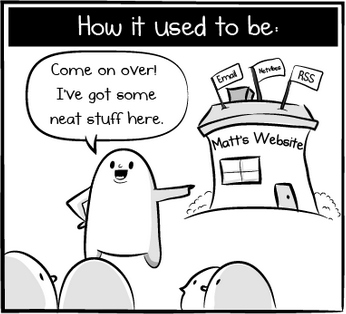
  • Oh, and this webcomic, of course.

As I’m sure I’ve given away these last three blog posts, I’m really interested in the storytelling potential of VR, and you can bet I’ll be bothering you all again with updates of the things I get to play with later this year (and, in fact, some of the cool technologies I’ve managed to get access to just while I’ve been writing up these blog posts).

If you haven’t had a chance to play with contemporary VR, get yourself a cardboard. It’s dirt-cheap and it’s (relatively) low-tech and it’s nowhere near as awesome as “real” hardware solutions… but it’s still a great introduction to what I’m talking about and it’s absolutely worth doing. And if you have, I’d love to hear your thoughts on storytelling using virtual reality, too.

× × × × × ×

Dan Q found GLMDCFM3 Ghosts of Hampton Gay

This checkin to GLMDCFM3 Ghosts of Hampton Gay reflects a geocaching.com log entry. See more of Dan's cache logs.

An Easter Sunday adventure for my 2 y/of neice and I brought us out here to find this cache. Yesterday we found the one on the other side of the river and had talked about the ruins we could see in the distance, so this seemed like an obvious outing!

Wellie’d up we hit the trail, although the little monster’s wellies were mostly unnecessary as she insisted on riding atop my shoulders all the way to the GZ. On the way, she observed that the old manor house – with fences and warning signs all around but a small agricultural shelter within the grounds – “is for pigs, not for people”.

Fix at GZ was a little shaky so it took us a few minutes to find, but we got there in the end. No sign of the World Travel Geocoin or AEC Routemaster travel bugs, but a different bug in situ. TNLN, SL, and saw what might well have been another ‘cacher dismount his bike as we headed back to the road: good luck, possibly-fellow-cacher! TFTC.

Dan Q found GLMCQ378 54 with the jokers

This checkin to GLMCQ378 54 with the jokers reflects a geocaching.com log entry. See more of Dan's cache logs.

Visited for an afternoon walk with my two-year-old niece. Easy find, and a nice cache in a nice location. Let the little ‘un choose where we signed the log (ultimately opting for one of the pictures of a lady): never seen a logbook like this one before! TNLN, TFTC.

Dan Q found GLMC2CK5 Have you got the right equipment

This checkin to GLMC2CK5 Have you got the right equipment reflects a geocaching.com log entry. See more of Dan's cache logs.

When I first saw this appear I thought that I’d have the FTF in the bag this morning. After all: nobody would come out last thing on a Tuesday night to start a multicache series, would they? Hah.

Well, come the morning I saw that I’d been beaten and opted to, instead of tackling the rush hour traffic, come along for a leisurely lunchtime look-see. The first waypoint was easy: I’m already equipped for wardriving so I just drove my car past the place (I didn’t even have to stop!) and then checked my laptop later – sure enough, only one detected SSID looked anything like GPS coordinates. The second waypoint slowed me down: for some reason, it took my GPSr a good long time to latch on to the Chirp and get the data I needed. Next up was the NFC tag, which was an easy find in the third place I looked. And finally, on to the cache itself which the coordinates lead me straight to.

Fantastic to see people doing things a little beyond the norm: things that take a little effort. Thanks for fab little adventure this lunchtime, and for a nice little cache. FP awarded.

We Hire the Best, Just Like Everyone Else

This is a repost promoting content originally published elsewhere. See more things Dan's reposted.

One of the most common pieces of advice you’ll get as a startup is this: Only hire the best. The quality of the people that work at your company will be one of the biggest factors in your success – or failure. I’ve heard this advice over and over and over at startup events, to…

Dan Q archived GC54F7B Oxford Steganography #2 – Selected Text

This checkin to GC54F7B Oxford Steganography #2 - Selected Text reflects a geocaching.com log entry. See more of Dan's cache logs.

It’s proved impossible for me to re-create the lenses used as clues in the parts of this series that have been “muggled”, and it seems that the only solution is to dis-assemble and archive the entire series. The bonus cache (#5) will remain available until March 2016 for anybody who’s solved the puzzle but hasn’t yet found it.

Dan Q archived GC54F78 Oxford Steganography #1 – Open In New Tab

This checkin to GC54F78 Oxford Steganography #1 - Open In New Tab reflects a geocaching.com log entry. See more of Dan's cache logs.

It’s proved impossible for me to re-create the lenses used as clues in the parts of this series that have been “muggled”, and it seems that the only solution is to dis-assemble and archive the entire series. The bonus cache (#5) will remain available until March 2016 for anybody who’s solved the puzzle but hasn’t yet found it.

Dan Q archived GC54F7J Oxford Steganography #3 – X-Ray

This checkin to GC54F7J Oxford Steganography #3 - X-Ray reflects a geocaching.com log entry. See more of Dan's cache logs.

It’s proved impossible for me to re-create the lenses used as clues in the parts of this series that have been “muggled”, and it seems that the only solution is to dis-assemble and archive the entire series. The bonus cache (#5) will remain available until March 2016 for anybody who’s solved the puzzle but hasn’t yet found it.

Dan Q found GLKZW2HZ Silver Screen

This checkin to GLKZW2HZ Silver Screen reflects a geocaching.com log entry. See more of Dan's cache logs.

FTF! Happened to be in the city centre eating my sandwiches and looking at my phone when the alert came in: new cache, less than a kilometre away! Hopped on my bike and bombed it down to find this wonderfully subtle cache. Tweezers would definitely have helped here, but a safety pin that I happened to be carrying worked pretty well too. Nice cache, hope it lasts! TFTC.

Immersive Storytelling – Thoughts on Virtual Reality, part 2

This is the second in a three-part blog post about telling stories using virtual reality. Read all of the parts here.

I’m still waiting to get in on the Oculus Rift and HTC Vive magic when they’re made generally-available, later this year. But for the meantime, I’m enjoying quite how hackable VR technologies are. I chucked my Samsung Galaxy S6 edge into an I Am Cardboard DSCVR, paired it with a gaming PC using TrinusVR, used GlovePIE to hook up a Wii remote (playing games with a keyboard or even a gamepad is challenging if your headset doesn’t have a headstrap, so a one-handed control is needed), and played a game of Gone Home. It’s a cheap and simple way to jump into VR gaming, especially if – like me – you already own the electronic components: the phone, PC, and Wiimote.

An I Am Cardboard, a Samsung Galaxy S6, and a Nintendo Wii Remote
My VR system is more-ghetto than yours.

While the media seems to mostly fixate on the value of VR in “action” gaming – shoot-’em-ups, flight simulators, etc. – I actually think there’s possibly greater value in it more story-driven genres. I chose Gone Home for my experiment, above, because it’s an adventure that you play at your own pace, where the amount you get out of it as a story depends on your level of attention to detail, not how quickly you can pull a trigger. Especially on this kind of highly-affordable VR gear, “twitchy” experiences that require rapid head turning are particularly unsatisfying, not-least because the response time of even the fastest screens is always going to be significantly slower than that of real life. But as a storytelling medium (especially in an affordable form) it’s got incredible potential.

Screengrab from Hong Kong Unrest - a 360° Virtual Reality Documentary.
Nothing quite gives you a feel of the human scale of the Hong Kong protests like being able to look around you, as if you’re stood in the middle of them.

I was really pleased to discover that some content creators are already experimenting with the storytelling potential of immersive VR experiences. An example would be the video Hong Kong Unrest – a 360° Virtual Reality Documentary, freely-available on YouTube. Standing his camera (presumably a Jump camera rig, or something similar) amongst the crowds of the 2014 Hong Kong protests, the creator of this documentary gives us a great opportunity to feel as though we’re standing right there with the protesters. The sense of immersion of being “with” the protesters is, in itself, a storytelling statement that shows the filmmaker’s bias: you’re encouraged to empathise with the disenfranchised Hong Kong voters, to feel like you’re not only with them in a virtual sense, but emotionally with them in support of their situation. I’m afraid that watching the click-and-drag version of the video doesn’t do it justice: strap a Cardboard to your head to get the full experience.

An augmented reality shoot-'em-up game via Microsoft Hololens
Don’t go thinking that I’m not paying attention to the development of the Hololens, too: I am, because it looks amazing. I just don’t know… what it’s for. And, I suspect, neither does Microsoft.

But aside from the opportunities it presents, Virtual Reality brings huge new challenges for content creators, too. Consider that iconic spaghetti western The Good, The Bad, And The Ugly. The opening scene drops us right into one of the artistic themes of the film – the balance of wide and close-up shots – when it initially shows us a wide open expanse but then quickly fills the frame with the face of Tuco (“The Ugly”), giving us the experience of feeling suddenly cornered and trapped by this dangerous man. That’s a hugely valuable shot (and a director’s wet dream), but it represents something that we simply don’t have a way of translating into an immersive VR setting! Aside from the obvious fact that the viewer could simply turn their head and ruin the surprise of the shot, it’s just not possible to fill the frame with the actor’s face in this kind of way without forcing the focal depth to shift uncomfortably.

Opening scene of The Good, The Bad, And The Ugly.
Sergio Leone’s masterpiece makes strategic use of alternating close and wide shots (and shots like the opening, which initially feels open but rapidly becomes claustrophobic).

That’s not to say that there exist stories that we can’t tell using virtual reality… just that we’re only just beginning to find out feet with this new medium. When stage directors took their first steps into filmography in the early years of the 20th century, they originally tried to shoot films “as if” they were theatre (albeit, initially, silent theatre): static cameras shooting an entire production from a single angle. Later, they discovered ways in which this new medium could provide new ways to tell stories: using title cards to set the scene, close-ups to show actors’ faces more-clearly, panning shots, and so on.

Similarly: so long as we treat the current generation of VR as something different from the faltering steps we took two and a half decades ago, we’re in frontier territory and feeling our way in VR, too. Do you remember when smartphone gaming first became a thing and nobody knew how to make proper user interfaces for it? Often your tiny mobile screen would simply try to emulate classic controllers, with a “d-pad” and “buttons” in the corners of the screen, and it was awful… but nowadays, we better-understand the relationship that people have with their phones and have adapted accordingly (perhaps the ultimate example of this, in my opinion, is the addictive One More Line, a minimalist game with a single-action “press anywhere” interface).

Dan plays Back To Dinosaur Island on an Oculus Rift.
A few seconds after this photograph was taken, a T-rex came bounding out from the treeline and I literally jumped.

I borrowed an Oculus Rift DK2 from a co-worker’s partner (have I mentioned lately that I have the most awesome co-workers?) to get a little experience with it, and it’s honestly one of the coolest bits of technology I’ve ever had the priviledge of playing with: the graphics, comfort, and responsiveness blows Cardboard out of the water. One of my first adventures – Crytek’s tech demo Back to Dinosaur Island – was a visual spectacle even despite my apparently-underpowered computer (I’d hooked the kit up to Gina, my two-month old 4K-capable media centre/gaming PC: I suspect that Cosmo, my multi-GPU watercooled beast might have fared better). But I’ll have more to say about that – and the lessons I’ve learned – in the final part of this blog post.

× × × ×

Dan Q found GLKZDAQT A Cryptic Cache

This checkin to GLKZDAQT A Cryptic Cache reflects a geocaching.com log entry. See more of Dan's cache logs.

Solved the puzzle yesterday but didn’t get the chance to come hint for this one until this morning, even I took a diversion from dropping my niece off at nursery to come and hunt! Sapphirites wasn’t kidding: getting to the GZ by the obvious route (from the South) would be easier with wellies right now, don’t know about coming from the North but I suspect it might be better. Fun cache, nice puzzle, good hiding spot. TFTC.