This checkin to GC7QG1Z Oxford’s Wild Wolf Three reflects a geocaching.com log entry. See more of Dan's cache logs.
Ran the trail myself, all looks good now!
This checkin to GC7QG1Z Oxford’s Wild Wolf Three reflects a geocaching.com log entry. See more of Dan's cache logs.
Ran the trail myself, all looks good now!
This checkin to GC7QG1Z Oxford’s Wild Wolf Three reflects a geocaching.com log entry. See more of Dan's cache logs.
Visited GZ as part of maintenance; all well here, although the “obvious” path to the cache continues to become increasingly overgrown – a fallen tree in the way almost but not quite justifies putting the terrain rating up half a point.
Two bicycles seem to have been abandoned near the GZ. One belongs to hire scheme Ofo and has been reported to them. Making a note here so that if one or both are seen to still be there in the New Year they can be reported as having been “abandoned for several weeks” as per council recommendations: https://www.oxford.gov.uk/info/20060/street_cleaning/168/report_an_abandoned_bicycle
Cache container and contents remain in perfect condition. Go find it!
I’m a huge fan of multifactor authentication. If you’re using it, you’re probably familiar with using an app on your phone (or receiving a text or email) in addition to a username and password when logging in to a service like your email, social network, or a bank. If you’re not using it then, well, you should be.
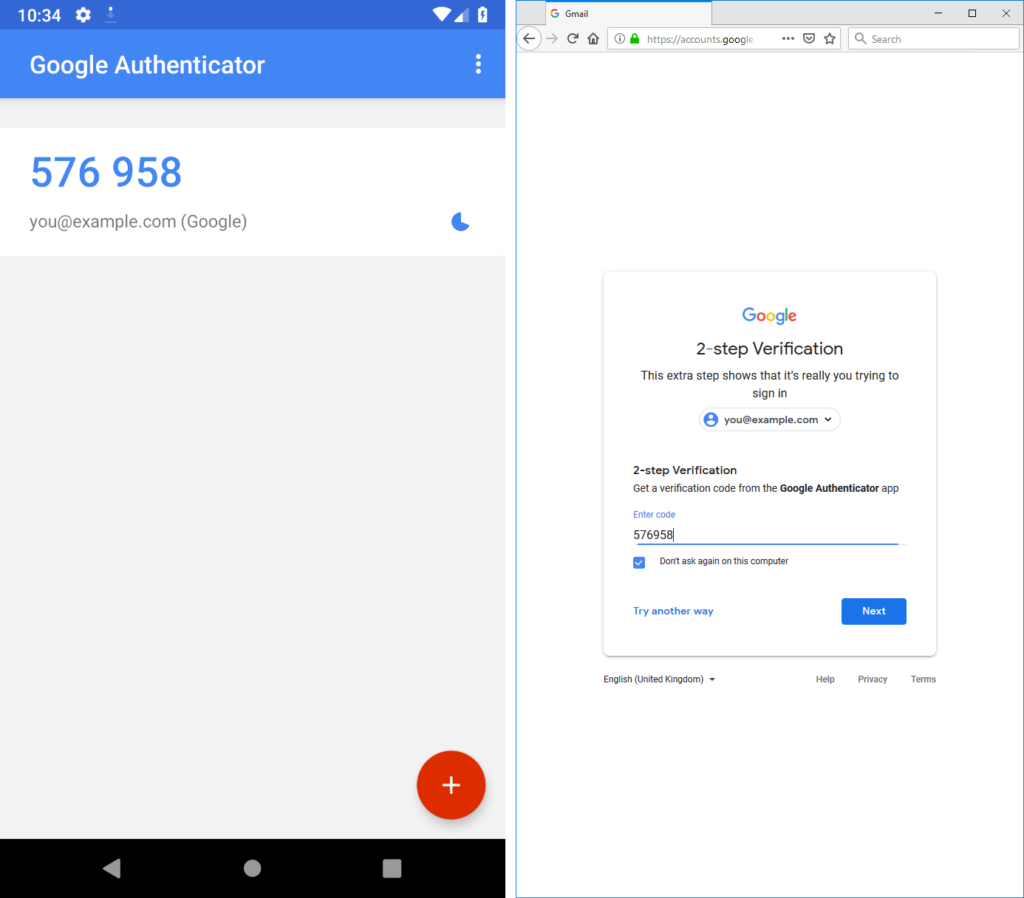
Ruth recently had a problem when she lost her phone and couldn’t connect to a service for which she usually used an authenticator app like the one pictured above, so I thought I’d share with you my personal strategy for managing multifactor authentication, in case it’s of any use to anybody else. After all: the issue of not-having-the-right-second-factor-to-hand has happened to me before, it’s certainly now happened to Ruth, and it’s probably something that’s happened to other people I know by now, too.

Here’s my strategy:

Some suggested backup strategies to consider (slightly biased towards TOTP):
#!/usr/bin/env ruby
require 'rubygems'
require 'rotp'

printf "%-30s %3s (%02ds) %4s\n", 'Account',
                                  'Now',
                                  (30 - (Time::now.utc.to_i % 30)),
                                  'Next'
puts '-' * 47
File.read(File.expand_path('~/.google-authenticator-accounts')).
     split("\n").reject{|l| l.strip == ''}.
     each do |account|
  if account =~ /^(.+) ([\w\d]+)$/
    totp = ROTP::TOTP.new($2)
    printf "%-30s %06s    %06s\n", $1,
                                   totp.at(Time::now.utc),
                                   totp.at(Time::now.utc + 30)
  end
end
I’ve occasionally been asked whether my approach actually yields me any of the benefits of two-factor authentication. After all, people say, aren’t I weakening its benefits by storing the TOTP generation key in the same place as my usernames and passwords rather than restricting it to my mobile device. This is true, and it is weaker to do this than to keep the two separately, but it’s not true to say that all of the benefits are negated: replay attacks by an attacker who intercepts a password are mitigated by this approach, for example, and these are a far more-common vector for identity theft than the theft and decryption of password safes.
Everybody has to make their own decisions on the balance of their convenience versus their security, but for me the sweet spot comes here: in preventing many of the most-common attacks against the kinds of accounts that I use and reinforcing my existing username/strong-unique-passwords approach without preventing me from getting stuff done. You’ll have to make your own decisions, but if you take one thing away from this, let it be that there’s nothing to stop you having multiple ways to produce TOTP/Google Authenticator credentials, and you should consider doing so.
This checkin to GC7QG1Z Oxford’s Wild Wolf Three reflects a geocaching.com log entry. See more of Dan's cache logs.
User Sapphirites advises that Waypoint #2 is missing. I plan to perform maintenance later today to bring this series back into working order.
This is a repost promoting content originally published elsewhere. See more things Dan's reposted.
Quantum computing is all the rage. It seems like hardly a day goes by without some news outlet describing the extraordinary things this technology promises. Most commentators forget, or just gloss over, the fact that people have been working on quantum computing for decades—and without any practical results to show for it.
We’ve been told that quantum computers could “provide breakthroughs in many disciplines, including materials and drug discovery, the optimization of complex manmade systems, and artificial intelligence.” We’ve been assured that quantum computers will “forever alter our economic, industrial, academic, and societal landscape.” We’ve even been told that “the encryption that protects the world’s most sensitive data may soon be broken” by quantum computers. It has gotten to the point where many researchers in various fields of physics feel obliged to justify whatever work they are doing by claiming that it has some relevance to quantum computing.
Meanwhile, government research agencies, academic departments (many of them funded by government agencies), and corporate laboratories are spending billions of dollars a year developing quantum computers. On Wall Street, Morgan Stanley and other financial giants expect quantum computing to mature soon and are keen to figure out how this technology can help them.
It’s become something of a self-perpetuating arms race, with many organizations seemingly staying in the race if only to avoid being left behind. Some of the world’s top technical talent, at places like Google, IBM, and Microsoft, are working hard, and with lavish resources in state-of-the-art laboratories, to realize their vision of a quantum-computing future.
In light of all this, it’s natural to wonder: When will useful quantum computers be constructed? The most optimistic experts estimate it will take 5 to 10 years. More cautious ones predict 20 to 30 years. (Similar predictions have been voiced, by the way, for the last 20 years.) I belong to a tiny minority that answers, “Not in the foreseeable future.” Having spent decades conducting research in quantum and condensed-matter physics, I’ve developed my very pessimistic view. It’s based on an understanding of the gargantuan technical challenges that would have to be overcome to ever make quantum computing work.
…
Great article undermining all the most-widespread popular arguments about how quantum computing will revolutionise aboslutely everything, any day now. Let’s stay realistic, here: despite all the hype, it might well be the case that it’s impossible to build a quantum computer of sufficient complexity to have any meaningful impact on the world beyond the most highly-experimental and theoretical applications. And even if it is possible, its applications might well be limited: the “great potential” they carry is highly hypothetical.
Don’t get me wrong, I’m super excited about the possibility of quantum computing, too. But as Mickhail points out, we must temper our excitement with a little realism and not give in to the hype.
This is a repost promoting content originally published elsewhere. See more things Dan's reposted.
This is a repost promoting content originally published elsewhere. See more things Dan's reposted.
One man – who appears to be afraid of chickens – plays Toto’s Africa on a rubber chicken, with backup from a real chicken. Congratulations: if you watched this, you just won the whole damn Internet.
This is a repost promoting content originally published elsewhere. See more things Dan's reposted.
…
Even if you love Chrome, adore Gmail, and live in Google Docs or Analytics, no single company, let alone a user-tracking advertising giant, should control the internet.
…
Diversity is as good for the web as it is for society. And it starts with us.
Yet more fallout from the Microsoft announcement that Edge will switch to Chromium, which I discussed earlier. This one’s pretty inspirational, and gives a good reminder about what our responsibilities are to the Web, as its developers.
This is a repost promoting content originally published elsewhere. See more things Dan's reposted.
Fantastic lightweight introduction to bacteriophages and how they can potentially be our next best weapon against infection as we approach the post-antibiotic age. Plus an interesting look at the history and the discovery of bacteriophages!
This is a repost promoting content originally published elsewhere. See more things Dan's reposted.
Microsoft is officially giving up on an independent shared platform for the internet. By adopting Chromium, Microsoft hands over control of even more of online life to Google.
This may sound melodramatic, but it’s not. The “browser engines” — Chromium from Google and Gecko Quantum from Mozilla — are “inside baseball” pieces of software that actually determine a great deal of what each of us can do online. They determine core capabilities such as which content we as consumers can see, how secure we are when we watch content, and how much control we have over what websites and services can do to us. Microsoft’s decision gives Google more ability to single-handedly decide what possibilities are available to each one of us.
From a business point of view Microsoft’s decision may well make sense. Google is so close to almost complete control of the infrastructure of our online lives that it may not be profitable to continue to fight this. The interests of Microsoft’s shareholders may well be served by giving up on the freedom and choice that the internet once offered us. Google is a fierce competitor with highly talented employees and a monopolistic hold on unique assets. Google’s dominance across search, advertising, smartphones, and data capture creates a vastly tilted playing field that works against the rest of us.
From a social, civic and individual empowerment perspective ceding control of fundamental online infrastructure to a single company is terrible. This is why Mozilla exists. We compete with Google not because it’s a good business opportunity. We compete with Google because the health of the internet and online life depend on competition and choice. They depend on consumers being able to decide we want something better and to take action.
Will Microsoft’s decision make it harder for Firefox to prosper? It could. Making Google more powerful is risky on many fronts. And a big part of the answer depends on what the web developers and businesses who create services and websites do. If one product like Chromium has enough market share, then it becomes easier for web developers and businesses to decide not to worry if their services and sites work with anything other than Chromium. That’s what happened when Microsoft had a monopoly on browsers in the early 2000s before Firefox was released. And it could happen again.
If you care about what’s happening with online life today, take another look at Firefox. It’s radically better than it was 18 months ago — Firefox once again holds its own when it comes to speed and performance. Try Firefox as your default browser for a week and then decide. Making Firefox stronger won’t solve all the problems of online life — browsers are only one part of the equation. But if you find Firefox is a good product for you, then your use makes Firefox stronger. Your use helps web developers and businesses think beyond Chrome. And this helps Firefox and Mozilla make overall life on the internet better — more choice, more security options, more competition.
Scathing but well-deserved dig at Microsoft by Mozilla, following on from the Edge-switch-to-Chromium I’ve been going on about. Chris is right: more people should try Firefox (it’s been my general-purpose browser on desktop and mobile ever since Opera threw in the towel and joined the Chromium hivemind in 2013, and on-and-off plenty before then) – not just because it’s a great browser (and it is!) but also now because it’s important for the diversity and health of the Web.
(Reprinted in full under a creative commons license.)
Our eldest, 4, started school this year and this week saw her first parents’ evening. This provided an opportunity for we, her parents, to “come out” to her teacher about our slightly-unconventional relationship structure. And everything was fine, which is nice.
I’m sure the first few months of every child’s school life are a time that’s interesting and full of change, but it’s been particularly fascinating to see the ways in which our young academic’s language has adapted to fit in with and be understood by her peers.
I first became aware of these changes, I think, when I overheard her describing me to one of her school friends as her “dad”: previously she’d always referred to me as her “Uncle Dan”. I asked her about it afterwards and she explained that I was like a dad, and that her friend didn’t have an “Uncle Dan” so she used words that her friend would know. I’m not sure whether I was prouder about the fact that she’d independently come to think of me as being like a bonus father figure, or the fact that she demonstrated such astute audience management.

I don’t object to being assigned this (on-again, off-again, since then) nickname. My moniker of Uncle Dan came about as a combination of an effort to limit ambiguity (“wait… which dad?”) and an attempt not to tread on the toes of actual-father JTA: the kids themselves are welcome to call me pretty-much whatever they’re comfortable with. Indeed, they’d be carrying on a family tradition if they chose-for-themselves what to call me: Ruth and her brothers Robin and Owen address their father not by a paternal noun but by his first name, Tom, and this kids have followed suit by adopting “Grand-Tom” as their identifier for him.
Knowing that we were unusual, though, we’d taken the time to do some groundwork before our eldest started school. For example we shared a book about and spent a while talking about how families differ from one another: we figure that an understanding that families come in all kinds of shapes and sizes is a useful concept in general from a perspective of diversity and and acceptance. In fact, you can hear how this teaching pays-off in the language she uses to describe other aspects of the differences she sees in her friends and their families, too.
Still, it was a little bit of a surprise to find myself referred to as a “dad” after four years of “Uncle Dan”.

Nonetheless: in light of the fact that she’d clearly been talking about her family at school and might have caused her teacher some confusion, when all three of us “parents” turned up to parents’ evening we opted to introduce ourselves and our relationship. Which was all fine (as you’d hope: as I mentioned the other day, our unusual relationship structure is pretty boring, really), and the only awkwardness was in having to find an additional chair than the teacher had been expecting to use with which to sit at the table.
There’s sometimes a shortage of happy “we did a thing, and it went basically the same as it would for a family with monogamous parents” poly-family stories online, so I thought this one was worth sharing.
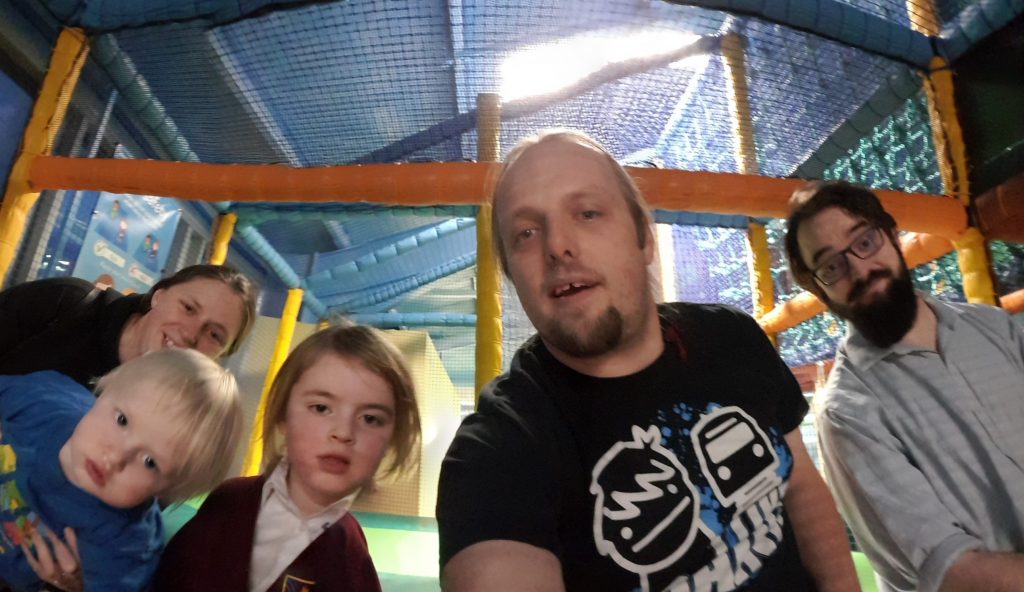
And better yet: apparently she’s doing admirably at school. So we all celebrated with an after-school trip to one of our favourite local soft play centres.

This is a repost promoting content originally published elsewhere. See more things Dan's reposted.
…
We used to have much more diversity in terms of browser engines years ago than we do today. This is easy to understand as the Web in 2018 is far more complex than it was in the early noughties. It is very costly to develop and maintain a Web engine and few companies have the necessary talent and cash to do it. Microsoft is one of those companies but the fact that it might be throwing in the towel on its engine signals a bad development for all of us.
…
Further evaluation of the dangers of the disappearing diversity on the Web, following in the theme of my thoughts the other day about Microsoft’s adoption of Chromium instead of EdgeHTML in its browser.
Andre raises a real point: how will we fight for a private and decentralised Web when it becomes “the Google Web”?
This is a repost promoting content originally published elsewhere. See more things Dan's reposted.
…
I don’t think Microsoft using Chromium is the end of the world, but it is another step down a slippery slope. It’s one more way of bolstering the influence Google currently has on the web.
We need Google to keep pushing the web forward. But it’s critical that we have other voices, with different viewpoints, to maintain some sense of balance. Monocultures don’t benefit anyone.
This essay follows-up nicely on my concerns about Microsoft’s move from EdgeHTML to Chromium in Edge, but goes further to discuss some of the bigger problems of a homogeneous web, especially one under Google’s influence.
This is a repost promoting content originally published elsewhere. See more things Dan's reposted.
Yesterday, Quora announced that 100 million user accounts were compromised, including private activity like downvotes and direct messages, by a “malicious third party.”
Data breaches are a frustrating part of the lifecycle of every online service — as they grow in popularity, they become a bigger and bigger target. Nearly every major online service has had a security breach: Facebook, Google, Twitter, Yahoo, Tumblr, Uber, Evernote, eBay, Adobe, Target, Twitter, and Sony all extensively leaked user data in the last few years.
Security breaches like these are a strong argument for using a password manager, but not a compelling reason to avoid a service you love, unless you plan to quit the internet entirely.
But this does seem like a good time to remind you of all the other reasons why you should never, ever use Quora.
…
Short summary of why you shouldn’t use Quora (even ignoring the recent security scare), for those who can’t be bothered clicking-through:
Just don’t use Quora.
Hot on the tail of Pong, I wanted to share another mini-project I’ve developed for the Bodleian: this year’s digital advent calendar:
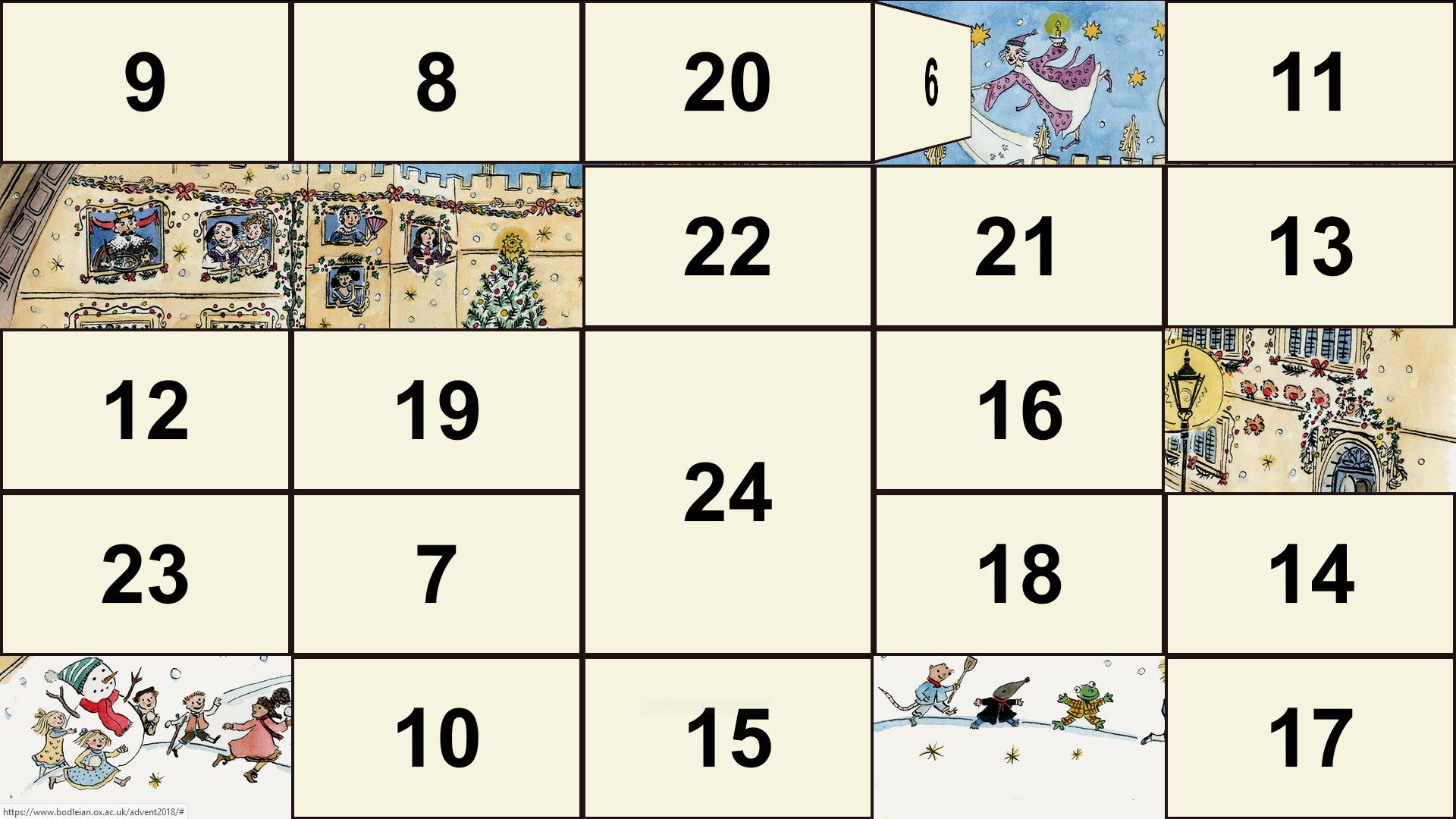
As each door is opened, a different part of a (distinctly-Bodleian/Oxford) winter scene unfolds, complete with an array of fascinating characters connected to the history, tradition, mythology and literature of the area. It’s pretty cool, and you should give it a go.
If you want to make one of your own – for next year, presumably, unless you’ve an inclination to count-down in this fashion to something else that you’re celebrating 25 days hence – I’ve shared a version of the code that you can adapt for yourself.
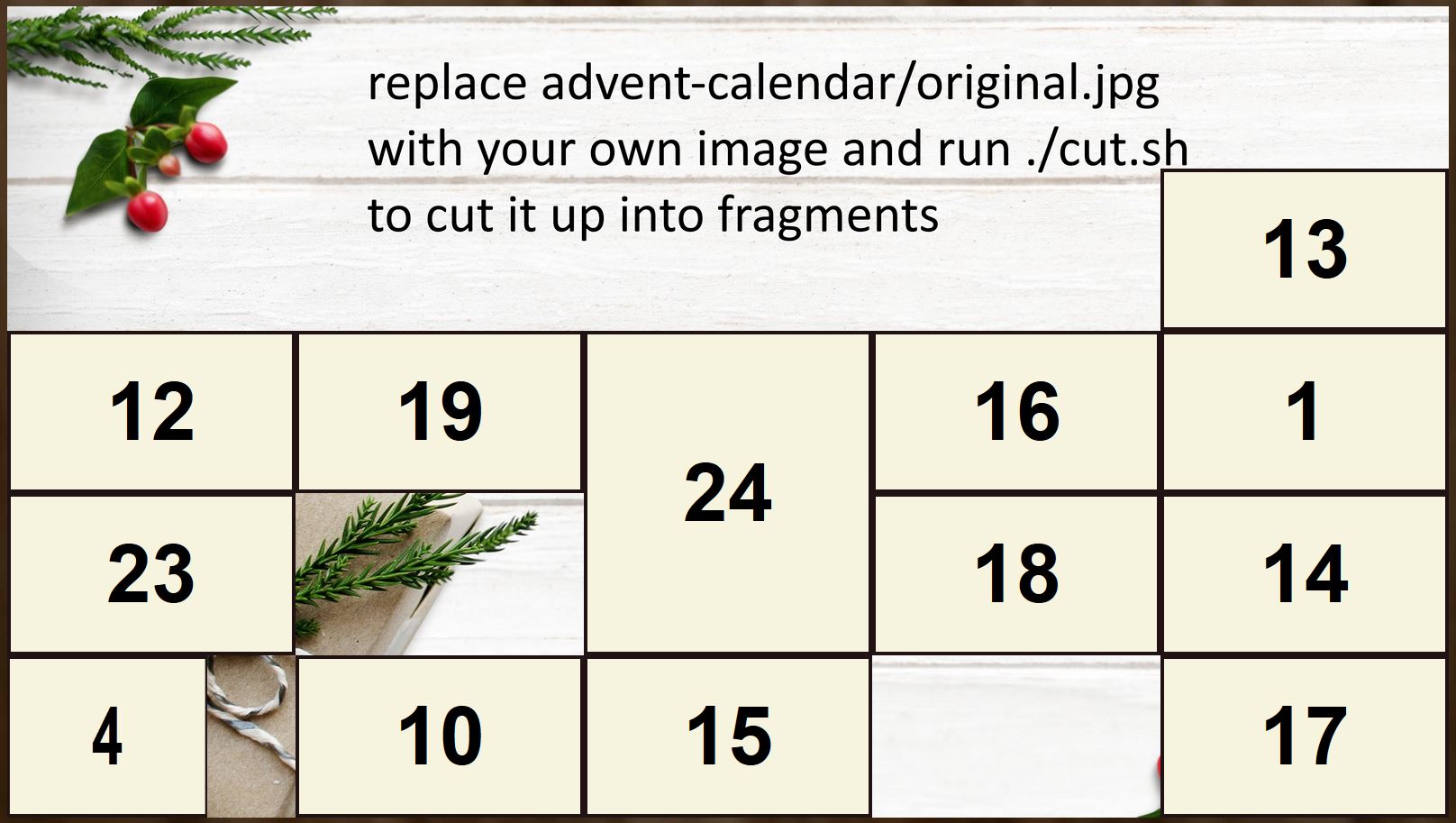
Features that make this implementation a good starting point if you want to make your own digital advent calendar include:
I’ve no idea if it’s any use to anybody, but it’s available on GitHub if you want it.