
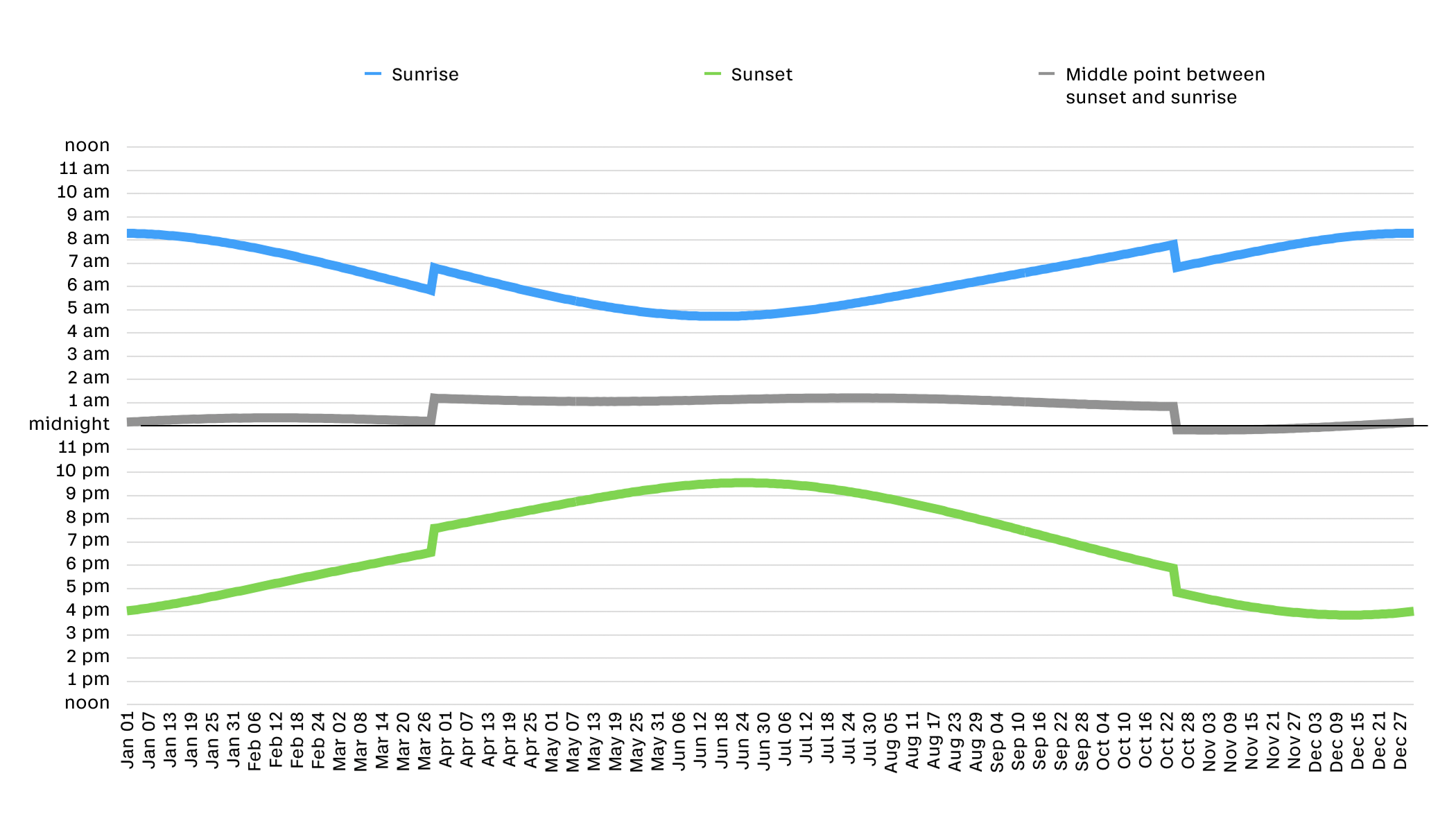
It does, of course, depend on your position within your solar timezone!
Berlin is about 13.5 degrees East of the Prime Meridian, so it's 13.5 / 360 * 24 = 0.9 hours. So that means it's 54 minutes East of UTC.
UTC is functionally equivalent (for normal humans) to GMT, which is calibrated based on the solar time at the Prime Meridian.
Germany's timezone is UTC+01:00 in the winter, so you'd expect solar "midnight" (and "midday" for that matter) to be 6 minutes "early", on average. Which is probably exactly what your graph shows! (There's a little bit of a wobble because of complicated orbital physics and inclination and stuff, but it's ABOUT right.)
Being out by an hour in summer is, of course, because the clocks are "wrong" by an hour in the summer, compared to solar time. Or rather, in Berlin, wrong by an hour and six minutes.
This rule, of course, doesn't hold true everywhere. If you live in the far West of China, your true solar time might be only UTC+05:20, but China's timezone is UTC+08:00, so solar events like sunrise, sunset, midday and "midnight" would fall over two and a half hours "late"!
What you're seeing in Berlin is the consequence of you being almost-exactly in the centre of the idealised solar UTC+1 timezone. Look at a timezone map that extends bands all the way to the top or bottom and you'll see what I mean! And spare a thought for the folks in Reykjavík who are on UTC+0 despite being at a solar position of approximately UTC-01:25!
0 comments