Samsung have been showing off pre-release versions of their new Galaxy S26 range. It’s all pretty same-old predictable changes (and I’m still not really looking for anything to replace my now-five-year-old mobile anyway!), but one feature in particular – one that they’re not even mentioning in their marketing copy – seemed interesting and innovative.
You know those polarising filters you can use to try to stop people shoulder-surfing? Samsung have come up with a software-controlled one.
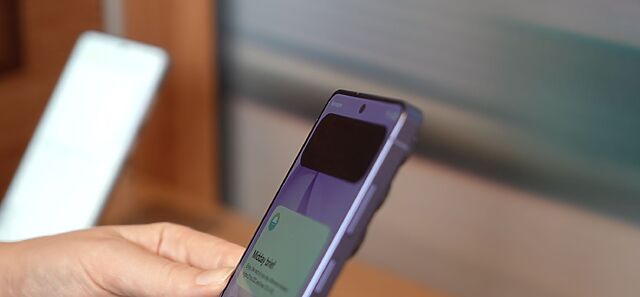
I assume that this black magic is facilitated by an additional layer between the screen and the glass, performing per-pixel selective polarisation in the same way as a monochrome LCD display might. But the fact that each pixel can now show two images – one to a user directly ahead, superimposed with another (monochrome) one to users with an offset viewing angle, is what interests me: my long-cultivated “hacker mentality” wants to ask “what I can make that do?”
Does the API of this (of this or of any similar or future screens?) provide enough control to manipulate the new layer? And is its resolution identical to that of the underlying screen?
Could “spoilers”, instead of being folded-away behind a <details>/<summary> or ROT13-encoded, say “tilt to reveal” and provide
a physicality to the mechanism of exposure?
Could diagrams embed their own metadata annotations: look at a blueprint from the side to see descriptions, or tilt your phone to see the alt-text on an image?
Can the polarisation layer be expanded to provide a more-sophisticated privacy overlay, such as a fake notification in place of a real one, to act as a honeypot?
Is there sufficient control over the angle of differentiation that a future screen could use eye tracking to produce a virtual lenticular barrier, facilitating a novel kind of autostereoscopic 3D display that works – like a hologram – from any viewing angle?
I doubt I’m buying one of these devices. But I’m very curious about all of these questions!
0 comments