I saw a heron this morning, and it reminded me of a police officer.
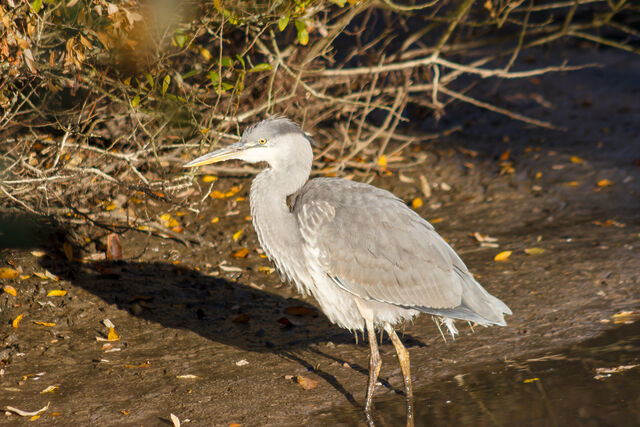
Right now, while my house is… not-so-inhabitable… I have a long drive to drop the kids off at school, and this morning it took us alongside the many flooded fields between our temporary accommodation and the various kid drop-offs.
Stopped at traffic lights, I watched a heron land in what would be best-described as a large puddle, rather than in the lake on the other side of the road. The lake, it turns out… was “guarded” by one of those fake heron things.
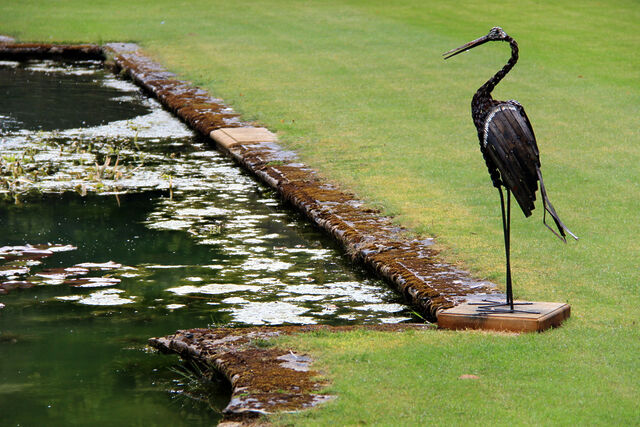
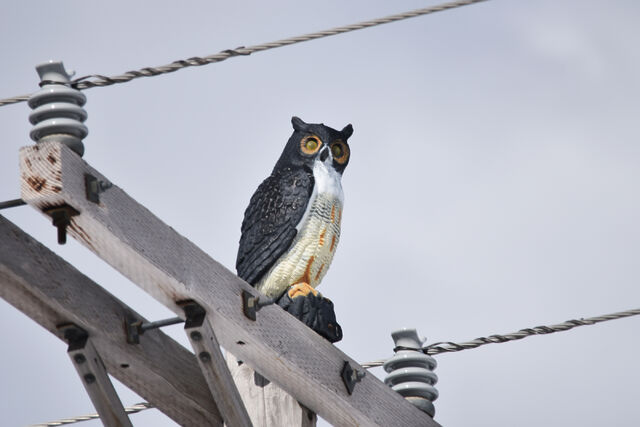
You’ve seen them, probably. People put them up to discourage territorial birds from visiting and eating all their fish.2 If you haven’t seen them, you might have at least spotted the fake owls, whose purpose is slightly different because they scare off other birds.
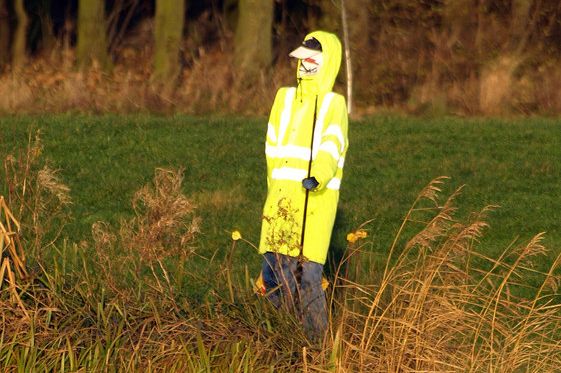
Anyway: I found myself thinking… do birds actually fall for this? Like scarecrows, it feels like they shouldn’t (and indeed, scarecrows don’t always work, and birds can quickly become accustomed to them). But clearly they work at least a little…?
Anyway, I found myself reminded of a geocaching expedition I went on outside Cambridge a couple of years ago. At around 6am I was creeping around outside a shopping centre on a Saturday morning, looking for a tiny magnetic geocache hidden behind a sign. I’d anticipated not having to use much “stealth” so early in the day… but nonetheless I kept getting the feeling that I was being watched.
It took me a few minutes until I worked out why: the local Home Bargains had put up a life-size standee of a police officer in just the right position that I kept catching him in the corner of my eye and second-guessing how much my digging-through-the-bushes looked incredibly suspicious!

I did a double-take the first time I spotted the officer, but soon realised he was fake. But the feeling of being watched persisted! There’s clearly something deeper in human psychology, more-instinctive, that – as social animals – gives us that feeling of being watched and influences our behaviour.
There’s a wonderful and much-cited piece of research from 2010 that describes how cooperative behaviour like proper use of an honesty box increases if you put a picture of some eyes above it: the mechanism’s not fully understood, but it’s speculated that it’s because it induces the feeling of being watched.
I reckon it’s similar with birds. They’re not stupid (some of them, like corvids, are famously smart… and probably many predator birds exhibit significant intelligence too), but if there’s something in your peripheral vision that puts you at unease… then of course you’re not going to be comfortable! And if there’s another option nearby5 that’ll work, that’s an easy win for a hungry bird.
You don’t need to actually believe that a scarecrow, a plastic bird, a poster of some eyes, or a picture of a bobby is real in order for it to have a psychological impact. That’s why – I believe – a fake heron works. And that’s why, today, a heron reminded me of a police officer.
Footnotes
1 I guess actual herons can’t tell the difference?
2 Presumably the same technique doesn’t work with sociable birds, who would probably turn up to try to befriend or woo the models.
3 I don’t know, but I do wonder, whether the picture is actually of a police officer or of a model. If I were a police officer and I knew that my likeness was being used at supermarkets and the like, I’d be first to volunteer to any call-outs to anywhere nearby them, so any suspect who ran from me would keep spotting me, following them, at every corner. You get few opportunities for pranks as a copper, I reckon, but this one would be a blast.
4 I wonder if a fake angler is more- or less-effective than a fake heron. Somewhere, an animal psychology PhD student is working out the experimental conditions to answer this question, I hope.
5 Remember: a bird can have a birds-eye view of feeding spots! If one option’s gonna make them feel like they’re being watched by a predator or a competitor, and another nearby option looks almost-as-good, they’re gonna take the alternative!
Why is the presence of herons undesirable to some? I can understand it for pigeons or geese that tend to poop places where humans would like to walk or park their cars, but herons are solitary and tend to be in the water. I thing them beautiful and an indicator of a healthy ecosystem.
If you have a pond full of fancy expensive fish, you might have a different opinion I guess!