
£4,803.40 a Year for Water?

When we picked up the keys to the rental house we’ll be living in while our home is repaired following the flood that forced us to evacuate, I took an initial meter reading then got in touch with super-reputable water company Thames Water to let them know the situation.

A digital water meter showing the value 381641.
The Chicory House’s water meter, found in a cupboard, is so much easier to read than the one at our regular house, which is found down a frequently-flooded manhole on the busy road outside.

Unfortunately, Thames Water had fucked-up1 and created an account for us already with the wrong information2, so by the time I’d reached out to them they were already getting themselves into a pickle.

It turns out that, presumably because of some shortsightedness on the part of their software engineers, their computer systems wouldn’t let them change the information to correct the problem. Nor could they simply delete the account and create a new one3. Instead, the had to close the account they’d erroneously set up such that the start and end date of the contract was our moving-in date… and then set up a new account starting from the day after.

Sigh. Fine! So long as it’s sorted, I didn’t even care. Until, that is, the bill arrived for the one day of the first (incorrectly-created) contract:

A Thames Water bill dated 18 April, for an account being closed '04/09/2026', covering a billing period of 9 April - 9 April, for £13.16.
This looks pretty low for a metered water bill, until you realise that it covers a period of literally only eleven hours from us moving in (and taking a meter reading) until the end of that day. And that during most of that time the water was switched-off because a pair of plumbers were installing a new bathroom!

That bill:

  • is for £13.16.
  • covers “9 April 2026 through 9 April 2026”, i.e. one day.
    • (which means that our estimated annual bill would be £4,803.40 (£13.16 × 365) – about eight times the national average)
  • states that our account closure was/will be “04/09/2026” – the only date on the letter that’s in “short” date format and which would appear to be 4 September (in UK date format) even though 9 April would make more sense (but would require interpreting it in US date format, which would make no sense).

Let’s see how that breaks down:

Breakdown of the '1 day' bill covering three cubic metres of water at £2.7346 (usage) and £1.4721 (sewerage), plus fixed charges, totalling £13.16.
The rates are standard, albeit a little on the high end: Thames Water need to raise funds right now to fix all of the leaks in their pipes, apparently. What’s odd is the volume of water they claim has been used.

According to this bill, we used three cubic metres of water between collecting the keys (at around 1pm), moving in, and taking a meter reading… and the end of the day. That’s three thousand litres of water.

Is it possible to achieve that level of water usage in the nine hours of billable time that this bill covers? I guess, if you really tried, you could:

  • completely fill and then drain our 100-litre bathtub, three times an hour, taking a five-and-a-half minute bath in each before draining it again, for the rest of the day4; or
  • run the kitchen tap – the highest-pressure tap in the house – continuously for six hours and forty minutes; or
  • repeatedly flush all three toilets, on “full-flush” mode, once every 79 seconds until midnight5, for example.
Dan, a white man with a blue ponytail, wearing a green t-shirt, watches a stopwatch timer on his phone while filling a measuring jug from the kitchen sink's tap.
Some science was involved in the writing of this blog post.

Obviously this is all ridiculous. I’m being ridiculous.

But then again, so is this bill, which claims that three adults spent 11 hours in a house and somehow used the amount of water that’s the recommended amount to drink in a day… by 1,500 adults. Despite the water being shut-off to install a shower and toilet for some of that time.

But then again, so is Thames Water’s computer system, which disallows the correction of mistakes even by their own staff and instead requires the creation of one-day contracts. And also can’t decide which country’s date format to use. And, possibly, doesn’t allow them to obey data protection laws.

The whole thing’s ridiculous. Which I’ll be letting Thames Water know. Let’s see if they agree.

Footnotes

1 This may be no surprise to anybody who’s ever dealt with Thames Water before, or who follows the news about their seemingly endless inability to keep clean water in its pipes and raw sewage out of our rivers, for example, while taking out loans in order to pay bonuses to their self-back-patting executives.

2 They used information provided to them by the estate agent and failed to connect it to the information they already had for us… which thanks to quirks of their information systems resulted in bigger problems down the line. Amusingly – and for a change! – none of the problems were related to my unusual name, this time around.

3 Curiously, these initial mistakes on the part of Thames Water left them processing personal information about me – an email address – that I’d never given to them, and allegedly unable to delete or correct it for six months after being asked to. This is the kind of thing that normally gives me an excuse for a field day of DPA2018-related letter writing, but this time around I’ve been too busy dealing with the bigger problems they’ve created to have a chance to stop and think about that: that’s how much of a mess they’ve made.

4 It’s only barely possible to repeatedly fill the bath this quickly, you need to use both hot and cold water: the cold inlet alone doesn’t have the pressure to fill it fast enough, but the hot water tank has its own separate inlet which makes all the difference. Also, a cold bath would suck, even if you’re only allowed five minutes in it before it’s time to drain the tub and start filling it again.

5 I once had a really rough night after a particularly dodgy curry, but I’ve never needed to be flushing a toilet twice a minute for eleven hours.

× × × ×

FlipFlop Solitaire’s Deck-Generation Secret

For the last few years, my go-to mobile game1 has been FlipFlop Solitaire.

The game

Animation showing FlipFlop Solitaire gameplay.
With its few-columns and large hit-areas, the game’s well-optimised for mobile play.

The premise is simple enough:

  • 5-column solitaire game with 1-5 suits.
  • 23 cards dealt out into those columns; only the topmost ones face-up.
  • 2 “reserve” cards retained at the bottom.
  • Stacks can be formed atop any suit based on value-adjacency (in either order, even mixing the ordering within a stack)
  • Individual cards can always be moved, but stacks can only be moved if they share a value-adjacency chain and are all the same suit.
  • Aim is to get each suit stacked in order at the top.
A late game on 5-suit FlipFlop solitaire with many mixed-suit stacks and many face-down cards.
Well this looks like a suboptimal position…

One of the things that stands out to me is that the game comes with over five thousand pre-shuffled decks to play, all of which guarantee that they are “winnable”.

Playing through these is very satisfying because it means that if you get stuck, you know that it’s because of a choice that you made2, and not (just) because you get unlucky with the deal.

FlipFlop's Deck Selector, showing that I've completed 596/1021 ex one suit, 453/1021 two suit, 327/1021 three suit, 222/1021 four suit, and 158/1021 five suit.
After giving us 5,105 pregenerated ‘decks’, author Zach Gage probably thinks we’ll never run out of playable games. Some day, I might prove him wrong.

Every deck is “winnable”?

When I first heard that every one of FlipFlop‘s pregenerated decks were winnable, I misinterpreted it as claiming that every conceivable shuffle for a game of FlipFlop was winnable. But that’s clearly not the case, and it doesn’t take significant effort to come up with a deal that’s clearly not-winnable. It only takes a single example to disprove a statement!

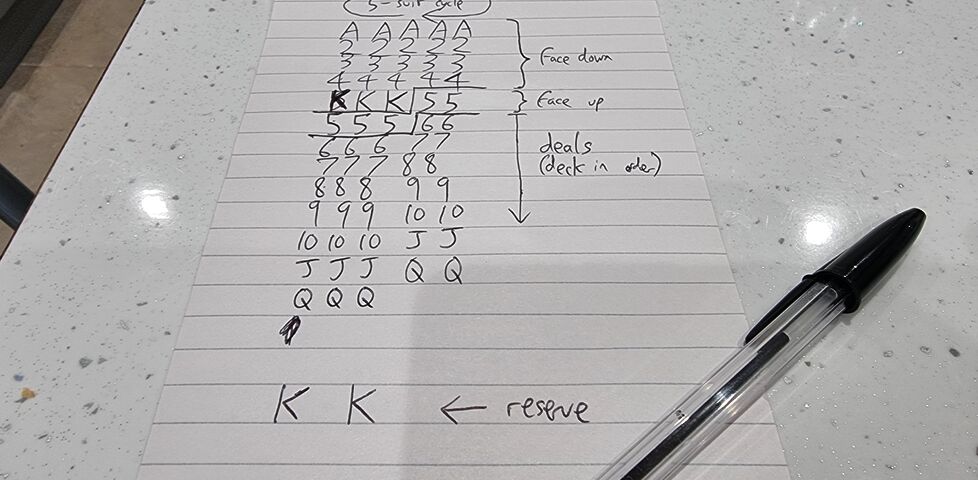
Paper-based sketch showing an 'unwinnable' deck of 'five suit' FlopFlop, formed by stacking the cards in a strict reverse order to make it as hard as possible.
If you think you’ve found a solution to this deal – for example, by (necessarily) dealing out all of the cards, then putting both reserve kings out and stacking everything else on top of them in order to dig down to the useful cards, bear in mind that (a) the maximum stack depth of 20 means you can get to a 6, or a 5, but not both, and (b) you can’t then move any of those stacks in aggregate because – although it’s not clear in my monochrome sketch – the suits cycle in a pattern to disrupt such efforts.

That it’s possible for a fairly-shuffled deck of cards to lead to an “unwinnable” game of FlipFlop Solitaire means the author must have necessarily had some mechanism to differentiate between “winnable” (which are probably the majority) and “unwinnable” ones. And therein lies an interesting problem.

If the only way to conclusively prove that a particular deal is “winnable” is to win it, then the developer must have had an algorithm that they were using to test that a given deal was “winnable”: that is – a brute-force solver.

So I had a go at making one3. The code is pretty hacky (don’t judge me) and, well… it takes a long, long time.

Text output from a command line program, with a representation of the starting state of 'ex one suit deck 568' having attempted all possible 9-move permutations (802,255 of them!).
This isn’t an animation, but it might as well be! By the time you’ve permuted all possible states of the first ten moves of this starting game, you’re talking about having somewhere in the region of three million possible states. Solving a game that needs a minimum of 80 moves takes… a while.

Partially that’s because the underlying state engine I used, BfsBruteForce, is a breadth-first optimising algorithm. It aims to find the absolute fewest-moves solution, which isn’t necessarily the fastest one to find because it means that it has to try all of the “probably stupid” moves it finds4 with the same priority as the the “probably smart” moves5.

I played about with enhancing it with some heuristics, and scoring different play states, and then running that in a pruned depth-first way, but it didn’t really help much. It came to an answer eventually, sure… but it took a long, long time, and it’s pretty easy to see why: the number of permutations for a shuffled deck of cards is greater than the number of atoms on Earth!

If you pull off a genuinely random shuffle, then – statistically-speaking – you’ve probably managed to put that deck into an order that no deck of cards has never been in before!6

And sure: the rules of the game reduce the number of possibilities quite considerably… but there’s still a lot of them.

So how are “guaranteed winnable” decks generated?

I think I’ve worked out the answer to this question: it came to me in a dream!

Maze puzzle showing five programmers connected to a spaghetti-like mess of lines; tracing one particular line leads to a laptop at the far end.
Show this puzzle to any smarter-than-average child and they’ll quickly realise that the fastest way to get the solution is not to start from each programmer and trace their path… but to start from the laptop and work backwards!

The trick to generating “guaranteed winnable” decks for FlipFlop Solitaire (and, probably, any similar game) is to work backwards.

Instead of starting with a random deck and checking if it’s solvable by performing every permutation of valid moves… start with a “solved” deck (with all the cards stacked up neatly) and perform a randomly-selected series of valid reverse-moves! E.g.:

  1. The first move is obvious: take one of the kings off the “finished” piles and put it into a column.
  2. For the next move, you’ll either take a different king and do the same thing, or take the queen that was exposed from under the first king and place it either in an empty column or atop the first king (optionally, but probably not, flipping the king face down).
  3. With each subsequent move, you determine what the valid next-reverse-moves are, choose one at random (possibly with some kind of weighting), and move on!

In computational complexity theory, you just transformed an NP-Hard problem7 into a P problem.

Once you eliminate repeat states and weight the randomiser to gently favour moving “towards” a solution that leaves the cards set-up and ready to begin the game, you’ve created a problem that may take an indeterminate amount of  time… but it’ll be finite and its complexity will scale linearly. And that’s a big improvement.

I started implementing a puzzle-creator that works in this manner, but the task wasn’t as interesting as the near-impossible brute-force solver so I gave up, got distracted, and wrote some even more-pointless code instead.

If you go ahead and make an open source FlipFlop deck generator, let me know: I’d be interested to play with it!

Footnotes

1 I don’t get much time to play videogames, nowadays, but I sometimes find that I’ve got time for a round or two of a simple “droppable” puzzle game while I’m waiting for a child to come out of school or similar. FlipFlop Solitaire is one of only three games I have installed on my phone for this purpose, the other two – both much less frequently-played – being Battle of Polytopia and the buggy-but-enjoyable digital version of Twilight Struggle.

2 Okay, it feels slightly frustrating when you make a series of choices that are perfectly logical and the most-rational decision under the circumstances. But the game has an “undo” button, so it’s not that bad.

3 Mostly I was interested in whether such a thing was possible, but folks who’re familiar with how much I enjoy “cheating” at puzzles (don’t get me started on Jigidi jigsaws…) by writing software to do them for me will also realise that this is Just What I Am Like.

4 An example of a “probably stupid” move would be splitting a same-suit stack in order to sit it atop a card of a different suit, when this doesn’t immediately expose any new moves. Sometimes – just sometimes – this is an optimal strategy, but normally it’s a pretty bad idea.

5 Moving a card that can go into the completed stacks at the top is usually a good idea… although just sometimes, and especially in complex mid-game multi-suit scenarios, it can be beneficial to keep a card in play so that you can use it as an anchor for something else, thereby unblocking more flexible play down the line.

6 Fun fact: shuffling a deck of cards is a sufficient source of entropy that you can use it to generate cryptographic keystreams, as Bruce Schneier demonstrated in 1999.

7 I’ve not thought deeply about it, but determining if a given deck of cards will result in a winnable game probably lies somewhere between the travelling salesman and the halting problem, in terms of complexity, right? And probably not something a right-thinking person would ask their desktop computer to do for fun!

× × × × × ×

Visualising Forged In The Dark probabilities

I was having trouble visualising the dice probabilities for some Forged in the Dark-based1 RPGs2, so I drew myself a diagram. I don’t know who, if anybody, would be interested in such a thing other than me… but that’s why we put these things online, right?

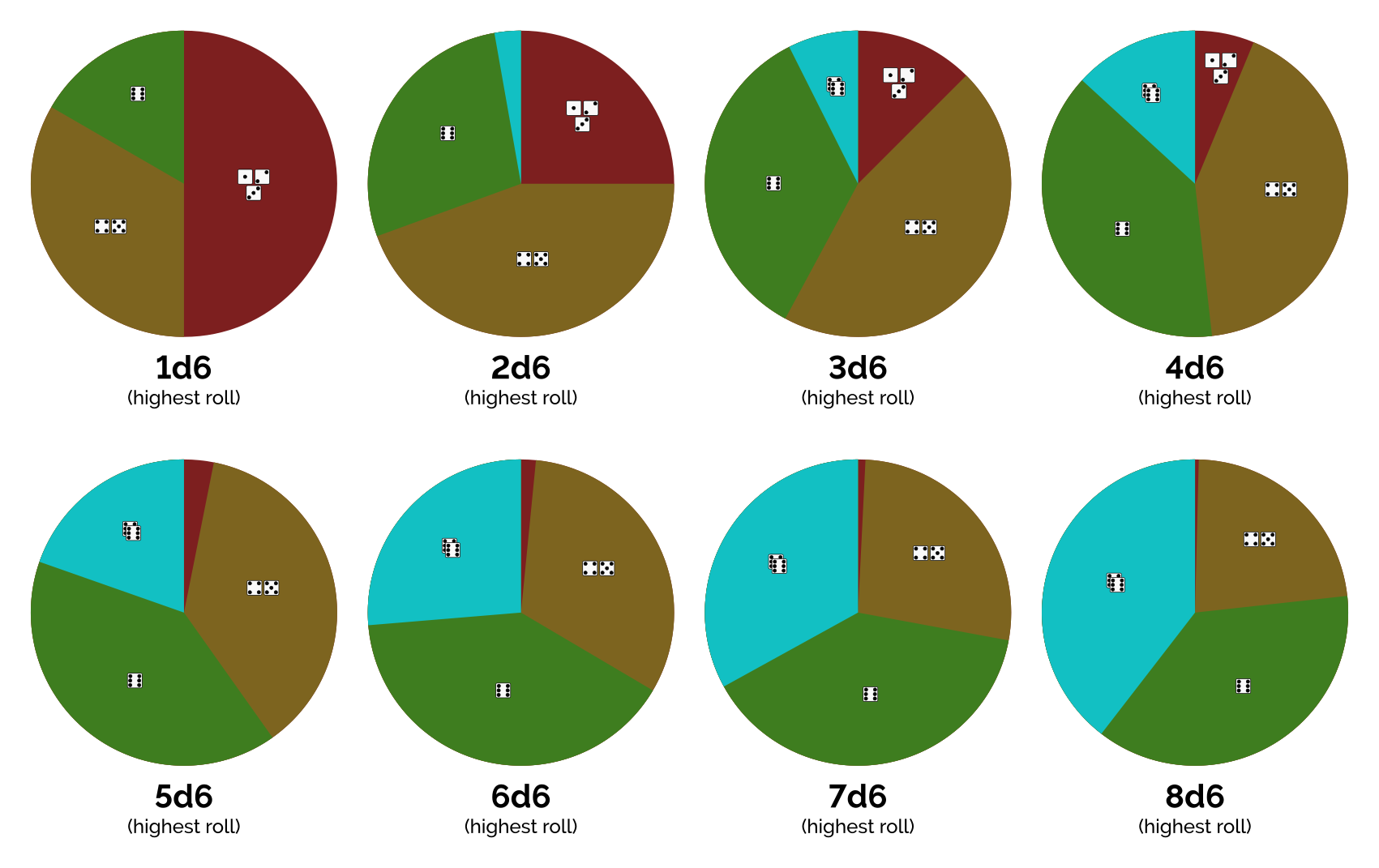
Pie charts approximating the probability of rolling 1-3, 4-5, 6, or 'multiple 6s' when rolling 1 through 8 six-sided dice.

The general idea for Forged in the Dark action resolution is that you throw a number of six-sided dice representative of your chance of success3. You look at the highest value rolled in your dice pool, typically with most or all of the following effects:

  • 1-3: Failure – depending on the circumstances you might be able to try again (with greater risk) and/or suffer some kind of consequence (a “harm” or “complication”).
  • 4-5: Limited success – you succeed, but with come kind of consequence.
  • 6: Success – you succeed!
  • Multiple 6s: Critical – you succeed, and it’s more-effective than you’d hoped or you gain some other benefit4.

If you’re playing Blades in the Dark or another Forged in the Dark-based game and find it useful to visualise how likely you are to get screwed-over by the dice… you’re welcome!

Footnotes

1 Forged in the Dark is the name of the permissively-licensed SRD originally used for fantasy RPG Blades in the Dark, but it’s been used in plenty of other places too where its relatively fast-and-loose mechanics are best-suited. Sharp-eyed readers might have noticed this come up in a repost from last week, too…

2 I may or may not be considering Forged in the Dark as the engine for a prototype RPG environment I’ve been half-heartedly constructing this winter…

3 A task for which you’ve prepared and have trained, in an area in which you’re skilled, and for which you’re well-equipped (e.g. an accomplished thief takes the time to carefully pick a basic lock using fine tools) is likely to involve rolling more dice than a less-fortunate individual.

4 I’m hugely grateful to AnyDice for helping with these calculations. Did you know that you need to be rolling ten six-sided dice before it becomes more-likely-than-not that there’ll be a double-six somewhere in there?

×

Note #27366

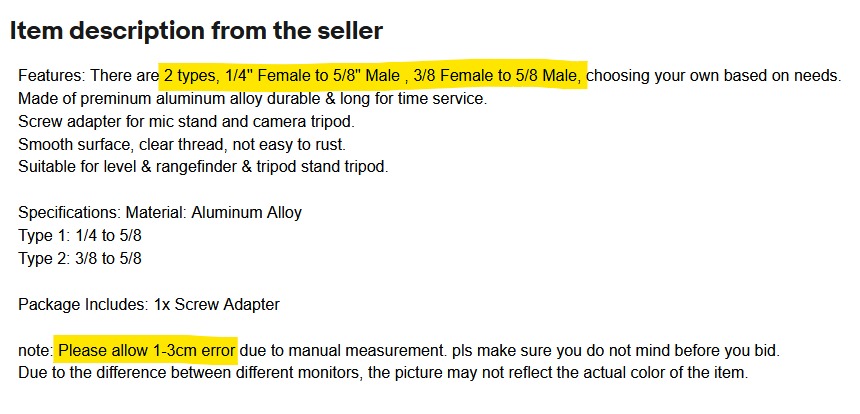
I’m looking at a listing for a ¼” to ⅝” screw adapter, for which the seller warns that I should “please allow 1-3cm error”.

A 3cm error would mean that a ⅝” screw could result in a screw thread anywhere between 1⅘” and… minus half an inch, I guess? (I don’t even know how to make the concept of negative lengths fit into my brain.)

I suppose this seller could send me an empty envelope and declare that it contained an infinitesimally small adapter. At which point… I’d be the one that was screwed!

Highlighted item description from an eBay listing. The highlighted section shows that the listing is for a quarter inch to a five-eighth of an inch adapter made of a premium aluminium alloy, and that the buyer should "please allow 1-3cm error due to manual measurement".

×

Q, Like…

Sometimes people connect my unusual name to popular culture. They say things like “Oh, Q like James Bond?” or “Oh, Q like Star Trek?”.

I think their choice of franchise tells me more about them than they learn from my answer, which is usually “No, Q like the set of rational numbers.”

Citing Lobachevsky

This is a repost promoting content originally published elsewhere. See more things Dan's reposted.

The recent death of Tom Lehrer has resulted in all manner of interesting facts and anecdotes about the man being published around the Internet, but perhaps my favourite was the tale about how, while working for the NSA in 1957, he snuck an Easter Egg into a research paper… that went undetected for nearly 60 years:

I worked as a mathematician at the NSA during the second Obama administration and the first half of the first Trump administration. I had long enjoyed Tom Lehrer’s music, and I knew he had worked for the NSA during the Korean War era.

The NSA’s research directorate has an electronic library, so I eventually figured, what the heck, let’s see if we can find anything he published internally!And I found a few articles I can’t comment on. But there was one unclassified article– “Gambler’s Ruin With Soft-Hearted Adversary”.

The paper was co-written by Lehrer and R. E. Fagen, published in January, 1957. The mathematical content is pretty interesting, but that’s not what stuck out to me when I read it. See, the paper cites FIVE sources throughout its body. But the bibliography lists SIX sources. What’s the leftover?

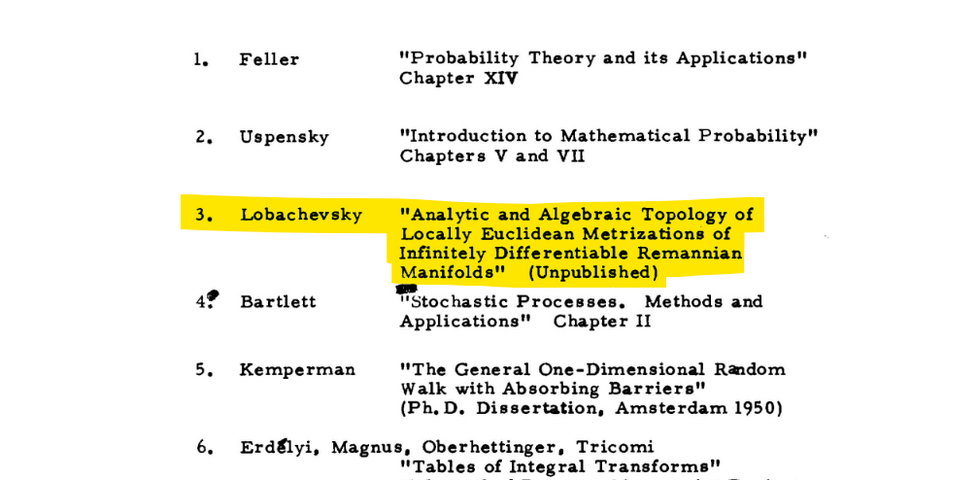
Academic bibliography, citing six papers related principally to probability. The third paper, highlighted for the picture, is: Lobachevsky, "Analytic and Algebraic Topology of Locally Euclidean Metrizations of Infinitely Differentiable Remannian Manifolds" (Unpublished)

So I sent an email to the NSA historians. And I asked them: hey, when was this first noticed, and how much of a gas did people think it was? Did he get in trouble for it? That sort of stuff.

The answer came back: “We’ve never heard of this before. It’s news to us.”

In November of 2016, nearly 60 years after the paper was published internally, I had discovered the joke.

Bozhe moi!

Very Tom Lehrer to hide a joke so well that nobody would even notice it for most of six decades, while undermining and subverting bureaucratic government processes.

And if you somehow don’t “get” the joke, Wikipedia can both explain and let you listen to the relevant song

Build Colors from Colors with CSS Relative Color Syntax

This is a repost promoting content originally published elsewhere. See more things Dan's reposted.

The feature here is that you can take a color you already have and manipulate its components. Which things you can change vary by the color space you choose, so for an RGB color you can change the red, green, blue, and alpha channels, for an HSL color you can change hue, saturation, lightness, and alpha, and for my beloved OKLCH you can change lightness, chroma, hue, and yes, opacity.

The syntax if you wanted to use this and not change anything about the color is:

oklch(from var(--color) l c h / 1)

But of course you can change each component, either swapping them entirely as with this which sets the lightness to 20%:

oklch(from var(--color) 20% c h / 1)

This is really something. I was aware that new colour functions were coming to CSS but kinda dropped the ball and didn’t notice that oklch(...) is, for the most part, usable in any modern browser. That’s a huge deal!

The OKLCH colour model makes more sense than RGB, covers a wider spectrum than HSL, and – on screens that support it – describes a (much) larger spectrum, providing access to a wider array of colours (with sensible fallbacks where they’re not supported). But more than that, the oklch(...) function provides good colour adaptation.

If you’ve ever used e.g. Sass’s darken(...) function and been disappointed when it seems to have a bigger impact on some colours than others… that’s because simple mathematical colour models don’t accurately reflect the complexities of human vision: some colours just look brighter, to us, thanks quirks of biochemistry, psychology, and evolution!

This colour vision curve feels to me a little like how pianos aren’t always tuned to equal-temper – i.e. how the maths of harmonics says that should be – but are instead tuned so that the lowest notes are tuned slightly flat and the highest notes slightly sharp to compensate for inharmonicity resulting from the varying stiffness of the strings. This means that their taut length alone doesn’t dictate what note humans think they hear: my understanding is that at these extremes, the difference in the way the wave propagates within the string results in an inharmonic overtone that makes these notes sound out-of-tune with the rest of the instrument unless compensated for with careful off-tuning! Humans experience something other than what the simple maths predicts, and so we compensate for it! (The quirk isn’t unique to the piano, but it’s most-obvious in plucked or struck strings, rather than in bowed strings, and for instruments with a wide range, of which a piano is of course both!)

OKLCH is like that. And with it as a model (and a quick calc(...) function), you can tell your CSS “make this colour 20% lighter” and get something that, for most humans, will actually look “20% lighter”, regardless of the initial hue. That’s cool.

I spent way too long playing with this colour picker while I understood this concept. And now I want to use it everywhere!

Hero of Alexandria

A little under two millennia ago1 there lived in the Egyptian city of Alexandria a Greek mathematician and inventor named Hero2, and he was a total badass who invented things that you probably thought came way later, and come up with mathematical tricks that we still use to this day3.

Inventions

Illustration of an aeolipile, showing a heated sphere or cylinder of water spraying steam in two different directions, causing it to rotate.
If you know of Hero’s inventions because of his aeolipile4,known as “Hero’s engine”, I’ve got bad news: it was probably actually invented by his predecessor Vitruvius. But Hero did come up with a way to use the technique to make a pneumatic temple door that automatically opened when you lit the fires alongside it.
Hero is variably credited with inventing, in some cases way earlier than you’re expecting:

  • automatic doors (powered either by pressure plates or by lit fires),
  • vending machines, which used the weight of a dispensed coin to open a valve and dispense holy water,
  • windmills (by which I mean wind-powered stationary machines capable of performing useful work),
  • the force pump – this is the kind of mechanism found in traditional freestanding village water pumps – for use in a fire engine,
  • float-valve and water-pressure based equilibrium pumps, like those found in many toilet cisterns, and
  • a programmable robot: this one’s a personal favourite of mine because it’s particularly unexpected – Hero’s cart was a three-wheeled contraption whose wheels were turned by a falling weight pulling on a rope, but the rope could be knotted and looped back over itself (here’s a modern reimplementation using Lego) to form a programmed path for the cart
Illustration showing mechanism of action of a fire-powered automatic door: heated air expands to displace water into a vessel whose now-increased weight pulls ropes wrapped around two wheels which pull open a pair of temple doors.
It’s just headcanon, but I choose to believe that the reason Hero needed to invent the fire extinguisher might have involved the number of “attempting to make fire do work” inventions that he came up with.

Mathematics

If you know of Hero because of his mathematical work, it’s probably thanks to his pre-trigonometric work on calculating the area of a triangle based only on the lengths of its sides.

But I’ve always been more-impressed by the iterative5 mechanism he come up with by which to derive square roots. Here’s how it works:

  1. Let n be the number for which you want to determine the square root.
  2. Let g1 be a guess as to the square root. You can pick any number; it can be 1.
  3. Derive a better guess g2 using g2 = ( g1 + n / g1 ) / 2.
  4. Repeat until gN gN-1, for a level of precision acceptable to you. The algorithm will be accurate to within S significant figures if the derivation of each guess is rounded to S + 1 significant figures.

That’s a bit of a dry way to tell you about it, though. Wouldn’t it be better if I showed you?

Put any number from 1 to 999 into the box below and see a series of gradually-improving guesses as to its square root6.

Interactive Widget

(There should be an interactive widget here. Maybe you’ve got Javascript disabled, or maybe you’re reading this post in your RSS reader?)

Maths is just one of the reasons Hero is my hero. And now perhaps he can be your hero too.

Footnotes

1 We’re not certain when he was born or died, but he wrote about witnessing a solar eclipse that we know to have occurred in 62 CE, which narrows it down a lot.

2 Or Heron. It’s not entirely certain how his name was pronounced, but I think “Hero” sounds cooler so I’m going with that.

3 Why am I blogging about this? Well: it turns out that every time I speak on some eccentric subject, like my favourite magic trick, I come off stage with like three other ideas for presentations, which leads to an exponential growth about “things I’d like to talk about”. Indeed, my OGN talk on the history of Oxford’s telephone area code was one of three options I offered to the crowd to vote on at the end of my previous OGN talk! In any case, I’ve decided that the only way I can get all of this superfluity of ideas out of my head might be to blog about them, instead; so here’s such a post!

4 If the diagram’s not clear, here’s the essence of the aeolipile: it’s a basic steam reaction-engine, in which steam forces its way out of a container in two different directions, causing the container to spin on its axis like a catherine wheel.

5 You can also conceive of it as a recursive algorithm if that’s your poison, for example if you’re one of those functional purists who always seem somehow happier about their lives than I am with mine. What’s that about, anyway? I tried to teach myself functional programming in the hope of reaching their Zen-like level of peace and contentment, but while I got reasonably good at the paradigm, I didn’t find enlightenment. Nowadays I’m of the opinion that it’s not that functional programming leads to self-actualisation so much as people capable of finding a level of joy in simplicity are drawn to functional programming. Or something. Anyway: what was I talking about? Oh, yeah: Hero of Alexandria’s derivation of square roots.

6 Why yes, of course I open-sourced this code.

× ×

D20 with Advantage

Dungeons & Dragons players spend a lot of time rolling 20-sided polyhedral dice, known as D20s.

In general, they’re looking to roll as high as possible to successfully stab a wyvern, jump a chasm, pick a lock, charm a Duke1, or whatever.

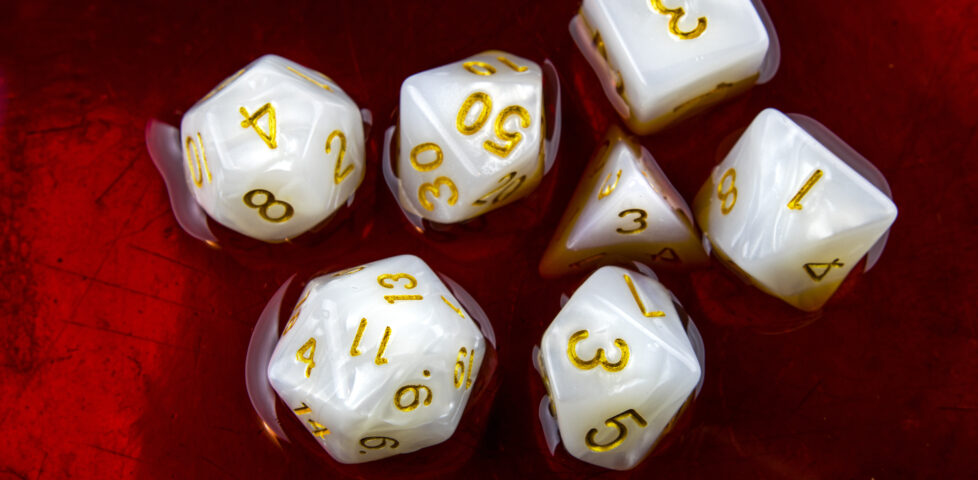
A 'full set' of white polyhedral dice commonly-used by roleplayers - a D4, D6, D8, two D10s, a D12, and a D20 - sit half-submerged in a red liquid.
Submerging your dice set in the blood of a halfling is a sure-fire way to get luckier rolls.

Roll with advantage

Sometimes, a player gets to roll with advantage. In this case, the player rolls two dice, and takes the higher roll. This really boosts their chances of not-getting a low roll. Do you know by how much?

I dreamed about this very question last night. And then, still in my dream, I came up with the answer2. I woke up thinking about it3 and checked my working.

1 2 3 4 5 6 7 8 9 10 11 12 13 14 15 16 17 18 19 20
1 1 2 3 4 5 6 7 8 9 10 11 12 13 14 15 16 17 18 19 20
2 2 2 3 4 5 6 7 8 9 10 11 12 13 14 15 16 17 18 19 20
3 3 3 3 4 5 6 7 8 9 10 11 12 13 14 15 16 17 18 19 20
4 4 4 4 4 5 6 7 8 9 10 11 12 13 14 15 16 17 18 19 20
5 5 5 5 5 5 6 7 8 9 10 11 12 13 14 15 16 17 18 19 20
6 6 6 6 6 6 6 7 8 9 10 11 12 13 14 15 16 17 18 19 20
7 7 7 7 7 7 7 7 8 9 10 11 12 13 14 15 16 17 18 19 20
8 8 8 8 8 8 8 8 8 9 10 11 12 13 14 15 16 17 18 19 20
9 9 9 9 9 9 9 9 9 9 10 11 12 13 14 15 16 17 18 19 20
10 10 10 10 10 10 10 10 10 10 10 11 12 13 14 15 16 17 18 19 20
11 11 11 11 11 11 11 11 11 11 11 11 12 13 14 15 16 17 18 19 20
12 12 12 12 12 12 12 12 12 12 12 12 12 13 14 15 16 17 18 19 20
13 13 13 13 13 13 13 13 13 13 13 13 13 13 14 15 16 17 18 19 20
14 14 14 14 14 14 14 14 14 14 14 14 14 14 14 15 16 17 18 19 20
15 15 15 15 15 15 15 15 15 15 15 15 15 15 15 15 16 17 18 19 20
16 16 16 16 16 16 16 16 16 16 16 16 16 16 16 16 16 17 18 19 20
17 17 17 17 17 17 17 17 17 17 17 17 17 17 17 17 17 17 18 19 20
18 18 18 18 18 18 18 18 18 18 18 18 18 18 18 18 18 18 18 19 20
19 19 19 19 19 19 19 19 19 19 19 19 19 19 19 19 19 19 19 19 20
20 20 20 20 20 20 20 20 20 20 20 20 20 20 20 20 20 20 20 20 20
Table illustrating the different permutations of two D20 rolls and the “advantage” result (i.e. the higher of the two).

The chance of getting a “natural 1” result on a D20 is 1 in 20… but when you roll with advantage, that goes down to 1 in 400: a huge improvement! The chance of rolling a 10 or 11 (2 in 20 chance of one or the other) remains the same. And the chance of a “crit” –  20 – goes up from 1 in 20 when rolling a single D20 to 39 in 400 – almost 10% – when rolling with advantage.

You can see that in the table above: the headers along the top and left are the natural rolls, the intersections are the resulting values – the higher of the two.

The nice thing about the table above (which again: was how I visualised the question in my dream!) is it really helps to visualise why these numbers are what they are. The general formula for calculating the chance of a given number when rolling D20 with advantage is ( n2 – (n-1)2 ) / 400. That is, the square of the number you’re looking for, minus the square of the number one less than that, over 400 (the total number of permutations)4.

Why roll two dice when one massive one will do?

Knowing the probability matrix, it’s theoretically possible to construct a “D20 with Advantage” die5. Such a tool would have 400 sides (one 1, three 2s, five 3s… and thirty-nine 20s). Rolling-with-advantage would be a single roll.

'400-sided die' shown on Numberwang.
I don’t think anybody’s ever built a real 400-sided die, but Numberwang! claimed to have one.

This is probably a totally academic exercise. The only conceivable reason I can think of would be if you were implementing a computer system on which generating random numbers was computationally-expensive, but memory was cheap: under this circumstance, you could pre-generate a 400-item array of possible results and randomly select from it.

But if anybody’s got a 3D printer capable of making a large tetrahectogon (yes, that’s what you call a 400-sided polygon – you learned something today!), I’d love to see an “Advantage D20” in the flesh. Or if you’d just like to implement a 3D model for Dice Box that’d be fine too!

Footnotes

1 Or throw a fireball, recall an anecdote, navigate a rainforest, survive a poisoning, sneak past a troll, swim through a magical swamp, hold on to a speeding aurochs, disarm a tripwire, fire a crossbow, mix a potion, appeal to one among a pantheon of gods, beat the inn’s landlord at an arm-wrestling match, seduce a duergar guard, persuade a talking squirrel to spy on some bandits, hold open a heavy door, determine the nature of a curse, follow a trail of blood, find a long-lost tome, win a drinking competition, pickpocket a sleeping ogre, bury a magic sword so deep that nobody will ever find it, pilot a spacefaring rowboat, interpret a forgotten language, notice an imminent ambush, telepathically commune with a distant friend, accurately copy-out an ancient manuscript, perform a religious ritual, find the secret button under the wizard’s desk, survive the blistering cold, entertain a gang of street urchins, push through a force field, resist mind control, and then compose a ballad celebrating your adventure.

2 I don’t know what it says about me as a human being that sometimes I dream in mathematics, but it perhaps shouldn’t be surprising given I’m nerdy enough to have previously recorded instances of dreaming in (a) Perl, and (b) Nethack (terminal mode).

3 When I woke up I also found that I had One Jump from Disney’s Aladdin stuck in my head, but I’m not sure that’s relevant to the discussion of probability; however, it might still be a reasonable indicator of my mental state in general.

4 An alternative formula which is easier to read but harder to explain would be ( 2(n – 1) + 1 ) / 400.

5 Or a “D20 with Disadvantage”: the table’s basically the inverse of the advantage one – i.e. 1 in 400 chance of a 20 through to 39 in 400 chance of a 1.

× ×

Sisyphus: The Board Game (Digital Edition)

I’m off work sick today: it’s just a cold, but it’s had a damn good go at wrecking my lungs and I feel pretty lousy. You know how when you’ve got too much of a brain-fog to trust yourself with production systems but you still want to write code (or is that just me?), so this morning I threw together a really, really stupid project which you can play online here.

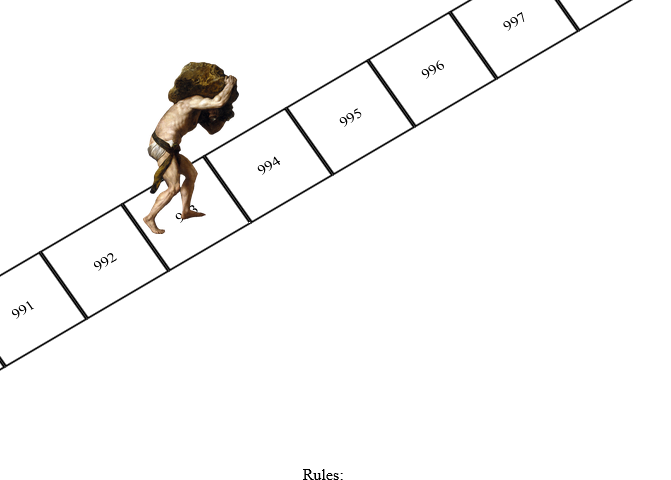
Screenshot showing Sisyphus carrying a rock up a long numbered gameboard; he's on square 993 out of 1000, but (according to the rules printed below the board) he needs to land on 1000 exactly and never roll a double-1 or else he returns to the start.
It’s a board game. Well, the digital edition of one. Also, it’s not very good.

It’s inspired by a toot by Mason”Tailsteak” Williams (whom I’ve mentioned before once or twice). At first I thought I’d try to calculate the odds of winning at his proposed game, or how many times one might expect to play before winning, but I haven’t the brainpower for that in my snot-addled brain. So instead I threw together a terrible, terrible digital implementation.

Go play it if, like me, you’ve got nothing smarter that your brain can be doing today.

Mathematics of Mid-Journey Refuelling

I love my electric car, but sometimes – like when I need to transport five people and a week’s worth of their luggage 250 miles and need to get there before the kids’ bedtime! – I still use our big ol’ diesel-burning beast. And it was while preparing for such a journey that I recently got to thinking about the mathematics of refuelling.

Car display showing "Please refuel. Range: 40ml"
I don’t know why you’d measure range in millilitres in the first place, but I’m hearing that I ought to fill up the car before we go.

It’s rarely worth travelling out-of-your-way to get the best fuel prices. But when you’re on a long road trip anyway and you’re likely to pass dozens of filling stations as a matter of course, you might as well think at least a little about pulling over at the cheapest.

You could use one of the many online services to help with this, of course… but assuming you didn’t do this and you’re already on the road, is there a better strategy than just trusting your gut and saying “that’s good value!” when you see a good price?

It turns out this is an application for the Secretary Problem (and probably a little more sensible than the last time I talked about it!).

A woman's hand reaches for one of four fuel pump nozzles. Photo by Gustavo Fring, used under the Pexels License.
If you can’t decide which nozzle is best, mix up a cocktail of them all. #TerribleProTip

Here’s how you do it:

  1. Estimate your outstanding range R: how much further can you go? Your car might be able to help you with this. Let’s say we’ve got 82 miles in the tank.
  2. Estimate the average distance between filling stations on your route, D. You can do this as-you-go by counting them over a fixed distance and continue from step #4 as you do so, and it’ll only really mess you up if there are very few. Maybe we’re on a big trunk road and there’s a filling station about every 5 miles.
  3. Divide R by D to get F: the number of filling stations you expect to pass before you completely run out of fuel. Round down, obviously, unless you’re happy to push your vehicle to the “next” one when it breaks down. In our example above, that gives us 16 filling stations we’ll probably see before we’re stranded.
  4. Divide F by e to get T (use e = 2.72 if you’re having to do this in your head). Round down again, for the same reason as before. This gives us T=5.
  5. Drive past the next T filling stations and remember the lowest price you see. Don’t stop for fuel at any of these.
  6. Keep driving, and stop at the first filling station where the fuel is the same price or cheaper than the cheapest you’ve seen so far.
Dan sitting in the driving seat of a car, doing maths on a portable whiteboard.
Obviously you should take care doing maths on the road. Don’t drink and derive!

This is a modified variant of the Secretary Problem because it’s possible for two filling stations to have the same price, and that’s reflected in the algorithm above by the allowance for stopping for fuel at the same price as the best you saw during your sampling phase. It’s probably preferable to purchase sub-optimally than to run completely dry, right?

Of course, you’re still never guaranteed a good solution with this approach, but it maximises your odds. Your own risk-assessment might rank “not breaking down” over pure mathematical efficiency, and that’s on you.

× × ×

Here’s What a Googol-to-One Gear Ratio Looks Like

This is a repost promoting content originally published elsewhere. See more things Dan's reposted.

To celebrate being alive for a billion seconds, Daniel Bruin built a machine with 100 gears with a 10-to-1 gear ratio…meaning that the overall gear ratio is a googol-to-one. (A googol is 1 with 100 zeros.)

To turn the last gear in this train one full revolution, you’d need to turn the first gear 10,​000,​000,​000,​000,​000,​000,​000,​000,​000,​000,​000,​000,​000,​000,​000,​000,​000,​000,​000,​000,​000,​000,​000,​000,​000,​000,​000,​000,​000,​000,​000,​000,​000 times.

By my estimation, that’s enough gearing to allow you to winch the entire solar system, by hand, with ease. Assuming you can find a tow hitch on it somewhere.

Who finished second?

This is a repost promoting content originally published elsewhere. See more things Dan's reposted.

Three athletes (and only three athletes) participate in a series of track and field events. Points are awarded for 1st, 2nd, and 3rd place in each event (the same points for each event, i.e. 1st always gets “x” points, 2nd always gets “y” points, 3rd always gets “z” points), with x > y > z > 0, and all point values being integers.
The athletes are named: Adam, Bob, and Charlie.

  • Adam finished first overall with 22 points.
  • Bob won the Javelin event and finished with 9 points overall.
  • Charlie also finished with 9 points overall.

Question: Who finished second in the 100-meter dash (and why)?

I enjoyed this puzzle so much that I shared it with (and discussed it at length with) my smartypants puzzle-sharing group. Now it’s your turn. The answer, plus a full explanation, can be found on the other side of the link, but I’d recommend that you try to solve it yourself first. If it seems impossible at first glance, start by breaking it down into what you can know, and what you can almost know, and work from there. Good luck!

And if anybody feels like hiring Nick to come and speak anywhere near where I am, that’d be awesome of you.

This equation will change how you see the world

This is a repost promoting content originally published elsewhere. See more things Dan's reposted.

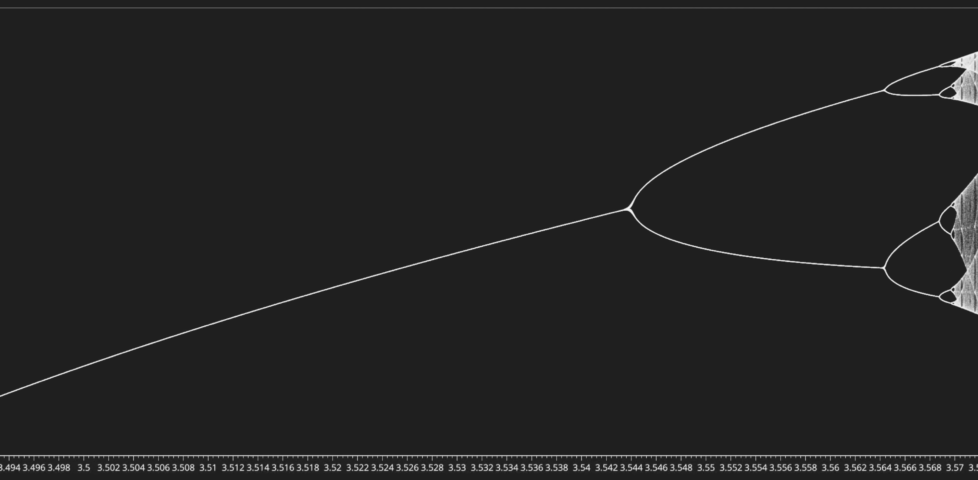
Normally I find Veritasium’s videos to be… less mindblowing than their titles would aim to have me believe. But I found this one pretty inspiring; the first Feigenbaum constant is a proper headtrip. And I feel like I’ve got new insights into the Mandelbrot set too.