Buying a House, Part 3

This blog post is the third in a series about buying our first house. If you haven’t already, you might like to read the first part. In the second post in the series, we’d put an offer on a house which had been accepted… but of course that’s still early days in the story of buying a house…

We hooked up with Truemans, a local solicitor, after discovering that getting our conveyancing services from a local solicitor is only marginally more-expensive than going with one of the online/phone/post based national ones, and you get the advantage of being able to drop in and harass them if things aren’t going as fast as you’d like. Truemans were helpful from day one, giving us a convenient checklist of all of the steps in the process of buying a house. I’m sure we could have got all the same information online, but by the time I was thinking about offers and acceptance and moving and mortgages and repayments and deposits and everything else, it was genuinely worth a little extra money just to have somebody say “next, this needs to happen,” in a reassuring voice.

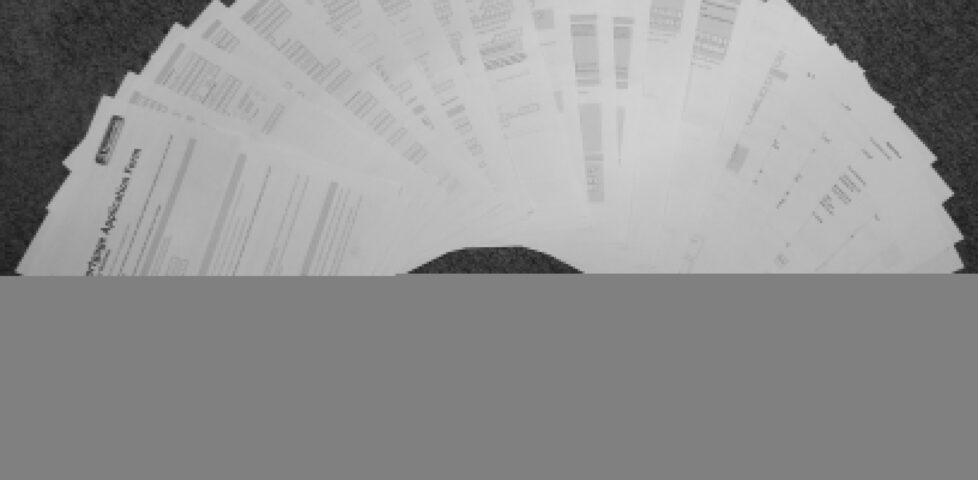
A 22-page form; each page is double-sided for added insanity.
This gargantuan beast is our mortgage application form. All of those pages are double-sided, by the way.

Meanwhile, we got on with filling out our mortgage application form. Our choice of lenders – which Stefan, who I’d mentioned in the last post, had filtered for us – was limited slightly by the fact that we wanted a mortgage for three people, not for one or two; but it wasn’t limited by as much as you might have thought. In practice, it was only the more-exotic mortgage types (e.g. Option ARMs, some varieties of interest-only mortgage) that we were restricted from, and these weren’t particularly appealing to us anyway. One downside of there being three of us, though, was that while our chosen lender had computerised their application process, the computerised version wasn’t able to handle more than two applicants, so we instead had to fill out a mammoth 22-page paper form in order to apply. At least it weeds out people who aren’t serious, I suppose.

A front door with a hole, boarded up with plywood.
The front door of our intended new home had recently sustained some… damage. That didn’t bode well.

I revisited the house to check out a few things from the outside: in particular, I was interested in the front door, which had apparently been broken during a… misunderstanding… by the current owners, who are in the middle of what seems like a complicated divorce. The estate agent had promised that it would be repaired before the sale, but when I went to visit I found that this hadn’t happened yet. Of course, now we had lawyers on our side, so it was a quick job to ask them to send a letter to the seller’s solicitor, setting the repair of the door as a condition upon which the sale was dependent.

A page from our Environmental Search, indicating some of the past uses of the land around the house we hope to buy.
The results of our Environmental Search were perhaps the most-interesting. But I’ll understand if you don’t think it’s as interesting as I do.

Our solicitors had also gotten started with the requisite local searches. One of the first things a conveyancing solicitor will do for you is do a little research to ensure that the property really is owned by the people who are selling it, that there’s no compulsory purchase order so that a motorway can be built through the middle of it, that it’s actually connected to mains water and sewers, that planning permission was correctly obtained for any work that’s been done on it, and that kind of thing. One of the first of these searches to produce results was the environmental search.

A map of the area around our new house, as it was about a century ago.
A map of the area around our new house, as it was about a century ago, unearthed by our convenient tame librarian.

One of the things that was revealed be the environmental search was that the area was at a significantly higher-than-average risk of subsidence, had the construction not been done in a particular way – using subsidence-proof bricks, or something, I guess? I theorised that this might be related to the infill activities that (the environmental search also reported) had gone on over the last hundred and fifty years. The house is near a major waterway, in an area that was probably once lower-lying and wetter, but many of the small ponds in the area were filled in in the early part of the 20th century (and then, of course, the area was developed as the suburbs of central Oxfordshire expanded, in the 1980s). Conveniently, we have a librarian on our house-buying team, and he was able to pull up a stack of old OS maps showing the area, and we were able to find our way around this now almost-unidentifiable landscape.

A map showing a field, hedgerows, water course and - highlighted in blue - a pond. The second highlighting in blue (bottom left) is a letter 'O', not a pond. I got carried away highlighting things, okay?
A map showing a field, hedgerows, water course and – highlighted in blue – a pond. The second highlighting in blue (bottom left) is a letter ‘O’, not a pond. I got carried away highlighting things, okay?

Sure enough, there were ponds there, once, but that’s as far as our research took us. Better, we thought, to just pass on the environmental search report to a qualified buildings surveyor, and have them tell us whether or not it was made out of subsidence-proof bricks or shifting-ready beams or whatever the hell it is that you do when you’re building a house to make it not go wonky. Seriously, I haven’t a clue, but I know that there are experts who do.

Three-panel diagram, showing a low-lying lake being pumped to allow house construction, but in the third panel - OH NOES! - the houses have gone lop-sided because without the water in it, the ground becomes unstable.
In this highly-realistic diagram, which wouldn’t look out of place in a geography textbook, houses go wonky because they’re built on ground that became more-compressible after it was drained. This is what I want to avoid.

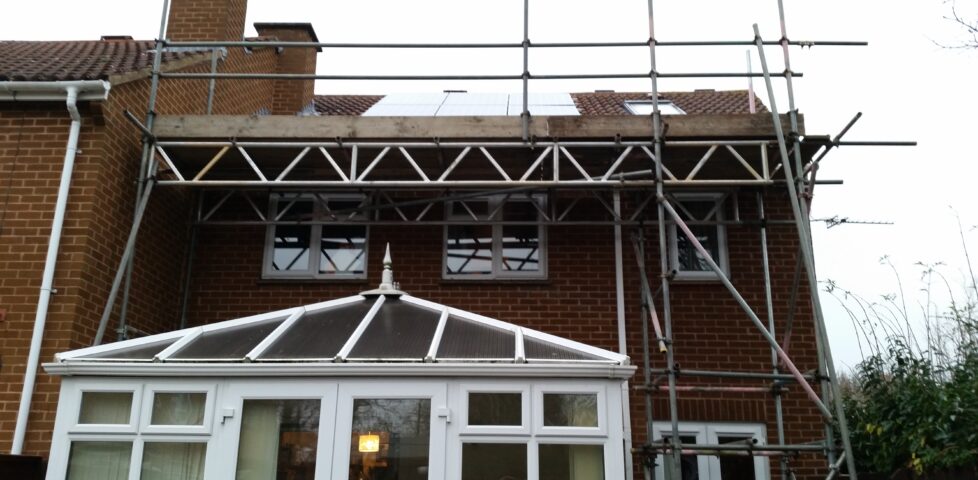
Given that the house we’re looking at is relatively new, I don’t anticipate there being any problems (modern building regulations are a lot more stringent than their historical counterparts), but when you’re signing away six-figures, you learn to pay attention to these kinds of things.

Hopefully, the fourth blog post in this series will be about exchanging contracts and getting ready to move in to our new home: fingers crossed!

× × × × × ×

Buying a House, Part 2

This blog post is the second in a series about buying our first house. If you haven’t already, you might like to read the first part.

When Ruth, JTA and I first set out to look at houses, we didn’t actually plan on buying one. We’d just gotten to the point where buying one felt like an imminent logical step, and so we decided to start looking around Oxford to see what kind of thing we might be able to get (and what it would cost us, if we did). Our thinking was that, by looking around a few places, we’d have some context from which to springboard our own discussions about what property we’d one day like to own.

The living room and stairwell of one of the houses we first ruled-out.
One of the first places we looked at seemed at first to be perfect. But the more we looked at it, the more we became convinced that it really wasn’t for us.

There’s something about “window shopping” for houses that’s liberating and exciting. We don’t need a house – we’ve got somewhere to live – but we’re going to come and look around anyway. Once you’re on their lists, estate agents will bombard you with suggestions of places that you might like, and you feel a little like they’re your servants, running around trying to please you (in actual fact, almost the opposite is true: they’re working on behalf of the seller… although it’s certainly in their interest to get the property sold promptly so that they can take their cut!).

A well-maintaned and lively garden stretches away.
The garden at this place stretched about 35 meters (115 feet), among its other charming features. But sadly, it turned out to be out of our price range.

But as we got into the swing of things, we discovered that we were ready to buy already. Between our savings (and, in particular, boosted by the first parts of my inheritance following my dad’s death last year, as we’re finally getting his estate sorted out), we actually have an acceptable deposit for a mortgage, and our renewal on our current place was looming fast. None of us having bought a house before, we did a bit of reading and decided that our first step probably ought to be to work out how much can we borrow. You know, just to make our window-shopping a little more believable. Maybe.

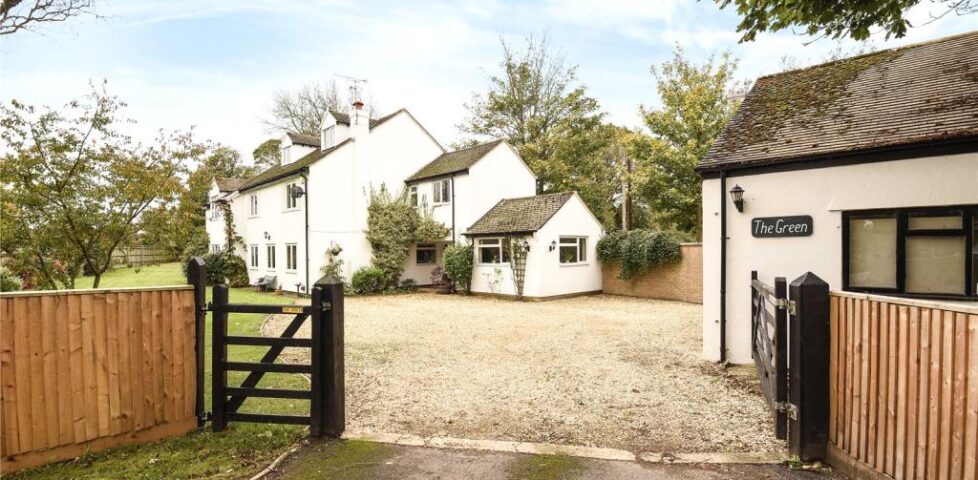
A house in Kidlington, North of Oxford. It might become a familiar sight...
This place is a lot like where we live now, but laid out in a more-spacious way. Hopefully you’ll be seeing it again in a future blog post…
Picture courtesy Google Maps.

One of the estate agents we dealt with introduced us to a chap called Stefan Cork, a mortgage broker working as part of the Mortgage Advice Bureau network. We were still only window-shopping at this point, but hey: if we were going to be allowed some free, no-commitment mortgage advice, then we might as well work out how much we could potentially borrow, right? After checking his credentials (the three questions you should ask every mortgage broker), I spoke to Stefan on the phone, and talked him through our situation. I described our unusual relationship structure (which he took in his stride) and the way that we means-assess our household contributions, alongside more mundane details like how much we earn and what kind of deposit we could rustle up. He talked us through our options and ballparked some of the kinds of numbers we’d be looking at, if we went ahead and got a mortgage.

Mortgage broker Stefan Cork amidst our mountains of paperwork.
Stefan’s really lovely, and didn’t panic for a moment when I said “By the way, I’m blogging this: can I take your photo?” If you’re looking for mortgage advice, get me to give you his number.

And somehow, somewhere along the line, our perspective switched. Instead of looking at houses just to give us a feel for what we might buy, “maybe next year”, we were genuinely looking to buy a house now. We re-visited some of the places we’d seen already, and increased our search of places we hadn’t yet seen. Over time, and by a process of elimination (slow Internet area; too many hills; too narrow staircases; too expensive; too wonky), we cut down our options to just three potential properties. And then just two. And then we came to an impasse.

So… we put offers on both. Under the law of England and Wales, a property purchase isn’t binding until the contracts have exchanged hands. Sellers benefit (and buyers suffer) from this all of the time, because it permits gazumping: even after the buyers have spent money on lawyers, mortgage applications, surveys and searches, the seller can change their mind and accept a higher offer from a different prospective buyer! But this legal quirk can work for buyers, too: in our case, we were able to put offers in of what we were willing to pay for each of two properties (different values, at that), and let them know that the first one of the two to agree to our price would be the one to get the sale!

A model house being pulled out of a terrace.
Let’s pull the old switch-a-roo! Making competing “lowball” offers on two properties at once and offering to purchase from the one that accepts first turns housebuying into a reverse-Dutch-auction.

Haggling for a house in this way felt incredibly ballsy (I’d been nominated as the negotiator on behalf of the other Earthlings), but it played against the psychology of our sellers. Suddenly, instead of being in a position of power (“no, we won’t accept that offer… go a little higher”), the sellers were made to feel that if they didn’t accept our offers (which were doubtless lower than they had hoped), they’d have a 50% chance of losing the sale entirely. When there are hundreds of thousands of pounds on the line, being able to keep your cool and show that you’re willing to go elsewhere is an incredibly powerful negotiating tactic.

True to our word: when one of them came back and accepted our offer, we withdrew the offer on the other house and began the (lengthy) paperwork to start getting the purchase underway. But that can wait for another blog post.

× × × × ×

Buying a House, Part 1

This blog post is the first in a series about buying our first house.

Today, I called up a man on the telephone and – on behalf of Ruth, JTA, and I – offered him several hundred thousand pounds in exchange for his house. Well, actually I spoke to the agent who represents him, but – crazy alternatives notwithstanding – I gather that’s sort-of the way that things are often done in the world of buying and selling property.

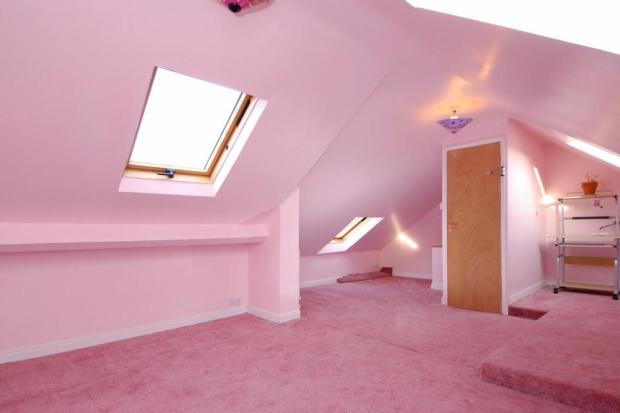
A very pink attic bedroom.
When looking at houses, it’s important to look beyond its current decoration, and see the potential beyond. If you ever get your eyesight back.

With house prices in Oxford averaging about twice the national average, it’s a genuinely scary thing to be doing, to be looking seriously at owning one. On the upside, once we’re done paying for it we could sell it and use the money to buy a yacht. On the downside, by the time we’re done paying for it the sea level may have risen by enough that we’ll need one.

A wood-burning fire.
Sure, it’s got a wood-burning fire, lots of space, and a fair price… but what are the downsides?

House-hunting has been challenging, at times. The place that first caught our interest got quickly pushed down the list after we thought about the implications that the layout of rooms would have for us (as well as its crazy stairwell). The second place that we ‘connected’ with seemed like a clear winner; lots of great features for a very reasonable price. But then we tried cycling to it, and it turns out there’s no way to get there from Oxford without going over what JTA described as “a mountain”! And then, in case we needed more dissuasion, I looked at how far it was from the nearest telephone exchange, and discovered that broadband Internet access there would be only marginally faster than dial-up… until at least 2015. It doesn’t matter how good its countryside views are, it’s not worth trading high-def video for!

Our current home in Oxford.
Will this be the last rented accommodation we ever have? [Google Street View]
I don’t know if there’ll be much to say about the process of buying a house, from here. I don’t know if there’s anything interesting enough to share! But just like my imminent jury duty, I thought I’d share with you all anyway, even if just to say: “How about a housewarming party, sometime?”

× × ×

The Flat Is Tidy

Thanks to JTA for his help. Huge thanks to Matt (temporarily minus his hat) for his help: feed the guy oatcakes and rum and he’ll mop your floor! Winnage!

This is, of course, a result of the anticipated sale of the building we live in. The owners of MG’s cafe, below us, and – in fact – the whole building, are selling up and leaving. I’m not sure if this is what they’d planned all along – to buy the building, renovate the café, and sell it at a profit – but it’s at least a little bit inconvenient for those of us who live there and don’t know if and when we’ll have new landlords and whether or not they’ll want tenants (for instance, one of the prospective buyers when the building last came up for sale would have wanted to turn The Flat into a home for themselves).

But hey; The Flat is clean. Come see.

Now Where Did I Put My House?

Did anybody see the story about the American who had their house stolen this weekend? That’s a fantastic theft to pull off. Wish I’d thought of it first. Ah well.

Also this weekend, a man is killed in a collision between a car and a train. Not particularly noteworthy under normal circumstances, I know, but the train in question is a tourist attraction – a one-third scale steam train with a top speed of 15mph, and the car was a Ford Escort, probably about the same size as the steam engine and weighing about half as much. It takes a special kind of bad driver to get struck on a level crossing at which the trains go barely fast enough to outrun a sprinting child.

Enough newssurfing – back to work;