The history of the organisation known as OS is not merely that of a group of earnest blokes with a penchant for triangulation and an ever-present soundtrack of rustling cagoules.
From its roots in military strategy to its current incarnation as producer of the rambler’s navigational aid, the government-owned company has been checking and rechecking all 243,241 sq km (93,916 sq miles) of Great Britain for
227 years. Here are some of the more peculiar elements in the past of the famous map-makers.
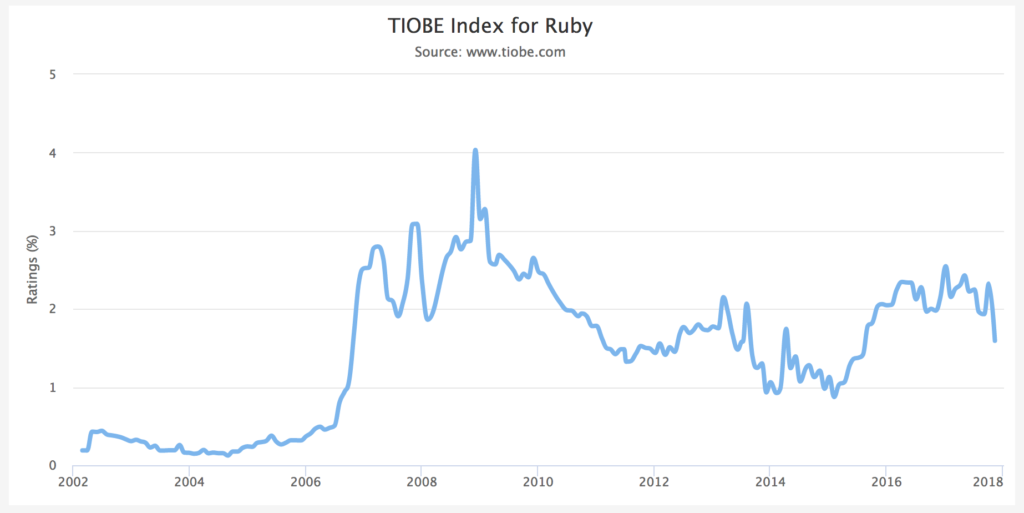
By 2005, Ruby had become more popular, but it was still not a mainstream programming language. That changed with the release of Ruby on Rails. Ruby on Rails was the “killer app” for
Ruby, and it did more than any other project to popularize Ruby. After the release of Ruby on Rails, interest in Ruby shot up across the board, as measured by the TIOBE language
index:
It’s sometimes joked that the only programs anybody writes in Ruby are Ruby-on-Rails web applications. That makes it sound as if Ruby on Rails completely took over the Ruby community,
which is only partly true. While Ruby has certainly come to be known as that language people write Rails apps in, Rails owes as much to Ruby as Ruby owes to Rails.
…
As an early adopter of Ruby (and Rails, when it later came along) I’ve always found that it brings me a level of joy I’ve experienced in very few other languages (and never as much).
Every time I write Ruby, it takes me back to being six years old and hacking BASIC on my family’s microcomputer. Ruby, more than
any other language I’ve come across, achieves the combination of instant satisfaction, minimal surprises, and solid-but-flexible object orientation. There’s so much to love about Ruby
from a technical perspective, but for me: my love of it is emotional.
Hello and thank you for attempting to engage in an unsolicited conversation with me! In order to ensure our interaction is productive and enriching for both parties, I invite you to
join my Matreon. For just a few dollars a month, you can continue to approach me with whatever the hell is on your mind regardless of context or appropriateness, and I will continue
to do the emotional labor required to respond without calling you a privileged, myopic dipshit.
Since you’re obviously the most important person in the universe and everything should cater to your needs, I’ve created a number of exciting options that you can take advantage of.
You know, like you take advantage of the way that women are culturally trained to be sweet and helpful when you fart words in their direction.
…
You know what: there are probably guys who’d pay for this and would then use their doing so as an illustration that women “need men to (financially) support them”.
When Firefox 64 arrives in December, support for RSS, the once celebrated content syndication scheme, and its sibling, Atom, will be missing.
“After considering the maintenance, performance and security costs of the feed preview and subscription features in Firefox, we’ve concluded that it is no longer sustainable to keep
feed support in the core of the product,” said Gijs Kruitbosch, a software engineer who works on Firefox at Mozilla, in a blog post on Thursday.
…
Not a great sign, but understandable. Live Bookmarks was never strong enough to be a full-featured RSS reader, and I don’t
know about you but I haven’t really made use of bookmarks for a good few years, let alone “live” bookmarks, but the media are likely to see this (as El Reg does, in the
article) as another nail in the coffin of one of the best syndication mechanisms the Web ever came up with.
Now, it’s Saturday morning and you’re
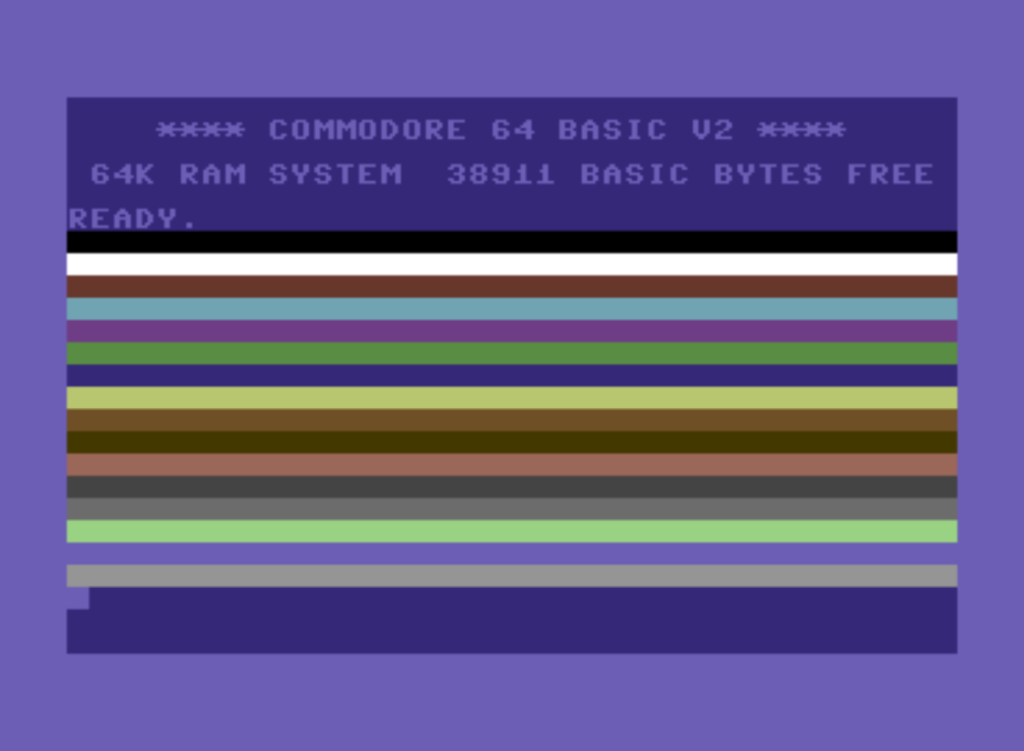
eager to try out what you’ve learned. One of the first things the manual teaches you how to do is change the colors on the display. You follow the instructions, pressing CTRL-9 to enter reverse type mode and then holding down the space bar to create long lines. You swap between colors using CTRL-1 through CTRL-8, reveling in your sudden new power over the TV screen.
As cool as this is, you realize it doesn’t count as programming. In order to program the computer, you learned last night, you have to speak to it in a language called BASIC. To you,
BASIC seems like something out of Star Wars, but BASIC is, by 1983, almost two decades old. It was invented by two Dartmouth professors, John Kemeny and Tom Kurtz, who wanted
to make computing accessible to undergraduates in the social sciences and humanities. It was widely available on minicomputers and popular in college math classes. It then became
standard on microcomputers after Bill Gates and Paul Allen wrote the MicroSoft BASIC interpreter for the Altair. But the manual doesn’t explain any of this and you won’t learn it for
many years.
One of the first BASIC commands the manual suggests you try is the PRINT command. You type in PRINT "COMMODORE
64", slowly, since it takes you a while to find the quotation mark symbol above the 2 key. You hit RETURN and this time, instead of complaining, the computer does exactly what you told it to do and displays “COMMODORE 64” on the next line.
Now you try using the PRINT command on all sorts of different things: two numbers added together, two numbers multiplied together, even several
decimal numbers. You stop typing out PRINT and instead use ?, since the manual has advised you that
? is an abbreviation for PRINT often used by expert programmers. You feel like an expert already, but
then you remember that you haven’t even made it to chapter three, “Beginning BASIC Programming.”
…
I had an Amstrad CPC, myself, but I had friends with C64s and ZX Spectrums and – being slightly older than the author – I got the
opportunity to experiment with BASIC programming on all of them (and went on to write all manner of tools on the CPC 464, 664, and 6128 models). I’m fortunate to have been able to get
started in programming in an era when your first experience of writing code didn’t have to start with an
examination of the different language choices nor downloading and installing some kind of interpreter or compiler: microcomputers used to just drop you at a prompt which
was your interpreter! I think it’s a really valuable experience for a child to have.
For a philosopher, Helen Nissenbaum is a surprisingly active participant in shaping how we collect,
use, and protect personal data. Nissenbaum, who earned her PhD from Stanford, is a professor of information science at Cornell Tech, New York City, where she focuses on the
intersection of politics, ethics, and values in technology and digital media — the hard stuff. Her framework for understanding digital privacy has deeply influenced
real-world policy.
In addition to several books and countless papers, she’s also coauthored privacy plug-ins for web browsers including TrackMeNot, AdNauseum, and Adnostic. Nissenbaum views these pieces
of code as small efforts at rationalizing a marketplace where opaque consent agreements give consumers little bargaining power against data collectors as they extract as much
information, and value from this information, as they can. Meanwhile, these practices offer an indefinite value proposition to consumers while compromising the integrity of digital
media, social institutions, and individual security.
Fundamentally, people haven’t changed much in tens of thousands of years. If ancient Egyptians had smartphones, you know full well that they’d have been posting cat pictures too. What
can we learn from this and how should we look at our role when developing front-end Web experiences?
There are two stories here. The first is a story about a vision of the web’s future that never quite came to fruition. The second is a story about how a collaborative effort to
improve a popular standard devolved into one of the most contentious forks in the history of open-source software development.
In the late 1990s, in the go-go years between Netscape’s IPO and the Dot-com crash, everyone could see that the web was going to be an even bigger deal than it already was, even if
they didn’t know exactly how it was going to get there. One theory was that the web was about to be revolutionized by syndication. The web, originally built to enable a simple
transaction between two parties—a client fetching a document from a single host server—would be broken open by new standards that could be used to repackage and redistribute entire
websites through a variety of channels. Kevin Werbach, writing for Release 1.0, a newsletter influential among investors in the 1990s, predicted that syndication “would
evolve into the core model for the Internet economy, allowing businesses and individuals to retain control over their online personae while enjoying the benefits of massive scale and
scope.”1 He invited his readers to imagine a future in
which fencing aficionados, rather than going directly to an “online sporting goods site” or “fencing equipment retailer,” could buy a new épée directly through e-commerce widgets
embedded into their favorite website about fencing.2
Just like in the television world, where big networks syndicate their shows to smaller local stations, syndication on the web would allow businesses and publications to reach
consumers through a multitude of intermediary sites. This would mean, as a corollary, that consumers would gain significant control over where and how they interacted with any given
business or publication on the web.
RSS was one of the standards that promised to deliver this syndicated future. To Werbach, RSS was “the leading example of a lightweight syndication protocol.”3 Another contemporaneous article called RSS the first
protocol to realize the potential of XML.4 It was
going to be a way for both users and content aggregators to create their own customized channels out of everything the web had to offer. And yet, two decades later, RSS appears to be a dying technology, now used chiefly by podcasters and programmers with tech blogs.
Moreover, among that latter group, RSS is perhaps used as much for its political symbolism as its actual utility. Though of course some people really do have RSS readers, stubbornly
adding an RSS feed to your blog, even in 2018, is a reactionary statement. That little tangerine bubble has become a wistful symbol of defiance against a centralized web increasingly
controlled by a handful of corporations, a web that hardly resembles the syndicated web of Werbach’s imagining.
The future once looked so bright for RSS. What happened? Was its downfall inevitable, or was it precipitated by the bitter infighting that thwarted the development of a single RSS
standard?
…
I’ve always been a huge fan of RSS, and I use it for just about everything (I’ll even hack-it-in to services that don’t supply it natively, just to make them fit around my workflow). But even I’ve got to admit that – outside
of podcasts – it’s not done well at retaining mainstream appeal, especially after the death of Google Reader. Right now, most
people seem content to get their updates from their social media circles, and take a manual approach (ugh) to reading content in the few other places that matter to them. That’s
problematic for all kinds of reasons, and I’m perfectly happy to be one of those old fuddy-duddies who likes his web standards open and independent!
A11Y Nutrition Cards is an attempt to digest and simplify the accessibility expectations when it comes to component authoring. Based on the WAI ARIA Authoring Practices Guide.
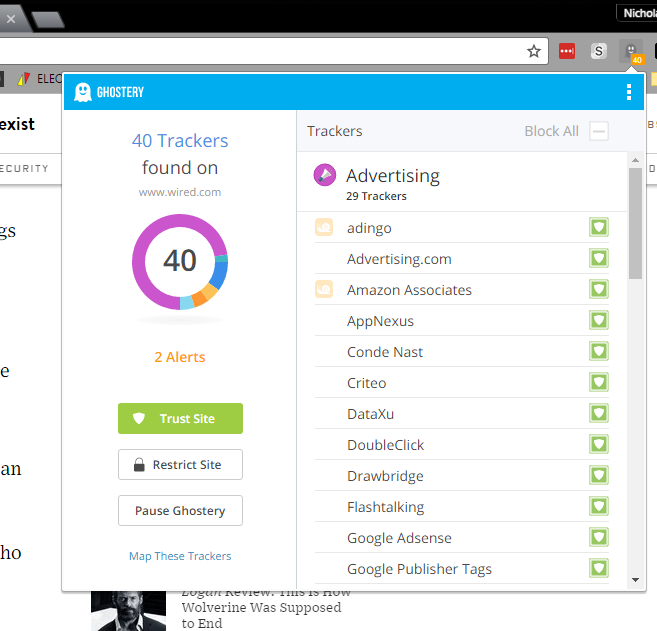
I’ve been, in the past, a firm distruster of ad blocking software. I still am, to a large extent. I don’t trust any company whose finance model is based on inserting exceptions for
advertisers they like. But I installed Ghostery, whose model is to use the stats of what gets blocked to offer consultancy to companies to make their adverts less horrific. I like
this idea, so I support it. My Ghostery install is fairly open, blocking only sites that offer page-takeover, popups, autoplaying videos, and other stuff that annoys me a lot. So I
get a bit annoyed when I’m scrolling through a Wired article and get something
like this:
Fine. I don’t disagree with the sentiment, but I don’t read Wired often enough to care about being a member, so yeah, ad supported isn’t unreasonable. Do you know what’s unreasonable,
Wired? This is what happens when I whitelist your site:
…
I’ve gone full-nuclear these last few years and I just keep Javascript disabled for most domains, most of the time (I’m using uMatrix).
The Web is a lot faster, for it, and I can just enable it for domains that “need” it as-and-when. I also keep a userscript to-hand that I can tweak as-and-when to block
anti-ad-blocker scripts, so that enabling Javascript on your domain (but not the domains of your dozen trackers/advertisers) doesn’t mean that I see your anti-ad-blocker popups either.
If your site nags gently (e.g. by mentioning where ads would be that they’re blocked, perhaps with a sad face emoticon) I’ll consider adding the ads, if your site has
value. But more likely, if your site’s good, I’ll be looking for the donate link. You can make more money out of me with donations than you ever would be showing me ads: I’m more than
happy to pay for the Web… I’m not happy to have 75% of the work my computer does when I’m reading your content be about your advertising partners tracking me nor about trying
to “block” me from seeing your content.
The full article helps show how bad the Web’s gotten. When it starts to get better again,
perhaps I’ll stop blocking ads and trackers so aggressively.
JavaScript is like salt. If you add just enough salt to a dish, it’ll help make the flavour awesome. Add too much though, and you’ll completely ruin it.
Similarly, if you add just enough JavaScript to your website, it’ll help make it awesome. Add too much though, and you’ll completely ruin it.
From now on, when I try to engage junior programmers with the notion that they should make use of their general-purpose computers to answer questions for them… no matter how silly the
question?… I’ll show them this video. It’s a moderately-concise explanation of the thought processes and programming practice involved in solving a simple, theoretical problem, and it
does a great job at it.
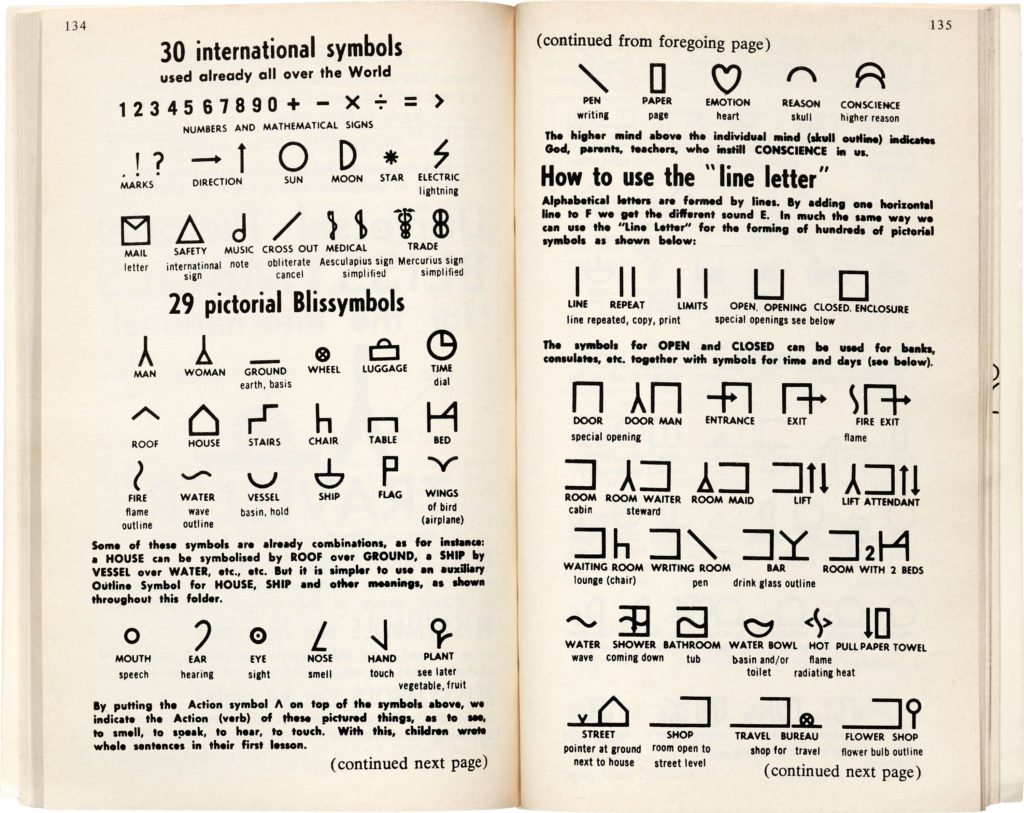
Blissymbolics was conceived by Austro-Hungarian expatriate Charles K. Bliss (1897–1985), born Karl Kasiel Blitz to a Jewish family in the town of Czernowitz (now Chernivtsi in
modern-day Ukraine). He was introduced to signs and symbols at an early age in the form of circuit diagrams – his father’s many occupations included mechanic and electrician – which
he understood immediately as a “logical language”. Bliss (then Blitz) attended the Vienna University of Technology for chemical engineering and went on to become chief of the patent
department at the German TV and radio company Telefunken, a career that was cut short in early 1938 when the Third Reich annexed Austria.
Bliss was sent to Dachau concentration camp, and then to Buchenwald, before escaping to England in 1939. The eight-month German bombing offensive against Britain known as The Blitz
began only months later, prompting him to change his surname “from the war-like Blitz to the peaceful Bliss”, as he recalled in a taped interview. Bliss fled to Shanghai by way of Canada and Japan, where he was reunited with his wife. Claire, a
German Catholic, had used her connections to get Bliss out of Buchenwald, but her relatively privileged status was not enough to spare her a fraught journey to safety across Europe
and Asia. Even in Shanghai, the couple was forced into the Hongkew ghetto following the Japanese occupation.
Bliss became enraptured with written Chinese, which he mistook initially for ideograms. (Chinese characters are, in fact, logograms.) Nevertheless, certain Chinese characters have
pictographic qualities, and it was the symbol for “man”, that sparked Bliss’s epiphany. As he learned enough to read Chinese newspaper headlines and shop signage, he soon
realized that he was reading the symbols not in Chinese, but in his native German. At the age of 45, Bliss was inspired to develop a non-alphabetic writing system that could be
mastered in a short period of time and read by anyone regardless of their spoken language. This work remained the focus of his life, even after he and Claire emigrated to Australia in
1946 and despite the general apathy and indifference with which it was met.
…
Fascinating article about the little-known “language” of Blissymbolics: coming from a similar era and background to Esperanto,
Blissymbolics failed even more to gain widespread traction but encompasses some really interesting ideas (about graphic notation and design, about linguistic concepts, about
communication theory) that we can still learn from. Read the full article…
On a blog, I can write about blogging and whimsically toss in self-indulgent pictures of May’s budding azaleas.
I can end my career, right here, in a flash. I can rant about the perfidy and corruption of my local governing party, who I devoutly hope are
about to be turfed by the voters. I can discuss the difference between O(1) and O(log(N)), which can usually be safely ignored.
On blogs, I can read most of the long-form writing that’s worth reading about the art and craft of programming computers. Or I can follow most of the economists’ debates that are
worth having. Or I can check out a new photographer every day and see new a way of seeing the world.
Having said that, it seems sad that most of the traffic these days goes to BigPubs. That the advertising dollars are being sucked inexorably into Facebook/Google and away from anyone else. That these days, I feel good over a piece that gets
more than twenty thousand reads (only one so far this year).
…
When I wrote about 20 years of blogging, this was the kind of thing I meant when I talked about why it’s important, to me. But Tim says
it better.