When somebody started repeatedly leaving bottles of urine on top of a utility cabinet in his neighbourhood, filmmaker Derek Milton decided to investigate. During his descent into
insanity as he tries to understand why this person keeps leaving their piss here (and who keeps collecting them, later), somehow sponsored by the Reolink Go PT Ultra range of security
cameras, we see through this entertaining (?) documentary (??) the story of an artist trying to interpret the work of another, more-shy, artist (???).
I don’t know, that’s the best description I can come up with for this weird project. I still don’t know why I watched it from beginning to end. But now you can, too.
I bumped into my 19-year-old self the other day. It was horrifying, in the same way that looking in the mirror every morning is horrifying, but with added horror on top.
I stopped him mid-stride, he wasn’t even looking at me. His attention was elsewhere. Daydreaming. I remember, I used to do a lot of that. I tapped his shoulder.
“Hey. Hi. Hello. It’s me! I mean: you.”
…
I wanted to pick two parts of this piece to quote, but I couldn’t. The whole thing is great. And it’s concise – only about 1,700 words – so you should just go read it.
I wonder what conversations I’d have with my 19-year-old self. Certainly technology would come up, as it was already a huge part of my life (and, indeed, I was already publishing on the
Web and even blogging), but younger-me would still certainly have been surprised by and interested in some of the changes that have happened since. High-speed, always-on cellular
Internet access… cheap capacitive touchscreens… universal media streaming… the complete disappearance of CRT screens… high-speed wireless networking…
Giles tells his younger self to hold onto his vinyl collection: to retain a collection of physical media for when times get strange and ephemeral, like now. What would I say to
19-year-old me? It’s easy to fantasise about the advice you’d give your younger self, but would I even listen to myself? Possibly not! I was a stubborn young know-it-all!
Anyway, go read Giles’ post because it’s excellent.
It’s not often these days that I have the experience of “I didn’t know the Web could do that‽”
Once was when I saw DHTML Lemmings, for example, at a time when adding JavaScript to a page usually
meant you were doing nothing more-sophisticated than adding a tooltip/popover or switching the images in your mystery
meat navigation menu. Another was when I saw Google Earth’s browser-based implementation for the first time, performing 3D manipulations of a quality that I’d
previously only seen in dedicated applications.
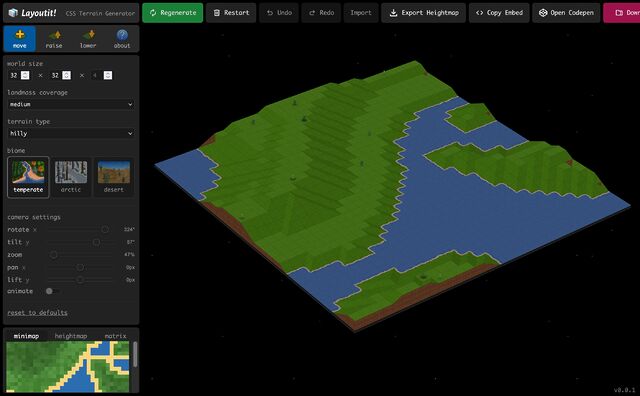
But I got that today when I played with Layoutit! Terra (from the folks behind one of the better CSS grid layout generators). It’d be
pretty cool if it were “just” a Transport Tycoon-like landscape generator and editor, but the thing that blew my mind was discovered that it’s implemented entirely in HTML and CSS… not
a line of JavaScript to be seen. Even speaking as somebody who played… and then reverse-engineered… things like Blackle Mori’s CSS Puzzle
Box, I can’t even begin to fathom how I’d begin to conceive of such a thing, let alone implement it.
Subject: “Re-Design and Promotion Strategy for Dead.Garden”
Subject: “About your Dead.Garden”
Subject: “Errors in your Dead.Garden”
Dear Dead,
your website is not good enough, in fact, it is actively bad.
Don’t you know that you need Search Engine Optimization?
What are you, some kind of idiot?
Your site is currently ranked on page 1,000,000 of Google,
and if we know anything (in fact, we know everything),
this means that you are wasting not only your time,
but much more importantly
money.
We’ve had a quick look at your site
and noticed a few areas that could be improved.
We’ve discovered that your website’s UI is,
frankly,
complete ass.
Your mobile experience is bad, your CTAs should be shinier and rounder;
Maybe put a gradient here and there.
How are you ever going to get someone to buy your product
without manipulating their behaviour?
You’re not selling anything?
Well then, what ARE you doing?
…
A fantastic poem that feels exactly like the subtext of every one of these emails I ever receive.
My blog is for me, first and foremost; I suspect Jo feels a similar way about their digital garden. I’m not interested in making money
with it, and I’m perfectly comfortable with the fact that it costs me money. These things are all fine. I don’t need an SEO merchant to tell me how they can improve it.
or, how to fuck your shit up by ignoring obvious birthday inflammation symptoms. don’t be like me. seek help.
sorry for this barely scripted and low quality video, the next one will be worse.
special thanks to doctor jacobi for the excellent care, and to the manna charitable foundation for the flight logistics.
The ever-excellent Blackle Mori1
posted this about 18 months ago but I don’t think it got the level of attention it deserves. If if you’ve never experienced birthday inflammation or known anybody who has, it’s an
eye-opening experience to hear a first-hand account of this unusual and definitely-real condition.
New research coordinated by the European Broadcasting Union (EBU) and led by the BBC has found that AI assistants – already a daily information gateway for millions of people –
routinely misrepresent news content no matter which language, territory, or AI platform is tested.
…
Key findings:
45% of all AI answers had at least one significant issue.
31% of responses showed serious sourcing problems – missing, misleading, or incorrect attributions.
20% contained major accuracy issues, including hallucinated details and outdated information.
…
In what should be as a surprise to nobody, but probably still is (and is probably already resulting in AI fanboys coming up with counterpoints and explanations): AI is not an accurate
way for you to get your news.
(I mean: anybody who saw Apple Intelligence’s AI summaries of news probably knew this already, but it turns out that it gets worse.)
There are problems almost half the time and “major accuracy issues” a fifth of the time.
I guess this is the Universe’s way of proving that people getting all of their news from Facebook wasn’t actually the worst timeline to live in, after all. There’s always
a worse one, it turns out.
…
Separately, the BBC has today published research into audience use and perceptions of AI assistants for News. This shows that many people trust AI assistants to be accurate – with
just over a third of UK adults saying that they trust AI to produce accurate summaries, rising to almost half for people under-35.
…
Personally, I can’t imagine both caring enough about a news item to want to read it and not caring about it enough that I feed it into an algorithm that, 45% of
the time, will mess it up. It’s fine to skip the news stories you don’t want to read. It’s fine to skim the ones you only care about a little. It’s even fine to just read the
headline, so long as you remember that media biases are even easier to hide from noncritical eyes if you don’t even get the key points of the article.
But taking an AI summary and assuming it’s accurate seems like a really wild risk, whether before or after this research was published!
This post advocates minimizing dependencies in web pages that you do not directly control. It conflates dependencies during build time and dependencies in the browser. I maintain
that they are essentially the same thing, that both have the same potential problems, and that the solution is the snappy new acronym HtDTY – Host the Damn Thing Yourself.
…
If your resources are large enough to cause a problem if you Host the Damn Things Yourself then consider finding ways to cut back on their size. Or follow my related advice –
HtDToaSYHaBRW IMCYMbT(P)WDWYD : Host the Damn Thing on a Service You Have A Business Relationship With, It May Cost You Money But They (Probably) Won’t Dick With Your Data.
…
Host the Damn Thing Yourself (HtDTY) is an excellent suggestion; I’ve been a huge fan of the philosophy for ages, but I like this acronym. (I wish it was pronounceable, but you can’t
have everything.)
Andrew’s absolutely right, but I’m not even sure he’s expressed all the ways in which he’s right. Here are my reasons to HtDTY, especially for frontend resources:
Security: As Andrew observes, you can’t protect against supply chain attacks if your supply chain wide open to exploitation. And I’m glad that he points out that
version pinning doesn’t protect you from this (although subsource integrity can).
Privacy: Similarly, Andrew nailed this one. If you host your fonts on Google Fonts, for example, you’re telling one of the biggest data-harvesting companies on the
Internet who’s accessing your website. Don’t do that (in that specific example, google-webfonts-helper is your friend).
Performance: Andrew rightly deconstructs the outdated argument that CDN caching improves your site’s performance. Edge caching might, in some
circumstances, but still has the problems listed above. But this argument can go further than Andrew’s observation that CDNs aren’t that much of a benefit… because sticking to just
one domain name means (a) fewer DNS lookups, (b) fewer TLS handshakes, (c) better compression, if e.g. your JavaScript assets are bundled or at least delivered in the same pipeline,
and (d) all the benefits of HTTP/2 and HTTP/3, like early hints, pipelining, etc. Nowadays, it can often be faster to not-use a CDN (depending on lots of factors), in
addition to all the above benefits.
Scroll art is a form of ASCII art where a program generates text output in a command line terminal. After the terminal window
fills, it begins to scroll the text upwards and create an animated effect. These programs are simple, beautiful, and accessible as programming projects for beginners. The SAM is a
online collection of several scroll art examples.
Here are some select pieces:
Zig-zag, a simple periodic pattern in a dozen lines of code.
Program output is limited to text (though this could include emoji and color.)
Once printed, text cannot be erased. It can only scroll up.
But these restrictions compel creativity. The benefit of scroll art is that beginner programmers can create scroll art apps with a minimal amount of experience. Scroll art
requires knowing only the programming concepts of print, looping, and random numbers. Every programming langauge has these features, so scroll art can be created in
any programming language without additional steps. You don’t have to learn heavy abstract coding concepts or configure elaborate software libraries.
…
Okay, so: scroll art is ASCII art, except the magic comes from the fact that it’s very long and as your screen scrolls to show it, an animation effect becomes apparent. Does that make
sense?
Anyway, The Scroll Art Museum has lots of them, and they’re much better than mine. I especially love the faux-parallax effect in Skulls and Hearts, created by a “background” repeating pattern being scrolled by a number of lines slightly off from its
repeat frequency while a foreground pattern with a different repeat frequency flies by. Give it a look!
I’d love to write a longer review to praise the art style and the concept, but there’s not much to say. Just… go and give it a shot; it’ll improve your day, I’m sure.
I think of ElonStan420 standing in that exhibit hall, eyeing those cars with disdain because all that time, energy, care, and expression “doesn’t really matter”. Those hand-painted
pinstripes don’t make the car faster or cheaper. Chrome-plated everything doesn’t make it more efficient. No one is going to look under the hood anyway.
…
Don’t read the comments on HackerNews, Adam! (I say this, but I’ve yet to learn not to do so myself, when occasionally my writing escapes from my site and finds its way over there.)
But anyway, this is a fantastic piece about functionalism. Does it matter whether your website has redundant classes defined in the HTML? It renders the same anyway, and odds are good
that nobody will ever notice! I’m with Adam: yes, of course it can matter. It doesn’t have to, but coding is both a science and an art, and
art matters.
…
Should every website be the subject of maximal craft? No, of course not. But in a industry rife with KPI-obsessed, cookie-cutter, vibe-coded, careless slop, we could use
more lowriders.
“OK,” the young man said, “but what can we do about the crash?” He was clearly very worried.
“I don’t think there’s anything we can do about that. I think it’s already locked in. I mean, maybe if we had a different government, they’d fund a jobs guarantee to pull us out of
it, but I don’t think Trump’ll do that, so –”
“But what can we do?“
We went through a few rounds of this, with this poor kid just repeating the same question in different tones of voice, like an acting coach demonstrating the five stages of grieving
using nothing but inflection. It was an uncomfortable moment, and there was some decidedly nervous chuckling around the room as we pondered the coming AI (economic) apocalypse, and
the fate of this kid graduating with mid-six-figure debts into an economy of ashes and rubble.
I firmly believe the (economic) AI apocalypse is coming.
…
I’m not sure I entirely agree with Doctorow on this one. I’ll probably read his upcoming book on the subject, though.
I agree that, based on the ways in which AI is being used, financed, and marketed… we’re absolutely in an unsustainable bubble. There’s a lot of fishy
accounting, dubious business models, and overpromised marketing. I’m not saying AI’s useless: it’s not! But it’s yet proven
itself to be revolutionary, nor even on the path to being so, and it’s so expensive that it seems unlikely that the current “first dose is free” business model is
almost-certainly unsustainable.
But I’m not convinced that a resulting catastrophic economic collapse is inevitable. Maybe I’m over-optimistic, but I like to imagine that the bubble can
fizzle-out gradually and the actually-valuable uses of AI can continue to be used in a sustainable way. (I’m less-optimistic that we’ll find a happy-solution to prevent AI from being
used to rip off artists, but that’s another story.)
I’ve tried to be pragmatic, but there’s something of a dilemma here.
Users should be free to run whatever code they like.
Vulnerable members of society should be protected from scams.
Do we accept that a megacorporation should keep everyone safe at the expense of a few pesky nerds wanting to run some janky code?
Do we say that the right to run free software is more important than granny being protected from scammers?
Do we pour billions into educating users not to click “yes” to every prompt they see?
Do we try and build a super-secure Operating System which, somehow, gives users complete freedom without exposing them to risk?
Do we hope that Google won’t suddenly start extorting developers, users, and society as a whole?
Do we chase down and punish everyone who releases a scam app?
Do we stick an AI on every phone to detect scam apps and refuse to run them if they’re dodgy?
I don’t know the answers to any of these questions and – if I’m honest – I don’t like asking them.
Google’s gradual locking-down of Android bothers me, too. I’ve rooted many of my phones
in order to unlock features that I benefit from (as a developer… and as a nerd!), and it’s bugged me on the occasions where I’ve been unable to run had to use complicated
workarounds to trick e.g. a bank’s app. Having gone to the effort to root a phone – which remains outside of the reach of most regular users – I’d be happy to accept an appropriate
share of the liability if my mistake, y’know, let a scammer steal all of my money.
That’s the risk you take with any device on which you have root, and it’s why we make it hard to the point of being discouraging. Because you can’t just put up a
warning and hope that users will read and understand it, because they won’t. They’ll just click whatever button looks like it’ll get them to the next step without even glancing at the
danger signs1.
I’m glad to have been increasingly decoupling myself from Google’s ecosystem, because I’ve been burned by it too. Like Terence, I’ve been hit by “real name” policies that discriminate against people with unusual names or who might be
at risk of impersonation2.
But I’m not convinced that there’s a good alternative for me to running Android on my mobile devices, at the moment: I really enjoyed Maemo back in the day; what’s the status of
Sailfish nowadays?
I get that we need to protect people from dangerous scammy apps. But I’d like to think there’s a middle-ground somewhere between Doctrowian “it’s your device, you’re responsible for
what runs on it” and the growing Apple/Google thinking of “if we don’t have the targetting coordinates of the developer that wrote the code, our OS won’t let you run it”. I’m ready to
concede that user education alone hasn’t worked, but there’s got to be a better solution than this, Google.
Footnotes
1 Incidentally, I don’t blame users for this behaviour. Users have absolutely
been conditioned, and continue to be conditioned, to click-without-reading. Cookie and privacy banners with dark patterns, EULAs and legal small print are notoriously (and often
unnecessarily) long and convoluted, and companies routinely try to blur the line between “serious thing you should really read but we want you not to” and “trivial thing that you
don’t need to read; it’s just a formality that we have to say it”.
2 Right now, my biggest fight with Google has come from the fact that lately, it seems
like every time I upload a Three Rings demo video to YouTube it gets deleted under their harassment policy for doxxing people…
people like “Alan Fakename” from Somewhereville, “Betty Notaperson” from Otherplace, and their friend “Chris McMadeup” who lives at 123 Imaginary Street. The appeals process turns out
to be that you click a button to appeal, but don’t get to provide any further information (e.g. to explain that these are clearly-fake people who won’t mind being doxxed on account of
the fact that they don’t exist), and then a few hours later you get an email to say “nah, we’re keeping it deleted”. I almost expect the YouTube version of my recent video demonstrating FreeDeedPoll.org.uk will be
next to be targetted by this policy for showing me scribbling the purported signature Sam McRealName, formerly known as Jo Genuine-Person.
In 2024, we each seperately submitted Freedom of Information requests to our country’s railway operators, asking for specification about how their barcodes worked. This has made a
lot of people very angry and has been widely regarded as a bad move.
This talk details the drama, lies, and nonsense, that ensued as seemingly every part of the UK’s and Slovenian rail industry set out to stop us from getting access to the
documents we requested.
Train tickets in the UK can be issued in two formats: on security card stock, or as a barcode on a mobile phone. Being the curious beings we are, we were curious about what was in
those barcodes. What information on us is processed in them? How do they encode our journeys? Can we do anything interesting with their contents?
…
In spite of knowledge from the reverse engineering work about these tickets’ use of public/private key cryptography, and the absolute non-issue of making public keys, well, public,
seemingly every part of the UK rail industry put Q’s picture on their office dartboard and vowed to never let them have these documents.
…
A really interesting-sounding session at MRMCD 2025 in a couple of weeks, by that other hacker called Q. Wish I could be there… but
failing that, perhaps the talk, or at least the discoveries, will make their way onto the open Internet?
Mastodon shows an “Alt” button in the bottom right of images that have associated alt text. This button, when clicked, shows the alt text the author has written for the image.
…
After using this button a few times, I realised how much I appreciated reading the alt text for an image. Reading the alt text helped me better understand an image. In some cases, I
saw posts where the alt text contained context about an image I otherwise would not have had (i.e. the specific name of the game from which a screenshot was taken).
…
Like James, I’ve also long enjoy Mastodon’s tools to help explore alt-text more-easily, but until I saw this blog post of his I’d never have considered porting such functionality to my
own sites.
He’s come up with an implementation, described in his post, that works pretty well. I find myself wondering if a <details>/<summary> UI metaphor
might be more appropriate than a visually-hidden checkbox. Where CSS is disabled or fails, James’ approach displays a checkbox, the word “ALT”, and the entire alt text, which is
visually confusing and will result in double-reading by screen readers.
A <details>/<summary> approach would be closer to
semantically-valid (though perhaps I’m at risk of making them a golden hammer?), and would degrade more gracefully
into situations in which CSS wasn’t available.
Still, a wonderful example of what can be done and something I might look at replicating during my next bout of blog redesigning!
Anyway: Acai turns out to be not only a kickass Clone Hero player, but he’s also a fun and charismatic commentator to take along for the ride.
Incidentally, it was fun to see that the same level of attention to detail has been paid to the on-screen lyrics for Clone Hero as were to the subtitles on the video version of the album. For example, they’ll sometimes imply that the next line is what
you’re expecting it to be, based on a familiarity with the song, only to bait-and-switch it out for the actual lyrics at the last second. Genius.