After a bit of a hunt and put off by the recent DNFs I was about to give up on this one when a passer by hinted that I should be looking “bayl sbhe fgrcf njnl”. TFTC!
I’ve exchanged messages with Taradoherty and it sounds like their previous log
(suggesting that the cache is missing) was posted in error. I’ve no reason to believe that there’s anything wrong with the cache.
#challengerobin is coming close to completion as Robin looks to be under a mile away and heading the right direction! https://danq.me/2018/11/09/challenge-robin-2/#waypoint-relubbus
It might not be clear to him yet that there’s a river in the way, but I’m sure he’ll find a bridge. Or swim.
Robin’s found the fourth clue (and a devious puzzle box) in #challengerobin 2. Now can he make it to the accomodation or must I drink all the beer by myself?
https://danq.me/2018/11/09/challenge-robin-2/#waypoint-cudden
#challengerobin Robin’s making slower progress up-hill now as he tries to find a mystery box identified only by its distance, like #geocaching with one eye tied behind your back, I
guess. https://danq.me/2018/11/09/challenge-robin-2/#waypoint-turnpike
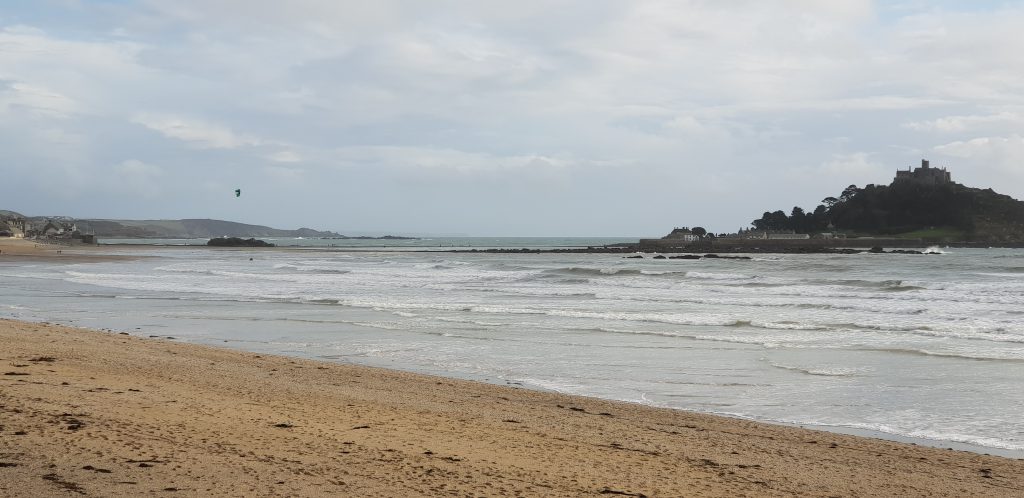
Sprinting along the coast, Robin threw himself into #challengerobin and made it to St. Michael’s Mount and back before the causeway was consumed by the waves. His next challenge? Find a
secret location knowing only its real-time distance from him: https://danq.me/2018/11/09/challenge-robin-2/#waypoint-longrock
Robin made it to Penzance and #challengerobin can continue! Receiving his first, well second, clue, he’s racing the tide to St. Michael’s Mount and across the causeway. Can he make it?
https://danq.me/2018/11/09/challenge-robin-2/#waypoint-station
After a series of setbacks, I’m determined to enable #challengerobin to continue. I’m off to meet Robin off his train and get him on-track, skipping the first clue. And
his brother Owen’s joining in, too… https://danq.me/2018/11/09/challenge-robin-2/#waypoint-plan
#challengerobin After the sleeper train was cancelled Robin ended up on a series of regular trains and now isn’t expected in Penzance until several hours after originally planned. Some
modifications may be needed… https://danq.me/2018/11/09/challenge-robin-2/#waypoint-curveball
#challengerobin hit a disaster early on: Robin was to find sleeper train tickets in a puzzle box, but a growing storm (see pic) has caused the train to be cancelled. What now?
https://danq.me/2018/11/09/challenge-robin-2/#waypoint-disaster
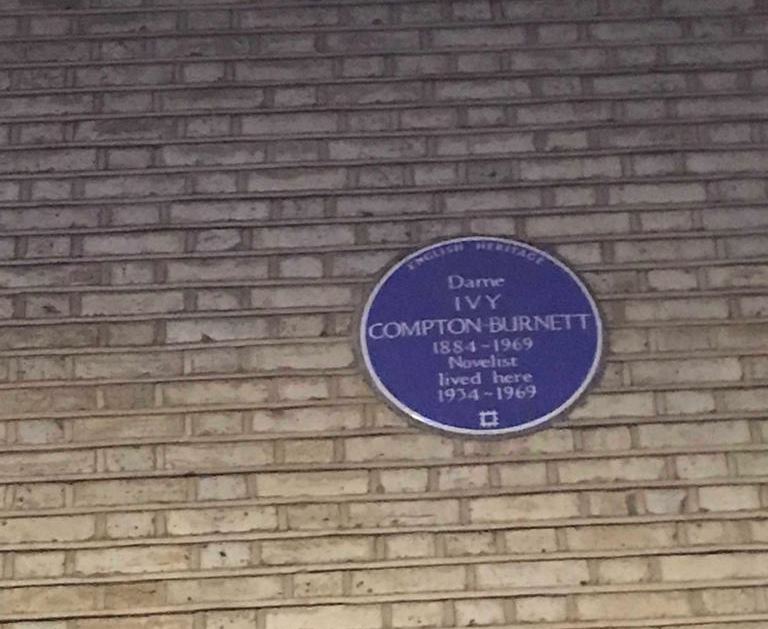
#challengerobin pushed-off in earnest with a blue-plaque-treasure trail around London and then back to Paddington station… but it looks like things are about to go very wrong…
https://danq.me/2018/11/09/challenge-robin-2/#waypoint-gardens
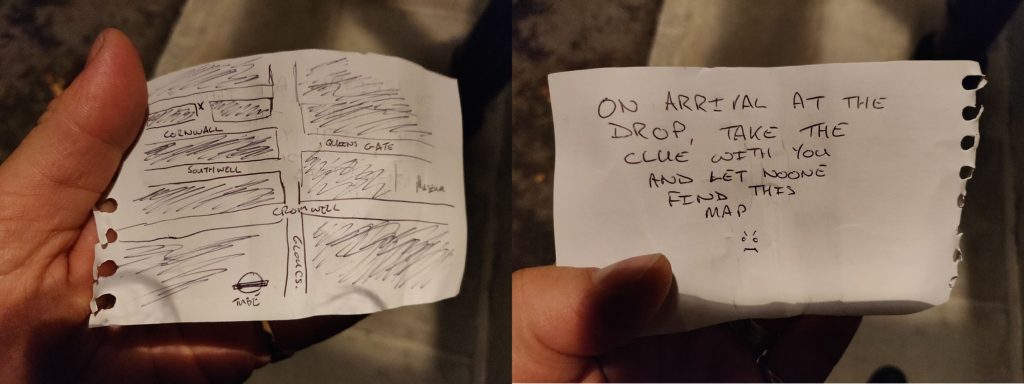
#challengerobin Robin finally made it to his contact and has been given a clue – a map to a Kensington street and instructions on what to do when he gets there:
https://danq.me/2018/11/09/challenge-robin-2/#waypoint-gbk
After the success of Challenge Robin this summer – where Ruth and I blindfolded her brother
Robin and drove him out to the middle of nowhere without his phone or money and challenged him to find his way home – Robin’s been angling for a sequel. He even went so far as to suffix the title
of his blog post on the subject “(part 1)”, in the hopes perhaps that we’d find a way to repeat the experience.
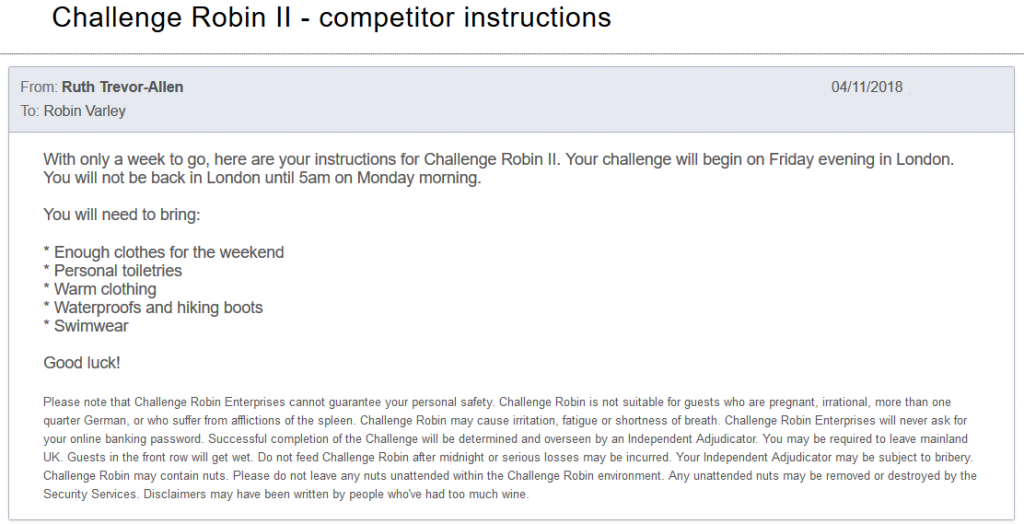
I gather that Robin was particularly concerned by the combination of the recommendation to bring swimwear and the warning that he may have to leave mainland UK… especially given that
the challenge takes place in November.
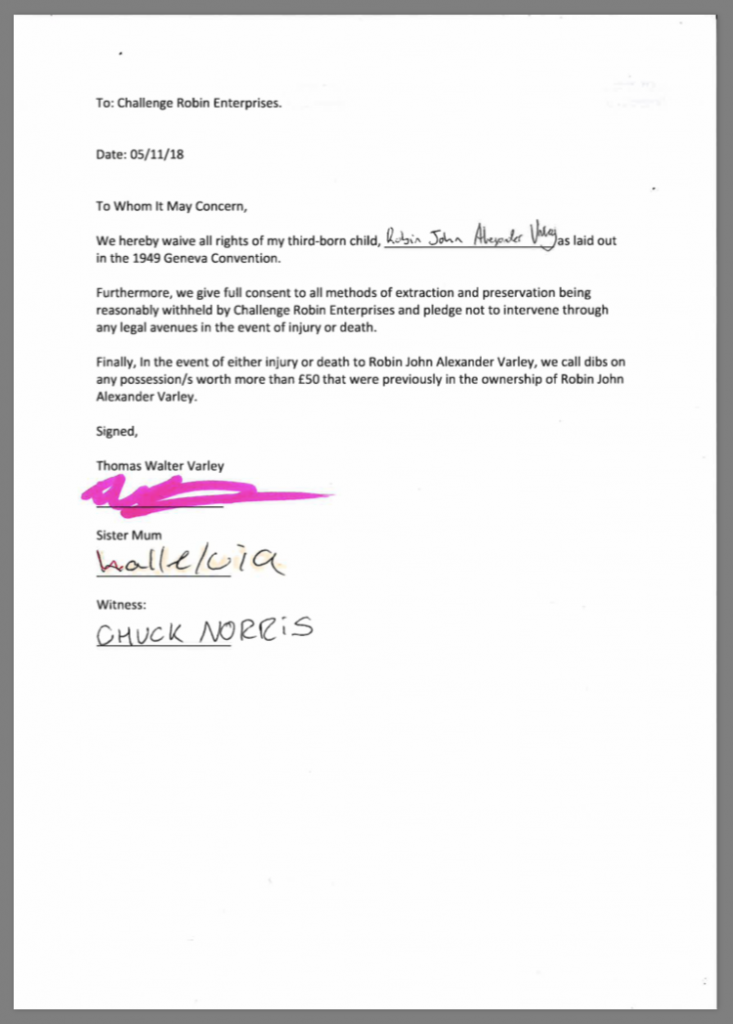
In response to an email sent a week in advance of the challenge, Robin quickly prepared and returned a “permission slip” from his parents, although I’m skeptical that either of them
actually saw this document, let alone signed it.
I’m told that the “signatures” on this document accurately replicate the signature styles of Robin’s parents. I’m guessing he forged a lot of these kinds of notes.
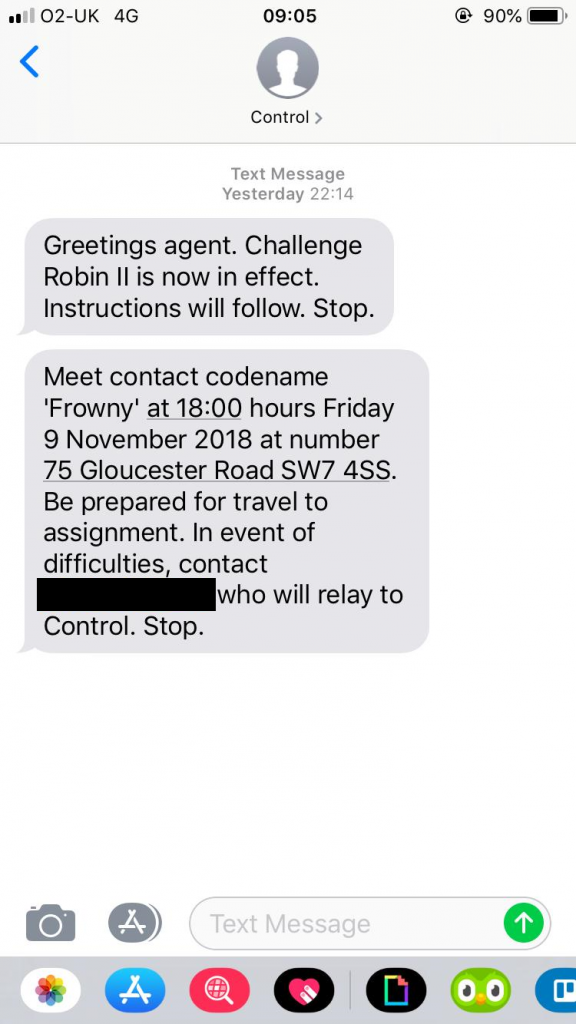
With about a day to go before the challenge began, Robin’s phone will have received a number of instructional messages from a sender-ID called “Control”, instructing him of his first
actions and kicking off his adventure. He’d already committed to going to work on Friday with a bag fully-packed for whatever we might have in store for him, but he doubtless wouldn’t
have guessed quite how much work had been put into this operation.
We considered giving Robin’s contact the alias ‘Smiler’, but ‘Frowny’ seemed more-fitting for the part.
By 18:06 he still hadn’t arrived to meet his contact. Had this adventure fallen at the first hurdle? Only time would tell…
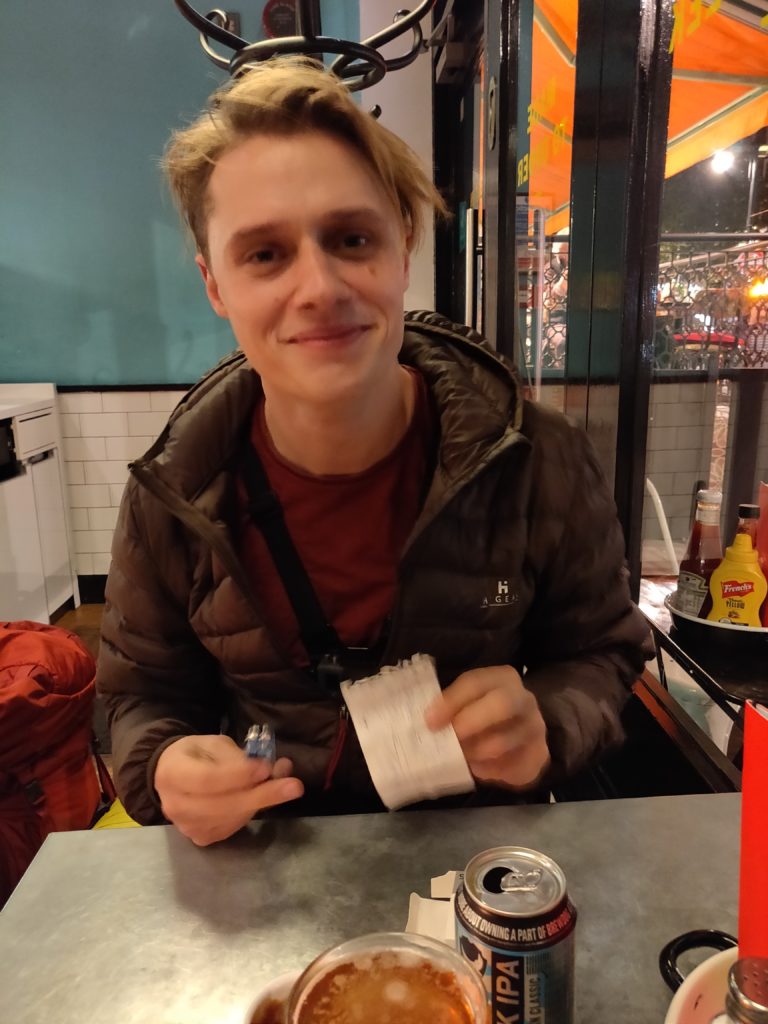
Update – Friday 9 November 18:45: Robin arrived late and apologetic to find his contact, “Frowny”, at the GBK at that address, was played by JTA.
After sufficient apologies he was allowed to be granted the clue we’d expected to give him earlier…
The pair ate and drank and “Frowny” handed Robin his first clue: a map pointing to Cornwall Gardens in Kensington and instructions on where to find the next clue when he got there. The
game was afoot!
I love the little “Frowny” face; it really make this prop.
Clearly he’d taken the idea of being prepared for anything to a level beyond what we’d expected. Among his other provisions, he was carrying a tent, sleeping bag, and passport!
“Clearly my mistake,” he told his contact, “Was giving intelligent people a challenge and then leaving them three months to plan.”
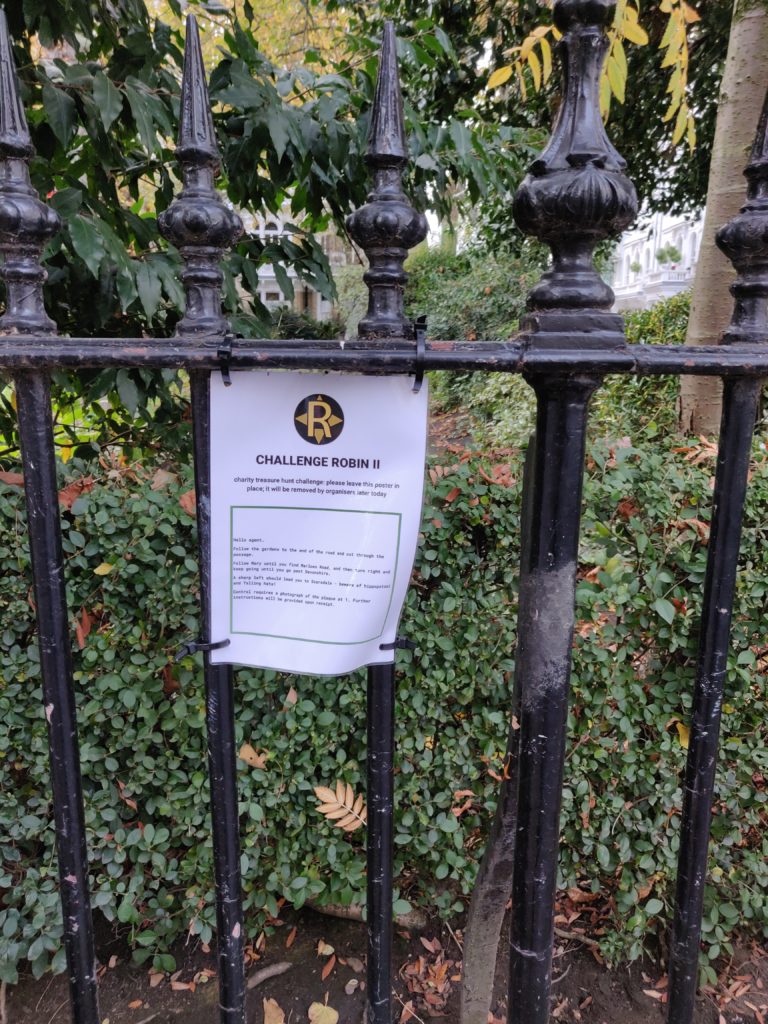
Update – Friday 9 November 19:53: In Cornwall Gardens, Robin found the note (delayed somewhat, perhaps by the growing dark) and began his treasure
trail.
The sign at Cornwall Gardens kickstarted a journey visiting a thematic series of blue plaques around London before eventually leading to the Paddington Bear statue at Paddington
Station…
Soon after, though, things started to go very wrong…
I’m not sure that this was even one of the ones he was supposed to photograph, but anyway…
Update – Friday 9 Novembr 20:40: Let’s take a diversion, and I’ll rely on JTA to keep Robin’s eyes away from this post for a bit. Here’s what was
supposed to happen:
Robin would follow a trail of clues around London which would give him key words whose names alluded to literature about Paddington (station) and Penzance. Eventually he’d find a
puzzle box and, upon solving it, discover inside tickets for the Paddington-to-Penzance overnight sleeper train.
Meanwhile, I’ve been rushing around the countryside near Penzance setting up an epic extension to the previous trail complete with puzzles, mixed-terrain hikes, highlands, islands,
lions, tigers and bears (oh my). Some of those might not really have been in the plan.
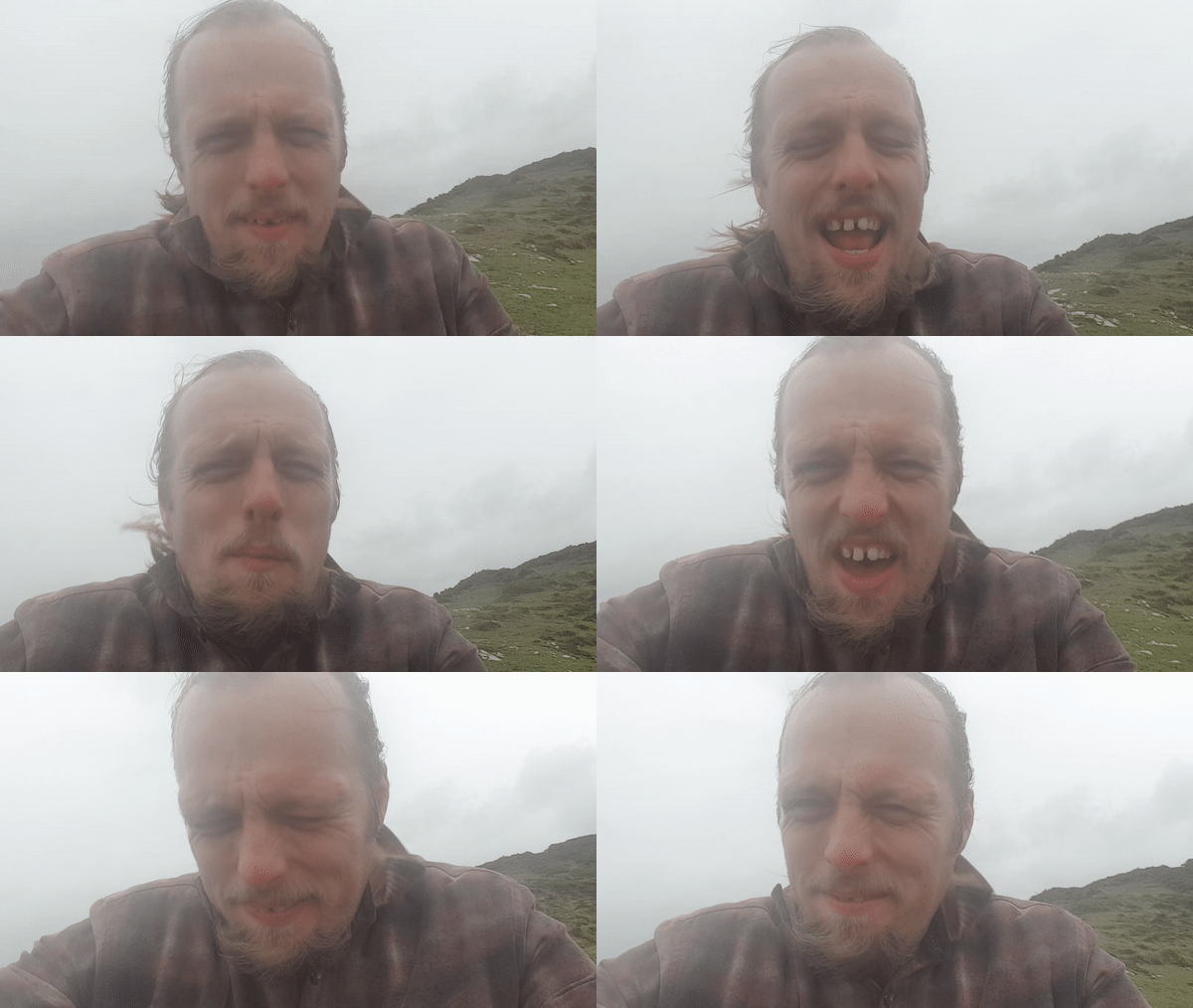
The storm was just starting as I climbed up to a cliff edge for an as-yet-undisclosed reason; it’s already looking pretty wild and getting wilder all the time!
So now we’re working out what to do next. Right now I’m holed-up in an undisclosed location near Penzance (the ultimate target of the challenge) and Robin’s all the way over in London.
We’re working on it, but this hasn’t been so successful as we might have liked.
Update – Saturday 10 November 07:58: We’ve managed to get Robin onto a series of different trains rather than the sleeper, so he’ll still get to
Penzance… eventually! Meanwhile, I’m adjusting the planned order of stages at this end to ensure that he can still get a decent hike in (weather permitting).
Update – Saturday 10 November 10:45: Originally, when Robin had been expected to arrive in Penzance via a sleeper train about three hours ago, he’d
have received his first instruction via The Gadget, which JTA gave him in London:
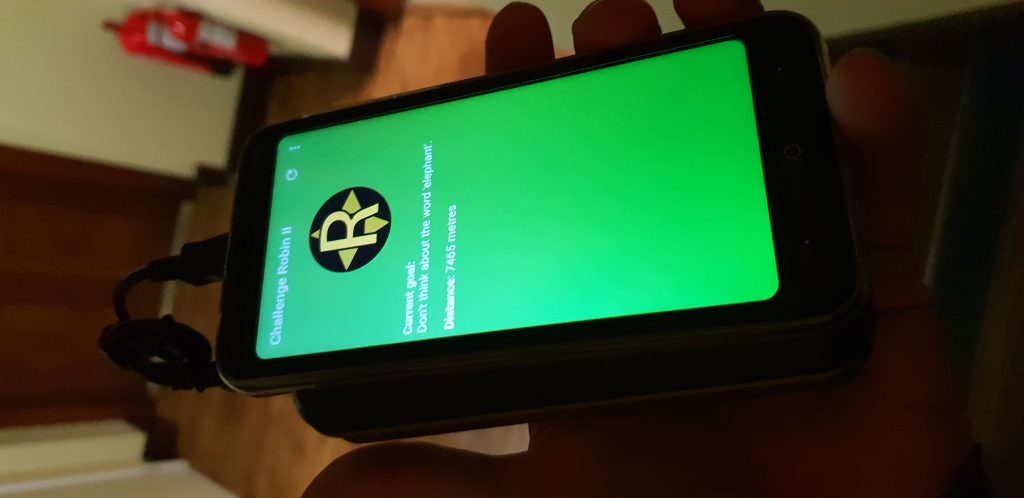
The Gadget is a cheap Android smartphone coupled to a beefy battery pack and running custom software I wrote for the challenge.
The Gadget’s primary purpose is to send realtime updates on Robin’s position so that I can plot it on a map (and report it to you guys!) and to issue him with hints so that he knows
where he’s headed next, without giving him access to a phone, Internet, navigation, maps, etc. The first instruction would be to head to Sullivan’s Diner for breakfast (where
I’ve asked staff to issue him with his first clue): cool eh? But now he’s only going to be arriving in the afternoon so I’m going to have to adapt on-the-fly. Luckily I’ve got a plan.
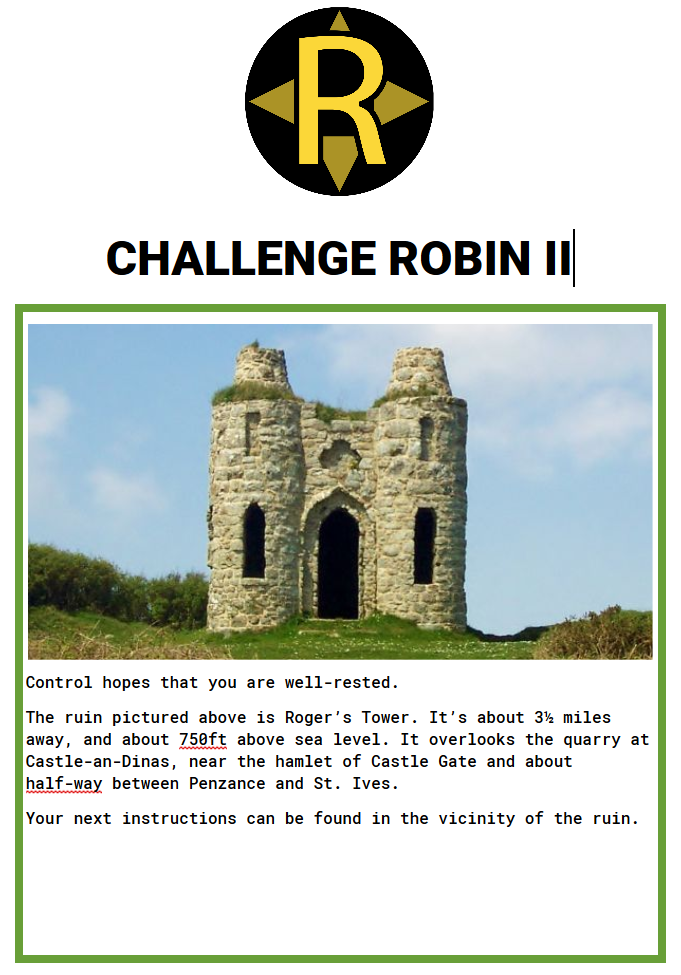
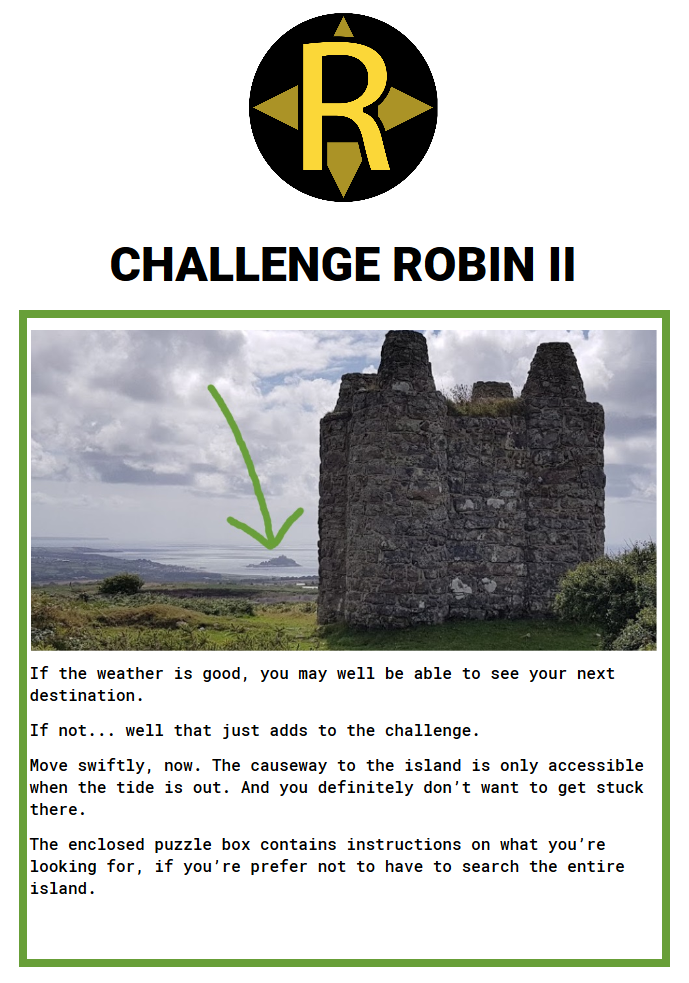
The first clue has a picture of the ruin of a hill fort a few miles away and vauge instructions on how to find it.
I’m going to meet Robin off his train and suggest he skips this first leg of the challenge, because the second leg is… sort-of time-critical…
Update – Saturday 10 November 13:29: Robin finally arrives in Penzance on a (further-delayed) train. I’ve given him a sausage sandwich at
Sullivan’s Diner (who then gave him the clue above), turned on The Gadget (so I’ve got live tracking of his location), and given him the next clue (the one he’d have gotten at
Roger’s Tower) and its accompanying prop.
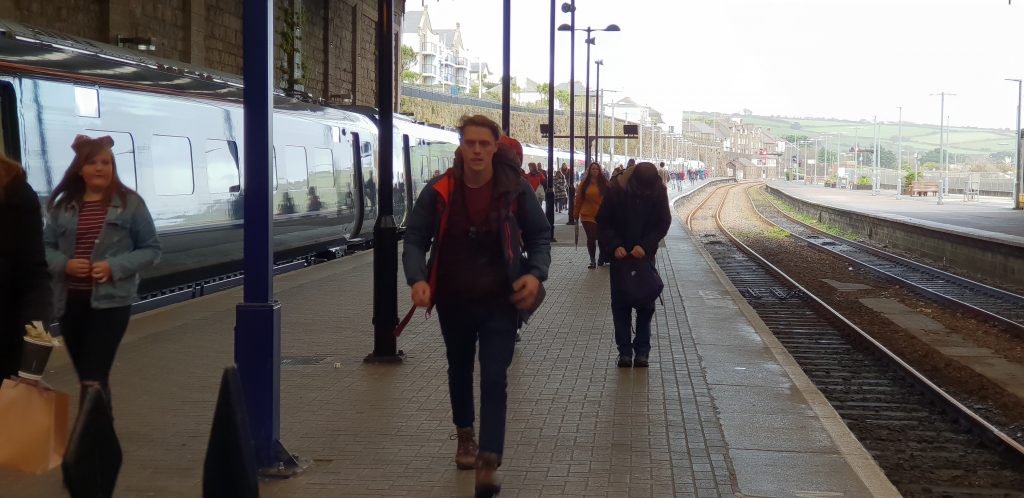
Rushing off the train, carrying his tent, sleeping bag, clothes…
Armed with the clue, Robin quickly saw the challenge that faced him…
The second clue SHOULD have been read at Roger’s Tower and so the photo would have made more sense.
After all of these delays, there’s only about an hour and a half until the tide comes in enough to submerge the causeway to St. Michael’s Mount: the island he’s being sent to. And he’s
got to get there (about an hour’s walk away), across the causeway, find the next clue, and back across the causeway to avoid being stranded. The race is on.
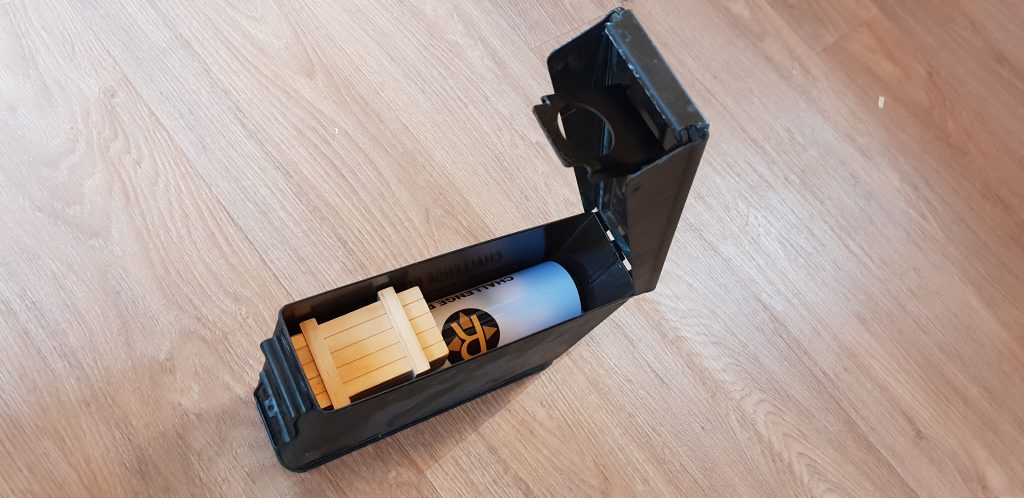
He WOULD have found this at Roger’s Tower. Why yes, I am a geocacher: why do you ask?
Luckily, he’d been able to open the puzzle box and knows broadly where to look on the island for the next clue. How will he do? We’ll have to wait and see…
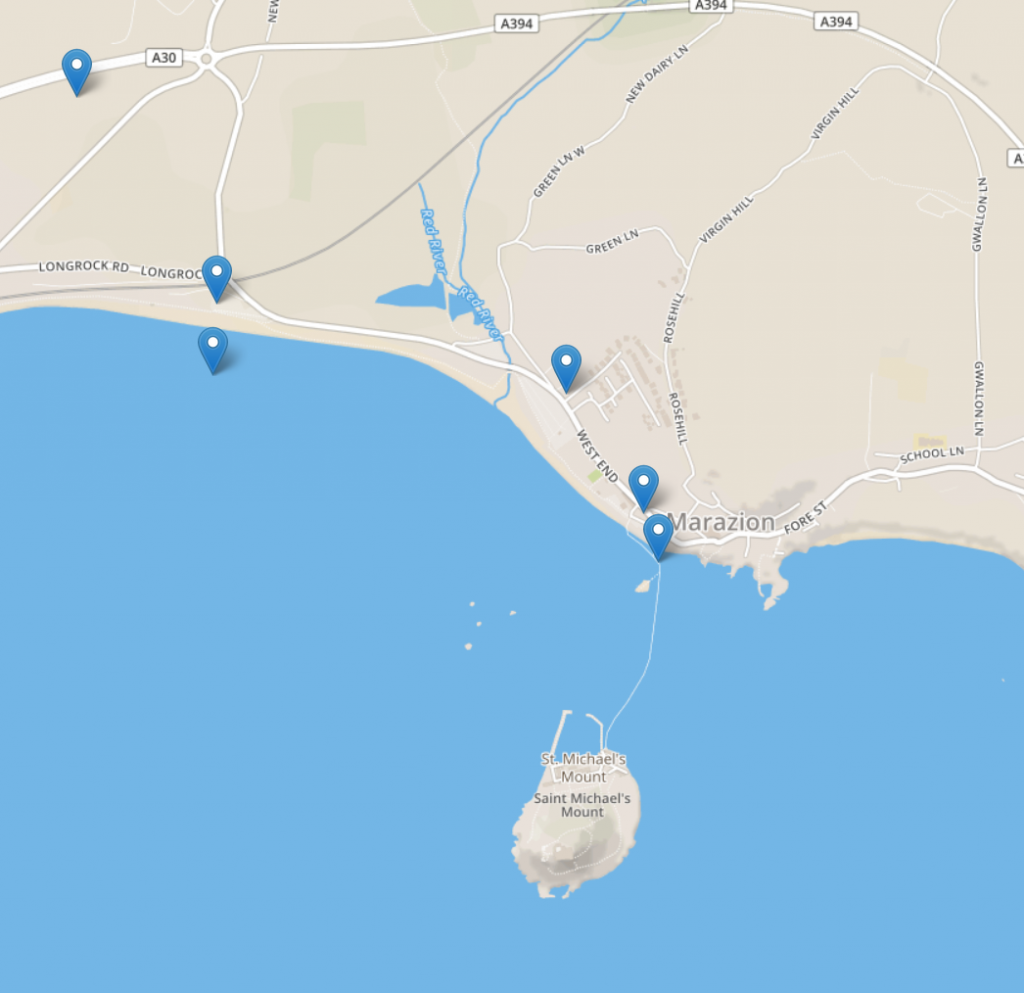
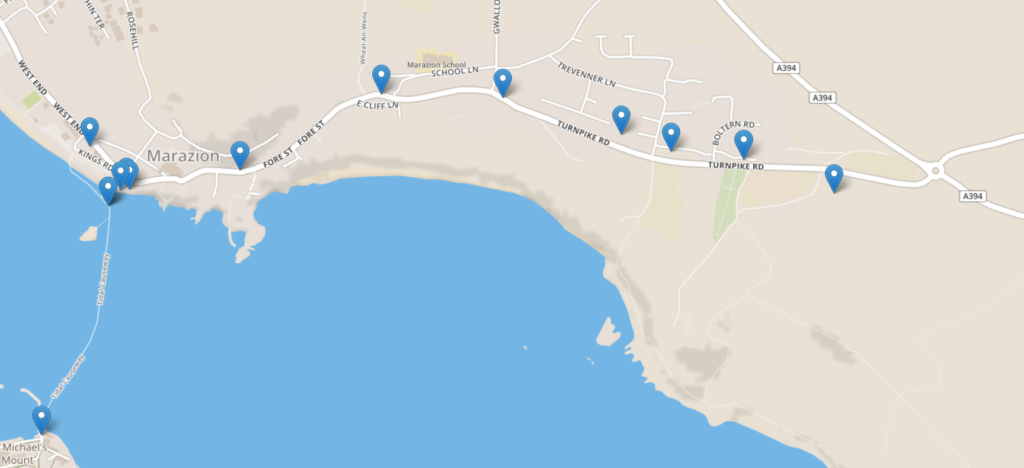
Update – Saturday 10 November 14:18: Robin made spectacular time sprinting along the coast to Longrock (although his route might have been
suboptimal). At 14:18 he began to cross to the island, but with only a little over half an hour until the tide began to cover the causeway, he’d have to hunt quickly for the password he
needed.
Each pin is 3 minutes apart. You do the maths.
At 14:22 he retreived the clue and put the password into The Gadget: now he had a new set of instructions – to get to a particular location without being told what it was… only a
real-time display of how far away it was. 7.5km and counting…
I THINK he’s the rightmost blob. I wish I’d brought a telephoto lens.
Update – Saturday 10 November 14:57: Robin’s making his way along the coast (at a more-reasonable pace now!). He’s sticking to the road rather
than the more-attractive coast path, so I’ve had “Control” give him a nudge via The Gadget to see if he’d prefer to try the more-scenic route: he’ll need to, at some point, if he’s to
find his way to the box I’ve hidden.
While not as steep as the gradient to Roger’s Tower would’ve been, the coast path isn’t without its steep bits, too.
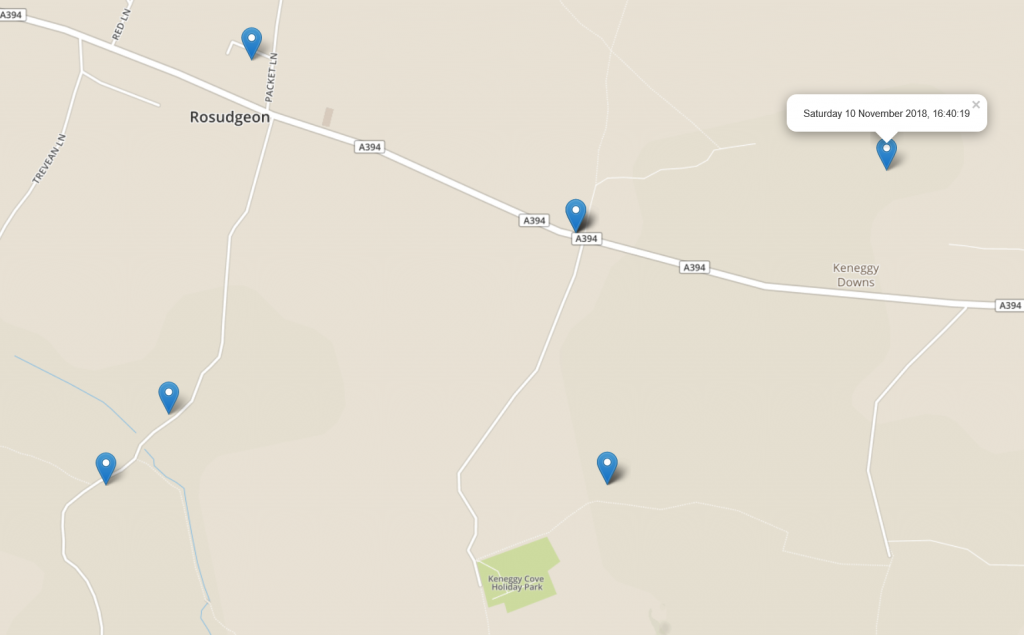
Update – Saturday 10 November 16:50: No idea where Robin is; The Gadget’s GPS has gone all screwy.
One of these pins is probably right, right?
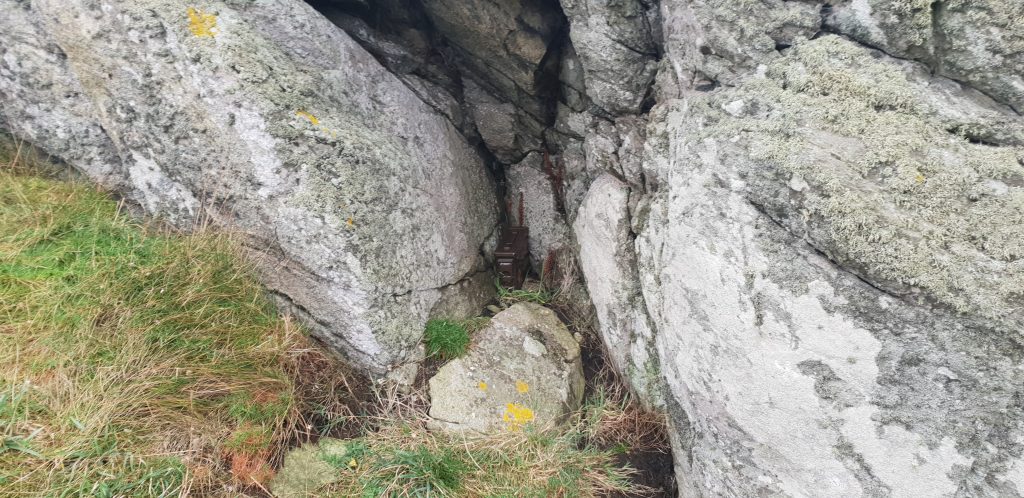
But it looks like he probably made it to Cudden Point, where the final clue was hidden. And then kept moving, suggesting that he retreived it without plunging over the cliff
and into the sea.
It’s not VERY well hidden, but it only had to survive a day. A stormy day, mind…
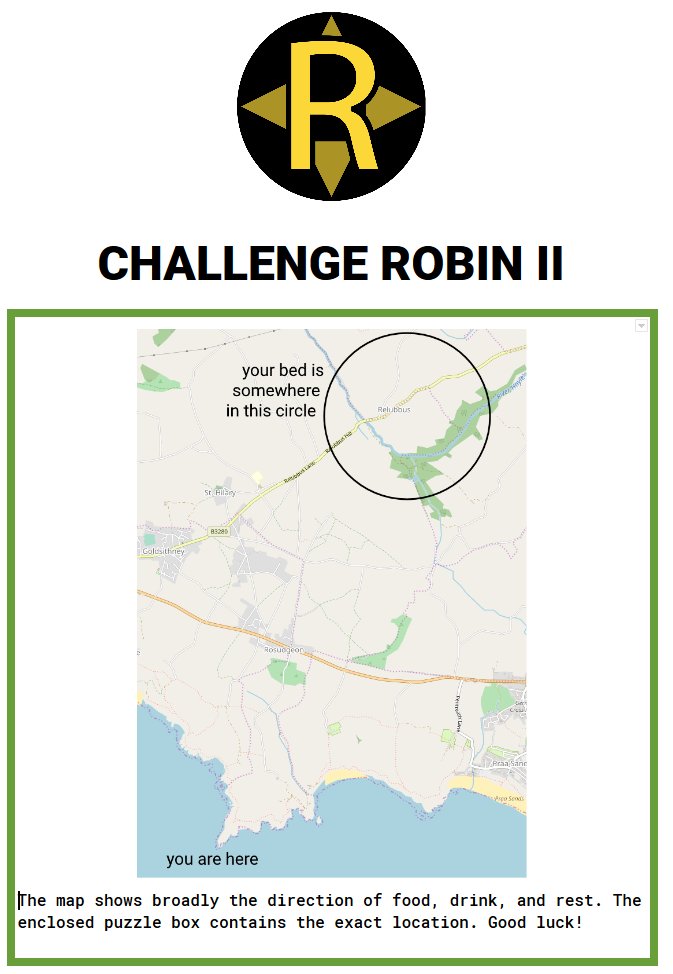
In it, he’ll have found a clue as to broadly where his bed is tonight, plus a final (very devious) puzzle box with the exact location.
The fourth clue basically says “your bed is THAT way, but you need to open THIS puzzle box to know exactly where”. Evil.
The sun is setting and Robin’s into the final stretch. Will he make it?
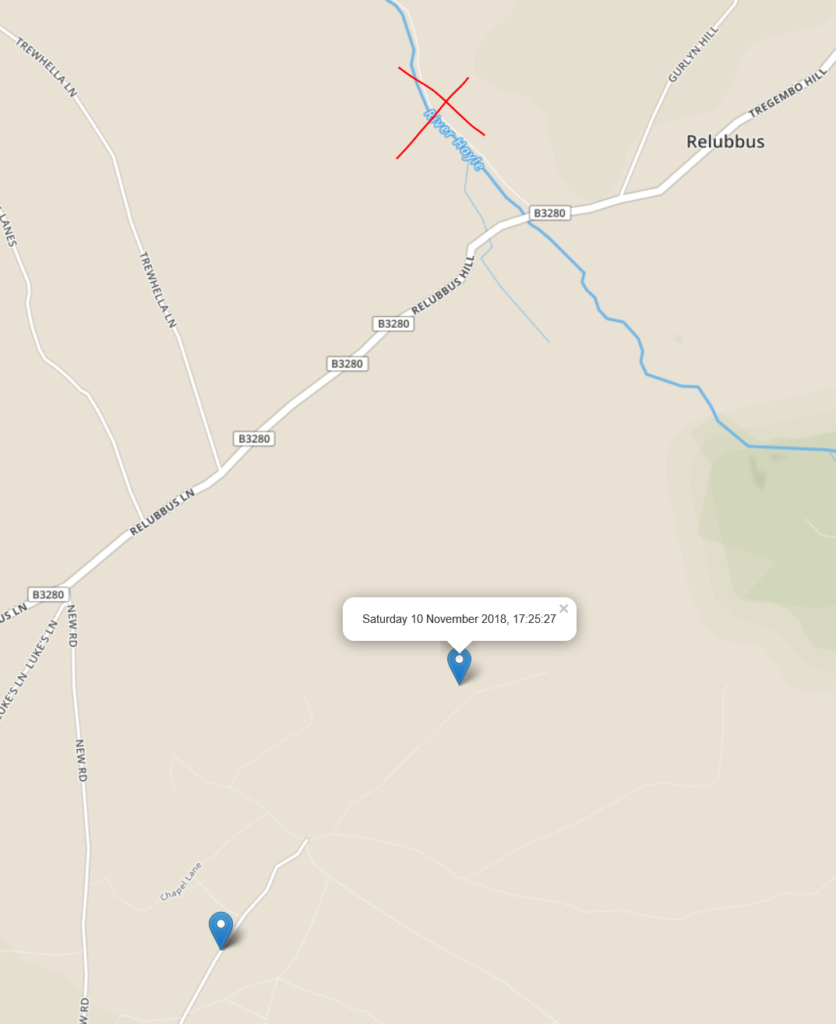
Update – Saturday 10 November 17:25: He’s going to make it! He’s actually going to make it! Looks like he’s under a mile away and heading in the
right direction!
It might not be clear to him yet that there’s a river in the way, but I’m sure he’ll find a bridge. Or swim.
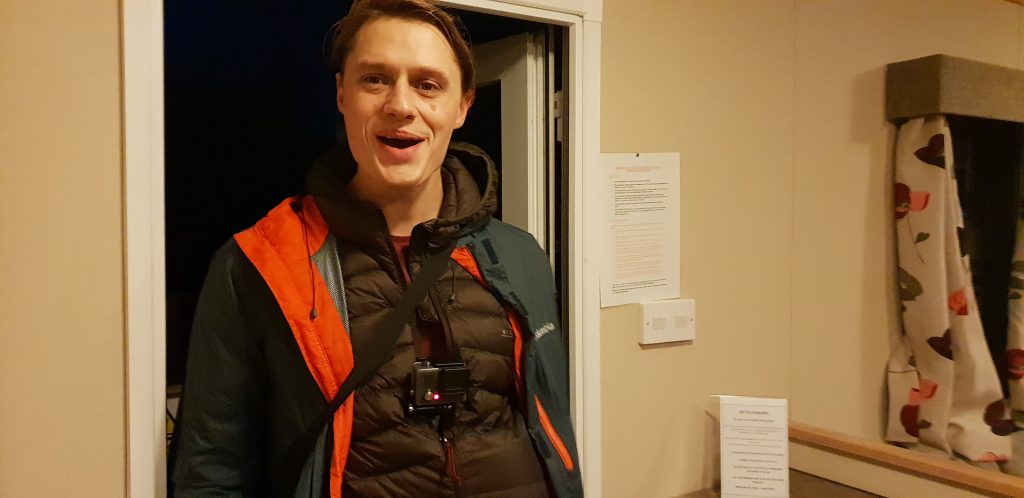
Update – Saturday 10 November 17:55: He made it!
Success!
We’ve both got lots to say, so a full debrief will take place in a separate blog post.