You can see the punchline coming from a mile away but it’s still awesome.
Precise Slice
This is a repost promoting content originally published elsewhere. See more things Dan's reposted.
You can see the punchline coming from a mile away but it’s still awesome.
This month I reminisced about that time Paul made and ate a Birmingham Egg (with help from Jon) and used doing so as a comment on Web siloisation and how it may be reducing diversity of “weird” content online. I also contemplated what recent observations about neural nets might mean for our understanding of child psychology and language development (in an only slightly tongue-in-cheek way).
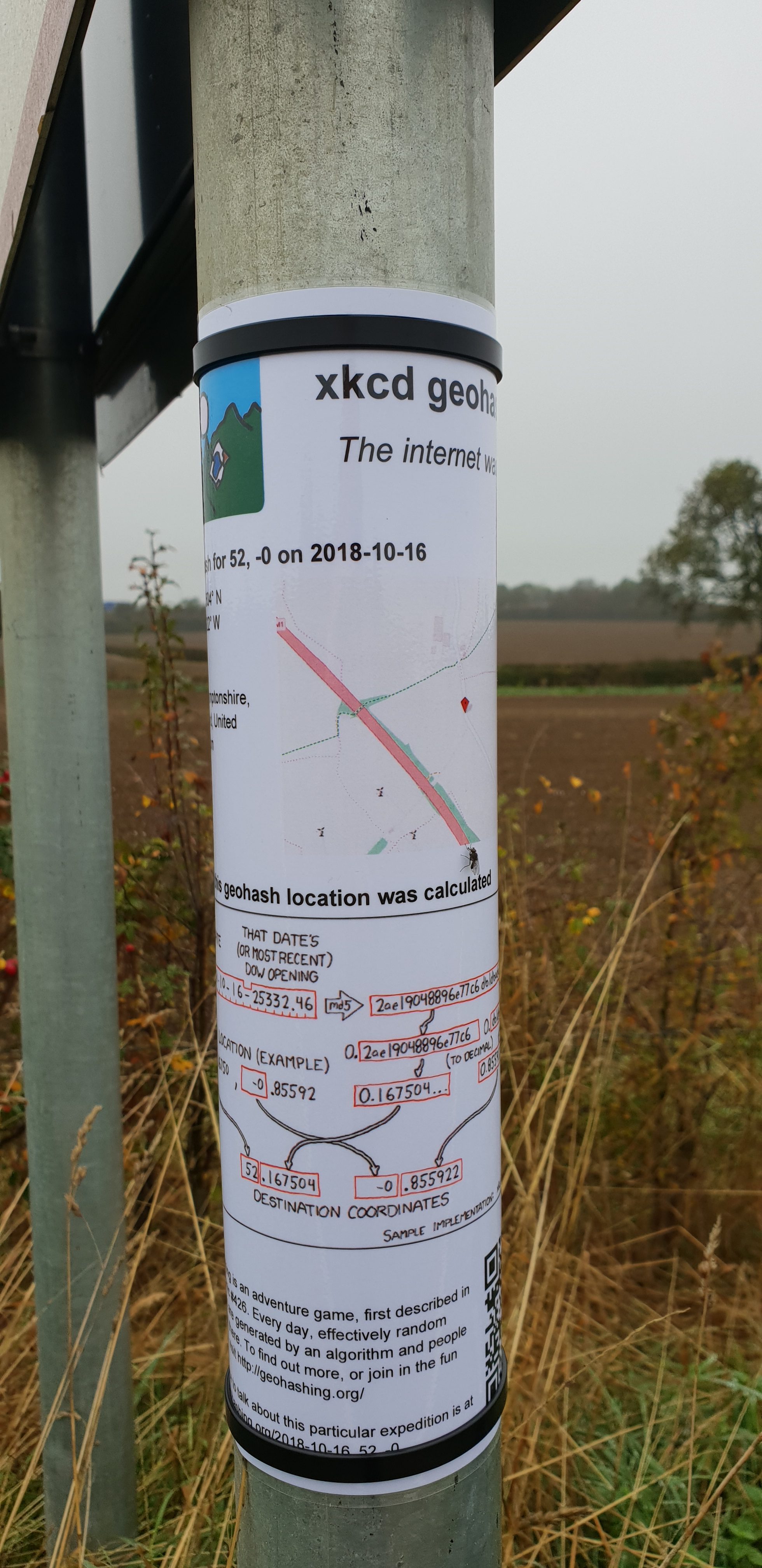
Ruth, JTA, the kids and I took a snowsports holiday to the French alps, where I also found a handful of geocaches: GLV85XH3, GLV85X2Z, and GLV85W40.
And I reposted an XKCD comic about violin plots, a community of Javascript <canvas> programmers who try to get great effects into only 140 characters of code, and a fabulous vlog telling a story about an unusual first-time RPG participant.
Posts marked by an asterisk (*) are referenced by the summary above.
Reposts marked with a dagger (†) include my comments or interpretation.
I normally reserve my “on this day” posts to look back at my own archived content, but once in a while I get a moment of nostalgia for something of somebody else’s that “fell off the web”. And so I bring you something you probably haven’t seen in over a decade: Paul and Jon‘s Birmingham Egg.
It was a simpler time: a time when YouTube was a new “fringe” site (which is probably why I don’t have a surviving copy of the original video) and not yet owned by Google, before Facebook was universally-available, and when original Web content remained decentralised (maybe we’re moving back in that direction, but I wouldn’t count on it…). And only a few days after issue 175 of the b3ta newsletter wrote:
* BIRMINGHAM EGG - Take 5 scotch eggs, cut in half and cover in masala sauce. Place in Balti dish and serve with naan and/or chips. We'll send a b3ta t-shirt to anyone who cooks this up, eats it and makes a lovely little photo log / write up of their adventure.
Clearly-inspired, Paul said “Guess what we’re doing on Sunday?” and sure enough, he delivered. On this day 13 years ago and with the help of Jon, Liz, Siân, and Andy R, Paul whipped up the dish and presented his findings to the Internet: the original page is long-gone, but I’ve resurrected it for posterity. I don’t know if he ever got his promised free t-shirt, but he earned it: the page went briefly viral and brought joy to the world before being forgotten the following week when we all started arguing about whether 9 Songs was a good film or not.
It was a simpler time, when, having fewer responsibilities, we were able to do things like this “for the lulz”. But more than that, it was still at the tail-end of the era in which individuals putting absurd shit online was still a legitimate art form on the Web. Somewhere along the way, the Web got serious and siloed. It’s not all a bad thing, but it does mean that we’re publishing less weirdness than we were back then.
This is a repost promoting content originally published elsewhere. See more things Dan's reposted.
This review of Chalet d'Or originally appeared on Google Maps. See more reviews by Dan.
This checkin to GLV85XH3 ??Le Sentier de la forêt?? : LA MADONE reflects a geocaching.com log entry. See more of Dan's cache logs.
Salutations d’Angleterre.
On a skiing holiday I took a day to go geocaching. This was my third find. Wonderful location, although I came (on foot) from the top and down rather than the bottom and up. Lovely location, FP awarded.
TFTC/MPLC!
This checkin to GLV85X2Z EABDG : Margaret la reine de fer reflects a geocaching.com log entry. See more of Dan's cache logs.
Salutations d’Angleterre.
On a skiing holiday I took a day to go geocaching. This was my second find. Shopkeeper was looking strangely at me through the window so I pretended to be interested in the sculpture and took photos until he stopped watching. Cache was in third place I looked.
SL. TFTC/MPLC!
This checkin to GLV85W40 LA MADONE DU GRAND BO ! reflects a geocaching.com log entry. See more of Dan's cache logs.
Salutations d’Angleterre.
On a skiing holiday I took a day to go geocaching. This was my first (and easiest) find. Log very wet, unable to sign, but photo attached of me and cache (taken some way away from GZ) as proof of find.
TFTC/MPLC!
This checkin to GC629TH EABDG : La vache qui tourne dans le Tour de France reflects a geocaching.com log entry. See more of Dan's cache logs.
Salutations d’Angleterre.
On a skiing holiday I took a day to go geocaching. Even with the hint, unable to find this cache: suspect it must be buried under ice and snow? If that’s possible, perhaps worth adding to the cache description or else removing the “winter” attribute? (Or maybe I just gave up too easily!)
This review of Tower of the Five Orders originally appeared on Google Maps. See more reviews by Dan.
This iconic Oxford landmark is named for the architectural characteristics of each of its five floors. Each exhibits a different order – or “style” – of classical architecture: from bottom to top – tuscan, doric, ionic, corinthian and composite. Part of the joy of “discovering” the tower, visiting as a tourist, comes from the fact that despite it’s size it’s unlikely to be the first thing you see as you enter the quad: coming in from the Great Gate, for example, it won’t be until you turn around and look up that you see it… and even at a glance you won’t necessarily observe its unusual architecture unless you’ve been told to look specifically at the columns.
This review of Bodleian Library Café originally appeared on Google Maps. See more reviews by Dan.
Nice cakes and large mugs of hot drinks in the fabulous Blackwell Hall. Beware the “no laptops” policy in the afternoon, though: they’re militant about policing it!
A recent article by Janelle Shane talked about her recent experience with Microsoft Azure’s image processing API. If you’ve not come across her work before, I recommend starting with her candy hearts, or else new My Little Pony characters, invented by a computer. Anyway:
The Azure image processing API is a software tool powered by a neural net, a type of artificial intelligence that attempts to replicate a particular model of how (we believe) brains to work: connecting inputs (in this case, pixels of an image) to the entry nodes of a large, self-modifying network and reading the output, “retraining” the network based on feedback from the quality of the output it produces. Neural nets have loads of practical uses and even more theoretical ones, but Janelle’s article was about how confused the AI got when shown certain pictures containing (or not containing!) sheep.
The AI had clearly been trained with lots of pictures that contained green, foggy, rural hillsides and sheep, and had come to associate the two. Remember that all the machine is doing is learning to associate keywords with particular features, and it’s clearly been shown many pictures that “look like” this that do contain sheep, and so it’s come to learn that “sheep” is one of the words that you use when you see a scene like this. Janelle took to Twitter to ask for pictures of sheep in unusual places, and the Internet obliged.
Many of the experiments resulting from this – such as the one shown above – work well to demonstrate this hyper-focus on context: a sheep up a tree is a bird, a sheep on a lead is a dog, a sheep painted orange is a flower, and so on. And while we laugh at them, there’s something about them that’s actually pretty… “human”.
I say this because I’ve observed similar quirks in the way that small children pick up language, too (conveniently, I’ve got a pair of readily-available subjects, aged 4 and 1, for my experiments in language acquisition…). You’ve probably seen it yourself: a toddler whose “training set” of data has principally included a suburban landscape describing the first cow they see as a “dog”. Or when they use a new word or phrase they’ve learned in a way that makes no sense in the current context, like when our eldest interrupted dinner to say, in the most-polite voice imaginable, “for God’s sake would somebody give me some water please”. And just the other day, the youngest waved goodbye to an empty room, presumably because it’s one that he often leaves on his way up to bed
For all we joke, this similarity between the ways in which artificial neural nets and small humans learn language is perhaps the most-accessible evidence that neural nets are a strong (if imperfect) model for how brains actually work! The major differences between the two might be simply that:
Things we take as fundamental, such as the nouns we assign to the objects in our world, are actually social/intellectual constructs. Our minds are powerful general-purpose computers, but they’re built on top of a biology with far simpler concerns: about what is and is-not part of our family or tribe, about what’s delicious to eat, about which animals are friendly and which are dangerous, and so on. Insofar as artificial neural nets are an effective model of human learning, the way they react to “pranks” like these might reveal underlying truths about how we perceive the world.
And maybe somewhere, an android really is dreaming of an electric sheep… only it’s actually an electric cat.
This is a repost promoting content originally published elsewhere. See more things Dan's reposted.
A visualisation of bike rides around Tampa, Florida, taken from the GPS logs of bike-sharing scheme Coast Bikes‘ vehicles.