Built In Obsolescence

This post contains and links to (clearly-identified) AI-generated content. As remains the case, none of my writing on this blog was generated by AI.

Imagine my excitement to learn that Pagan Wander Lu just dropped a new EP, Built In Obsolescence. And then imagine my horror to discover that it’s actually produced by P-AI-gan Wanderer Lu; an AI that’s been given PWL lyrics and some artistic direction.

Wot.

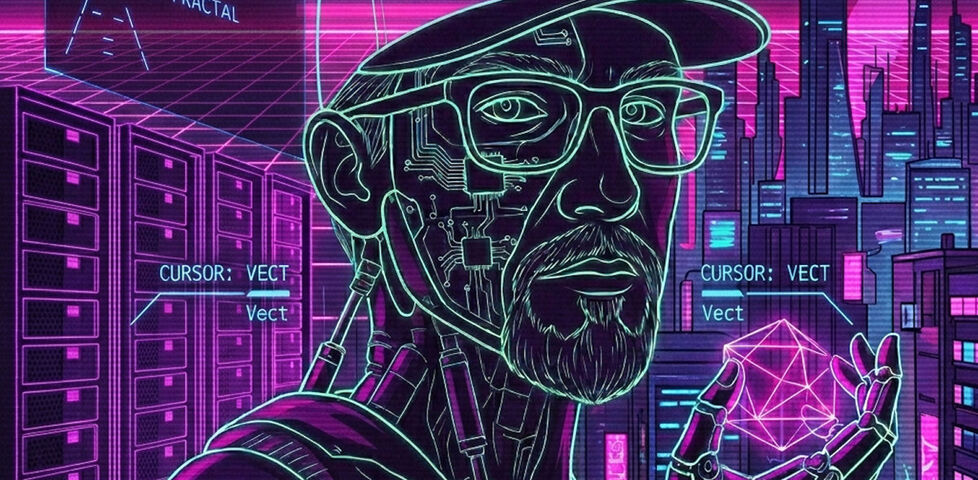
AI-generated EP cover of Built In Obsolescence by PAIgan Wanderer Lu, showing a neon digital outline of Andy.
The album art’s clearly also AI-generated, and that’s… well… you know. At least this robot hand has got the correct number of fingers.

Nothingness is what silicon dreams

My younger child’s been getting into PWL in a big way lately. As a result of this, I ended up making time for a careful re-listen to a lot of the back catalogue. This in turn inspired a blog post last year in which I mentioned that Checker Charlie‘s observations about humans replacing their work with machine effort feels increasingly prophetic in the age of generative AI. That’s something I didn’t see in it when I first reviewed it 13 years prior.

I’ve played with AI-generated music a couple of times myself, of course, mostly as an academic exercise. And it’s becoming more and more apparent that it’s hard to avoid bumping into it in the “real world”.

Early efforts at AI music were pretty unconvincing, always sounding a bit auto-tuney, frequently struggling to stress lines in the right places, and tripping over themselves when they try to do anything even remotely more-interesting than a simple repeating melody atop a predictable chord sequence. But they’re getting… shall we say… “better”, and there have been times nowadays when I’ve gotten some way through a track before realising that I’m listening to AI.

At least PWL’s being honest about it and declaring at the outset that this is AI-generated art. There’s plenty of folks using AI to generate content online and not declaring it, which is pretty awful1. Anyway: in this EP the AI’s moderately well-concealed and listening casually to most of the tracks I wouldn’t have noticed it if I hadn’t been told2.

Is there life enough in these chords?

So I listened to the EP. Three times.

The cover of Checker Charlie, I’m sad to admit, works. It’s got the feel of early-nineties pop, full of synths and saccharine, but instead of insipid lyrics about love it benefits a lot from Andy’s lyrical prowess. It’s a bouncy bop that would be forgettable if it weren’t for the excellent story told by the words is, I suppose, what I mean to say. And, of course, it’s the song that would have made me think about this. Anyway: I enjoyed it and would absolutely listen to it again, and I don’t know what that says about me, about the song, or anything else.

Uncanny Valley doesn’t work as well. Musically, it feels like a new artist in 2012 drew inspiration from their dad’s new wave albums but wanted to make it sound more like Carly Rae Jepsen was collabing with Daft Punk. And the result is kind-of…flat? Could I even say… soulless? It feels like it might have been the B-side of their cover of Chemicals Like You, which rolls out next in the same vein. Twice was probably enough for these two.

Repetition 4 is among my favourite – let’s say top 15? – Pagan Wanderer Lu songs and the AI’s cover of it starts so strong. It finishes pretty strong too. The voice it’s chosen shows only a hint of uncanny-valley-autotune and it wails plaintively. The most human-made bits – the lyrical themes of fighting for creativity against your own struggles as a vulnerable and flawed human “machine” – remain solid. I really expected to love this one! But by the time we were half way through the song it felt… musically-repetitive. You know when you get a pop cover of a classic song sometimes3 and you feel like the cover artist… missed the point somehow? That’s what this feels like to me.

The repetitions of “we are all machines… for dancing” in the original felt meaningful and real; a human’s cathartic resignation to pleasure in the simple things we all enjoy, despite the challenges of life… but the AI cover adds this kind of doo-woppy backing vocals that subtract, rather than adding to, the meaning. I’m not saying it ruins it – it’s still a fun and bouncy version of a great song… but it’s one of those covers that leaves you longing for the original.

And then there’s the “unaligned version” of Uncanny Valley. I’m not sure if the introduced distortions in this version are AI-generated or not. They don’t feel like the kinds of “creative” choices that any AI I’ve played with would make, so I suspect this represents a closer human intervention in the AI’s process: humans imitating machines imitating humans, perhaps? Anyway: the change doesn’t add anything for me.

Had this been produced entirely by a human, I’d say that EP consists one one track I’d add to my everyday playlist (the cover of Checker Charlie), maybe one or two tracks that I “wouldn’t necessarily skip” if they came up on a random shuffle while I wad driving… and the rest just feels too much like “bad cover” vibes.

And that’s as much of a review as I’m willing to give, for the reasons touched-upon below.

Building the engines of our own defeat

I continue to have several issues with the widespread use of generative AI, and in particular I have problems with it being used in the production of art. Those are partially mitigated by it being used by an artist to remix their own work, and partially mitigated by the transparent declaration of the use of AI by the publisher both of which are true in this case. But many issues (ethical, environmental, etc.) still remain.

Perhaps the biggest of which in this case is my concern that we’re using automation wrong.

As a child, I was optimistic about a future in which machines would take away the boring and repetitive work that humans do, leaving us free to pivot to experimental and experiential roles: the joy of working hard in the quest of discovery and of creativity. But instead, the predominant popular use of generative AI is to replace exactly those things, leaving humans only with an increasing amount of drudgery, review, and fact-checking. Where did we go wrong?

Don’t get me wrong: I love that Pagan Wanderer Lu has created this EP. Taking art that he’s created, whose concept touches on the concepts of AI… and feeding them into an actual AI for reinterpretation is transformative. It’s worthy of discussion as a piece of art in its own right. And the result is… well, some of it’s good, and other bits are okay.

What I don’t like is what it represents: the wider societal issue of the mainstream use of these technologies that have enormous unsolved problems.

So I guess… I appreciate the cognitive dissonance of enjoying a peice of music and disliking what it means?

Footnotes

1 Whether or not the side-effect of undisclosed AI-generated content “poisoning the well” for future AI training is a good or bad thing remains an open question, in my mind, but it’s certainly a real phenomenon. You know how we salvage the wrecks of ships sunk before the atomic age because they’re untainted by man-made radioactivity, which makes them useful for special purposes? It feels like the Internet before the explosion in generative AI may provide a similar cultural resource for future AI training, if you see what I mean.

2 And assuming I wasn’t already familiar with the artist, who doesn’t usually sound like an auto-tuned female singer.

3 I don’t have a specific example so I hope this is a universal experience!

Wikipedia @ 25: Rail transport in Indonesia

Duration

Podcast Version

This post is also available as a podcast. Listen here, download for later, or subscribe wherever you consume podcasts.

To celebrate the site’s 25th birthday this year, Wikipedia is encouraging/challenging people to read one Wikipedia article a day for 25 consecutive days. I felt that I could do one better than that: not only reading an article but – where I found one that was particularly interesting – to write a blog post or record a podcast episode for each of those days, sharing what I learned. For each entry, I’ll hit “random article” a few times until something catches my interest, start reading, and then start writing! Everything I’ve written below came from Wikipedia… so you should check other sources before you use it to do your homework. Happy birthday, Wikipedia!


Today’s random article: Argo Wilis
Today’s topic: Rail transport in Indonesia

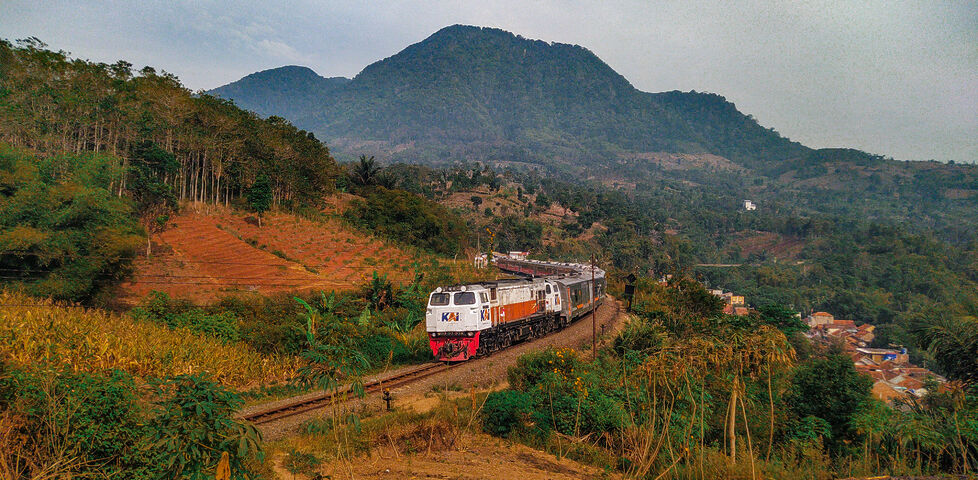
A long train snakes around hillside stepped farms in a tropical and mountainous landscape.
The Argo Wilis, near Lebakjero Station. Photograph courtesy of Naufal Farras, used under a Creative Commons license.

With such an unfamiliar-sounding article title as “Argo Wilis” I momentarily thought I was playing Two Of These People Are Lying, but it turns out that it’s just a train. Well, I say just a train, but it’s a train that took me on a journey (ah-hah!) to a rabbithole of Wikipedia pages, and today I’m going to drag you along with me.

The Argo Wilis is a train that goes back and forth along the Southernmost train line connecting Surabaya Gubeng, in the East, to Bandung, in the West, along Java, the vastly most-populous island of the Indonesian archipelago: most of the length of the island. “Argo” means “mountain”: it’s part of a modern collection of “Argo network” trains that are each named after mountains in the region. Mount Wilis itself is a dormant volcano whose magma chamber apparently has the potential for future geothermal power generation possibilities.

Map showing the East-West route of a train line along the island of Java.
Map courtesy Twotwofourtysix, used under a Creative Commons license.

Learning about the Argo Wilis got me to reading about rail travel in Indonesia in general. There are particular challenges to running a train network in a mountainous island nation with a somewhat monsoonal climate, it seems!

Like: one of the stops on the Argo Wilis‘s line is Cipeundeuy, a relatively tiny mountain station that every single passing train stops at in both directions. Why? Because every train is required to have its brakes tested here before proceeding down the mountain slops on either side of it!

Cipeundeuy Railway Station, a small white building with a railway track running alongside, with people on the platform.
All services must stop here, and have since the 1910s (except for a brief period in the 1990s).

That rule’s existed since the railway was first built, under Dutch East Indies rule, over a century ago. It’s been consistently enforced ever since… except for a spell in the early 1990s when the practice was stopped… until a head-on crash in 1995 nearby acted as a reminder of the importance of the checks, at which point they were reinstated.

 Workers pose at a railway tunnel under construction in the mountains.
The construction of the Javanese railways up and over or through the many mountains of the island would have been an incredible feat of engineering even today, let alone in the late 19th and very-early 20th centuries.

Anyway, here are some other things I learned about Indonesia’s railways while I was exploring Wikipedia:

Trains drive on the right

Like many island nations (and in common with some non-island nations, particularly those that were part of the British Empire), Indonesian cars drive on the left. But unusually, their railways don’t follow the same pattern: on twin-tracks, Indonesian trains typically travel on the right.

The Dutch colonists were already running their railways on the right and brought this tradition with them, but when the Netherlands switched to right-hand driving for their cars in 1906 (except in Rotterdam, which imposed no fixed rules about which side of the road you should drive on until 1917!), they only dragged some of their colonies along for the ride.

Suriname is another former Dutch colony that still drives on the left. The question of which side their trains travel on is somewhat moot, though, because they don’t currently operate any trains on their railways.

Train classes

Not sufficing to have just first and second class travel like we do here in the UK, Indonesian trains are broken down into at least four classes: luxuryexecutivebusiness, and economy. Plus a further two categories for tourist-centric trains, imperial and priority. Plus some sub-classes that seem to be line-specific.

Interior of a busy train carriage.
“Premium economy”-class interior of the train Sawunggalih Utama. Photo courtesy Gaudi Renanda, used under a Creative Commons license.

It’s all mostly diesel locomotives…

Jakarta’s got an electrified metro system, but most of the Indonesian rail network’s powered by diesel. However, a handful of industrial narrow-gauge mountain railways might still see the use of steam locomotives for farming or mining purposes, like this one seen hauling sugar cane in 2003:

A small steam locomotive pulls carts full of cut sugar cane along a railway line through cropped fields.
Photo courtesy Joachim Lutz, used under a Creative Commons license.

Jakarta was supposed to be getting an electrified monorail, but the project stalled in 2008 and the already-built infrastructure is in the process of being demolished.

Lebong Tandai is a special case

The remote mountain village of Lebong Tandai is only reliably connected to the rest of the world via a mountain railway line. Much of the narrow-gauge track is connected via a plateway, rather than by sleepers, and residents operate the tiny motorised locomotives independently of the rest of the railway network.

A tiny enclosed passenger rail vehicle crosses an old narrow iron bridge in a jungle.
This “Molek-Motor” on the remote line to Lebong Tandai is constructed out of the remains of a goods vehicle that was written-off after an accident. Photo courtesy Harry Siswoyo, used under a Creative Commons license.

Anyway, that’s what I enjoyed learning about on today’s Wikipedia dive. I wonder what I’ll learn tomorrow! (If it’s as-interesting, I’ll let you know!)