Dan Q found GCBAJC3 Cache me if you can, Jeremy

This checkin to GCBAJC3 Cache me if you can, Jeremy reflects a geocaching.com log entry. See more of Dan's cache logs.

Despite being relatively ‘local’ – only half a mile away, and fans of the show – it took until this morning before the family and I actually came to up visit Clarkson’s Farm. We’re even-more-local but now, after a flood made our house uninhabitable and we moved, temporarily, to a holiday let just up the road.

A family sits at a picnic table in a barn, eating sausage sandwiches.

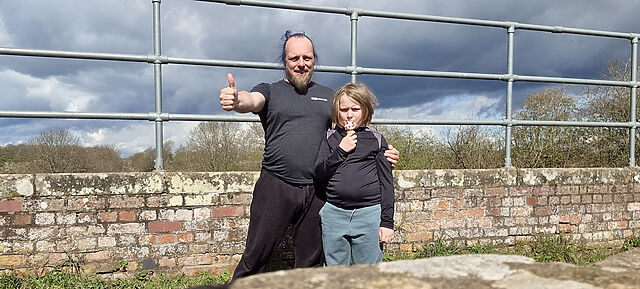
This morning we visited Diddly Squat for a round of sausage sandwiches, after which the youngest child and I decided to make a run for this nearby geocache. The kid put his finger right on the cache before I’d even had a chance to take a look for it!

Dan and a child stand at a bus stop, with Diddly Squat Farm Shop in the background.

Log signed, and a car full of Hawkstone Lager acquired, we were all done. TFTC!

× ×

Why Apple’s move to video could endanger podcasting’s greatest power

This is a repost promoting content originally published elsewhere. See more things Dan's reposted.

So it was inevitable that Apple would add video support to their podcasting apps. And it makes sense for Apple to update the technical underpinnings; the assumptions that were made when designing podcasts over two decades ago aren’t really appropriate for many contemporary uses. For example, back then, by default an entire podcast episode would be downloaded to your iPod for convenient listening on the go, just like songs in your music library. But downloading a giant 4K video clip of an hour-long podcast show that you might not even watch, just in case you might want to see it, would be a huge waste of resources and bandwidth. Modern users are used to streaming everything. Thus, Apple updated their apps to support just grabbing snippets of video as they’re needed, and to their credit, Apple is embracing an open video format when doing so, instead of some proprietary system that requires podcasters to pay a fee or get permission.

The problem, though, is that Apple is only allowing these new video streams to be served by a small number of pre-approved commercial providers that they’ve hand-selected. In the podcasting world, there are no gatekeepers; if I want to start a podcast today, I can publish a podcast feed here on anildash.com and put up some MP3s with my episodes, and anyone anywhere in the world can subscribe to that podcast, I don’t have to ask anyone’s permission, tell anyone about it, or agree to anyone’s terms of service.

When I started my pointless podcast, I didn’t need anybody else’s infrastructure or permission. Podcasts are, in the vein of the Web itself (and thanks at least in part to my former coworker Dave Winer), distributed and democratised.

All you need to host a podcast is an RSS file and some audio files. You can put them onto your shared VM. You can put them onto your homelab, You can put them onto a GitHub Pages site. You can put them onto a Neocities site. Or you can shell out for a commercial host and distribute your content across a global network of CDNs, for maximum performance! All of these are podcasts, and they’re all equal from a technical perspective.1

Video podcasts could be the same. Even if – as Apple suggest – HLS is to be mandatory for their player2, that doesn’t necessitate a big corporate third-party provider. Having an “allowlist” of people who can host your podcast’s video is gatekeeping.

Also, it’s… not really podcasting any more. It’s been pointed out that before “platform-exclusive” podcasts (I’m looking at you, Spotify) are not truly podcasts: if it’s not an RSS feed plus some audio files, it’s not a podcast, it’s lightly sparkling audio.

Can the same analogy be used for a podcast player? Is a player that only supports content (in this case, video content) if it’s hosted by a particular partner… not-a-podcast-player? Either way, it’s pretty embarrassing for Apple of all people to turn their back on what makes a podcast a podcast.

Footnotes

1 Technically, my podcast is just a collection of posts that share a ClassicPress “tag”; ClassicPress gives me “RSS feed of a particular tag” for free, so all I needed to do was (a) add metadata to point to my MP3 files (b) and use a hook to inject the relevant <enclosure> element into the feed. There are almost certainly plugins that could have done it for me, but it’s a simple task so I just wrote a few lines of PHP code and called it a day!

2 This is… fine, I guess. I’d rather that an <enclosure> be more-agnostic. If I only want to provide a single fat MP4 file, then it’s up to my listeners to say “this is shit, why can’t I stream this on my cellular data, I’m gonna listen/watch somebody else instead”. But even if HLS is required, that’s not difficult: I talked about how to do it last year while demonstrating variable-aspect-ratio videos (in vanilla HTML)!