As I lay in bed the other night, I became aware of an unusually-bright LED, glowing in the corner of my room1. Lying still in the dark, I noticed that as I looked directly at the light meant that I couldn’t see it… but when I looked straight ahead – not at it – I could make it out.
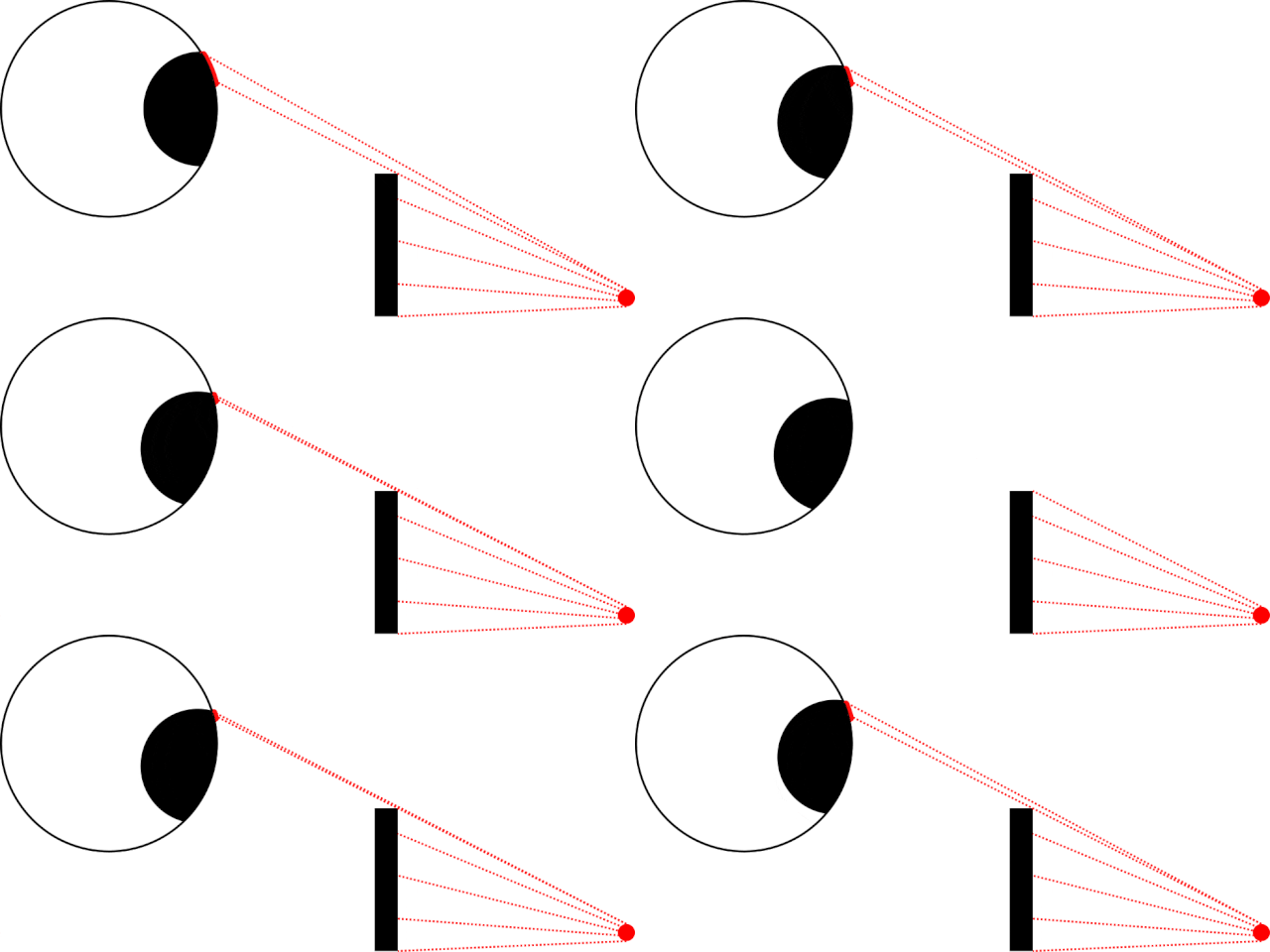
This phenomenon seems to be most-pronounced when the thing you’re using a single eye to looking at something small and pointlike (like an LED), and where there’s an obstacle closer to your eye than to the thing you’re looking at. But it’s still a little spooky2.
It’s strange how sometimes you might be less-able to see something that you’re looking directly at… than something that’s only in your peripheral vision.
I’m now at six months since I started working for Firstup.3 And as I continue to narrow my focus on the specifics of the company’s technology, processes, and customers… I’m beginning to lose a sight of some of the things that were in my peripheral vision.
I’m a big believer in the idea that folks who are new to your group (team, organisation, whatever) have a strange superpower that fades over time: the ability to look at “how you work” as an outsider and bring new ideas. It requires a certain boldness to not just accept the status quo but to ask “but why do we do things this way?”. Sure, the answer will often be legitimate and unchallengeable, but by using your superpower and raising the question you bring a chance of bringing valuable change.
That superpower has a sweet spot. A point at which a person knows enough about your new role that they can answer the easy questions, but not so late that they’ve become accustomed to the “quirks” that they can’t see them any longer. The point at which your peripheral vision still reveals where there’s room for improvement, because you’re not yet so-focussed on the routine that you overlook the objectively-unusual.
I feel like I’m close to that sweet spot, right now, and I’m enjoying the opportunity to challenge some of Firstup’s established patterns. Maybe there are things I’ve learned or realised over the course of my career that might help make my new employer stronger and better? Whether not not that turns out to be the case, I’m enjoying poking at the edges to find out!
Footnotes
1 The LED turned out to be attached to a laptop charger that was normally connected in such a way that it wasn’t visible from my bed.
2 Like the first time you realise that you have a retinal blind spot and that your brain is “filling in” the gaps based on what’s around it, like Photoshop’s “smart remove” tool is running within your head.
3 You might recall that I wrote about my incredibly-efficient experience of the recruitment process at Firstup.
Yep I’m a big believer in the “hasn’t drunk the Koolaid” yet superpower – I consider a lack of buy-in to the status quo a rare and precious resource and I’m pretty sure that new joiners in my team get tired of me always asking them in 1-1s whether they have any feedback on how we work.
With some folks, you really have to work to get them to share what (only) they can see! A great many people feel like because they’re new, their opinion is significantly less valuable, and it’s hard to persuade them otherwise!
Peripheral vision is more light sensitive than central vision (because the fovea is composed of mostly color-specific cone cells, whole the periphery has more-sensitive rod cells). I suspect this effect has more to do with detecting a faint, partially occluded LED in a dark room than the parallax effect from your diagram. The lens only rotates a millimeter or so when looking at something peripherally, which seems too small for the parallax you show in the diagram. You could test this by checking if the light also becomes visible looking down (towards the pillow).
Smart observation! And yes, like a good scientist, I tried looking “towards the pillow” (further down) and indeed it wasn’t visible, which is why I was confident in my “obstruction” hypothesis. The angular change was very slight – about what’s shown in the animation – so I’m not sure that the motion-sensitivity of the edges of my retina were a significant factor.
Later, I experimented with trying to turn my eye very slowly (harder than it sounds: eyes are geared to “flick” from point to point, it seems!) and eventually managed to successfully see “half an LED” by looking “across” the top of the obstruction!