Fake Herons

I saw a heron this morning, and it reminded me of a police officer.

A juvenile grey heron wades along a muddy stream bank.
If you plot a pair of axes for birds ‘looking really dorky, especially when flying’ and ‘actually being really cool’, the grey heron would sit at the sweet spot.

Right now, while my house is… not-so-inhabitable… I have a long drive to drop the kids off at school, and this morning it took us alongside the many flooded fields between our temporary accommodation and the various kid drop-offs.

Stopped at traffic lights, I watched a heron land in what would be best-described as a large puddle, rather than in the lake on the other side of the road. The lake, it turns out… was “guarded” by one of those fake heron things.

Metalwork fake heron alongside a manicured pond.
I didn’t get a photo of the fake heron, but I can tell you that it was one of those tacky plastic ones, not a fancy-looking metal one like this.1 Photograph copyright Christine Matthews, used under a Creative Commons license.

You’ve seen them, probably. People put them up to discourage territorial birds from visiting and eating all their fish.2 If you haven’t seen them, you might have at least spotted the fake owls, whose purpose is slightly different because they scare off other birds.

Anyway: I found myself thinking… do birds actually fall for this? Like scarecrows, it feels like they shouldn’t (and indeed, scarecrows don’t always work, and birds can quickly become accustomed to them). But clearly they work at least a little…?
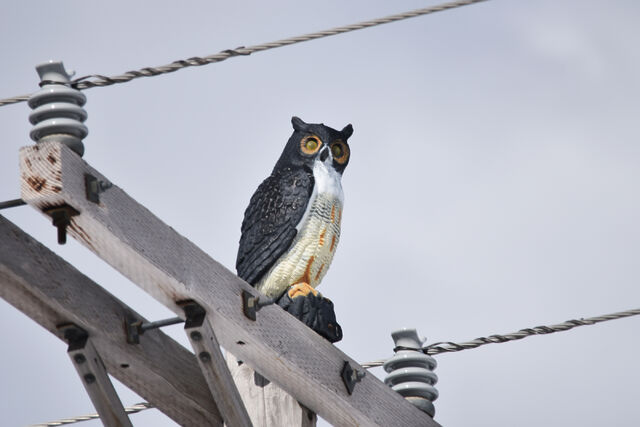
A fake plastic owl 'perched' atop a wooden electricity pylon.
If you don’t want birds, get a pretend bird. The same trick works for girlfriends.

Anyway, I found myself reminded of a geocaching expedition I went on outside Cambridge a couple of years ago. At around 6am I was creeping around outside a shopping centre on a Saturday morning, looking for a tiny magnetic geocache hidden behind a sign. I’d anticipated not having to use much “stealth” so early in the day… but nonetheless I kept getting the feeling that I was being watched.

It took me a few minutes until I worked out why: the local Home Bargains had put up a life-size standee of a police officer in just the right position that I kept catching him in the corner of my eye and second-guessing how much my digging-through-the-bushes looked incredibly suspicious!
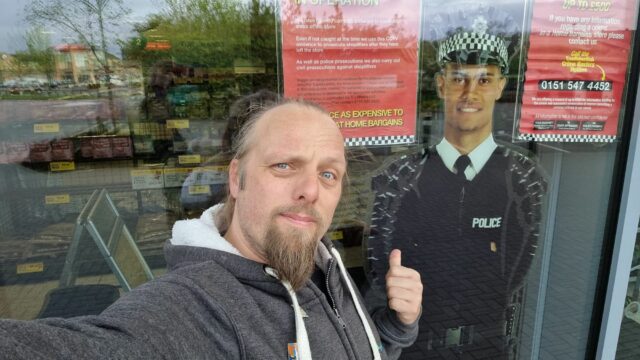
Dan stands outside a floor-to-ceiling shop window within which is a cardboard cut-out of a smiling police officer.
Rationally, I knew that this fella wasn’t real3, but that didn’t stop him from making my brain go “wait, is that copper watching me hide behind a sign in the empty car park of a budget variety store, like he thinks I’m the world’s loneliest drug dealer?”

I did a double-take the first time I spotted the officer, but soon realised he was fake. But the feeling of being watched persisted! There’s clearly something deeper in human psychology, more-instinctive, that – as social animals – gives us that feeling of being watched and influences our behaviour.

There’s a wonderful and much-cited piece of research from 2010 that describes how cooperative behaviour like proper use of an honesty box increases if you put a picture of some eyes above it: the mechanism’s not fully understood, but it’s speculated that it’s because it induces the feeling of being watched.
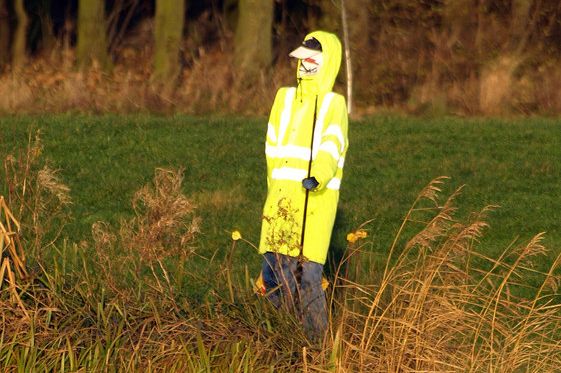
A mannequin wears a high-vis jacket and holds a fishing rod, standing in the rushes of a lake.
I found this picture of a fake angler (this is a mannequin with a fishing pole!), which I guess is also an anti-heron measure.4 Photograph copyright Andy Beecroft, used under a Creative Commons license.

I reckon it’s similar with birds. They’re not stupid (some of them, like corvids, are famously smart… and probably many predator birds exhibit significant intelligence too), but if there’s something in your peripheral vision that puts you at unease… then of course you’re not going to be comfortable! And if there’s another option nearby5 that’ll work, that’s an easy win for a hungry bird.

You don’t need to actually believe that a scarecrow, a plastic bird, a poster of some eyes, or a picture of a bobby is real in order for it to have a psychological impact. That’s why – I believe – a fake heron works. And that’s why, today, a heron reminded me of a police officer.

Footnotes

1 I guess actual herons can’t tell the difference?

2 Presumably the same technique doesn’t work with sociable birds, who would probably turn up to try to befriend or woo the models.

3 I don’t know, but I do wonder, whether the picture is actually of a police officer or of a model. If I were a police officer and I knew that my likeness was being used at supermarkets and the like, I’d be first to volunteer to any call-outs to anywhere nearby them, so any suspect who ran from me would keep spotting me, following them, at every corner. You get few opportunities for pranks as a copper, I reckon, but this one would be a blast.

4 I wonder if a fake angler is more- or less-effective than a fake heron. Somewhere, an animal psychology PhD student is working out the experimental conditions to answer this question, I hope.

5 Remember: a bird can have a birds-eye view of feeding spots! If one option’s gonna make them feel like they’re being watched by a predator or a competitor, and another nearby option looks almost-as-good, they’re gonna take the alternative!

× × × × ×

How to date a recording using background electrical noise

This is a repost promoting content originally published elsewhere. See more things Dan's reposted.

Matching a target ENF series with a section of a reference series

We’re going to use ENF matching to answer the question “here’s a recording, when was it was (probably) taken?” I say “probably” because all that ENF matching can give us is a statistical best guess, not a guarantee. Mains hum isn’t always present on recordings, and even when it is, our target recording’s ENF can still match with the wrong section of the reference database by statistical misfortune.

Still, even though all ENF matching gives us is a guess, it’s usually a good one. The longer the recording, the more reliable the estimate; in the academic papers that I’ve read 10 minutes is typically given as a lower bound for getting a decent match.

To make our guess, we’ll need to:

  1. Extract the target recording’s ENF values over time
  2. Find a database of reference ENF values, taken directly from the electrical grid serving the area where the recording was made
  3. Find the section of the reference ENF series that best matches the target. This section is our best guess for when the target recording was taken

We’ll start at the top.

About a year after Tom Scott did a video summarising how deviation over time (and location!) of the background electrical “hum” produced by AC power can act as a forensic marker on audio recordings, Robert Heaton’s produced an excellent deep-dive into how you can play with it for yourself, including some pretty neat code.

I remember first learning about this technique a few years ago during my masters in digital forensics, and my first thought was about how it might be effectively faked. Faking the time of recording of some audio after the fact (as well as removing the markers) is challenging, mostly because you’ve got to ensure you pick up on the harmonics of the frequencies, but it seems to me that faking it at time-of-recording ought to be reasonably easy: at least, so long as you’re already equipped with a mechanism to protect against recording legitimate electrical hum (isolated quiet-room, etc.):

Taking a known historical hum-pattern, it ought to be reasonably easy to produce a DC-to-AC converter (obviously you want to be running off a DC circuit to begin with, e.g. from batteries, so you don’t pick up legitimate hum) that regulates the hum frequency in a way that matches the historical pattern. Sure, you could simply produce the correct “noise”, but doing it this way helps ensure that the noise behaves appropriately under the widest range of conditions. I almost want to build such a device, perhaps out of an existing portable transformer (they come in big battery packs nowadays, providing a two-for-one!) but of course: who has the time? Plus, if you’d ever seen my soldering skills you’d know why I shouldn’t be allowed to work on anything like this.

×

Wake Me Up When September Begins

As a result of a couple of different health issues and the death of my old and much-loved mobile, August wasn’t shaping up to be a very good month already. But the biscuit was really taken this week during what turned into An Unexpectedly Expensive Night Out.

An Unexpectedly Expensive Night Out

It started okay: Ruth and went out for tapas, then for cocktails, and then to the cinema to watch the (pretty disappointing) Cowboys & Aliens. So a good start, getting worse. The food was cheap (hooray for vouchers!), the cocktails were reasonably priced (although we did have… a few of them), and the cinema was aided by Orange Wednesdays, so all seemed to be going pretty well, so far, until we came to going home.

Because when we got back to the cycle racks, my bike wasn’t there. By the look of things, somebody cut through my bike lock and had away with it, rendering me bikeless. Suddenly, it became a far more-expensive night out than I’d planned for.

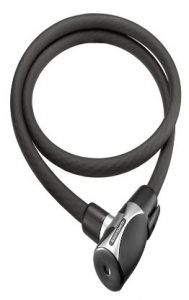
Here's the kind of lock I was using. Turns out that it's insufficient to stop a determined attacker.

They say that you haven’t lived in Oxford until you’ve had your bike stolen[citation needed]. Well: now I have, and I’ve learned an important lesson about the ineffectiveness of moderate-security cable locks like the Kryptonite HardWire (the lock I was using) when up against thieves who are willing to put in the effort to, for example, bring bolt cutters on a night out.

I spoke to a police officer yesterday who’s going to see if any of the nearby CCTV cameras are going to be of any use in finding the bugger.  But in the meantime, I’ve had enough of August. It’s had highlights, like Liz & Simon’s wedding, but mostly it’s been less-than-great.

Wake me up when September begins.

×

Dan Arrested; Carrying Offensive Weapon

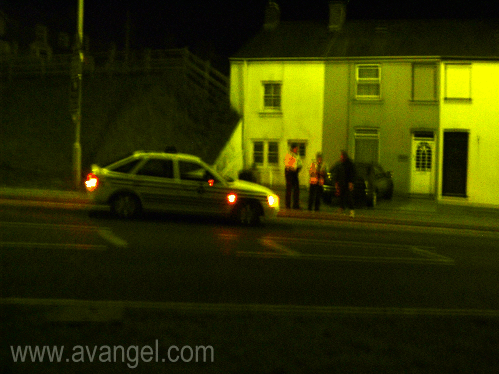
Dan gets stopped by two police officers while carrying a battle-axe through the streets of Aberystwyth. Original content on AvAngel.com appeared, as follows:

Andy’s account –

I wonder how many police officers, when asked by the guy they’ve just stopped on the street for carrying a battle-axe, will actually go to the URL he tells them. Well; here’s hoping at least one, given that that’s what just happened to me! Take a look at this picture on Dan’s Picture Page for an overview of the events. The picture is taken by Rory, with his brand-spanking new digital camera. Thanks, Rory!

Dan, with an axe, being questioned by the police

Dan’s account –

“Well, what do we do with you now?” asked the police officer, after the search (which had revealed nothing more than lots of keys, a phallic-looking torch, a pack of cards, and a tampon) was complete.

“I expect that’s mainly up to you,” replied Dan, “You being the police officer, and all.”

“Well, we could take you and your axe up the hill and escort you home,” he said.

“Mm-hmm,” Dan said, “Could my friends come along for the ride?” He gestured across the street, where Rory and De were waiting, looking bored. The police officer shook his head disdainfully. “What’re the other options, then?”

“We could take you back to the police station under arrest for carrying an offensive weapon.”

“I don’t like that idea, either. What’s the third option?”

“There isn’t a third option.”

“Guess I’ll be riding with you then.” Dan turned and spoke to Rory and De. “I’ll catch you two back on campus,” he said, “You can pay for your taxi!”

As the police car pulled away, Dan had one more question for the confused officers:

“Have you ever visited AvAngel.com?”

Crosslink: the axe can be seen in photos taken at Christmas.

×