The long read: Every baffled new parent goes searching for answers in baby manuals. But what they really offer is the reassuring fantasy that life’s most difficult questions have
one right answer
Human beings are born too soon. Within hours of arriving in the world, a baby antelope can clamber up to a
wobbly standing position; a day-old zebra foal can run from hyenas; a sea-turtle, newly hatched in the sand, knows how to find its way to the ocean. Newborn humans, on the other
hand, can’t hold up their own heads without someone to help them. They can’t even burp without assistance. Place a baby human on its stomach at one day old – or even three
months old, the age at which lion cubs may be starting to learn to hunt – and it’s stranded in position until you decide to turn it over, or a sabre-toothed tiger strolls into
the cave to claim it. The reason for this ineptitude is well-known: our huge brains, which make us the cleverest mammals on the planet, wouldn’t fit through the birth canal if
they developed more fully in the womb. (Recently, cognitive scientists have speculated that babies may actually be
getting more useless as evolution proceeds; if natural selection favours ever bigger brains, you’d expect humans to be born with more and more developing left to do.)
This is why humans have “parenting”: there is a uniquely enormous gap between the human infant and the mature animal. That gap must be bridged, and it’s difficult to resist
the conclusion that there must be many specific things adults need to get right in order to bridge it. This, in turn, is why there are parenting advice manuals – hundreds and
hundreds of them, serving as an index of the changing ways we have worried about how we might mess up our children.
To pre-empt any gatekeeping bronies in their generally-quite-nice society who want to tell me that I’m no “true” fan: save your breath, I already know. I’m not
actually claiming any kinship with the brony community. But what’s certainly true is that I’ve gained a level of appreciation for My Little Pony: Friendship is Magic that certainly goes beyond that of most people who aren’t fans of
the show (or else have children who are), and I thought I’d share it with you. (I can’t promise that it’s not just Stockholm syndrome, though…)
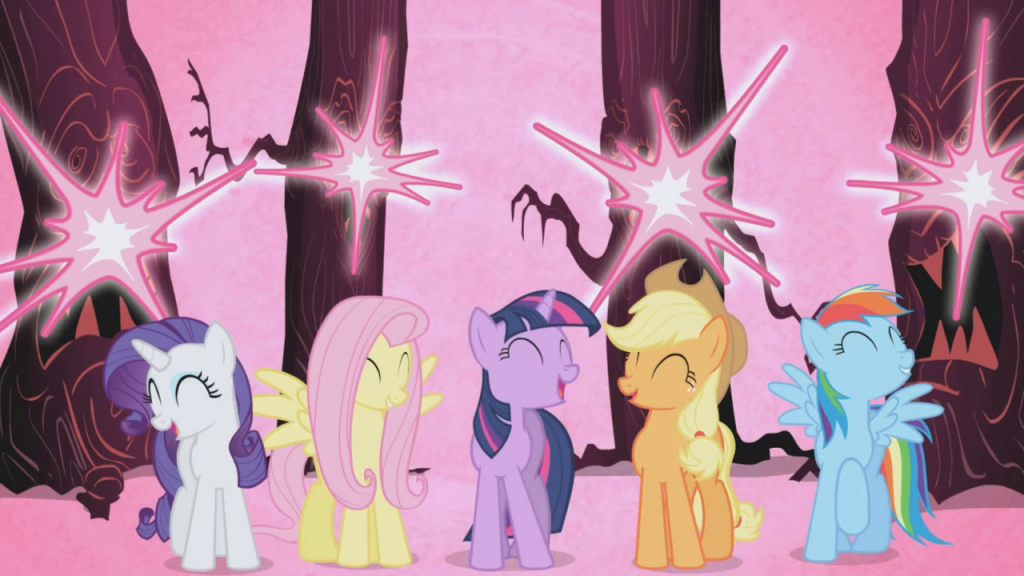
Twilight Sparkle and Rainbow Dash. Their friendship is magic, and yours can be too.
Ignoring the fact that I owned, at some point in the early 1980s, a “G1” pony toy (possibly Seashell) from the original, old-school My Little Pony, my first introduction to the modern series came in around 2010
when, hearing about the surprise pop culture appeal of the rebooted franchise, I watched the first two episodes, Friendship is Magic parts one and two: I’m aware that after I mentioned it to
Claire, she went on to watch most of the first season (a pegasister in
the making, perhaps?). Cool, I thought: this is way better than most of the crap cartoons that were on when I was a kid.
? Chortle at the kooky… snortle at the spooky… ?
And then… I paid no mind whatsoever to the franchise until our little preschooler came home from the library, early in 2017, with a copy of an early reader/board book called Fluttershy and the Perfect Pet. This turns out to be a re-telling of the season 2 episode May The Best Pet Win!, although of course I only know that with hindsight. I casually mentioned to her that there was a TV
series with these characters, too, and she seemed interested in giving it a go. Up until that point her favourite TV shows were probably PAW Patrol and Thomas the Tank Engine & Friends, but
these quickly gave way to a new-found fandom of all things MLP.
No ponies were harmed in the staging of this apparent massacre.
The bobbin’s now watched all seven seasons of Friendship is Magic plus the movie and so, by proxy – with a few exceptions where for example JTA was watching an episode with her – have I. And it’s these exceptions where I’d “missed” a few
episodes that first lead to the discovery that I am, perhaps, a “closet Brony”. It came to me one night at the local pub that JTA and I
favour that when we ended up, over our beers, “swapping notes” about the episodes that we’d each seen in order to try to make sense of it all. We’re each routinely roped into playing
games for which we’re expected to adopt the role of particular ponies (and dragons, and changelings, and at least one centaur…), but we’d both ended up getting confused as to
what we were supposed to be doing at some point or another on account of the episodes of the TV show we’d each “missed”. I’m not sure how we looked to the regulars – two 30-something
men sitting by the dartboard discussing the internal politics and friendship dramas of a group of fictional ponies and working out how the plots were interconnected – but if anybody
thought anything of it, they didn’t say so.
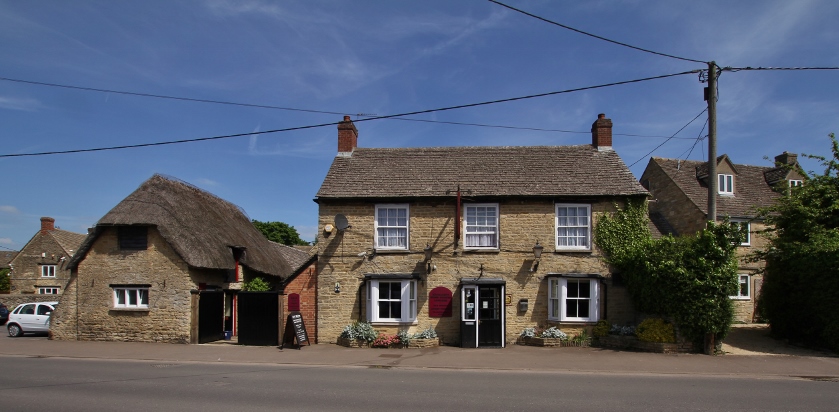
JTA and I’s local is among the most distinctly “village pub”-like pubs I’ve ever visited.
By the time the movie was due to come out, I was actually a little excited about it, and not even just in a vicarious way (I would soon be disappointed, mind: the movie’s mediocre at best, but at the three-year-old I took to the cinema was impressed, at least, and the “proper”
bronies – who brought cupcakes and costumes and sat at the back of the cinema – seemed to enjoy themselves, so maybe I just set my expectations too high). Clearly something in the TV
show had sunk its hooks into me, at least in a minor way. It’s not that I’d ever watch an episode without the excuse of looking after a child who wanted to do so… but I also
won’t deny that by the end of The Cutie Remark, Part One I wanted to make sure that I was the one to be
around when the little ‘un watched the second part! How wouldStarlight Glimmer be defeated?
? My little popcorn, my little popcorn… ?
At least part of the appeal is probably that the show is better than most other contemporary kids’ entertainment, and as anybody with young children knows, you end up exposed to plenty
of it. Compare to PAW Patrol (the previous obsession in our household), for example. Here we have two shows that each use six animated animals to promote an ever-expanding toy
line. But in Friendship is Magic the ponies are all distinct and (mostly) internally-consistent characters with their own individual identity, history, ambitions, likes and
dislikes that build a coherent whole (and that uniquely contributes to the overall identity of the group). In PAW Patrol, the pups are almost-interchangeable in identity
(and sometimes purpose), each with personality quirks that conveniently disappear when the plot demands it
(Marshall suddenly and without announcement stops being afraid of heights when episodes are released to promote the new “air pup” toys, and Chase’s allergy to cats somehow only
manifests itself some of the time and with some cats) and other characteristics that feel decidedly… forced. MLP‘s writing isn’t
great by any stretch of the imagination, but compared to the other things I could be watching with the kids it’s spectacular!
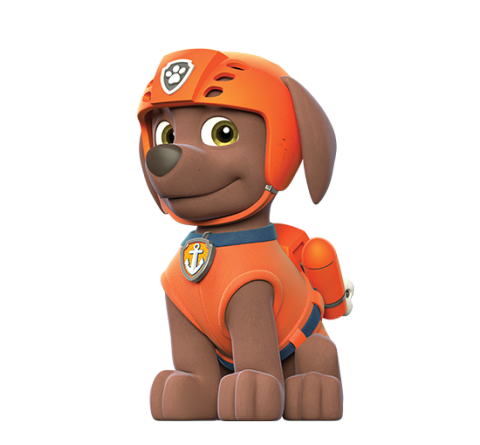
Seriously, Zuma: what are you FOR?
And compare the morality of the two shows. Friendship is Magic teaches us the values of friendship (duh), loyalty, trust, kindness, and respect, as well as carrying a strong
feminist message that young women can grow up to be whatever the hell they want to be. Conversely, the most-lasting lesson I’ve taken from watching PAW Patrol (and I’ve
seen a lot of that, too) is that police and spy agencies are functionally-interchangeable which very-much
isn’t the message I want our children to take away from their screen time.
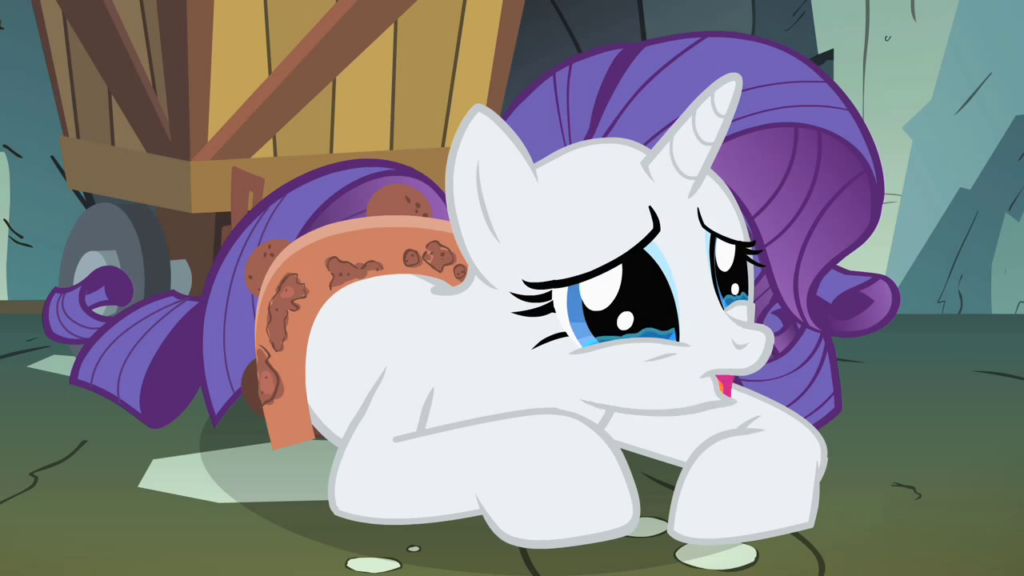
Not all lessons are good lessons. I’m talking to you, Rarity.
It’s not perfect, of course. The season one episode A Dog And Pony Show‘s enduring moral, in which unicorn pony
Rarity is kidnapped by subterranean dogs and made to mine gemstones (she has a magical talent for divining for seams of them), seems to be that the best way for a woman to get her way
over men is to make a show of whining incessantly until they submit, and to win arguments by deliberately misunderstanding their statements as something that she can take offence to.
That’s not just a bad ethical message, it also reinforces a terrible stereotype and thoroughly undermines Rarity’s character! Thankfully, such issues are few and far between and on the
whole the overwhelming message of My Little Pony is one of empowerment, equality, and fairness.
If Mr. Labrador had a Twitter account, this episode of Peppa Pig would have put him at the receiving end of a whole Internetload of feminist complaints.
For the most part, Equestria is painted as a place where gender doesn’t and shouldn’t matter, which is fantastic! Compare to the Peppa
Pig episode (and accompanying book) called Funfair in which Mummy Pig
is goaded into participating in an archery competition by being told that “women are useless” at it, because it’s a “game of skill”. And while Mummy Pig does surprise the
stallholder by winning, that’s the only rebuff: it’s still presented as absolutely acceptable to make skill judgements based on gender – all that is taught is that Mummy Pig is
an outlier (which is stressed again when she wins at a hammer swing competition, later); no effort is made to show that it’s wrong to express prejudice over stereotypes. Peppa Pig is
full of terrible lessons for children even if you choose to ignore the time the show told Australian kids to pick up and play with spiders.
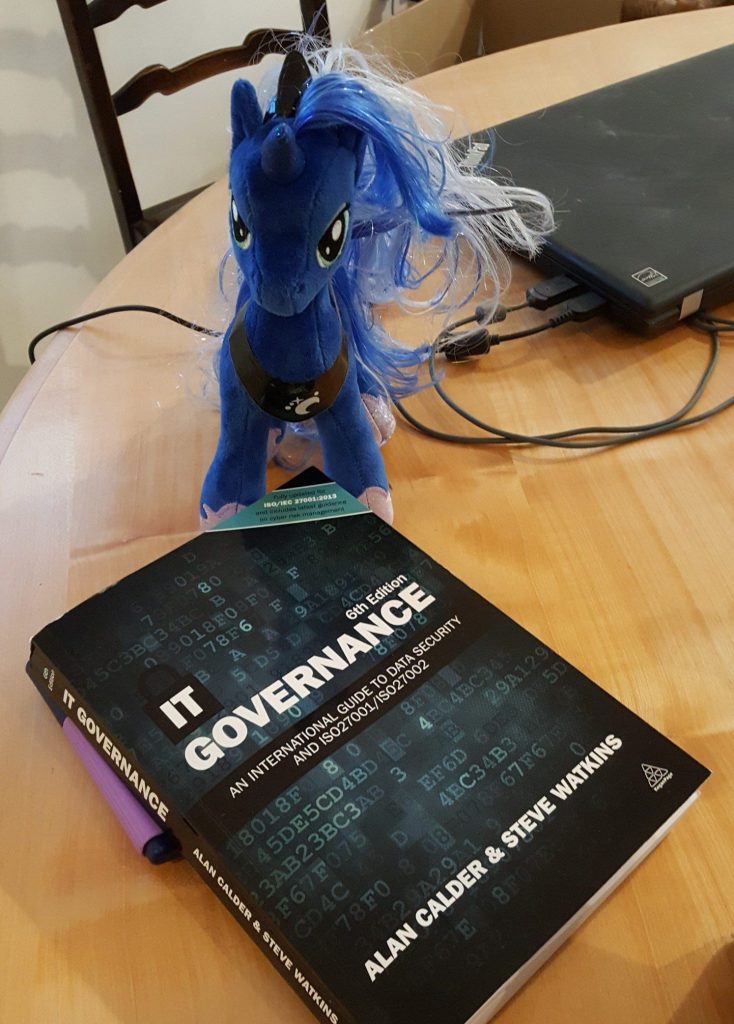
Princess Luna knows what I should have been doing instead of writing this post.
I probably know the words to most of the songs that’ve had album releases (we listen to them in the car a lot; unfortunately a voice from the backseat seems to request the detestable Christmas album more than any of the far-better ones). I’m probably the second-best person in my house at
being able to identify characters, episodes, and plotlines from the series. I have… opinions on the portrayal of Twilight Sparkle’s character in the script of the movie.
Also, it might be the case that I own more than one article of geeky My Little Pony-themed clothing.
I don’t describe myself as a Brony (not that there’d be anything wrong if I did!), but I can see how others might. I think I get an exemption for not having been to a convention or read
any fanfiction or, y’know, watched any of it without a child present. I think that’s the key.
No matter how prepared you think you are for the questions your toddler might ask (and the ways in which they might go on to interpret your answer), they’ll always find a way to catch
you off guard. The following exchange with our little one began last weekend in the car:
I’m sure we’ve all been asked “Why can’t I drink what you’re drinking?”
Her: “I read the Beano Annual at Grandtom’s house.” (Grandtom is what she calls Ruth‘s father – her maternal
grandfather.)
Me: “Oh? Did you like it?”
Her: “Yes. Did you have the Beano Annual when you were a little boy?”
Me: “Yes: I would sometimes get one for Christmas when I was little.”
Her: “Who gave it to you?”
Me: “My mummy and daddy did.”
Her: “Your mummy is Nanna Doreen.”
Me: “That’s right.”
Her: “Why haven’t I met your daddy?”
Dan and daddy.
That’s a question that I somehow hadn’t expected to come up so soon. I probably ought to have guessed that it was on its way, given her interest in her extended family lately and how
they’re all connected to one another, but I’d somehow assumed that it’d have come up organically at some point or another before her curiosity had made the connection that there was
somebody clearly missing: somebody whom she’d heard mentioned but, inexplicably, never met.
Me: “My daddy died, a couple of years before you were born. He was climbing a mountain one day when he had a nasty accident and fell off, and he died.”
Her: “…” (a thoughtful pause)
Me: “Are you okay?”
Her: “How many birthdays did he have?”
Me: “Fifty-four. That’s a bigger number than you can count to, I think!”
Her: “How many birthdays will I have?”
Wow, this went further than I expected, very quickly. Obviously, I want to be open about this: the last thing I want is to introduce a taboo, and I’m a big believer in the idea that
on I’m suddenly conscious of the fact that she’s clearly close to a minor existential crisis, having for possibly the first time connected the concepts of age and death. And, of
course, I’m trying to translate my thoughts into ideas that a toddler can follow every step of the way. While simultaneously trying to focus on driving a car: she knows how to pick her
timing! Okay…
Me: “Nobody knows for sure, but you’ll probably get lots and lots: seventy, eighty, ninety… maybe even a hundred birthdays!”
Her: “Then I’ll have a hundred candles.”
Me: “That’s right. Do you think you could blow out a hundred candles?”
Three candles was well within her grasp.
So far, so good. Knowing that, like most toddlers, ours has a tendency to make some new discovery and then sit on it for a day or two before asking a follow-up question, I briefed Ruth
and JTA so that they wouldn’t be caught too off-guard when she started telling them, for example, what she’d like for her hundredth
birthday or something.
And all was well until yesterday, when we were laying in the garden under the recent glorious sunshine, playing a game that involved rolling along the lawn and back and bumping
into one another in the middle, when she stood up and announced that she’d like to play something different.
Her: “Now we’re playing the die game.”
Me: “Oh…kay. How do we play that?”
Her: “We’re going to go up a mountain and then fall off.”
Me: (following her in a stomp around the garden) “Then what do we do?”
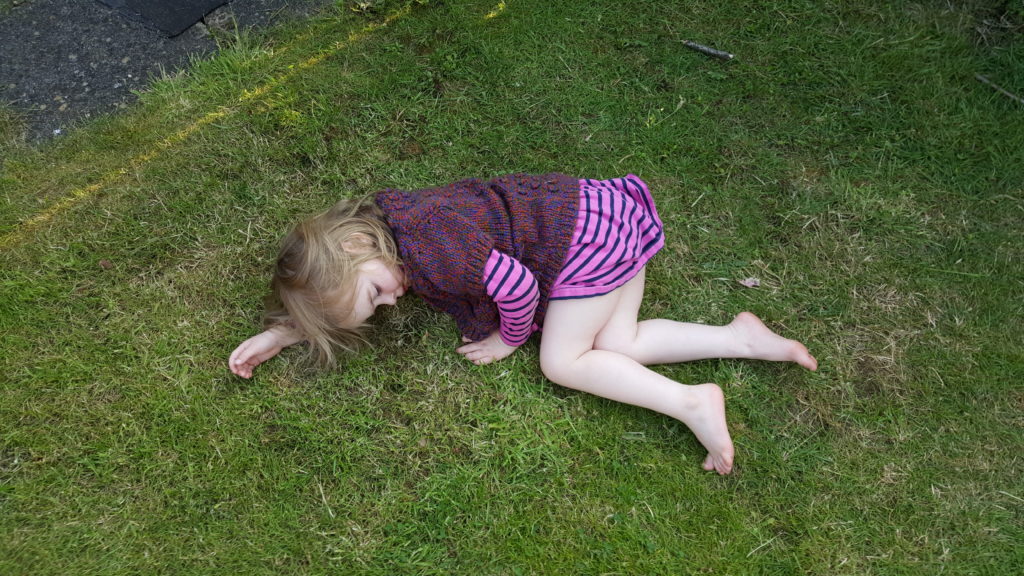
Her: “We die.” (mimes falling and then lies very still)
A ‘dead’ body at the bottom of a ‘mountain’. Erk!
And so that’s how I came to spend an afternoon repeatedly re-enacting the circumstances of my father’s death, complete – later on, after Ruth
mentioned the air ambulance that carried his body down from the mountain – with a helicopter recovery portion of the game. I’ve role-played some unusual games over the years, but this
one was perhaps the oddest, made stranger by the fact that it was invented by a three year-old.
Toddlers process new information in strange (to adults) ways, sometimes.
I’m not sure that there’s any age that’s too-young at which to try to cultivate an interest in science. Once a child’s old enough to ask why something is the case, every
question poses an opportunity for an experiment! Sometimes a thought experiment is sufficient (“Uncle Dan: why do dogs not wear clothes?”) but other times provide the opportunity for
some genuine hands-on experimentation (“Why do we put flowers in water?”). All you have to do is take every question and work out what you’d do if you didn’t know the answer
either! A willingness to take any problem with a “let’s find out” mentality teaches children two important things: (a) that while grown-ups will generally know more than them, that
nobody has all the answers, and (b) that you can use experiments to help find the answers to questions – even ones that have never been asked before!
“Why do we make jewellery out of different things?” Thanks to the Pitt Rivers Museum for inspiring this question… and helping us to find an
answer.
Sometimes it takes a little more effort. Kids – like all of us, a lot of the time – can often be quite happy to simply accept the world as-it-is and not ask “why”. But because a fun and
educational science activity is a good way to occupy a little one (and remember: all it needs to be science is to ask a question and then try to use evidence to answer it!), I’ve been
keeping a list of possible future activities so that we’ve got a nice rainy-day list of things to try. And because we are, these days, in an increasingly-large circle of breeders, I
thought I’d share some with you.
You don’t strictly need a cement mixer full of custard to demonstrate dilatant (non-Newtonian) fluids, but messiness is engaging all by itself.
Here’s some of the activities we’ve been doing so far (or that I’ve got lined-up for future activities as and when they become appropriate):
Measuring and graphing rainfall
We’ve spent a lot of time lately taking about calendars, weather, and seasons, so I’m thinking this one’s coming soon. All we need is a container you can leave in the
garden, a measuring jug, and some graph paper.
Experimenting with non-Newtonian fluids
You can make a dilatant fluid with cornflower and water: it acts like a liquid, but you can slap it and grab it like a solid. Fine, very wet sand (quicksand!) demonstrates
pseudoplasticity which also explains how paint ‘blobs’ on your brush but is easy to spread thin on the paper.
Magnets
I’m really looking forward to the opportunity to play with magnets: we’ve started already with thanks to Brio wooden railway and talking about the fact that the rolling stock will
attach one way around (and seem to jump together when they get close) but repel the other way around, and we’ve also begun looking at the fact that if you remove a carriage from the
middle of a train the remaining segments are already correctly-aligned in order to be re-attached.
Different kinds of bouncy balls
We’ve had fun before measuring how high different kinds of balls (air-filled rubber football, large solid rubber ball, skeletal rubber ball, small solid rubber ball) bounce when
dropped from a stepladder onto a patio and talking about how ‘squishy’ they are relative to one another, and speculating as to the relationship between the two.
Spotting different subspecies of ladybirds is a great springboard to talking about heritable characteristics and phenotypic variation. Snails are another good candidate.
Demonstrating capillary action/siphoning
Two containers – one with a fluid in and one without – joined over the rim by a piece of paper towel will eventually reach an equilibrium of volume, first as a result of capillary
action causing the fluid to climb the paper and then using a siphon effect to continually draw more over the edge.
Illustrating the solar system (to scale)
It helps adults and children alike to comprehend the scale of the solar system if you draw it to scale. If you’ve got a long street nearby you can chalk it onto the pavement. If not,
you’ll need a very small scale, but doing the Earth and Moon might suffice.
Electricity
Batteries, wires, and LEDs are a moderately safe and simple start to understanding electricity. Taking a ‘dead’ battery from a drained toy and putting it into the circuit shows the
eventual state of batteries. Connecting lights in series or parallel demonstrates in very simple terms resistance. Breaking or joining a circuit illustrates that switches function
identically wherever they’re placed on the circuit.
Vortices
I’m interested in trying to replicate this experiment into making different kinds of standing vortices in water, but I might
have to wait until our little scientist has slightly more patience (and fine motor control!).
Water, tissue paper, and patience is all you need to demonstrate capillary action and siphoning. Food colouring’s an optional bonus.
Centripetal force
We’ve been lucky enough to get to talk about this after using a whirlpool-shaped piece of marble run, but if we hadn’t then I was
thinking we’d wait until the next time it was sunny enough for outdoor water play and use the fact that a full bucket can be spun around without spilling any in a similar way.
Bug counting
Take a quadrant of garden and count the different kinds of things living in it. Multiply up to estimate the population across the garden, or measure different parts (lawn versus
bedding plants versus patio, direct sunlight versus shade, exposed versus covered, etc.) to see which plants or animals prefer different conditions.
Growing plants
Caring for different kinds of plants provides an introduction to botany, and there’s a lot to observe, from the way that plants grow and turn to face the light to the different stages
of their growth and reproduction. Flowers give an attractive result at the end, but herbs and vegetables can be eaten! (Our little scientist is an enormous fan of grazing home-grown
chives.)
Mechanics and force
We’ve taken to occasionally getting bikes out of the shed, flipping them upside-down, and observing how changing the cogs that the chain runs over affects how hard you need to push
the pedals to get movement… but also how much the movement input is multiplied into the movement of the wheel. We’re not quite at a point where we can reliably make predictions based
on this observation, but we’re getting there! I’m thinking that we can follow-up this experiment by building simple catapults to see how levers act as a force multiplier.
Cooking provides opportunities for exploration, too. Bake some bread and you’ve got an excuse to talk about yeast!
Chromotography of inks
I’ve been waiting to do this until I get the chance to work out which felt tip pens are going to give us the most-exciting results… but maybe that’s an experiment we should do
together, too! Colouring-in coffee filter papers and then letting them stand in a cup of water (assuming a water-soluable ink) should produce pretty results… and show the composition
of the inks, too!
Colour mixing
Mixing paint or play-doh is an easy way to demonstrate subtractive colour mixing. We got the chance to do some additive colour mixing using a colour disk spinner at a recent science
fair event, but if we hadn’t I’d always had plans to build our own, like this one.
Structure and form of life
Looking at the way that different plants and animals’ physical structure supports their activities makes for good hands-on or thought-driven experimentation. A day at the zoo gets a
few steps more-educational for a preschooler when you start talking about what penguins are able to do as a result of the shape of their unusual wings and a walk in the park can be
science’d-up by collecting the leaves of different trees and thinking about why they’re different to one another.
Stabbing balloons
The classic magic trick of poking a skewer through a balloon… with petroleum jelly on the skewer… lends itself to some science, so it’s on my to-do list.
Subtractive colour mixing can be demonstrated by mixing paint. Colour and spin a wheel to demonstrate additive mixing.
Surface tension
Water’s such a brilliant chemical because it’s commonplace, safe, and exhibits so many interesting phenomena. Surface tension can be demonstrated by ‘floating’ things like paperclips
on top of the surface, and can be broken by the addition of soap.
Astronomy
In the winter months when the sun sets before bedtime are a great time to show off stars, planets, satellites and the moon. Eyes or binoculars are plenty sufficient to get started.
Life cycles
I was especially pleased when our nursery kept an incubator full of chicken eggs so that the children could watch them hatch and the chicks emerge. We’d looked at this process before
at a farm, but it clearly had a big impact to see it again. Helping to collect eggs laid by my mother’s chickens helps to join-up the circle. Frogspawn and caterpillars provide a way
to look at a very different kind of animal life.
Putting baking soda into things
Different everyday kitchen liquids (water, vinegar, oil…) react differently to the addition of baking soda. This provides a very gentle introduction to chemistry and provides an
excuse to talk about making and testing predictions: now that we’ve seen what cold water does, do you think that hot water will be the same or different?
“Why do some animals have sharp teeth and some have flat teeth?” was a question I posed. We found the answer together (and were wowed by the size of the T-rex skeleton behind the
camera) at the Natural History Museum.
Bubbles and foams
Blowing bubbles through different types of mesh (we just used different kinds of tea towels elastic-banded to the cut-off end of a plastic bottle) demonstrates how you can produce
foams of different consistencies – from millions of tiny bubbles to fewer larger bubbles – because of the permeability of the fabric. And then we wrecked the last tea towel by adding
food colouring to it so we could make coloured foams (“bubble snakes”).
Phase transition
Start with ice and work out what makes it melt: does it melt faster in your hand or in a dish? Does it melt faster or slower if we break it up into smaller parts? If we ‘paint’
pictures on the patio with them, where does the water go? I’m also thinking about ways in which we can safely condense the steam (and capture the vapour) from the kettle onto e.g. a
chilled surface. Once we’re at a point where a thermometer makes sense I was also considering replicating the experiment of measuring the temperature of melting snow: or perhaps even
at that point trying to manipulate the triple point of water using e.g. salt.
Dissection
Take apart the bits of a flower, or look in detail at the parts of a bone-in cut of meat, and try to understand what they’re all for and why they are the way they are.
What floats?
Next time the paddling pool is out, I’d like to start a more-serious look at which things float and which things don’t any try to work out why. What might initially seem intuitive –
dense (heavy-for-their-size) things sink – can be expanded by using plasticine to make a mixture of ‘sinking’ and ‘floating’ vessels and lead to further discovery. I’m also thinking
we need to do the classic ‘raisins in a fizzy drink’ thing (raisins sink, but their rough surfaces trap the bubbles escaping from the now-unpressurised liquid, causing them to float
back up to shed their bubbles).
Get some hands-on biology at your nearest petting zoo. No science in this picture, but plenty of hugging.
So there’s my “now and next” list of science activities that we’ll be playing at over the coming months. I’m always open to more suggestions, though, so if you’re similarly trying to
help shape an enquiring and analytical mind, let me know what you’ve been up to!
On Monday, Tiny turned 6 months old. For half a year now, I’ve been a parent. It still feels pretty weird to call myself that, though. Parent is a word that conjures up a mental image
of someone strong, nurturing, patient, and above all who knows all the answers. In many ways, I feel more like I’m discovering life alongside my daughter than guiding her along the
path.
…
Being out-and-about with a baby is a whole different experience. Strangers will strike up a conversation – and, more amazingly still, I don’t usually mind. Tiny is such a blessing
that I can’t begrudge others a few minutes of cooing. The biggest difference isn’t other people, though.
…
Ruth’s just written about her first six months of being a parent. It’s worth a read.