
Wikipedia @ 25: Rail transport in Indonesia

Duration

Podcast Version

This post is also available as a podcast. Listen here, download for later, or subscribe wherever you consume podcasts.

To celebrate the site’s 25th birthday this year, Wikipedia is encouraging/challenging people to read one Wikipedia article a day for 25 consecutive days. I felt that I could do one better than that: not only reading an article but – where I found one that was particularly interesting – to write a blog post or record a podcast episode for each of those days, sharing what I learned. For each entry, I’ll hit “random article” a few times until something catches my interest, start reading, and then start writing! Everything I’ve written below came from Wikipedia… so you should check other sources before you use it to do your homework. Happy birthday, Wikipedia!


Today’s random article: Argo Wilis
Today’s topic: Rail transport in Indonesia

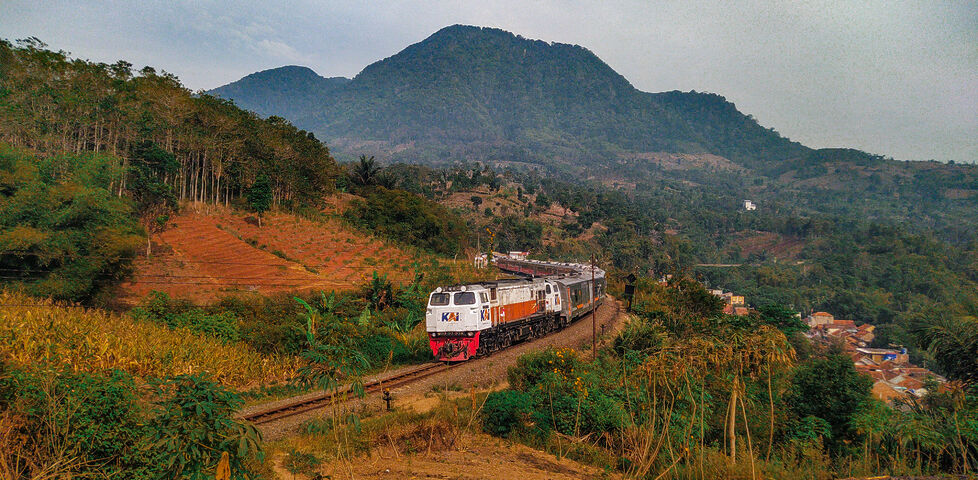
A long train snakes around hillside stepped farms in a tropical and mountainous landscape.
The Argo Wilis, near Lebakjero Station. Photograph courtesy of Naufal Farras, used under a Creative Commons license.

With such an unfamiliar-sounding article title as “Argo Wilis” I momentarily thought I was playing Two Of These People Are Lying, but it turns out that it’s just a train. Well, I say just a train, but it’s a train that took me on a journey (ah-hah!) to a rabbithole of Wikipedia pages, and today I’m going to drag you along with me.

The Argo Wilis is a train that goes back and forth along the Southernmost train line connecting Surabaya Gubeng, in the East, to Bandung, in the West, along Java, the vastly most-populous island of the Indonesian archipelago: most of the length of the island. “Argo” means “mountain”: it’s part of a modern collection of “Argo network” trains that are each named after mountains in the region. Mount Wilis itself is a dormant volcano whose magma chamber apparently has the potential for future geothermal power generation possibilities.

Map showing the East-West route of a train line along the island of Java.
Map courtesy Twotwofourtysix, used under a Creative Commons license.

Learning about the Argo Wilis got me to reading about rail travel in Indonesia in general. There are particular challenges to running a train network in a mountainous island nation with a somewhat monsoonal climate, it seems!

Like: one of the stops on the Argo Wilis‘s line is Cipeundeuy, a relatively tiny mountain station that every single passing train stops at in both directions. Why? Because every train is required to have its brakes tested here before proceeding down the mountain slops on either side of it!

Cipeundeuy Railway Station, a small white building with a railway track running alongside, with people on the platform.
All services must stop here, and have since the 1910s (except for a brief period in the 1990s).

That rule’s existed since the railway was first built, under Dutch East Indies rule, over a century ago. It’s been consistently enforced ever since… except for a spell in the early 1990s when the practice was stopped… until a head-on crash in 1995 nearby acted as a reminder of the importance of the checks, at which point they were reinstated.

 Workers pose at a railway tunnel under construction in the mountains.
The construction of the Javanese railways up and over or through the many mountains of the island would have been an incredible feat of engineering even today, let alone in the late 19th and very-early 20th centuries.

Anyway, here are some other things I learned about Indonesia’s railways while I was exploring Wikipedia:

Trains drive on the right

Like many island nations (and in common with some non-island nations, particularly those that were part of the British Empire), Indonesian cars drive on the left. But unusually, their railways don’t follow the same pattern: on twin-tracks, Indonesian trains typically travel on the right.

The Dutch colonists were already running their railways on the right and brought this tradition with them, but when the Netherlands switched to right-hand driving for their cars in 1906 (except in Rotterdam, which imposed no fixed rules about which side of the road you should drive on until 1917!), they only dragged some of their colonies along for the ride.

Suriname is another former Dutch colony that still drives on the left. The question of which side their trains travel on is somewhat moot, though, because they don’t currently operate any trains on their railways.

Train classes

Not sufficing to have just first and second class travel like we do here in the UK, Indonesian trains are broken down into at least four classes: luxuryexecutivebusiness, and economy. Plus a further two categories for tourist-centric trains, imperial and priority. Plus some sub-classes that seem to be line-specific.

Interior of a busy train carriage.
“Premium economy”-class interior of the train Sawunggalih Utama. Photo courtesy Gaudi Renanda, used under a Creative Commons license.

It’s all mostly diesel locomotives…

Jakarta’s got an electrified metro system, but most of the Indonesian rail network’s powered by diesel. However, a handful of industrial narrow-gauge mountain railways might still see the use of steam locomotives for farming or mining purposes, like this one seen hauling sugar cane in 2003:

A small steam locomotive pulls carts full of cut sugar cane along a railway line through cropped fields.
Photo courtesy Joachim Lutz, used under a Creative Commons license.

Jakarta was supposed to be getting an electrified monorail, but the project stalled in 2008 and the already-built infrastructure is in the process of being demolished.

Lebong Tandai is a special case

The remote mountain village of Lebong Tandai is only reliably connected to the rest of the world via a mountain railway line. Much of the narrow-gauge track is connected via a plateway, rather than by sleepers, and residents operate the tiny motorised locomotives independently of the rest of the railway network.

A tiny enclosed passenger rail vehicle crosses an old narrow iron bridge in a jungle.
This “Molek-Motor” on the remote line to Lebong Tandai is constructed out of the remains of a goods vehicle that was written-off after an accident. Photo courtesy Harry Siswoyo, used under a Creative Commons license.

Anyway, that’s what I enjoyed learning about on today’s Wikipedia dive. I wonder what I’ll learn tomorrow! (If it’s as-interesting, I’ll let you know!)