AMP Is Poisonous

If you’re a web developer and you haven’t come across the Google AMP project yet… then what stone have you been living under? But just in case you have been living under such a stone – or you’re not a web developer – I’ll fill you in. If you believe Google’s elevator pitch, AMP is “…an open-source initiative aiming to make the web better for all… consistently fast, beautiful and high-performing across devices and distribution platforms.”

I believe that AMP is fucking poisonous and that the people who’ve come out against it by saying it’s “controversial” so far don’t go remotely far enough. Let me tell you about why.

AMP logo in handcuffs

When you configure your website for AMP – like the BBC, The Guardian, Reddit, and Medium already have – you deliver copies of your pages written using AMP HTML and AMP JS rather than the HTML and Javascript that you’re normally would. This provides a subset of the functionality you’re used to, but it’s quite a rich subset and gives you a lot of power with minimal effort, whether you’re trying to make carousels, video players, social sharing features, or whatever. Then when your site is found via Google Search on a mobile device, then instead of delivering the user to your AMP HTML page or its regular-HTML alternative… Google delivers your site for you via an ultra-fast precached copy via their own network. So far, a mixed bag, right? Wrong.

What’s poisonous about Google AMP

Ignoring the facts that you can get locked-in if you try it once, it makes the fake news problem worse than ever, and it breaks the core concepts of a linkable web, the thing that worries me the most is that AMP represents the most-subtle threat to Net Neutrality I’ve ever seen… and it’s from an organisation that is nominally in favour of a free and open Internet but that stands to benefit from a more-closed Internet so long as it’s one that they control.

Google’s stated plan to favour pages that use AMP creates a publisher’s arms race in which content creators are incentivised to produce content in the (open-source but) Google-controlled AMP format to rank higher in the search results, or at least regain parity, versus their competitors. Ultimately, if everybody supported AMP then – ignoring the speed benefits for mobile users (more on that in a moment) – the only winner is Google. Google, who would then have a walled garden of Facebook-beating proportions around the web. Once Google delivers all of your content, there’s no such thing as a free and open Internet any more.

So what about those speed increases? Yes, the mobile web is slower than we’d like and AMP improves that. But with the exception of the precaching – which is something that could be achieved by other means – everything that AMP provides can be done using existing technologies. AMP makes it easy for lazy developers to make their pages faster, quickly, but if speed on mobile devices is the metric for your success: let’s just start making more mobile-friendly pages! We can make the mobile web better and still let it be our Web: we don’t need to give control of it to Google in order to shave a few milliseconds off the load time.

We need to reject AMP, and we need to reject it hard. Right now, it might be sufficient to stand up to your boss and say “no, implementing AMP on our sites is a bad idea.” But one day, it might mean avoiding the use of AMP entirely (there’ll be browser plugins to help you, don’t worry). And if it means putting up with a slightly-slower mobile web while web developers remain lazy, so be it: that’s a sacrifice I’m willing to make to help keep our web free and open. And I hope you will be, too.

Like others, I’m just hoping that Sir Tim will feel the urge to say something about this development soon.

AMP: breaking news

This is a repost promoting content originally published elsewhere. See more things Dan's reposted.

Google has made much of their Accelerated Mobile Pages project as a solution to bloated websites and frustrated users. But could AMP actually be bad news for the web, bad news for news, and part of a trend of news distribution that is bad for society in general?

I didn’t start out as strongly anti-AMP. Providing tools for making websites faster is always great, as is supporting users in developing countries with lighter-weight pages that don’t cost them a month’s wages. It’s totally true that today webpages are in a pretty sorry state…

Living In The Future

Eurovision Night 2012.
Eurovision Night 2012. In a moment of surreal awesomeness, Matt R holds a mirror up to the webcam in order to show Gareth the collection of whisky that’s just outside of his field of vision.

Sometimes it’s really like we’re living in the future. Exciting new technologies keep appearing, and people just keep… using them as if they’d always been there. If tomorrow we perfected the jetpack, the flying car, and the silver jumpsuit, I’ll bet that nobody would think twice about it.

Recently, I’ve had two occasions to use Google+ Hangouts, and I’ve been incredibly impressed.

The first was at Eurovision Night 2012, which was quite a while ago now. Adam did a particularly spectacular job of putting together some wonderful pre-Eurovision entertainments, which were synched-up between our two houses. Meanwhile, he and I (and Rory and Gareth and occasionally other people) linked up our webcams and spare screens via a Google+ hangout, and… it worked.

It just worked. Now I know that the technology behind this isn’t new: back in 2004, I upgraded the Troma Night set-up in Aberystwyth to add a second webcam to the Troma Night live feed. But that was one-way, and we didn’t do sound (for lack of bandwidth and concerns about accidental piracy of the soundtracks to the movies we were watching, of all things, rather than for any particularly good reason). But it really did “just work”, and we were able to wave at each other and chat to each other and – mostly – just “share in the moment” of enjoying the Eurovision Song Contest together, just like we would have in person when we lived in the same town.

At the weekend, I was originally supposed to be in Lancashire, hanging out with my family, but owing to a series of unfortunate disasters (by the way; I’m walking with a stick right now – but that’s not interesting enough to be worth blogging about), I was stuck in Oxford. Despite torrential rain where I was, Preston was quite sunny, and my family decided to have a barbeque.

A Google+ Hangout with my family and I.
I join a Google+ hangout at my (late) father’s house, where the rest of my family are having a barbeque.

I was invited… via Google+. They didn’t have Internet access, so they used a mobile dongle plugged into a laptop. I connected in from my desktop computer and then – later – from my mobile phone. So yes, this was at times a genuine mobile-to-mobile multi-party video conference, and it was simple enough that my mother was able to set it up by herself.

Like I said: living in the future.

× ×

8-Bit Google Maps

It’s like stepping back in time through videogaming history. And also sideways, into a parallel universe of knights and dragons.

8-bit Google Maps. At different view levels, you’ll see mountainous areas (Wales is worth looking at) and sprites for cities of different sizes.

It’s like Google Maps, but in the style of retro top-down, turn-based RPGs. It’s really quite impressive: it’s presumably being generated at least semi-dynamically (as it covers the whole world), but it’s more than a little impressive. It sometimes makes mistakes with rivers – perhaps where their visibility from the air is low – but nonetheless an interesting feat from a technical perspective.

There’s “8-bit Street View”, too.

Nice one, Google. Go take a look.

Searching For A Virgin

You just can’t rely on GMail’s “contacts” search any more. Look what it came up with:

Not a result I'd commonly associate with the word "virgin".

With apologies to those of you who won’t “get” this: the person who came up in the search results is a name that is far, far away, in my mind, from the word “virgin”.

In not-completely-unrelated news, I use a program called SwiftKey X on my phone, which uses Markov chains (as I’ve described before) to intelligently suggest word completion and entire words and phrases based on the language I naturally use. I had the software thoroughly parse my text messages, emails, and even this blog to help it learn my language patterns. And recently, while writing a text message to my housemate Paul, it suggested the following sentence as the content of my message:

I am a beautiful person.

I have no idea where it got the idea that that’s something I’m liable to say with any regularity. Except now that it’s appeared on my blog, it will. It’s all gone a little recursive.

×

I have multiple GMail accounts. I’d like to see a different notification icon for each. Any suggestions?

This self-post was originally posted to /r/androidapps. See more things from Dan's Reddit account.

The first of the two apps mentioned in this article – “Gmail Notifier” – sounds perfect, but doesn’t seem to exist any more.

GMail Notifier + Widgets looks like it might do it (it’s designed to do different icons depending on labels). Does anybody have any experience with this?

Or any other suggestions? I’m running CM7.1 on a HTC Sensation, in case it matters.

Googling for Suicide, Part II

You may remember that earlier this year I wrote a letter to Google suggesting that they ought to publicise the number of Samaritans to people searching for suicide-related topics: sort-of like a free Featured Link, but just advertising the phone number of a support service that, in particular, provides emotional support to those who are having suicidal thoughts.

Well, it seems that now they’ve done it (click on the image below to see a larger version).

The top of the search results when performing a Google search for 'suicide' in the UK.

I’d like to think that I played a small part in making this happen. Thanks, Google.

×

Googling For Suicide In The UK

I sent a letter to Google, today. Click to see it in large-o-vision.


I my letter, I suggest that the search giant should add a feature to their UK search, as they already have to their USA search, that would provide the details of an appropriate emotional support helpline service to people searching for suicide-related topics (such as “how to commit suicide”, etc.). This would provide minimal disruption to users merely interested in the topic, but could potentially provide a critical lifeline to somebody in dire need.

Just thought I’d share that with you.

Update: Google have now made the change I suggested! Read more about it here.

×

Google’s April Fool…

…seems to be to not text me me Google Calendar alerts this morning. So I didn’t get reminded to put the bins out, which I’ve kind-of come to rely on. Whoops!

ATOM Feed Of Your GMail Inbox?

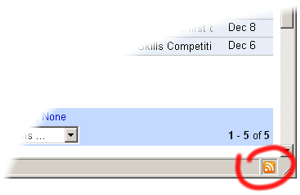
Checking my GMail account this morning, I noticed an unusual icon in the lower-right corner of the browser window:

Atom feed icon showing in a web browser viewing GMail

It turns out that Google‘s GMail service seems to be testing an ATOM feed – a kind of syndication feed (similar to those used by weblogs and news sites – see Scatmania’s ATOM feed) that can be ‘subscribed’ to from your desktop computer.

Right now, the GMail feed looks pretty bare:

ATOM feed from GMail

Nonetheless, this is an interesting turn of events – didn’t Google recently say that no other automated mail checking tools were to be used except for their own GMail Notifier (sorry, can’t find a news story to link)? But now it looks like they’re working on developing a format by which anybody can ‘subscribe’ to their own inbox (although probably only using a web browser – the non-browser-based XML readers seem to have difficulty with cookies, which are likely to be required.

It’s all interesting.

×

Paul In Aber

Paul made it to Aber. Woo and indeed hoo. He, Bryn, Kit, Claire, and I went to the beach and drank beer and ate pizza to celebrate. Then Claire and I took turns in an inflatable dingy and I got soaked as a wave leapt over the side. You’ll probably see their reports of this on their journals, soon, too.

The wiki I was coding got finished. Sadly, only a few of you who read this will ever be allowed to see it, but it’s pretty sweet.

Plothole appeared in the story on Andy’s LiveJournal – he has me drinking tea, which, as everybody knows, isn’t going to happen on account of (a) caffiene being a really, really bad thing for me and (b) I don’t particularly like tea. Have reported this to him and await feedback.

This made me laugh: type Weapons of Mass Destruction into Google and you’ll get this page. I laughed lots.