Great cache container! I’m visiting the Open University to take an exam, this afternoon, and enjoyed the opportunity to find a handful of caches (both these, and the nearby series of
virtuals from a different cache listing site) while in the vicinity. TFTC!
I’ve got an exam in Milton Keynes in the afternoon, so it’d be only a minor diversion for me to come and try to visit this roadside hashpoint. I hope to be there about 10:30.
Expedition
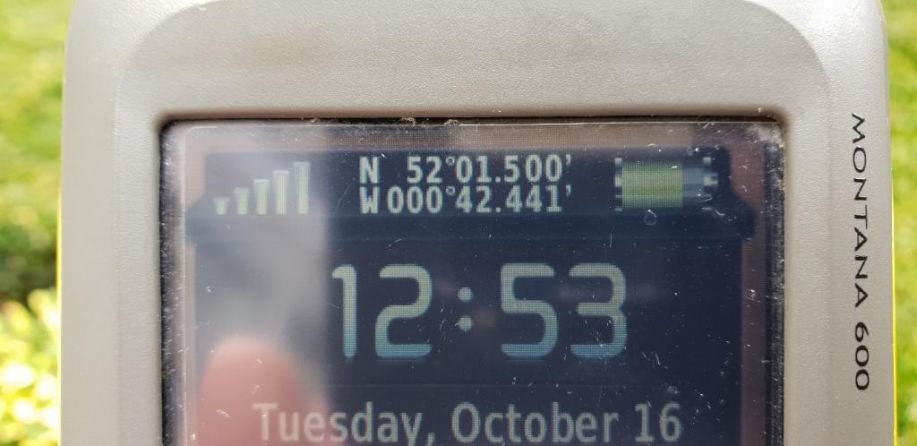
Failed to turn on the tracklogger on my GPS, but I remembered to get photos at least. This was a quick and easy run, although I did get accosted by a local who saw me hanging around
near the wind farm and putting up a sign… I think that after the controversy these epic windmills caused he might
have thought that I was putting up a planning notice to erect some more or something. Once I explained what I was doing he seemed happy enough.
Used my new 360° full-panoramic camera to take a picture at the hashpoint; I’ll put a VR-ready version on my website and link it here when I get the chance.
Clearly somebody doesn’t want this geocache here because both the original and the replacement containers have been quite-obviously-deliberately buried under a block of concrete: that’s
some seriously-dedicated muggling! I’ve removed everything I can of the cache container and its assembly (unfortunately some remains under the concrete and I’d need a crane to lift
it!).
Wild Wolf Three’s and Long Lost Zoo are still viable nearby caches if you’re looking for some local history as you explore.
In hindsight, I should’ve anticipated that when the nearby schools’ terms started this hiding place would be at-risk. I’ve been checking on this spot at school-kicking-out time for a
few weeks and, sure enough, the tree that was the hiding place is a hot climbing-spot for local kids, so I can’t imagine that returning the cache at this location will ever work.
If you’re looking for local animal-related history, though, Wild Wolf Three and Long-Lost Zoo are still alive and well!
After a few false starts with the arithmetic (hint: make sure you’re substituting the right value into the right place!) – thanks for the checker! – this was a quick and easy find. Log
completely full and in need of replacement. TFTC!
Flew by to collect the requisite information while on the way to IndieWebCamp Oxford this morning. So long as the
rain holds off and I can solve the coordinates, I may be back at lunchtime to find the cache! Love instruction C, by the way… I’ll consider it!
As an ocassional geocacher and geohasher, I’m encouraged to post logs describing my adventures, and each major provider wants me to post my logs into theirsilo (see e.g. my logs on geocaching.com, on opencache.uk, and on the geohashing wiki). But as a believer in
the ideals behind the IndieWeb (since long before anybody said “IndieWeb”), I’m opposed to keeping the only copy of content that I produce in an
environment controlled by somebody else (why?).
How do I reconcile this?
Just another hundred metres to the cache, then it’s time to freeze my ass back to base.
What I’d prefer would be to be able to write my logs here, on my own blog, and for my content to by syndicated via some process into the logging systems of the various silo sites I
prefer. This approach is called POSSE – Publish on Own Site, Syndicate
Elsewhere. In addition to the widely-described benefits of this syndication strategy, such a system would also make it possible for me to:
write single posts that represent the same location published on multiple silos (e.g. a visit to a geocache published on two different listing sites [e.g. 1, 2])
Applying such an tool would require some work as different silos have different acceptable content rules (geocaching.com, for example, effectively forbids mention of the existence of
other geocache listing sites), but that’d theoretically be workable.
The ideal solution would be POSSE-based.
Unfortunately, content rules aren’t the only factor making PESOS – writing content into each silo and then copying it
to my blog – preferable to POSSE. There’s also:
Not all of the silos offer suitable (published) APIs, and where they do, the APIs are all distinctly different.
Geocaching.com specifically forbids the use of unapproved automated robots to access the site (and almost
certainly wouldn’t approve the kind of tool that would be ideal).
The siloed services are well-supported by official and third-party apps with medium-specific logic which make them the best existing way to produce logs.
A PESOS-based solution is far easier to implement, in this case.
Needless to say: as much as I’d have loved to POSSE my geo* logs, PESOS will do.
Implementation
My implementation is a WordPress plugin which does two things. The first is that it provides a Javascript bookmarklet and an
accompanying dynamically-generated Javascript file (the former loads the latter) served from my blog’s domain. That Javascript file contains reference to every log already published to
my blog, so that the Javascript code can deliberately omit these logs from any import. When executed on a log listing page like those linked above, it copies all of the details of that
log into a form which submits them back to my blog, where it’s received by the second part of the plugin.
The import controls appear in a new, right-most column (GCVote is also visible running in my browser).
The second part of the plugin takes this data and creates a new draft post. My plugin is pretty opinionated on this part because it’s geared strongly towards my use-case, so if you want
to use it yourself you’ll probably want to tweak the code a little (e.g. it applies specific tags and names metadata fields a particular way).
When run on OpenCache.uk effectively the same interface is presented, even though the underlying mechanisms and data locations are different.
It’s not fully-automated and it’s not POSSE,but it’s “good enough” and it’s enabled me to synchronise all of my cache logs to my blog. I’ve plans to extend it to support other GPS game services to streamline my de-siloisation even further.