
Kind: Reposts
Reposting of content from another site, often with commentary.
-
How to Poach an Egg and Leave a Marriage
by Brandy Jensen ...
Set a timer. Cook the eggs for precisely three minutes and not a second longer.
Everyone thinks they have a sense of how time passes, but it’s crucial to use a timer. You are never as right as you think. Three minutes goes by more quickly than you expect. Six years even quicker.
...
… -
Chromedge and headcount
So Microsoft is going to retire EdgeHTML and use Chromium instead for Edge while not really answering the question if the web [is] better off with less engine diversity. This upset people, and Mozilla, especially, is worrying about the future:
Will Microsoft’s decision make it harder for Firefox to prosper? It could. Making … -

Letters For Lucardo
by Erika Moen
Oh Joy Sex Toy
Click through for the full review. I've always loved me some Oh Joy Sex Toy, but I've rarely been inclined to buy something off the back of one of Erika's recommendations until now. -

The Case Against Quantum Computing
by Mikhail Dyakonov Quantum computing is all the rage. It seems like hardly a day goes by without some news outlet describing the extraordinary things this technology promises. Most commentators forget, or just gloss over, the fact that people have been working on quantum computing for decades—and without any practical results to show for it.
We’ve … -
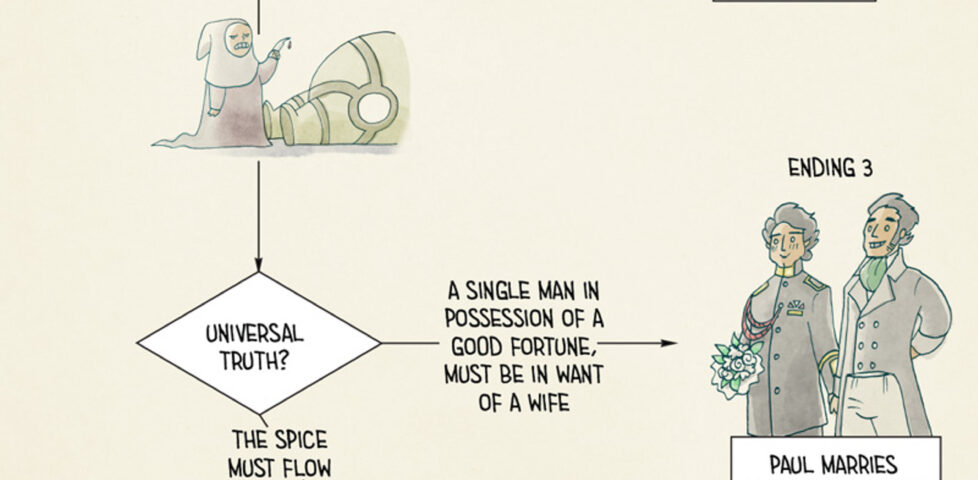
Dune
Trudy & Doug (Oglaf, Patreon) -

Toto - Africa (Chicken cover)
Big Marvel (youtube.com)
Big Marvel (YouTube)
One man - who appears to be afraid of chickens - plays Toto's Africa on a rubber chicken, with backup from a real chicken. Congratulations: if you watched this, you just won the whole damn Internet. -
Browser diversity starts with us
Jeffrey Zeldman (zeldman.com) ...
Even if you love Chrome, adore Gmail, and live in Google Docs or Analytics, no single company, let alone a user-tracking advertising giant, should control the internet.
...
Diversity is as good for the web as it is for society. And it starts with us.
Jeffrey Zeldman
Yet more fallout from the Microsoft … -

Long-forgotten virus could help solve antibiotics crisis
Alexander Belcredi (TED)
Fantastic lightweight introduction to bacteriophages and how they can potentially be our next best weapon against infection as we approach the post-antibiotic age. Plus an interesting look at the history and the discovery of bacteriophages! -
Goodbye, EdgeHTML
Microsoft is officially giving up on an independent shared platform for the internet. By adopting Chromium, Microsoft hands over control of even more of online life to Google.
This may sound melodramatic, but it’s not. The “browser engines” — Chromium from Google and Gecko Quantum from Mozilla — are “inside baseball” pieces of software that actually … -
![Image representing post: While we Blink, we loose [sic] the Web](https://bcdn.danq.me/_q26u/2018/12/browser-marketshare-nov-2018-chromes1-978x480.png#12140)
While we Blink, we loose [sic] the Web
...
We used to have much more diversity in terms of browser engines years ago than we do today. This is easy to understand as the Web in 2018 is far more complex than it was in the early noughties. It is very costly to develop and maintain a Web engine and few companies have the … -
Risking a Homogeneous Web
...
I don’t think Microsoft using Chromium is the end of the world, but it is another step down a slippery slope. It’s one more way of bolstering the influence Google currently has on the web.
We need Google to keep pushing the web forward. But it’s critical that we have other voices, with different viewpoints, to … -

Why You Should Never, Ever Use Quora
Yesterday, Quora announced that 100 million user accounts were compromised, including private activity like downvotes and direct messages, by a “malicious third party.”
Data breaches are a frustrating part of the lifecycle of every online service — as they grow in popularity, they become a bigger and bigger target. Nearly every major online service has had … -

Best mimicry ever
From Real Monstrosities via Ed Yong via Matthew Cobb comes one of the best cases of mimicry I’ve ever seen. Natural selection has been a fantastic artist here, giving a perfect illusion of three-dimensionality. In fact, this may be the most astonishing case of mimicry I know.
It’s a moth from eastern Asia: Uropyia meticulodina—a fantastic … -
Lunch With My First Love, 20 Years Later
I twist the band on my left ring finger. I never know what to do with my hands, especially when I’m nervous.
I’m at McDonald’s. I see him at the door before he sees me. I watch him look around the room. My heart is beating so fast it’s making me dizzy. The … -

'Boring and normal': the new frontier of polyamorous parenting
by Zosia Bielski Sometimes Stephanie Weisner doesn’t know how two-parent families do it all, without a Mike in tow.
Weisner, 38, has been in a polyamorous relationship with her husband, Ian Hubbard, and her work colleague, Mike Wissink, for eight years. The three adults all live together in one home in Moncton, alongside Weisner and Hubbard’s …