A former employee of the state of Texas describes the profound effect the executions had on her.
Texas has executed far more people than any other US state, and one former employee of the state has watched hundreds of executions unfold. She speaks to Ben Dirs about the profound
effect that had on her.
It is 18 years since Michelle Lyons watched Ricky McGinn die. But it still makes her cry.
When she least expects it, she’ll see McGinn’s mother, in her Sunday best, her hands pressed against the glass of the death chamber. Dressed to the nines to watch her son get
executed. Some farewell party.
For 12 years – first as a newspaper reporter, then as a spokesperson for the Texas Department of Criminal Justice (TDCJ) – it was part of Lyons’ job to witness every execution carried
out by the state.
Between 2000 and 2012, Lyons saw almost 300 men and women die on the gurney, violent lives being brought to a peaceful conclusion, two needles trumping the damage done.
Lyons witnessed her first execution when she was 22. After seeing Javier Cruz die, she wrote in her journal: “I was completely fine with it. Am I supposed to be upset?”
Meet the donors, patients, doctors and scientists involved in the complex global network of rare – and very rare – blood. By Penny Bailey.
His doctor drove him over the border. It was quicker that way: if the man donated in Switzerland, his blood would be delayed while paperwork was filled out and authorisations
sought.
The nurse in Annemasse, France, could tell from the label on the blood bag destined for Paris that this blood was pretty unusual. But when she read the details closely, her eyes
widened. Surely it was impossible for this man seated beside her to be alive, let alone apparently healthy?
Thomas smiled to himself. Very few people in the world knew his blood type did – could – exist. And even fewer shared it. In 50 years, researchers have turned up only 40 or so
other people on the planet with the same precious, life-saving blood in their veins.
…
I only have pretty regular (ABO-type O, Rh D+) blood, but it pleased me to discover this article right after I’ve started donating blood again after a long dry spell.
The group is considering dropping God from its meetings guidance. This is the new religiosity, says the Guardian columnist Simon Jenkins
The Quakers are clearly on to something. At their annual get-together this weekend they are reportedly thinking of
dropping God from their “guidance to meetings”. The reason, said one of them, is because the term “makes some Quakers feel uncomfortable”. Atheists, according to a Birmingham
University academic, comprise a rising 14% of professed
Quakers, while a full 43% felt “unable to profess a belief in God”. They come to meetings for fellowship, rather than for higher guidance. The meeting will also consider
transgenderism, same-sex marriage, climate change and social media. Religion is a tiring business.
I am not a Quaker or religious, but I have been to Quaker meetings, usually marriages or funerals, and found them deeply moving. The absence of ritual, the emphasis on silence and
thought and the witness of “friends” seemed starkly modernist. Meeting houses can be beautiful spaces. The loveliest I know dates from 1700 and is lost in deep woods near Meifod,
Powys. It is a place of the purest serenity, miles from any road and with only birdsong to blend with inner reflection.
The Quakers’ lack of ceremony and liturgical clutter gives them a point from which to view the no man’s land between faith and non-faith that is the “new religiosity”. A dwindling 40%
of Britons claim to believe in some form of God, while a third say they are atheists. But that leaves over a quarter in a state of vaguely agnostic “spirituality”. Likewise, while well over half of
Americans believe in the biblical God, nearly all believe in “a higher power or spiritual force”.
What these words mean is now the subject of intense debate…
This is amazing, and I’ve no idea how it’s only got (at the time of writing) ~28,000 views. Seriously: push on through the first two minutes and pay atention to how the effects and
filming are executed. Then keep watching.
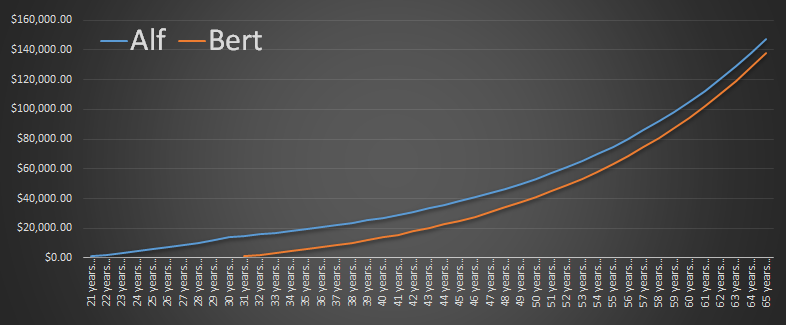
Spectacular example of why when saving (e.g. for a pension) it’s often more important to save early than it is to save lots. So get saving! Even with an understanding
of compound interest, these numbers can surprise you.
The only time better than today would have been yesterday, and you already missed that boat.
the other day i was thinking about the term pyramid scheme, and why they called it pyramid scheme and not triangle scheme
and i asked you what you thought
you thought it added a certain gravitas, and linked the idea of economic prosperity
with some of history’s greatest architectural achievements
unconsciously suggesting a silent wealth of gold and heat
a triangle is two dimensional, and therefore
a less striking mental image than the idea of a third dimension of financial fraud
which is how many dimensions of financial fraud the term pyramid scheme suggests
but i had to pause for a second at the financial fraud part
because it occurred to me i didn’t know what pyramid schemes really were
i knew they had something to do with people getting money from nothing
like
the person at the top of the pyramid scheme, or more accurately
triangle scheme, acquires a number of investors and takes their money
and then pays the first lot of investors with the money from another bunch of investors
and so on and so forth
all the way to the bottom of the triangle
or pyramid face
which is the kind of stupid thing that happens
if you keep your money in a pyramid and not a bank account
although if you ask me banks are the real pyramid schemes after all
or was love the real pyramid scheme? i can’t remember
maybe it’s better to keep your money in a pyramid than a bank
and i should shop around and compare the interest rates on different pyramids
maybe i should open up a savings pyramid
with a whole bunch of trapdoors and malarias
to keep the financial anthropologists
i mean bankers out
my emeralds cooling under the ground like beautiful women’s eyes
i think this was supposed to be a metaphor for something
but i can’t remember where i was going with it
and now it’s been swept away by the winds of
whatever
but knowing me, it was probably love
that great dark blue sex hope that keeps coming true
that cartoon black castle with a single bird flying over it
i don’t know where this poem ends
how far below the sand
but it’s still early evening
and you and I are a little drunk
you answer the phone
you pour me a drink
i know you hate the domestic in poetry but you should have thought of that before you invited me to move in with you
i used to think arguments were the same as honesty
i used to think screaming was the same as passion
i used to think pain was meaningful
i no longer think pain is meaningful
i never learned anything good from being unhappy
i never learned anything good from being happy either
the way i feel about you has nothing to do with learning
it has nothing to do with anything
but i feel it down in the corners of my sarcophagus
i feel it in my sleep
even when i am not thinking about you
you are still pouring through my blood, like fire through an abandoned hospital ward
these coins are getting heavy on my eyes
it has been a great honor and privilege to love you
it has been a great honor and privilege to eat cold pizza on your steps at dawn
love is so stupid: it’s like punching the sun
and having a million gold coins rain down on you
which you don’t even have to pay tax on
because sun money is free money
and i’m pretty sure there are no laws about that
but i would pay tax
because i believe that hospitals and education
and the arts should be publicly funded
even this poem
when i look at you, my eyes are two identical neighborhood houses on fire
when i look at you my eyes bulge out of my skull like a dog in a cartoon
when i am with you
an enormous silence descends upon me
and i feel like i am sinking into the deepest part of my life
we walk down the street, with the grass blowing back and forth
i have never been so happy
Coder wants to grow the speech-to-text coding community, uses his fun game to advocate.
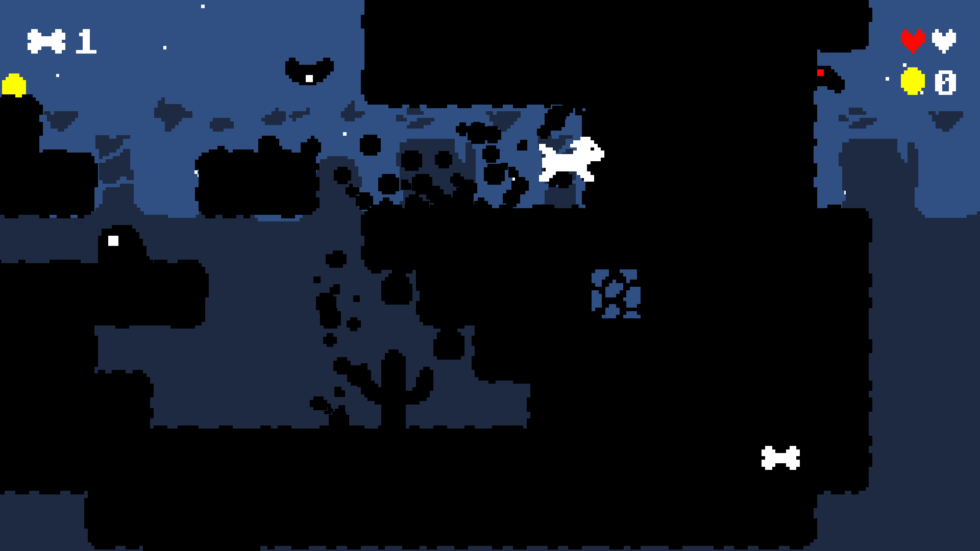
Dig Dog is a pretty fun little video game. Call it “Spelunky for kids”—and don’t think of that as a backhanded compliment, either. Dig Dog, which launched
Thursday on iOS, Xbox, Windows, and Mac, shaves away some of the
genre’s complications, controls smoothly, and has depth. It’s as if the modern wave of randomly generated, dig-for-surprises adventures had existed in early ’80s arcades. (And all for
only $3!)
I liked Dig Dog enough when I stumbled upon it at last year’s Fantastic Arcade event in Austin, Texas. But my
interest in the game spiked when its creator reached out ahead of this week’s launch to confirm something I’m not sure any other video game creator has done: coding an entire game by
himself… without using his hands.
Convenience is the most underestimated and least understood force in the world today. As a driver of human decisions, it may not offer the illicit thrill of Freud’s unconscious
sexual desires or the mathematical elegance of the economist’s incentives. Convenience is boring. But boring is not the same thing as trivial.
In the developed nations of the 21st century, convenience — that is, more efficient and easier ways of doing personal tasks — has emerged as perhaps the most powerful force
shaping our individual lives and our economies. This is particularly true in America, where, despite all the paeans to freedom and individuality, one sometimes wonders whether
convenience is in fact the supreme value.
As Evan Williams, a co-founder of Twitter, recently put it, “Convenience decides everything.” Convenience seems to make our decisions for us, trumping what we like to imagine are
our true preferences. (I prefer to brew my coffee, but Starbucks instant is so convenient I hardly ever do what I “prefer.”) Easy is better, easiest is best.
Convenience has the ability to make other options unthinkable. Once you have used a washing machine, laundering clothes by hand seems irrational, even if it might be cheaper.
After you have experienced streaming television, waiting to see a show at a prescribed hour seems silly, even a little undignified. To resist convenience — not to own a cellphone,
not to use Google — has come to require a special kind of dedication that is often taken for eccentricity, if not fanaticism.
For all its influence as a shaper of individual decisions, the greater power of convenience may arise from decisions made in aggregate, where it is doing so much to structure the
modern economy. Particularly in tech-related industries, the battle for convenience is the battle for industry dominance.
Americans say they prize competition, a proliferation of choices, the little guy. Yet our taste for convenience begets more convenience, through a combination of the economics of
scale and the power of habit. The easier it is to use Amazon, the more powerful Amazon becomes — and thus the easier it becomes to use Amazon. Convenience and monopoly seem to be
natural bedfellows.