Welcome to my 88×31 button creator, this is a pretty rough and ready implementation so it could be buggy, please let me know if you find any issues.
This supports gif despite the basic canvas tag limitation courtesy of gif.js – none of
this would be possible without that project.
…
Dan (whose website is freakin’ awesome, by the way) has done an amazing job with this new 88×31 generator. Look at this (trashy, but I don’t care) button I threw together in literally
seconds, with it:
Have a play, and remind yourself that the Web is brilliant.
I’ve been enjoying playing Chain Words, from eclectech, intermittently, since it came out in November (when I complained
that the word ‘TOSSPOT’ was rejected; I don’t know if this obvious omission has yet been corrected). If you’ve not given it a go yet, and you like a word game that’s “a bit
different”, you should try it!
I’m not saying the plain-text is the best web experience. But it is an experience. Perfect if you like your browsing fast, simple, and readable. There are no
cookie banners, pop-ups, permission prompts, autoplaying videos, or garish colour schemes.
I’m certainly not the first person to do this, so I thought it might be fun to gather a list of websites which you browse in text-only mode.
…
Terence Eden’s maintaining a list of websites that are presented as, or are wholly or partially available via, plain text. Obviously my own text/plain
blog is among them, and is as far as I’m aware the only one to be entirely presented as text/plain.
Anyway, this inspired me to write a post of my own (on text/plain blog, of course!), in which I ask the question: what do we
consider plain text? Based on the sites in the list, Markdown is permissible as plain text, (for the purposes of Terence’s list), but this implies that “plain text” is a
spectrum of human-readability.
If Markdown’s fine, then presumably Gemtext would be too? How about BBCode? HTML and RTF are explicitly excluded by Terence’s rules,
but I’d argue that HTML 1.0 could be more human-readable than some of the more-sophisticated dialects of BBCode (or any Markdown that contains tables, unless those tables are laid-out
in a way that specifically facilitates human-readability)?
As I say in my post:
  <--  More human-readable                                              Less human-readable  -->
|-----------|-----------|-----------|------------|-----------|-----------|-----------|-----------|
Plain text       Gemtext       Markdown        BBCode         HTML 1.0         Modern HTML     RTF
This provocation is only intended to get you to think about “what does it mean for a markup language to be ‘human readable’?” Where do you draw the line?
already use the system & don’t like learning new things,
enjoy medieval fantasy settings, with a 60-70% combat tilt,
like vague, unopinionated systems,
don’t mind overly corporate media,
just kinda like it (which is totally fair)
And if you do fit the bill here, I truly do wish you all the best in your 5e adventures…
But just because one system is for you, doesn’t mean others aren’t! pulls away curtain, exaggerated
…
As a quick disclaimer, this hobby, like many others, is a matter of taste. I, like everyone else, am biased towards a certain kind of game. Specifically, I absolutely adore games
that place roleplay at center stage. Games that deal with the complexities of identity. Games with innovative mechanics. Games that present deep ethical quandaries. Games that make
everyone at the table ponder something meaningful. If you like similar games, you’ll probably love my recommendations. If you don’t, then don’t worry! There are so many more games
out there that will be for you and not for me, (5e included!), and I absolutely love that about this hobby.
I listed a good few options above, but also, I’d encourage you to take a gander at a few of the following games, most if not all of which I will write full reviews for eventually:
Spire: Rise against the oppressive high elves in a revolution destined for ruin, in an attempt to make a difference. Check out the fallout system in this one, it’s genuinely a
game changer.
Blades in the Dark: Gang warfare: the game. Run a gang in a dark, steampunk, ghost-ridden world, and execute sick heists. Prep is for losers when in-scene you can just flashback
to that time you prepared for this exact eventuality.
Slugblaster: TEENS ON HOVERBOARDS! DOIN’ SICK TRICKS! GOIN’ THROUGH PORTALS! GETTIN’ THAT SWEET SWEET INTERNET CLOUT! RUNNIN’ FROM INTERDIMENSIONAL POLICE!
YEAHHHHHHHHHHHHHHHHH!!!!!!!!
Lichcraft: You’re trans and the wait for gender affirming healthcare is 300 years. Welp time to turn to the dark arts and become a lich!
It saddens me a little that D&D (5e or whatever) is so-firmly entrenched as “the” default choice of TTRPG.
It’s fine, I guess (with the caveats above about what it’s best at and, by proxy, what it’s weaker at), and I’ve on many occasions enjoyed D&D both as a PC’s player and as
a DM. But that it’s so much the de-facto standard that D&D is in many circles synonymous with roleplaying is… just a bit of a waste, really!
I love that Kai not only shares an explanation of these limitations but that they also go on to share a handful of recommendations of other games to consider, the next time the TTRPG
itch gets you! I’d heard of Blades in the Dark (perhaps courtesy of the use of the Forged in the Dark engine in other games; I’m
not certain), but the other three are completely alien to me… and they all sound great in different ways.
I wonder if I can persuade some Abnibbers to hook up for a mini-campaign/one-shot of Slugblaster or something at some
point? Spire sounds great too, and I like the theme of Lichcraft: there’s some interesting ideas to explore in that universe!
What about when you want to keep global styles out of your component, like with a third-party widget that gets loaded on lots of different pages?
I kind-of sort-of see the logic in that. But I also think wanting your component to not look like a cohesive part of the page its loaded into is weird and unexpected.
…
I so-rarely disagree with Chris on JavaScript issues, but I think I kinda do on this one. I fully agree that the Shadow DOM is usually a bad idea and its
encapsulation concept encourages exactly the kind of over-narrow componentised design thinking that React also suffers from. But I think that the rebuttal Chris picks up
on is valid… just sometimes.
When I created the Beige Buttons component earlier this year, I used the shadow DOM. It was the
first time I’ve done so: I’ve always rejected it in my previous (HTML) Web Components for exactly the reasons Chris describes. But I
maintain that it was, in this case, the right tool for the job. The Beige Buttons aren’t intended to integrate into the design of the site on which they’re placed, and
allowing the site’s CSS to interact with some parts of it – such as the “reset” button – could fundamentally undermine the experience it intends to create!
I appreciate that this is an edge case, for sure, and most Web Component libraries almost certainly shouldn’t use the shadow DOM. But I don’t think it’s valid to
declare it totally worthless.
That said, I’ve not yet had the opportunity to play with Cascade Layers, which – combined with directives like all: reset;, might provide a way to strongly
override the style of components without making it impossibly hard for a site owner to provide their own customised experience. I’m still open to persuasion!
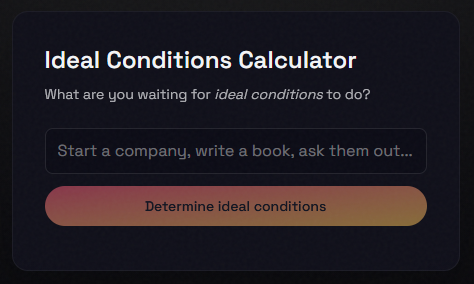
Waiting for the ideal time to finally do that thing you’ve been procrastinating on? Greg’s clever new micro-site will help you decide the perfect time to do it (and no, it doesn’t
necessarily just say “now!”).
Woodcraft Folk stands in solidarity with every trans child, young person and volunteer who faces exclusion from Girlguiding UK following the announcement on Trans inclusion.
We recognise that Girlguiding UK have taken this decision in the context of intense political pressure and legal uncertainty. However, this does not make the outcome acceptable.
Young people should never bear the consequences of political disputes. All children and young people deserve respect, safety and inclusion in their youth organisations.
…
Excellent statement from Woodcraft Folk.
I was saddened to hear the news that Girlguiding will no longer accept trans girls as members. It seems to me that it
would have been perfectly reasonable for them to change their articles in response to the Supreme Court silliness: instead of declaring themselves as being for the benefit
of “girls and women” they could have become for the benefit of “girls, women, trans girls, and trans women”.
Yes, obviously it’s horrible that the Supreme Court’s othering decision means that people have to spell out that “by women, we mean all women, including trans women”. But
that’s a thing that a charity can do. It’s perfectly reasonable for a charity to be for the benefit of multiple groups.
But no, they took the easy option.
So it’s great to see youth-supporting organisations like Woodcraft Folk make a statement like this that trans kids continue to be welcome with them. Okay, this was easier
for them than for Girlguiding because Woodcraft’s articles didn’t contain any gendered language in the first place. And it’s fine that Girlguiding’s does use gendered
language – it’s okay for charities to be gender-specific! – but it’s a shame that they didn’t… pardon the pun… have the balls to stand up for what’s right
for all women and girls, in spite of the UK’s growing transphobia. Ugh.
I already understand how using a threshold map to perform dithering works and have even implemented dithering algorithms, and I still appreciated this amazing visual explainer
which helped put it in a light I’d never considered before. A highly-recommended read, and I’ve subscribed to Damar’s RSS feed so I
get to see Part 2 when it happens.
(I also enjoyed playing with the dithering experiment on his CodePen, because it turns out that the technology behind
this interactive demo is as interesting as the topic being described!)
HTTP/1 may appear simple because of several reasons: it is readable text, the most simple use case is not overly complicated and existing tools like curl and browsers help making
HTTP easy to play with.
The HTTP idea and concept can perhaps still be considered simple and even somewhat ingenious, but the actual machinery is not.
[goes on to describe several specific characteristics of HTTP that make it un-simple, under the headings:
newlines
whitespace
end of body
parsing numbers
folding headers
never-implemented
so many headers
not all methods are alike
not all headers are alike
spineless browsers
size of the specs
]
I discovered this post late, while catching up on posts in the comp.infosystems.gemini newsgroup,
but I’m glad I did because it’s excellent. Daniel Stenberg is, of course, the creator of cURL and so probably knows more about the intricacies of HTTP
than virtually anybody (including, most-likely, some of the earliest contributors to its standards), and in this post he does a fantastic job of dissecting the oft-made argument that
HTTP/1 is a “simple” protocol; based usually upon the argument that “if a human can speak it over telnet/netcat/etc., it’s simple”.
This argument, of course, glosses over the facts that (a) humans are not simple, and the things that we find “easy”… like reading a string of ASCII representations of digits and
converting it into a representation of a number… are not necessarily easy for computers, and (b) the ways in which a human might use HTTP 0.9 through 1.1 are rarely representative of
the complexities inherent in more-realistic “real world” use.
Obviously Daniel’s written about Gemini, too, and I agree with some of his points there (especially the fact that the
specification intermingles the transfer protocol and the recommended markup language; ick!). There’s a reasonable rebuttal here (although it has its faults too, like how it conflates the volume of data involved in the
encryption handshake with the processing overhead of repeated handshakes). But now we’re going way down the rabbithole and you didn’t come here to listen to me dissect
arguments and counter-arguments about the complexities of Internet specifications that you might never use, right? (Although maybe you should: you could have been reading this blog post via Gemini, for instance…)
But if you’ve ever telnet’ted into a HTTP server and been surprised at how “simple” it was, or just have an interest in the HTTP specifications, Daniel’s post is worth a read.
I’m writing up this information because Dreamwidth’s legal advocacy work has been largely underrecognized. I have not seen a scrap of mainstream news coverage out there that delves
into the unique role that Dreamwidth has played in the NetChoice lawsuits, and in a tech news landscape that inspires so much resignation and despair, I think people deserve to know
about how Dreamwidth is putting up a fight. Not only does Dreamwidth refuse to engage in intrusive tracking, it’s proactively participating in lawsuits against state governments
that try to force its hand. For all that many lawmakers are trying to make the web worse, Dreamwidth is leveraging itself as proof that a better web is possible.
…
If your mental model of Dreamwidth is “it’s like LiveJournal, but…” then you owe it to yourself to read Coyote’s excellent explanation of how
Dreamwidth is so much more: a beacon of privacy-centric and censorship-resistant blog hosting in a world that increasingly seems at-best uninterested and at-worst actively
hosting to such things.
That it’s not for me personally (I’m more a selfhost type) doesn’t mean it’s not a great choice for you: it’s got solid free and reasonably-priced premium tiers and all the kinds of
features you’d expect from a service live LiveJournal, or Tumblr, or Medium… but without all of the antifeatures that come with each of those.
And yeah, they’re on the side of the good guys:
I think there’s mileage in stealing repurposing this iconic line…
Coyote also wrote the excellent You Can Make A Website, if you’re looking for further reading from
the same author.
Recent discussion about the perils of doors in gamedev reminded me of a bug caused by a door in a game you may have heard of called “Half Life 2”. Are you sitting comfortably? Then
I shall begin.
…
What is meant to happen is a guard (spoiler alert – it’s actually Barney in disguise) bangs on a door, the door opens, he says “get in”, and then the game waits for you to enter
the room before the script proceeds.
But in this case the door sort of rattled, but didn’t open, and then locked shut again. So you can’t get in the room, and the gate closed behind you, so you can’t go do anything
else. The guard waits forever, pointing at the locked door, and you’re stuck.
…
If you watch the video, when the door unlocks and then opens, there’s a second guard standing inside the room to the left of the opening door. That guard is actually standing very
slightly too close – the very corner of his bounding box intersects the door’s path as it opens. So what’s happening is the door starts to open, slightly nudges into the guard’s
toe, bounces back, closes, and then automatically locks. And because there’s no script to deal with this and re-open the door, you’re stuck.
…
So this kicked off an even longer bug-hunt. The answer was (as with so many of my stories) good old floating point. Half Life 2 was originally shipped in 2004, and although the SSE
instruction set existed, it wasn’t yet ubiquitous, so most of HL2 was compiled to use the older 8087 or x87 maths instruction set. That has a wacky grab-bag of precisions – some
things are 32-bit, some are 64-bit, some are 80-bit, and exactly which precision you get in which bits of code is somewhat arcane.
…
Amazing thread from Tom Forsyth, reflecting on his time working at Valve. The tl;dr is that after their compiler was upgraded (to support the SSE instruction sets that had now become
common in processors), subsequent builds of Half-Life 2 became unwinnable. The reason was knock-on effects from a series of precision roundings, which meant that a Combine
security guard’s toe was in a slightly wrong place and the physics engine would bounce a door off him.
A proper 500-mile-email grade story, in terms of unusual bugs.
Got to admit, this is really cool and something I can see myself using a lot. So I installed the prerequisites:
brew install asciinema
npm install -g svg-term-cli
Then I gave it a go. I needed to use asciinema rec -f asciicast-v2 myfile.cast to record my screen into Asciinema‘s version 2 format,
because the new version 3 format isn’t yet supported by svg-term-cli (but there is at least an asciinema
convert command if you record in the “wrong” one).
Then I ran cat myfile.cast | svg-term --out myfile.cast.svg to convert that terminal recording into an SVG: I happened to be in a directory containing the source code of FreeDeedPoll.org.uk, so recorded myself running an 11ty development server with npm serve:
In the 1980s and 1990s, when I was a kid, smoking was everywhere. Restaurants, bars, and a little before my time, airplanes!
The idea that people would smoke was treated as inevitable, and the idea that you could get them to stop was viewed as wildly unrealistic.
Sound familiar? But in the early 2000’s, people did stop smoking!
…
But a few years ago, the trend started to reverse. You know why?
Vaping.
Vape pens were pushed as a “safer alternative to smoking,” just like Anil is suggesting with Firefox AI. And as a result, not only did people who would have smoked anyways start up
again, but people who previously wouldn’t have started.
…
I know it’s been a controversial and not-for-everyone change, but I’ve personally loved that Chris Ferdinandi has branched out from simply giving weekday JavaScript tips to also
providing thoughts and commentary on wider issues in tech, including political issues. I’m 100% behind it: Chris has a wealth of experience and an engaging writing style and even when I
don’t 100% agree with his opinions, I appreciate that he shares them.
And he’s certainly got a point here. Pushing “less-harmful” options (like vaping… possibly…) can help wean people off something “more-harmful”… but it can also normalise a harmful
behaviour that’s already on the way out by drawing newcomers to the “less-harmful” version.
My personal stance remains that GenAI may have value (though not for the vast majority of things that
people market it as having value for, where – indeed – it’s possibly doing more harm than good!), but it’s possible that we’ll never know because the entire discussion space is poisoned now by the hype. That means it’ll be years before proper, unbiased conversations can take place,
free of the hype, and it’s quite possible that the economy of AI will have collapsed by then. So maybe we’ll never
know.
Anyway: good post by Chris; just wanted to share that, and also to add a voice of support for the direction he’s taken his blog these last few years.
“Botsplaining,” as I use the term, describes a troubling new trend on social media, whereby one person feeds comments made by another person into a large language model (like
ChatGPT), asks it to provide a contrarian (often condescending) explanation for why that person is “wrong,” and then pastes the resulting response into a reply. They may
occasionally add in “I asked ChatGPT to read your post, and here’s what he said,”2 but most just let the LLM speak freely on
their behalf without acknowledging that they’ve used it. ChatGPT’s writing style is incredibly obvious, of course, so it doesn’t really matter if they disclose their use of it or
not. When you ask them to stop speaking to you through an LLM, they often simply continue feeding your responses into ChatGPT until you stop engaging with them or you block them.
This has happened to me multiple times across various social media platforms this year, and I’m over it.
…
Stephanie hits it right on the nose in this wonderful blog post from last month.
I just don’t get it why somebody would ask an AI to reply to me on their behalf, but I see it all the time. In threads around the ‘net, I see people say “I
put your question into ChatGPT, and here’s what it said…” I’ve even seen coworkers at my current and formers employer do it.
What do they think I am? Stupid? It’s not like I don’t know that LLMs exist, what they’re good at, what they’re bad at (I’ve been blogging about it for years
now!), and more-importantly, what people think they’re good at but are wrong about.
If I wanted an answer from an AI (which, just sometimes, I do)… I’d have asked an AI in the first place.
If I ask a question and it’s not to an AI, then it’s safe for you to assume that it’s because what I’m looking for isn’t an answer from an AI. Because if that’s
what I wanted, that’s what I would have gotten in the first place and you wouldn’t even have known. No: I asked a human a question because I wanted an answer
from a human.
When you take my request, ignore this obvious truth, and ask an LLM to answer it for you… it is, as Stephanie says, disrespectful to me.
But more than that, it’s disrespectful to you. You’re telling me that your only value is to take what I say, copy-paste it to a chatbot, then copy-paste the answer
back again! Your purpose in life is to do for people what they’re perfectly capable of doing for themselves, but slower.
Galaxy Quest had a character (who played a character) who was as useful as you are, botsplainer. Maybe that should be a clue?
How low an opinion must you have of yourself to volunteer, unsolicited to be the middle-man between me and a mediocre search engine?
If you don’t know the answer, say nothing. Or say you don’t know. Or tell me you’re guessing, and speculate. Or ask a clarifying question. Or talk about a related problem and see if we
can find some common ground. Bring your humanity.
But don’t, don’t, don’t belittle both of us by making yourself into a pointless go-between in the middle of me and an LLM. Just… dont’t.
I’ve found my relationships are healthier when I keep my offline-first relationships offline (e.g. not following each other on Facebook or Instagram) —
following someone’s Instagram makes it feel like I know what’s going on with them without interacting. Following offline friends on social media can reduce what used to be
normal friendships into parasocial relationships.
…
I suspect bringing offline relationships online is responsible for a lot of the loneliness people feel — social media looks like you have all these
friends… but no one you could ask to feed your cat while you’re away, because one-to-many broadcasting replaced direct interactions 😿 Essentially, the offline relationship became an
online one.
…
Tracy’s observations here are absolutely excellent, and spot-on. I’ve absolutely experienced some of the problems she’s described when trying to use social media to supplement
“offline-first” relationships.
Unfortunately, unilaterally following Tracy’s segregation strategy doesn’t necessarily guarantee that you’re going to avoid the problems she’s identified. That’s especially true if you
haven’t always followed her guidance!
Like many folks I know, I joined Facebook when it became available to me and used it to connect with most of the people I knew in the real world. And certainly, this caused a
problematic blurring of our online and offline interactions! People in my friend group would switch to “broadcast mode”, not reaching out to query one another’s status and wellbeing,
and coming to assume that anything they’d shared online would be universally known among their friends (I was definitely guilty of this myself; sometimes I still am!).
I dropped Facebook about 14 years ago, but it’s still the case that my offline-first friends will sometimes assume that I’ll know something that they posted there (or to
some other platform). And it’s still the case that I’m not as good as I could be at reaching-out and checking-in. (At least that latter point is something actionable that I can work
with, I suppose.)
After thirty years online, it seems to me that converting an online relationship to an offline one is a rarity. But converting one born-offline into an online one, or a “hybrid” one
that somehow exhibits some of the worst characteristics of both, is distressingly easy… even when you don’t intend it.
Tracy’s post’s got much more to say, and I thoroughly recommend it. I don’t know that I’m personally ready to make as firm a distinction between my “online” and “offline” friends as she
seems to – there are aspects of the hybrid model that actually work quite well for me, much of the time – but I like having a framework around which to think and talk about the
differences.